The message that James wants to impart to his readers is designed to be clear and practical. Yet, I always find myself amazed at what I discover in these reflections when I walk through a portion of scriptures, the connections that get made with other portions of the text, the ways in which there is depth and richness that a casual reader may miss. James, like most of the New Testament letters not attributed to Paul, were barely touched upon in my studies in seminary, nor have they been a part of my regular preaching or study. I was amazed at the ways the letter of James connects with the law, the prophets, wisdom literature, and the words of Jesus as he attempts to shape the faithful practice of his Jewish Christian audience.
Prior to coming to this reflection on James has been a series of reflections on a significant portion of the Hebrew Scriptures/Old Testament which have nurtured a love within me for the depth and riches of law, the history, the prophetic witness, and the wisdom tradition which all attempt to speak to the experience of the people of Israel with their God. When I worked through the Gospel of Matthew and Revelation several years ago, those reflections were shaped by the wisdom accumulated through those journeys, and now the same is true of James. I am thankful for both my own heightened awareness of the language of the scripture that the early Christians read but also for the patient work of scholars who dedicate their lives to the study of specific books. I was impressed by the richness that I had previously overlooked in James’s short letter to the twelve tribes in the Diaspora. Part of the paradox of scripture is that it can be both clear and practical and at the same time deep and profound.
James is attempting to cultivate in his hearers an authentic and living faith that is demonstrated through practices of compassion and mercy. Sometimes James can appear as judgmental to a casual reader, but fundamental to the witness of James is mercy. James does have some challenging words for our context, and his language is often like that of an Old Testament prophet, but sometimes the challenging words are the ones we need to wrestle with the most. This is a short letter, but it challenged me, it was like doing a steeper climb but for a shorter duration than my experience of some other books. This may be because I am more of a New Testament scholar than a Hebrew bible scholar, but I think it is also due to the wide number of topics James covers in this short letter. I am thankful for the witness of James and the way in which his attempts to cultivate a living faith in the communities he is writing to in his time continue to challenge us to an authentic living faith two millennia later.
1Come now, you rich people, weep and wail for the miseries that are coming to you. 2Your riches have rotted, and your clothes are moth-eaten. 3Your gold and silver have rusted, and their rust will be evidence against you, and it will eat your flesh like fire. You have laid up treasure during the last days. 4Listen! The wages of the laborers who mowed your fields, which you kept back by fraud, cry out, and the cries of the harvesters have reached the ears of the Lord of hosts. 5You have lived on the earth in luxury and in pleasure; you have nourished your hearts in a day of slaughter. 6You have condemned and murdered the righteous one, who does not resist you.
James’s rhetoric may be harsh to many modern readers who were raised in a Christianity which has made its peace with the capitalistic and consumeristic culture of the United States. Over a century ago, Walter Rauschenbusch, one of the primary thinkers behind the social gospel movement which attempted to bring faith and action on behalf of the vulnerable together could say that James, “pronounces an invective against the rich which would seem intolerably denunciatory in the mouth of a modern socialist preacher.” (Moore-Keish, 2019, p. 166) Yet, James is not speaking in a language unusual to scripture. James’s language throughout his letter has been in concert with the law, wisdom literature, the prophets, and the teachings of Jesus. That it may seem “intolerably denunciatory” should give us pause. We may not inhabit a situation similar to the early Christians who James is writing to, but the discomfort should cause an honest dialogue about the world and the values we assume. Luke Timothy Johnson asks this question in an existential way when he states:
Perhaps the most serious question for Christianity in the present circumstance is whether it is any longer in a position to exercise the kind of prophetic critique of that outlook such as enunciated by James. Is it not the case that many churches are themselves so co-opted by the logic of envy and arrogance—if not strictly monetary terms, then in terms of membership and influence—that they cannot perceive that such is the way of the wisdom from below, which is earthbound, unspiritual, and demonic? (NIB XII:218)
From the very beginning of the story of Israel they were always intended to embody a different set of values and practices than Egypt and all the following empires of the world that surrounded them. The commandments, statutes and ordinances given to the Hebrew people were to create a society where the vulnerable were cared for. Many of the laws are specifically to limit the acquisition of excessive amounts of property and wealth at the expense of the neighbor. Throughout the letter, James has often referenced topics which mirror the language of Leviticus 19. Once again James speaks in concert with Leviticus 19:
You shall not defraud your neighbor; you shall not steal; and you shall not keep for yourself the wages of a laborer until morning. Leviticus 19:13
Likewise, Deuteronomy also states:
You shall pay them their wages daily before sunset, because they are poor and their livelihood depends on them; otherwise they might cry to the Lord against you, and you would incur guilt.Deuteronomy 24: 14-15
James’s tone is similar to the prophets and a person familiar with the language of the prophets will quickly pick up the language of the ‘day of the LORD’ utilized by the prophets even before the ‘last days’ are mentioned in verse three. Malachi is a good example of this language and in chapter three the oppression of hired workers and the vulnerable is tied with sorcerers, adulterers, and those whose words are false:
Then I will draw near to you for judgment; I will be swift to bear witness against the sorcerers, against the adulterers, against those who swear falsely, against those who oppress the hired workers in their wages, the widow, and the orphan, against those who thrust aside the alien and do not fear me, says the Lord of hosts. Malachi 3:5
Yet, the strongest resonance with this passage is in the words of Jesus:
“But woe to you who are rich, for you have received your consolation.“Woe to you who are full now, for you will be hungry. “Woe to you who are laughing now, for you will mourn and weep. Luke 6: 24-25
“Do not store up for yourselves treasures on earth, where moth and rust consume and where thieves break in and steal, but store up for yourselves treasures in heaven, where neither moth nor rust consumes and where thieves do not break in and steal. Matthew 6: 19-20
The scriptures may be speaking in the same key, but we may hear this as dissonant in our context. Many people in our time and in James’s time would look at wealth as a positive thing and there is a significant thread in scripture where God does want the people to prosper. Yet, one of the dangers to the health of the community was the acquisition of large amounts of wealth (primarily in the form of land, but also in terms of money) by a few at the expense of the rest of the community, particularly the most vulnerable members of the community. I have said before that in the United States one of our greatest idols is security, the desire to be able to ensure our own future without needing either God or the community. Wealth has become one of the most important ways of keeping score in our society and the acquisition of more wealth is often seen as a goal which surpasses all other goals. James’s counter voice is that the very wealth that we have utilized to attempt to secure our future is corroded and moth-eaten. Our bank balance sheets and acquisitive lifestyles testify against us. Those who lived in pleasure at the expense of their employees, whether landowners who failed to pay the harvester or corporations who increased their earnings while failing to pay a living wage, have now become the Pharoah and his taskmasters who the cries of the laborers testify to God against. And God hears these cries throughout the scriptures.
There has been a lively discussion on the identity of “the righteous one” James references. One common opinion is that the righteous one are the poor among the faithful who are perishing due to the injustice of their world. Another option is that the righteous one is Jesus and that the rich are somehow complicit in the crucifixion. I think it is likely that James is speaking in a manner reflected in Matthew 25: 31-46, where Jesus is met in the face of the vulnerable ones who are seen by the faithful but ignored by the unrighteous. These rich ones may feel like the world is being served to them as an all-you-can-eat banquet, but what James sees is a darker reality for those rich who live at the expense of others. They are like cattle in a feedlot being fattened for the day of slaughter. James believes, in concert with the rest of scripture, that the injustice practiced by the rich and powerful will be answered by God’s judgment.
James’s words are difficult to wrestle with in my context of an affluent suburb of Dallas, Texas but they also are important. We live in a time of increasing disparity between those at the top of the economic ladder and those at the bottom. James’s words will probably never have a hearing among those in our culture who utilize their wealth to manipulate the political or tax system to benefit their own business or bank balance, but these actions, for James, at the expense of the vulnerable in society are a form of violence and murder. For those who claim the letter of James as a part of their scriptures and a witness to faith it presents several challenges. It reminds us that our security is not to be found in laying aside silver, gold, currency or any other type of possession but in the God who hears the cries of the vulnerable. James, like the law and the prophets, sees faith as embodied throughout the entirety of life and that a faith without works on behalf of the neighbor is a dead faith. Most in my community would have been considered wealthy in James’s world, and we often underestimate the gifts we have been given to steward on behalf of the community. The scripture does has positive witnesses to wealth, for example Job mentioned in the next section, but the danger of wealth is that it becomes central to our identity and the score card by which we measure success is that it becomes possible to justify practices which may end up being legalized violence and even murder against the most vulnerable in society.
James 5: 7-12
7Be patient, therefore, brothers and sisters, until the coming of the Lord. The farmer waits for the precious crop from the earth, being patient with it until it receives the early and the late rains. 8You also must be patient. Strengthen your hearts, for the coming of the Lord is near. 9Brothers and sisters, do not grumble against one another, so that you may not be judged. See, the Judge is standing at the doors! 10As an example of suffering and patience, brothers and sisters, take the prophets who spoke in the name of the Lord. 11Indeed, we call blessed those who showed endurance. You have heard of the endurance of Job, and you have seen the outcome that the Lord brought about, for the Lord is compassionate and merciful. 12Above all, brothers and sisters, do not swear, either by heaven or by earth or by any other oath, but let your “Yes” be yes and your “No” be no, so that you may not fall under condemnation.
James now returns to the brothers and sisters of his community to encourage them to stand fast and endure as they await the coming of the Lord. These final two sections are full of proverbs for the community attempting to live faithfully in the world. The world is unjust and there are rich whose actions endanger the vulnerable in the community, but James trusts that God’s judgement is near. Patience may not be the best word for the Greek makrothymia. Translators have suggested endure, persist, withstand, or stand fast as possible alternatives which capture the more active sense of the word. James utilizes two images for endurance in parallel: a farmer waiting on the growing crop and the biblical image of Job. The long wait from planting to harvest would be a part of the life of the majority of people in James’s world and there is a reason for the prevalence of this image throughout the scriptures. This is the only utilization of Job in the New Testament, and Job, like Abraham and Rahab earlier and Elijah in the following section, is utilized as a representative figure for an idea. Job may not have been passive in dealing with his situation in the narrative of Job, but he does endure and the Lord rewarded Job for his endurance.
James echoes the saying of Jesus also reflected in Matthew 5: 33-37. I think many people would long for a world where truthful speech was the norm and one of the struggles of our digitally pluralistic society is that truthful speech may be indistinguishable from partial truths, obfuscations and maliciously told lies. As I think about the issues facing society: immigration, global warming, poverty, discrimination, and many others, it is amazing the number of both conspiracy theories and misinformation that are given equal space to information that is well thought out and accepted by those working in the various fields. Perhaps reflecting on the untruth operating on his own society in the mid-1930s, Dietrich Bonhoeffer could comment in Discipleship:
There is no truth towards Jesus without truth toward other people. Lying destroys community. But truth rends false community and founds genuine fellowship. There is no following Jesus without living in the truth unveiled before God and other people. (DBWE 4: 131)
Yet even churches and communities of faith can easily become places that do not value truth but rather seek either easy accommodation or avoiding controversial topics of conversation. Even organizations that expressly claim to value truth in their mission or value statements may, by their actions demonstrate a preference for a convenient lie.
James and Jesus imagine a world where truthful speech is the norm and God has drawn near. It may take patience to see the fruit of this trust, it may involve the endurance of Job, and yet underlying the faith of Christianity is a God who values truth, who protects the vulnerable, and judges the unrighteous. James attempts to strengthen his brothers and sisters scattered throughout the world who are attempting to live truthfully and persistently awaiting the promised harvest of God’s fields.
James 5: 13-20
13Are any among you suffering? They should pray. Are any cheerful? They should sing songs of praise. 14Are any among you sick? They should call for the elders of the church and have them pray over them, anointing them with oil in the name of the Lord. 15The prayer of faith will save the sick, and the Lord will raise them up, and anyone who has committed sins will be forgiven. 16Therefore confess your sins to one another and pray for one another, so that you may be healed. The prayer of the righteous is powerful and effective. 17Elijah was a human like us, and he prayed fervently that it might not rain, and for three years and six months it did not rain on the earth. 18Then he prayed again, and the heaven gave rain, and the earth yielded its harvest. 19My brothers and sisters, if anyone among you wanders from the truth and is brought back by another, 20you should know that whoever brings back a sinner from wandering will save the sinner’s soul from death and will cover a multitude of sins.
James continues with a set of final proverbs to encourage the community in their journey. Prayer is an overarching theme of the verses thirteen through eighteen and it is both the prayers of the individual and the community which enter James’s reflection. The suffering ones should pray, and asking God for what is necessary has appeared as a topic previously in James (1:5,6; 4: 2-3). It is likely that both the suffering and the cheerful are undergoing some struggles and it may be that in some cases the suffering are those who have not ‘taken courage’ while the cheerful have (McKnight, 2011, p. 433) but there will always be those whose suffering is more acute and those whose troubles are lighter. The individual may pray or sing songs of praise based on their circumstances, but the community also has a role in helping those in need. Those who are sick or carrying sins are to call the elders in the community. Much like the friends who carried the paralytic to Jesus (Mark 2: 1-12 and parallels) the elders carry the sick body or the sin sick soul to God that it may be healed. The fact that James can appeal to four people from the story of Israel (Abraham, Rahab, Job, and now Elijah) may be related to the Jewish nature of his community. Paul, whose primary audience was Gentile, can appeal to Abraham and Adam, universal figures, but James may have a fuller catalog of faithful figures he can reference by name and have a story associated with them. (Moore-Keish, 2019, p. 195) Elijah is portrayed as a character whose faithful witness and prayer did incredible things like the three and a half years without rain or the raising of the widow’s son. Yet, Elijah is also ‘human like us.’ In prayer the incredible things of Elijah are accessible to the faithful one asking for God’s healing or forgiveness for a member of the community.
The God who James witnesses to is a God who desires the return of the wanderer. James’s letter may continue to reference Leviticus 19:
“You shall not hate in your heart anyone of your kin; you shall reprove your neighbor, or you will incur guilt yourself. Leviticus 19:17
Or may be following Proverbs, “Hatred stirs up strife, but love covers all offenses.” (Proverbs 10:12) or simply the desire of God expressed throughout the law, the prophets, the story of Israel, the psalms, and the words of Jesus that express the desire for the prodigal people to return to their God. There is always a place for redemption among the people of God. As Jesus said after the parable of the lost sheep, there is more joy in heaven over one sinner repenting than over ninety-nine righteous people who have no need of repentance (Luke 15:7).
Job (oil on canvas) by Bonnat, Leon Joseph Florentin (1833-1922)
James 4:1-10
1Those conflicts and disputes among you, where do they come from? Do they not come from your cravings that are at war within you? 2You want something and do not have it, so you commit murder. And you covet something and cannot obtain it, so you engage in disputes and conflicts. You do not have because you do not ask. 3You ask and do not receive because you ask wrongly, in order to spend what you get on your pleasures. 4Adulterers! Do you not know that friendship with the world is enmity with God? Therefore whoever wishes to be a friend of the world becomes an enemy of God. 5Or do you suppose that the scripture speaks to no purpose? Does the spirit that God caused to dwell in us desire envy? 6But God gives all the more grace; therefore it says, “God opposes the proud but gives grace to the humble.” 7Submit yourselves therefore to God. Resist the devil, and he will flee from you. 8Draw near to God, and he will draw near to you. Cleanse your hands, you sinners, and purify your hearts, you double-minded. 9Lament and mourn and weep. Let your laughter be turned into mourning and your joy into dejection. 10Humble yourselves before the Lord, and he will exalt you.
James begins this portion of his letter with a set of militaristic terms which are to be at odds with the wisdom which comes from above which is pure, peaceable, gentle, willing to yield, full of mercy and good fruits, and without a trace of partiality or hypocrisy (3:17). Yet, it is precisely these militaristic verbs of conflicts (polemos), disputes (mache), waging war (stateuo), commit murder (phoneuo), and conflict (polemeo) which are tearing the body apart. These warlike verbs are driven by cravings (hedone), want (epithymeo), and coveting (zealoo). Earlier James had linked cravings to temptation and temptation to sin and sin to death (1:14-15) and now these cravings, wants, and desires are dealing death in the body of the community. James uses this stark language to show how those he is addressing have adopted the values of the world rather than submitting to the wisdom of God.
James’s language is full of conflict-related terms, and he criticizes those who engage in disputes and conflicts, but I do not believe that James is provoking a conflict but instead identifying the conflicts that are already present in the body. It is possible that James is speaking of the war within you in a manner similar to Paul’s description of the internal conflict of Romans 7, but I find it more likely that James’s target is a conflict emerging externally within these early Christian communities. It is possible that the polemic (from the Greek polemos translated by the NRSVue here as conflict) is merely verbal and that the murder mentioned is merely metaphorical. Yet, this time before the Jewish war[1] was a time of factions and disputes within the Jewish community in Judea and Galilee and there may have been zealots (from the Greek zealoo translated by the NRSVue as coveting) who were engaged in violence to attempt to establish their vision of justice. There is a continual struggle in the Hebrew scriptures against those who seek their own pleasure/cravings (the Greek hedone where we get our term hedonic) and advantage at the expense of others in the community. Whether verbal or physical there is something rearing its head in the conflict of the community that represents the values of the world and not of God. Those called followers of Christ may be attempting to seize their desires through disputes and conflicts, and even when they do ask they ask merely for the hedonic things that the world values rather than entrusting their desires to God.
James leans into the prophetic language of adultery to speak of the unfaithfulness of these followers of Christ to the faith of Christ. As Scot McKnight illustrates:
Hosea was the first to speak of the covenant relationship of Israel with YHWH in terms of marital intimacy and marital infidelity (Hos 1-3, 9:1). His language was then picked up like variations on a theme, by Isaiah (54: 1-6, 57:3), Jeremiah (2:2;3: 6-14, 20) and Ezekiel (16: 23-26-38; 23:45). Both Jesus (Matt 12:39; 16:4; Mark 8:38) and the early Christians (1 Cor 6:15; 2 Cor 11:2; Eph 5:22-32; Rev 19:7; 21:9) carried on this tradition by using marital imagery for God’s people and referring to disobedience as relational, covenantal infidelity. (McKnight, 2011, p. 332)
James is not alone in placing the world (and its values) in conflict with God and God’s covenant values. 1 John uses very similar language:
Do not love the world or the things in the world. The love of the Father is not in those who love the world, for all that is in the world—the desire of the flesh, the desire of the eyes, the pride in riches—comes not from the Father but from the world. And the world and its desire are passing away, but those who do the will of God abide forever. 1 John 2: 15-17
Jesus would tell his followers that one cannot serve two masters, and although in Matthew’s gospel Jesus is placing God and wealth (mammon) in conflict (Matthew 6:24) here friendship with the word (and its values) is enmity with God. Those who James addresses are mistaking earthly things for heavenly things, worldly wisdom for divine wisdom.
Verse five and six have given interpreters a lot of struggles throughout history. Many readers have been confused because James appears to cite an unknown scripture with unclear Greek grammar. (Moore-Keish, 2019, p. 145) One possible solution which I find helpful is proposed by Scot McKnight that the scripture quoted is Proverbs 3:34 which actually is quoted in verse six, and the remainder of verse five is setting the framework for James quoting Proverbs. Another option McKnight mentions is the general theme of God’s jealous love throughout the scriptures. (McKnight, 2011, p. 336) This quote contrasting the proud (scorners in NRSVue’s translation of Proverbs 3:34)[2] and the humble who God grants grace to forms a pivot between James’s identification of the conflicts in the community and the distorted worldview that causes the conflicts and the actions of those who would follow the way of Christ.
Ten imperatives occurring in a staccato manner provide the call to action in resisting the friendship of the world. James calls these Jesus followers to submit, resist, draw near, cleanse, purify, lament, mourn, weep, allow laughter to be turned to mourning, and humble themselves. Both James and 1 Peter use Proverbs 3:34 and then turn to imperatives to shape the proper actions of the community in similar manners:
In the same way, you who are younger must be subject to the elders. And all of you must clothe yourselves with humility in your dealings with one another, for “God opposes the proud but gives grace to the humble.” Humble yourselves, therefore, under the mighty hand of God, so that he may exalt you in due time.Cast all your anxiety on him, because he cares for you. Discipline yourselves; keep alert. Like a roaring lion your adversary the devil prowls around, looking for someone to devour. Resist him, steadfast in your faith, for you know that your brothers and sisters in all the world are undergoing the same kinds of suffering. 1 Peter 5: 5-9
Submission to God and God’s will is a common theme in the Hebrew scriptures. The call to resist (anthistemi) has the military connotation to stand one’s ground, hence Ephesians uses this term:
Therefore take up the whole armor of God, so that you may be able to withstand on the evil day and, having prevailed against everything, to stand firm (anthistemi). Ephesians 6:13
In Genesis, in the story of Cain and Able, Cain is instructed to resist sin:
The Lord said to Cain, “Why are you angry, and why has your countenance fallen? If you do well, will you not be accepted? And if you do not do well, sin is lurking at the door; its desire is for you, but you must master it.” Genesis 4: 6-7
Here James is telling these followers of Christ if they stand firm (resist) the devil that it will cause him to flee. Throughout the prophets there is a call to return to God, for example:
Therefore say to them: Thus says the Lord of hosts: Return to me, says the Lord of hosts, and I will return to you, says the Lord of hosts. Zech 1:3 (see also Malachi 3:7)
James continues to draw together themes from throughout scriptures in an echo of Psalm 24:
Who shall ascend the hill of the Lord? And who shall stand in his holy place? Those who have clean hands and pure hearts, who do not lift up their souls to what is false and do not swear deceitfully.Psalm 24: 3-4
The idea of being double-minded, trying to be friends with God and the world, have been present throughout this section but here James utilizes the term first used in 1:7. James would likely agree with Ecclesiastes that there is a time for everything, but the conflict at work in the community demonstrates to James that it is a time for mourning. As the prophet Joel could state to his community:
Yet even now, says the Lord, return to me with all your heart, with fasting, with weeping, and with mourning; rend your hearts and not your clothing. Return to the Lord your God,for he is gracious and merciful, slow to anger, abounding in steadfast love, and relenting from punishment. Joel 2: 12-13
I do not believe that James is intending to form a dour community but reading the signs of the times he feels that those who are laughing now will mourn when God’s kingdom comes and those who are mourning now will laugh (Luke 6:25). The people of God are to embrace humility (tapeinosis) in a way very different than the surrounding world. As Joel Green states, “Outside biblical useage, the terminology for one who is humble (tapeinos)or humility (tapeinosis) is generally negative.” (Green, 2025, p. 122) The New Testament thinks of this term very differently as Mary’s song illustrates when it declares that God has “looked with favor on the lowly state [tapeinosis] of his servant,” and ”lifts up the lowly [tapeinos]” (Luke 1: 48, 52)
Almost two millenia after James wrote his letter to these twelve tribes in the Diaspora, we still struggle to separate the ways of the world from the ways of God. Walter Brueggemann describes our plight in this way,
We who are not the richest nation are today’s main coveters….the central problem of our lives is that we are torn apart by the conflict between our attraction to the good news of God’s abundance and the power of our belief in scarcity—a belief that makes us greedy, mean and unneighborly. We spend our lives trying to sort out this ambiguity. (Moore-Keish, 2019, p. 145) quoting Brueggemann, “The Liturgy of Abundance and the Myth of Scarcity”
In a culture that promotes cravings (hedone), want (epithymeo), and coveting (zealoo) we also are called to submit, resist, draw near, cleanse, purify, lament, mourn, weep, allow laughter to be turned to mourning, and humble ourselves. Our faith tells us that God will provide what we need and yet the world tells us we must seize and secure our own future. James may be frustrated with his initial hearers yet I doubt his language would change much if he were able to address the followers of Christ scattered throughout the world today and divided by our own conflicts, disputes, and even wars.
James 4: 11-12
11Do not speak evil against one another, brothers and sisters. Whoever speaks evil against another or judges another speaks evil against the law and judges the law, but if you judge the law, you are not a doer of the law but a judge. 12There is one lawgiver and judge who is able to save and to destroy. So who, then, are you to judge your neighbor?
James has already indicated at the beginning of chapter three that not many should be teachers because of the danger of the misuse of the tongue and the danger it can cause in the community. Now James instructs the not to speak against (Greek katalaleo, NRSVue speak evil) or judge (Greek krivo) their neighbor. James again echoes Jesus in the Sermon on the Mount (Matthew 7:1-5) when he commands his followers not to judge. The one lawgiver who can save and destroy is God (see Matthew 10:28; Deuteronomy 32:39) and followers of the way of Jesus are not to put themselves in God’s place where they are the judges of the law. The followers of Christ are to learn to be doers of the law and worry about the log in their own eye before they attempt to remove the mote from their neighbor’s eye. (Matthew 7:5).
13Come now, you who say, “Today or tomorrow we will go to such and such a town and spend a year there, doing business and making money.” 14Yet you do not even know what tomorrow will bring. What is your life? For you are a mist that appears for a little while and then vanishes. 15Instead you ought to say, “If the Lord wishes, we will live and do this or that.” 16As it is, you boast in your arrogance; all such boasting is evil. 17Anyone, then, who knows the right thing to do and fails to do it commits sin.
In humbling oneself and submitting to God one learns the wisdom that one’s life is completely in God’s hands. The foolish person believes they are the master of their own destiny and like the rich young fool in Luke 12: 15-20 makes grandiose plans for a future that never arrives. James taps into the one of the fundamental insights of Ecclesiastes and Proverbs about the evanescent nature of life. Humanity is mist which appears for a little while and vanishes. This immediately calls to mind one of the favorite words of the writer of Ecclesiastes, the Hebrew word hebel (or hevel)[3]. This Hebrew word is where Abel’s name comes from in Genesis 4 and although most English translations render it as vanity it literally means vapor, smoke, mist. Humans for James and Ecclesiastes are hebel/hevel. Or as Proverbs can state, “Do not boast about tomorrow, for you do not know what a day may bring.” (Proverbs 27:1) and “The human mind may devise many plans, but it is the purpose of the Lord that will be established.” (Proverbs 19:21)
Language is important to James because it demonstrates that one understands one’s place within God’s world. Instead of claiming that one is the master of one’s future one submits one’s life to the will of God. To boast of one’s own self-security and future is the way of the world and in opposition to God.
Language is important to James, but it is not sufficient. Knowledge is also important but insufficient. Just as faith without works is dead for James, one who knows the right thing and does not act in accordance with that knowledge commits sin. James is attempting to form communities scattered throughout the world who can resist the ways of the world and carrying a living faith which can follow the way of Jesus faithfully as they await with patience the coming of the kingdom of God.
[1] Assuming the letter is from James the Just who dies in 62 CE or someone roughly contemporary to him.
[2] Often scripture quoted in the New Testament may be subtly different than in the Old Testament/Hebrew Scriptures and this normally is because the New Testament will quote the Septuagint (the Greek translation of the Hebrew Scriptures) while the NRSVue and most other English translations go back to the Hebrew text. Hebrew is a very different language than Greek or English and there is often shades of meaning that are unable to be fully captured in any translation.
[3] In Hebrew the letter ‘Bet’ can be either a ‘b’ or ‘v’ sound.
Creation: Lady Wisdom in Creation by Connor White (Cover image for Creative Words)
James: 3: 13-18 What Wisdom Looks Like In Action
13Who is wise and knowledgeable among you? Show by your good life that your works are done with gentleness born of wisdom. 14But if you have bitter envy and selfish ambition in your hearts, do not be arrogant and lie about the truth. 15This is not wisdom that comes down from above but is earthly, unspiritual, devilish. 16For where there is envy and selfish ambition, there will also be disorder and wickedness of every kind. 17But the wisdom from above is first pure, then peaceable, gentle, willing to yield, full of mercy and good fruits, without a trace of partiality or hypocrisy. 18And the fruit of righteousness is sown in peace by those who make peace.
James has been talking about wisdom throughout the letter, and just as faith requires faithful works for James, so wisdom requires works done in gentleness. Faithful behavior and speech is shaped by humble wisdom that seeks peace. The bible often uses wise and knowledgeable as a shorthand for teaching (McKnight, 2011, p. 299) and Deuteronomy, for example, begins with seeking wise and knowledgeable ones who can serve alongside of Moses and Joshua together:
Choose for each of your tribes individuals who are wise, discerning, and reputable, and I will make them your leaders.’ You answered me, ‘The plan you have proposed is a good one.’ So I took the leaders of your tribes, wise and reputable individuals, and installed them as leaders over you, commanders of thousands, commanders of hundreds, commanders of fifties, commanders of tens, and officials, throughout your tribes. Deuteronomy 1: 13-15.
James continues to have his gaze centered on those who are leaders of the community and instructs them on the type of fruit that leaders are expected to bear. Like Jesus, James believes that wisdom will be vindicated by her deeds (Matthew 11:19). Those deeds of gentleness emerge from the vine of wisdom.
For James wisdom and foolishness are not a passive way of thinking but are demonstrated by a life of goodness or wickedness. Like faith, for James, wisdom and or foolishness are about what they generate rather than some cognitive content. As in wisdom literature, wisdom is always tied to practices and actions. Foolishness bears envy and selfish ambition, wickedness and disorder. Jesus would rebuke Peter for putting his mind on earthly things instead of divine things (Matthew 16:23 and parallels) and here James shows the difference between an earthly, unspiritual, and devilish (or demonic) foolishness of envy and selfish ambition bearing the fruit of wickedness and disorder and wisdom from above. These earthly, unspiritual, and devilishly oriented people generate words and actions which distort and falsify the truth.
In contrast, the wisdom from above is described with seven ‘fruits’ of wisdom similar to Paul’s fruits of the Spirit (Galatians 5: 19-23). Purity only occurs here in James and in 4:8 in a verbal form (to cleanse) yet James has been seeking a faith and wisdom whose life is ethically and morally completed in mercy and humility. Peace is a central idea to this section and goes back to the Hebrew concept of shalom which is more than the absence of conflict but reflects a wholeness and harmony with God’s will for the world. In contrast to the envy and self-ambition of the earthly foolishness is the gentleness and willingness of yield of the heavenly wisdom. Mercy is strongly connected for both James and Jesus with their understandings of righteousness, and here it is connected to the fruits of wisdom. The final two characteristics are in Greek adiakritos and anypokritos. When you place an ‘a’ at the front of a Greek term it negates it or turns it into its opposite. Diakritos is to judge and so it becomes without judgement and anypokritos is ‘without hypocrisy.’ While the fruit of the earthly, unspiritual, and devilish foolishness is disorder and wickedness, the fruit of wisdom is sown in peace by peacemakers.
Another inspiration for James may be the personification of wisdom and foolishness in Proverbs 7 and 8. James has frequently utilized the patterns and language of wisdom literature in his letter and although he does not explicitly allude to the adulterous woman and lady wisdom, the contrast between this earthly, unspiritual, and devilish antiwisdom in contrast with the pure, peaceable, truthful, prudent knowledgeable, orderly, just and righteous lady wisdom of Proverbs eight. Even if James does not intend to evoke this specific image he demonstrates confidence in utilizing the practical wisdom of Proverbs and other wisdom literature to help his audience shape their lives.
The brief descriptions of James in the book of Acts describe him as a peacemaker. As Martha L. Moore-Kiesh states:
The emphasis on peacemaking comports well with the image of James, the brother of the Lord, in the book of Acts. Named there as a leader of the church in Jerusalem, James offers a compromise on an important controversy about how to respond to the “Gentiles who are turning to God” (Acts 15:19). In Acts 21, he also works to diminish conflict between Paul and certain Christian Jews in Jerusalem who are spreading rumors that Paul is teaching Jews living among the Gentiles to “forsake Moses” (Acts 21:21) (Moore-Keish, 2019, p. 135)
James was likely struggling with divisive forces in his society and within the rapidly evolving community of Jesus followers. If the letter of James was written in the late 50s or early 60s of the first century, the time between the crucifixion and resurrection and the Jewish War, when Paul and other apostles are doing successful if controversial ministry among the Gentiles, and the followers of Jesus are trying to navigate their place in Judea and the diaspora, he likely encountered several leadership struggles that threatened to divide the community. But the church of Christ in every age has struggled with those who mistook earthly for divine things, who distort and falsify the truth with their words and actions, who are driven by envy or selfish ambition and who bear fruits of wickedness and disorder. Jesus would tell his followers, “Blessed are the peacemakers, for they will be called children of God.” (Matthew 5: 9) and James points to a heavenly wisdom which bears the fruit of righteousness sown in peace by those who make peace. Just as a good tree is known by the fruit it produces, so wisdom is vindicated by its peaceful deeds.
1Not many of you should become teachers, my brothers and sisters, for you know that we who teach will face stricter judgment. 2For all of us make many mistakes. Anyone who makes no mistakes in speaking is mature, able to keep the whole body in check with a bridle. 3If we put bits into the mouths of horses to make them obey us, we guide their whole bodies. 4Or look at ships: though they are so large and are driven by strong winds, yet they are guided by a very small rudder wherever the will of the pilot directs. 5So also the tongue is a small member, yet it boasts of great exploits. How great a forest is set ablaze by such a small fire! 6And the tongue is a fire. The tongue is placed among our members as a world of iniquity; it stains the whole body, sets on fire the cycle of life, and is itself set on fire by hell. 7For every species of beast and bird, of reptile and sea creature, can be tamed and has been tamed by the human species, 8but no one can tame the tongue—a restless evil, full of deadly poison. 9With it we bless the Lord and Father, and with it we curse people, made in the likeness of God. 10From the same mouth comes a blessing and a curse. My brothers and sisters, this ought not to be so. 11Does a spring pour forth from the same opening both fresh and brackish water? 12Can a fig tree, my brothers and sisters, yield olives or a grapevine figs? No more can salt water yield fresh.
Words matter. For those entrusted with the authority to speak on behalf of a community, to shape its life and actions, those words they speak in teaching and leadership can shape both the faithful and the perception of the faithful in the world around them. Yet, in an age where words have increased exponentially and everyone through the existing technology can have a platform to broadcast their opinions as facts, James’s warning is even more prescient. As a person who attempts to use my words carefully, I also see the way the tools of the information age have created an age of misinformation. I saw this firsthand during the week I was writing this reflection which I will share below, but I share Luke Timothy Johnson’s view that, “We dwell in a virtual Babel of linguistic confusion and misdirection.” (NIB XII: 206) In the United States we have often highlighted the value of free speech, but I fear that we have rarely emphasized the responsibility of utilizing of freedom of speech in a way that builds up the community of faith and our surrounding world.
James’s words about the tongue are likely intended for his entire audience, but he is intentional in his decision to begin this section by addressing teachers in the community. Teachers, to utilize James’s metaphors, can be the bit and bridle which guide the community, the rudder that steers the ship of the church through the strong winds of the world or they can be the fire which burns the community to ash and ruins. They are not to be like some of the religious leaders that Jesus spoke against in Matthew’s gospel:
They love to have the place of honor at banquets and the best seats in the synagogues and to be greeted with respect in the marketplaces and to have people call them rabbi. But you are not to be called rabbi, for you have one teacher, and you are all brothers and sisters.Matthew 23: 6-8
If James is writing in the time leading up to the Jewish War where conflict was in the air and the wood is dry and easily kindled for revolution, it is probable that James, particularly with his words in the next section, is resisting those leaders in his community and in Judea who were using words to inflame. There have always been teachers who have used their words in irresponsible, uncaring, and hurtful ways but in times of conflict we often mistake cruelty and confidence for faith. James’s earlier words where faith is contrasted with doubt may lead some readers to mistakenly believe James advocates for this type of faith, but this chapter shows how mistaken that reading of James would be. Any leader who can bless God and curse people has missed what faith is for James. Faith for James does works born of gentleness and wisdom as the following section will highlight.
James can acknowledge that we all make mistakes, and that mistakes in speaking are perhaps the most difficult to restrain. James continues to utilize the Greek teleios (NRSVue mature, NRSV perfect)[1] which is a word of goal or destination. If you can restrain your words you are complete or whole or mature, and while words are important they need to be well chosen. James introduced this in chapter 1,[2] and now focuses his writing on several commonly used images for speech. Scot McKnight shows the way the metaphors that James uses are present in the writings of other ancient authors:
Plutarch compares words let loose to boats caught by winds that shipwreck and sparks caught by winds that set off fires…Philo connects horses and bits but what strikes the reader of his On the Creation is that these are set in a context of humans being made in God’s image and having the capacity to train animals. (83-86). In his Allegorical Interpretation of Genesis, Philo connects the rudder and boat to a mind set ablaze by irrational sense like fire (3.224). (McKnight, 2011, pp. 276-277)
Yet, James is also tapping into wisdom literature’s concern for the tongue. For example:
Lying lips conceal hatred, and whoever utters slander is a fool. When words are many, transgression is not lacking, but the prudent are restrained in speech.The tongue of the righteous is choice silver; the mind of the wicked is of little worth.The lips of the righteous feed many, but fools die for lack of sense. Proverbs 10: 18-21
Death and life are in the power of the tongue, and those who love it will eat its fruits. Proverbs 18:21
A person may make a slip without intending it. Who has not sinned with his tongue? Sirach 19:16[3]
Or in Matthew’s gospel:
I tell you, on the day of judgment you will have to give an account for every careless word you utter, for by your words you will be justified, and by your words you will be condemned.”Matthew 12: 36-37
Speech is important throughout both scripture and imagery related to speech and tongues abounds in the ancient world, but James’s words about the tongue still can shock. In James’s imagery the tongue seems to have a will of its own. As Joel Green notes:
We hear James’s charge that horses and ships can be controlled by the tongue seems out of control. Notice again James’s wording: “It boasts of great things” (and not, say, “With it we boast of great things”)—as if the tongue had a mind of its own. (Green, 2025, p. 102)
The word the NRSVue translates as ‘tame’ (damazo) is a word for subduing or restraining, and tame is probably a little weak in a context where the tongue is unrestrainable. The tongue can set ablaze, is a restless evil and full of deadly poison in what may be an echo of Psalm 140:3, “They make their tongue sharp as a snake’s, and under their lips is the venom of vipers.” I’m writing this in the week before Pentecost when tongues of fire rested on the first apostles, but as Martha L. Moore-Keish aptly states:
at Pentecost, the tongues of fire were sent by God, empowering people to speak by the power of the Spirit. The question is: Whose fiery tongues are inspiring us? Whose words are we speaking? (Moore-Keish, 2019, p. 125)
Unrestrained tongues which can curse those made in God’s image are not inspired by the wisdom from above (as the next section discusses) but are earthly, unspiritual, and devilish. They are set on fire by hell/Gehenna[4] and bring death instead of life. Many may have grown up with the proverb, “Sticks and stones may break my bones, but words will never hurt me.” But James knows better, as does scripture. As Proverbs says, death and life are in the power of the tongue.
James has earlier discussed a double-minded faith and now talks about a contradictory action by the tongue which should be as impossible as both fresh and brackish water coming from the same spring at the same time. Here the tongue is used to bless God and curse people made in the likeness of God. Just as faith of Jesus is incompatible with favoritism to the rich, it is incompatible with cursing another person. James does not limit this cursing to the community of faith, for Jewish thought would say that all humanity, male and female, are formed in God’s image. Just as fig trees cannot bear olives or vineyards figs, so the tongue of a person of faith should only flow with blessings for both God and those formed in God’s image.
As I have sat with James’s words through this week, I have also had to sit with a heartbreaking image of how true James’s words are. My congregation is in Frisco, Texas a very diverse suburb of Dallas of approximately 250,000 people. Unlike many parts of Texas, the diversity in Frisco in heavily Asian, particularly Indian, in background and I will see people from my community playing cricket across the street from my church instead of football or baseball most Sunday mornings. Our congregation is situated next to a very large Hindu temple, and our communities have had an ongoing relationship and dialogue for eighteen years. But Frisco was also on the front page of the Dallas Morning News this morning for a contentious city council meeting on Tuesday night, which I was present for, where several individuals and groups unleashed their tongues in ways that were both painful and hateful. Some of these were people with authority over a church, others were people who called themselves Christian. Much of it was political theater and may have been motivated by envy or selfish ambition, and it did bring disorder and wickedness. It did not look like the fruits of wisdom that James discusses below. In James’s time and in ours not many should be leaders and those who are must continually learn to restrain their tongues and speak words of blessing instead of cursing.
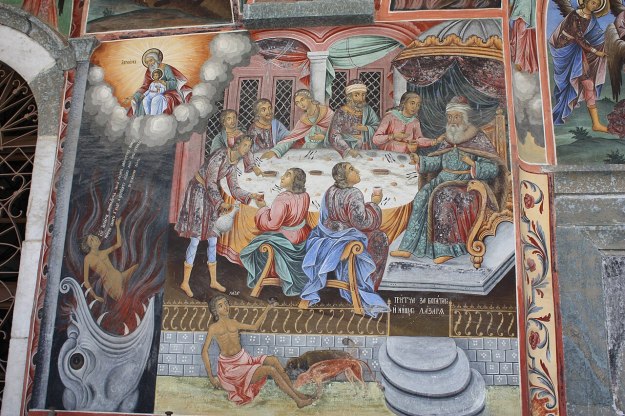
Fresco of Lazarus and the Rich Man at the Rila Monastery.
James 2: 1-13
1My brothers and sisters, do not claim the faith of our Lord Jesus Christ of glory while showing partiality. 2For if a person with gold rings and in fine clothes comes into your assembly, and if a poor person in dirty clothes also comes in, 3and if you take notice of the one wearing the fine clothes and say, “Have a seat here in a good place,” while to the one who is poor you say, “Stand there,” or, “Sit by my footstool,” 4have you not made distinctions among yourselves and become judges with evil thoughts? 5Listen, my beloved brothers and sisters. Has not God chosen the poor in the world to be rich in faith and to be heirs of the kingdom that he has promised to those who love him? 6But you have dishonored the poor person. Is it not the rich who oppress you? Is it not they who drag you into the courts? 7Is it not they who blaspheme the excellent name that was invoked over you? 8If you really fulfill the royal law according to the scripture, “You shall love your neighbor as yourself,” you do well. 9But if you show partiality, you commit sin and are convicted by the law as transgressors. 10For whoever keeps the whole law but fails in one point has become accountable for all of it. 11For the one who said, “You shall not commit adultery,” also said, “You shall not murder.” Now if you do not commit adultery but you murder, you have become a transgressor of the law. 12So speak and so act as those who are to be judged by the law of liberty. 13For judgment will be without mercy to anyone who has shown no mercy; mercy triumphs over judgment.
Bolded words have notes on translation below.
One thing I do not want to do in these reflections is to distort the simplicity of the ideas James is conveying to his readers. James maintains that claiming the faith of our Lord Jesus Christ is incompatible with actions that show favoritism to the rich over the poor. For James the faith of Jesus is a faith that keeps the whole law in a merciful manner. Like Matthew’s gospel, I think the letter of James is often misunderstood as rigid and legalistic. James is attempting to shape his readers into an authentic practice of faith which shows mercy to the neighbor without favoritism. The law is not an unbearable burden for James, but it is the law of liberty, it is the way of wisdom which leads to a whole life.
Faith is an important concept to James, especially in this chapter where it occurs thirteen times. In the previous chapter I quoted Joel Green’s note that faith for James was more akin to confidence, which makes sense in chapter one where faith is contrasted with doubt, but as James focuses intensely on faith in this chapter I find this previous definition of faith incomplete. Although two of the thirteen uses of faith in this chapter are in the first thirteen verses (the remainder are in the second half of the chapter) I want to highlight that for James, in addition to confidence, faith is connected to practice. Faith for James is connected with the Jewish idea of ‘halakha’ which in not merely about knowing but about walking in the way of the law. That is why confidence and belief are inseparable from concrete actions towards one’s neighbor.
If a person with gold rings and a person with dirty clothes comes into their synagogue[1] (NRSVue assembly) they are not to make distinctions between the two. The person with gold rings and fine clothing may not be a part of their community and they like the person in dirty clothes have come in for various reasons. James does not exclude the person whose appearance indicates wealth, he just states that granting favoritism to the wealthy visitor over the poor visitor is incompatible with the faith in Jesus. In James’s world of reversals, the poor are rich in faith and heirs of the kingdom in language that echoes the blessings of Jesus on the poor (Matthew 5:3; Luke 6:20). Ultimately the prejudices of the society around them are likely so ingrained in this gathering of people who are likely predominantly poor that James’s community needs to be instructed in the way faith causes these practices to be overturned. The rich ones are like those in the prophets who oppressed the poor, aliens, widows, and orphans as Martha L. Moore-Keish explains:
The term translated in the NRSV as “oppress” (katadunasteuo) is particularly significant, because it is the same word used by the prophets in the Greek version of the Old Testament for the oppressive actions of the rich against the poor, aliens, widows, and orphans (see Jer. 7:6; Ezek. 18:12; Amos 8:4). James 2:6 also resonates closely with the language in Proverbs about dishonoring the poor and God’s threat to take the offenders to court (e.g., Prov. 14:31; 17:5 a; 22: 23-24). In all these passages, katadunasteuo is a strong word with violent implications. “It is also significant that in the only other place the word is used in the New Testament, the ‘devil’ is the subject (Acts 10:38).” (Moore-Keish, 2019, p. 89)
We do not know what prompts this specific warning against favoritism towards the rich in James’s letter. It is possible that this could be like Jesus’s use of the parable of the rich man and Lazarus (Luke 16: 19-31) which puts two opposing characters alongside one another as an object lesson for the audience. It is possible that James is working in a synagogue where Sadducees and Pharisees are present and his words may be echoing Jesus’s words of condemnation about the Pharisees seeking places of honor and respect (Matthew 23: 6-7). Regardless of where others in James’s community see this favoritism modeled, James views it as incompatible with the faith in Jesus.
I serve in Frisco, Texas, a very prosperous suburb of Dallas and an area where the vast majority of my congregation would be considered incredibly wealthy by the standards of James original audience. I have also spent my entire ministry in suburban areas (North Little Rock, AR, Edmond, OK, and Papillion, NE). I am aware of the tension that these words evoke in me as a person who is very intentional about how I dress and present myself. Yet, this section also has made me reflect upon a moment several years ago in my ministry here where an older member in one of my communities, who was also one of the least well off members of my community, remarked to a young woman approaching the congregation for the first time and wearing jeans that were fashionably ripped, “Girl, go put some pants on.” I apologized to the visitor and immediately pulled the member aside and was very emphatic that she could never do that again because it was the opposite of the welcome we wanted anyone to feel. I was irate because I felt like the words, which she later claimed were a joke, indicated to this woman that she was unwelcome in our midst. I would not share this story if the person who said these words was still alive and it doesn’t completely correlate with James’s words but for me it shows how even those among us with the least may look for opportunities to place themselves in a position of judgment over others.
James joins Jesus and several other New Testament authors in finding Leviticus 19:18 as the central concept of the law. As Scot McKnight says,
Several New Testament writings…quote Leviticus 19:18…Paul explicitly makes it the fundamental rule of life (Rom 12:19; 13:9; Gal 5:14), while Peter hedges in that direction (1 Pet 4:8) and John explodes into full focus on love (John 13: 34-35; 1 John 3:11; 4;17). It is not without significance that James is the only person in the New Testament after Jesus who quotes both sides of the Jesus Creed; loving God in 1:12 and 2:5 and loving others as oneself here in 2:8. (McKnight, 2011, p. 208)
Leviticus 19:18 may be the ‘royal law’ in James, but James also connects loving neighbor as requiring compliance with all the commandments. James noting of the commandments on adultery and murder may reflect Jesus’s expansion of these commandments in the Sermon on the Mount (Matthew 5: 21-30) or an exposition on Leviticus 19 which brackets the love command in verse eighteen with,
“You shall not hate in your heart anyone of your kin; you shall reprove your neighbor, or you will incur guilt yourself. You shall not take vengeance or bear a grudge against any of your people, but you shall love your neighbor as yourself: I am the Lord. Leviticus 19:17
It is plausible that James may be referring back to Leviticus 19 throughout this reflection, especially in the previous section Leviticus 19:15 is relevant:
“You shall not render an unjust judgment; you shall not be partial to the poor or defer to the great: with justice you shall judge your neighbor. Leviticus 19:15
Although, Leviticus 19:20 does deal with sexual relations with a slave, James here appeals to the commandment on adultery (along with murder) rather than the specific case highlighted in Leviticus. It is likely that James, like Jesus, expands the view of adultery beyond the limits envisioned in Exodus, Leviticus, and Deuteronomy.
The royal law on loving the neighbor as oneself, which includes adherence to the commandments, is also the law of liberty. James’s vision of a community of living and authentic faith is a place where the poor are not discriminated against, and the neighbor is loved and protected. Yet, James like the other New Testament authors view the commandments through the lens of mercy. Again, James echoes ideas Jesus articulates in the Sermon on the Mount:
“Blessed are the merciful, for they will receive mercy. Matthew 5:7
but if you do not forgive others, neither will your Father forgive your trespasses.Matthew 6:15
James is not attempting to articulate anything novel when it comes to the faith of these followers of Jesus but instead is selecting key practices which are critical to the walk of faith. Faith for James is composed of both certainty and practiced consistent with the values centered on the loving the neighbor as oneself in a merciful and life-giving way.
[1] James knows the word for church (ekklesia) and uses it in 5:14, so calling the assembly ‘your synagogue’ is intentional. As I mention in the introduction, my assumption is that James the brother of Jesus is the author of this letter and we are given a window on early Christianity contemporaneous with Paul’s letters and the boundaries between Christianity and Judaism are probably not as rigid as they will be later.
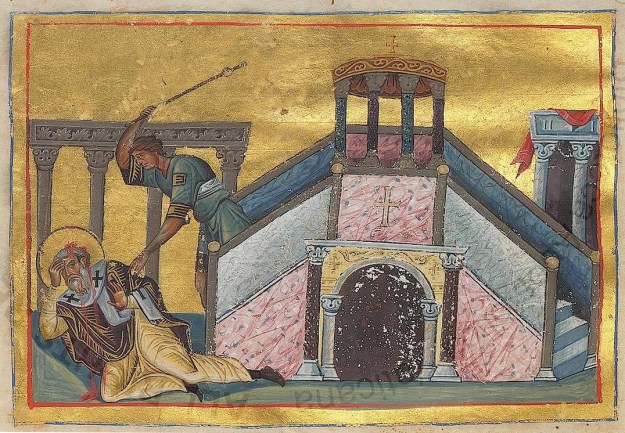
Martyrdom of James the Just By Authors of Menologion of Basil II (circa 985 AC, Constantinople), Byzantine manuscript illuminators
James 1: 16-21
Words highlighted have notes below on translation.
16Do not be deceived, my beloved brothers and sisters. 17Every generous act of giving, with every perfect gift, is from above, coming down from the Father of lights, with whom there is no variation or shadow due to change. 18In fulfillment of his own purpose he gave birth to us by the word of truth, so that we would become a kind of first fruits of his creatures.
19You must understand this, my beloved brothers and sisters: let everyone be quick to listen, slow to speak, slow to anger, 20for human anger does not produce God’s righteousness. 21Therefore rid yourselves of all sordidness and rank growth of wickedness, and welcome with meekness the implanted word that has the power to save your souls.
In contrast to the desire, sin, death conception metaphor in the previous section we now have the first fruits among God’s creatures of those who have received both a birth from above and gifts from above. In contrast to desire which is from this world is generosity and every ‘perfect’ (teleios) gift which comes from the Father above. Verse seventeen is one of the frequently used verses of James, particularly in the Eastern church where it is a part of the Divine Liturgy of Saint John Chrysostom, and its sentiment that every good gift comes from above is clear. The title Father of lights likely relates to God as the creator of the sun, moon, and stars, but I also wonder if James is intentionally using the binary light and darkness to contrast the desire, sin, death path of darkness to the generosity and perfect gifts path of light. Also continuing the thought of God not being the source of temptation/testing now the Father of lights has no shadow and no variation. James does seem to lean into a more philosophical conception of God as the ultimate good and unchanging than many other parts of the scriptures, but James is also working in the binary language of the wisdom tradition: wicked/righteous, death/life, light/darkness.
God giving birth to us from above follows a similar metaphor to Jesus’s dialogue with Nicodemus in John’s gospel where one must be born from above.[1] Paul also uses the language of ‘first fruits’ to talk about both Jesus[2] and these followers of the way of Jesus.[3] Whether the word of truth is the teachings of Jesus, some direct revelation from God, or the law (Torah) is not clear, but it connects to the implanted word of verse 21 which comes from outside of us and gives birth to this new creation in the midst of the world. James is likely less concerned with the mechanism of how God transforms people from those on the path of desire, sin, and death to generosity and life than the fruits of that transformation. As Bede the Venerable, a well-known eight century English monk, stated:
God has changed us from being children of darkness into being children of light, not because of any merits of our but by his own will, through the water of regeneration…we have become ‘the first fruits of his creatures,’ which means that we have been exalted over the rest of creation.” (Moore-Keish, 2019, p. 57)
To be the first fruits of creation for James means a transformed way of living. James in Acts is often portrayed as a peacemaker finding a way for the church and Jerusalem to accept the mission of Paul and others among the Gentiles. Anger is antithetical to James’s view of God’s righteousness. This pairs with Jesus’s teaching on anger in the Sermon on the Mount[4] where reconciliation is more important than sacrifice or worship. James, like Jesus and the prophets, does look for right practice more than right worship or right confession. The way of James is a way of listening, being slow to speak and slow to anger. Being slow to anger also echoes the characteristics of God given to Moses in Exodus 34, “The LORD, the LORD, A God merciful and gracious, slow to anger, and abounding in steadfast love and faithfulness” (Exodus 34: 6).
Throughout the New Testament there are multiple times where newborn believers are called to change their ways, particularly in relation to anger. Two examples would be:
But now you must get rid of all such things: anger, wrath, malice, slander, and abusive language from your mouth. Do not lie to one another, seeing that you have stripped off the old self with its practices and have clothed yourselves with the new self, which is being renewed in knowledge according to the image of its creator. Colossians 3: 8-10
Rid yourselves, therefore, of all malice and all guile, insincerity, envy, and all slander. Like newborn infants, long for the pure, spiritual milk, so that by it you may grow into salvation. 1 Peter 2: 1-2
These first fruits are to root out the sordidness and wickedness clearing the ground for the implanted word that brings this new growth and fruit. James uses multiple interlocking metaphors to contrast the way of death with the way of life. Birth and field metaphors come together. Unlike Jesus’s parable of the wheat and the tares[5] where the good and the unrighteous grow together, James envisions a world where the field has been cleared of the bad growth which strangles the harvest so that there can be a full harvest of the first fruits of the seeds God has sown in the lives of the faithful.
James 1: 22-27
22But be doers of the word and not merely hearers who deceive themselves. 23For if any are hearers of the word and not doers, they are like those who look at themselves in a mirror; 24for they look at themselves and, on going away, immediately forget what they were like. 25But those who look into the perfect law, the law of liberty, and persevere, being not hearers who forget but doers who act—they will be blessed in their doing. 26If any think they are religious and do not bridle their tongues but deceive their hearts, their religion is worthless. 27Religion that is pure and undefiled before God the Father is this: to care for orphans and widows in their distress and to keep oneself unstained by the world.
James and Paul are often portrayed in conflict, where Paul talks about faith and James talks about works. It is plausible that James is aware of Paul’s teachings and is issuing a corrective note to those who have become overfocused on knowledge or wisdom to the exclusion of practice, but James’s language here would not be alien to Paul, “For it is not the hearers of the law who are righteous in God’s sight but the doers of the law who will be justified.” (Romans 2:13) The reformation/counterreformation debates about faith opposed to works were focused on the wrong works, from the perspective of James. For James these works continue the concern of the law, the prophets, and Jesus to care for the vulnerable, to live a life in harmony with God’s will for the world, and to show mercy. Hearing and knowledge for James are not enough, but his teaching here again echoes Jesus.
“Everyone, then, who hears these words of mine and acts on them will be like a wise man who built his house on rock. The rain fell, the floods came, and the winds blew and beat on that house, but it did not fall because it had been founded on rock. And everyone who hears these words of mine and does not act on them will be like a foolish man who built his house on sand. The rain fell, and the floods came, and the winds blew and beat against that house, and it fell—and great was its fall!”Matthew 7: 24-27 parallel Luke 6: 46-49
But he said, “Blessed rather are those who hear the word of God and obey it!” Luke 11:28
James jumps to an additional metaphor of a person looking at themselves in the mirror and forgetting what they see being like the person who hears and does not act. What the NRSVue, along with most translations, render as ‘themselves’ is the Greek phrase to prospon tes geneseos, literally ‘the face of their origin (beginning).’ James may be wanting to indicate that the person looks at their ‘true self’ and then walks away from their true self into the paths that corrupt that self. But those who look at themselves in the light of God’s perfect (teleios) law of liberty and work (NRSVue act) in harmony with that law are happy/blessed their existence.
James turns to the topic of religion with two statements that look back on the previous argument and ahead to the remainder of the letter. James’s comments on bridling the tongue look back to his words of being quick to listen and slow to speak in verse nineteen and ahead to his lengthier discourse on the tongue in 3: 1-12. James’s pure and undefiled religion which cares for the vulnerable looks ahead to 2:14-17 and back to the reversals of 1:9-11.
Care for the vulnerable, particularly the orphan and the widow, is frequently highlighted in the law and the prophets:
You shall not abuse any widow or orphan. Exodus 22:22
who executes justice for the orphan and the widow, and who loves the strangers, providing them food and clothing.Deuteronomy 10:18
James, like several of the prophets, argues for an understanding of religion that is less about acts of sacrifice in the context of the temple and centrally focused on the justice lived in society. Religion is not to bribe God with one’s gifts but instead to live in obedience with God’s will as expressed in the law. A mark of the faithfulness of one’s religious work is the way the vulnerable of the surrounding society are cared for in James’s view. A religion of unrestrained speech and ignored widows and orphans is a defiled faith to James.
9Let the brother or sister of humble means boast in having a high position 10and the rich in having been humbled, because the rich will disappear like a flower in the field. 11For the sun rises with its scorching heat and withers the field; its flower falls, and its beauty perishes. It is the same way with the rich; in the midst of a busy life, they will wither away. 12Blessed is anyone who endures temptation. Such a one has stood the test and will receive the crown of life that the Lord has promised to those who love him. 13No one, when tempted, should say, “I am being tempted by God,” for God cannot be tempted by evil and he himself tempts no one. 14But one is tempted by one’s own desire, being lured and enticed by it; 15then, when desire has conceived, it engenders sin, and sin, when it is fully grown, gives birth to death.
The message of Jesus in the gospels is full of reversals where the lowly are brought high and the mighty are brought low. The song of Mary, the Magnificat, in Luke 1:46-55 is a prime example of this theme:
He has brought down the powerful from their thrones and lifted up the lowly;he has filled the hungry with good things and sent the rich away empty. Luke 1: 52-53
Scot McKnight makes an interesting note on the childhood experience of Jesus and James, assuming James the brother of Jesus as the author of the letter:
If there is any truth to the tradition that Joseph died and left Mary a widow, James would have been part of a family in stress, and that might help explain why James sees pure religion as caring for the poor and widows (James 1:26-27). (McKnight, 2011, p. 16)
Jesus would continually use the language of reversal where the first are last and the last are first,[1] and the exalted are humbled and the humbled exalted.[2] This section also resonates strongly with Jesus’s teaching not to worry about food and drink and clothing in the Sermon on the Mount.[3] The rich disappear like the flowers of the field, just as Solomon in all his glory is not clothed like the flowers of the field. For James’s wisdom does not trust in the position and grandeur that comes from wealth, these are only transitory things which are untrustworthy and wither away. Just as Jesus could tell his disciples that one cannot serve God and wealth (Mammon), James tells the recipients of this letter that the rich will be humbled but the humble will be lifted up to a high position. The God who provides for the birds of the air and the flowers of the field provides for the brother and sister of humble means while the rich are tempted to serve wealth as their master and order their lives according to the kingdom of Mammon.
The word ‘blessed’ in verse twelve continues to indicate that James is following the pattern of Hebrew wisdom literature. The Greek Makarios is the same term used in the Beatitudes of the Sermon on the Mount and is the Greek term which translates the Hebrew ‘asre (or ‘ashrei) often rendered ‘happy’ in most translations. The word means blessed, happy, or contented and is frequently used in wisdom literature. Here those who endure temptation or testing (Greek periasmos)[4] are happy/blessed. In a similar pattern to the Beatitudes, James lifts up something that normally is not considered blessed (enduring temptation/testing) and then indicates the reward (receiving the crown of life). Yet, James is also concerned that people understand that, in his view, God is not the cause of the temptation but instead the temptation comes from a misdirected desire. On the one hand there are points in the Old Testament where God clearly does test God’s people, and throughout many portions of the Old Testament God is responsible for both the good things that happen and the bad things that happen. As I mention in my reflection on A Split in the Identity of God this perspective evolves and by the time of the New Testament there are forces, like the devil and demons, actively opposed to God’s will for the world. Yet for James the temptation is due to one’s own desire. The word translated by the NRSVue as ‘desire’ (epithumias) in moral discourse has a negative sense of ‘evil desire’ or ‘craving.’ (Green, 2025, p. 40) This is a misplaced desire. Desire can be rightly placed on God, like in Psalm 42, “As the deer longs for flowing streams, so my soul longs for you.” Here desire has been corrupted and longs for things that are not God. Like the adulterous, loose, dangerous woman in Proverbs 5,6, and 7 who is opposed to lady wisdom and lures the growing child into a dangerous liaison, now a personified desire seduces the unwise and gives birth to a child names sin who births a child named death. In contrast to the temptations/testing of faith which leads to endurance and endurance completes its work so that the person may be complete, the temptation/testing of one’s desire leads to sin which leads to death. One path leads to wisdom, completion, and life while the other leads to foolishness, sin, and death. James, like Paul, personifies sin, death, and desire. Despite the sexual metaphor of desire conceiving sin which conceives death it is telling that in James’s letter sexual activity is not an area where he counsels his audience.
Jan Hus Memorial at Old Town Square in Prague built in 1915. Photo by Jorge Royan. Shared under CC BY-SA 3.0
James 1: 1-8
Words highlighted have notes below on translation.
1James, a servant of God and of the Lord Jesus Christ, To the twelve tribes in the dispersion: Greetings. 2My brothers and sisters, whenever you face various trials, consider it all joy, 3because you know that the testing of your faith produces endurance. 4And let endurance complete its work, so that you may be complete and whole, lacking in nothing. 5If any of you is lacking in wisdom, ask God, who gives to all generously and ungrudgingly, and it will be given you. 6But ask in faith, never doubting, for the one who doubts is like a wave of the sea, driven and tossed by the wind. 7, 8For the doubter, being double-minded and unstable in every way, must not expect to receive anything from the Lord.
James, the author of the letter, has traditionally been understood as James the Just or James the brother of our Lord who was one of the influential early leaders of the church in Jerusalem.[1] Throughout this reflection my assumption will be that this is an early Christian letter, written in a similar time period to the letters of Paul, from a leader of the church in Jerusalem to the Jewish followers of Jesus scattered throughout the world. James introduces himself as a servant (literally slave in Greek) of God and of the Lord Jesus Christ. Although the translation of the Greek doulos as ‘servant’ in most English translations makes sense, especially with the history of how slaves were treated in the United States, it is worth noting that most of the apostles claim to be slaves/servants of Christ or God. In the ancient world a slave could exercise authority on behalf of their master, yet unlike a servant who is employed and can quit a slave was owned by the household. From a contemporary perspective in an individualistic society where personal freedom is highly valued it is worth being reminded that in the ancient world you were always bound to your family or the household you served. I do think for James the sense of obedience and servitude are an important part of how he sees the life of wisdom.
James and the author of 1 Peter are the only two New Testament authors to address their letters to the diaspora. Although at the time of the writing of James, assuming that the biblical James is the author, Israel and Jerusalem are not yet in rebellion against Rome, there are still more Jews living outside of Palestine in the diaspora than who live inside it. (Moore-Keish, 2019, pp. 20-21) At this early time, prior to 62 CE when James the Just is killed, the boundaries between Judaism and Christianity are still porous and many of the early followers of the way of Jesus Christ considered themselves a part of the Jewish people. Yet, there is also throughout the New Testament an adoption of the titles and language used for the Jewish people throughout the Old Testament to speak about the role of the new followers of Jesus throughout the church. Although James is writing in a manner that is highly reflective of the Hebrew Scriptures and Torah obedience, it is also likely that his audience may also include the churches of Paul and others among the Gentiles. James never mentions Sabbath-keeping, circumcision, or diet. Like the Gospel of Matthew, James attempts to write about a faith that is connected with Torah observance the letter is also shaped by a merciful reading of scripture which is shaped by both the teachings of Jesus and the prophetic witness before him.
Most modern translations will translate the Greek adelphos/adelphoi with ‘brothers and sisters’ rather than the generic ‘brother/brothers’ since James was addressing both men and women with the letter. What immediately strikes me as we enter into the letter of James is the way many of the early Christian writers are sharing a common vocabulary as they address the new followers of the way of Jesus Christ. James’s brief encouragement to find joy in their trials echoes Jesus’s words in the Sermon on the Mount:
“Blessed are you when people revile you and persecute you and utter all kinds of evil against you falsely on my account. Rejoice and be glad, for your reward is great in heaven, for in the same way they persecuted the prophets who were before you. Matthew 5: 11-12
Although James has been often read in opposition to Paul, his language throughout this letter often uses the same language and rhythms as Paul. Here in verses three and four you can see a similar pattern in Paul’s letter to the Romans:
And not only that, but we also boast in our afflictions, knowing that affliction produces endurance, and endurance produces character, and character produces hope, and hope does not put us to shame, because God’s love has been poured into our hearts through the Holy Spirit that has been given to us. Romans 5: 3-5[2]
In verse four we have the first appearance in the letter of the Greek teleios (NRSVue ‘mature’/NRSV ‘perfect’). This is an important word for James; the word is used twenty times in the New Testament; five of those uses occur in this short letter. Additionally, James utilized both the verbal form teleo twice and the substantive telos once. (Moore-Keish, 2019, p. 28) When I was working through Matthew’s gospel this was a word I wrestled with because I don’t believe that the word intends the sense of moral perfection that is often read into it.[3]Teleios is a word of destination and completion, and I like the NRSVue’s adoption of ‘mature’ for this word. James does want his readers to live a complete and mature life shaped by the path of God’s wisdom.
The letter of James shares many similarities with the wisdom literature in the Old Testament with its interest in shaping a life that is faithful to God’s intent as outlined in the law. Wisdom literature often contrasts the path of wisdom with the opposing path of foolishness. James contrasts the single-minded way of faith with the double-minded way of doubt. Faith and doubt are opposing ideas in James, and I believe that Joel B. Green captures the essence of James’s thought when he states that for James, “faith has more the sense of confidence.” (Green, 2025, p. 30) In the Gospel of Matthew ,faith had more the sense of openness and in Matthew’s gospel worship and doubt often coexisted, but James is approaching faith and doubt as opposites. James’s definition of faith is, ironically, incredibly close to Luther’s famous explanation of the first commandment, “We are to fear, love, and trust God above all things.” Faith and wisdom are a single-minded confidence in God and God’s ways. For those lacking in wisdom they are told to ask God confidently for the wisdom they need to lack nothing. The parallel use of ‘lacking nothing’ in verse four and ‘lacking wisdom’ five form an interesting parallel between ‘enduring trials’ and ‘asking God for wisdom.’
James targets those among his readers whose practice does not match their profession. They are double-minded because they want to be friends of God and friends of the world at the same time. (NIB XII:182) James’s thoughts echo Jesus’s words contrasting between those who try to serve two masters,[4] and it is telling that Jesus is contrasting those who serve God and wealth as James is about to contrast those of humble means and the rich.
Martha L. Moore-Keish quotes a portion from the final letter of the Jan Hus, a reformer in Czechoslovakia (1369-1415) before he was burned at the stake that I want to close this portion of the reflection with because it wrestles with the themes of James in the concrete moment of temptation/trial:
Surely it is difficult to rejoice without perturbation, and to esteem it all joy in various temptations. It is easy to talk about it and to expound it, but difficult to fulfill it. Even the most patient and valiant soldier, knowing that on third day He would rise, conquering by His death the enemies and redeeming the elect from damnation, after the Last Supper was troubled in spirit…O most kind Christ, draw us weaklings after Thyself, for unless Thou draw us, we cannot follow Thee! Give us a courageous spirit that it may be ready; and if the flesh is weak, may Thy grace go before, now, as well as subsequently. For without Thee we can do nothing, and particularly to go to a cruel death for Thy sake. Give us a valiant spirit, a fearless heart, the right faith, a firm hope, and perfect love, that we may offer our lives for Thy sake with the greatest patience and joy. Jan Hus, from a letter written just prior to his being burned at the stake on July 6, 1415. (Moore-Keish, 2019, p. 25)
[1] Mark 6:3 indicates that Jesus has two brothers, James and Joses. James as a leader of the early church is mentioned in Acts 12:17; James plays a pivotal role in the Jerusalem council in Acts 15 (see verse 13) as well as meeting with Paul when he returns to Jerusalem in Acts 21: 17-26. Throughout Acts James is one of the leaders of the church and he often acts in a conciliatory manner between the church in Jerusalem and the Hellenistic mission of Paul and others. In Paul’s letter to the Galatians, James seems to have enough influence and power to make Peter change his behavior.
[2] See also 1 Peter 1: 6-7: In this you rejoice, even if now for a little while you have had to suffer various trials, so that the genuineness of your faith—being more precious than gold that, though perishable, is tested by fire—may be found to result in praise and glory and honor when Jesus Christ is revealed.