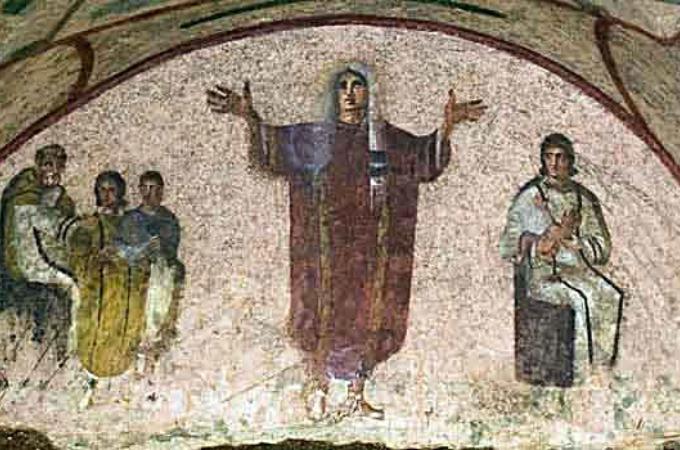
A Maskil of David. When he was in the cave. A Prayer.
1With my voice I cry to the Lord; with my voice I make supplication to the Lord. 2I pour out my complaint before him; I tell my trouble before him. 3When my spirit is faint, you know my way.
In the path where I walk, they have hidden a trap for me. 4Look on my right hand and see: there is no one who takes notice of me; no refuge remains to me; no one cares for me.
5I cry to you, O Lord; I say, “You are my refuge, my portion in the land of the living.” 6Listen to my cry, for I am brought very low.
Save me from my persecutors, for they are too strong for me. 7Bring me out of prison, so that I may give thanks to your name. The righteous will surround me, for you will deal bountifully with me.
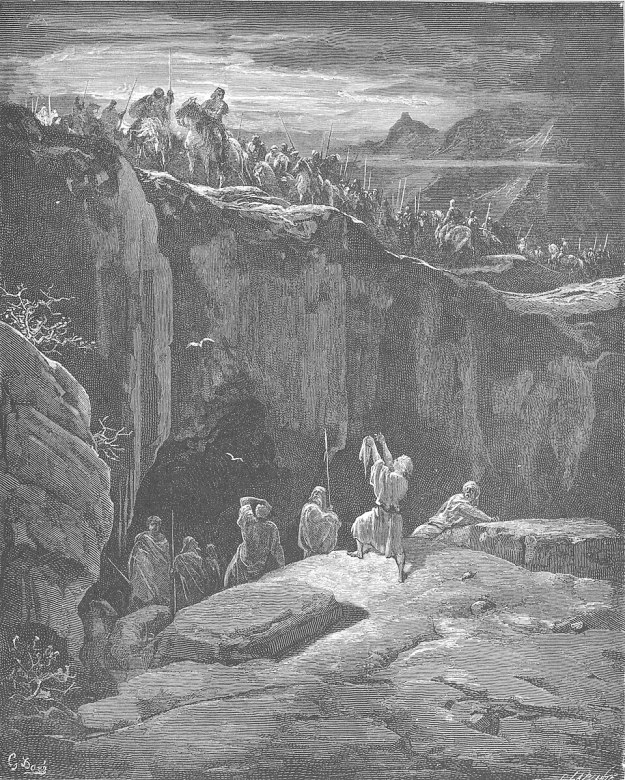
The superscription of this psalm has two possible moments in the life of David. The first is in 1 Samuel 22 when David is in the cave at Adullam. David in this portion of his story has just departed from King Achish of Gath after pretending to be mad.[1] David arrives at Adullam alone, but later is met by family and other followers there. The alternative is when he is in the wilderness of En-gedi, fleeing from Saul’s army. This is the cave where David has the opportunity to kill Saul but only cuts off a portion of his cloak because he will not strike the LORD’s anointed one (1 Samuel 23-24). This psalm in which the speaker feels oppressed and abandoned by the community of faith could fit either situation or many other situations that people of faith have encountered.
The psalmist cries to the LORD from a moment where they feel alone, overwhelmed, and trapped. The verb for “cry to” is different from “call upon” at the beginning of Psalm 141. Here the word is the Hebrew za’aq, “which conveys the idea of crying out in acute distress and seeking deliverance.” (Nancy deClaisse-Walford, 2014, p. 978) The word occurs twice in this psalm (vs. 1,5) and only three other times in the psalms (22:5; 107: 13,19). Yet, as J. Clinton McCann, Jr. notes
Hebrew za’aq…it recalls the exodus (see Exodus 2:23); it is a crucial part of the pattern in the book of Judges (see Judges 3:9, 15; 6: 6-7); indeed, it became understood as a typical element in God’s dealing with God’s people. (NIB IV: 1247)
Within the story of Israel, when they groaned and cried out (za’aq) to God, God heard and remembered them. Now the psalmist taps into this belief and cries out to God that they may be heard and remembered. They speak their complaint and trouble from this hiding place in the wilderness where their spirit is faint, they trust that God knows the way to their refuge.
Much of the imagery of the poem is related to hunting with the psalmist as the prey being pursued. The pursuit of their enemies has left them vulnerable and alone. Enemies can lay traps but there is no one at the right hand to come to the aid of the psalmist. In the language of the poem there is no where left for them to flee, no refuge to seek, they are imprisoned by the pursuing enemy. They are brought low and do not have the power to deliver themselves. Their only hope is that God will be their refuge, bring them out of their imprisonment, and deliver them from their pursuers. They desire to be in a place where they can be in the company of the righteous again, rather than being isolated and surrounded by their oppressors. Yet, even in their distress they trust that their God will deliver, deal bountifully with them, release them from prison, and return them to their place among God’s faithful people.
[1] Achish was aware of David as an opponent when he served under Saul and was suspicious of David’s loyalties, so David pretended to be mad but ultimately departs for Adullam when he is not welcome in Achish’s house.
and the lifting up of my hands as an evening sacrifice.
3Set a guard over my mouth, O LORD;
keep watch over the door of my lips.
4Do not turn my heart to any evil,
to busy myself with wicked deeds
in company with those who work iniquity;
do not let me eat of their delicacies.
5Let the righteous strike me;
let the faithful correct me.
Never let the oil of the wicked anoint my head,
for my prayer is continually against their wicked deeds.
6When they are given over to those who shall condemn them,
then they shall learn that my words were pleasant.
7Like a rock that one breaks apart and shatters on the land,
so shall their bones be strewn at the mouth of Sheol.
8But my eyes are turned toward you, O GOD, my Lord;
in you I seek refuge; do not leave me defenseless.
9Keep me from the trap that they have laid for me
and from the snares of evildoers.
10Let the wicked fall into their own nets,
while I alone escape.
The rich poetic imagery of the prayers of the worshipper ascending to God like the fragrant smoke of burning incense has always been a memorable aspect of this psalm. In my own practice this psalm is frequently used in evening prayer within the setting of Marty Haugen’s Holden Evening Prayer where verse two of the psalm becomes the refrain for the psalmody. Yet within the psalm there is a contrast between this slow imagery of prayers ascending like incense at the evening sacrifice and the urgent call of the psalmist for God to hear and come quickly. There are numerous verbal links with Psalm 140[1] but they are used to a different end. Psalm 140 cries out for God to deliver the psalmist from the poisonous words of violent men, but Psalm 141 calls on God to prevent the petitioner from their own heart and mouth being used for wickedness.
The psalm is linked poetically to the actions of worship: burning incense and offering a sacrifice. These words may originate during worship, or the author may view these words as a sacrifice and pleasant odor they can present before God. I appreciate the multisensory image which involves both scent and a visual image combined with the audible speaking of these words before God. If the prayer is offered at the evening sacrifice the petitioner may be hoping to partake in the holy portion of the evening sacrifice rather than the delicacies of those who work iniquity.
The psalmist called for God’s immediate action and that action is turned towards delivering them from the words and practices of the wicked. The language of the psalm is echoed in the warnings about appropriate companions scattered throughout Proverbs and many readers of this psalm believe the author has become associated with companions whose words and actions are evil. They ask God to guard their mouth and watch the door of their lips to prevent their tongue from becoming like the tongues sharp and snakes and lips with the venom of vipers in the previous psalm. Similarly, they ask God to keep their heart from evil and wicked deeds in the company of those who work iniquity. It is plausible that those the author speaks of are royalty and he may be echoing Proverbs 23:2, “Do not desire an official’s delicacies, for they are deceptive food.”
Any translation of verses five to seven of the psalm have had to smooth out the Hebrew text.[2] The NRSVue does a good job of creating a stanza that makes sense and I will follow their translation in continuing to discuss the psalm. The psalmist asks for the righteous to correct them, even striking them to discipline them. The language of anointing may indicate that the ones the psalmist speaks about are royalty and their anointing of the psalmist would be recognizing him as included in their group. Perhaps the psalmist is a prophet who has been speaking words that the princes and nobles did not want to hear, but they have attempted to entice him to join with them. Ultimately the psalmist agrees with the belief that God will not allow the wicked to prosper forever and eventually their bones will be scattered like a rock that shatters when it is cast against the ground.
They know that they are in danger of being ensnared by these wicked ones. Whether they have willingly been seduced into this position or these evil ones are attempting to trap them in words or actions, they understand that their deliverance will come from God. God can guard their mouth from words that can be used against them, turn their heart away from the acts which are contrary to God’s wisdom, or to be tempted by the delicacies that these workers of iniquity have set before them. Instead, the psalmist asks that these evil ones would fall into their own traps, ensnared in their own plots and actions. Just as Christians regularly pray “lead us not into temptation and deliver us from evil” this psalmist knows the dangers of the temptations and the lure of the evil snares set for them.
The appeal of the psalm for God to guard our lips, our hearts, and ultimately our actions in an environment of temptation is a prayer that resonates for followers of every time. Hundreds of billions of dollars are spent annually on advertising that asks us to taste the delicacies set before us. The digital world and the real world are full of traps to ensnare us in actions that we know are foolish but find enticing. The life of faith involves sending up prayers to God for words and actions that are faithful instead of wicked. We all need to be delivered from temptation. I certainly have had times where I needed divine help to restrain my tongue or to give me the strength to live according to my convictions. I have needed the correction of faithful brothers and sisters in the body of Christ. For me the psalm is a reminder that we rely on God and God’s people as we attempt to live a faithful life amid a world of temptations.
[1] Nancy deClaissé-Walford lists nine verbal connections: ““Wicked” (rasa) occurs in Pss. 140:8 and 141:4, 10; “righteousness” (sadiq) in 140:3 and 141:5; “guard, keep” (samar) in 140:4 and 141: 3, 9; “lip” (sapa) in 140:3,9 and 141:3; “malicious” (ra’) in 140: 1,2, 11 and 141:4; “LORD my Lord (YHWH’adonay) in 140:7 and 141:8; “trap” (pah) in 140:5 and 141:9; “snare” (moqes) in 140:5 and 141:9; and “lend an ear” (‘azan) in 140:6 and 141:1.” (Nancy deClaisse-Walford, 2014, p. 972)
[2] Nancy deClaissé-Walford attempts to give a closer translation to the Hebrew:
5 Let the righteous strike me with hesed and reprove me;
let my head not refuse such oil
Indeed continually my prayer is against their maliciousness.
6 Let their judges be hurled down into the hands of the rock,
And then they will hear my sayings, for they are pleasant.
7 Like the furrowing and breaking up of the earth,
our bones are scattered to the mouth of Sheol. (Nancy deClaisse-Walford, 2014, p. 973)
The process of reading, reflecting and writing on scripture has been formative to my faith and growth over the past fourteen years. I’m always amazed at the discoveries in each book I’ve studied and the way previously underutilized texts have shared their world and wisdom with me. Attempting to translate scripture is more than the translation of the Greek or Hebrew into English, but it also involves translating the texts from a very different world and time to our modern ears. 1 Timothy is an excellent example of this. Sexuality, the role of women in the church and society, the expectations of the household, and the existence of slavery are just a couple of the realities that require translation between the first century and the twenty-first century. Yet I find this letter’s attempts to help Timothy address the conflicts over doctrine and practice in communities of faith in Ephesus providing a window into the life of the early church and some practical guidance for those attempting to manage the continuing reality of church conflict two millennia later.
1 Timothy gives us a window on Paul attempting to help the congregation in Ephesus receive the gospel of God’s salvation while navigating the expectations of the Roman empire and the Hellenistic world. He has to balance the church (ekklesia) with the household (oikos) especially since most churches likely met in the households of members. These early Christ followers come from very different economic backgrounds and likely have varying familiarity with the stories of Jesus and the Scriptures of the church (the Old Testament at this time). Timothy is given the challenging task of being Paul’s young emissary to these Ephesian churches where he has to provide a clear witness and exemplary example to the elders, young men, widows, young women, slaves, and masters among these households and churches. Church leadership both then and now can seem a daunting and impossible task at the same time it is viewed as a noble one.
This short letter provides numerous opportunities for reflection on the difference between the world of the early Christians and our own. For those willing to approach this text with curiosity it should provide an opportunity to refine what one believes and why one believes it. I am like many pastors who have rarely utilized the Pastoral Letters in my preaching and teaching, and I found this close examination of this letter very helpful. One of the things it challenged me to rethink was praying for those in leadership in government even when I may disagree with their beliefs or policies. The conviction that God desires to save all and the Christ was given as a ransom for all allows Paul to understand that kings, leaders, and even Caesar were in need of prayers, supplications, and thanksgivings.
St. Paul Writing His Epistles probably by Valentin de Boulogne (1618-1620)
1 Timothy 6: 1-2a
Bolded text has notes on translation below.
1Let all who are under the yoke of slavery regard their masters as worthy of all honor, so that the name of God and the teaching may not be blasphemed. 2Those who have believing masters must not be disrespectful to them on the ground that they are brothers and sisters; rather, they must serve them all the more, since those who benefit by their service are believers and beloved.
The Ephesus that Paul writes to in 1 Timothy is a very different world than our modern minds are used to. The views on sexuality, the place of women in worship, expectations of leaders, expectations of families in relation to their parents, and now slavery are all challenging topics that should invite discussion. It is also important to acknowledge that these texts have been used to impose the worldview of the ancient world or to resist the movements for change for women, enslaved people, and other groups throughout history. I do believe that as 2 Timothy states:
All scripture is inspired by God and is useful for teaching, for reproof, for correction, and for training in righteousness 2 Timothy 3:16
Engaging in the places where scripture is challenging should allow us to refine our values and why we hold them so that we may be trained to embody righteousness in our own time.
Slavery in the ancient world, particularly in the Roman empire of Paul’s time, was a part of the way that the world was ordered. Paul did not defend slavery, but he also did not condemn it. In Philemon Paul speaks on behalf of the runaway slave Onesimus and encourages him to be received back as “more than a slave, a beloved brother” (16) but acknowledges Philemon’s role as Onesimus’s master and his ability to make decisions about his slave’s future. Ephesians 6:5-8 and Colossians 3:22-24 include master/slave relations as a part of the household codes with expectations for both masters and slaves, but not challenging the reality of slavery in the Roman world. Paul is not alone in this. 1 Peter 2: 18-25, the Didache 4:10, and several other early Christian documents operate with the understanding that slavery was a part of the ordering of the Roman world. Thomas Long makes a helpful analogy when he states:
The Pastor could no more envision a society this side of heaven in which there was no slavery than those of us raised in the 1950s and 1960s could imagine the digital world we now inhabit. (Long, 2016, p. 166)
Slavery in Rome was not based on any racial dynamic. Many slaves were captured in the wars the Roman empire fought which brought slaves from Africa, the Middle East, and Europe. Many scholars once believed that most slavery in the Roman world was for a fixed number of years and that it allowed opportunities for advancement, but that is now highly debated. Some slaves could operate with immense power on behalf of their master, and that is the world envisioned in many of Jesus’s parables, but slavery was a massive portion of the economy in Roman society.
Before I comment directly on the text, I want to briefly talk about slavery as it is understood in the history of the United States. The reality of chattel slavery in the United States was very different from the ancient world. Instead of being predominantly urban it was predominantly rural. It underwrote the economy in the southern United States, particularly the farming of cotton. One dynamic was that the slaves in the United States, brought forcibly from Africa, was that they were viewed as less human than their white masters. Willie James Jennings in his book The Christian Imagination: Theology and the Origins of Race discusses a deformed Christian imagination which allowed generations of missionaries, priests, bishops, as well as everyday Christians to be unable to see the common humanity of the people indigenous to Africa, Asia and the New World. Throughout the era of colonization, the colonizers practiced an inverted hospitality where they assumed that the land, the resources, and even the people were there in service to them. Yet, the same scripture read by the colonizers would eventually be read in a new light by abolitionist, slaves, and the colonized. One critical difference for Paul is that both the slaves and the masters were brothers and sisters sharing both a common humanity and a common calling in Christ.
Paul only addresses the slaves and not the masters in 1 Timothy, and it is plausible that once again Paul is addressing a problem that has emerged as both slaves and masters hear the language of being brothers and sisters in Christ while living as master/slave in the household. Those under the yoke of slavery are commanded to regard their masters as worthy of honor (tima, the same term in the previous chapter for true widows and worthy elders are entitled to). Many of the slaves in the community may not have served believing masters and actions of disrespect towards their masters may be bringing suspicion to the communities in the eyes of the surrounding community. For those whose masters were believers they may be asserting their equality in the household or refusing to serve. There is no evidence in Paul’s letters of rebellion, but the view of the masters was likely diminished in the eyes of their slaves. As Luke Timothy Johnson states:
In the ancient world, such attitudinal derogation was almost worse than open rebellion, for it more effectively subverted the social order. (Johnson, 2001, p. 288)
Yet, Paul’s language is not as one sided as the English renders it. The word translated “serve them” (euergesia) is a word of benefaction, something normally reserved for those in power. Paul’s language indicates that the slave serving the master is done from a position of power. Paul will call the believing masters believers and beloved suggesting that the slave and master share a bond that remains distinctive to their shared commitment to Jesus. I’m not willing to go quite as far as Luke Timothy Johnson to state that Paul’s language here may be more liberating than his diplomacy with Philemon (Johnson, 2001, p. 290) but Paul throughout his letters has attempted to find a way to manage the realities of being brothers and sisters in the church (ekklesia) with the realities of men and women, slave and master, rich and poor in the Roman household (oikos). Paul, like Christians of all times, live in the hope of the new creation but must continue to function in the environment and expectations of their time.
1 Timothy 6: 2b-19
Teach and urge these duties. 3Whoever teaches otherwise and does not agree with the sound words of our Lord Jesus Christ and the teaching that is in accordance with godliness4is conceited, understanding nothing, and has a morbid craving for controversy and for disputes about words. From these come envy, dissension, slander, base suspicions, 5and wrangling among those who are depraved in mind and bereft of the truth, imagining that godliness is a means of gain. 6Of course, there is great gain in godliness combined with contentment, 7for we brought nothing into the world, so that we can take nothing out of it, 8but if we have food and clothing, we will be content with these. 9But those who want to be rich fall into temptation and are trapped by many senseless and harmful desires that plunge people into ruin and destruction. 10For the love of money is a root of all kinds of evil, and in their eagerness to be rich some have wandered away from the faith and pierced themselves with many pains.
11But as for you, man of God, shun all this; pursue righteousness, godliness, faith, love, endurance, gentleness. 12Fight the good fightof the faith; take hold of the eternal life to which you were called and for which you made the good confession in the presence of many witnesses. 13In the presence of God, who gives life to all things, and of Christ Jesus, who in his testimony before Pontius Pilate made the good confession, I charge you 14to keep the commandment without spot or blame until the manifestation of our Lord Jesus Christ, 15which he will bring about at the right time—he who is the blessed and only Sovereign, the King of kings and Lord of lords. 16It is he alone who has immortality and dwells in unapproachable light, whom no one has ever seen or can see; to him be honor and eternal dominion. Amen. 17As for those who in the present age are rich, command them not to be haughty or to set their hopes on the uncertainty of riches but rather on God, who richly provides us with everything for our enjoyment. 18They are to do good, to be rich in good works, generous, and ready to share, 19thus storing up for themselves the treasure of a good foundation for the future, so that they may take hold of the life that really is life.
Paul encourages Timothy to continue to teach and urge the congregation to maintain their responsibilities in the church and the home. Those teaching otherwise (heterodidaskalia– literally another or other teaching) are in contrast with the healthy (hugianousin where our modern word hygiene comes from) words received from Jesus and the teaching in accordance with godliness (eusebia one of Paul’s favorite words throughout this letter, as mentioned before it has elements of religion, piety, godliness and it involves the entire practice of faith). In contrast to the healthy words of Jesus are the sick (nouson NRSVue morbid) words which crave controversy and are deluded[1] disputing about words. From these other teachings, which have wandered away from the healthy words received from Jesus, spring a list of vices which end with the idea of eusebia (religion/piety) being utilized for gain.
The idea of religion/piety being utilized for personal gain is a theme that emerges throughout history. Jesus criticized religious leaders in his time who:
As he taught, he said, “Beware of the scribes, who like to walk around in long robes and to be greeted with respect in the marketplaces and to have the best seats in the synagogues and places of honor at banquets! They devour widows’ houses and for the sake of appearance say long prayers. They will receive the greater condemnation.” Mark 12: 38-40
Paul makes it clear that elders who teach well are worthy of honor (tima) which includes financial compensation, but it is plausible that some leaders have emerged who have utilized their position in the community to benefit their honor and financial status. It is also highly likely that the financial troubles of some of the widows in the community may be related to these teachers who in Paul’s view have misled these women.
It is also important to acknowledge that reading 1 Timothy, along with the other New Testament letters, undermines the sociological assumption that I was taught in seminary: that the early Christians all came from among the poor. Summarizing several themes from the letter Luke Timothy Johnson points out:
We have already seen that some believers were slave owners (6:1-2). Some women were able at worship to make a display of their extravagant clothing, hairdos, and jewelry (2:9). Some families were in the position to support the poor widows of their households (5:4, 8, 16). I have already suggested that the presence of such visible wealth presented temptations to leaders. …Paul takes pain to ensure that supervisors and helpers not be lovers of money (3:3) or do anything for a profit (3:8). (Johnson, 2001, pp. 302-303)
Paul points to a godliness (eusebia) combined with contentment (autarkeia) in contrast with the use of godliness for gain. Autarkeia is an important virtue for Stoics and Cynics, but Paul is not opposed to using an idea from the surrounding culture to communicate how the life of faith is practiced. Paul uses the same term in Philippians 4:11, ”Not that I am referring to being in need, for I have learned to be content (autarkeia) with whatever I have.” In contrast those who are not content and desire to be rich are faced with many destructive temptations.
The most famous verse in 1 Timothy is verse ten, and the NRSVue correctly identifies that “the love of money is a root of all kinds of evil.” Most earlier translations added the exclusive “the” which is not present in the Greek. The exclusive translations seem to indicate in this proverb that the love of money is the only root of evil, but the Greek indicates that this desire is one among the many roots. Yet, it is a critical root and Paul will return one additional time to how followers of Jesus with wealth are to act to prevent them from wandering away from the faith and being pierced by many pains.
Paul turns again to Timothy encouraging him to pursue righteousness, godliness, faith, love, endurance, and gentleness instead of wealth. Fight the good fight here is the language of sports, unlike 1:18 where the Greek is the language of military conflict, where Timothy is encourage to strive towards the life of the new age (NRSVue eternal life) which Timothy has confessed. This is one of only three times where Pilate is given the title Pontius in the bible[2] and Jesus’s confession before Pilate likely refers to a narrative similar to the passion narrative of either the synoptic gospels or the gospel of John. This may also indicate an early confession emerging among the church where Pilate’s title is linked to his person as occurs in the Apostles’ and Nicene Creeds. Paul and Timothy await the manifestation of Jesus which will be brought about in God’s time (kairos).[3] The language of verse fifteen and sixteen may have been a confession of faith utilized in the Ephesian communities. The statement that no one has ever seen God likely originates in God’s words to Moses in Exodus 33:20 and echoes in the conclusion of the prologue of John’s gospel:” No one has ever seen God. It is the only Son, himself God, who is close to the Father’s heart, who has made him known.” (John 1:18)
Paul returns to how those with wealth are to live as believers. One of the dangers throughout the bible related to wealth is that the wealthy one believes they are self-reliant and they fail to acknowledge the gifts they have received from God. The love of money may be a root of all kinds of evil, but Paul does not view wealth as inherently evil. If they have been given wealth, they are to use that wealth to be generous, do good, and share. Paul echoes the language of the gospels of storing up treasures (Matthew 6: 19-20; 19:21; Luke 12:21, 33-34). Engaging wealth as a gift to be generous with rather than something to be loved and sought after enables the faithful one to take hold of the life that really is life.
1 Timothy 6: 20-21
20Timothy, guard the deposit entrusted to you. Avoid the profane chatter and contradictions of what is falsely called knowledge; 21by professing it some have missed the mark as regards the faith. Grace be with you.
Paul closes with a final reminder to Timothy to protect the gospel he learned from Paul in the face of competing messages. This other teaching is falsely named (Greek pseudonumoo- pseudonym) knowledge. Other in Ephesus, and likely elsewhere, have focused on the wrong thing and missed the mark. Timothy is to hold fast and guard the precious gift of faith he has received and Paul closes the letter wishing for grace to rest upon his young delegate trying restore order and unity in faith to this community which has been fractured by bad teaching and harmful practices.
[1] Jouette Bassler notes that deluded is a better translation of tetyphotai than the NRSVue’s conceited. (Bassler, 1996, p. 109)
[3]Kairos time as opposed to chronos (chronological) time is appointed time or special time. Within the world of the New Testament is was time appointed by God for a specific purpose.
An Old Woman Reading, Probably the Prophetess Hannah by Rembrandt (1631)
1 Timothy 5
Highlighted words have notes on translation below.
1Do not speak harshly to an older man, but speak to him as to a father, to younger men as brothers, 2to older women as mothers, to younger women as sisters—with absolute purity. 3Honor widows who are really widows. 4If a widow has children or grandchildren, they should first learn their religious duty to their own family and make some repayment to their parents, for this is pleasing in God’s sight. 5The real widow, left alone, has set her hope on God and continues in supplications and prayers night and day, 6but the widow who lives for pleasure is dead even while she lives. 7Give these commands as well, so that they may be above reproach. 8And whoever does not provide for relatives, and especially for family members, has denied the faith and is worse than an unbeliever. 9Let a widow be put on the list if she is not less than sixty years old and has been married only once; 10she must be well attested for her good works, as one who has brought up children, shown hospitality, washed the saints’ feet, helped the afflicted, and devoted herself to doing good in every way. 11But refuse to put younger widows on the list, for when their sensual desires alienate them from Christ, they want to marry, 12and so they incur condemnation for having violated their first pledge. 13Besides that, they learn to be idle, gadding about from house to house, and they are not merely idle but also gossips and busybodies, saying what they should not say. 14So I would have younger widows marry, bear children, and manage their households, so as to give the adversary no occasion to revile us. 15For some have already turned away to follow Satan. 16If any believing woman has relatives who are widows, let her assist them; let the church not be burdened, so that it can assist those who are real widows. 17Let the elders who rule well be considered worthy of double honor, especially those who labor in preaching and teaching, 18for the scripture says, “You shall not muzzle an ox while it is treading out the grain” and “The laborer deserves to be paid.” 19Never accept any accusation against an elder except on the evidence of two or three witnesses. 20As for those who persist in sin, rebuke them in the presence of all, so that the rest also may stand in fear. 21In the presence of God and of Christ Jesus and of the elect angels, I warn you to keep these instructions without prejudice, doing nothing on the basis of partiality. 22Do not ordain anyone hastily, and do not participate in the sins of others; keep yourself pure. 23No longer drink only water, but take a little wine for the sake of your stomach and your frequent ailments. 24The sins of some people are conspicuous and precede them to judgment, while the sins of others follow them there. 25So also good works are conspicuous, and even when they are not, they cannot remain hidden.
Throughout this chapter the duties of the household (Greek oikos) and the duties of the church (Greek ekklesia) are brought together to address two specific groups in the church in Ephesus. The bulk of the discussion is focused on widows (Greek chera) but is bracketed by the discussion of relating to and disciplining elders/older men (Greek presbyteros). Although the two initial verses open with four groups: older men/elders, younger men, older women, and younger women; younger men do not enter into the discussion of the chapter but the proper role of older and younger women does heavily enter the discussion of the obligation of the household and the church in relation to widows.
Modern readers who come from a society with much greater opportunities for women may feel that Paul is attempting to unfairly suppress the role of women throughout 1 Timothy. Addressing issues related to women occupy a large portion of the letter, and as Luke Timothy Johnson highlights:
Certainly, there is some sort of unrest among the women in the Ephesian church. They are wearing expensive clothing and extravagant hairdos in the assembly (2: 9-10) and are asserting the right to teach there (2: 11-15). In this chapter, we see some of them charged with self-indulgence (5:6) and with being gossipers as they move from house to house, saying things they should not (5:13). Neither is there any doubt that Paul proposes that women generally should be in subordination (2:11) and that younger women should remain in domestic roles (2:15; 5:14). (Johnson, 2001, p. 271)
We know that one of the false teachings that Paul is confronting in this letter is teachers forbidding marriage (4:3) which may be creating a group of women who are reliant on the church, and perhaps these false teachers for support. The word translated widow (chera) refers at its most fundamental level to a woman living without a husband. The most common meaning is a woman whose husband has died, but it is not the only meaning. (Bassler, 1996, p. 93) One educated guess at the situation Paul is addressing is that the false teachers have created a group of younger women, claiming the title of widows, who are creating a financial strain on the church and without having a household to manage are moving from home to home in the community creating issues. More on this possibility below, but prior to dealing with this potential group of women Paul deals with the responsibilities of every member of the community of faith (ekklesia) for their household.
Honoring widows who are truly widows is not merely paying respect. Underlying this discussion is the commandment to ‘honor one’s father and mother.” The expectation of the commandment on honoring parents is that children would support and care for their parents in their old age. Children and grandchildren of a widow cannot abandon the responsibilities of the household by expecting the church to care for their mothers/grandmothers who cannot care for themselves. As mentioned in chapter two, there are very few opportunities for women in the ancient world to support themselves and widows without a family to support them are one of the primary vulnerable populations, along with orphans and foreigners, highlighted throughout the scriptures. Children and grandchildren in scriptures, as well as the expectation of the ancient world, has a duty to care for their parents. Paul in verse four brings together the word for household (oikos) and the word for religion/piety/religious responsibility (eusebias) to link the expectation both within the church and the family that children/grandchildren/relatives care for their vulnerable women family members. Failure to provide for a family members is a denial of the faith and they are unfaithful (apistia-literally without faith) and bad/evil (kakos). Before the community of faith assumes the responsibility of caring for the widows the expectation is that the household would care for its own allowing the church to care for the widows who have no one to rely upon except God and God’s people.
It is plausible that there were widows who were cared for by their families and still expected additional support from the church and these may have been some of the women dressing in fine clothing and jewelry that Paul criticized in chapter two. Paul attempts to limit the widows cared for by the church by wanting them to be sixty years old or older, an age beyond the expectation to remarry. To be the wife of one man has a similar range of interpretive options highlighted in the discussion of overseers and deacons in chapter two. To be honored and financially compensated there also is the expectation of a life well lived according to the values of the culture: doing good deeds, raising children, showing hospitality, washing feet, and helping the afflicted. I disagree with James D. G. Dunn’s evaluation that washing feet showed the lower status of widows and wives. (NIB XI: 819) Instead, foot washing was a mark of communal service expected of disciples (John 13) and was likely a practice of the early churches. For these widows, who were given not only respect but also financial support by the congregation, they were expected to live a life that modeled the expectations of both the household in the ancient world (oikos) and the church (ekklesia).
The instructions given for younger widows are likely to come from the struggles Timothy is attempting to deal with in Ephesus. I do find it plausible that some of the teachers who had been forbidding marriage had created a group of women who were straining the economic resources of the church and perhaps creating dissension as they moved among households without the responsibilities of their own household to manage. When we bring our modern expectations of relationships into this passage, we misunderstand the world Paul is addressing. Relationships in the ancient world were primarily an economic arrangement with romantic implications instead of romantic relationships with economic implications. Most marriages in the ancient world were arranged marriages. We may view things very differently in our time, but being married, bearing children, and managing a household were the inherited expectations of women. This is why being a widow or being barren is such an existential threat in the ancient world for women. The term utilized for managing a household (oikodespot– house ‘despot’/lord) is used frequently in Matthew’s gospel in Jesus’ parables to describe the master of a household.[1] Although women and men exercised different roles in the household, women had significant responsibilities in managing a household in the ancient world often freeing men to participate in a more public way in the society. Women without this role in the ancient world, especially if they were separated from their parental home, would be economically vulnerable and likely relied both on the church and individual households.
I want to avoid speculating too much on the young ‘widows’ and the elders and any real or perceived sexual impropriety occurring in these Ephesian congregations, but it is worth noting that Paul three times calls for Timothy to be pure (4:12; 5:2, 22) and in this chapter he is to be pure with ‘younger women’ and ‘not participate in the sins of others.’ These young ‘widows’ who may have pledged themselves to Christ likely find themselves envying the security and relationships of other women in the community. These young ‘widows’ are accused by Paul of spreading gossip[2] and being busybodies who are creating problems for the community and possibly in households as well. Their actions have given external adversaries reasons to view the community with suspicion and have perhaps pulled some away from the faith through following these false teachers or by discrediting the congregation by its inability to manage these women.
The chapter begins by telling Timothy not to speak harshly/sharply rebuke[3] an elder/older man (Greek presbyter). Now in verse seventeen the discussion returns to elders (presbyters) and the contrast between an elder who ‘rules well’ and one in need of correction before God and the community. A good elder is worthy of double honor (tima the same term used for ‘real widows’ being honored) and it is possible that this indicates a worthy elder is to be compensated twice what a widow is, but although the Paul’s quotations indicate that elders are paid, the double amount may be too literal of a reading. The elders who toil in preaching (literally the word) and teaching are highlighted here. Paul quotes Deuteronomy 25:4 and a saying of Jesus that will be included in Matthew 10:10 and Luke 10:7. Although the gospels were probably not written[4] the early communities did likely have a collection of stories and sayings of Jesus that they shared and echo in the Pauline and other early letters. The requirement of multiple witnesses to accept an accusation against an elder follows the expectations of Deuteronomy 19: 15 which requires multiple witness to convict any person. Yet those who are accused and continue in their sin are to be brought before God, Christ, and the elect angels[5] presumably within the assembled congregation. Timothy is charged not to quickly lay hands on a person, presumably referring to the laying on of hands by the elders in which Timothy was appointed to his leadership role in the church[6], to not share in the sins of others, and to remain pure. Timothy is cautioned not to quickly grant authority before the individual has demonstrated they are worthy of the trust bestowed on them.
The note to no longer drink only water can be read in two ways. A water only regimen in the ancient world may not reflect a dietary choice but may be a statement of an ascetic lifestyle and may be reflecting some of the actions of the false teachers. (Long, 2016, p. 158) It is possible that Timothy, in attempting to bring back some of these false teachers and their followers, is adopting some of their practices to attempt to reach these members and Paul is counseling him not to do so. Yet the mention of the stomach and frequent ailments presents another possibility. Water in the ancient world was a frequent source of bacteria and infections. There was no water purification and ancient sanitary practices, especially in a large city, could easily impact water quality. Wine was often viewed as a safer and more sanitary option than water. With Timothy’s responsibilities it is possible to imagine him in the way James D.G. Dunn does:
But in context we can perhaps imagine an unduly serious young man whose heavy responsibilities caused him considerable stress, manifested in stomach cramps and other ailments. (NIB XI: 823)
Perhaps Paul is merely giving some guidance for a young leader who struggles to care for himself as he ministers to these challenging communities in Ephesus.
Throughout the letter Paul has encouraged good works, and like the letter of James there is the expectation of a way of life that is reflective of the faith. Some of the actions of the church will conform to the expectations of society and the household while others will in positive ways be a light among the community. Sometimes their good work is seen immediately, other times it becomes apparent gradually among the community. Timothy has been given a heavy task in correcting the elders and women in the community and restoring them to a life that is faithful both to the household and to the community of faith. Timothy is called to help these early followers of Christ balance their religious responsibilities (eusebias) with their household responsibilities (oikos).
[2] The Greek phylaros refers to gossip of “a serious and slanderous sort.” (Johnson, 2001, p. 267)
[3] The Greek epiplessein is a harsh word which is a sharp rebuke and even can connote physical striking. (Johnson, 2001, p. 260)
[4] Assuming an early date for 1 Timothy when Paul is the author. Some scholars place 1 Timothy as a later document which may post-date Matthew and Luke.
[5] The Greek angelos can mean angels or messengers. Most translations assume a group of elect angels here, but the reading of human messenger is possible.
[6] The NRSVue’s translation of this as ‘ordain’ assumes a more complete understanding of ministry than likely existed in the early church. The laying on of hands was a sign of granting authority but it does not necessarily grant an existing title with responsibilities like it does as church authority becomes more formal.
1Now the Spirit expressly says that in later times some will renounce the faith by paying attention to deceitful spirits and teachings of demons, 2through the hypocrisy of liars whose consciences are seared with a hot iron. 3They forbid marriage and abstain from certain foods, which God created to be received with thanksgiving by those who believe and know the truth. 4For everything created by God is good, and nothing is to be rejected, provided it is received with thanksgiving, 5for it is sanctified by God’s word and by prayer.
6If you put these instructions before the brothers and sisters, you will be a good servant of Christ Jesus, nourished on the words of the faith and of the sound teaching that you have followed. 7Have nothing to do with profane and foolish tales. Train yourself in godliness, 8for, while physical training is of some value, godliness is valuable in every way, holding promise for both the present life and the life to come. 9The saying is sureand worthy of full acceptance. 10For to this end we toil and suffer reproach, because we have our hope set on the living God, who is the Savior of all people, especially of those who believe. 11Command and teach these things. 12Let no one despise your youth, but set the believers an example in speech and conduct, in love, in faith, in purity. 13Until I arrive, give attention to the public reading of scripture, to exhorting, to teaching. 14Do not neglect the gift that is in you, which was given to you through prophecy with the laying on of hands by the council of elders. 15Put these things into practice, devote yourself to them, so that all may see your progress. 16Pay close attention to yourself and to your teaching; continue in these things, for in doing this you will save both yourself and your hearers.
The apostle Paul’s ministry involved him seeding and supporting churches throughout modern day Turkey, Greece, and beyond. These churches, likely meeting in the homes of individual members, received some formation during the duration of Paul’s presence with them but as Paul’s attention is spread across a larger number of cities and churches the need for instruction becomes apparent. Thankfully for later generations, Paul did a lot of this instruction and correction through letters attempting to continue to guide and shape this young but rapidly growing and evolving church. Paul now writes to Timothy as he attempts to counter the false teachings and practices which are dividing the church in Ephesus both to encourage his younger counterpart and to support his work in correcting these beliefs which are infiltrating the life of the community.
The early Christian community did expect God to speak through the Spirit in prophecy, proclamation, and in acts of healing and power. In Corinth Paul had to counsel that congregation on how to utilize these gifts of the Spirit, but the assumption throughout Paul’s letter is that the Spirit is active and communicating with this young community of faith. Now Paul’s instructions are framed within the statement of the Spirit, presumably through prophecy, that in later times some will renounce (Greek apostesontai, where we get the English word apostate) the faith and that behind these deviant teaching are deceitful spirits and demons. Modern readers may be uncomfortable that Paul is ‘demonizing’ these false teachers, but for Paul this is a matter of critical importance to the life of the church and the individuals. The actions of these teachers is causing strife within the church, leading some down paths which are contrary to the faith, and likely leading others to walk away from these communities in conflict. Paul feels that the gospel is at stake and this is a matter of life and death. The hypocrisy of liars (Greek hupokrisei pseudologon, where our word hypocrisy comes from and ‘false words’) has cauterized the consciences of these teachers. As Jouette M. Bassler can state about the Greek word behind cauterized/seared with a hot iron:
Burning with a hot iron (Gk. Kausteriazein) was done to numb or cauterize a wound, to punish, or to identify ownership (NEB, cf 2 Tim 2:26). Any of these meanings could apply here; the essential point is one of contrast between those whose consciences are good (1:5, 19) or pure (3:9; 2 Tim 1:3) and those whose consciences are rejected. (Bassler, 1996, p. 80)
The two false teachings and practices highlighted in the letter are forbidding marriage and abstaining from certain foods. The forbidding of marriage may have led to some of the instructions on widows in chapter five, but it also fundamentally undermines the social structure of the ancient world. In the ancient world there were few opportunities for women to be self-supporting (outside of prostitution or being a courtesan among the upper class). It is possible that these teachers are anticipating the advent of Christ’s kingdom in a short period of time and view the current time as unworthy of investing in, but Paul may view their actions as turning away from God’s intent for relationships in creation. The actions of these teachers may also be causing these young churches to be viewed with suspicion by their neighbors and placing a stumbling block before those who need to hear the gospel. Paul wrestled with controversies around eating throughout his ministry, both within a Jewish context attempting to maintain the distinctive eating practices of the Jewish people and imposing dietary and other expectation on early Christians but also within the Greco-Roman world where meat was often associated with communal sacrifices to other gods. Paul explicitly wraps both marriage and eating of food under the things God created for humanity to be received with thanksgiving (Greek euchapistias, the word where our English eucharist comes from). These eucharistic gifts are made holy/sanctified (Greek hagiazetai) by God’s word and prayer. This language reminds me of Luther’s discussion of the sacraments where he connects the receiving of the physical element (water, bread, wine) with the Word and command of God.
Paul expects Timothy to place the contents of the letters before the Ephesian congregations, and in doing so Timothy is a good servant (literally deacon) of Christ Jesus. As mentioned in the previous chapter, the title of deacon and the act of serving are used interchangeably in the early church and the roles are not rigidly defined. Timothy can be a representative of Paul charged with overseeing the congregations in Ephesus, and yet always remains a servant. Timothy has received faithful teaching in contrast to the false words of the troublesome teachers operating in Ephesus. Yet, even Timothy is charged to stay away from profane teaching and ‘foolish tales’ (literally old women myths). I can understand the NRSVue’s discomfort, feeling that ‘old wives tales’ is a translation pejorative to women, but through most of history there have been ‘old wives’ tales’ that were a place where stories, beliefs, and practices, some which may have contradicted the teaching of the church and other authorities, were handed down. Critical to 1 Timothy is the Greek eusebias which means piety, religion, or as the NRSVue renders it godliness. I prefer religion here although it is also an imperfect translation since many think of this either in terms of religious belief or practice within a church. In modern American thought godliness is next to cleanliness and this term’s connection with religious practice has been lost. Piety is an important idea in the Greco-Roman world, but it’s reception in English is often limited to actions that happen in the context of worship and prayer rather than the more wholistic idea the eusebias points to. Eusebias for Paul is something that’s value far exceeds physical training, which Paul uses in several metaphors in his letters, but this term for Paul seems to encompass faith and practice, including but not limited to worship and prayer. Just as the athlete endures physical toil and suffering, so the person training in religion/godliness will endure toil and suffering from the surrounding world as it resists these practices and beliefs as well as the demonic/false teachings of those causing divisions among the community of faith. As James D. G. Dunn articulates:
The writer makes clear that such growth and development depend on training and the discipline involved (vv. 7-8); they involve hard work and sweat-inducing exertion (v. 15). Here again a choice once made has to be repeatedly reaffirmed and lived out. (NIB XI: 816)
The saying is sure (the Greek is literally faith(ful) the word pistis ho logos) and worthy of all acceptance appears for the second time highlighting the statement of faith that the faithful suffer and toil over. Previously in 1 Timothy 1: 15 the faithful saying was that Christ Jesus came into the world to save sinners. Now, their hope is in the living God who is the Savior of all people. It is a common biblical belief that the God of the bible (as well as of Israel and the people of God) is a living and active God who is actively engaged in the world. Savior, as mentioned in the first chapter, is a common Old Testament title for God and was likely utilized in the communities in Ephesus. That God is the Savior of all people may point to the idea of a universal salvation or it may be intended to expand the horizon of God’s salvation beyond Israel. The idea of God saving all being indicative of a universalistic hope is congruent with the follow on phrase which declares especially those who believe. Some readers view this phrase as correcting the previous one, but I read this as highlighting those who believe within the larger set of those who God intends to save. Although the method of argumentation is different, since the question is likely different in Ephesus, it has a similar logic to Paul’s rationale for God utilizing the faithlessness of Israel to include the Gentiles and then the grafting of the Gentiles onto the holy tree to point to God regrafting on the branches of Israel that have fallen off so that along with the Gentiles all Israel will be saved (Romans 11).
The instructions to Timothy starting in verse eleven encourage him to not only command and teach but set an example in speech and conduct. Although authenticity is a word of our time, the expectation of congruity between one’s proclamation and one’s actions was very important in rhetorical expectations of the Greco-Roman world. As Luke Timothy Johnson states:
We are reminded of how seriously ancient philosophers regarded the responsibility of teachers to live in accord with what they professed…Since philosophy in the Hellenistic period was considered to be essentially a matter of integrity of life, and since virtue was thought to be learned first and best by the imitation of living models, the teacher has no greater duty than to live in a manner consonant with the principles he enunciated. (Johnson, 2001, p. 255)
The speech, conduct, love, faith and purity which Timothy exhibits will be as crucial in his work to bring healing and wholeness to the community as the commands and teaching he does. Timothy may be young among the elders of the Ephesian church, but his example should demonstrate his worth along with the calling he has received through prophecy[1] and laying on of hands. Paul and the council of elders (presbyteriou where the term Presbyter comes from and the Presbyterian church gets its name). It is not clear whether the prophecy came at the moment of the laying on of hands by the council of elders or before, and whether this council of elders was in Jerusalem, in Ephesus, or in some other place in the Pauline mission area, but Timothy has been set aside for his ministry representing Paul, but more essentially representing Christ. Timothy is called to live a public life which bears witness to the teaching entrusted to him in word and in action which forms a powerful example for his hearers.
The formation of the overseers and deacons in the previous chapters and the expectations of Timothy in our current chapter point to the public life of those set aside for roles of leadership in the church. The life of a leader in the church expects that their faith and practice will be an example of the faith and practices they are attempting to cultivate in their communities. Yet, we live in a time where postmodernity and other forces have made talking about standards both for the church and its leaders difficult. Luke Timothy Johnson continues his statement from earlier stating:
The widespread unwillingness in contemporary Western culture to provide direct and unambiguous moral instruction or to assume responsibility for acting in a manner that can be exemplary for others would have been unintelligible in antiquity. (Johnson, 2001, p. 255)
The damage done both to the community’s reputation and the trust within the community when leaders and members do not act in a way that reflects the faith they proclaim is profound. The church has always had divisions, but only a leader who embodies the faith for the community can begin to rebuild trust and authentically proclaim the gospel. Timothy, and faith leaders who follow him into broken communities, brings light into the darkness of division, clarity into the confusion and clashes over practices and beliefs, and healing so that the gospel can be heard both in the church and in the surrounding world. Failure to attend to a life that embodies the gospel places unnecessary stumbling blocks before the entirety of the world that the living God of the gospel desires to save.
[1] Paul also mentioned the prophecy over Timothy in 1:18.
Highlighted terms or phrases have notes below on translation.
1 Timothy 3: 1-13 Qualifications of Overseers and Men and Women in Serving Roles
1The saying is sure: whoever aspires to the office of bishop desires a noble task. 2Now a bishop must be above reproach, married only once, temperate, self-controlled, respectable, hospitable, an apt teacher, 3not a drunkard, not violent but gentle, not quarrelsome, and not a lover of money. 4He must manage his own household well, keeping his children submissive and respectful in every way, 5for if someone does not know how to manage his own household, how can he take care of God’s church? 6He must not be a recent convert, or he may be puffed up with conceit and fall into the condemnation of the devil. 7Moreover, he must be well thought of by outsiders, so that he may not fall into disgrace and the snare of the devil.
8Deaconslikewise must be serious, not double-tongued, not indulging in much wine, not greedy for money; 9they must hold fast to the mystery of the faith with a clear conscience. 10And let them first be tested; then, if they prove themselves blameless, let them serve as deacons. 11Womenlikewise must be serious, not slanderers, but temperate, faithful in all things. 12Let deacons be married only once, and let them manage their children and their households well; 13for those who serve well as deacons gain a good standing for themselves and great boldness in the faith that is in Christ Jesus.
When we hear the titles of bishop and deacons and we talk about their role in taking care of the church we can easily overlay modern positions, authority, structure and assumptions onto this letter. To translate the Greek word episkopos (where the Episcopal church gets its name) as bishop for most modern readers conjures men (and women depending on your tradition) in ornate vestments participating and leading large numbers of churches and leaders. Deacons (Greek diakonoi) within most modern churches would fit somewhere lower in the hierarchy than bishops and in many places this role still maintains the connection with the service ministries of the church. Yet the church at the time Paul is writing to Timothy is far different than its modern incarnation.
The early churches in Ephesus carried out many of the activities that the synagogues did for the Jewish community throughout the diaspora: They prayed (2: 1-3), read and explained scripture (4:13), and cared for widows (5:3-16) and likely other vulnerable members of the community. However, it is significant that instead of the adoption of religious titles like priest, or even high priest, of the Jewish as well as other Roman temples, they utilize episkopos and diakonoi: “overseer” and “server.” The term episkopos was commonly used for positions with oversight, particularly financial oversight, in the surrounding culture. (Bassler, 1996, p. 64)
It is important to remember that the early church met primarily in the homes of one of the community members. The household of both individuals as well as the household of God is central to the language of 1 Timothy. As James D.G. Dunn states:
Just as good order in the state (2: 1-2) led into thoughts of good order in the household (2: 9-15), so also that leads into thoughts of good order in the church (3: 1-13). (NIB XI: 804)
Men in the Greco-Roman world who were viewed as leaders were expected to manage their household well. This is a world before the separation of work and home: the management of the home (Greek oikos) is foundational to the economic outputs (Greek oikonomia literally house management) for not only the home but for the city and empire. A man with disobedient children or an unstable marriage was viewed in the ancient world as a poor home-maker, and a person unable to manage their household was unlikely to be a good manager of the household of God.
It is likely that “overseers” or “bishops” were hosting gatherings of the faithful in their homes and their hospitality. The receiving and sending off of guests in the ancient world was a central role in households throughout the Greco-Roman and Jewish world, and it is likely that the hospitality expected of the episkopos could be costly as well as the frequent presence of Christians in their home.
The virtues listed for the “overseer” or “bishop” are virtues that would be “marks of good character” (Long, 2016, p. 88) throughout the culture. Being beyond reproach introduces the list of virtues which focus more on how they embody their faith in their living than their mere knowledge of faith. “Married once” is literally “the husband of one woman” and can be understood to address a range of meanings: a man who marries once and if widowed does not remarry, or monogamous rather than polygamous, or faithful to one’s wife without a mistress, or ruling out divorce or serial matrimony, or it may be encouraging a married overseer in contrast to a celibate one. (Johnson, 2001, pp. 213-214) The list continues with temperate, self-controlled, and respectable—terms that will be expanded on in the following verse. As mentioned above, hospitality by inviting people into one’s household would be expected by an “overseer” and the only skill-based item on the list is that they are to be a good teacher.
These leaders are not to be addicted to wine, bullying, or a lovers of money. They are to be peaceable (a-machos in Greek) rather than one who engages in battle (mache), this would exclude a type of macho behavior that some mistake for leadership. As mentioned earlier, the management of one’s own household is an indicator of the possibility of being an leader in the community of the faithful. Just as women were to be submissive in the assembly (2:11) now the children of the “overseer” are also to be submissive. Finally these leaders are not to be recent converts (neophytes, Greek neophutov) so that they may not become overconfident or puffed up and be misled by the devil, but they are also to have a good witness (NRSVue well thought, Greek martupian (where our word martyr comes from) kalos). For these “overseers” there is the need for both a faithful example of a leader within the household and the public facing witness to the church’s faith and righteousness.
The requirements of “deacons” or “servers” is similar to the expectations of an “overseer.” Before drawing too great a distinction between “overseer” and “servers” it is worth noting that:
Paul, for example, describes Timothy (1 Thess 3:2), Phoebe (Rom 16:1), the civil ruler (Rom 13:4), Apollos (1 Cor 3:5), himself (2 Cor 6:4), and even Christ (Rom 15:8) as diakonoi. In Phil 1:1, the deacon is linked with the bishop or overseer, though the relationship between these two is not spelled out (cf. 1 Clem. 42. 4-5; Did. 15.1). Though Paul used this word, as he did “overseer,” to describe a role or function in 1 Timothy the noun clearly refers to a position for which one is tested. (Bassler, 1996, p. 69)
While Paul, Timothy, Apollos, and even Christ all serve, there does seem to be the beginning of a distinctive serving role in the young church. Paul here[1] and other places[2] accepts women in this role. One distinct addition to the description of the deacon is that they are not double-tongued (literally two worded). Thomas Long makes an educated guess about the possible need for this description:
If they indeed were practical helpers in the community, the ones who assisted the elders and bishops in their duties and the ones who did the legwork of running the financial support program for widows, then they would naturally be constantly in and out of homes in the community. If they were people who spike one way in one home and another way in another, if they were gossips who spread rumors and gave one version of events here and a different version there, or if they were duplicitous flatterers who spoke soothing words of comfort to a widow in need and then whispered about her to the next widow, they could easily spread the contagion of divisiveness. (Long, 2016, p. 93)
Like overseers they as men and women are to manage their household before they are entrusted to enter the household of others. They are to hold fast to the mysteries of the faith and not to spread false doctrines and practices. These “servers,” like the “overseers,” can build up the household of faith, or through unserious, deceitful talk, drunkenness, greed, or bad reputation damage the same household.
Although we do not know the details of the conflicts that Paul is writing to Timothy to help him address, the need for Paul to state to aspire to be an overseer is a good thing may continue to indicate that the struggles of the community has made good leaders cautious before assuming these roles in the community. It’s unlikely that Paul goes into this extended discussion of leadership without needing to address the absence of leaders of the proper character in these roles. For Paul the expectations of a good man (or woman) in fulfilling their roles within the household is the minimum threshold that all leaders in the household of faith should surpass.
There are many ways that our world and cultural expectations are different from the world of Paul but the need for ethical leadership remains. I have seen the damage that an unfaithful leader can do in a community and in half of the communities I have served I have had to intentionally rebuild trust between the community and their leaders. The scandals in the Catholic Church as well as Protestant churches have done great harm to the members of those communities and to the reputation of the church and its leaders in the society. New York times columnist Frank Bruni when commenting on the sex scandals in the Catholic church stated:
the evil that an entire institution can do, though it supposedly dedicates itself to good…[and by] the way that a religious organization can behave almost precisely as a corporation does, with fudged words, twisted logic and a transcendent instinct for self-protection that frequently trump the principled handing of a specific grievance or a particular victim. (Long, 2016, p. 91)
This is one of the passages that I have wrestled with personally since my divorce in 2010[3], and then my remarriage five years later. Although I have on occasion been told by another person in the church that I shouldn’t be a pastor because of my divorce I was fortunate to have a bishop as well as colleagues who prayed for me, offered counsel and guidance. I do think we underprepare people entering ministry and their families for the pressure of trying to balance their household and the demands of the household of faith.
Trying to set guidelines for leadership within the church takes wisdom and grace, but those set aside for leadership are held to a higher standard. An unfaithful leader can cause immense harm to their fellow members of the body of Christ, can destroy a congregation and damage the Church’s reputation, and unfortunately the desire to protect an institution’s reputation has often perpetuated the harm. Normally we focus on sexuality as the location of the damage, but I have also seen congregations damaged by the addiction of a leader, financial mismanagement, and bullying. Being above reproach, temperate, self-controlled, respectable, hospitable, and a faithful teacher while managing one’s relationships and household is a daunting task but it is also a noble one for the one called to such a ministry of overseeing a community of faith or the service ministries of the church.
1 Timothy 3: 14-16 The Mystery at the Heart of the Gospel
14 I hope to come to you soon, but I am writing these instructions to you so that, 15 if I am delayed, you may know how one ought to behave in the household of God, which is the church of the living God, the pillar and support of the truth. 16 Without any doubt, the mystery of godliness is great: He was revealed in flesh, vindicated in spirit, seen by angels, proclaimed among gentiles, believed in throughout the world, taken up in glory.
Paul would be known to the community in Ephesus since, according to Acts 19, he spent two years there. As mentioned previously, Paul went to Macedonia and then sent Timothy back to Ephesus to address some of the problems reported in this letter. I know that a lot of very intelligent readers in the last two centuries have viewed this letter as written at a later date by a later author writing in Paul’s name, but there are a number of sections like this one where this later writer would have to fabricate not only these more personal addresses, but also why write a letter about two famous members of the church addressing issues at Ephesus when the people in that congregation would know Paul and Timothy, know their own situation (which is not presented in a flattering manner in this letter) likely within a generation of Paul’s death. Is it possible that someone later wrote 1 Timothy? It is possible, but to me the easier reading is that Paul is addressing his hope to return to the community at Ephesus in a world where travel is not quick or reliable. For later generations of Christians, we are the beneficiaries of Paul’s attempt to support the early Christian communities through writing letters which we continue to have.
Paul throughout his letters often talks about ‘mystery’ when referring to the revelation which led to his ministry among the Gentiles (Romans 11:25; Ephesians 3: 3-9; Colossians 1: 26-27). Here in 1 Timothy the ‘mystery of faith’ (v.9) and ‘the mystery of godliness’ (v. 16) appears to be linked to the confession of faith which concludes verse sixteen. What the NRSVue translates as ‘godliness’ is the Greek eusebia which is normally translated piety or religion, so Paul here is talking about the ‘mystery’ of the faith as it is practiced. Confessional fragments are common in Paul’s letters, the most famous examples being Philippians 2: 5-11 and Colossians 1: 15-23, and just as the later church would develop creeds as a teaching method of handing on the faith, the church of Paul’s day had these fragments which illuminate the narrative content of the faith of these followers of Jesus. Yet, as James D.G. Dunn states there is also a sense that there is a mysterious aspect to the faith, “requiring someone skilled in understanding and exposition to unveil it to initiates.” (NIB XI: 807)
The six lines in the NRSVue are short but focus on key points of the story of Jesus. Jesus was revealed ‘in the flesh’ a key Pauline term which here reflects the humanity of Jesus without Paul’s normal negative implication of the flesh’s corruption by sin. Jesus is ‘justified’ (Greek dikiao, NRSVue vindicated) in the Spirit. The NRSVue’s rendering of this term as vindicated obscures this central Pauline word of justification. The Greek angelos (NRSVue angels) can mean angels as heavenly beings but also can generically mean ‘messengers’ and that is likely the intended meaning here, that Jesus was revealed to messengers, like Paul, who would proclaim him among the gentile/nations (Greek ethnos has both meanings: Gentiles as other than Jews and the nations). To me the rendering of ethnos as the nations makes sense in the context where Jesus is believed throughout the world. Finally, Jesus is taken up into glory, echoing the story of the ascension.
[1] There is some debate over the sudden introduction of women in verse 11. Some interpreters view this as referring to the wives of deacons, but many interpreters seem to believe that this is a role open to women in Ephesus.
1First of all, then, I urge that supplications, prayers, intercessions, and thanksgivings be made for everyone, 2for kings and all who are in high positions, so that we may lead a quiet and peaceable life in all godliness and dignity. 3This is right and acceptable before God our Savior, 4who desires everyone to be saved and to come to the knowledge of the truth. 5For there is one God; there is also one mediator between God and humankind, Christ Jesus, himself human, 6who gave himself a ransom for all —this was attested at the right time.7For this I was appointed a herald and an apostle (I am telling the truth; I am not lying), a teacher of the gentiles in faith and truth.
Among the communities that Timothy is attempting to shepherd we have already seen evidence of divisions and factions in this letter. Paul is working through Timothy to address the harmful teachings and practices which have distracted these followers of Christ from their participation in God’s mission in Ephesus and likely, as we will discuss in the next section, damaging their reputation among their neighbors. It is easy for conflict to divide the community into groups rallied around different leaders, different practices, different beliefs and beginning to view one another as enemies. Paul’s advice to this congregation begins with reshaping their prayers to be for “all.”
In my final year of seminary, twenty-two years ago, I took a course that went through Jaroslav Pelikan’s five volume treatment of the Christian Tradition where he adapts the traditional phrase lex orandi, lex credenda (literally law of prayer, law of belief). His basic point was that the way the church worshipped and prayed throughout history shaped the beliefs of the church and that many of the beliefs adopted began in local practices. Paul here is shaping their practice of prayer trusting that praying rightly will help transform some of the unhelpful beliefs. The key word in this section is the Greek word pas “all, everyone.” In contrast to praying only for my small group of believers who may look, think, act, believe and practice like me now supplications, prayers, intercessions, and thanksgivings are to be made for “all” (NRSVue everyone).
Prayer for all may be the beginning of repairing the divisions in the community and transforming “us” and “them” into a “we.” It reminds the praying community that “all” are a part of the people we lift up in prayer and thanksgiving before God. Yet Paul does not stop with the wall of the community but pushes these prayers beyond the community walls into the public square. These communities of faith are not to withdraw from the community. As Thomas Long memorably states:
The Pastor knew well that being Easter people did not mean renouncing the world, donning white robes, going to the mountaintop, and singing “I’ll Fly Away.” Rather it meant the harder task of living the gospel every day in the rough and tumble world of pagan neighbors and worldly powers. (Johnson, 2001, p. 60)
The followers of Jesus will be confined to Israel where everyone will be expected to be faithful to the God of Israel and the law.[1] From the time of Jeremiah onwards, the faithful scattered throughout the world have been encouraged to “seek the welfare of the city where they have been sent.” (Jeremiah 29:7). Within Judaism the prayer for kings, other than the kings of Israel or Judah, goes back to at least Ezra.[2] Paul continues this practice and this will continue throughout early Christian writings. Followers of Christ would pray for the emperor, but they would not pray to the emperor which would be something they would be persecuted for in later times, but here as elsewhere Paul encourages them to find a way to be good citizens within the political order of the day.[3] There may have been some among the early followers of Jesus who were advocating for a more contentious position in relation to the empire, similar to the Jewish movements occurring in the time leading up to the Jewish War with Rome (66-73/74 CE) but Paul advocates for a quiet and peaceable life. Even Revelation, which advocates for withdrawing from Rome, does not view conflict with Rome as the role of Christians. Paul and most early Christians likely viewed Rome as a reality that would be replaced by the advent of the kingdom of God, but that coming kingdom was something they prayed for and did not revolt to bring about. Yet, Paul’s extension of the “all” to include the emperor and those in authority is probably less about appeasement and more about the expansive desire that the emperor and those in high positions would also be saved by the God who desires to save “all.”
This is the only time Paul uses the language of ‘mediator’ in relation to Christ. In Galatians the law came through a ‘mediator’[4] and this is a way that Paul distances to law from God. The only other place in the New Testament that uses mediator language for Christ is the Letter to the Hebrews where Christ is the mediator of a new covenant between God and the people.[5] Most translations will show verse five indented like poetry, and many believe this is quoting a pre-existing teaching or fragment that would be known in the community. It is likely that the mediator language was known in this community.
The language of ‘ransom’ where Christ presented his fully human self for is an evocative image with a long history of debate in Christianity. Paul and the early Christians deployed a wide range of vocabulary to try to describe what Christ’s life, death, and resurrection meant both for believers and the world. This word for ransom (Greek antilytron) is only utilized here in the New Testament,[6] although Paul can utilize the word apolytron (NRSVue ‘redemption) to similar effect in several places.[7] Ransom in Roman society was a rich image because it was the primary way a slave could be granted freedom. Roughly 10-15% of the population of the Roman Empire were slaves, many of them captives from Rome’s various wars. The proportion of people who were slaves was highest in Rome and in urban areas, so there would be a large slave population in Ephesus (see chapter six). A slave could be freed by someone paying a ransom on the slave’s behalf, and so in a community of slaves (and slave holders) the ransoming of a person would be well known. Later Christian thinkers would focus on who the ransom was paid to (God, the devil, etc.) but for early Christians the experience of bondage and the hope of freedom are what this image evokes. Once again the ransom is paid for “all.”
Paul is a witness and declarer of this new reality mediated and paid for by Christ for “all.” This is all occurring within God’s appointed (kairos) time which is not measured in the minutes, hours, days, weeks or years of chronological (from the Greek chronos) time. Paul’s phrase “I am not lying” (Greek ou pseudomai) occurs, as Luke Timothy Johnson notes, “with perhaps disconcerting frequency in Paul’s letters; in addition to Rom 9:1, see 2 Cor 11:31 and Gal 1:20.” (Johnson, 2001, p. 193) For Paul’s, and by extension Timothy’s, ministry his call to be a teacher of the faith to the Gentiles (or nations) is central to both his ministry and his authority in times of conflict.
In a time of community division where false teachings and practices have created problems Paul begins by correcting the prayers of the community. The practice of praying for “all” within and beyond the community. Seeking the welfare of the city, the empire, and its leaders as citizens of both Ephesus and the kingdom of heaven because all of creation is caught up in the mediation of Christ and the ransom of Christ. The prayers of the faithful for “all” reflect the saving desire of God for “all.”
2 Timothy 2: 8-15
8I desire, then, that in every place the men should pray, lifting up holy hands without anger or argument, 9also that the women should dress themselves in moderate clothing with reverence and self-control, not with their hair braided or with gold, pearls, or expensive clothes, 10but with good works, as is proper for women who profess reverence for God. 11Let a woman learn in silence with full submission. 12I do not permit a woman to teach or to have authority over a man; she is to keep silent. 13For Adam was formed first, then Eve, 14and Adam was not deceived, but the woman was deceived and became a transgressor. 15Yet she will be saved through childbearing, provided they continue in faith and love and holiness, with self-control.
1 Timothy has several passages that evoke passionate discussions among modern readers, none more than the current one in relation to women in the community of faith. The text in the hands of its original readers was a tool that was helping to repair the divisions in the community, but many women may have been in environments where this text was wielded like a weapon to keep women out of leadership, to maintain power arrangements the way they are constructed, and even in some cases quoted to sanction abusive treatment. Just because a passage is difficult or has been used in a harmful manner does not mean we should ignore it. Sometimes it is precisely these difficult texts which can produce the richest dialogues.
Paul begins with speaking to men in the community and beyond. Paul’s desire that men in “all” places pray with hands lifted up to God continues the expansive theme of prayer in the previous section, and may seem initially like a contrast with the limiting words that come immediately afterwards. Yet it is worth noting what Paul is desiring and not desiring. Paul desires pray with hands raised from “all” places but also indicates that this is to be done without anger or argument. As Thomas Long frames this action:
Praying with hands open and lifted is a sign of humility and dependence on God. Men who have their hands open and raised in prayer cannot close their fists in rage. (Long, 2016, p. 72)
Anger in both ancient literature and in modern society is an emotion normally associated with men. Anger (Greek orge) is not merely a feeling of passion but the feeling or passion put into action verbally or physically. (Johnson, 2001, p. 199) As Paul has done throughout this chapter, right prayer is to lead to right belief and disposition. Instead of the anger and arguments present in the Ephesian community this posture of prayer symbolically lets go of the anger, voices are turned to prayer instead of argument, and in this posture new ways can be learned and a broken community healed. The church becomes a community that prays for not only their fellow members in the body of Christ but for “all.” In a church caught up in God’s desire that “all” will be saved, prayer is lifted up for “all” and in “all” places.
For many modern readers they can cruise along with what Paul is saying through the first eight verses of this chapter, but when he begins speaking about women everything said before can be lost for many readers. The Paul who has been committed to “all” now appears to be a different Paul who is silencing a large group within the community. As we enter these verses which have been utilized to silence women and keep them from leadership in the church I’m going to slow us down and try to engage them in the time when Paul writes them and why the same person who says in Christ there is no male and female would now speak of how women dress, how they are to be silent and submissive, and not to be in a role of teaching. The final step of any interpretation of scripture should be how we utilize this scripture in our own time and where it both challenges us and may even help us articulate what we believe and why we believe it.
When one engages writing from an author in a different time and with a different worldview than our own it can be easy to dismiss them as irrelevant, uninformed, prejudiced, and unworthy of our time or consideration. It should not be surprising that views on men and women were different almost two thousand years ago than they are today. The role of women today would be unrecognizable to my grandparent’s generation which grew up in the 1930s, and continues to evolve rapidly.[8] There are limits to what we know about life two thousand years ago, and there is lively debate about the role of women in the early church and in Roman society. What we do have is the writings of people who lived in the time around Paul and how they expressed the role of women as well as historical examples of women who did not fit the pattern expressed by these writers.
Paul is not unique in asking women to dress modestly and to let her good works be her ornamentation. This type of language is common in both Greco-Roman and Jewish writings of the time. (Johnson, 2001, p. 199) The book of James can critique the wealthy man who comes in wearing gold rings and fine clothes (James 2: 2) and 1 Peter echoes many of the things Paul prohibits here: braided hair, gold ornamentation, and fancy clothes. Although there is positive the description of the woman of substance in Proverbs 31: 10-31 who dresses in fine linen and purple (22), this is not the norm.
There are two feasible interpretations of how the women’s dress is being interpreted by others in the church and the surrounding community. One possibility, highlighted by Elsa Tamez, is that the women are attempting to appear as rich. (Long, 2016, p. 74) Clothing and ornamentation have always been a way of communicating status and prosperity and that may have been the women in Ephesian community’s intention, but there is also another role that these women may be assuming. Kathleen Corley in her book Private Women Public Meals: Social Conflict in the Synoptic Tradition draws a contrast between private women and public women. Wives, daughters, and widows were private women. Public women were sometimes thought of as prostitutes, but there were also courtesans who were educated and would be present at meals with men. In contrast to the moral piety recommended by emperor Augustus (who reigned at the time of Jesus birth) the women we know from this era include names like “Cleopatra, Julia, Poppaea, Sempronia, and Messalina who were hardly known by Romans for their virtue.” (Corley, 1993, p. 43) These women who are braiding their hair, wearing fine clothing, pearls and gold, speaking up in gatherings of men were likely being viewed by their neighbors as moving into this space of courtesans/public women and impacting the reception of these communities of Christ by their neighbors.
In the ancient world family was the foundation of society, a reality reflected in most ancient religions. Marriages in the ancient world were an economic relationship which may have romantic inclinations in contrast to modern marriages which are thought of as being held together by love and economic implications are thought of as secondary. Most marriages at this time were arranged marriages and a woman who portrays herself as a public woman and speaks freely may by dress and behavior be harming their future livelihood. We also know that one of the things Paul is writing about is a false teaching forbidding marriage (1 Timothy 4:3) likely in anticipation of Christ’s return.
There is a non-canonical book known as the Acts of Paul and Thecla which is written sometime prior to 190 CE which embraces some of the ideas Paul warns against in 1 Timothy: a life of perpetual virginity, abstinence from certain food, and world renouncing ideas. For Paul life engages with God’s work in creation and “truth and grace reverberate in the mundane realities of everyday life and relationships.” (Long, 2016, p. 80) Paul’s view of marriage as a place where men are subordinate to Christ and women are subordinate to their husband, while perhaps unpopular today is consistent in his writings. (1 Corinthians 11: 2-3; Ephesians 5: 21-33; Colossians 3: 18-25) Paul also uses a similar interpretation of Genesis 3 in 1 Corinthians 11: 8-9 and 2 Corinthians 11: 2-3 and it is also a pattern utilized by the contemporary Jewish philosopher Philo. Most modern readers will come to a different reading of Genesis, but Paul’s interpretation is consistent with his time viewing Eve as the one who was the transgressor and deceived one.
The passage ends with the statement that women will be saved through childbearing provided they continue in faith, love, holiness and self-control. In our culture this is another statement that is hard to comprehend, but in the ancient world it was much easier to hear. Children in the ancient world were associated with being blessed by God and infertility was a crisis to a woman’s identity. There is a reason the barrenness of Sarah, Rebekah, Rachel, the unnamed mother of Samson, Hannah, the wealthy Shunammite woman, and in the New Testament Elizabeth are viewed as a crisis for the woman and her place in the family. There has been a massive swing in the view of children in the past century mainly due to the shift of work away from the household and into the workplace. For most of history having children was viewed as a source of security (children would take over the home and care for aging parents) and labor from a young age. In recent years children may still be viewed as a blessing but also as a burden due to the cost of raising and educating a child to prepare them for life in the modern world. Many modern families choose not to have children to allow both partners to pursue their careers and in most places a woman’s value is no longer associated with her bearing and raising children. Thomas Long approaches this statement by saying, “childbearing is not a means of salvation for women; it is one of the arenas in which salvation occurs.” (Long, 2016, p. 81) I believe he is right that Paul views salvation as not some escape from this world but woven together with God’s actions bringing life to women, men, and children in the mundane everyday acts of provision and nurture in God’s creation.
I am a part of a church that has ordained women for fifty-five years, and I have never known a church where women could not serve as pastors. The majority of my colleagues in seminary were women and I know many excellent women who are both pastors and lay leaders in the church. Yet it took a long time for individual churches to be open to women in pastoral and other leadership roles. There are also many churches that still do not allow women to be pastors or teachers. People of faith have always had to wrestle with what portions of scripture are unique to a specific moment in history and what aspects still apply in our time. It is inescapable, both in the bible and our own time, that the surrounding culture will impact how we practice our faith but it is worth spending the time reflecting why we practice and preach the way we do.
Throughout this chapter the goal has been for the people to live a peaceful and quiet life within their society. Paul in his ministry in the Hellenistic world is conscious of the values, dress, beliefs, and behaviors of his surrounding world. In many ways Paul models what the Jesuits will later adopt in their missionary work where he utilizes the common language and attempts to find common ground between the local traditions and the gospel he is entrusted with. Paul believed women were firmly equal with men in membership in the church and identity in Christ, but Paul also did not want the actions of women and men in the community to place additional stumbling blocks for their neighbors encountering the saving God of the gospels.
I do think this uncomfortable passage still has questions for us to wrestle with in our own culture. In our time we are highly individualistic while in Paul’s time they thought primarily in terms of family and community and this passage makes me think about where we have neglected the common good for our own individual fulfillment. Paul’s discussion of prayer for “all” including political leaders has prompted me to think about how unprayerful my language can become for political leaders who I disagree with. Prayer permeates this passage and I have often moved directly into dialogue or even confrontation without prayer. The well-known proverb that ‘clothes make the man’ in combination with Paul’s words about women’s dress here allow an opportunity for considering what message our clothing and ornamentation are sending to our neighbors. I have seen in my lifetime a phenomenal change in societal dialogue around masculinity and femininity, and I do think that we as people of faith do need to consider how we shape women and men for both the world they encounter and their relationships with one another. I know a lot of young people are hesitant to have children for economic and other reasons and I think this can give us encouragement to wonder at a world where children are viewed as blessings and potential instead of an economic burden. None of these reflections have easy answers and they touch on core portions of our lives, but for me this chapter reminds me of how God’s salvation impacts “all” of life for me, my neighbor, my nation, and my world.
[1] In fairness, Israel/Judah was always in contact with other cultures, beliefs, and values.
[2] Ezra 6:10, see also Baruch 1:10-12 which prays for King Nebuchadrezzar.
[8] Those advocating for change may not feel that it is occurring rapidly, but from a historical perspective the opportunities for education, employment, equality, participation in the political process, leadership in religious organizations, and beyond for women are a tectonic shift in only a couple of generations.
1Paul, an apostle of Christ Jesus by the command of God our Savior and of Christ Jesus our hope, 2To Timothy, my true child in the faith: Grace, mercy, and peace from God the Father and Christ Jesus our Lord.
Letters in the ancient world begin with the identification of the sender and the recipient. Paul begins by making a strong claim to authority, “an apostle of Christ Jesus by the command of God our Savior and Christ Jesus our hope.” When Paul begins with the title of apostle (e.g. 1 Corinthians, Galatians) he is often writing to communities dealing with crisis and where his authority is needed. In letters like Romans or Philippians where he is not addressing significant behavioral issues or where he wants to be more diplomatic he utilizes the title of servant/slave (doulos) of the Lord. Paul also immediately leans into the title of God as our Savior. God as Savior is a common theme in the Old Testament/Hebrew Scriptures[1] and it is worth remembering at the time these letters are written the stories of the gospels are likely circulating but they have not been collected and distributed throughout these young communities of faith. The Scriptures for these early Christian are the Hebrew Scriptures.
Timothy is described as Paul’s ‘true child,’ an adjective that normally defines a child born in wedlock. A legitimate child as opposed to an illegitimate one (NIB XI: 790). Yet, when the letter continues ‘in the faith’ most readers would probably understand Timothy as Paul’s true and authentic delegate, that Timothy and Paul share the same faith and that Timothy is being empowered to speak with Paul’s authority. Paul’s also utilizes the term for ‘true’ (gnesios) in Philippians 2:20 to speak of Timothy’s true concern for the welfare of the Philippians. Timothy is Paul’s trusted representative before the Ephesians, one who is like a son to him.
Paul concludes the greeting with a blessing. Grace (charis) is a distinctive Pauline term, and the vast majority of this term’s occurrences happen in Paul’s letters. Here the term is combined with two additional terms: peace (eirene) and mercy (eleos). Peace brings forward the Hebrew idea of shalom and mercy (eleos) is the normal term used to translate in both Greek and English the Hebrew term hesed. These three rich terms are brought together to bless Timothy and his community. God is referred to here as Father, a common way of referring to God in both the teaching of Jesus and occurs frequently in Pauline benedictions, and Christ Jesus our Lord is placed in parallel usage of God the Father.
1 Timothy 1: 3-11
3I urge you, as I did when I was on my way to Macedonia, to remain in Ephesus so that you may instruct certain people not to teach different teachings 4and not to occupy themselves with myths and endless genealogies that promote speculations rather than the divine training that is known by faith. 5But the aim of such instruction is love that comes from a pure heart, a good conscience, and sincere faith. 6Some people have deviated from these and turned to meaningless talk, 7desiring to be teachers of the law without understanding either what they are saying or the things about which they make assertions. 8Now we know that the law is good, if one uses it legitimately; 9this means understanding that the law is laid down not for the righteous but for the lawless and disobedient, for the godless and sinful, for the unholy and profane, for those who kill their father or mother, for murderers, 10the sexually immoral, men who engage in illicit sex, slave traders, liars, perjurers, and whatever else is contrary to the sound teaching 11that conforms to the glorious gospel of the blessed God, with which I was entrusted.
In many of Paul’s letters there would be a thanksgiving for the community, but here the letter moves immediately into instructions. Paul has done this in Galatians, so this is not unheard of, and like Galatians Paul is concerned about the continuation of the community. Verse three gives us the setting where Timothy receives the letter, Ephesus where he is instructed to remain, and Paul at some earlier time departed for Macedonia. In Acts Paul sent Timothy on to Macedonia while he stayed in Ephesus (Acts 19:22) and later proceeds to Macedonia. Later he will gather with the Ephesian elders in Miletus (Acts 20:17). This letter is likely between Paul’s departure from Ephesus and his later meeting with the elders.[2]
Among the early Christians in Ephesus there are different teachings emerging. We have glimpses into the challenges that the early churches face through letters like this 1 Timothy, the book of Acts and the book of Revelation. The Book of Acts portrays Ephesus as a city where the early Christ followers meet resistance both from within the synagogue and from the followers of the Greek gods, particularly the followers of Artemis. Revelation’s letter to the Ephesians points to a community that has learned to test those claiming to be apostles and continuing to deal with groups, like the Nicolaitans, who are viewed as harmful by the author of Revelation. Yet, in Revelation these conflicts have sapped the energy of the churches in this large city. We may not be able to identify specifically the ‘myths and genealogies’ that some are teaching but to Paul they are leading people away from the central witness of Christ. The ‘myths and genealogies’ may be focusing on the wrong things in scripture, since Paul indicates that some are desiring to be teachers of the law, but they may also be a distortion coming from outside of the scriptures. Another possibility is that these teachers who are leading people into “meaningless talk” have separated teaching from action. They may be so focused on some knowledge they are attempting to wrestle from the scriptures or from the surrounding culture that they have stopped the distinctive practices that shaped the early Christians.
Paul then focuses on the law and how it is utilized. Paul’s declaration that the law is good is similar to statements he has made in Romans[3] but also indicates that the law is not for the righteous. Perhaps Paul intends something similar to the fruits of the Spirit mentioned in Galatians where “There is no law against such things.” (Galatians 5: 32) Paul likely composes the vice list in verses nine and ten while reflecting on the ten commandments. Godless and sinful refer to someone behaving blasphemously towards God while unholy and profane likely reference the commandment on keeping the Sabbath holy and profaning the name of God. Killing of father and mother and murderers bring together the commandment to honor father and mother and murder. The commandment on adultery also references both the ‘sexually immoral’ and ‘men who engage in illicit sex.’ The Greek term pornos (NRSVue sexually immoral) is the prefix for the English word pornography. As Luke Timothy Johnson notes, “In the LXX and the NT, the term is used for the sexually immoral without specific reference to homosexuality.” (Johnson, 2001, p. 170) The Greek arsenkoitos (NRSVue men who engage in illicit sex) is literally one who has sex with a man. As James D.G. Dunn notes,
Today the most controversial of these is the putting of homosexual practice (v. 10; the term almost certainly comes from Lev 18:22; 20:13) under the prohibition of adultery; the teaching is consistent with Paul’s views expressed earlier in Rom 1:26-27; 1 Cor 6: 9-10 (NIB XI:791)
This is the first of many times where 1 Timothy will come into conflict with elements of our culture, just as it was likely in conflict with elements of Paul’s time. Many Greek authors write about relationships between a man and an adolescent youth (pederasty) but there is some debate about how often these relationships were sexual. Paul viewed the existence of same-sex relationships as one of the many examples of how far humanity and creation had been corrupted by sin.
On a personal note, the larger church I am a part of has struggled with the question of homosexuality within the larger picture of sexuality since before I entered seminary in 2000. It has been a divisive issue within the larger church and within congregations I have served. I also have a non-gender binary child and my perspective on this issue has shifted throughout my life. When I entered seminary, I would have agreed that LGBTQ+ people have a place within the congregation but I would have been opposed to them having leadership roles whether as pastors, deacons or in positions of authority. Through experiences, wrestling with scripture, and faithful conversations I am now open to LGBTQ+ people who are trying to live faithfully serving in the leadership of the church but I also understand why others struggle to accept them into leadership, just as some do not accept women in leadership (see chapter 2).
Returning to the vice list: stealing is not simply stealing but “slave dealing.” I will talk about slavery more in chapter 6, but although slavery was an accepted part of the Roman empire “slave traders” have normally been viewed with disdain. Liars and perjures point to the commandment on bearing false witness. Paul concludes with ‘whatever is contrary to the sound teaching’ which returns us to the questions about different teaching which began this section. Paul is asking his hearers to measure the teaching they are receiving against the gospel he shared with them for its conformity to Christ and scripture in both teaching and living.
1 Timothy 1: 12-17
12 I am grateful to Christ Jesus our Lord, who has strengthened me, because he considered me faithful and appointed me to his service, 13 even though I was formerly a blasphemer, a persecutor, and a man of violence. But I received mercy because I had acted ignorantly in unbelief, 14 and the grace of our Lord overflowed for me with the faith and love that are in Christ Jesus. 15 The saying is sure and worthy of full acceptance: that Christ Jesus came into the world to save sinners—of whom I am the foremost. 16 But for that very reason I received mercy, so that in me, as the foremost, Jesus Christ might display the utmost patience as an example to those who would come to believe in him for eternal life. 17 To the King of the ages, immortal, invisible, the only God, be honor and glory forever and ever. Amen.
For Paul his call to serve Jesus was transformational. He went from someone who, out of ignorance, was acting against God’s will to one whose life is completely committed to the gospel. One of the rhetorical effects of this narration of Paul’s transformation from a faithless one (apistis-without faith, NRSVue ‘unbelief’) to one overflowing with faith and love, from a man of violence to a man of peace, from a blasphemer to a servant of God is to provide hope that those lost to these different teachings can be reclaimed to God and Christ.
Paul talks about faith (Greek pisitis) more proportionally in 1 Timothy than in any other letter except Galatians and Romans.[4] Sometimes English translations obscure the occurrences of ‘faith’ as occurs in verse fifteen. Normally English translations render this verse similar to the NRSVue, “the saying is sure and worthy of full acceptance.” A literal translation of the Greek would be, “the word of faith (or faithful word) and worthy of all acceptance.” What word is faith worthy of all acceptance? That Christ Jesus came into the world to save sinners. Paul’s transformation becomes the model of what Christ is doing with those who were once estranged from God. Jesus is at work in Paul showing the patience of God that is for all who have faith in God.
The Greek word aionios (eon) occurs four times in the final two verses of this section. It occurs at the end of sixteen paired with life (zoe)-into life of the eon/age. Most translations render this ‘eternal life’ and while Paul, I believe, does believe that the age God is creating is eternal he is not thinking of an existence in heaven. For Paul, and the other New Testament authors, God’s kingdom and age is coming to earth. The next occurrence of eon is in the title for God, the king of the eon/age. Life in the eon/age is linked to the king of the eon/age who rules the eon of eons/age to age. God is also described as immortal/incorruptible, invisible and the only God. God being the one God goes back to the Shema (Deuteronomy 6:4), the central confession of faith of the Jewish people. God is also frequently referred to as unseen in both the Old and New Testament and while God being unending or incorruptible is assumed but rarely spoken throughout the scriptures. It is possible that Paul is using a title for God that is frequently utilized by the communities in Ephesus.
1 Timothy 1: 18-20
18This charge I commit to you, Timothy, my child, in accordance with the prophecies made earlier about you, so that by following them you may fight the good fight, 19having faith and a good conscience. By rejecting conscience, certain persons have suffered shipwreck in the faith; 20among them are Hymenaeus and Alexander, whom I have turned over to Satan, so that they may be taught not to blaspheme.
The chapter closes with a personal note to Timothy intended to be overheard by the community. Paul reaffirms the closeness with Timothy using the familial language of father to child but also links Timothy’s calling to prophecies made in the church. Timothy is the chosen one, chosen both by Paul and by God. The language shifts to military language. “Fight the good fight” is literally (military) service in this good campaign/battle. Dealing with church conflict is challenging. In my own story I was an officer in the U.S. Army prior to seminary and my job as a leader in the Army may have been harder physically, but leading a congregation through conflict was more emotionally draining.
Hymenaeus and Alexander were people Paul excluded from the community of the faithful. The early communities may not have a word like excommunication for this disfellowshipping of a former member of the faith but even at this early stage there is a need for boundaries. Hymenaeus will be mentioned in 2 Timothy 2:17 along with Philetus as spreading a teaching that the resurrection has already occurred. Alexander the Coppersmith is listed in 2 Timothy 4: 14 as one who did Paul great harm[5] and both are people for Timothy to avoid. In Greek these individuals are handed over by Paul to ‘the satan.’ In Matthew’s gospel which also has this type of disfellowshipping (Matthew 18:17) the desire is that the person changes and they are returned to fellowship. The use of the definite article (the) with the title satan may refer to this role of the accuser in the Old Testament, particularly Job. Here ‘the satan’ is ultimately God’s agent. Martin Luther would sometimes refer to the devil as ‘God’s devil’ because even though the devil may be opposed to God’s designs, even his opposition to God was brought into God’s design.
One of the hardest things for a community to do is to remove a member, but it can also be one of the most important things for the life of a community. Whether it is false teaching, bullying, or other unsafe behavior the failure to address the person who has been corrected and refuses to change will undermine the community. Timothy, in our letter, likely dealt with a very challenging moment in the life of the community and may need the support of Paul, his spiritual father. He may need to be reminded of his calling that God has placed on him as he attempts to bring this community back to faithfulness and peace.
[1] E.g. Deuteronomy 32:15; Psalm 27: 1, 9; Isaiah 45:15, 21; This is also the background for this usage in Mary’s Song commonly called the Magnificat in Luke 1:47.
[2] In this reflection my assumption is that Paul wrote this letter. Many scholars believe 1 Timothy is written by a later author after Paul’s death and therefore the letter comes from a later time. I am also assuming that Acts narration of Paul’s life is generally accurate but incomplete, not capturing every detail of Paul’s ministry.
[3] Romans 7: 7, 14, 21; in Galatians Paul’s language about the law is less friendly but in Galatians 3: 21 the use of the law is in a limited manner like he utilizes here.
[4] 1 Timothy has eighteen uses of pistis in six chapters, Galatians has twenty-two in six chapters and Romans thirty-seven in sixteen chapters. (Johnson, 2001, p. 158)
[5] This may be the same Alexander mentioned in Acts 19:33.
1 Timothy is the first of a collection of letters called the Pastoral letters, and although these three letters are often treated together, each letter has its own character and reason for being written. 1 Timothy is addressed to Timothy, but it is likely intended to be read to the community that Timothy is working with rather than being a more personal letter like 2 Timothy. I am working through this reflection from the perspective that 1 Timothy is an authentic letter from Paul (see discussion in the Introduction to the Pastoral Letters) writing to Timothy at Ephesus.
Ephesus, on the western edge of modern-day Turkey, as Luke Timothy Johnson describes it,
Ephesus was “the first and greatest metropolis of Asia,” …Its population during the early empire was probably between 100,000 and 150,000, making it rank only below Rome and Alexandria in size as an urban center. (Johnson, 2001, p. 142)
Being one of the largest cities in the Roman empire, it is a place where there are already Christian disciples present before Paul’s arrival according to the book of Acts (Acts 19: 1-7). Yet, these Christian disciples are missing a critical component of the understanding of baptism. One of the reasons some readers feel this letter is not from Paul but from a later writer is that it does not precisely line up with the narration of the book of Acts where Paul sends Timothy to Macedonia, while he stays in Ephesus (Acts 19:22), but it is plausible that after Paul goes to Macedonia that he sends Timothy as his representative to address issues continuing to emerge among the communities of faithful in Ephesus.
One of the things that is clear from the letter is that the community of the faithful in Ephesus that Timothy is attempting to guide and correct is dealing with conflicts over beliefs and behaviors. There are connections between this letter and 1 Corinthians, but also between content in Ephesians. As we approach this letter to Timothy and the churches in Ephesus, it is worth remembering that Paul is writing to a community in trouble. Paul’s intention here is to correct issues that are emerging and threatening the future of these communities of faith and to strengthen Timothy’s presence among them. In Thomas Long’s memorable image, “In the Pastoral Epistles, though we see the church on the mechanic’s lift in the garage, and we are given guidance form performing an ecclesial engine overhaul.” (Long, 2016, p. 1) Yet, the work of performing an “ecclesial engine overhaul” is messy work.
In 1 Timothy there will be solutions that Paul commands that may be unpopular to many people today. Paul leans into traditional gender roles, traditional roles in societal hierarchy, and we see within these churches one of the early mentions of deacons and bishops. Paul is not a systematic theologian in this letter presenting a solution for all times and places, he is rolling up his sleeves to get his hands dirty with the overhaul needed in this community at this time. Yet, it is always dangerous to attempt to read modern values onto ancient people. There are several difficult passages to work through in this short letter, but I believe an honest conversation with these texts is fruitful even if it can be difficult.
Among many modern readers 1 Timothy has received skeptical and critical readings, but what I will be attempting is a charitable and generous reading. Ellen Davis, a writer I’ve learned a great deal from, describes a charitable reading in this way:
The difficult text is worthy of charity from its interpreters. Interpretive charity does not mean pity but rather something more like generosity and patience toward the text…Charitable reading requires considerable effort; it is easier to dispense with the difficult text. Those who regard a text as religiously authoritative are willing to sustain that effort, because they perceive it in some sense as a gift from God. (Davis, 2003, p. 178)
One of the perspectives I adopted when I was working through Deuteronomy was to wonder what type of world or community it was attempting to imagine. I look forward to the process of trying to imagine the community of faith that Paul and Timothy desire at the completion of this ecclesial engine overhaul.