Tag Archives: Wisdom Psalms

Psalm 128 A Blessed Life for the Man, His Family, and His Society

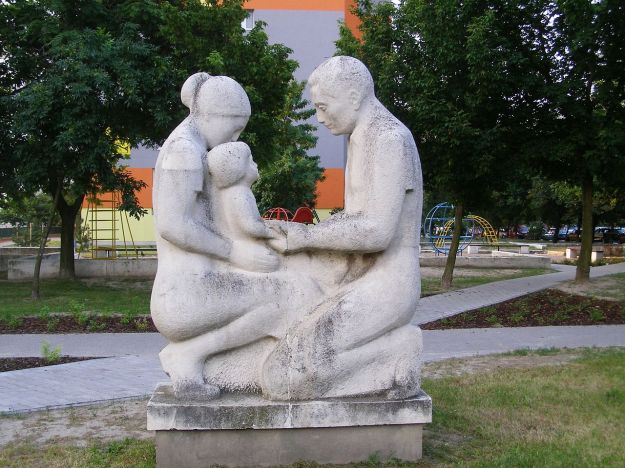
Parents with child statue, Hrobákova street, Petržalka, Bratislava By Kelovy – Own work, Public Domain, https://commons.wikimedia.org/w/index.php?curid=1622776

Psalm 128

A Song of Ascents.

1Happy is everyone who fears the LORD,
  who walks in his ways.
2
You shall eat the fruit of the labor of your hands;
  you shall be happy, and it shall go well with you.

3
Your wife will be like a fruitful vine
  within your house;
 your children will be like olive shoots
  around your table.
4
Thus shall the man be blessed
  who fears the LORD.

5
The LORD bless you from Zion.
  May you see the prosperity of Jerusalem
  all the days of your life.
6
May you see your children’s children.
  Peace be upon Israel!

Bolded words have notes on translation below.

In contrast to the individualistic ways that most people of the modern west conceptualize their world, for most ancient societies and religions the primary unit is not the individual but the family. A good life started with a prospering family and then extended to the prosperity of the city and then to the nation. This way of thinking is reflected in this psalm about a blessed life for a man, his family, Jerusalem, and all Israel. This is a wisdom psalm as the key word happy (Hebrew ‘asre) should alert us.[1] Psalms 127 and 128 share several frequently used wisdom words along with the conception that following the path of wisdom leads to a prosperous household.

Fearing the LORD and walking in the way of the LORD leads to happiness/contentment and enjoying the fruit of their labor. Ecclesiastes may believe that the labor/toil we do is vanity, but even Ecclesiastes can state:

There is nothing better for mortals than to eat and drink and find enjoyment in their toil. This also, I saw, is from the hand of God, for apart from him who can eat or who can have enjoyment? For to the one who pleases him God gives wisdom and knowledge and joy, but to the sinner he gives the work of gathering and heaping, only to give to one who pleases God. This also is vanity and a chasing after wind. Ecclesiastes 2: 24-26

The contentment is not merely for the man (literally mighty one, Hebrew gibbor)[2] but for the entire household. Grape vines and olive trees are two of the critical agricultural products of Israel. The metaphorical linking of the fruitfulness of the land to the wife (or wives) and children of the man coincides with the view that children are a sign of blessing and barrenness is a sign of disfavor.

The blessing of this ‘mighty one’ and their family now is extended to Jerusalem and Israel. Jerusalem is the place where the temple of the LORD resides and where the hoped for blessing would originate from on earth, and the psalmist desires to hearer to see the prosperity (Hebrew tob, literally goodness) of the city throughout their life. Seeing grandchildren is a sign of old age acquired and a family which continues to grow. The psalm ends with the desire of peace (shalom) resting on Israel. The man (mighty one) has received a blessed life for himself, his family, and for his society.

Psalm 128 shares a common worldview with Martin Luther’s explanation of the first commandment as, “We are to fear, love, and trust God above all things.” Fearing the LORD and walking in the ways of the LORD in biblical thought leads to prosperity. There are righteous people who suffer, who may be barren, and the wicked do sometimes prosper, but for the psalms the belief that God will provide for the faithful is fundamental. The stated blessing in this psalm echoes the idea of peace represented in the words of the prophet Micah:

but they shall all sit under their own vines and under their own fig trees, and no one shall make them afraid, for the mouth of the Lord of hosts has spoken. Micah 4:4

It sharply contrasts with the judgment on Cain in Genesis 4:

And now you are cursed from the ground, which has opened its mouth to receive your brother’s blood from your hand.When you till the ground, it will no longer yield to you its strength; you will be a fugitive and a wanderer on the earth.” Cain said to the Lord, “My punishment is greater than I can bear! Today you have driven me away from the soil, and I shall be hidden from your face; I shall be a fugitive and a wanderer on the earth, and anyone who meets me may kill me.” Genesis 4: 11-14

At a fundamental level what the scriptures consider wisdom is simple: fearing the LORD and walking in his ways. Following this path entrusts one’s life, one’s family, and one’s society into the hands of God. The faithful one’s throughout the Jewish and Christian story have entrusted God can care for their life, their family and the world around them.


[1] The Hebrew ‘asre is frequently an indicator of wisdom literature. We may not think of happy or blessed in this way, but for Hebrew writers this is a common word when talking about the path of wisdom. Wisdom writers can interchange the idea of happiness and wisdom, see for example the way Psalm 110:10; Proverbs 1:7; 9:10 can pair wisdom with the fear of the LORD. Walter Brueggemann and William Bellinger, Jr. say of ‘asre, “The term introduces an observation about living: one who walks or lives in ways in line with YHWH’s purposes find wholeness. (Bellinger, 2014, p. 545)

[2] Hebrew gibbor which can refer to physical strength or the economic strength to equip oneself and a group for combat. Ruth 4:11 uses this term for economic ability in reference to Boaz.
Psalm 49 Wealth, Wisdom and Death

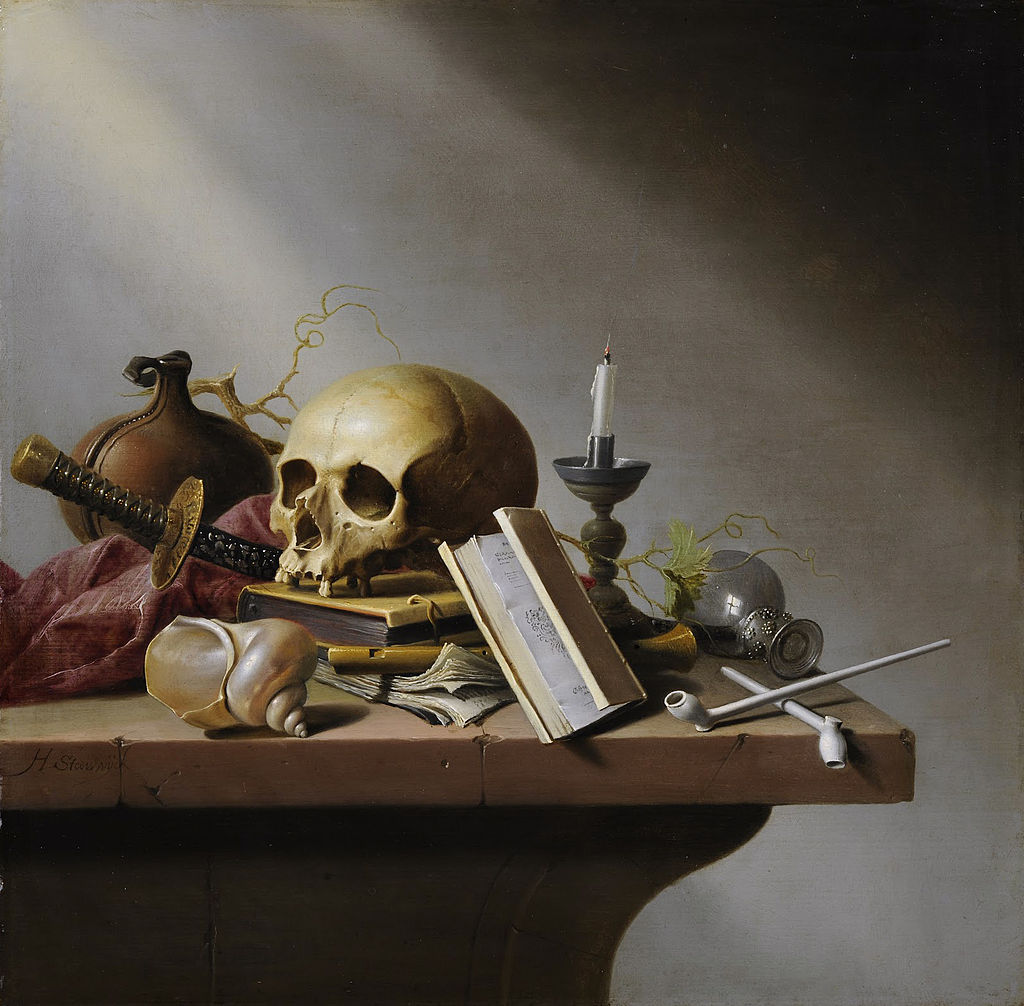
Harmen Steenwijck, Vanitas (1640)

Psalm 49

<To the leader. Of the Korahites. A Psalm.>
1 Hear this, all you peoples; give ear, all inhabitants of the world,
2 both low and high, rich and poor together.
3 My mouth shall speak wisdom; the meditation of my heart shall be understanding.
4 I will incline my ear to a proverb; I will solve my riddle to the music of the harp.
5 Why should I fear in times of trouble, when the iniquity of my persecutors surrounds me,
6 those who trust in their wealth and boast of the abundance of their riches?
7 Truly, no ransom avails for one’s life, there is no price one can give to God for it.
8 For the ransom of life is costly, and can never suffice
9 that one should live on forever and never see the grave.
10 When we look at the wise, they die; fool and dolt perish together and leave their wealth to others.
11 Their graves are their homes forever, their dwelling places to all generations, though they named lands their own.
12 Mortals cannot abide in their pomp; they are like the animals that perish.
13 Such is the fate of the foolhardy, the end of those who are pleased with their lot. Selah
14 Like sheep they are appointed for Sheol; Death shall be their shepherd; straight to the grave they descend, and their form shall waste away; Sheol shall be their home.
15 But God will ransom my soul from the power of Sheol, for he will receive me. Selah
16 Do not be afraid when some become rich, when the wealth of their houses increases.
17 For when they die they will carry nothing away; their wealth will not go down after them.
18 Though in their lifetime they count themselves happy — for you are praised when you do well for yourself —
19 they will go to the company of their ancestors, who will never again see the light.
20 Mortals cannot abide in their pomp; they are like the animals that perish.

Psalm 49 takes on the tone of wisdom literature like the book of Proverbs or Ecclesiastes and engages the topic of wealth in relation to death. The poet believes there is a moral order to the universe that the righteous and unrighteous, the rich and the poor, the wise and the foolish live within. The simple belief that those who do good will prosper and those who are evil will see their ambitions thwarted may not be observed in the daily experience of the psalmist, but death becomes the ransom that no amount of wealth can cover. We are taken into the riddle of: Why should one fear in times of trouble when powerful and presumably wealthy persecutors oppress the righteous one? For the author of the psalm there is comfort in the knowledge that the rich cannot buy their way out of Sheol and that the moral order of God’s universe remains intact.

Humans fear death and we spend an incredible amount of our wealth in the United States attempting to avoid succumbing to death. Even though Christians believe in the resurrection of the dead, many still approach their death with apprehension. To quote a Kenny Chesney song, “Everybody wants to go to heaven…But nobody wanna go now.” But even with all the advances in medical technology and the amount of money that is spent to prolong life being wealthy cannot grant immortality. The idea of being able to secure one’s life through wealth has been explored in futuristic dystopian imaginations, like the 2011 movie In Time, where the poor have their life shortened and the rich have their life extended at the expense of the poor or Jupiter Ascending (2015) where entire worlds are populated so that they can be harvested to provide extended life for the galaxy’s wealthiest clients. In many ways the moral imagination of these dystopian worlds models the economic imagination of Egypt in the Exodus and any society that viewed people as a commodity and wealth as a privilege of a small elite. If wealth were able to ensure immortality fear would drive many to acquire this ransom from death at any cost but thankfully, as I wrote when discussing Ecclesiastes 2, “mortality is the great equalizer in all its unfairness.” Yet, for the psalmist’s moral universe mortality is the great equalizer for, as they are considering it, death is the shepherd which God uses to ensure that those who are materially wealthy and politically powerful do not forever hold power over the righteous ones.

Within the worldview of the psalms the conception of heaven or hell as places that people go in the afterlife has not developed and as we saw in Psalm 6 the conception of Sheol as a place where the dead go is not a place of reward or punishment but simply a place outside of the realm of the living. When the author speaks of God ransoming their soul from Sheol it is trusting that God will not let them die at this point while their persecutors prosper, but instead that the moral order of God’s promises will ensure that their life endures but the life of the wealthy persecutors will reach its end without God’s intervention on their behalf. The God of Israel is a God who intervenes in the life of the faithful to ensure that they are not destroyed, and that God’s promises bear fruit in their lives.

This final Korahite psalm of Book II (Psalms 42-49) is an example of a reflection on situational wisdom. The psalms are more poetry than systematic theology and combine emotion with logic and faith to attempt to discern an answer to the world as the authors of these songs encounter them. Looking at the world from the perspective of one undergoing persecution by a wealthy and powerful oppressor, the psalmist can see death as God’s equalizer. Illness, weakness and impending death in psalms of lament are all brought before God as things that are being unfairly born by the righteous one. But the wisdom of the book of psalms is bringing all these pieces of situational wisdom, cries of lament, praises of joy, love songs and meditations together into a collection of psalms which address the breadth of human emotion and experience.