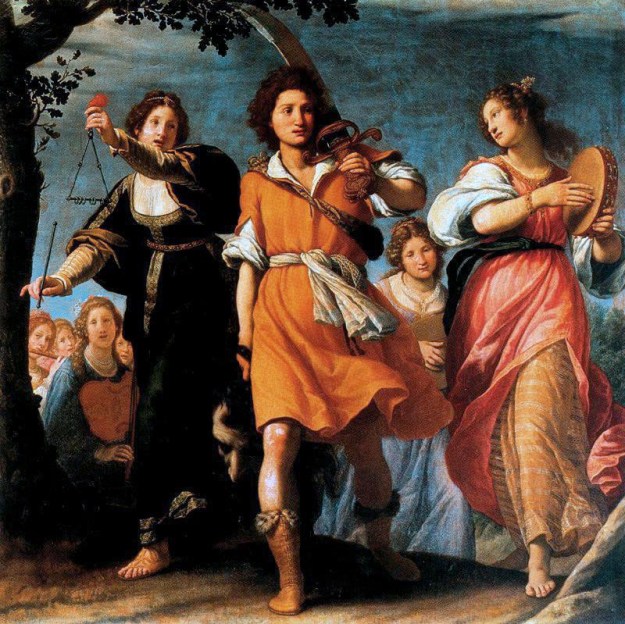
King David, the King of Israel by Gerard van Honthorst
Psalm 140
To the leader. A Psalm of David.
1Deliver me, O LORD, from evildoers[1]; protect me from those who are violent, 2who plan evil things in their minds and stir up wars continually. 3They make their tongue sharp as a snake’s, and under their lips is the venom of vipers. Selah
4Guard me, O LORD, from the hands of the wicked; protect me from the violent who have planned my downfall. 5The arrogant have hidden a trap for me, and with cords they have spread a net, along the road they have set snares for me. Selah
6I say to the LORD, “You are my God; give ear, O LORD, to the voice of my supplications.” 7O LORD, my Lord, my strong deliverer, you have covered my head in the day of battle. 8Do not grant, O LORD, the desires of the wicked; do not further their evil plot. Selah
9Those who surround me lift up their heads; let the mischief of their lips overwhelm them! 10Let burning coals fall on them! Let them be flung into pits, no more to rise! 11Do not let the slanderer be established in the land; let evil speedily hunt down the violent!
12I know that the LORD maintains the cause of the needy and executes justice for the poor. 13Surely the righteous shall give thanks to your name; the upright shall live in your presence.
Psalm 140 is the poetic prayer of an individual asking God to deliver them from violent adversaries. The Hebrew of the poem divides into four roughly equal parts (divided by the word selah) with a closing statement of trust.[2] The first two sections use the metaphors of venomous snakes, warfare, and hunting to describe the actions of the violent ones to the God who can deliver the psalmist. The central section turns away from the violent ones to the God who delivers the psalmist in the midst of battle. The fourth section asks for God’s judgment on these evil and violent opponents before the final two verses again return to the God who maintains the cause of the needy.
The enemies are identified only as evildoers, violent, and wicked. Although the psalmist utilizes the metaphor of warfare it is likely that the enemies’ actions may be primarily verbal with the focus on the tongue and lips in the serpent imagery and the hiding of traps for a hunter. That does not mean that the threat is not ominous. The enemies may be attempting to ensnare the psalmist through their word games in court or poison their reputation. These violent ones are stirring up conflict and evil, planning the downfall and entrapment of the faithful psalmist.
God is named at the beginning of each of the first two sections, but in the central section the name of God is called out four times.[3] The LORD is the psalmists God, and then the psalmist asks their God to hear their supplications. The word translated supplications comes from the verbal root hanan which is translated “showing favor” in Psalms 111, 112, and 123 and is part of the self-description of God in Exodus 34:6. The psalmist declares their allegiance to their God and God’s description of Godself before returning to the military metaphors where God clothes them for battle and delivers them. The psalmist closes this section by appealing to God to not grant the desires of the wicked, but instead to hear the appeals of the righteous one.
In the fourth section returns to the enemies that have risen against the psalmist. This section again returns to the verbal themes with the mischief of the lips being turned against those who speak violently against the psalmist. Now the psalmist asks God to judge them with burning coals, falling into the pit. Ultimately the psalmist asks that evil would hunt down these violent, wicked ones. As with all cries to God to judge the enemy, the enemy resides in God’s hands and not the psalmist.
The psalmist closes with a note of trust which calls again on God as the one who protects the needy and poor. The psalmist trusts that their current situation where the wicked and violent successfully oppress the righteous will not last. God hears the cry of the vulnerable and defends them. God will not allow the wicked to prosper indefinitely. The psalmist looks forward to the day when they can give thanks to the LORD for the way God has delivered them from this moment of trouble.
[1] “The Hebrew word is ‘ra, most often translated as “evil.” The word “evil” in English carries an ethical, moral tone that, while appropriate for Ps. 140, is probably not as appropriate as malicious, which means, “having, shown, or cause by malice; spiteful; intentionally mischievous or harmful.”” (Nancy deClaisse-Walford, 2014, p. 968)
[2] Clifford Allen noted that verses 1-3 contain twenty-three Hebrew words, ending with selah; verses 4-5 contain twenty-three words, ending with selah; verses 6-8 contain twenty-four words, ending with selah; verses 9-11 contain twenty-three words with verses 12-13 as a closing statement of trust. (Nancy deClaisse-Walford, 2014, p. 967)
[3] In English translations the capitalized LORD indicates that the four letters of the divine name are behind the translation (YHWH) with vowel markings indicating it is to be spoken as Adonai (Lord). In verse seven the second Lord is the Hebrew Adonai.
1O Lord, you have searched me and known me. 2You know when I sit down and when I rise up; you discern my thoughts from far away. 3You search out my path and my lying down and are acquainted with all my ways. 4Even before a word is on my tongue, O Lord, you know it completely. 5You hem me in, behind and before, and lay your hand upon me. 6Such knowledge is too wonderful for me; it is so high that I cannot attain it.
7Where can I go from your spirit? Or where can I flee from your presence? 8If I ascend to heaven, you are there; if I make my bed in Sheol, you are there. 9If I take the wings of the morning and settle at the farthest limits of the sea, 10even there your hand shall lead me, and your right hand shall hold me fast. 11If I say, “Surely the darkness shall cover me, and night wraps itself around me,” 12even the darkness is not dark to you; the night is as bright as the day, for darkness is as light to you.
13For it was you who formed my inward parts; you knit me together in my mother’s womb. 14I praise you, for I am fearfully and wonderfully made. Wonderful are your works; that I know very well. 15My frame was not hidden from you, when I was being made in secret, intricately woven in the depths of the earth. 16Your eyes beheld my unformed substance. In your book were written all the days that were formed for me, when none of them as yet existed. 17How weighty to me are your thoughts, O God! How vast is the sum of them! 18I try to count them—they are more than the sand; I come to the end—I am still with you.
19O that you would kill the wicked, O God, and that the bloodthirsty would depart from me— 20those who speak of you maliciously and lift themselves up against you for evil! 21Do I not hate those who hate you, O Lord? And do I not loathe those who rise up against you? 22I hate them with perfect hatred; I count them my enemies. 23Search me, O God, and know my heart; test me and know my thoughts. 24See if there is any wicked way in me, and lead me in the way everlasting.
Psalm 139 is a paradox. The first eighteen verses in poetic and beautiful imagery describe the psalmists experience of being fully known by God. The language of the final six verses describes the psalmist’s reaction to the jarring reality that there are many who oppose the ways of God. Many readers of this psalm are surprised at the sudden change from the sense of wonder and awe in the first three stanzas of the psalm to the imprecatory voice of the final stanza. Most readers may be familiar with the first eighteen verses while the final six will rarely appear in the worship of most churches. Some scholars feel that these verses were later added into the beautiful and comforting message of God’s full knowledge and encompassing of the speaker, but I feel the psalm makes sense as we have received it as I will share below.
A key word in this psalm is “known/knowledge” which occurs seven times (vv. 1-2, 4, 6, 14, 23 twice) and while the seven occurrences may be random, Hebrew poetry like to utilize numerical occurrence to make a point. Seven is traditionally a number of completeness. So, in addition to the thematic complete knowledge of God it may also be structurally reinforcing this message. (NIB IV: 1235) The verbs attributed to God including “know,” “search,” and “test” often appear in imagery when God is described as a judge, and this image of God is often used when one is calling on God for intervention or help. (Mays, 1994, pp. 426-427) Throughout the psalm the psalmist wrestles with the reality that they are known, searched, and tested completely by God and yet the wicked ones who resist God’s way still endure and God is called to judge these ones who the psalmist ‘hates’ (see below).
In the first stanza God knows the psalmist’s thoughts, words, and actions completely. Whether the psalmist is coming or going, waking or sleeping, standing or sitting, God knows their path, their thoughts, and even the words that have not left their mouth. They live their life surrounded by God’s presence and comforted by God’s touch. They respond in an appropriate sense of awe and wonder that the God who created the heavens and the earth can know them. The psalm is not interested in constructing a doctrine of omnipotence and omnipresence but instead deploys its language to try to express their wonder that God knows them, comforts them, is present with them and protects them.
The second stanza continues the wonder at God’s presence throughout the creation. The most surprising line of this stanza is that the psalmist includes God’s presence in Sheol, a place in other psalms where people are cut off from God’s hand (Psalm 88). Yet, for the psalmist even this place where God had been thought absent God is present. Heaven to Sheol, from the rising sun to the farthest edges of the sea, and even in the darkest night they are seen and known by God. There is nowhere in all creation, the heavens, the earth and under the earth, where they can escape God’s spirit or God’s sight. For the psalmist this is an awe-inspiring reality but primarily in a comforting rather than an ominous sense.
The third stanza turns the reflections to God’s deep involvement throughout the duration of their life. The beautiful language of God knitting the psalmist together in their mother’s womb, shaping and forming them for their life in God’s presence and protection. They wonder at their body and mind created by the hand of God and the days of their life are numbered according to God’s plan. The psalmist is less concerned with an idea or predestination than poetically describing the wonder at their life shaped by God’s hands and lived within God’s presence.
It may be a paradox, but for me the first three stanzas set up the final stanza. The psalmist looks upon God’s active presence in their own life and experience and then turns outward to the world where injustice and wickedness persist. The language does not seem to indicate that the psalmist is personally under threat or attack but instead seems to be broken-hearted by the ways in which others are treating God and God’s commandments. They are heartsick by the idolatry and injustice they see at work in the world and they call upon the God who is profoundly present throughout their life to extend that presence throughout the world and judge the wicked and those who oppose God’s ways. The language of ‘kill’ and ‘hate’ are jarring to our ears. The word translated ‘hate’ (Hebrew sane’) refers to an emotional aversion to something or someone. (Nancy deClaisse-Walford, 2014, p. 966) Throughout the psalms and wisdom literature in the bible the wicked pose a threat, leading astray others from following God’s way and threatening the peace of the society. The psalmist in their own way is calling on God for God’s will to be done on earth. The God who is present throughout the life of the psalmist and whose spirit is present throughout the world is asked to judge the earth and be as deeply involved throughout the creation as they perceive God being within their own life. Like the other psalms calling on God to judge an enemy, the enemy is committed into God’s hands. Yet the psalmist joins those throughout the generations calling upon God to establish God’s justice on earth and to heal the society from the damage done by the wicked, the bloodthirsty, those who speak maliciously, and who rise up against God.
1I give you thanks, O LORD, with my whole heart; before the gods I sing your praise; 2I bow down toward your holy temple and give thanks to your name for your steadfast love and your faithfulness, for you have exalted your name and your word above everything. 3On the day I called, you answered me; you increased my strength of soul.
4All the kings of the earth shall praise you, O LORD, for they have heard the words of your mouth. 5They shall sing of the ways of the LORD, for great is the glory of the LORD. 6For though the LORD is high, he regards the lowly, but the haughty he perceives from far away.
7Though I walk in the midst of trouble, you preserve me against the wrath of my enemies; you stretch out your hand, and your right hand delivers me. 8The Lord will fulfill his purpose for me; your steadfast love, O LORD, endures forever. Do not forsake the work of your hands.
Psalm 138 utilizes themes common throughout the book of Psalms as it thanks and praises the God the psalmist follows with their whole heart. To follow the LORD with one’s whole heart is not merely a matter of belief but also behavior. The heart in Hebrew thought is not the seat of emotion but the seat of will and intention. The first stanza of the psalm begins with the heart, the seat of will and intention, and ends with the nephesh (NRSVue soul) which is the center or essence of life and being. ‘Heart’ and ‘soul’ they give thanks, sing praise, bow down, and call upon the LORD their God.
This psalm, like many portions of the Hebrew Scriptures, are not monotheistic as we conceive, but view the LORD the God of Israel as the God above all gods. In the midst of a pluralistic world where others worship other gods the psalmist sings the praise of the God above all gods. This God whose name[1] and ‘word’[2] are exalted above everything is the God worthy of thanks, praise and bowing down to. The LORD is known by the central descriptions of God’s characters: ‘steadfast love’ (hesed)[3] and faithfulness (‘emet). The LORD is a God who answers when the psalmist calls and they are strengthened in courage and ‘strength of soul’ in response.
The praise of the LORD expands from the psalmist in the first stanza to ‘all the kings of the earth’ in the second. The ‘words’ of the LORD have now spread to the nations and these mighty one join the psalmist in singing of the glory of God. Throughout the psalms there have been times when the praise of God has been echoed throughout the creation but here the emphasis is on the nations not only praising the glory and power of the LORD but also the ways of the LORD. Central to the way of the LORD is the care of the lowly who God regards. The mighty and haughty may find themselves distant from God but the lowly and vulnerable are seen and protected by God. The kings of the earth in honoring the ways of God would also turn to practices which protect the vulnerable and lowly.
Even though the psalmist appears to be delivered in the first stanza, the final stanza returns to God protecting them in the midst of trouble. Thematically this stanza is similar to Psalm 23 preserving the faithful one in the midst of trouble and delivering them from their enemies. The hand of the LORD is a central feature to these final two verses, appearing three times. The psalmist is the work of the hands of God but also asks God to stretch out the hand in protection and deliver with the right hand. The LORD fulfills God’s purposes, and the psalmist echoes the refrain of Psalm 136 ‘your steadfast love, O LORD, endures forever.’ J. Clinton McCann Jr. summarizes the psalm nicely when he states:
The psalmist is able to present his or her whole life to God, because the psalmist trust that it is God’s character to manifest “steadfast love” (hesed) and “faithfulness” (‘emet). (NIB IV: 1232)
The psalmist’s wholehearted and embodied thanks, praise and worship points to a future reality when all the king and nations of the earth join in the celebration of the ways of God. They entrust themselves to the God of steadfast love and faithfulness who walks with them in the midst of trouble.
[1] The name of the LORD is a central idea in Hebrew thought and lies behind the commandment on honoring God’s name and keeping it holy. The temple, for example, is ‘a house built for the name of the LORD.’ The name of the LORD can refer to the presence of God but with the understanding that all the earth cannot contain the presence of the LORD.
[2] The Hebrew term for ‘word’ throughout this psalm is not the normal debar but instead from the verbal root ‘amar. Nancy deClaissé-Walford indicates this is more of an emphasis on voicing of the word and perhaps ‘sayings’ is a more accurate translation of this less common word. (Nancy deClaisse-Walford, 2014, p. 960)
[3] For more about the hesed of God see my comments on Psalm 136.
By the Waters of Babylon, painting by Arthur Hacker, c. 1888
Psalm 137
1By the rivers of Babylon— there we sat down, and there we wept when we remembered Zion. 2On the willows there we hung up our harps. 3For there our captors asked us for songs, and our tormentors asked for mirth, saying, “Sing us one of the songs of Zion!”
4How could we sing the LORD’s song in a foreign land? 5If I forget you, O Jerusalem, let my right hand wither![1] 6Let my tongue cling to the roof of my mouth, if I do not remember you, if I do not set Jerusalem above my highest joy.
7Remember, O LORD, against the Edomites the day of Jerusalem’s fall, how they said, “Tear it down! Tear it down! Down to its foundations!” 8O daughter Babylon, you devastator! Happy shall they be who pay you back what you have done to us! 9Happy shall they be who take your little ones and dash them against the rock!
The deportation to Babylon is one of the pivotal events in the story of the Jewish people. The Deuteronomic history (Joshua, Judges, 1&2 Samuel and 1&2 Kings) ends with exile as does the retelling of the story of Israel and Judah by the author of 1&2 Chronicles. Two of the three major prophets, Jeremiah and Ezekiel, have their ministries in the time immediately before and after the final deportation.[2] The Gospel of Matthew when it organizes the genealogy of Jesus breaks the second and third groups of generations at the deportation to Babylon. There are pre-exilic experiences of Judaism and post-exilic experiences and scholars often divide texts into pre-exilic and post-exilic texts. The loss of the Davidic king, the city of Jerusalem, the temple destroys many of the central features of Jewish life and requires a reorganization for the people of their identity and their faith. Psalm 137 taps into the grief, confusion, anger, and desire for revenge of the refugees of Jerusalem arriving at the rivers of Babylon crying out their jagged words to God through their tears.
Zion, the destination of the Songs of Ascent (Psalms 120-134), is a smoldering ruin. The songs of Zion, like Psalm 46 and 48, were full of a confidence that God was in the midst of the city and would defend it from harm by breaking bows, shattering spears, and burning shields (Psalm 46: 9). Yet the prophet Ezekiel declared that God has departed the temple and the city because of the idolatry of the people (Ezekiel 10). The city of peace (Yeru-shalom) has become the casualty of war, and the survivors of the siege and deportation sit as strangers in the land of their enemy grieving their loss, questioning their future, resisting their captor’s taunts, and shedding tears as they remember their lost home. There are no songs of mirth that can come from the heavy hearts of these grieving and shattered people. Their captors may taunt them desiring to hear their songs of Zion where the God of Israel promised to defend the city so they can mock the absence of their God, and so they hang their harps on the willow trees and no songs of joy and praise are able to emerge from the broken hearts of the captive people.
The people are committing themselves to ‘never forget’ the city and what occurred there. They may eventually have to settle down and make their home by the rivers of Babylon, but they can no more forget Jerusalem than their right hand. If they forget Jerusalem, they ask to lose their power to act and speak. Looking at this poem through the lens of Elisabeth Kübler-Ross’s stages of grief the first six verses rest within the space of depression but in verse seven they turn to anger.
Psalm 137 is an imprecatory psalm, like Psalm 58 and 109, and it will probably not make its way into the worship bulletins or the sermons of many churches, but it has something to teach us. This is the language of the broken heart crying out in its pain against those who have wounded it. There is a reason that Jeremiah and Ezekiel spend so much ink crying for revenge against those who participated in the destruction of Jerusalem (Jeremiah 46-51, Ezekiel 24-32). Jeremiah’s harshest words are directed to Babylon (Jeremiah 50-51) while Jeremiah, Ezekiel, and Obadiah (Jeremiah 49: 7-11; Ezekiel 25: 8-11; 35; Obadiah 10-14) bear witness to the betrayal of Edom.[3]
Nancy deClaissé-Walford speaks about revenge by saying:
The basic human desire for revenge when we or those we love have been wronged. God does not ask us to suppress these emotions, but rather to speak about them in plain and heartfelt terms. (Nancy deClaisse-Walford, 2014, p. 957)
Yet I suspect that many people of faith would be troubled by the graphic and violent language that the people call for against their enemies. It is only in this psalm that the Hebrew asre (NRSVue ‘happy’), so often an indicator of wisdom literature, is deployed to call for violence against one’s enemies. It is easy for those who have lived in peace to find the language of killing the children of one’s enemies repulsive but it is likely that these survivors saw their own children die of starvation during the siege, brutality during the conquest of the city, or abused and killed on their journey to Babylon. Their red-hot anger is an honest if uncomfortable emotion. A traumatized people call for their oppressors to experience what they have experienced, and rather than suppressing those feelings they exclaim them to God in plain and heartfelt terms. They may wonder if God hears their cries any longer but they have no other place to direct their raw rage about a world that no longer makes sense, where their children endured starvation, death, brutality, and trauma.
Miroslav Volf relates a story recorded by Željko Vukovic from the conflict between the Serbs and Croats in Bosnia.
I am a Muslim, and I am thirty five years old. To my second son who was just born, I gave the name “Jihad.” So he would not forget the testament of his mother—revenge. The first time I put my baby at the breast I told him, “May this milk choke you if you forget.” So be it. The Serbs taught me to hate. For the last two months there was nothing in me. No pain, no bitterness. Only hatred. I taught these children to love. I did. I am a teacher of literature. I was born in Ilijaś and I almost died there. My student, Zoran, the only son of my neighbor, urinated into my mouth. As the bearded hooligans standing around laughed, he told me: “You are good for nothing else, you stinking Muslim woman…” I do not know whether I first heard the cry of felt the blow. My former colleague, a teacher of physics, was yelling like mad, “Ustasha, ustasha…”And kept hitting me. Wherever he could. I have become insensitive to pain. But my soul it hurts. I taught them to love and all the while they were making preparations to destroy everything that is not of the Orthodox faith. Jihad—war. This is the only way… ” (Volf, 1996, p. 111)
Thankfully most of us have never experienced the level of degradation and dehumanization expressed by this Muslim woman or by these Jewish survivors, but the rage and the anger will go somewhere. It can be handed on as an inheritance over the generations, as is done by this mother who names her son Jihad and continues among the Jewish people in their desire to never again find themselves enduring another Holocaust, or it can be lifted up in imprecatory cries to God like in this psalm.
Ellen Davis’s chapter on the cursing psalms in Getting Involved with God: Rediscovering the Old Testament (Davis, 2001, pp. 23-29) has been influential on my thinking about the imprecatory psalms, like this one. She proposes three possible uses for psalms like this one when we are angry, and one, if we have the courage to encounter these words when we are not. First, they can give us words to wrap around our anger when we are not able to find adequate words on our own. She shares the advice a professor once gave her after a betrayal, “Go into the chapel when no one else is around and shout these at the top of your lungs.” This practice allowed her to both vent and release the anger but hearing herself speak these words she also could hear the self-righteousness and pettiness in her petitions. Secondly, the psalms function as divinely given ‘counselors’ and teach us that vengeful anger is one mode of access to God. We can come to know that God who created us for life together is also outraged by those who destroy community or deny justice. Thirdly, the cry is a cry for God to act which allows the petitioner to bypass acting personally against the one who harmed us. We demand our enemy be driven into God’s hands, but we are not in control of what happens there or how God brings about this justice and reconciliation. Finally, she suggests if we are reading when we feel none of the feelings in the psalm to turn it around and to ask if there is anyone in the community or among God’s people who may want to pray these words about me? (Davis 2001, 26-29)
My prayer is that no one reading these words ever encounters the dehumanizing experiences which call into question their identity and their faith like these refugees remembering Zion by the rivers of Babylon, mourning the loss of their homes, their neighbors, their society, and likely their children. Yet at some point we all know the desire for revenge on those who have wounded us and those we love. Many will encounter events which reshape their identity and may challenge their faith. Others will long for a home and a safety that no longer exist. They may not be able to sing the songs of their God with a heavy heart, at least not the ones full of praise and joy. At that point the jagged words of Psalm 58, 109, and 137 may be closer to the words their hearts need to speak as they grieve, question, and wrestle. They may need to know that this space of heartbrokenness and rage where they wish for vengeance on those who caused the pain is not a space they need to hide from God, but instead people of faith for millennia have voiced these words calling for judgment but entrusting vengeance to the Lord. They can no more forget the object of their grief than their right hand nor may they be able to speak of anything else in this moment of pain. Yet God’s people trust that God hears the words of these refugees from the world they knew, when they were safe and loved before that world collapsed around them and that God can lead them beyond this moment. They may long with Isaiah for a time when the tears of this moment are wiped away and the death causing action on this world cease:
And he will destroy on this mountain the shroud that is cast over all peoples, the covering that is spread over all nations;he will swallow up death forever. Then the Lord God will wipe away the tears from all faces, and the disgrace of his people he will take away from all the earth, for the Lord has spoken. Isaiah 25: 7-8
[1] Hebrew literally: “If I forget Jerusalem, forget my right (hand).”
[2] There are two deportations under Babylon. The initial deportation (598/597 BCE) takes the king (Jehoiakim) and many of the leaders, artisans, priests, and other elites of the land. The prophet Ezekiel is one of those taken into exile with this initial group and his declarations come from this space in the exile. The prophet Jeremiah is still with the remnant in Jerusalem. Those left behind rebel against Babylon and in 586 BCE after a crippling siege the city wall is broken down, the temple and city destroyed, and much of the remnant is taken into exile in Babylon. For more detail see my post on the Babylonian Empire.
[3] Edom is one of the nations who met with King Zedekiah in Jerusalem (Jeremiah 27:3). It is likely that these kings were negotiating a defensive alliance against Babylon, but when Babylon besieges Jerusalem Edom seizes the opportunity to participate in the destruction and pillaging of their neighbor.
Book 52: Lord of the Flies by William Golding (1954)
This is a series of reflections reading through Time Magazine’s top 100 novels as selected by Lev Grossman and Richard Lacayo published since 1923 (when Time magazine was founded). For me this is an attempt to broaden my exposure to authors I may not encounter otherwise, especially as a person who was not a liberal arts major in college. Time’s list is alphabetical, so I decided to read through in a random order, and I plan to write a short reflection on each novel.
The Lord of the Flies is a novel I encountered in either late middle school or early high school as required reading and reread now as an adult. The novel follows a group of boys who crash on an island during a war, perhaps even a nuclear war, and find themselves alone and isolated from society. The novel is an exploration of the darkness of the human, particularly male, heart when isolated from the civilizing influence of society. The rules on the island quickly breakdown when Ralph, the boy initially selected by the boys as chief, is unable to maintain control over both the hunters, led by Jack, and the little ones who tend to do their own thing. Eventually Jack and his hunters continue to devolve into a violent and savage tribe that results in the death of two of the boys and the story ends with their hunt of Ralph before an officer of the Royal Navy arrives on the island to rescue the boys.
The Lord of the Flies is a story about children, but it also exhibits the author’s low view of humanity apart from the civilizing restraint of law and order. It might be this book’s place within the assigned reading of my childhood, but this felt like a book you were supposed to read and not enjoy. It felt like the theme of the book was more important than the characters. While there are some cleverly written plot ideas in the book, like the alluding to biblical language with the Beast from the Sea and the Beast of the Air or the Lord of the Flies, it just felt like the narration and dialogue fell flat. The individual children were more types than developed characters: Ralph was the somewhat slow protagonist, Piggy the overweight, asthmatic scared know it all, Simon the introverted and spiritual one, Jack the bully always needing to be right. It probably didn’t help that I listened to the audiobook version read by the author, and the author’s narration did not help the story.
1O give thanks to the Lord, for he is good, for his steadfast love endures forever. 2O give thanks to the God of gods, for his steadfast love endures forever. 3O give thanks to the Lord of lords, for his steadfast love endures forever;
4who alone does great wonders, for his steadfast love endures forever; 5who by understanding made the heavens, for his steadfast love endures forever; 6who spread out the earth on the waters, for his steadfast love endures forever; 7who made the great lights, for his steadfast love endures forever; 8the sun to rule over the day, for his steadfast love endures forever; 9the moon and stars to rule over the night, for his steadfast love endures forever;
10who struck Egypt through their firstborn, for his steadfast love endures forever; 11and brought Israel out from among them, for his steadfast love endures forever; 12with a strong hand and an outstretched arm, for his steadfast love endures forever; 13who divided the Red Sea in two, for his steadfast love endures forever; 14and made Israel pass through the midst of it, for his steadfast love endures forever; 15but overthrew Pharaoh and his army in the Red Sea, for his steadfast love endures forever; 16who led his people through the wilderness, for his steadfast love endures forever; who made water flow from the rock, for his steadfast love endures forever; 17who struck down great kings, for his steadfast love endures forever; 18and killed famous kings, for his steadfast love endures forever; 19Sihon, king of the Amorites, for his steadfast love endures forever; 20and Og, king of Bashan, for his steadfast love endures forever; 21and gave their land as a heritage, for his steadfast love endures forever; 22a heritage to his servant Israel, for his steadfast love endures forever.
23It is he who remembered us in our low estate, for his steadfast love endures forever; 24and rescued us from our foes, for his steadfast love endures forever; 25who gives food to all flesh, for his steadfast love endures forever.
26O give thanks to the God of heaven, for his steadfast love endures forever.
There are words that we utilize all the time that are sometimes the hardest to define. The Hebrew word hesed (NRSVue “steadfast love”) is used 245 times in the Hebrew scriptures and 127 times in the Book of Psalms. (Nancy deClaisse-Walford, 2014, p. 948) But if you ask people who study the Old Testament/Hebrew Scriptures to define this word you will get a variety of ideas: steadfast love, covenant faithfulness, enduring commitment, or lovingkindness. What no one disagrees with is that hesed is a defining characteristic of God’s relationship with God’s people. It appears twice in Exodus 34: 1-10 when God declares who God will be in what is known as the thirteen attributes of God (frequently repeated or alluded to throughout the scriptures):
The Lord descended in the cloud and stood with him there and proclaimed the name, “The LORD.” The Lord passed before him and proclaimed, “The LORD, the LORD, a God merciful and gracious, slow to anger, and abounding in steadfast love and faithfulness,keeping steadfast love for the thousandth generation, forgiving iniquity and transgression and sin, yet by no means clearing the guilty, but visiting the iniquity of the parents upon the children and the children’s children to the third and the fourth generation.” Exodus 34:5-8.
But like love, this term is difficult to put limits and boundaries on. Arthur Green, a Jewish scholar defines hesed as “a free-flowing love that knows no bounds.” (Nancy deClaisse-Walford, 2014, p. 948) So perhaps trying to put limits and boundaries around the meaning of hesed is like trying to catch the wind, but it is constantly seen in action throughout the scriptures and particularly the psalms. In this psalm where refrain continually reminds us that “for his steadfast love endures forever” or as Nancy deClaissé-Walford renders the phrase, “because for all time is the LORD’s hesed.” (Nancy deClaisse-Walford, 2014, p. 950) I am a believer that love is as much a verb as it is a noun, and the pattern of this psalm which matches the story of God’s actions with the enduring quality of God’s hesed “makes it clear that hesed is action; the wonders are a performance of hesed.” (Mays, 1994, p. 420)
The structure of Psalm 136 lends itself to being utilized in liturgical use where the leader most likely spoke the first half while the worshippers responded with the repetitive second half of each verse as a refrain. As Nancy deClaissé-Walford notes:
The same refrain occurs in a number of liturgical passages in the Hebrew Bible (1 Chr. 16:34; 2 Chr. 5:13; 7:3; 20:21; Ezra 3:11) and in other psalms (106:1; 107:1; 118: 1-4; 100:5). (Nancy deClaisse-Walford, 2014, p. 948)
Most modern readers gloss over the refrain after the initial verses, but as Leslie C. Allen reminds us that this repetition in the congregation becomes, “the regular heartbeat of the congregational refrain.” (Nancy deClaisse-Walford, 2014, p. 951) Creation, exodus, the promised land, the provision of daily bread are all a part of the enduring hesed of the LORD the God of Israel.
Psalm 135 and 136 share common themes and language in expressing the praiseworthiness of the LORD. Psalm 136 only mentions the name of God in verse one, and throughout the rest of the psalm is referred to by titles (God of gods, Lord of lords) or by action. As in the previous psalm, creation and the exodus narrative are linked together. This linkage brings together Israel’s unique origin story where God chooses them with God’s purpose for the entirety of creation. As J. Clinton McCann, Jr. states it,
In other words, the story of Israel’s deliverance from Egypt (that is, from death) and entry into the land (that is life) is still the story of the fulfillment of God’s creational purposes. (NIB IV:1224-1225)
Israel was, through their covenantal faithfulness, to embody a way of living in harmony with God’s will for the world. The ways of Egypt and other kingdoms and empires throughout history that opposed God’s will would find out that this love of God is not sentimental but will resist the powers that work against the enduring hesed of God for the world and God’s people.
The psalm ends with God remembering the people in their low estate, rescuing them from their foes, and giving food to all flesh. That God’s provision of ‘daily bread’ is now linked to God’s incredible acts of hesed in the creation of the cosmos, the rescue from Egypt, and the overcoming of the barriers to reaching the promised land. Yet, the ending of this psalm and the content of Psalm 137 invites us to ponder the people of Israel at their lowest point: the beginning of the Babylonian exile. Even in this godforsaken moment the hesed of God is unending. In their low estate they are still remembered, God can and will rescue them from their foes and provide for them and all creation because the hesed of God endures forever. For that unending hesed they can give thanks to the God of heaven.
1Praise the LORD! Praise the name of the LORD; give praise, O servants of the LORD, 2you who stand in the house of the LORD, in the courts of the house of our God. 3Praise the LORD, for the LORD is good; sing to his name, for he is gracious. 4For the LORD has chosen Jacob for himself, Israel as his own possession.
5For I know that the LORD is great; our Lord is above all gods. 6Whatever the LORD pleases he does, in heaven and on earth, in the seas and all deeps. 7He it is who makes the clouds rise at the end of the earth; he makes lightnings for the rain and brings out the wind from his storehouses.
8He it was who struck down the firstborn of Egypt, both humans and animals; 9he sent signs and wonders into your midst, O Egypt, against Pharaoh and all his servants. 10He struck down many nations and killed mighty kings— 11Sihon, king of the Amorites, and Og, king of Bashan, and all the kingdoms of Canaan— 12and gave their land as a heritage, a heritage to his people Israel.
13Your name, O LORD, endures forever, your renown, O LORD, throughout all ages. 14For the LORD will vindicate his people and have compassion on his servants.
15The idols of the nations are silver and gold, the work of human hands. 16They have mouths, but they do not speak; they have eyes, but they do not see; 17they have ears, but they do not hear, a nose, but there is no breath in their mouths. 18Those who make them and all who trust them shall become like them.
19O house of Israel, bless the LORD! O house of Aaron, bless the LORD! 20O house of Levi, bless the LORD! You who fear the Lord, bless the LORD! 21Blessed be the LORD from Zion, he who resides in Jerusalem. Praise the LORD!
This song of praise contrasts the LORD the God of Israel who is over the heavens, the earth, and the seas, who humiliated Egypt and brought the people through the wilderness and into the promised land with the ineffectual idols worshipped by their neighbors. The imageless God of Israel who crafted creation is contrasted with these lifeless images which are the products of human hands. This song calling the people to praise echoes much of the themes and language of Psalm 115 and it may have built upon that psalm, but it plays on two central themes which permeate the psalms words about God: creation and the exodus.
Although Psalm 135 does not have the call and response structure of Psalm 136, its structure is designed for gathered worship assembly. The opening four verses and the final three verses have the priests and people declaring their allegiance to the LORD and against the idols of the nations while the center of the psalm acts like a recitation or sermon passing on central knowledge to the people about the LORD that they worship. Those gathered from Israel are called to praise the LORD who is good and has chosen this people as his possession from among the nations.
The LORD is good, but the LORD is also great. The God of Israel is the God of the heavens, the earth but also the sea with its depths. This is the God who answers to no one and who is capable of doing whatever God desires. The chaotic sea and the storms of the heavens are all within this God’s hands and all other gods are subordinate to the God of Israel. Israel does not live in a monotheistic world but a pluralistic one, but the great LORD of Israel who creates the heavens and the earth, the seas and the storms is subordinate to no other gods and certainly not to the idols of the nations. One of the primary Canaanite gods that the Israelites encountered was Baal, a storm god who tamed the chaotic seas, but now this psalm usurps the characteristics attributed by their neighbors to Baal for the LORD the God of Israel who makes clouds rise and makes the lightning and brings out the winds.[1]
There is for Israel the general knowledge of their God as the creator, but there is also the specific knowledge of the God who took them out of Egypt and led them to their place in the promised land. The LORD brought the signs and wonders against Pharoah and Egypt which culminated in the death of the firstborns (Exodus 7-12). This God journeyed with them through the wilderness and then when kings like King Sihon of the Amorites and King Og of Bashan marched out to resist them God fought for Israel (Numbers 21: 21-35) as well as driving out the people of Canaan (Joshua). Israel’s position within their land is a gift from their God. The God who can do whatever God pleases throughout creation chose to take the people from their slavery in Egypt into their heritage within the land of Israel.
As mentioned above, Israel lived in a polytheistic world not a monotheistic one. Israel was always tempted by the gods of the nations around them, and the retelling of Israel’s history is full of times where the idols of the nations were worshipped alongside of or instead of the God of Israel. The faithful continued to resist and deride the pointless worship of idols, and here these gods shaped by human hands with silver are gold may have a face, but there is no breath (ruach) within them. These images formed by people created in the image of God lack the animating force of life that only the LORD can give. Those whose hands and devotions turn away to these lifeless images of silver and gold become futile like them.
Like the pilgrims of the songs of ascent (Psalms 120-134) the people have gathered together to praise and bless the LORD. The house of Israel, the descendants of Aaron who serve as priests, the Levites who work in the house of the LORD, and all those who fear the LORD are called to bless the LORD. Zion is the place where the people gather to send up their blessings and praise because the LORD has chosen to dwell among them in the city of Jerusalem. They gather together to praise the living God unlike the inanimate idols of the nations. They send up blessings to the God who presides over creation and who brought God’s chosen people out of Egypt and to the promised land with mighty acts. They join with their brothers and sisters in the act of praising the LORD.
[1]Psalm 29 also recasts the language of the worship of a storm god to worship the LORD the God of Israel.
1Come, bless the LORD, all you servants of the LORD, who stand by night in the house of the LORD! 2Lift up your hands to the holy place, and bless the LORD. 3May the LORD, maker of heaven and earth, bless you from Zion.
Psalm 134 is the final song of ascent where the pilgrims have arrived at their destination, and they are invited to do what they came to Zion to do: praise the LORD. This short psalm is only twenty-four words in Hebrew, but five of those words are the name of God: YHWH (LORD)[1], another three are a title for God (maker of heaven and earth), and three more are the Hebrew verb barak (bless). In the first two verses God is the focus of the actions of praise and blessing as the pilgrims enter into the space of worship. In the final verse the direction is reversed as the pilgrims are sent forth with a blessing, presumably spoken by a priestly figure, as they leave Zion and return to their homes.
In the previous psalm, the unity of the people was celebrated as they came to their destination and now all the gathered ones are called to participate in the actions of blessing the LORD the God of Israel. The actions of the worship are kinetic involving the lifting up of their hands within the holy space, but barak originally meant “to kneel” and that may also be a posture of worship expected within the movement of the psalm. (NIB IV: 1217) The people have made the effort to journey to the house of the LORD, a holy place where God’s presence dwells, and now their actions are now a part of their offering of obedience, homage, and trust to their God.
Within the flow of worship there is a time to be gathered and a time to be sent. One of the actions of sending is a benediction, a final blessing. Within my congregation I typically utilize either a trinitarian benediction or the Aaronic benediction from Numbers 6: 22-26. The brief benediction, which ends Psalm 134, and by extension the songs of ascent, is designed for the pilgrims who have come to Zion but now must return to their own towns or nations. The benediction seeks the blessing of the LORD upon those pilgrims, and wherever they go they are in the dominion of the maker of heaven and earth, yet the blessing emanates from this holy space in Zion where God’s presence rests. They came to this place to offer their blessing and worship to their God, and they are sent back into the world bearing God’s blessing upon them.
[1] The divine name is formed by four Hebrew letters transliterated as YHWH, often pronounce Yahweh, but is spoken as Adonai (Lord) when read by a cantor in the space of worship. This is due to the commandment about not taking the name of the Lord your God in vain. That is why most English translations will translate these four letters as LORD in all capital letters to indicate the name of God is behind the translation.
Consecration of Aaron and His Sons, illustration from the 1890 Holman Bible
Psalm 133
A Song of Ascents.
1How very good and pleasant it is when kindred live together in unity! 2It is like the precious oil on the head, running down upon the beard, on the beard of Aaron, running down over the collar of his robes. 3It is like the dew of Hermon, which falls on the mountains of Zion. For there the LORD ordained his blessing, life forevermore.
Bolded words have notes on translation below.
This short psalm utilizes two images of fluids flowing down as a metaphor for the good and pleasant experience of unity among kindred. Every world religion I am aware of utilizes familial imagery and then expands the imagery of family to the expectations of community life. Here within the pilgrims coming into Jerusalem and reciting these songs of ascent they are surrounded by other travelers who have come from other towns and perhaps other countries. Yet, for the Hebrew people they were all children of Abraham, Isaac, and Jacob. They were all an extended family. They were all kin.
As the travelers move towards the temple the first good and pleasant image remembers the anointing of Aaron as the high priest for the people. The pouring of oil on the head is common in the ancient world and had both provided moisture to the scalp and skin as well as a pleasant odor. Yet oil is precious and the image here is of fine oil being used lavishly. The oil flows down (Hebrew yored) from the hair to the beard to the collar of the robes. The anointing of Aaron is imagined as a special and lavish event, and the pilgrims going up to Jerusalem are joined to this good and pleasant memory from the past as they come together in unity to worship the LORD in Zion.
Mount Hermon is roughly 200 kilometers north of Jerusalem and the snow and water that collects there is the source of the Jordan River. The water from Hermon flows down (NRSVue which falls on)[1] to the mountains of Zion as God provides life for the land and people. The LORD utilizes both the normal events of rain and snow and the ritual events of anointing priests to provide a good and pleasant place for the children of Abraham, Isaac, and Jacob to live in unity and prosperity forevermore.
Adele Berlin suggests that the imagery of Psalm 133 may invoke a hope for the reunification of the northern kingdom of Israel and the southern kingdom of Judah by poetically having the “dew of Hermon” in the northern kingdom flow to Zion in the heart of Judah. (NIB IV: 1214) Whether the psalmist imagines a reunification of Israel and Judah is uncertain, but within the context of a pilgrimage to Zion the bonds of family are extended to new kindred from different starting points but sharing a common destination. They all come together to experience the good and pleasant reality of kindred living together in unity under God’s blessing.
[1] This is the same Hebrew verb yored utilized in verse two for the oil flowing down to Aaron’s beard and robes.
Book 22: The Confessions of Nat Turner by William Sty
This is a series of reflections reading through Time Magazine’s top 100 novels as selected by Lev Grossman and Richard Lacayo published since 1923 (when Time magazine was founded). For me this is an attempt to broaden my exposure to authors I may not encounter otherwise, especially as a person who was not a liberal arts major in college. Time’s list is alphabetical, so I decided to read through in a random order, and I plan to write a short reflection on each novel.
The Confessions of Nat Turner is a historical fiction reconstruction of Nat Turner’s life and the rebellion he led in Virginia prior to the Civil War. The book begins with a final reading of Nat Turner’s confession prepared by his lawyer Thomas Grey but quickly moves into a flashback which walks through the life of Nat as a young slave who is taught to read and occupies a world between his white masters and the slaves who work in the fields. Nat Turner is briefly promised a path to freedom by Samuel Turner, his master at the time who educated and saw him apprenticed as a carpenter, but Turner is unable to fulfill this promise when his fortunes fail. Nat is still promised a path to freedom when he is given to Reverend Eppes, but Eppes is far from a paragon of holiness and Nat finds himself serving not only Eppes but his entire congregation. Nat finally ends up as the slave of a hardworking and honest owner named Travis who allows Nat to utilize his skills, but Nat also begins to have visions which lead him to believe he is a prophet called to lead the black people in revolt. Nat gathers a group of loyal subordinate leaders around him and plans his revolt which occurs in August 1831.
The revolt never reaches its ultimate objective for several reasons. Just as the revolt is beginning an unruly and violent slave named Will requests to join but refuses to maintain the ideals Nat Turner established of not getting drunk or raping white women. Nat is also unable to kill the people he is asking his followers to kill and that leads to conflict over his leadership, particularly by those following the violent Will, and eventually he does kill the one white person he hoped would not be present. Finally, they anticipated the slaves from the surrounding plantations joining their revolt, but some fought with their masters against the revolt and many who did join quickly became drunk and were unreliable fighters.
William Styron’s book is thought provoking, although it was hard for me to view Nat Turner as a heroic figure. I struggled with the bloodthirsty reading of the prophets which is very different than my own reading of them. Nat was given opportunities and education that few slaves could ever imagine and although his life did have betrayals and abuses, his experiences were far less abusive than many of his fellow slaves. I do think William Styron did a good job of portraying the experience of a black slave and some of the ways they had to carefully navigate their interactions with white people.