James 1: 1-8
Words highlighted have notes below on translation.
1 James, a servant of God and of the Lord Jesus Christ,
To the twelve tribes in the dispersion:
Greetings.
2 My brothers and sisters, whenever you face various trials, consider it all joy, 3 because you know that the testing of your faith produces endurance. 4 And let endurance complete its work, so that you may be complete and whole, lacking in nothing.
5 If any of you is lacking in wisdom, ask God, who gives to all generously and ungrudgingly, and it will be given you. 6 But ask in faith, never doubting, for the one who doubts is like a wave of the sea, driven and tossed by the wind. 7, 8 For the doubter, being double-minded and unstable in every way, must not expect to receive anything from the Lord.
James, the author of the letter, has traditionally been understood as James the Just or James the brother of our Lord who was one of the influential early leaders of the church in Jerusalem.[1] Throughout this reflection my assumption will be that this is an early Christian letter, written in a similar time period to the letters of Paul, from a leader of the church in Jerusalem to the Jewish followers of Jesus scattered throughout the world. James introduces himself as a servant (literally slave in Greek) of God and of the Lord Jesus Christ. Although the translation of the Greek doulos as ‘servant’ in most English translations makes sense, especially with the history of how slaves were treated in the United States, it is worth noting that most of the apostles claim to be slaves/servants of Christ or God. In the ancient world a slave could exercise authority on behalf of their master, yet unlike a servant who is employed and can quit a slave was owned by the household. From a contemporary perspective in an individualistic society where personal freedom is highly valued it is worth being reminded that in the ancient world you were always bound to your family or the household you served. I do think for James the sense of obedience and servitude are an important part of how he sees the life of wisdom.
James and the author of 1 Peter are the only two New Testament authors to address their letters to the diaspora. Although at the time of the writing of James, assuming that the biblical James is the author, Israel and Jerusalem are not yet in rebellion against Rome, there are still more Jews living outside of Palestine in the diaspora than who live inside it. (Moore-Keish, 2019, pp. 20-21) At this early time, prior to 62 CE when James the Just is killed, the boundaries between Judaism and Christianity are still porous and many of the early followers of the way of Jesus Christ considered themselves a part of the Jewish people. Yet, there is also throughout the New Testament an adoption of the titles and language used for the Jewish people throughout the Old Testament to speak about the role of the new followers of Jesus throughout the church. Although James is writing in a manner that is highly reflective of the Hebrew Scriptures and Torah obedience, it is also likely that his audience may also include the churches of Paul and others among the Gentiles. James never mentions Sabbath-keeping, circumcision, or diet. Like the Gospel of Matthew, James attempts to write about a faith that is connected with Torah observance the letter is also shaped by a merciful reading of scripture which is shaped by both the teachings of Jesus and the prophetic witness before him.
Most modern translations will translate the Greek adelphos/adelphoi with ‘brothers and sisters’ rather than the generic ‘brother/brothers’ since James was addressing both men and women with the letter. What immediately strikes me as we enter into the letter of James is the way many of the early Christian writers are sharing a common vocabulary as they address the new followers of the way of Jesus Christ. James’s brief encouragement to find joy in their trials echoes Jesus’s words in the Sermon on the Mount:
“Blessed are you when people revile you and persecute you and utter all kinds of evil against you falsely on my account. Rejoice and be glad, for your reward is great in heaven, for in the same way they persecuted the prophets who were before you. Matthew 5: 11-12
Although James has been often read in opposition to Paul, his language throughout this letter often uses the same language and rhythms as Paul. Here in verses three and four you can see a similar pattern in Paul’s letter to the Romans:
And not only that, but we also boast in our afflictions, knowing that affliction produces endurance, and endurance produces character, and character produces hope, and hope does not put us to shame, because God’s love has been poured into our hearts through the Holy Spirit that has been given to us. Romans 5: 3-5[2]
In verse four we have the first appearance in the letter of the Greek teleios (NRSVue ‘mature’/NRSV ‘perfect’). This is an important word for James; the word is used twenty times in the New Testament; five of those uses occur in this short letter. Additionally, James utilized both the verbal form teleo twice and the substantive telos once. (Moore-Keish, 2019, p. 28) When I was working through Matthew’s gospel this was a word I wrestled with because I don’t believe that the word intends the sense of moral perfection that is often read into it.[3] Teleios is a word of destination and completion, and I like the NRSVue’s adoption of ‘mature’ for this word. James does want his readers to live a complete and mature life shaped by the path of God’s wisdom.
The letter of James shares many similarities with the wisdom literature in the Old Testament with its interest in shaping a life that is faithful to God’s intent as outlined in the law. Wisdom literature often contrasts the path of wisdom with the opposing path of foolishness. James contrasts the single-minded way of faith with the double-minded way of doubt. Faith and doubt are opposing ideas in James, and I believe that Joel B. Green captures the essence of James’s thought when he states that for James, “faith has more the sense of confidence.” (Green, 2025, p. 30) In the Gospel of Matthew ,faith had more the sense of openness and in Matthew’s gospel worship and doubt often coexisted, but James is approaching faith and doubt as opposites. James’s definition of faith is, ironically, incredibly close to Luther’s famous explanation of the first commandment, “We are to fear, love, and trust God above all things.” Faith and wisdom are a single-minded confidence in God and God’s ways. For those lacking in wisdom they are told to ask God confidently for the wisdom they need to lack nothing. The parallel use of ‘lacking nothing’ in verse four and ‘lacking wisdom’ five form an interesting parallel between ‘enduring trials’ and ‘asking God for wisdom.’
James targets those among his readers whose practice does not match their profession. They are double-minded because they want to be friends of God and friends of the world at the same time. (NIB XII:182) James’s thoughts echo Jesus’s words contrasting between those who try to serve two masters,[4] and it is telling that Jesus is contrasting those who serve God and wealth as James is about to contrast those of humble means and the rich.
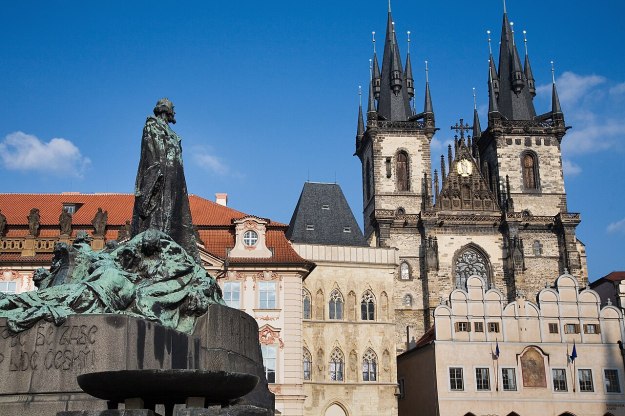
Martha L. Moore-Keish quotes a portion from the final letter of the Jan Hus, a reformer in Czechoslovakia (1369-1415) before he was burned at the stake that I want to close this portion of the reflection with because it wrestles with the themes of James in the concrete moment of temptation/trial:
Surely it is difficult to rejoice without perturbation, and to esteem it all joy in various temptations. It is easy to talk about it and to expound it, but difficult to fulfill it. Even the most patient and valiant soldier, knowing that on third day He would rise, conquering by His death the enemies and redeeming the elect from damnation, after the Last Supper was troubled in spirit…O most kind Christ, draw us weaklings after Thyself, for unless Thou draw us, we cannot follow Thee! Give us a courageous spirit that it may be ready; and if the flesh is weak, may Thy grace go before, now, as well as subsequently. For without Thee we can do nothing, and particularly to go to a cruel death for Thy sake. Give us a valiant spirit, a fearless heart, the right faith, a firm hope, and perfect love, that we may offer our lives for Thy sake with the greatest patience and joy. Jan Hus, from a letter written just prior to his being burned at the stake on July 6, 1415. (Moore-Keish, 2019, p. 25)
[1] Mark 6:3 indicates that Jesus has two brothers, James and Joses. James as a leader of the early church is mentioned in Acts 12:17; James plays a pivotal role in the Jerusalem council in Acts 15 (see verse 13) as well as meeting with Paul when he returns to Jerusalem in Acts 21: 17-26. Throughout Acts James is one of the leaders of the church and he often acts in a conciliatory manner between the church in Jerusalem and the Hellenistic mission of Paul and others. In Paul’s letter to the Galatians, James seems to have enough influence and power to make Peter change his behavior.
[2] See also 1 Peter 1: 6-7: In this you rejoice, even if now for a little while you have had to suffer various trials, so that the genuineness of your faith—being more precious than gold that, though perishable, is tested by fire—may be found to result in praise and glory and honor when Jesus Christ is revealed.
[3] See my reflection on Matthew 5: 33-48 and Perfection and Blamelessness in the Bible.
 Sign of the Rose