Tag Archives: early church

1 Timothy 4 Encouraging Timothy and Correcting False Teachings

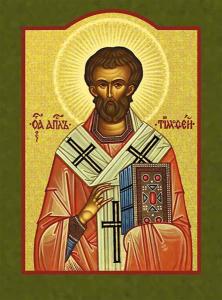
Saint Timothy Orthodox Icon

1 Timothy 4 

1 Now the Spirit expressly says that in later times some will renounce the faith by paying attention to deceitful spirits and teachings of demons, 2 through the hypocrisy of liars whose consciences are seared with a hot iron. 3 They forbid marriage and abstain from certain foods, which God created to be received with thanksgiving by those who believe and know the truth. 4 For everything created by God is good, and nothing is to be rejected, provided it is received with thanksgiving, 5 for it is sanctified by God’s word and by prayer.

  6
 If you put these instructions before the brothers and sisters, you will be a good servant of Christ Jesus, nourished on the words of the faith and of the sound teaching that you have followed. 7 Have nothing to do with profane and foolish tales. Train yourself in godliness, 8 for, while physical training is of some value, godliness is valuable in every way, holding promise for both the present life and the life to come. 9 The saying is sure and worthy of full acceptance. 10 For to this end we toil and suffer reproach, because we have our hope set on the living God, who is the Savior of all people, especially of those who believe.
  11
 Command and teach these things. 12 Let no one despise your youth, but set the believers an example in speech and conduct, in love, in faith, in purity. 13 Until I arrive, give attention to the public reading of scripture, to exhorting, to teaching. 14 Do not neglect the gift that is in you, which was given to you through prophecy with the laying on of hands by the council of elders. 15 Put these things into practice, devote yourself to them, so that all may see your progress. 16 Pay close attention to yourself and to your teaching; continue in these things, for in doing this you will save both yourself and your hearers.

The apostle Paul’s ministry involved him seeding and supporting churches throughout modern day Turkey, Greece, and beyond. These churches, likely meeting in the homes of individual members, received some formation during the duration of Paul’s presence with them but as Paul’s attention is spread across a larger number of cities and churches the need for instruction becomes apparent. Thankfully for later generations, Paul did a lot of this instruction and correction through letters attempting to continue to guide and shape this young but rapidly growing and evolving church. Paul now writes to Timothy as he attempts to counter the false teachings and practices which are dividing the church in Ephesus both to encourage his younger counterpart and to support his work in correcting these beliefs which are infiltrating the life of the community.

The early Christian community did expect God to speak through the Spirit in prophecy, proclamation, and in acts of healing and power. In Corinth Paul had to counsel that congregation on how to utilize these gifts of the Spirit, but the assumption throughout Paul’s letter is that the Spirit is active and communicating with this young community of faith. Now Paul’s instructions are framed within the statement of the Spirit, presumably through prophecy, that in later times some will renounce (Greek apostesontai, where we get the English word apostate) the faith and that behind these deviant teaching are deceitful spirits and demons. Modern readers may be uncomfortable that Paul is ‘demonizing’ these false teachers, but for Paul this is a matter of critical importance to the life of the church and the individuals. The actions of these teachers is causing strife within the church, leading some down paths which are contrary to the faith, and likely leading others to walk away from these communities in conflict. Paul feels that the gospel is at stake and this is a matter of life and death. The hypocrisy of liars (Greek hupokrisei pseudologon, where our word hypocrisy comes from and ‘false words’) has cauterized the consciences of these teachers. As Jouette M. Bassler can state about the Greek word behind cauterized/seared with a hot iron:

Burning with a hot iron (Gk. Kausteriazein) was done to numb or cauterize a wound, to punish, or to identify ownership (NEB, cf 2 Tim 2:26). Any of these meanings could apply here; the essential point is one of contrast between those whose consciences are good (1:5, 19) or pure (3:9; 2 Tim 1:3) and those whose consciences are rejected. (Bassler, 1996, p. 80)

The two false teachings and practices highlighted in the letter are forbidding marriage and abstaining from certain foods. The forbidding of marriage may have led to some of the instructions on widows in chapter five, but it also fundamentally undermines the social structure of the ancient world. In the ancient world there were few opportunities for women to be self-supporting (outside of prostitution or being a courtesan among the upper class). It is possible that these teachers are anticipating the advent of Christ’s kingdom in a short period of time and view the current time as unworthy of investing in, but Paul may view their actions as turning away from God’s intent for relationships in creation. The actions of these teachers may also be causing these young churches to be viewed with suspicion by their neighbors and placing a stumbling block before those who need to hear the gospel. Paul wrestled with controversies around eating throughout his ministry, both within a Jewish context attempting to maintain the distinctive eating practices of the Jewish people and imposing dietary and other expectation on early Christians but also within the Greco-Roman world where meat was often associated with communal sacrifices to other gods. Paul explicitly wraps both marriage and eating of food under the things God created for humanity to be received with thanksgiving (Greek euchapistias, the word where our English eucharist comes from). These eucharistic gifts are made holy/sanctified (Greek hagiazetai) by God’s word and prayer. This language reminds me of Luther’s discussion of the sacraments where he connects the receiving of the physical element (water, bread, wine) with the Word and command of God.

 Paul expects Timothy to place the contents of the letters before the Ephesian congregations, and in doing so Timothy is a good servant (literally deacon) of Christ Jesus. As mentioned in the previous chapter, the title of deacon and the act of serving are used interchangeably in the early church and the roles are not rigidly defined. Timothy can be a representative of Paul charged with overseeing the congregations in Ephesus, and yet always remains a servant. Timothy has received faithful teaching in contrast to the false words of the troublesome teachers operating in Ephesus. Yet, even Timothy is charged to stay away from profane teaching and ‘foolish tales’ (literally old women myths). I can understand the NRSVue’s discomfort, feeling that ‘old wives tales’ is a translation pejorative to women, but through most of history there have been ‘old wives’ tales’ that were a place where stories, beliefs, and practices, some which may have contradicted the teaching of the church and other authorities, were handed down. Critical to 1 Timothy is the Greek eusebias which means piety, religion, or as the NRSVue renders it godliness. I prefer religion here although it is also an imperfect translation since many think of this either in terms of religious belief or practice within a church. In modern American thought godliness is next to cleanliness and this term’s connection with religious practice has been lost. Piety is an important idea in the Greco-Roman world, but it’s reception in English is often limited to actions that happen in the context of worship and prayer rather than the more wholistic idea the eusebias points to. Eusebias for Paul is something that’s value far exceeds physical training, which Paul uses in several metaphors in his letters, but this term for Paul seems to encompass faith and practice, including but not limited to worship and prayer. Just as the athlete endures physical toil and suffering, so the person training in religion/godliness will endure toil and suffering from the surrounding world as it resists these practices and beliefs as well as the demonic/false teachings of those causing divisions among the community of faith. As James D. G. Dunn articulates:

The writer makes clear that such growth and development depend on training and the discipline involved (vv. 7-8); they involve hard work and sweat-inducing exertion (v. 15). Here again a choice once made has to be repeatedly reaffirmed and lived out. (NIB XI: 816)

The saying is sure (the Greek is literally faith(ful) the word pistis ho logos) and worthy of all acceptance appears for the second time highlighting the statement of faith that the faithful suffer and toil over. Previously in 1 Timothy 1: 15 the faithful saying was that Christ Jesus came into the world to save sinners. Now, their hope is in the living God who is the Savior of all people. It is a common biblical belief that the God of the bible (as well as of Israel and the people of God) is a living and active God who is actively engaged in the world. Savior, as mentioned in the first chapter, is a common Old Testament title for God and was likely utilized in the communities in Ephesus. That God is the Savior of all people may point to the idea of a universal salvation or it may be intended to expand the horizon of God’s salvation beyond Israel. The idea of God saving all being indicative of a universalistic hope is congruent with the follow on phrase which declares especially those who believe. Some readers view this phrase as correcting the previous one, but I read this as highlighting those who believe within the larger set of those who God intends to save. Although the method of argumentation is different, since the question is likely different in Ephesus, it has a similar logic to Paul’s rationale for God utilizing the faithlessness of Israel to include the Gentiles and then the grafting of the Gentiles onto the holy tree to point to God regrafting on the branches of Israel that have fallen off so that along with the Gentiles all Israel will be saved (Romans 11).

The instructions to Timothy starting in verse eleven encourage him to not only command and teach but set an example in speech and conduct. Although authenticity is a word of our time, the expectation of congruity between one’s proclamation and one’s actions was very important in rhetorical expectations of the Greco-Roman world. As Luke Timothy Johnson states:

We are reminded of how seriously ancient philosophers regarded the responsibility of teachers to live in accord with what they professed…Since philosophy in the Hellenistic period was considered to be essentially a matter of integrity of life, and since virtue was thought to be learned first and best by the imitation of living models, the teacher has no greater duty than to live in a manner consonant with the principles he enunciated. (Johnson, 2001, p. 255)

The speech, conduct, love, faith and purity which Timothy exhibits will be as crucial in his work to bring healing and wholeness to the community as the commands and teaching he does. Timothy may be young among the elders of the Ephesian church, but his example should demonstrate his worth along with the calling he has received through prophecy[1] and laying on of hands. Paul and the council of elders (presbyteriou where the term Presbyter comes from and the Presbyterian church gets its name). It is not clear whether the prophecy came at the moment of the laying on of hands by the council of elders or before, and whether this council of elders was in Jerusalem, in Ephesus, or in some other place in the Pauline mission area, but Timothy has been set aside for his ministry representing Paul, but more essentially representing Christ. Timothy is called to live a public life which bears witness to the teaching entrusted to him in word and in action which forms a powerful example for his hearers.

The formation of the overseers and deacons in the previous chapters and the expectations of Timothy in our current chapter point to the public life of those set aside for roles of leadership in the church. The life of a leader in the church expects that their faith and practice will be an example of the faith and practices they are attempting to cultivate in their communities. Yet, we live in a time where postmodernity and other forces have made talking about standards both for the church and its leaders difficult. Luke Timothy Johnson continues his statement from earlier stating:

The widespread unwillingness in contemporary Western culture to provide direct and unambiguous moral instruction or to assume responsibility for acting in a manner that can be exemplary for others would have been unintelligible in antiquity. (Johnson, 2001, p. 255)

The damage done both to the community’s reputation and the trust within the community when leaders and members do not act in a way that reflects the faith they proclaim is profound. The church has always had divisions, but only a leader who embodies the faith for the community can begin to rebuild trust and authentically proclaim the gospel. Timothy, and faith leaders who follow him into broken communities, brings light into the darkness of division, clarity into the confusion and clashes over practices and beliefs, and healing so that the gospel can be heard both in the church and in the surrounding world. Failure to attend to a life that embodies the gospel places unnecessary stumbling blocks before the entirety of the world that the living God of the gospel desires to save.


[1] Paul also mentioned the prophecy over Timothy in 1:18.
1 Timothy 3 Expectations of Leaders in the Community and the Mystery of the Faith

Highlighted terms or phrases have notes below on translation.

1 Timothy 3: 1-13 Qualifications of Overseers and Men and Women in Serving Roles

1 The saying is sure: whoever aspires to the office of bishop desires a noble task. 2 Now a bishop must be above reproach, married only once, temperate, self-controlled, respectable, hospitable, an apt teacher, 3 not a drunkard, not violent but gentle, not quarrelsome, and not a lover of money. 4 He must manage his own household well, keeping his children submissive and respectful in every way, 5 for if someone does not know how to manage his own household, how can he take care of God’s church? 6 He must not be a recent convert, or he may be puffed up with conceit and fall into the condemnation of the devil. 7 Moreover, he must be well thought of by outsiders, so that he may not fall into disgrace and the snare of the devil.

  8 Deacons likewise must be serious, not double-tongued, not indulging in much wine, not greedy for money; 9 they must hold fast to the mystery of the faith with a clear conscience. 10 And let them first be tested; then, if they prove themselves blameless, let them serve as deacons. 11 Women likewise must be serious, not slanderers, but temperate, faithful in all things. 12 Let deacons be married only once, and let them manage their children and their households well; 13 for those who serve well as deacons gain a good standing for themselves and great boldness in the faith that is in Christ Jesus.

When we hear the titles of bishop and deacons and we talk about their role in taking care of the church we can easily overlay modern positions, authority, structure and assumptions onto this letter. To translate the Greek word episkopos (where the Episcopal church gets its name) as bishop for most modern readers conjures men (and women depending on your tradition) in ornate vestments participating and leading large numbers of churches and leaders. Deacons (Greek diakonoi) within most modern churches would fit somewhere lower in the hierarchy than bishops and in many places this role still maintains the connection with the service ministries of the church. Yet the church at the time Paul is writing to Timothy is far different than its modern incarnation.

The early churches in Ephesus carried out many of the activities that the synagogues did for the Jewish community throughout the diaspora: They prayed (2: 1-3), read and explained scripture (4:13), and cared for widows (5:3-16) and likely other vulnerable members of the community. However, it is significant that instead of the adoption of religious titles like priest, or even high priest, of the Jewish as well as other Roman temples, they utilize episkopos and diakonoi: “overseer” and “server.” The term episkopos was commonly used for positions with oversight, particularly financial oversight, in the surrounding culture. (Bassler, 1996, p. 64)

It is important to remember that the early church met primarily in the homes of one of the community members. The household of both individuals as well as the household of God is central to the language of 1 Timothy. As James D.G. Dunn states:

Just as good order in the state (2: 1-2) led into thoughts of good order in the household (2: 9-15), so also that leads into thoughts of good order in the church (3: 1-13). (NIB XI: 804)

Men in the Greco-Roman world who were viewed as leaders were expected to manage their household well. This is a world before the separation of work and home: the management of the home (Greek oikos) is foundational to the economic outputs (Greek oikonomia literally house management) for not only the home but for the city and empire. A man with disobedient children or an unstable marriage was viewed in the ancient world as a poor home-maker, and a person unable to manage their household was unlikely to be a good manager of the household of God.

It is likely that “overseers” or “bishops” were hosting gatherings of the faithful in their homes and their hospitality. The receiving and sending off of guests in the ancient world was a central role in households throughout the Greco-Roman and Jewish world, and it is likely that the hospitality expected of the episkopos could be costly as well as the frequent presence of Christians in their home.

The virtues listed for the “overseer” or “bishop” are virtues that would be “marks of good character” (Long, 2016, p. 88) throughout the culture.  Being beyond reproach introduces the list of virtues which focus more on how they embody their faith in their living than their mere knowledge of faith. “Married once” is literally “the husband of one woman” and can be understood to address a range of meanings: a man who marries once and if widowed does not remarry, or monogamous rather than polygamous, or faithful to one’s wife without a mistress, or ruling out divorce or serial matrimony, or it may be encouraging a married overseer in contrast to a celibate one. (Johnson, 2001, pp. 213-214) The list continues with temperate, self-controlled, and respectable—terms that will be expanded on in the following verse. As mentioned above, hospitality by inviting people into one’s household would be expected by an “overseer” and the only skill-based item on the list is that they are to be a good teacher.

These leaders are not to be addicted to wine, bullying, or a lovers of money. They are to be peaceable (a-machos in Greek) rather than one who engages in battle (mache), this would exclude a type of macho behavior that some mistake for leadership. As mentioned earlier, the management of one’s own household is an indicator of the possibility of being an leader in the community of the faithful. Just as women were to be submissive in the assembly (2:11) now the children of the “overseer” are also to be submissive. Finally these leaders are not to be recent converts (neophytes, Greek neophutov) so that they may not become overconfident or puffed up and be misled by the devil, but they are also to have a good witness (NRSVue well thought, Greek martupian (where our word martyr comes from) kalos). For these “overseers” there is the need for both a faithful example of a leader within the household and the public facing witness to the church’s faith and righteousness.

The requirements of “deacons” or “servers” is similar to the expectations of an “overseer.” Before drawing too great a distinction between “overseer” and “servers” it is worth noting that:

Paul, for example, describes Timothy (1 Thess 3:2), Phoebe (Rom 16:1), the civil ruler (Rom 13:4), Apollos (1 Cor 3:5), himself (2 Cor 6:4), and even Christ (Rom 15:8) as diakonoi. In Phil 1:1, the deacon is linked with the bishop or overseer, though the relationship between these two is not spelled out (cf. 1 Clem. 42. 4-5; Did. 15.1). Though Paul used this word, as he did “overseer,” to describe a role or function in 1 Timothy the noun clearly refers to a position for which one is tested. (Bassler, 1996, p. 69)

While Paul, Timothy, Apollos, and even Christ all serve, there does seem to be the beginning of a distinctive serving role in the young church. Paul here[1] and other places[2] accepts women in this role. One distinct addition to the description of the deacon is that they are not double-tongued (literally two worded). Thomas Long makes an educated guess about the possible need for this description:

If they indeed were practical helpers in the community, the ones who assisted the elders and bishops in their duties and the ones who did the legwork of running the financial support program for widows, then they would naturally be constantly in and out of homes in the community. If they were people who spike one way in one home and another way in another, if they were gossips who spread rumors and gave one version of events here and a different version there, or if they were duplicitous flatterers who spoke soothing words of comfort to a widow in need and then whispered about her to the next widow, they could easily spread the contagion of divisiveness. (Long, 2016, p. 93)

Like overseers they as men and women are to manage their household before they are entrusted to enter the household of others. They are to hold fast to the mysteries of the faith and not to spread false doctrines and practices. These “servers,” like the “overseers,” can build up the household of faith, or through unserious, deceitful talk, drunkenness, greed, or bad reputation damage the same household.

Although we do not know the details of the conflicts that Paul is writing to Timothy to help him address, the need for Paul to state to aspire to be an overseer is a good thing may continue to indicate that the struggles of the community has made good leaders cautious before assuming these roles in the community. It’s unlikely that Paul goes into this extended discussion of leadership without needing to address the absence of leaders of the proper character in these roles. For Paul the expectations of a good man (or woman) in fulfilling their roles within the household is the minimum threshold that all leaders in the household of faith should surpass.

There are many ways that our world and cultural expectations are different from the world of Paul but the need for ethical leadership remains. I have seen the damage that an unfaithful leader can do in a community and in half of the communities I have served I have had to intentionally rebuild trust between the community and their leaders. The scandals in the Catholic Church as well as Protestant churches have done great harm to the members of those communities and to the reputation of the church and its leaders in the society. New York times columnist Frank Bruni when commenting on the sex scandals in the Catholic church stated:

the evil that an entire institution can do, though it supposedly dedicates itself to good…[and by] the way that a religious organization can behave almost precisely as a corporation does, with fudged words, twisted logic and a transcendent instinct for self-protection that frequently trump the principled handing of a specific grievance or a particular victim. (Long, 2016, p. 91)

This is one of the passages that I have wrestled with personally since my divorce in 2010[3], and then my remarriage five years later. Although I have on occasion been told by another person in the church that I shouldn’t be a pastor because of my divorce I was fortunate to have a bishop as well as colleagues who prayed for me, offered counsel and guidance. I do think we underprepare people entering ministry and their families for the pressure of trying to balance their household and the demands of the household of faith.

Trying to set guidelines for leadership within the church takes wisdom and grace, but those set aside for leadership are held to a higher standard. An unfaithful leader can cause immense harm to their fellow members of the body of Christ, can destroy a congregation and damage the Church’s reputation, and unfortunately the desire to protect an institution’s reputation has often perpetuated the harm. Normally we focus on sexuality as the location of the damage, but I have also seen congregations damaged by the addiction of a leader, financial mismanagement, and bullying. Being above reproach, temperate, self-controlled, respectable, hospitable, and a faithful teacher while managing one’s relationships and household is a daunting task but it is also a noble one for the one called to such a ministry of overseeing a community of faith or the service ministries of the church.

1 Timothy 3: 14-16 The Mystery at the Heart of the Gospel


  14 I hope to come to you soon, but I am writing these instructions to you so that, 15 if I am delayed, you may know how one ought to behave in the household of God, which is the church of the living God, the pillar and support of the truth. 16 Without any doubt, the mystery of godliness is great:
 He was revealed in flesh,
  vindicated in spirit,
   seen by angels,
 proclaimed among gentiles,
  believed in throughout the world,
   taken up in glory.

Paul would be known to the community in Ephesus since, according to Acts 19, he spent two years there. As mentioned previously, Paul went to Macedonia and then sent Timothy back to Ephesus to address some of the problems reported in this letter. I know that a lot of very intelligent readers in the last two centuries have viewed this letter as written at a later date by a later author writing in Paul’s name, but there are a number of sections like this one where this later writer would have to fabricate not only these more personal addresses, but also why write a letter about two famous members of the church addressing issues at Ephesus when the people in that congregation would know Paul and Timothy, know their own situation (which is not presented in a flattering manner in this letter) likely within a generation of Paul’s death. Is it possible that someone later wrote 1 Timothy? It is possible, but to me the easier reading is that Paul is addressing his hope to return to the community at Ephesus in a world where travel is not quick or reliable. For later generations of Christians, we are the beneficiaries of Paul’s attempt to support the early Christian communities through writing letters which we continue to have.

Paul throughout his letters often talks about ‘mystery’ when referring to the revelation which led to his ministry among the Gentiles (Romans 11:25; Ephesians 3: 3-9; Colossians 1: 26-27). Here in 1 Timothy the ‘mystery of faith’ (v.9) and ‘the mystery of godliness’ (v. 16) appears to be linked to the confession of faith which concludes verse sixteen. What the NRSVue translates as ‘godliness’ is the Greek eusebia which is normally translated piety or religion, so Paul here is talking about the ‘mystery’ of the faith as it is practiced. Confessional fragments are common in Paul’s letters, the most famous examples being Philippians 2: 5-11 and Colossians 1: 15-23, and just as the later church would develop creeds as a teaching method of handing on the faith, the church of Paul’s day had these fragments which illuminate the narrative content of the faith of these followers of Jesus. Yet, as James D.G. Dunn states there is also a sense that there is a mysterious aspect to the faith, “requiring someone skilled in understanding and exposition to unveil it to initiates.” (NIB XI: 807)

The six lines in the NRSVue are short but focus on key points of the story of Jesus. Jesus was revealed ‘in the flesh’ a key Pauline term which here reflects the humanity of Jesus without Paul’s normal negative implication of the flesh’s corruption by sin. Jesus is ‘justified’ (Greek dikiao, NRSVue vindicated) in the Spirit. The NRSVue’s rendering of this term as vindicated obscures this central Pauline word of justification. The Greek angelos (NRSVue angels) can mean angels as heavenly beings but also can generically mean ‘messengers’ and that is likely the intended meaning here, that Jesus was revealed to messengers, like Paul, who would proclaim him among the gentile/nations (Greek ethnos has both meanings: Gentiles as other than Jews and the nations).  To me the rendering of ethnos as the nations makes sense in the context where Jesus is believed throughout the world. Finally, Jesus is taken up into glory, echoing the story of the ascension.


[1] There is some debate over the sudden introduction of women in verse 11. Some interpreters view this as referring to the wives of deacons, but many interpreters seem to believe that this is a role open to women in Ephesus.

[2] For example, Phoebe in Romans 16:1.

[3] I try to remain transparent about my own journey through this both in my three part reflection on What I Learned About Myself, Life and God from my Divorce, as well as passages like Deuteronomy 24; Matthew 5: 21-32; and 19:1-12 where divorce are mentioned.

James 1: 1-8 The Wisdom of the Letter of James

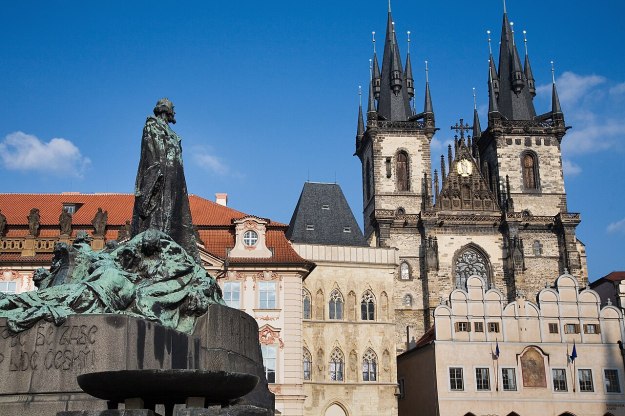
Jan Hus Memorial at Old Town Square in Prague built in 1915. Photo by Jorge Royan. Shared under CC BY-SA 3.0

James 1: 1-8

Words highlighted have notes below on translation.

 1 James, a servant of God and of the Lord Jesus Christ,
  To the twelve tribes in the dispersion:
  Greetings.
  2
 My brothers and sisters, whenever you face various trials, consider it all joy, 3 because you know that the testing of your faith produces endurance. 4 And let endurance complete its work, so that you may be complete and whole, lacking in nothing.
  5
 If any of you is lacking in wisdom, ask God, who gives to all generously and ungrudgingly, and it will be given you. 6 But ask in faith, never doubting, for the one who doubts is like a wave of the sea, driven and tossed by the wind. 7, 8 For the doubter, being double-minded and unstable in every way, must not expect to receive anything from the Lord.

James, the author of the letter, has traditionally been understood as James the Just or James the brother of our Lord who was one of the influential early leaders of the church in Jerusalem.[1] Throughout this reflection my assumption will be that this is an early Christian letter, written in a similar time period to the letters of Paul, from a leader of the church in Jerusalem to the Jewish followers of Jesus scattered throughout the world. James introduces himself as a servant (literally slave in Greek) of God and of the Lord Jesus Christ. Although the translation of the Greek doulos as ‘servant’ in most English translations makes sense, especially with the history of how slaves were treated in the United States, it is worth noting that most of the apostles claim to be slaves/servants of Christ or God. In the ancient world a slave could exercise authority on behalf of their master, yet unlike a servant who is employed and can quit a slave was owned by the household. From a contemporary perspective in an individualistic society where personal freedom is highly valued it is worth being reminded that in the ancient world you were always bound to your family or the household you served. I do think for James the sense of obedience and servitude are an important part of how he sees the life of wisdom.

James and the author of 1 Peter are the only two New Testament authors to address their letters to the diaspora. Although at the time of the writing of James, assuming that the biblical James is the author, Israel and Jerusalem are not yet in rebellion against Rome, there are still more Jews living outside of Palestine in the diaspora than who live inside it. (Moore-Keish, 2019, pp. 20-21) At this early time, prior to 62 CE when James the Just is killed, the boundaries between Judaism and Christianity are still porous and many of the early followers of the way of Jesus Christ considered themselves a part of the Jewish people. Yet, there is also throughout the New Testament an adoption of the titles and language used for the Jewish people throughout the Old Testament to speak about the role of the new followers of Jesus throughout the church. Although James is writing in a manner that is highly reflective of the Hebrew Scriptures and Torah obedience, it is also likely that his audience may also include the churches of Paul and others among the Gentiles. James never mentions Sabbath-keeping, circumcision, or diet. Like the Gospel of Matthew, James attempts to write about a faith that is connected with Torah observance the letter is also shaped by a merciful reading of scripture which is shaped by both the teachings of Jesus and the prophetic witness before him.

Most modern translations will translate the Greek adelphos/adelphoi with ‘brothers and sisters’ rather than the generic ‘brother/brothers’ since James was addressing both men and women with the letter. What immediately strikes me as we enter into the letter of James is the way many of the early Christian writers are sharing a common vocabulary as they address the new followers of the way of Jesus Christ. James’s brief encouragement to find joy in their trials echoes Jesus’s words in the Sermon on the Mount:

“Blessed are you when people revile you and persecute you and utter all kinds of evil against you falsely on my account. Rejoice and be glad, for your reward is great in heaven, for in the same way they persecuted the prophets who were before you. Matthew 5: 11-12

Although James has been often read in opposition to Paul, his language throughout this letter often uses the same language and rhythms as Paul. Here in verses three and four you can see a similar pattern in Paul’s letter to the Romans:

And not only that, but we also boast in our afflictions, knowing that affliction produces endurance,  and endurance produces character, and character produces hope,  and hope does not put us to shame, because God’s love has been poured into our hearts through the Holy Spirit that has been given to us. Romans 5: 3-5[2]

In verse four we have the first appearance in the letter of the Greek teleios (NRSVue ‘mature’/NRSV ‘perfect’). This is an important word for James; the word is used twenty times in the New Testament; five of those uses occur in this short letter. Additionally, James utilized both the verbal form teleo twice and the substantive telos once. (Moore-Keish, 2019, p. 28) When I was working through Matthew’s gospel this was a word I wrestled with because I don’t believe that the word intends the sense of moral perfection that is often read into it.[3] Teleios is a word of destination and completion, and I like the NRSVue’s adoption of ‘mature’ for this word. James does want his readers to live a complete and mature life shaped by the path of God’s wisdom.

The letter of James shares many similarities with the wisdom literature in the Old Testament with its interest in shaping a life that is faithful to God’s intent as outlined in the law. Wisdom literature often contrasts the path of wisdom with the opposing path of foolishness. James contrasts the single-minded way of faith with the double-minded way of doubt. Faith and doubt are opposing ideas in James, and I believe that Joel B. Green captures the essence of James’s thought when he states that for James, “faith has more the sense of confidence.” (Green, 2025, p. 30) In the Gospel of Matthew ,faith had more the sense of openness and in Matthew’s gospel worship and doubt often coexisted, but James is approaching faith and doubt as opposites. James’s definition of faith is, ironically, incredibly close to Luther’s famous explanation of the first commandment, “We are to fear, love, and trust God above all things.” Faith and wisdom are a single-minded confidence in God and God’s ways. For those lacking in wisdom they are told to ask God confidently for the wisdom they need to lack nothing. The parallel use of ‘lacking nothing’ in verse four and ‘lacking wisdom’ five form an interesting parallel between ‘enduring trials’ and ‘asking God for wisdom.’

James targets those among his readers whose practice does not match their profession. They are double-minded because they want to be friends of God and friends of the world at the same time. (NIB XII:182) James’s thoughts echo Jesus’s words contrasting between those who try to serve two masters,[4] and it is telling that Jesus is contrasting those who serve God and wealth as James is about to contrast those of humble means and the rich.  

Martha L. Moore-Keish quotes a portion from the final letter of the Jan Hus, a reformer in Czechoslovakia (1369-1415) before he was burned at the stake that I want to close this portion of the reflection with because it wrestles with the themes of James in the concrete moment of temptation/trial:

Surely it is difficult to rejoice without perturbation, and to esteem it all joy in various temptations. It is easy to talk about it and to expound it, but difficult to fulfill it. Even the most patient and valiant soldier, knowing that on third day He would rise, conquering by His death the enemies and redeeming the elect from damnation, after the Last Supper was troubled in spirit…O most kind Christ, draw us weaklings after Thyself, for unless Thou draw us, we cannot follow Thee! Give us a courageous spirit that it may be ready; and if the flesh is weak, may Thy grace go before, now, as well as subsequently. For without Thee we can do nothing, and particularly to go to a cruel death for Thy sake. Give us a valiant spirit, a fearless heart, the right faith, a firm hope, and perfect love, that we may offer our lives for Thy sake with the greatest patience and joy. Jan Hus, from a letter written just prior to his being burned at the stake on July 6, 1415. (Moore-Keish, 2019, p. 25)


[1] Mark 6:3 indicates that Jesus has two brothers, James and Joses. James as a leader of the early church is mentioned in Acts 12:17; James plays a pivotal role in the Jerusalem council in Acts 15 (see verse 13) as well as meeting with Paul when he returns to Jerusalem in Acts 21: 17-26. Throughout Acts James is one of the leaders of the church and he often acts in a conciliatory manner between the church in Jerusalem and the Hellenistic mission of Paul and others. In Paul’s letter to the Galatians, James seems to have enough influence and power to make Peter change his behavior.

[2] See also 1 Peter 1: 6-7:  In this you rejoice, even if now for a little while you have had to suffer various trials, so that the genuineness of your faith—being more precious than gold that, though perishable, is tested by fire—may be found to result in praise and glory and honor when Jesus Christ is revealed.

[3] See my reflection on Matthew 5: 33-48 and Perfection and Blamelessness in the Bible.

[4] Matthew 6:24.