Tag Archives: Church conflict

1 Timothy 1 Paul Encourages Timothy in Ephesus

The Library of Celsus in Ephesus Photo By Benh LIEU SONG – Own work, CC BY-SA 3.0, https://commons.wikimedia.org/w/index.php?curid=15578063

1 Timothy 1: 1-2

1Paul, an apostle of Christ Jesus by the command of God our Savior and of Christ Jesus our hope,
  2
To Timothy, my true child in the faith:
  Grace, mercy, and peace from God the Father and Christ Jesus our Lord.

Letters in the ancient world begin with the identification of the sender and the recipient. Paul begins by making a strong claim to authority, “an apostle of Christ Jesus by the command of God our Savior and Christ Jesus our hope.” When Paul begins with the title of apostle (e.g. 1 Corinthians, Galatians) he is often writing to communities dealing with crisis and where his authority is needed. In letters like Romans or Philippians where he is not addressing significant behavioral issues or where he wants to be more diplomatic he utilizes the title of servant/slave (doulos) of the Lord. Paul also immediately leans into the title of God as our Savior. God as Savior is a common theme in the Old Testament/Hebrew Scriptures[1] and it is worth remembering at the time these letters are written the stories of the gospels are likely circulating but they have not been collected and distributed throughout these young communities of faith. The Scriptures for these early Christian are the Hebrew Scriptures.

Timothy is described as Paul’s ‘true child,’ an adjective that normally defines a child born in wedlock. A legitimate child as opposed to an illegitimate one (NIB XI: 790). Yet, when the letter continues ‘in the faith’ most readers would probably understand Timothy as Paul’s true and authentic delegate, that Timothy and Paul share the same faith and that Timothy is being empowered to speak with Paul’s authority. Paul’s also utilizes the term for ‘true’ (gnesios) in Philippians 2:20 to speak of Timothy’s true concern for the welfare of the Philippians. Timothy is Paul’s trusted representative before the Ephesians, one who is like a son to him.

Paul concludes the greeting with a blessing. Grace (charis) is a distinctive Pauline term, and the vast majority of this term’s occurrences happen in Paul’s letters. Here the term is combined with two additional terms: peace (eirene) and mercy (eleos). Peace brings forward the Hebrew idea of shalom and mercy (eleos) is the normal term used to translate in both Greek and English the Hebrew term hesed. These three rich terms are brought together to bless Timothy and his community. God is referred to here as Father, a common way of referring to God in both the teaching of Jesus and occurs frequently in Pauline benedictions, and Christ Jesus our Lord is placed in parallel usage of God the Father.   

1 Timothy 1: 3-11

  3I urge you, as I did when I was on my way to Macedonia, to remain in Ephesus so that you may instruct certain people not to teach different teachings 4and not to occupy themselves with myths and endless genealogies that promote speculations rather than the divine training that is known by faith. 5But the aim of such instruction is love that comes from a pure heart, a good conscience, and sincere faith. 6Some people have deviated from these and turned to meaningless talk, 7desiring to be teachers of the law without understanding either what they are saying or the things about which they make assertions.
  8
Now we know that the law is good, if one uses it legitimately; 9this means understanding that the law is laid down not for the righteous but for the lawless and disobedient, for the godless and sinful, for the unholy and profane, for those who kill their father or mother, for murderers, 10the sexually immoral, men who engage in illicit sex, slave traders, liars, perjurers, and whatever else is contrary to the sound teaching 11that conforms to the glorious gospel of the blessed God, with which I was entrusted.

In many of Paul’s letters there would be a thanksgiving for the community, but here the letter moves immediately into instructions. Paul has done this in Galatians, so this is not unheard of, and like Galatians Paul is concerned about the continuation of the community. Verse three gives us the setting where Timothy receives the letter, Ephesus where he is instructed to remain, and Paul at some earlier time departed for Macedonia. In Acts Paul sent Timothy on to Macedonia while he stayed in Ephesus (Acts 19:22) and later proceeds to Macedonia. Later he will gather with the Ephesian elders in Miletus (Acts 20:17). This letter is likely between Paul’s departure from Ephesus and his later meeting with the elders.[2]  

Among the early Christians in Ephesus there are different teachings emerging. We have glimpses into the challenges that the early churches face through letters like this 1 Timothy, the book of Acts and the book of Revelation. The Book of Acts portrays Ephesus as a city where the early Christ followers meet resistance both from within the synagogue and from the followers of the Greek gods, particularly the followers of Artemis. Revelation’s letter to the Ephesians points to a community that has learned to test those claiming to be apostles and continuing to deal with groups, like the Nicolaitans, who are viewed as harmful by the author of Revelation. Yet, in Revelation these conflicts have sapped the energy of the churches in this large city. We may not be able to identify specifically the ‘myths and genealogies’ that some are teaching but to Paul they are leading people away from the central witness of Christ. The ‘myths and genealogies’ may be focusing on the wrong things in scripture, since Paul indicates that some are desiring to be teachers of the law, but they may also be a distortion coming from outside of the scriptures. Another possibility is that these teachers who are leading people into “meaningless talk” have separated teaching from action. They may be so focused on some knowledge they are attempting to wrestle from the scriptures or from the surrounding culture that they have stopped the distinctive practices that shaped the early Christians.

Paul then focuses on the law and how it is utilized. Paul’s declaration that the law is good is similar to statements he has made in Romans[3] but also indicates that the law is not for the righteous. Perhaps Paul intends something similar to the fruits of the Spirit mentioned in Galatians where “There is no law against such things.” (Galatians 5: 32) Paul likely composes the vice list in verses nine and ten while reflecting on the ten commandments. Godless and sinful refer to someone behaving blasphemously towards God while unholy and profane likely reference the commandment on keeping the Sabbath holy and profaning the name of God. Killing of father and mother and murderers bring together the commandment to honor father and mother and murder. The commandment on adultery also references both the ‘sexually immoral’ and ‘men who engage in illicit sex.’ The Greek term pornos (NRSVue sexually immoral) is the prefix for the English word pornography. As Luke Timothy Johnson notes, “In the LXX and the NT, the term is used for the sexually immoral without specific reference to homosexuality.” (Johnson, 2001, p. 170) The Greek arsenkoitos (NRSVue men who engage in illicit sex) is literally one who has sex with a man. As James D.G. Dunn notes,

Today the most controversial of these is the putting of homosexual practice (v. 10; the term almost certainly comes from Lev 18:22; 20:13) under the prohibition of adultery; the teaching is consistent with Paul’s views expressed earlier in Rom 1:26-27; 1 Cor 6: 9-10 (NIB XI:791)

This is the first of many times where 1 Timothy will come into conflict with elements of our culture, just as it was likely in conflict with elements of Paul’s time. Many Greek authors write about relationships between a man and an adolescent youth (pederasty) but there is some debate about how often these relationships were sexual. Paul viewed the existence of same-sex relationships as one of the many examples of how far humanity and creation had been corrupted by sin.

On a personal note, the larger church I am a part of has struggled with the question of homosexuality within the larger picture of sexuality since before I entered seminary in 2000. It has been a divisive issue within the larger church and within congregations I have served. I also have a non-gender binary child and my perspective on this issue has shifted throughout my life. When I entered seminary, I would have agreed that LGBTQ+ people have a place within the congregation but I would have been opposed to them having leadership roles whether as pastors, deacons or in positions of authority. Through experiences, wrestling with scripture, and faithful conversations I am now open to LGBTQ+ people who are trying to live faithfully serving in the leadership of the church but I also understand why others struggle to accept them into leadership, just as some do not accept women in leadership (see chapter 2).

Returning to the vice list: stealing is not simply stealing but “slave dealing.” I will talk about slavery more in chapter 6, but although slavery was an accepted part of the Roman empire “slave traders” have normally been viewed with disdain. Liars and perjures point to the commandment on bearing false witness. Paul concludes with ‘whatever is contrary to the sound teaching’ which returns us to the questions about different teaching which began this section. Paul is asking his hearers to measure the teaching they are receiving against the gospel he shared with them for its conformity to Christ and scripture in both teaching and living.  

1 Timothy 1: 12-17

  12 I am grateful to Christ Jesus our Lord, who has strengthened me, because he considered me faithful and appointed me to his service, 13 even though I was formerly a blasphemer, a persecutor, and a man of violence. But I received mercy because I had acted ignorantly in unbelief, 14 and the grace of our Lord overflowed for me with the faith and love that are in Christ Jesus. 15 The saying is sure and worthy of full acceptance: that Christ Jesus came into the world to save sinners—of whom I am the foremost. 16 But for that very reason I received mercy, so that in me, as the foremost, Jesus Christ might display the utmost patience as an example to those who would come to believe in him for eternal life. 17 To the King of the ages, immortal, invisible, the only God, be honor and glory forever and ever. Amen.

For Paul his call to serve Jesus was transformational. He went from someone who, out of ignorance, was acting against God’s will to one whose life is completely committed to the gospel. One of the rhetorical effects of this narration of Paul’s transformation from a faithless one (apistis-without faith, NRSVue ‘unbelief’) to one overflowing with faith and love, from a man of violence to a man of peace, from a blasphemer to a servant of God is to provide hope that those lost to these different teachings can be reclaimed to God and Christ.

Paul talks about faith (Greek pisitis) more proportionally in 1 Timothy than in any other letter except Galatians and Romans.[4] Sometimes English translations obscure the occurrences of ‘faith’ as occurs in verse fifteen. Normally English translations render this verse similar to the NRSVue, “the saying is sure and worthy of full acceptance.” A literal translation of the Greek would be, “the word of faith (or faithful word) and worthy of all acceptance.” What word is faith worthy of all acceptance? That Christ Jesus came into the world to save sinners. Paul’s transformation becomes the model of what Christ is doing with those who were once estranged from God. Jesus is at work in Paul showing the patience of God that is for all who have faith in God.

The Greek word aionios (eon) occurs four times in the final two verses of this section. It occurs at the end of sixteen paired with life (zoe)-into life of the eon/age. Most translations render this ‘eternal life’ and while Paul, I believe, does believe that the age God is creating is eternal he is not thinking of an existence in heaven. For Paul, and the other New Testament authors, God’s kingdom and age is coming to earth. The next occurrence of eon is in the title for God, the king of the eon/age. Life in the eon/age is linked to the king of the eon/age who rules the eon of eons/age to age. God is also described as immortal/incorruptible, invisible and the only God. God being the one God goes back to the Shema (Deuteronomy 6:4), the central confession of faith of the Jewish people. God is also frequently referred to as unseen in both the Old and New Testament and while God being unending or incorruptible is assumed but rarely spoken throughout the scriptures. It is possible that Paul is using a title for God that is frequently utilized by the communities in Ephesus.   

1 Timothy 1: 18-20

  18This charge I commit to you, Timothy, my child, in accordance with the prophecies made earlier about you, so that by following them you may fight the good fight, 19having faith and a good conscience. By rejecting conscience, certain persons have suffered shipwreck in the faith; 20among them are Hymenaeus and Alexander, whom I have turned over to Satan, so that they may be taught not to blaspheme.

The chapter closes with a personal note to Timothy intended to be overheard by the community. Paul reaffirms the closeness with Timothy using the familial language of father to child but also links Timothy’s calling to prophecies made in the church. Timothy is the chosen one, chosen both by Paul and by God. The language shifts to military language. “Fight the good fight” is literally (military) service in this good campaign/battle. Dealing with church conflict is challenging. In my own story I was an officer in the U.S. Army prior to seminary and my job as a leader in the Army may have been harder physically, but leading a congregation through conflict was more emotionally draining.

Hymenaeus and Alexander were people Paul excluded from the community of the faithful. The early communities may not have a word like excommunication for this disfellowshipping of a former member of the faith but even at this early stage there is a need for boundaries. Hymenaeus will be mentioned in 2 Timothy 2:17 along with Philetus as spreading a teaching that the resurrection has already occurred. Alexander the Coppersmith is listed in 2 Timothy 4: 14 as one who did Paul great harm[5] and both are people for Timothy to avoid. In Greek these individuals are handed over by Paul to ‘the satan.’ In Matthew’s gospel which also has this type of disfellowshipping (Matthew 18:17) the desire is that the person changes and they are returned to fellowship. The use of the definite article (the) with the title satan may refer to this role of the accuser in the Old Testament, particularly Job. Here ‘the satan’ is ultimately God’s agent. Martin Luther would sometimes refer to the devil as ‘God’s devil’ because even though the devil may be opposed to God’s designs, even his opposition to God was brought into God’s design.

One of the hardest things for a community to do is to remove a member, but it can also be one of the most important things for the life of a community. Whether it is false teaching, bullying, or other unsafe behavior the failure to address the person who has been corrected and refuses to change will undermine the community. Timothy, in our letter, likely dealt with a very challenging moment in the life of the community and may need the support of Paul, his spiritual father. He may need to be reminded of his calling that God has placed on him as he attempts to bring this community back to faithfulness and peace.


[1] E.g. Deuteronomy 32:15; Psalm 27: 1, 9; Isaiah 45:15, 21; This is also the background for this usage in Mary’s Song commonly called the Magnificat in Luke 1:47.

[2] In this reflection my assumption is that Paul wrote this letter. Many scholars believe 1 Timothy is written by a later author after Paul’s death and therefore the letter comes from a later time. I am also assuming that Acts narration of Paul’s life is generally accurate but incomplete, not capturing every detail of Paul’s ministry.

[3] Romans 7: 7, 14, 21; in Galatians Paul’s language about the law is less friendly but in Galatians 3: 21 the use of the law is in a limited manner like he utilizes here.

[4] 1 Timothy has eighteen uses of pistis in six chapters, Galatians has twenty-two in six chapters and Romans thirty-seven in sixteen chapters. (Johnson, 2001, p. 158)

[5] This may be the same Alexander mentioned in Acts 19:33.

Brief Introduction to 1 Timothy

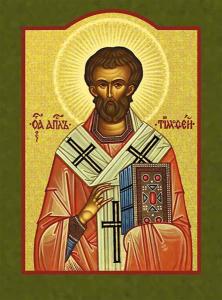
Statue of Saint Timothy at St. Timothy ‘s Church, The Villages, Florida Photo by Whoisjohngalt – Own work, CC BY-SA 4.0, https://commons.wikimedia.org/w/index.php?curid=85244772

1 Timothy is the first of a collection of letters called the Pastoral letters, and although these three letters are often treated together, each letter has its own character and reason for being written. 1 Timothy is addressed to Timothy, but it is likely intended to be read to the community that Timothy is working with rather than being a more personal letter like 2 Timothy. I am working through this reflection from the perspective that 1 Timothy is an authentic letter from Paul (see discussion in the Introduction to the Pastoral Letters) writing to Timothy at Ephesus.

Ephesus, on the western edge of modern-day Turkey, as Luke Timothy Johnson describes it,

Ephesus was “the first and greatest metropolis of Asia,” …Its population during the early empire was probably between 100,000 and 150,000, making it rank only below Rome and Alexandria in size as an urban center. (Johnson, 2001, p. 142)

Being one of the largest cities in the Roman empire, it is a place where there are already Christian disciples present before Paul’s arrival according to the book of Acts (Acts 19: 1-7). Yet, these Christian disciples are missing a critical component of the understanding of baptism. One of the reasons some readers feel this letter is not from Paul but from a later writer is that it does not precisely line up with the narration of the book of Acts where Paul sends Timothy to Macedonia, while he stays in Ephesus (Acts 19:22), but it is plausible that after Paul goes to Macedonia that he sends Timothy as his representative to address issues continuing to emerge among the communities of faithful in Ephesus.

One of the things that is clear from the letter is that the community of the faithful in Ephesus that Timothy is attempting to guide and correct is dealing with conflicts over beliefs and behaviors. There are connections between this letter and 1 Corinthians, but also between content in Ephesians. As we approach this letter to Timothy and the churches in Ephesus, it is worth remembering that Paul is writing to a community in trouble. Paul’s intention here is to correct issues that are emerging and threatening the future of these communities of faith and to strengthen Timothy’s presence among them. In Thomas Long’s memorable image, “In the Pastoral Epistles, though we see the church on the mechanic’s lift in the garage, and we are given guidance form performing an ecclesial engine overhaul.” (Long, 2016, p. 1) Yet, the work of performing an “ecclesial engine overhaul” is messy work.

In 1 Timothy there will be solutions that Paul commands that may be unpopular to many people today. Paul leans into traditional gender roles, traditional roles in societal hierarchy, and we see within these churches one of the early mentions of deacons and bishops. Paul is not a systematic theologian in this letter presenting a solution for all times and places, he is rolling up his sleeves to get his hands dirty with the overhaul needed in this community at this time. Yet, it is always dangerous to attempt to read modern values onto ancient people. There are several difficult passages to work through in this short letter, but I believe an honest conversation with these texts is fruitful even if it can be difficult.

Among many modern readers 1 Timothy has received skeptical and critical readings, but what I will be attempting is a charitable and generous reading. Ellen Davis, a writer I’ve learned a great deal from, describes a charitable reading in this way:

The difficult text is worthy of charity from its interpreters. Interpretive charity does not mean pity but rather something more like generosity and patience toward the text…Charitable reading requires considerable effort; it is easier to dispense with the difficult text. Those who regard a text as religiously authoritative are willing to sustain that effort, because they perceive it in some sense as a gift from God. (Davis, 2003, p. 178)

One of the perspectives I adopted when I was working through Deuteronomy was to wonder what type of world or community it was attempting to imagine. I look forward to the process of trying to imagine the community of faith that Paul and Timothy desire at the completion of this ecclesial engine overhaul.

James 4 Addressing the Cause of the Conflicts in the Body

Job (oil on canvas) by Bonnat, Leon Joseph Florentin (1833-1922)

James 4:1-10

 1Those conflicts and disputes among you, where do they come from? Do they not come from your cravings that are at war within you? 2You want something and do not have it, so you commit murder. And you covet something and cannot obtain it, so you engage in disputes and conflicts. You do not have because you do not ask. 3You ask and do not receive because you ask wrongly, in order to spend what you get on your pleasures. 4Adulterers! Do you not know that friendship with the world is enmity with God? Therefore whoever wishes to be a friend of the world becomes an enemy of God. 5Or do you suppose that the scripture speaks to no purpose? Does the spirit that God caused to dwell in us desire envy? 6But God gives all the more grace; therefore it says,
 “God opposes the proud
  but gives grace to the humble.”
7
Submit yourselves therefore to God. Resist the devil, and he will flee from you. 8Draw near to God, and he will draw near to you. Cleanse your hands, you sinners, and purify your hearts, you double-minded. 9Lament and mourn and weep. Let your laughter be turned into mourning and your joy into dejection. 10Humble yourselves before the Lord, and he will exalt you.

James begins this portion of his letter with a set of militaristic terms which are to be at odds with the wisdom which comes from above which is pure, peaceable, gentle, willing to yield, full of mercy and good fruits, and without a trace of partiality or hypocrisy (3:17). Yet, it is precisely these militaristic verbs of conflicts (polemos), disputes (mache), waging war (stateuo), commit murder (phoneuo), and conflict (polemeo) which are tearing the body apart. These warlike verbs are driven by cravings (hedone), want (epithymeo), and coveting (zealoo). Earlier James had linked cravings to temptation and temptation to sin and sin to death (1:14-15) and now these cravings, wants, and desires are dealing death in the body of the community. James uses this stark language to show how those he is addressing have adopted the values of the world rather than submitting to the wisdom of God.

James’s language is full of conflict-related terms, and he criticizes those who engage in disputes and conflicts, but I do not believe that James is provoking a conflict but instead identifying the conflicts that are already present in the body. It is possible that James is speaking of the war within you in a manner similar to Paul’s description of the internal conflict of Romans 7, but I find it more likely that James’s target is a conflict emerging externally within these early Christian communities. It is possible that the polemic (from the Greek polemos translated by the NRSVue here as conflict) is merely verbal and that the murder mentioned is merely metaphorical. Yet, this time before the Jewish war[1] was a time of factions and disputes within the Jewish community in Judea and Galilee and there may have been zealots (from the Greek zealoo translated by the NRSVue as coveting) who were engaged in violence to attempt to establish their vision of justice. There is a continual struggle in the Hebrew scriptures against those who seek their own pleasure/cravings (the Greek hedone where we get our term hedonic) and advantage at the expense of others in the community. Whether verbal or physical there is something rearing its head in the conflict of the community that represents the values of the world and not of God. Those called followers of Christ may be attempting to seize their desires through disputes and conflicts, and even when they do ask they ask merely for the hedonic things that the world values rather than entrusting their desires to God.

James leans into the prophetic language of adultery to speak of the unfaithfulness of these followers of Christ to the faith of Christ. As Scot McKnight illustrates:

Hosea was the first to speak of the covenant relationship of Israel with YHWH in terms of marital intimacy and marital infidelity (Hos 1-3, 9:1). His language was then picked up like variations on a theme, by Isaiah (54: 1-6, 57:3), Jeremiah (2:2; 3: 6-14, 20) and Ezekiel (16: 23-26-38; 23:45). Both Jesus (Matt 12:39; 16:4; Mark 8:38) and the early Christians (1 Cor 6:15; 2 Cor 11:2; Eph 5:22-32; Rev 19:7; 21:9) carried on this tradition by using marital imagery for God’s people and referring to disobedience as relational, covenantal infidelity. (McKnight, 2011, p. 332)

James is not alone in placing the world (and its values) in conflict with God and God’s covenant values. 1 John uses very similar language:

Do not love the world or the things in the world. The love of the Father is not in those who love the world, for all that is in the world—the desire of the flesh, the desire of the eyes, the pride in riches—comes not from the Father but from the world. And the world and its desire are passing away, but those who do the will of God abide forever. 1 John 2: 15-17

Jesus would tell his followers that one cannot serve two masters, and although in Matthew’s gospel Jesus is placing God and wealth (mammon) in conflict (Matthew 6:24) here friendship with the word (and its values) is enmity with God. Those who James addresses are mistaking earthly things for heavenly things, worldly wisdom for divine wisdom.

Verse five and six have given interpreters a lot of struggles throughout history. Many readers have been confused because James appears to cite an unknown scripture with unclear Greek grammar. (Moore-Keish, 2019, p. 145) One possible solution which I find helpful is proposed by Scot McKnight that the scripture quoted is Proverbs 3:34 which actually is quoted in verse six, and the remainder of verse five is setting the framework for James quoting Proverbs. Another option McKnight mentions is the general theme of God’s jealous love throughout the scriptures. (McKnight, 2011, p. 336) This quote contrasting the proud (scorners in NRSVue’s translation of Proverbs 3:34)[2] and the humble who God grants grace to forms a pivot between James’s identification of the conflicts in the community and the distorted worldview that causes the conflicts and the actions of those who would follow the way of Christ.

Ten imperatives occurring in a staccato manner provide the call to action in resisting the friendship of the world. James calls these Jesus followers to submit, resist, draw near, cleanse, purify, lament, mourn, weep, allow laughter to be turned to mourning, and humble themselves. Both James and 1 Peter use Proverbs 3:34 and then turn to imperatives to shape the proper actions of the community in similar manners:

In the same way, you who are younger must be subject to the elders. And all of you must clothe yourselves with humility in your dealings with one another, for
 “God opposes the proud
  but gives grace to the humble.”
Humble yourselves, therefore, under the mighty hand of God, so that he may exalt you in due time.Cast all your anxiety on him, because he cares for you. Discipline yourselves; keep alert. Like a roaring lion your adversary the devil prowls around, looking for someone to devour. Resist him, steadfast in your faith, for you know that your brothers and sisters in all the world are undergoing the same kinds of suffering. 1 Peter 5: 5-9

Submission to God and God’s will is a common theme in the Hebrew scriptures. The call to resist (anthistemi) has the military connotation to stand one’s ground, hence Ephesians uses this term:

Therefore take up the whole armor of God, so that you may be able to withstand on the evil day and, having prevailed against everything, to stand firm (anthistemi). Ephesians 6:13

In Genesis, in the story of Cain and Able, Cain is instructed to resist sin:

The Lord said to Cain, “Why are you angry, and why has your countenance fallen? If you do well, will you not be accepted? And if you do not do well, sin is lurking at the door; its desire is for you, but you must master it.” Genesis 4: 6-7

Here James is telling these followers of Christ if they stand firm (resist) the devil that it will cause him to flee. Throughout the prophets there is a call to return to God, for example:

Therefore say to them: Thus says the Lord of hosts: Return to me, says the Lord of hosts, and I will return to you, says the Lord of hosts. Zech 1:3 (see also Malachi 3:7)

James continues to draw together themes from throughout scriptures in an echo of Psalm 24:

Who shall ascend the hill of the Lord? And who shall stand in his holy place? Those who have clean hands and pure hearts, who do not lift up their souls to what is false and do not swear deceitfully. Psalm 24: 3-4

The idea of being double-minded, trying to be friends with God and the world, have been present throughout this section but here James utilizes the term first used in 1:7. James would likely agree with Ecclesiastes that there is a time for everything, but the conflict at work in the community demonstrates to James that it is a time for mourning. As the prophet Joel could state to his community:

Yet even now, says the Lord, return to me with all your heart, with fasting, with weeping, and with mourning; rend your hearts and not your clothing. Return to the Lord your God,for he is gracious and merciful, slow to anger, abounding in steadfast love, and relenting from punishment. Joel 2: 12-13

I do not believe that James is intending to form a dour community but reading the signs of the times he feels that those who are laughing now will mourn when God’s kingdom comes and those who are mourning now will laugh (Luke 6:25). The people of God are to embrace humility (tapeinosis) in a way very different than the surrounding world. As Joel Green states, “Outside biblical useage, the terminology for one who is humble (tapeinos)or humility (tapeinosis) is generally negative.” (Green, 2025, p. 122) The New Testament thinks of this term very differently as Mary’s song illustrates when it declares that God has “looked with favor on the lowly state [tapeinosis] of his servant,” and ”lifts up the lowly [tapeinos]” (Luke 1: 48, 52)

Almost two millenia after James wrote his letter to these twelve tribes in the Diaspora, we still struggle to separate the ways of the world from the ways of God. Walter Brueggemann describes our plight in this way,

We who are not the richest nation are today’s main coveters….the central problem of our lives is that we are torn apart by the conflict between our attraction to the good news of God’s abundance and the power of our belief in scarcity—a belief that makes us greedy, mean and unneighborly. We spend our lives trying to sort out this ambiguity. (Moore-Keish, 2019, p. 145) quoting Brueggemann, “The Liturgy of Abundance and the Myth of Scarcity”

In a culture that promotes cravings (hedone), want (epithymeo), and coveting (zealoo) we also are called to submit, resist, draw near, cleanse, purify, lament, mourn, weep, allow laughter to be turned to mourning, and humble ourselves. Our faith tells us that God will provide what we need and yet the world tells us we must seize and secure our own future. James may be frustrated with his initial hearers yet I doubt his language would change much if he were able to address the followers of Christ scattered throughout the world today and divided by our own conflicts, disputes, and even wars.

James 4: 11-12

  11Do not speak evil against one another, brothers and sisters. Whoever speaks evil against another or judges another speaks evil against the law and judges the law, but if you judge the law, you are not a doer of the law but a judge. 12There is one lawgiver and judge who is able to save and to destroy. So who, then, are you to judge your neighbor?

James has already indicated at the beginning of chapter three that not many should be teachers because of the danger of the misuse of the tongue and the danger it can cause in the community. Now James instructs the not to speak against (Greek katalaleo, NRSVue speak evil) or judge (Greek krivo) their neighbor. James again echoes Jesus in the Sermon on the Mount (Matthew 7:1-5) when he commands his followers not to judge. The one lawgiver who can save and destroy is God (see Matthew 10:28; Deuteronomy 32:39) and followers of the way of Jesus are not to put themselves in God’s place where they are the judges of the law. The followers of Christ are to learn to be doers of the law and worry about the log in their own eye before they attempt to remove the mote from their neighbor’s eye. (Matthew 7:5).

Image from https://www.sciencedaily.com/releases/2014/01/140130190453.htm

James 4: 13-17

  13Come now, you who say, “Today or tomorrow we will go to such and such a town and spend a year there, doing business and making money.” 14Yet you do not even know what tomorrow will bring. What is your life? For you are a mist that appears for a little while and then vanishes. 15Instead you ought to say, “If the Lord wishes, we will live and do this or that.” 16As it is, you boast in your arrogance; all such boasting is evil. 17Anyone, then, who knows the right thing to do and fails to do it commits sin.

In humbling oneself and submitting to God one learns the wisdom that one’s life is completely in God’s hands. The foolish person believes they are the master of their own destiny and like the rich young fool in Luke 12: 15-20 makes grandiose plans for a future that never arrives. James taps into the one of the fundamental insights of Ecclesiastes and Proverbs about the evanescent nature of life. Humanity is mist which appears for a little while and vanishes. This immediately calls to mind one of the favorite words of the writer of Ecclesiastes, the Hebrew word hebel (or hevel)[3]. This Hebrew word is where Abel’s name comes from in Genesis 4 and although most English translations render it as vanity it literally means vapor, smoke, mist. Humans for James and Ecclesiastes are hebel/hevel. Or as Proverbs can state, “Do not boast about tomorrow, for you do not know what a day may bring.” (Proverbs 27:1) and “The human mind may devise many plans, but it is the purpose of the Lord that will be established.” (Proverbs 19:21)

Language is important to James because it demonstrates that one understands one’s place within God’s world. Instead of claiming that one is the master of one’s future one submits one’s life to the will of God. To boast of one’s own self-security and future is the way of the world and in opposition to God.

Language is important to James, but it is not sufficient. Knowledge is also important but insufficient. Just as faith without works is dead for James, one who knows the right thing and does not act in accordance with that knowledge commits sin. James is attempting to form communities scattered throughout the world who can resist the ways of the world and carrying a living faith which can follow the way of Jesus faithfully as they await with patience the coming of the kingdom of God.


[1] Assuming the letter is from James the Just who dies in 62 CE or someone roughly contemporary to him.

[2] Often scripture quoted in the New Testament may be subtly different than in the Old Testament/Hebrew Scriptures and this normally is because the New Testament will quote the Septuagint (the Greek translation of the Hebrew Scriptures) while the NRSVue and most other English translations go back to the Hebrew text. Hebrew is a very different language than Greek or English and there is often shades of meaning that are unable to be fully captured in any translation.

[3] In Hebrew the letter ‘Bet’ can be either a ‘b’ or ‘v’ sound.