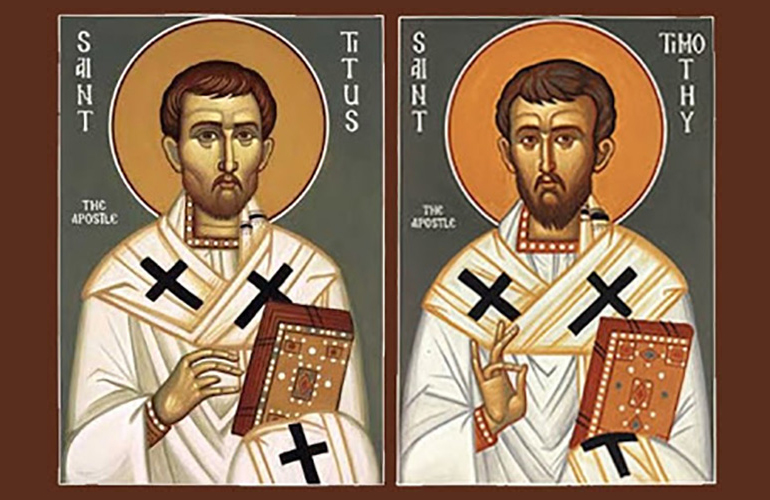
1 Timothy 6: 1-2a
Bolded text has notes on translation below.
1 Let all who are under the yoke of slavery regard their masters as worthy of all honor, so that the name of God and the teaching may not be blasphemed. 2 Those who have believing masters must not be disrespectful to them on the ground that they are brothers and sisters; rather, they must serve them all the more, since those who benefit by their service are believers and beloved.
The Ephesus that Paul writes to in 1 Timothy is a very different world than our modern minds are used to. The views on sexuality, the place of women in worship, expectations of leaders, expectations of families in relation to their parents, and now slavery are all challenging topics that should invite discussion. It is also important to acknowledge that these texts have been used to impose the worldview of the ancient world or to resist the movements for change for women, enslaved people, and other groups throughout history. I do believe that as 2 Timothy states:
All scripture is inspired by God and is useful for teaching, for reproof, for correction, and for training in righteousness 2 Timothy 3:16
Engaging in the places where scripture is challenging should allow us to refine our values and why we hold them so that we may be trained to embody righteousness in our own time.
Slavery in the ancient world, particularly in the Roman empire of Paul’s time, was a part of the way that the world was ordered. Paul did not defend slavery, but he also did not condemn it. In Philemon Paul speaks on behalf of the runaway slave Onesimus and encourages him to be received back as “more than a slave, a beloved brother” (16) but acknowledges Philemon’s role as Onesimus’s master and his ability to make decisions about his slave’s future. Ephesians 6:5-8 and Colossians 3:22-24 include master/slave relations as a part of the household codes with expectations for both masters and slaves, but not challenging the reality of slavery in the Roman world. Paul is not alone in this. 1 Peter 2: 18-25, the Didache 4:10, and several other early Christian documents operate with the understanding that slavery was a part of the ordering of the Roman world. Thomas Long makes a helpful analogy when he states:
The Pastor could no more envision a society this side of heaven in which there was no slavery than those of us raised in the 1950s and 1960s could imagine the digital world we now inhabit. (Long, 2016, p. 166)
Slavery in Rome was not based on any racial dynamic. Many slaves were captured in the wars the Roman empire fought which brought slaves from Africa, the Middle East, and Europe. Many scholars once believed that most slavery in the Roman world was for a fixed number of years and that it allowed opportunities for advancement, but that is now highly debated. Some slaves could operate with immense power on behalf of their master, and that is the world envisioned in many of Jesus’s parables, but slavery was a massive portion of the economy in Roman society.
Before I comment directly on the text, I want to briefly talk about slavery as it is understood in the history of the United States. The reality of chattel slavery in the United States was very different from the ancient world. Instead of being predominantly urban it was predominantly rural. It underwrote the economy in the southern United States, particularly the farming of cotton. One dynamic was that the slaves in the United States, brought forcibly from Africa, was that they were viewed as less human than their white masters. Willie James Jennings in his book The Christian Imagination: Theology and the Origins of Race discusses a deformed Christian imagination which allowed generations of missionaries, priests, bishops, as well as everyday Christians to be unable to see the common humanity of the people indigenous to Africa, Asia and the New World. Throughout the era of colonization, the colonizers practiced an inverted hospitality where they assumed that the land, the resources, and even the people were there in service to them. Yet, the same scripture read by the colonizers would eventually be read in a new light by abolitionist, slaves, and the colonized. One critical difference for Paul is that both the slaves and the masters were brothers and sisters sharing both a common humanity and a common calling in Christ.
Paul only addresses the slaves and not the masters in 1 Timothy, and it is plausible that once again Paul is addressing a problem that has emerged as both slaves and masters hear the language of being brothers and sisters in Christ while living as master/slave in the household. Those under the yoke of slavery are commanded to regard their masters as worthy of honor (tima, the same term in the previous chapter for true widows and worthy elders are entitled to). Many of the slaves in the community may not have served believing masters and actions of disrespect towards their masters may be bringing suspicion to the communities in the eyes of the surrounding community. For those whose masters were believers they may be asserting their equality in the household or refusing to serve. There is no evidence in Paul’s letters of rebellion, but the view of the masters was likely diminished in the eyes of their slaves. As Luke Timothy Johnson states:
In the ancient world, such attitudinal derogation was almost worse than open rebellion, for it more effectively subverted the social order. (Johnson, 2001, p. 288)
Yet, Paul’s language is not as one sided as the English renders it. The word translated “serve them” (euergesia) is a word of benefaction, something normally reserved for those in power. Paul’s language indicates that the slave serving the master is done from a position of power. Paul will call the believing masters believers and beloved suggesting that the slave and master share a bond that remains distinctive to their shared commitment to Jesus. I’m not willing to go quite as far as Luke Timothy Johnson to state that Paul’s language here may be more liberating than his diplomacy with Philemon (Johnson, 2001, p. 290) but Paul throughout his letters has attempted to find a way to manage the realities of being brothers and sisters in the church (ekklesia) with the realities of men and women, slave and master, rich and poor in the Roman household (oikos). Paul, like Christians of all times, live in the hope of the new creation but must continue to function in the environment and expectations of their time.
1 Timothy 6: 2b-19
Teach and urge these duties. 3 Whoever teaches otherwise and does not agree with the sound words of our Lord Jesus Christ and the teaching that is in accordance with godliness 4 is conceited, understanding nothing, and has a morbid craving for controversy and for disputes about words. From these come envy, dissension, slander, base suspicions, 5 and wrangling among those who are depraved in mind and bereft of the truth, imagining that godliness is a means of gain. 6 Of course, there is great gain in godliness combined with contentment, 7 for we brought nothing into the world, so that we can take nothing out of it, 8 but if we have food and clothing, we will be content with these. 9 But those who want to be rich fall into temptation and are trapped by many senseless and harmful desires that plunge people into ruin and destruction. 10 For the love of money is a root of all kinds of evil, and in their eagerness to be rich some have wandered away from the faith and pierced themselves with many pains.
11 But as for you, man of God, shun all this; pursue righteousness, godliness, faith, love, endurance, gentleness. 12 Fight the good fight of the faith; take hold of the eternal life to which you were called and for which you made the good confession in the presence of many witnesses. 13 In the presence of God, who gives life to all things, and of Christ Jesus, who in his testimony before Pontius Pilate made the good confession, I charge you 14 to keep the commandment without spot or blame until the manifestation of our Lord Jesus Christ, 15 which he will bring about at the right time—he who is the blessed and only Sovereign, the King of kings and Lord of lords. 16 It is he alone who has immortality and dwells in unapproachable light, whom no one has ever seen or can see; to him be honor and eternal dominion. Amen.
17 As for those who in the present age are rich, command them not to be haughty or to set their hopes on the uncertainty of riches but rather on God, who richly provides us with everything for our enjoyment. 18 They are to do good, to be rich in good works, generous, and ready to share, 19 thus storing up for themselves the treasure of a good foundation for the future, so that they may take hold of the life that really is life.
Paul encourages Timothy to continue to teach and urge the congregation to maintain their responsibilities in the church and the home. Those teaching otherwise (heterodidaskalia– literally another or other teaching) are in contrast with the healthy (hugianousin where our modern word hygiene comes from) words received from Jesus and the teaching in accordance with godliness (eusebia one of Paul’s favorite words throughout this letter, as mentioned before it has elements of religion, piety, godliness and it involves the entire practice of faith). In contrast to the healthy words of Jesus are the sick (nouson NRSVue morbid) words which crave controversy and are deluded[1] disputing about words. From these other teachings, which have wandered away from the healthy words received from Jesus, spring a list of vices which end with the idea of eusebia (religion/piety) being utilized for gain.
The idea of religion/piety being utilized for personal gain is a theme that emerges throughout history. Jesus criticized religious leaders in his time who:
As he taught, he said, “Beware of the scribes, who like to walk around in long robes and to be greeted with respect in the marketplaces and to have the best seats in the synagogues and places of honor at banquets! They devour widows’ houses and for the sake of appearance say long prayers. They will receive the greater condemnation.” Mark 12: 38-40
Paul makes it clear that elders who teach well are worthy of honor (tima) which includes financial compensation, but it is plausible that some leaders have emerged who have utilized their position in the community to benefit their honor and financial status. It is also highly likely that the financial troubles of some of the widows in the community may be related to these teachers who in Paul’s view have misled these women.
It is also important to acknowledge that reading 1 Timothy, along with the other New Testament letters, undermines the sociological assumption that I was taught in seminary: that the early Christians all came from among the poor. Summarizing several themes from the letter Luke Timothy Johnson points out:
We have already seen that some believers were slave owners (6:1-2). Some women were able at worship to make a display of their extravagant clothing, hairdos, and jewelry (2:9). Some families were in the position to support the poor widows of their households (5:4, 8, 16). I have already suggested that the presence of such visible wealth presented temptations to leaders. …Paul takes pain to ensure that supervisors and helpers not be lovers of money (3:3) or do anything for a profit (3:8). (Johnson, 2001, pp. 302-303)
Paul points to a godliness (eusebia) combined with contentment (autarkeia) in contrast with the use of godliness for gain. Autarkeia is an important virtue for Stoics and Cynics, but Paul is not opposed to using an idea from the surrounding culture to communicate how the life of faith is practiced. Paul uses the same term in Philippians 4:11, ”Not that I am referring to being in need, for I have learned to be content (autarkeia) with whatever I have.” In contrast those who are not content and desire to be rich are faced with many destructive temptations.
The most famous verse in 1 Timothy is verse ten, and the NRSVue correctly identifies that “the love of money is a root of all kinds of evil.” Most earlier translations added the exclusive “the” which is not present in the Greek. The exclusive translations seem to indicate in this proverb that the love of money is the only root of evil, but the Greek indicates that this desire is one among the many roots. Yet, it is a critical root and Paul will return one additional time to how followers of Jesus with wealth are to act to prevent them from wandering away from the faith and being pierced by many pains.
Paul turns again to Timothy encouraging him to pursue righteousness, godliness, faith, love, endurance, and gentleness instead of wealth. Fight the good fight here is the language of sports, unlike 1:18 where the Greek is the language of military conflict, where Timothy is encourage to strive towards the life of the new age (NRSVue eternal life) which Timothy has confessed. This is one of only three times where Pilate is given the title Pontius in the bible[2] and Jesus’s confession before Pilate likely refers to a narrative similar to the passion narrative of either the synoptic gospels or the gospel of John. This may also indicate an early confession emerging among the church where Pilate’s title is linked to his person as occurs in the Apostles’ and Nicene Creeds. Paul and Timothy await the manifestation of Jesus which will be brought about in God’s time (kairos).[3] The language of verse fifteen and sixteen may have been a confession of faith utilized in the Ephesian communities. The statement that no one has ever seen God likely originates in God’s words to Moses in Exodus 33:20 and echoes in the conclusion of the prologue of John’s gospel:” No one has ever seen God. It is the only Son, himself God, who is close to the Father’s heart, who has made him known.” (John 1:18)
Paul returns to how those with wealth are to live as believers. One of the dangers throughout the bible related to wealth is that the wealthy one believes they are self-reliant and they fail to acknowledge the gifts they have received from God. The love of money may be a root of all kinds of evil, but Paul does not view wealth as inherently evil. If they have been given wealth, they are to use that wealth to be generous, do good, and share. Paul echoes the language of the gospels of storing up treasures (Matthew 6: 19-20; 19:21; Luke 12:21, 33-34). Engaging wealth as a gift to be generous with rather than something to be loved and sought after enables the faithful one to take hold of the life that really is life.
1 Timothy 6: 20-21
20 Timothy, guard the deposit entrusted to you. Avoid the profane chatter and contradictions of what is falsely called knowledge; 21 by professing it some have missed the mark as regards the faith.
Grace be with you.
Paul closes with a final reminder to Timothy to protect the gospel he learned from Paul in the face of competing messages. This other teaching is falsely named (Greek pseudonumoo- pseudonym) knowledge. Other in Ephesus, and likely elsewhere, have focused on the wrong thing and missed the mark. Timothy is to hold fast and guard the precious gift of faith he has received and Paul closes the letter wishing for grace to rest upon his young delegate trying restore order and unity in faith to this community which has been fractured by bad teaching and harmful practices.
[1] Jouette Bassler notes that deluded is a better translation of tetyphotai than the NRSVue’s conceited. (Bassler, 1996, p. 109)
[2] See also Luke 3:1, Acts 4:27.
[3] Kairos time as opposed to chronos (chronological) time is appointed time or special time. Within the world of the New Testament is was time appointed by God for a specific purpose.