Tag Archives: Marcion

Introduction to the Pastoral Letters: 1 Timothy, 2 Timothy, and Titus

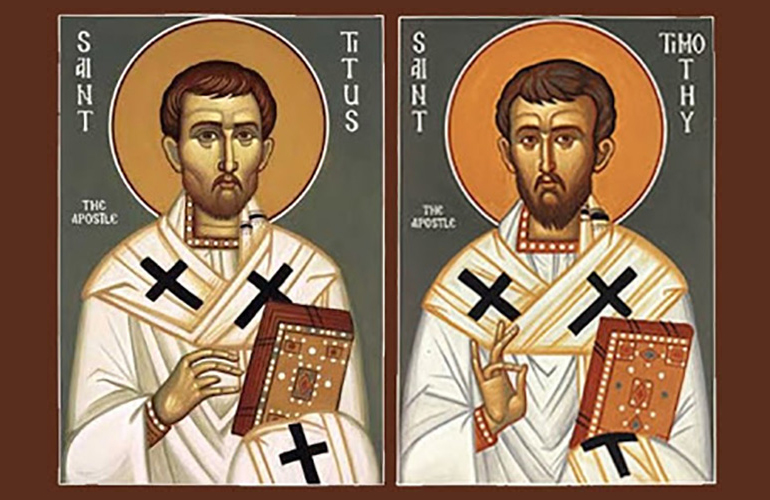
Icon of Saint Titus and Saint Timothy. Image from Timothy and Titus, Companions of Saint Paul – The Episcopal Church

Every pastor has portions of scripture that are central and that they know well and other portions that they are less familiar with and less likely to use in their preaching and teaching. One of my motivations within these reflections has been to expand my familiarity and comfort with portions of scripture I was less familiar with. To utilize a couple verses of 2 Timothy:

All scripture is inspired by God and is useful for teaching, for reproof, for correction, and for training in righteousness,so that the person of God may be proficient, equipped for every good work. 2 Timothy 3: 16-17

Yet, there is some irony in the way 1& 2 Timothy and Titus are viewed by many modern scholars. Since the nineteenth century many scholars have questioned whether these three books were written by Paul or whether they are written after Paul’s death utilizing Paul’s reputation to give force to these letters. The letters, for many, may still be scripture but they have been relegated to a secondary, or in some cases even lower, status because they may not be viewed as ‘authentically Pauline’ and coming from a later stage in the formation of the church rather than being one of the earlier witnesses to the formation of Christianity. The New Testament professors I had in seminary handed on the consensus that Pastoral letters were not Pauline and therefore received little if any attention. Because of this the very books that claim all scripture is inspired by God and useful are among the most neglected in the New Testament.

My assumption throughout these reflections will be that 1 & 2 Timothy as well as Titus are written by Paul the Apostle. I will go into more of my reasoning below, but whether they are written by Paul or a student of Paul they remain for me, and for Christianity as a whole, a part of our scriptures. To many readers of the Bible the type of discussions that scholars have about texts can be confusing. Most readers of the bible may not spend a lot of time in 1& 2 Timothy and Titus, but they also would be wary of someone questioning the authority of these books they accept as scripture. There are some portions of these letters that modern readers find jarring, especially when talking about women in the church and the existence of slavery. Like all scripture we must wrestle with what it meant in it is specific to the time and audience it is written to and what expectations we bring to our own time. Yet, for me, I find this type of wrestling with scripture, trying to understand it on its own terms and to imagine the world it is trying to create in its original environment a fruitful and life-giving process.

For most of the history of the church the Pastoral Letters were assumed to be Pauline. The only groups that did not include these letters as a part of scripture, like the followers of Marcion[1] and perhaps Valentinius, were considered heretics and their exclusion of these books were not based on any questions of authorship. Polycarp appears to reference 1 Timothy and 2 Timothy in his Letter to the Philippians dated between 110 and 135 CE and the book is heavily utilized by early church leaders like Ireneaus, Clement, and Tertullian. The first person to challenge the Pauline authorship of the Pastoral Letters was Fredrich Schleirmacher, an influential German theologian and scholar, in 1806. Schleirmacher felt there was a Pauline style that could be measured and these letters failed to meet the criteria. Many other scholars would follow Schleirmacher developing authentic Pauline themes and vocabulary to test these letters against while others would compare the events of the letters with the narration of Paul’s ministry in Acts,[2] while others simply went along with what seemed to be an emerging scholarly consensus in the nineteenth and twentieth century.[3]

The reasoning behind my engaging 1 & 2 Timothy and Titus as Pauline letters is fairly simple. First, all three letters explicitly claim to be written by Paul (1 Timothy 1:1; 2 Timothy 1:1; Titus 1:1). Although writing a letter or document under the name of an established individual was a common practice in the ancient world as was viewed as honorific rather than dishonest, for me there would have to be some decisive reason to distrust what the letters claim to be. Secondly, each letter has its own character (1 Timothy is less personal and probably intended to be heard by a congregation) but in 2 Timothy 4 and Titus 3 there are some very personal moments and a lot of people, who the original recipients of the letter were likely aware of and who would raise questions for any reader with knowledge of Paul’s time in ministry if they were created to pass off the letters as authentic.

Christian scholars who do not view these letters as authentically Pauline will typically point to a handful of reasons: the letters do not reflect Paul’s theology, the letters utilize different language than the authentic Pauline letters, the conflicts and the type of organization/hierarchy in the church are presumed to come from a later time. I appreciate and have benefited from the works of those, like James D. G. Dunn, who write works like The Theology of Paul the Apostle and take the ‘authentic Pauline letters’ as the source to identify the elements of Paul’s theology. However, Paul is not a systematic theologian and writes letters to deal with concrete issues in communities and relationships that he knew. Paul may think theologically but his letters are also shaped strongly by the context they are written to. Paul’s language changes dramatically between letters as well: Romans may share similar language to Galatians, but 1 Corinthians employs very different terms. Paul does talk of people being led astray by ‘myths and endless genealogies’ (1 Timothy 1:6) which many scholars of the late nineteenth and early twentieth centuries linked with Gnosticism[4] but we simply do not know the exact issues that these communities are dealing with. The roles of bishop and deacon outlined in these letters does not necessarily indicate a late date nor the highly institutional roles these would later become. Luke Timothy Johnson also highlights that Paul did not establish the community in Ephesus and that the letters presume the existence of these roles and only give advice about the mental and moral qualities of the people who should fill these roles. (Johnson, 2001, p. 75)

There are some difficult texts in 1 & 2 Timothy and Titus. We may wish for a Paul who continually lives out the vision of Galatians 3:28 where there is no longer Jew or Greek, slave or free, male or female. Yet, there are places, both in the Pastoral letters and in the other Pauline letters, where we look uncomfortably about what he may say about the role of women in communities, the assumptions of slavery and how slaves and masters are to relate to one another, sexuality, and several other issues. Paul is writing to his congregations almost two thousand years ago with very different assumptions, some of which Paul challenges and some of which Paul does not. Thomas Long is helpful when he states:

One could imagine many ways of relating to the emperor—pray for the emperor, not pray for the emperor, pray to the emperor, refuse to pray to the emperor, obey the emperor, resist the emperor, die for the emperor, die at the hands of the emperor—but a world without the emperor? Unimaginable. Therefore, the author of the Pastorals, given his context, will consistently offer advice about how to move the pieces on the chessboard. We sometimes lose patience with him because we expect him to throw out the chessboard and to change the game itself. (Long, 2016, p. 6)

The board we play on will look different than Paul’s, but it is fruitful to study the moves he makes based on his experience of God and the world he inhabits.

Dialogue Partners for these Reflections

Bassler, Jouette M. 1 Timothy, 2 Timothy, Titus: Abingdon New Testament Commentaries. (Nashville: Abingdon Press, 1996). Noted as (Bassler, 1996).

The Abingdon New Testament Commentaries are written to be accessible to those with some familiarity with the bible and are short enough that most readers can follow. Jouette Bassler taught at Perkins Theological Seminary at Southern Methodist University in Dallas. She comes from the perspective that the author of these letters is not Paul, but one who appreciates the pseudonymous author’s rhetorical skill and ethical and theological perspective.

Dunn, James D. G., “First and Second Letters to Timothy” and “Letter to Titus” in New Interpreter’s Bible: A Commentary in Twelve Volumes. Volume XI, pp. 789-880. (Nashville: Abingdon Press, 2000). Noted as (NIB XI).

The New Interpreter’s Bible is a good resource for pastors wanting a collection that includes the entire bible (including the apocrypha) and I have been impressed by the collection of scholars they assembled for this project.  James Dunn is a very highly respected New Testament scholar who taught for decades at the University of Durham in England. He has written heavily on Jesus, Paul, and the early church and is associated with the New Perspective on Paul which attempted to locate Paul within the matrix of Jewish thought in the first century. Dunn also views the Pastoral Letters as written by someone after Paul. The Theology of Paul the Apostle was an influential book for me when I was particularly focused on Pauline scholarship in 2005-2010.

Johnson, Luke Timothy. The First and Second Letters to Timothy: A New Translation with Introduction and Commentaries: The Achor Yale Bible. (New Haven, Yale University Press, 2001). Noted as (Johnson, 2001).

The Anchor Yale Bible Commentaries are designed to be textual commentaries with a lot of notes on the translation which I find to be helpful but are a bit clunky for a lot of readers. Luke Timothy Johnson teaches at Candler School of Theology at Emory University in Atlanta, Georgia. He is an excellent translator and thinker who is willing to challenge commonly held views. Johnson’s commentary is written from the perspective that Paul wrote 1& 2 Timothy as well as Titus (although his commentary is only on the first two letters). His introduction to all three letters and their reception by Christians throughout history is incredibly helpful.  

Long, Thomas G. 1 & 2 Timothy and Titus: Belief A Theological Commentary on the Bible. (Louisville, KY: Westminster John Knox Press, 2016) noted as (Long, 2016)

Thomas Long is a very well-know instructor of preaching who taught at Candler School of Theology, Emory University in Atlanta. The Belief Commentary series intentionally brought in theologians and non-biblical study specialists to write each volume to approach the texts from a different perspective than most traditional commentaries, an approach I’ve found to be a helpful voice. He also assumes that these letters are written by a later voice claiming to be Paul.


[1] Marcion believed that the Old Testament God was distinct from the gracious God of the New Testament and constructed a scripture that included ten letters of Paul, not including the Pastorals, and a highly modified version of Luke’s gospel. Marcion’s position was declared heretical by the church and Marcion was excommunicated by the church around 144 CE. Valentinius, a contemporary of Marcion, was a one of the early Gnostic teachers who were also viewed as heretics by the emerging church.  

[2] Ironically many scholars at the same time, and some of the same scholars, who viewed the Pastoral letters as inauthentic, viewed Luke’s narration in the book of Acts as unreliable as well.

[3] For those who want more detail on the historical reception of 1 & 2 Timothy and Titus see his excellent narration in his commentary. (Johnson, 2001, pp. 20-55)

[4] Gnosticism emerged both within and outside of Christianity in the Greco-Roman world and the term is broad covering a wide range of belief systems. Within Christianity we know of teachers like Valentinius in the mid-second century which does have a very elaborate ‘genealogy’.


Violence and the Bible

Battle of Gilboa by Jean Forquet (1420-1480)

Battle of Gilboa by Jean Forquet (1420-1480)

If you spend much time with scripture you have to come to some sense of resolution about how you will approach the question of violence within the Bible. If you are following what I am writing about Esther, we are entering a portion where when you take seriously the violence that is being talked about, which I will do, it should force you to ask some really difficult questions.

Probably the simplest answer that many people come to is to simply ignore it.  The bible like so much of the media we consume simply assumes violence is a part of life. In the book of Esther the violence is never ascribed to God or God’s will, it is simply a result of the way things are and the characters in the book work and live out of the societies assumption towards violence and revenge.  At other times the violence is directly attributed to God’s will, for example this is the prophet Samuel speaking to King Saul to get him to go and wipe out the Amalekites:

Thus says the Lord of hosts, ‘I will punish the Amalekites for what they did in opposing the Israelites when they came up out of Egypt. Now go and attack Amalek, and utterly destroy all that they have; do not spare them, but kill both man and woman, child and infant, ox and sheep, camel and donkey. 1 Samuel 15: 2-3

I choose this one because it may have some relevance to the story of Esther since the villan in the story is an Agagite (King Agag is the one Saul did not kill, but Samuel the prophet did and perhaps some think this is the cause of the animosity). But this is one of many throughout the Old Testament where God seems to tell the people in effect ‘wipe them out, all of them.’ At other times God is behind the violent action, whether in the plagues in Egypt or even God being behind the armies of Assyria and Babylon taking the people into exile. Yet on the other hand Jesus effectively argues for non-violent lifestyle, and throughout much of the Old Testament, particularly in the prophets, we see a hope for a vision of peace and harmony where swords are turned into plowshears and nations no longer train for war. The contrast was such that one of the earliest heresies in the church, Marcionism, argued that there were two gods, the New Testament God of Jesus and the Old Testament demiurge who was the violent and evil creator (more about Marcion in the Place of Authority 2-3: The Early Church’s Identity Problem).

At some level, I have had to reconcile how I approach this issue because within it rests a broader question on how we approach and value scripture:

An approach, but not one I advocate, followed by many conservative Christians is to fully embrace the picture of the violent God, hence God’s wrath and holiness become central parts of their theology. Within this approach violence may have a divine sanction, especially towards the other. This was the way of thinking that was operative during the crusades or the colonization of the Americas where the options presented were convert or die. This is in my opinion a very dangerous ideology and ripe for abuse in many ways, where the other is de-humanized and can be eliminated as offensive to God. Within this theology the spokesman (and it typically is a man-although not always) gets to determine what is holy and what is profane and as a mouthpiece of their god. Much violence, abuse, and destruction has been sanctioned by advocates of this theology and while one can make a biblical justification for it-it goes completely against the vision of Christianity I practice.

Another approach which tries to engage the question faithfully, is represented by the Old Testament scholar Walter Brueggemann, who states God is in recovery from violence. Brueggemann attempts to take the Old Testament witness very seriously as a whole and is a phenomenal interpreter of texts and theologian, yet this is still not the approach I would advocate. You can see Brueggemann talk about this way of thinking here.

As a Lutheran pastor there are several pieces of my tradition that form my approach to this question:

  1. Ultimately as a Lutheran I am focused on God’s action of coming down in the life and ministry of Jesus of Nazareth, or Jesus the Christ, as the lens through which the rest of scripture is viewed. Jesus words and ministry interpret and critique the rest of scripture, and so it is here that I look to find what God is like.
  2. Lutheran interpretation of scripture has always advocated for ‘a cannon within the cannon’ which is a fancy way of saying not all scripture has equal weight or value. As I mentioned a couple times going through Esther, Martin Luther didn’t like Esther (or James or Revelation for that matter) because what was important was what reveals Christ.
  3. Finally from a Lutheran perspective God is ultimately a gracious God and so while I would not go the direction of Marcion and eliminate the Old Testament, rather I read the bible back and forth, and even in the times of darkness and violence to ask the question of ‘where is the God of love in the midst of this’ and there may be parts where we say ‘the God of love does not seem to be in this’ at least at this point as we read, but sometime later we may see something different.

The scriptures are in dialogue with each other and are not one unified voice, but rather a chorus of different voice trying to point to God. I attempt to take scripture very seriously, but there will be times when I struggle against a certain piece (as I will with the ninth chapter of Esther) because it seems to go against the grain of the ultimate direction of where scripture is hearing, it may be out of tune with the rest of the chorus. Yet my own voice is just one voice within the larger chorus of voices trying to wrestle with the God scripture tries to point us to. The Old Testament in particular deals with the parts of life that we may not think God has much part of, yet it puts the place of God right in the middle of the messiness of life (violence, broken families, living in exile and many other situations). I think Ellen Davis does a very nice job talking about this here and I would like to think my way is similar to hers. Sometimes it means we will wrestle with scriptures and the pictures of God  it paints, but to me that is a part of our vocation as the people of God.

The perfectionist part of me struggles with putting out such a rough reflection, and I may come back and do some more work on this at another point, but I am also trying to put limits to how long I spend on any one project.

purple rose 01 by picsofflowers.blogspot.com

The Place of Authority 2-3:The Early Church’s Identity Problem

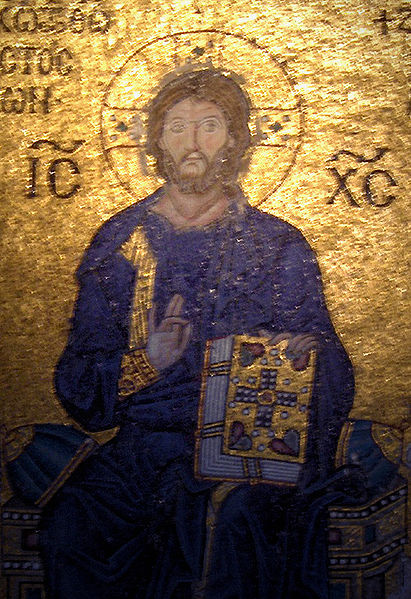
Image of Christ Pantocrator (Almighty or Lord of Hosts), Hagia Sopia, Istanbul, Turkey

When a movement is centered on one person who is no longer present in a corporeal (bodily) form that the members of that movement can continue to speak to and learn from eventually there will come an identity crisis where people begin to ask, “Are we following the right Jesus?” “Are we being faithful to his vision?” “Are we still following the God he pointed to?” As the church entered the second century it was dealing with heavy pressures from the empire around it and at the same time this early church had to figure out who it was from pressures from within.

It was still early in the church’s young life; the canon (the selections of works that would come to make up the bible) was not fixed. The four gospels, Matthew, Mark, Luke and John were in wide circulation as well as many of the letters associated with Paul, but depending where you went the Shepherd of Hermas or the Letters of Clement or the Didache may also be present (which would later be viewed a positive works but not held at the same level as scripture). The challenge to how to tell the story of being the people of Jesus arose from within and to react to this challenge the church adapted and changed.

One of Christianity’s greatest gifts was that it was not tied to one language or culture. As it spread across the known world at that time it would be quickly translated into Greek (the language of the Eastern half of the Roman Empire) and eventually into more and more languages and cultures. The reason that the books that are a part of the New Testament are in Greek, not Hebrew or Aramaic,  is that by the time the stories of Jesus are written down and as Paul and others wrote letters they were going to churches that primarily spoke Greek (at least as a second language). With this encounter with the Greek world and language also came an encounter with Greek thought which was much different from the Jewish or Hebrew worldview that Jesus and all the original apostles came out of. As Greek speaking and thinking individuals encountered Christianity and they translated the message they would both be changed by it and in their own way they would transform the message as well. The question has to emerge what is a valid transformation and what is not? Two long lasting assumptions that many Christians include as central to their thought: the immortality of the soul or the absoluteness of God are Greek ideas not Biblical ones and yet with the introduction of Greek culture they become a part of the thought of the early church.

One of the early challenges came from a wealthy Christian named Marcion. While Hebrew thought has no problem with contradictions and gaps, a Greek thinker like Marcion could not abide contradictions. Among other things, Marcion felt that the God of the Old Testament was not reconcilable with the God of Jesus. Marcion read how in the Old Testament that God called for wars which wiped out entire populations, called down judgments in a harsh and unforgiving manner and came to the conclusion that in combination with these things he read and the reality of suffering in the world that the creator must be evil and different from the God of Jesus. In contrast to almost every other church leader at the time, Marcion read Old Testament literally rather than allegorically. Marcion felt that the Old Testament should not be a part of the Christian scriptures and therefore it should be thrown out. In addition to this, in a Greek way of thinking that viewed sex, childbirth and the body in general as bad, Marcion could not accept that Christ was born of a woman-even if it was a virginal birth God could not be born of a woman. For the first time we begin to see in a very powerful way the emergence of theology more than narrative as formational for a way of thinking about God and Jesus. Marcion quickly identified the contradictions and the differences in the New Testament gospels that were being held in most churches, so he eliminated Matthew, Mark and John and seriously redacted Luke to try to remove anything “impure” to be put alongside of Paul’s letters (also purified of Jewish “interpolations”). These modifications were viewed to be unorthodox by the leaders of the church in Rome and in 144 CE he was expelled from the early church. Marcion became one of the earliest to try to put together a canon, a list of texts that would form the basis for the church’s authority and the church would continue to deal with his followers for decades.

Another threat to the view of who Christ was came from those often referred to as Gnostic Christians. Gnostics are so named because they believed that they had secret knowledge that others, including other Christians, did not have. I am not convinced that there is one direction among the groups and the scriptures that we might label Gnostic, in fact they seem to represent a wide range of things. We are the beneficiaries of the rediscovery of several of the Gnostic gospels at Nag Hammadi in 1945 which give us a window into what Gnosticism may have looked like. Some of these, like the Gospel of Thomas, are very similar to many of the sayings in Matthew and Luke and portray Jesus as a wisdom teacher. Others like the Gospel of Truth associated with the Gnosticism of the Valentinians develop a whole cosmology that put Jesus among many heavenly beings and looks very little like anything we would recognize as Christian. Like Marcion they held the body as bad and the soul as good (or divine spark would be a term you might see in Gnostic gospels) and the purpose of having the proper Gnostic knowledge is for that soul or divine spark to be liberated from the body.  Again the early church made the decision that this was not an accurate representation of the faith and the Gnostic gospels would not become a part of the canon.

Each time a crisis presented itself between a Greek way of thinking and a Jewish way of thinking the church attempted to remain with the Jewish way. At the same time, even while trying to remain close to the Jewish origins of the story, the questions that were being asked were no longer the questions of the Hebrew mind, they were the questions of the Greek world. The Bible began to be viewed in terms that were familiar to the Greek way of thinking, so God had to be omnipotent, omniscient and omnipresent (all powerful, all knowing and present everywhere) and this rather than the narrative became decisive for decisions. The biblical hope of a bodily resurrection at the return of Jesus, the participation in the new creation and all the images that populate the gospels and Paul’s letters began to be read in terms of the soul joining God in heaven. The story when it was read was often interpreted allegorically (there are gifts and challenges that come with this) and theology and a few common practices became the points where identity was formed for the early church. It is to these practices we will turn next.

purple rose 01 by picsofflowers.blogspot.com