Tag Archives: Ephesus

1 Timothy 3 Expectations of Leaders in the Community and the Mystery of the Faith

Highlighted terms or phrases have notes below on translation.

1 Timothy 3: 1-13 Qualifications of Overseers and Men and Women in Serving Roles

1The saying is sure: whoever aspires to the office of bishop desires a noble task. 2Now a bishop must be above reproach, married only once, temperate, self-controlled, respectable, hospitable, an apt teacher, 3not a drunkard, not violent but gentle, not quarrelsome, and not a lover of money. 4He must manage his own household well, keeping his children submissive and respectful in every way, 5for if someone does not know how to manage his own household, how can he take care of God’s church? 6He must not be a recent convert, or he may be puffed up with conceit and fall into the condemnation of the devil. 7Moreover, he must be well thought of by outsiders, so that he may not fall into disgrace and the snare of the devil.

  8Deacons likewise must be serious, not double-tongued, not indulging in much wine, not greedy for money; 9they must hold fast to the mystery of the faith with a clear conscience. 10And let them first be tested; then, if they prove themselves blameless, let them serve as deacons. 11Women likewise must be serious, not slanderers, but temperate, faithful in all things. 12Let deacons be married only once, and let them manage their children and their households well; 13for those who serve well as deacons gain a good standing for themselves and great boldness in the faith that is in Christ Jesus.

When we hear the titles of bishop and deacons and we talk about their role in taking care of the church we can easily overlay modern positions, authority, structure and assumptions onto this letter. To translate the Greek word episkopos (where the Episcopal church gets its name) as bishop for most modern readers conjures men (and women depending on your tradition) in ornate vestments participating and leading large numbers of churches and leaders. Deacons (Greek diakonoi) within most modern churches would fit somewhere lower in the hierarchy than bishops and in many places this role still maintains the connection with the service ministries of the church. Yet the church at the time Paul is writing to Timothy is far different than its modern incarnation.

The early churches in Ephesus carried out many of the activities that the synagogues did for the Jewish community throughout the diaspora: They prayed (2: 1-3), read and explained scripture (4:13), and cared for widows (5:3-16) and likely other vulnerable members of the community. However, it is significant that instead of the adoption of religious titles like priest, or even high priest, of the Jewish as well as other Roman temples, they utilize episkopos and diakonoi: “overseer” and “server.” The term episkopos was commonly used for positions with oversight, particularly financial oversight, in the surrounding culture. (Bassler, 1996, p. 64)

It is important to remember that the early church met primarily in the homes of one of the community members. The household of both individuals as well as the household of God is central to the language of 1 Timothy. As James D.G. Dunn states:

Just as good order in the state (2: 1-2) led into thoughts of good order in the household (2: 9-15), so also that leads into thoughts of good order in the church (3: 1-13). (NIB XI: 804)

Men in the Greco-Roman world who were viewed as leaders were expected to manage their household well. This is a world before the separation of work and home: the management of the home (Greek oikos) is foundational to the economic outputs (Greek oikonomia literally house management) for not only the home but for the city and empire. A man with disobedient children or an unstable marriage was viewed in the ancient world as a poor home-maker, and a person unable to manage their household was unlikely to be a good manager of the household of God.

It is likely that “overseers” or “bishops” were hosting gatherings of the faithful in their homes and their hospitality. The receiving and sending off of guests in the ancient world was a central role in households throughout the Greco-Roman and Jewish world, and it is likely that the hospitality expected of the episkopos could be costly as well as the frequent presence of Christians in their home.

The virtues listed for the “overseer” or “bishop” are virtues that would be “marks of good character” (Long, 2016, p. 88) throughout the culture.  Being beyond reproach introduces the list of virtues which focus more on how they embody their faith in their living than their mere knowledge of faith. “Married once” is literally “the husband of one woman” and can be understood to address a range of meanings: a man who marries once and if widowed does not remarry, or monogamous rather than polygamous, or faithful to one’s wife without a mistress, or ruling out divorce or serial matrimony, or it may be encouraging a married overseer in contrast to a celibate one. (Johnson, 2001, pp. 213-214) The list continues with temperate, self-controlled, and respectable—terms that will be expanded on in the following verse. As mentioned above, hospitality by inviting people into one’s household would be expected by an “overseer” and the only skill-based item on the list is that they are to be a good teacher.

These leaders are not to be addicted to wine, bullying, or a lovers of money. They are to be peaceable (a-machos in Greek) rather than one who engages in battle (mache), this would exclude a type of macho behavior that some mistake for leadership. As mentioned earlier, the management of one’s own household is an indicator of the possibility of being an leader in the community of the faithful. Just as women were to be submissive in the assembly (2:11) now the children of the “overseer” are also to be submissive. Finally these leaders are not to be recent converts (neophytes, Greek neophutov) so that they may not become overconfident or puffed up and be misled by the devil, but they are also to have a good witness (NRSVue well thought, Greek martupian (where our word martyr comes from) kalos). For these “overseers” there is the need for both a faithful example of a leader within the household and the public facing witness to the church’s faith and righteousness.

The requirements of “deacons” or “servers” is similar to the expectations of an “overseer.” Before drawing too great a distinction between “overseer” and “servers” it is worth noting that:

Paul, for example, describes Timothy (1 Thess 3:2), Phoebe (Rom 16:1), the civil ruler (Rom 13:4), Apollos (1 Cor 3:5), himself (2 Cor 6:4), and even Christ (Rom 15:8) as diakonoi. In Phil 1:1, the deacon is linked with the bishop or overseer, though the relationship between these two is not spelled out (cf. 1 Clem. 42. 4-5; Did. 15.1). Though Paul used this word, as he did “overseer,” to describe a role or function in 1 Timothy the noun clearly refers to a position for which one is tested. (Bassler, 1996, p. 69)

While Paul, Timothy, Apollos, and even Christ all serve, there does seem to be the beginning of a distinctive serving role in the young church. Paul here[1] and other places[2] accepts women in this role. One distinct addition to the description of the deacon is that they are not double-tongued (literally two worded). Thomas Long makes an educated guess about the possible need for this description:

If they indeed were practical helpers in the community, the ones who assisted the elders and bishops in their duties and the ones who did the legwork of running the financial support program for widows, then they would naturally be constantly in and out of homes in the community. If they were people who spike one way in one home and another way in another, if they were gossips who spread rumors and gave one version of events here and a different version there, or if they were duplicitous flatterers who spoke soothing words of comfort to a widow in need and then whispered about her to the next widow, they could easily spread the contagion of divisiveness. (Long, 2016, p. 93)

Like overseers they as men and women are to manage their household before they are entrusted to enter the household of others. They are to hold fast to the mysteries of the faith and not to spread false doctrines and practices. These “servers,” like the “overseers,” can build up the household of faith, or through unserious, deceitful talk, drunkenness, greed, or bad reputation damage the same household.

Although we do not know the details of the conflicts that Paul is writing to Timothy to help him address, the need for Paul to state to aspire to be an overseer is a good thing may continue to indicate that the struggles of the community has made good leaders cautious before assuming these roles in the community. It’s unlikely that Paul goes into this extended discussion of leadership without needing to address the absence of leaders of the proper character in these roles. For Paul the expectations of a good man (or woman) in fulfilling their roles within the household is the minimum threshold that all leaders in the household of faith should surpass.

There are many ways that our world and cultural expectations are different from the world of Paul but the need for ethical leadership remains. I have seen the damage that an unfaithful leader can do in a community and in half of the communities I have served I have had to intentionally rebuild trust between the community and their leaders. The scandals in the Catholic Church as well as Protestant churches have done great harm to the members of those communities and to the reputation of the church and its leaders in the society. New York times columnist Frank Bruni when commenting on the sex scandals in the Catholic church stated:

the evil that an entire institution can do, though it supposedly dedicates itself to good…[and by] the way that a religious organization can behave almost precisely as a corporation does, with fudged words, twisted logic and a transcendent instinct for self-protection that frequently trump the principled handing of a specific grievance or a particular victim. (Long, 2016, p. 91)

This is one of the passages that I have wrestled with personally since my divorce in 2010[3], and then my remarriage five years later. Although I have on occasion been told by another person in the church that I shouldn’t be a pastor because of my divorce I was fortunate to have a bishop as well as colleagues who prayed for me, offered counsel and guidance. I do think we underprepare people entering ministry and their families for the pressure of trying to balance their household and the demands of the household of faith.

Trying to set guidelines for leadership within the church takes wisdom and grace, but those set aside for leadership are held to a higher standard. An unfaithful leader can cause immense harm to their fellow members of the body of Christ, can destroy a congregation and damage the Church’s reputation, and unfortunately the desire to protect an institution’s reputation has often perpetuated the harm. Normally we focus on sexuality as the location of the damage, but I have also seen congregations damaged by the addiction of a leader, financial mismanagement, and bullying. Being above reproach, temperate, self-controlled, respectable, hospitable, and a faithful teacher while managing one’s relationships and household is a daunting task but it is also a noble one for the one called to such a ministry of overseeing a community of faith or the service ministries of the church.

1 Timothy 3: 14-16 The Mystery at the Heart of the Gospel


  14 I hope to come to you soon, but I am writing these instructions to you so that, 15 if I am delayed, you may know how one ought to behave in the household of God, which is the church of the living God, the pillar and support of the truth. 16 Without any doubt, the mystery of godliness is great:
 He was revealed in flesh,
  vindicated in spirit,
   seen by angels,
 proclaimed among gentiles,
  believed in throughout the world,
   taken up in glory.

Paul would be known to the community in Ephesus since, according to Acts 19, he spent two years there. As mentioned previously, Paul went to Macedonia and then sent Timothy back to Ephesus to address some of the problems reported in this letter. I know that a lot of very intelligent readers in the last two centuries have viewed this letter as written at a later date by a later author writing in Paul’s name, but there are a number of sections like this one where this later writer would have to fabricate not only these more personal addresses, but also why write a letter about two famous members of the church addressing issues at Ephesus when the people in that congregation would know Paul and Timothy, know their own situation (which is not presented in a flattering manner in this letter) likely within a generation of Paul’s death. Is it possible that someone later wrote 1 Timothy? It is possible, but to me the easier reading is that Paul is addressing his hope to return to the community at Ephesus in a world where travel is not quick or reliable. For later generations of Christians, we are the beneficiaries of Paul’s attempt to support the early Christian communities through writing letters which we continue to have.

Paul throughout his letters often talks about ‘mystery’ when referring to the revelation which led to his ministry among the Gentiles (Romans 11:25; Ephesians 3: 3-9; Colossians 1: 26-27). Here in 1 Timothy the ‘mystery of faith’ (v.9) and ‘the mystery of godliness’ (v. 16) appears to be linked to the confession of faith which concludes verse sixteen. What the NRSVue translates as ‘godliness’ is the Greek eusebia which is normally translated piety or religion, so Paul here is talking about the ‘mystery’ of the faith as it is practiced. Confessional fragments are common in Paul’s letters, the most famous examples being Philippians 2: 5-11 and Colossians 1: 15-23, and just as the later church would develop creeds as a teaching method of handing on the faith, the church of Paul’s day had these fragments which illuminate the narrative content of the faith of these followers of Jesus. Yet, as James D.G. Dunn states there is also a sense that there is a mysterious aspect to the faith, “requiring someone skilled in understanding and exposition to unveil it to initiates.” (NIB XI: 807)

The six lines in the NRSVue are short but focus on key points of the story of Jesus. Jesus was revealed ‘in the flesh’ a key Pauline term which here reflects the humanity of Jesus without Paul’s normal negative implication of the flesh’s corruption by sin. Jesus is ‘justified’ (Greek dikiao, NRSVue vindicated) in the Spirit. The NRSVue’s rendering of this term as vindicated obscures this central Pauline word of justification. The Greek angelos (NRSVue angels) can mean angels as heavenly beings but also can generically mean ‘messengers’ and that is likely the intended meaning here, that Jesus was revealed to messengers, like Paul, who would proclaim him among the gentile/nations (Greek ethnos has both meanings: Gentiles as other than Jews and the nations).  To me the rendering of ethnos as the nations makes sense in the context where Jesus is believed throughout the world. Finally, Jesus is taken up into glory, echoing the story of the ascension.


[1] There is some debate over the sudden introduction of women in verse 11. Some interpreters view this as referring to the wives of deacons, but many interpreters seem to believe that this is a role open to women in Ephesus.

[2] For example, Phoebe in Romans 16:1.

[3] I try to remain transparent about my own journey through this both in my three part reflection on What I Learned About Myself, Life and God from my Divorce, as well as passages like Deuteronomy 24; Matthew 5: 21-32; and 19:1-12 where divorce are mentioned.

1 Timothy 1 Paul Encourages Timothy in Ephesus

The Library of Celsus in Ephesus Photo By Benh LIEU SONG – Own work, CC BY-SA 3.0, https://commons.wikimedia.org/w/index.php?curid=15578063

1 Timothy 1: 1-2

1Paul, an apostle of Christ Jesus by the command of God our Savior and of Christ Jesus our hope,
  2
To Timothy, my true child in the faith:
  Grace, mercy, and peace from God the Father and Christ Jesus our Lord.

Letters in the ancient world begin with the identification of the sender and the recipient. Paul begins by making a strong claim to authority, “an apostle of Christ Jesus by the command of God our Savior and Christ Jesus our hope.” When Paul begins with the title of apostle (e.g. 1 Corinthians, Galatians) he is often writing to communities dealing with crisis and where his authority is needed. In letters like Romans or Philippians where he is not addressing significant behavioral issues or where he wants to be more diplomatic he utilizes the title of servant/slave (doulos) of the Lord. Paul also immediately leans into the title of God as our Savior. God as Savior is a common theme in the Old Testament/Hebrew Scriptures[1] and it is worth remembering at the time these letters are written the stories of the gospels are likely circulating but they have not been collected and distributed throughout these young communities of faith. The Scriptures for these early Christian are the Hebrew Scriptures.

Timothy is described as Paul’s ‘true child,’ an adjective that normally defines a child born in wedlock. A legitimate child as opposed to an illegitimate one (NIB XI: 790). Yet, when the letter continues ‘in the faith’ most readers would probably understand Timothy as Paul’s true and authentic delegate, that Timothy and Paul share the same faith and that Timothy is being empowered to speak with Paul’s authority. Paul’s also utilizes the term for ‘true’ (gnesios) in Philippians 2:20 to speak of Timothy’s true concern for the welfare of the Philippians. Timothy is Paul’s trusted representative before the Ephesians, one who is like a son to him.

Paul concludes the greeting with a blessing. Grace (charis) is a distinctive Pauline term, and the vast majority of this term’s occurrences happen in Paul’s letters. Here the term is combined with two additional terms: peace (eirene) and mercy (eleos). Peace brings forward the Hebrew idea of shalom and mercy (eleos) is the normal term used to translate in both Greek and English the Hebrew term hesed. These three rich terms are brought together to bless Timothy and his community. God is referred to here as Father, a common way of referring to God in both the teaching of Jesus and occurs frequently in Pauline benedictions, and Christ Jesus our Lord is placed in parallel usage of God the Father.   

1 Timothy 1: 3-11

  3I urge you, as I did when I was on my way to Macedonia, to remain in Ephesus so that you may instruct certain people not to teach different teachings 4and not to occupy themselves with myths and endless genealogies that promote speculations rather than the divine training that is known by faith. 5But the aim of such instruction is love that comes from a pure heart, a good conscience, and sincere faith. 6Some people have deviated from these and turned to meaningless talk, 7desiring to be teachers of the law without understanding either what they are saying or the things about which they make assertions.
  8
Now we know that the law is good, if one uses it legitimately; 9this means understanding that the law is laid down not for the righteous but for the lawless and disobedient, for the godless and sinful, for the unholy and profane, for those who kill their father or mother, for murderers, 10the sexually immoral, men who engage in illicit sex, slave traders, liars, perjurers, and whatever else is contrary to the sound teaching 11that conforms to the glorious gospel of the blessed God, with which I was entrusted.

In many of Paul’s letters there would be a thanksgiving for the community, but here the letter moves immediately into instructions. Paul has done this in Galatians, so this is not unheard of, and like Galatians Paul is concerned about the continuation of the community. Verse three gives us the setting where Timothy receives the letter, Ephesus where he is instructed to remain, and Paul at some earlier time departed for Macedonia. In Acts Paul sent Timothy on to Macedonia while he stayed in Ephesus (Acts 19:22) and later proceeds to Macedonia. Later he will gather with the Ephesian elders in Miletus (Acts 20:17). This letter is likely between Paul’s departure from Ephesus and his later meeting with the elders.[2]  

Among the early Christians in Ephesus there are different teachings emerging. We have glimpses into the challenges that the early churches face through letters like this 1 Timothy, the book of Acts and the book of Revelation. The Book of Acts portrays Ephesus as a city where the early Christ followers meet resistance both from within the synagogue and from the followers of the Greek gods, particularly the followers of Artemis. Revelation’s letter to the Ephesians points to a community that has learned to test those claiming to be apostles and continuing to deal with groups, like the Nicolaitans, who are viewed as harmful by the author of Revelation. Yet, in Revelation these conflicts have sapped the energy of the churches in this large city. We may not be able to identify specifically the ‘myths and genealogies’ that some are teaching but to Paul they are leading people away from the central witness of Christ. The ‘myths and genealogies’ may be focusing on the wrong things in scripture, since Paul indicates that some are desiring to be teachers of the law, but they may also be a distortion coming from outside of the scriptures. Another possibility is that these teachers who are leading people into “meaningless talk” have separated teaching from action. They may be so focused on some knowledge they are attempting to wrestle from the scriptures or from the surrounding culture that they have stopped the distinctive practices that shaped the early Christians.

Paul then focuses on the law and how it is utilized. Paul’s declaration that the law is good is similar to statements he has made in Romans[3] but also indicates that the law is not for the righteous. Perhaps Paul intends something similar to the fruits of the Spirit mentioned in Galatians where “There is no law against such things.” (Galatians 5: 32) Paul likely composes the vice list in verses nine and ten while reflecting on the ten commandments. Godless and sinful refer to someone behaving blasphemously towards God while unholy and profane likely reference the commandment on keeping the Sabbath holy and profaning the name of God. Killing of father and mother and murderers bring together the commandment to honor father and mother and murder. The commandment on adultery also references both the ‘sexually immoral’ and ‘men who engage in illicit sex.’ The Greek term pornos (NRSVue sexually immoral) is the prefix for the English word pornography. As Luke Timothy Johnson notes, “In the LXX and the NT, the term is used for the sexually immoral without specific reference to homosexuality.” (Johnson, 2001, p. 170) The Greek arsenkoitos (NRSVue men who engage in illicit sex) is literally one who has sex with a man. As James D.G. Dunn notes,

Today the most controversial of these is the putting of homosexual practice (v. 10; the term almost certainly comes from Lev 18:22; 20:13) under the prohibition of adultery; the teaching is consistent with Paul’s views expressed earlier in Rom 1:26-27; 1 Cor 6: 9-10 (NIB XI:791)

This is the first of many times where 1 Timothy will come into conflict with elements of our culture, just as it was likely in conflict with elements of Paul’s time. Many Greek authors write about relationships between a man and an adolescent youth (pederasty) but there is some debate about how often these relationships were sexual. Paul viewed the existence of same-sex relationships as one of the many examples of how far humanity and creation had been corrupted by sin.

On a personal note, the larger church I am a part of has struggled with the question of homosexuality within the larger picture of sexuality since before I entered seminary in 2000. It has been a divisive issue within the larger church and within congregations I have served. I also have a non-gender binary child and my perspective on this issue has shifted throughout my life. When I entered seminary, I would have agreed that LGBTQ+ people have a place within the congregation but I would have been opposed to them having leadership roles whether as pastors, deacons or in positions of authority. Through experiences, wrestling with scripture, and faithful conversations I am now open to LGBTQ+ people who are trying to live faithfully serving in the leadership of the church but I also understand why others struggle to accept them into leadership, just as some do not accept women in leadership (see chapter 2).

Returning to the vice list: stealing is not simply stealing but “slave dealing.” I will talk about slavery more in chapter 6, but although slavery was an accepted part of the Roman empire “slave traders” have normally been viewed with disdain. Liars and perjures point to the commandment on bearing false witness. Paul concludes with ‘whatever is contrary to the sound teaching’ which returns us to the questions about different teaching which began this section. Paul is asking his hearers to measure the teaching they are receiving against the gospel he shared with them for its conformity to Christ and scripture in both teaching and living.  

1 Timothy 1: 12-17

  12 I am grateful to Christ Jesus our Lord, who has strengthened me, because he considered me faithful and appointed me to his service, 13 even though I was formerly a blasphemer, a persecutor, and a man of violence. But I received mercy because I had acted ignorantly in unbelief, 14 and the grace of our Lord overflowed for me with the faith and love that are in Christ Jesus. 15 The saying is sure and worthy of full acceptance: that Christ Jesus came into the world to save sinners—of whom I am the foremost. 16 But for that very reason I received mercy, so that in me, as the foremost, Jesus Christ might display the utmost patience as an example to those who would come to believe in him for eternal life. 17 To the King of the ages, immortal, invisible, the only God, be honor and glory forever and ever. Amen.

For Paul his call to serve Jesus was transformational. He went from someone who, out of ignorance, was acting against God’s will to one whose life is completely committed to the gospel. One of the rhetorical effects of this narration of Paul’s transformation from a faithless one (apistis-without faith, NRSVue ‘unbelief’) to one overflowing with faith and love, from a man of violence to a man of peace, from a blasphemer to a servant of God is to provide hope that those lost to these different teachings can be reclaimed to God and Christ.

Paul talks about faith (Greek pisitis) more proportionally in 1 Timothy than in any other letter except Galatians and Romans.[4] Sometimes English translations obscure the occurrences of ‘faith’ as occurs in verse fifteen. Normally English translations render this verse similar to the NRSVue, “the saying is sure and worthy of full acceptance.” A literal translation of the Greek would be, “the word of faith (or faithful word) and worthy of all acceptance.” What word is faith worthy of all acceptance? That Christ Jesus came into the world to save sinners. Paul’s transformation becomes the model of what Christ is doing with those who were once estranged from God. Jesus is at work in Paul showing the patience of God that is for all who have faith in God.

The Greek word aionios (eon) occurs four times in the final two verses of this section. It occurs at the end of sixteen paired with life (zoe)-into life of the eon/age. Most translations render this ‘eternal life’ and while Paul, I believe, does believe that the age God is creating is eternal he is not thinking of an existence in heaven. For Paul, and the other New Testament authors, God’s kingdom and age is coming to earth. The next occurrence of eon is in the title for God, the king of the eon/age. Life in the eon/age is linked to the king of the eon/age who rules the eon of eons/age to age. God is also described as immortal/incorruptible, invisible and the only God. God being the one God goes back to the Shema (Deuteronomy 6:4), the central confession of faith of the Jewish people. God is also frequently referred to as unseen in both the Old and New Testament and while God being unending or incorruptible is assumed but rarely spoken throughout the scriptures. It is possible that Paul is using a title for God that is frequently utilized by the communities in Ephesus.   

1 Timothy 1: 18-20

  18This charge I commit to you, Timothy, my child, in accordance with the prophecies made earlier about you, so that by following them you may fight the good fight, 19having faith and a good conscience. By rejecting conscience, certain persons have suffered shipwreck in the faith; 20among them are Hymenaeus and Alexander, whom I have turned over to Satan, so that they may be taught not to blaspheme.

The chapter closes with a personal note to Timothy intended to be overheard by the community. Paul reaffirms the closeness with Timothy using the familial language of father to child but also links Timothy’s calling to prophecies made in the church. Timothy is the chosen one, chosen both by Paul and by God. The language shifts to military language. “Fight the good fight” is literally (military) service in this good campaign/battle. Dealing with church conflict is challenging. In my own story I was an officer in the U.S. Army prior to seminary and my job as a leader in the Army may have been harder physically, but leading a congregation through conflict was more emotionally draining.

Hymenaeus and Alexander were people Paul excluded from the community of the faithful. The early communities may not have a word like excommunication for this disfellowshipping of a former member of the faith but even at this early stage there is a need for boundaries. Hymenaeus will be mentioned in 2 Timothy 2:17 along with Philetus as spreading a teaching that the resurrection has already occurred. Alexander the Coppersmith is listed in 2 Timothy 4: 14 as one who did Paul great harm[5] and both are people for Timothy to avoid. In Greek these individuals are handed over by Paul to ‘the satan.’ In Matthew’s gospel which also has this type of disfellowshipping (Matthew 18:17) the desire is that the person changes and they are returned to fellowship. The use of the definite article (the) with the title satan may refer to this role of the accuser in the Old Testament, particularly Job. Here ‘the satan’ is ultimately God’s agent. Martin Luther would sometimes refer to the devil as ‘God’s devil’ because even though the devil may be opposed to God’s designs, even his opposition to God was brought into God’s design.

One of the hardest things for a community to do is to remove a member, but it can also be one of the most important things for the life of a community. Whether it is false teaching, bullying, or other unsafe behavior the failure to address the person who has been corrected and refuses to change will undermine the community. Timothy, in our letter, likely dealt with a very challenging moment in the life of the community and may need the support of Paul, his spiritual father. He may need to be reminded of his calling that God has placed on him as he attempts to bring this community back to faithfulness and peace.


[1] E.g. Deuteronomy 32:15; Psalm 27: 1, 9; Isaiah 45:15, 21; This is also the background for this usage in Mary’s Song commonly called the Magnificat in Luke 1:47.

[2] In this reflection my assumption is that Paul wrote this letter. Many scholars believe 1 Timothy is written by a later author after Paul’s death and therefore the letter comes from a later time. I am also assuming that Acts narration of Paul’s life is generally accurate but incomplete, not capturing every detail of Paul’s ministry.

[3] Romans 7: 7, 14, 21; in Galatians Paul’s language about the law is less friendly but in Galatians 3: 21 the use of the law is in a limited manner like he utilizes here.

[4] 1 Timothy has eighteen uses of pistis in six chapters, Galatians has twenty-two in six chapters and Romans thirty-seven in sixteen chapters. (Johnson, 2001, p. 158)

[5] This may be the same Alexander mentioned in Acts 19:33.

Brief Introduction to 1 Timothy

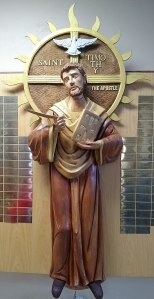
Statue of Saint Timothy at St. Timothy ‘s Church, The Villages, Florida Photo by Whoisjohngalt – Own work, CC BY-SA 4.0, https://commons.wikimedia.org/w/index.php?curid=85244772

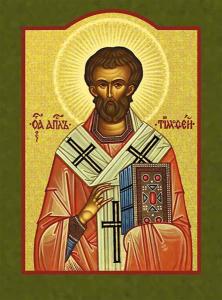
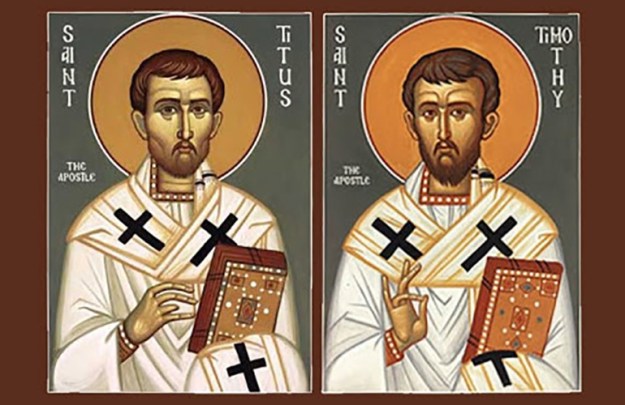
1 Timothy is the first of a collection of letters called the Pastoral letters, and although these three letters are often treated together, each letter has its own character and reason for being written. 1 Timothy is addressed to Timothy, but it is likely intended to be read to the community that Timothy is working with rather than being a more personal letter like 2 Timothy. I am working through this reflection from the perspective that 1 Timothy is an authentic letter from Paul (see discussion in the Introduction to the Pastoral Letters) writing to Timothy at Ephesus.

Ephesus, on the western edge of modern-day Turkey, as Luke Timothy Johnson describes it,

Ephesus was “the first and greatest metropolis of Asia,” …Its population during the early empire was probably between 100,000 and 150,000, making it rank only below Rome and Alexandria in size as an urban center. (Johnson, 2001, p. 142)

Being one of the largest cities in the Roman empire, it is a place where there are already Christian disciples present before Paul’s arrival according to the book of Acts (Acts 19: 1-7). Yet, these Christian disciples are missing a critical component of the understanding of baptism. One of the reasons some readers feel this letter is not from Paul but from a later writer is that it does not precisely line up with the narration of the book of Acts where Paul sends Timothy to Macedonia, while he stays in Ephesus (Acts 19:22), but it is plausible that after Paul goes to Macedonia that he sends Timothy as his representative to address issues continuing to emerge among the communities of faithful in Ephesus.

One of the things that is clear from the letter is that the community of the faithful in Ephesus that Timothy is attempting to guide and correct is dealing with conflicts over beliefs and behaviors. There are connections between this letter and 1 Corinthians, but also between content in Ephesians. As we approach this letter to Timothy and the churches in Ephesus, it is worth remembering that Paul is writing to a community in trouble. Paul’s intention here is to correct issues that are emerging and threatening the future of these communities of faith and to strengthen Timothy’s presence among them. In Thomas Long’s memorable image, “In the Pastoral Epistles, though we see the church on the mechanic’s lift in the garage, and we are given guidance form performing an ecclesial engine overhaul.” (Long, 2016, p. 1) Yet, the work of performing an “ecclesial engine overhaul” is messy work.

In 1 Timothy there will be solutions that Paul commands that may be unpopular to many people today. Paul leans into traditional gender roles, traditional roles in societal hierarchy, and we see within these churches one of the early mentions of deacons and bishops. Paul is not a systematic theologian in this letter presenting a solution for all times and places, he is rolling up his sleeves to get his hands dirty with the overhaul needed in this community at this time. Yet, it is always dangerous to attempt to read modern values onto ancient people. There are several difficult passages to work through in this short letter, but I believe an honest conversation with these texts is fruitful even if it can be difficult.

Among many modern readers 1 Timothy has received skeptical and critical readings, but what I will be attempting is a charitable and generous reading. Ellen Davis, a writer I’ve learned a great deal from, describes a charitable reading in this way:

The difficult text is worthy of charity from its interpreters. Interpretive charity does not mean pity but rather something more like generosity and patience toward the text…Charitable reading requires considerable effort; it is easier to dispense with the difficult text. Those who regard a text as religiously authoritative are willing to sustain that effort, because they perceive it in some sense as a gift from God. (Davis, 2003, p. 178)

One of the perspectives I adopted when I was working through Deuteronomy was to wonder what type of world or community it was attempting to imagine. I look forward to the process of trying to imagine the community of faith that Paul and Timothy desire at the completion of this ecclesial engine overhaul.

Revelation 2 The Messages to the First Four Churches

Revelation 2: 1-7 The Message to Ephesus

1 “To the angel of the church in Ephesus write: These are the words of him who holds the seven stars in his right hand, who walks among the seven golden lampstands:

 2 “I know your works, your toil and your patient endurance. I know that you cannot tolerate evildoers; you have tested those who claim to be apostles but are not, and have found them to be false. 3 I also know that you are enduring patiently and bearing up for the sake of my name, and that you have not grown weary. 4 But I have this against you, that you have abandoned the love you had at first. 5 Remember then from what you have fallen; repent, and do the works you did at first. If not, I will come to you and remove your lampstand from its place, unless you repent. 6 Yet this is to your credit: you hate the works of the Nicolaitans, which I also hate. 7 Let anyone who has an ear listen to what the Spirit is saying to the churches. To everyone who conquers, I will give permission to eat from the tree of life that is in the paradise of God.

The next two chapters are made up of seven messages to the seven churches of Asia. While each message is directed to a specific church dealing with specific challenges these messages also allow the reader to see their own community in light of the struggles and triumphs of these churches. Each message shares a basic pattern:

Introduction
Commendation
Reproof
Call to repent
Commendation for resistance to false messages
Conclusion/Promise

All these cities shared a number of common features being a part of the Roman empire: they all had populations that mixed Romans, Greeks, and Jewish populations as well, all the Christian groups in these cities were small minorities in a sea of polytheistic religious practices including the worship of the emperor who had to navigate life in a complex world where society and religion were closely intermingled, and all of these cities were dependent on their connection to Rome for trade and it was common for local leaders to attempt to pay tribute to Rome. Contrary to what many people would guess, worshipping of the Roman emperor as a ‘god’ or a ‘son of a god’ seems to have emerged not in Rome but in the provinces where local officials were attempting to demonstrate their loyalty and curry favor with the empire.

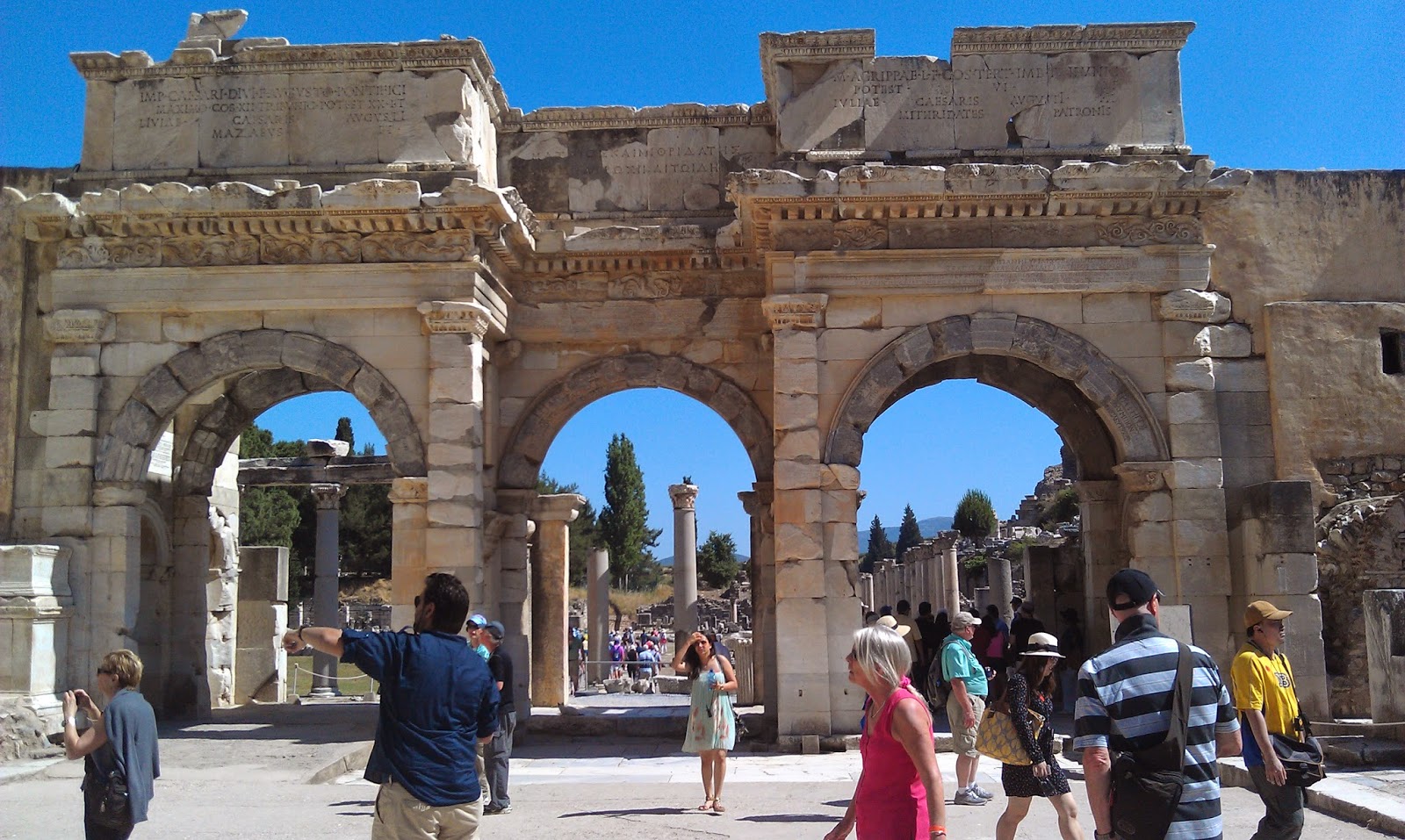
Monumental Gate in Ephesus dedicated to Emperor Caesar Augustus, son of god and high priest and the members of his family By Hawkeye58, CC BY-SA 3.0, https://commons.wikimedia.org/w/index.php?curid=3669323

Ephesus was a port city that relied upon trade. Artemis was one of the major deities worshipped in Ephesus and often being a part of a trade in the ancient world was associated with a temple. When Acts 19 relates the story of Paul being in Ephesus we can see the connection between the trade of the silversmiths, the temple of Artemis and the way in which Paul’s message was viewed not only as a different religious sect but a challenge to the economy of the city and was enough to cause a riot. Ephesus was also a port where slaves were traded along with all other forms of commerce.

In the introduction to the message of the church in Ephesus’ angel we are directed back to the image of Christ which John initially sees in Revelation 1, the seven stars and seven lampstands. The church in Ephesus is commended for its discernment between true and false apostles and their endurance in their allegiance to Jesus. Craig Koester suggests that where they have fallen is related to this: “the problem seems to be that their opposition to false teachers has led to a loss of love for other believers. Therefore, the Ephesians are called to do the work they did at first, which would have been acts of service for others.” (Koester, 2014, p. 269) This is one of the challenges Christians of many times have had to deal with. It is too common for communities that become rigid in their boundaries to become suspicious and hostile to outsiders, but Christian communities were to be communities of hospitality, service and love and yet remain true to their commitments to the gospel in a pluralistic world. They are called to repentance, to turn back to their first love and if they fail to repent they ultimately will fail to be church. The image of their lampstand being removed also means that the community has been symbolically removed.

The Nicolaitans are mentioned for the first time here. We don’t know much about this group. It is often conjectured that they were willing to eat meat offered to idols, like some of the believers Paul addressed at Corinth (1 Corinthians 8). This educated guess makes sense in a world where meat was often available at festivals (in a world before refrigeration most times when you ate meat would be at festivals and almost every festival in the ancient world would have religious aspects). Ultimately the Nicolaitans probably advocated for a less distinctive Christianity where people could still partake in the public events and trade groups associated with local and Roman customs, authorities and powers. To John this level of accommodation betrays their allegiance to the one who holds the seven stars and seven lampstands.

In the conclusion we have the first use of one of Revelation’s favored words: conquer (Greek nikao). This word has aspects of conquering in military, sporting and in the terms of remaining faithful and it will be important to watch how Revelation redefines this term in light of Christ victory (conquest). This Greek word is probably best known today in its use by the giant athletic shoe and clothing company and cultural icon Nike. Those in Ephesus are commended to conquer in light of Christ’s conquest which comes through love and steadfastness. If they conquer they are promised to eat from the tree of life which is mentioned in Genesis 3 and reappears in Revelation 22.

Revelation 2: 8-11 The Message to Smyrna

 8 “And to the angel of the church in Smyrna write: These are the words of the first and the last, who was dead and came to life:

 9 “I know your affliction and your poverty, even though you are rich. I know the slander on the part of those who say that they are Jews and are not, but are a synagogue of Satan. 10 Do not fear what you are about to suffer. Beware, the devil is about to throw some of you into prison so that you may be tested, and for ten days you will have affliction. Be faithful until death, and I will give you the crown of life. 11 Let anyone who has an ear listen to what the Spirit is saying to the churches. Whoever conquers will not be harmed by the second death.

The second message to the church in Smyrna is shorter and reflects a different situation for the church being addressed. The church in Smyrna is undergoing affliction and poverty yet their faith seems to be strong. Their steadfastness in this cultural has probably had an economic cost, but instead of storing up treasures on earth this community seems to have placed their riches in heaven where neither moth nor rust consume (Matthew 19-21). They have resisted assimilation into the ways of the empire and local culture. They may also be experiencing conflict with the Jewish community or Christians that have argued for retaining the practices of the Jewish law.

As mentioned above trade in the ancient world was also linked with both religious and political practices that many early Christians may have found troubling. There was no separation of church and state like we can discuss in modern times. Successful merchants were expected to show patronage to both the civic projects which would pay homage to the Roman empire and to show their devotion to the appropriate deities for their trade. Christians and Jews both would have resisted this. Jews within the empire were known and had some level of protection for their practice. Within the Roman empire, with its emphasis on piety, security, concord and peace, there were many who were intrigued by a religion like Judaism with its focus on the law. As Christianity and Judaism begin to move farther apart in this period the early Christians probably lost the shelter of being known as a Jewish movement and may have encountered animosity from Jewish people not wanting to be associated with what was perceived as a heretical and dangerous movement.

The term ‘synagogue of Satan’ sets up an opposition between the ‘congregation of the Lord.’ In Revelation’s time the conflict was fresh and the early Christians were a very small group within the empire. There probably was some sense of betrayal by those in the synagogues over their exclusion or perhaps even identification to authorities. Yet this term has an unfortunate history within the church. The church would in the span of two centuries move from being a small group sometimes actively persecuted within the empire and other times excluded from commerce and the broader society to an accepted and eventually the official religion of the empire. The church as a power within Roman and other societies would use this and other passages in the New Testament as justification for their later persecution of the Jewish people. The connection of the church and the synagogue would be lost only to be recently appreciated again.

This message is one of encouragement for a community either enduring or about to endure hardship. John mentions imprisonment as a part of the suffering they will endure and to remain faithful until death. In documents shortly after Revelation’s composition we start to see the early church writing about early martyrs like Polycarp, Perpetua, Felicity, Ptolemaeus and many others. Their steadfast witness would become an important illustration of the content of their hope. Those who conquer will be given the crown of life, and perhaps they will see themselves among the elders casting their crowns before the throne. The resurrection was central to the hope of the early church and the witness of those willing to be faithful unto death gave a new meaning to the word which is translated as witness (martyr). In light of the militaristic images throughout much of Revelation we see now the church in Smyrna addressed like soldiers going into battle, and yet their conquering will not be through taking other lives but in the willingness to give up their own on the model of Christ.

Revelation 2: 12-17 The Message to Pergamum

12 “And to the angel of the church in Pergamum write: These are the words of him who has the sharp two-edged sword:

 13 “I know where you are living, where Satan’s throne is. Yet you are holding fast to my name, and you did not deny your faith in me even in the days of Antipas my witness, my faithful one, who was killed among you, where Satan lives. 14 But I have a few things against you: you have some there who hold to the teaching of Balaam, who taught Balak to put a stumbling block before the people of Israel, so that they would eat food sacrificed to idols and practice fornication. 15 So you also have some who hold to the teaching of the Nicolaitans. 16 Repent then. If not, I will come to you soon and make war against them with the sword of my mouth. 17 Let anyone who has an ear listen to what the Spirit is saying to the -churches. To everyone who conquers I will give some of the hidden manna, and I will give a white stone, and on the white stone is written a new name that no one knows except the one who receives it.

The third message is addressed to the church in Pergamum and it has a two-sided message of encouragement and repentance. They are living in a culture that is opposed to the Lordship of Christ and in Antipas we see evidence of the only person in these messages who has been killed for his faith at this point. In a culture that called for them to assimilate to the practices of the community around them and to pay homage to the emperor the early Christians found themselves labeled as atheist and disturbers of the peace.

Pergamum was a city where the imperial cult was a source of pride. As mentioned above the worship of Caesar as a god was practiced more commonly throughout the provinces as a way of showing their piety, devotion and to curry favor with Rome. They established the first provincial temple dedicated to Augustus and the goddess of Rome after receiving permission to establish a sacred precinct to Augustus in 29 BCE (Koester, 2014, p. 284). Rome’s economic and military power became enshrined as a civil religion where the emperor and the might of Rome was lifted up, honored and worshipped.

Pergamum Theater By Bernard Gagnon – Own work, CC BY-SA 3.0, https://commo
ns.wikimedia.org/w/index.php?curid=42275209

The early Christians would have met strong resistance in Pergamum for their unwillingness to participate in the civic religious festivals and honors. Yet, in the midst of this there are apparently some in the community who are trying to find a way to remain connected to the society and a part of the church. There would have been strong pressure to accommodate with the culture in both eating and participating in some of these rituals.

The reference to the stories of Balak and Balaam from Numbers 22-25 may have indicated some Jewish background for this community or at least familiarity with this story from the people of Israel’s approach to the promised land. Balaam is commissioned by King Balak of Moab to curse the people of Israel as they moved toward Moab but, after the incident with a talking donkey saving Balaam from the angel of the LORD, Balaam extends three blessings to Israel. Yet, the people of Israel at Shittim begin to have sexual relations with the women of Moab and are invited to participate in the worship of other gods and this kindles the LORD’s anger at this infidelity to God’s calling of them as the LORD’s chosen people who are to have no other gods. John uses this story to chastise those who he feels have been unfaithful to their calling by participating in these practices. The Nicolaitans are mentioned in connection with this and probably are willing to take part in these festivals and eat the food offered there. John wants those in the congregation participating in this that they have aligned themselves with the forces opposed to God and that Christ will be making war against these forces.

Fornication in scripture does not always mean sexual immorality. Most frequently this term is used metaphorically to refer to idolatry (ex. Hosea 1,2, Jeremiah 3,). It can also refer to participating in commercial activities that were viewed as unfaithful (and this is a common use in Revelation). Sometimes fornication is literally fornication but frequently in the prophets and Revelation it is a metaphorical unfaithfulness through idolatrous and commercial practices.

To those who conquer there is the promise of manna and a white stone with a new name on it. Manna is the bread that the LORD fed the Israelites with in the journey in the wilderness from Egypt to the promised land (Exodus 16: 4-8). The white stone could have a couple of meanings in the society: indicating a positive vote, a token of admission or as a stone of protection like in an amulet. I find the idea of the positive vote most likely since voting in the ancient world was often done by placing a small stone in an urn and typically a white stone was a positive vote while a black stone was a negative vote. The name on the stone is probably the name of Christ but could be a new name given to the individual believer as a sign of their new identity.

Revelation 2: 18-29 The Message to Thyatira

 18 “And to the angel of the church in Thyatira write: These are the words of the Son of God, who has eyes like a flame of fire, and whose feet are like burnished bronze:

 19 “I know your works — your love, faith, service, and patient endurance. I know that your last works are greater than the first. 20 But I have this against you: you tolerate that woman Jezebel, who calls herself a prophet and is teaching and beguiling my servants to practice fornication and to eat food sacrificed to idols. 21 I gave her time to repent, but she refuses to repent of her fornication. 22 Beware, I am throwing her on a bed, and those who commit adultery with her I am throwing into great distress, unless they repent of her doings; 23 and I will strike her children dead. And all the churches will know that I am the one who searches minds and hearts, and I will give to each of you as your works deserve. 24 But to the rest of you in Thyatira, who do not hold this teaching, who have not learned what some call ‘the deep things of Satan,’ to you I say, I do not lay on you any other burden; 25 only hold fast to what you have until I come. 26 To everyone who conquers and continues to do my works to the end, I will give authority over the nations; 27 to rule them with an iron rod, as when clay pots are shattered — 28 even as I also received authority from my Father. To the one who conquers I will also give the morning star. 29 Let anyone who has an ear listen to what the Spirit is saying to the churches.

The message to the church of Thyatira is predominantly addressed to a faction within the church associated with a woman named Jezebel here. The community is growing in their practices of faithfulness, hospitality, service and endurance with exception to this group and for those who have not associated with this group the are only called to hold fast.

Jezebel is a reference to the wife of King Ahab, daughter of King Ethbaal of the Sidonians who is in direct opposition to the prophet Elijah and along with King Ahab turns Israel away from worshipping the LORD the God of Israel to worshipping Baal (I Kings 16: 30-22:40). John and this woman apparently had struggled for authority in the church and John had probably used the language of Jezebel to name her in previous incidents. The woman titled Jezebel was probably a resident member of the congregation and so that provided an additional challenge for John who was not. As mentioned above the fornication is probably a metaphorical use of the term where her followers participated in the society’s religious and commercial practices in a way that John deemed idolatrous and unfaithful. The ‘deep things of Satan’ is probably a parody of the ‘deep things of God’ where some group claims to have some deeper knowledge of God’s will or intention. As in Daniel 2:22 where God reveals the deep and hidden things or 1 Corinthians 2: 10 where the Spirit searches even the depths of God, there may have been some claim made by this group of some deeper knowledge of God’s will that John denies. In language that parallels Jeremiah 17:10, John now sets this group apart as one under God’s judgment for their deeds.

The community that conquers is now to rule alongside Christ. They will also receive the promised ruler, the morning star, who is Christ. This is also the only use of Son of God in Revelation, although Jesus will refer to God as Father, and the community who will eventually receive the morning star and Son of God cannot extend those titles to anyone else. In a society where Caesar was lifted up as a son of a god this exclusive claim that the early Christians made in their society had political consequences. Yet, they look forward to a time when the world is reversed and the faithful ones rule the nation rather than those Revelation will later label as monstrous.