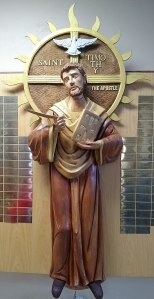
1 Timothy is the first of a collection of letters called the Pastoral letters, and although these three letters are often treated together, each letter has its own character and reason for being written. 1 Timothy is addressed to Timothy, but it is likely intended to be read to the community that Timothy is working with rather than being a more personal letter like 2 Timothy. I am working through this reflection from the perspective that 1 Timothy is an authentic letter from Paul (see discussion in the Introduction to the Pastoral Letters) writing to Timothy at Ephesus.
Ephesus, on the western edge of modern-day Turkey, as Luke Timothy Johnson describes it,
Ephesus was “the first and greatest metropolis of Asia,” …Its population during the early empire was probably between 100,000 and 150,000, making it rank only below Rome and Alexandria in size as an urban center. (Johnson, 2001, p. 142)
Being one of the largest cities in the Roman empire, it is a place where there are already Christian disciples present before Paul’s arrival according to the book of Acts (Acts 19: 1-7). Yet, these Christian disciples are missing a critical component of the understanding of baptism. One of the reasons some readers feel this letter is not from Paul but from a later writer is that it does not precisely line up with the narration of the book of Acts where Paul sends Timothy to Macedonia, while he stays in Ephesus (Acts 19:22), but it is plausible that after Paul goes to Macedonia that he sends Timothy as his representative to address issues continuing to emerge among the communities of faithful in Ephesus.
One of the things that is clear from the letter is that the community of the faithful in Ephesus that Timothy is attempting to guide and correct is dealing with conflicts over beliefs and behaviors. There are connections between this letter and 1 Corinthians, but also between content in Ephesians. As we approach this letter to Timothy and the churches in Ephesus, it is worth remembering that Paul is writing to a community in trouble. Paul’s intention here is to correct issues that are emerging and threatening the future of these communities of faith and to strengthen Timothy’s presence among them. In Thomas Long’s memorable image, “In the Pastoral Epistles, though we see the church on the mechanic’s lift in the garage, and we are given guidance form performing an ecclesial engine overhaul.” (Long, 2016, p. 1) Yet, the work of performing an “ecclesial engine overhaul” is messy work.
In 1 Timothy there will be solutions that Paul commands that may be unpopular to many people today. Paul leans into traditional gender roles, traditional roles in societal hierarchy, and we see within these churches one of the early mentions of deacons and bishops. Paul is not a systematic theologian in this letter presenting a solution for all times and places, he is rolling up his sleeves to get his hands dirty with the overhaul needed in this community at this time. Yet, it is always dangerous to attempt to read modern values onto ancient people. There are several difficult passages to work through in this short letter, but I believe an honest conversation with these texts is fruitful even if it can be difficult.
Among many modern readers 1 Timothy has received skeptical and critical readings, but what I will be attempting is a charitable and generous reading. Ellen Davis, a writer I’ve learned a great deal from, describes a charitable reading in this way:
The difficult text is worthy of charity from its interpreters. Interpretive charity does not mean pity but rather something more like generosity and patience toward the text…Charitable reading requires considerable effort; it is easier to dispense with the difficult text. Those who regard a text as religiously authoritative are willing to sustain that effort, because they perceive it in some sense as a gift from God. (Davis, 2003, p. 178)
One of the perspectives I adopted when I was working through Deuteronomy was to wonder what type of world or community it was attempting to imagine. I look forward to the process of trying to imagine the community of faith that Paul and Timothy desire at the completion of this ecclesial engine overhaul.

