Monthly Archives: August 2026

1 Timothy 1 Paul Encourages Timothy in Ephesus

The Library of Celsus in Ephesus Photo By Benh LIEU SONG – Own work, CC BY-SA 3.0, https://commons.wikimedia.org/w/index.php?curid=15578063

1 Timothy 1: 1-2

1Paul, an apostle of Christ Jesus by the command of God our Savior and of Christ Jesus our hope,
  2
To Timothy, my true child in the faith:
  Grace, mercy, and peace from God the Father and Christ Jesus our Lord.

Letters in the ancient world begin with the identification of the sender and the recipient. Paul begins by making a strong claim to authority, “an apostle of Christ Jesus by the command of God our Savior and Christ Jesus our hope.” When Paul begins with the title of apostle (e.g. 1 Corinthians, Galatians) he is often writing to communities dealing with crisis and where his authority is needed. In letters like Romans or Philippians where he is not addressing significant behavioral issues or where he wants to be more diplomatic he utilizes the title of servant/slave (doulos) of the Lord. Paul also immediately leans into the title of God as our Savior. God as Savior is a common theme in the Old Testament/Hebrew Scriptures[1] and it is worth remembering at the time these letters are written the stories of the gospels are likely circulating but they have not been collected and distributed throughout these young communities of faith. The Scriptures for these early Christian are the Hebrew Scriptures.

Timothy is described as Paul’s ‘true child,’ an adjective that normally defines a child born in wedlock. A legitimate child as opposed to an illegitimate one (NIB XI: 790). Yet, when the letter continues ‘in the faith’ most readers would probably understand Timothy as Paul’s true and authentic delegate, that Timothy and Paul share the same faith and that Timothy is being empowered to speak with Paul’s authority. Paul’s also utilizes the term for ‘true’ (gnesios) in Philippians 2:20 to speak of Timothy’s true concern for the welfare of the Philippians. Timothy is Paul’s trusted representative before the Ephesians, one who is like a son to him.

Paul concludes the greeting with a blessing. Grace (charis) is a distinctive Pauline term, and the vast majority of this term’s occurrences happen in Paul’s letters. Here the term is combined with two additional terms: peace (eirene) and mercy (eleos). Peace brings forward the Hebrew idea of shalom and mercy (eleos) is the normal term used to translate in both Greek and English the Hebrew term hesed. These three rich terms are brought together to bless Timothy and his community. God is referred to here as Father, a common way of referring to God in both the teaching of Jesus and occurs frequently in Pauline benedictions, and Christ Jesus our Lord is placed in parallel usage of God the Father.   

1 Timothy 1: 3-11

  3I urge you, as I did when I was on my way to Macedonia, to remain in Ephesus so that you may instruct certain people not to teach different teachings 4and not to occupy themselves with myths and endless genealogies that promote speculations rather than the divine training that is known by faith. 5But the aim of such instruction is love that comes from a pure heart, a good conscience, and sincere faith. 6Some people have deviated from these and turned to meaningless talk, 7desiring to be teachers of the law without understanding either what they are saying or the things about which they make assertions.
  8
Now we know that the law is good, if one uses it legitimately; 9this means understanding that the law is laid down not for the righteous but for the lawless and disobedient, for the godless and sinful, for the unholy and profane, for those who kill their father or mother, for murderers, 10the sexually immoral, men who engage in illicit sex, slave traders, liars, perjurers, and whatever else is contrary to the sound teaching 11that conforms to the glorious gospel of the blessed God, with which I was entrusted.

In many of Paul’s letters there would be a thanksgiving for the community, but here the letter moves immediately into instructions. Paul has done this in Galatians, so this is not unheard of, and like Galatians Paul is concerned about the continuation of the community. Verse three gives us the setting where Timothy receives the letter, Ephesus where he is instructed to remain, and Paul at some earlier time departed for Macedonia. In Acts Paul sent Timothy on to Macedonia while he stayed in Ephesus (Acts 19:22) and later proceeds to Macedonia. Later he will gather with the Ephesian elders in Miletus (Acts 20:17). This letter is likely between Paul’s departure from Ephesus and his later meeting with the elders.[2]  

Among the early Christians in Ephesus there are different teachings emerging. We have glimpses into the challenges that the early churches face through letters like this 1 Timothy, the book of Acts and the book of Revelation. The Book of Acts portrays Ephesus as a city where the early Christ followers meet resistance both from within the synagogue and from the followers of the Greek gods, particularly the followers of Artemis. Revelation’s letter to the Ephesians points to a community that has learned to test those claiming to be apostles and continuing to deal with groups, like the Nicolaitans, who are viewed as harmful by the author of Revelation. Yet, in Revelation these conflicts have sapped the energy of the churches in this large city. We may not be able to identify specifically the ‘myths and genealogies’ that some are teaching but to Paul they are leading people away from the central witness of Christ. The ‘myths and genealogies’ may be focusing on the wrong things in scripture, since Paul indicates that some are desiring to be teachers of the law, but they may also be a distortion coming from outside of the scriptures. Another possibility is that these teachers who are leading people into “meaningless talk” have separated teaching from action. They may be so focused on some knowledge they are attempting to wrestle from the scriptures or from the surrounding culture that they have stopped the distinctive practices that shaped the early Christians.

Paul then focuses on the law and how it is utilized. Paul’s declaration that the law is good is similar to statements he has made in Romans[3] but also indicates that the law is not for the righteous. Perhaps Paul intends something similar to the fruits of the Spirit mentioned in Galatians where “There is no law against such things.” (Galatians 5: 32) Paul likely composes the vice list in verses nine and ten while reflecting on the ten commandments. Godless and sinful refer to someone behaving blasphemously towards God while unholy and profane likely reference the commandment on keeping the Sabbath holy and profaning the name of God. Killing of father and mother and murderers bring together the commandment to honor father and mother and murder. The commandment on adultery also references both the ‘sexually immoral’ and ‘men who engage in illicit sex.’ The Greek term pornos (NRSVue sexually immoral) is the prefix for the English word pornography. As Luke Timothy Johnson notes, “In the LXX and the NT, the term is used for the sexually immoral without specific reference to homosexuality.” (Johnson, 2001, p. 170) The Greek arsenkoitos (NRSVue men who engage in illicit sex) is literally one who has sex with a man. As James D.G. Dunn notes,

Today the most controversial of these is the putting of homosexual practice (v. 10; the term almost certainly comes from Lev 18:22; 20:13) under the prohibition of adultery; the teaching is consistent with Paul’s views expressed earlier in Rom 1:26-27; 1 Cor 6: 9-10 (NIB XI:791)

This is the first of many times where 1 Timothy will come into conflict with elements of our culture, just as it was likely in conflict with elements of Paul’s time. Many Greek authors write about relationships between a man and an adolescent youth (pederasty) but there is some debate about how often these relationships were sexual. Paul viewed the existence of same-sex relationships as one of the many examples of how far humanity and creation had been corrupted by sin.

On a personal note, the larger church I am a part of has struggled with the question of homosexuality within the larger picture of sexuality since before I entered seminary in 2000. It has been a divisive issue within the larger church and within congregations I have served. I also have a non-gender binary child and my perspective on this issue has shifted throughout my life. When I entered seminary, I would have agreed that LGBTQ+ people have a place within the congregation but I would have been opposed to them having leadership roles whether as pastors, deacons or in positions of authority. Through experiences, wrestling with scripture, and faithful conversations I am now open to LGBTQ+ people who are trying to live faithfully serving in the leadership of the church but I also understand why others struggle to accept them into leadership, just as some do not accept women in leadership (see chapter 2).

Returning to the vice list: stealing is not simply stealing but “slave dealing.” I will talk about slavery more in chapter 6, but although slavery was an accepted part of the Roman empire “slave traders” have normally been viewed with disdain. Liars and perjures point to the commandment on bearing false witness. Paul concludes with ‘whatever is contrary to the sound teaching’ which returns us to the questions about different teaching which began this section. Paul is asking his hearers to measure the teaching they are receiving against the gospel he shared with them for its conformity to Christ and scripture in both teaching and living.  

1 Timothy 1: 12-17

  12 I am grateful to Christ Jesus our Lord, who has strengthened me, because he considered me faithful and appointed me to his service, 13 even though I was formerly a blasphemer, a persecutor, and a man of violence. But I received mercy because I had acted ignorantly in unbelief, 14 and the grace of our Lord overflowed for me with the faith and love that are in Christ Jesus. 15 The saying is sure and worthy of full acceptance: that Christ Jesus came into the world to save sinners—of whom I am the foremost. 16 But for that very reason I received mercy, so that in me, as the foremost, Jesus Christ might display the utmost patience as an example to those who would come to believe in him for eternal life. 17 To the King of the ages, immortal, invisible, the only God, be honor and glory forever and ever. Amen.

For Paul his call to serve Jesus was transformational. He went from someone who, out of ignorance, was acting against God’s will to one whose life is completely committed to the gospel. One of the rhetorical effects of this narration of Paul’s transformation from a faithless one (apistis-without faith, NRSVue ‘unbelief’) to one overflowing with faith and love, from a man of violence to a man of peace, from a blasphemer to a servant of God is to provide hope that those lost to these different teachings can be reclaimed to God and Christ.

Paul talks about faith (Greek pisitis) more proportionally in 1 Timothy than in any other letter except Galatians and Romans.[4] Sometimes English translations obscure the occurrences of ‘faith’ as occurs in verse fifteen. Normally English translations render this verse similar to the NRSVue, “the saying is sure and worthy of full acceptance.” A literal translation of the Greek would be, “the word of faith (or faithful word) and worthy of all acceptance.” What word is faith worthy of all acceptance? That Christ Jesus came into the world to save sinners. Paul’s transformation becomes the model of what Christ is doing with those who were once estranged from God. Jesus is at work in Paul showing the patience of God that is for all who have faith in God.

The Greek word aionios (eon) occurs four times in the final two verses of this section. It occurs at the end of sixteen paired with life (zoe)-into life of the eon/age. Most translations render this ‘eternal life’ and while Paul, I believe, does believe that the age God is creating is eternal he is not thinking of an existence in heaven. For Paul, and the other New Testament authors, God’s kingdom and age is coming to earth. The next occurrence of eon is in the title for God, the king of the eon/age. Life in the eon/age is linked to the king of the eon/age who rules the eon of eons/age to age. God is also described as immortal/incorruptible, invisible and the only God. God being the one God goes back to the Shema (Deuteronomy 6:4), the central confession of faith of the Jewish people. God is also frequently referred to as unseen in both the Old and New Testament and while God being unending or incorruptible is assumed but rarely spoken throughout the scriptures. It is possible that Paul is using a title for God that is frequently utilized by the communities in Ephesus.   

1 Timothy 1: 18-20

  18This charge I commit to you, Timothy, my child, in accordance with the prophecies made earlier about you, so that by following them you may fight the good fight, 19having faith and a good conscience. By rejecting conscience, certain persons have suffered shipwreck in the faith; 20among them are Hymenaeus and Alexander, whom I have turned over to Satan, so that they may be taught not to blaspheme.

The chapter closes with a personal note to Timothy intended to be overheard by the community. Paul reaffirms the closeness with Timothy using the familial language of father to child but also links Timothy’s calling to prophecies made in the church. Timothy is the chosen one, chosen both by Paul and by God. The language shifts to military language. “Fight the good fight” is literally (military) service in this good campaign/battle. Dealing with church conflict is challenging. In my own story I was an officer in the U.S. Army prior to seminary and my job as a leader in the Army may have been harder physically, but leading a congregation through conflict was more emotionally draining.

Hymenaeus and Alexander were people Paul excluded from the community of the faithful. The early communities may not have a word like excommunication for this disfellowshipping of a former member of the faith but even at this early stage there is a need for boundaries. Hymenaeus will be mentioned in 2 Timothy 2:17 along with Philetus as spreading a teaching that the resurrection has already occurred. Alexander the Coppersmith is listed in 2 Timothy 4: 14 as one who did Paul great harm[5] and both are people for Timothy to avoid. In Greek these individuals are handed over by Paul to ‘the satan.’ In Matthew’s gospel which also has this type of disfellowshipping (Matthew 18:17) the desire is that the person changes and they are returned to fellowship. The use of the definite article (the) with the title satan may refer to this role of the accuser in the Old Testament, particularly Job. Here ‘the satan’ is ultimately God’s agent. Martin Luther would sometimes refer to the devil as ‘God’s devil’ because even though the devil may be opposed to God’s designs, even his opposition to God was brought into God’s design.

One of the hardest things for a community to do is to remove a member, but it can also be one of the most important things for the life of a community. Whether it is false teaching, bullying, or other unsafe behavior the failure to address the person who has been corrected and refuses to change will undermine the community. Timothy, in our letter, likely dealt with a very challenging moment in the life of the community and may need the support of Paul, his spiritual father. He may need to be reminded of his calling that God has placed on him as he attempts to bring this community back to faithfulness and peace.


[1] E.g. Deuteronomy 32:15; Psalm 27: 1, 9; Isaiah 45:15, 21; This is also the background for this usage in Mary’s Song commonly called the Magnificat in Luke 1:47.

[2] In this reflection my assumption is that Paul wrote this letter. Many scholars believe 1 Timothy is written by a later author after Paul’s death and therefore the letter comes from a later time. I am also assuming that Acts narration of Paul’s life is generally accurate but incomplete, not capturing every detail of Paul’s ministry.

[3] Romans 7: 7, 14, 21; in Galatians Paul’s language about the law is less friendly but in Galatians 3: 21 the use of the law is in a limited manner like he utilizes here.

[4] 1 Timothy has eighteen uses of pistis in six chapters, Galatians has twenty-two in six chapters and Romans thirty-seven in sixteen chapters. (Johnson, 2001, p. 158)

[5] This may be the same Alexander mentioned in Acts 19:33.

Brief Introduction to 1 Timothy

Statue of Saint Timothy at St. Timothy ‘s Church, The Villages, Florida Photo by Whoisjohngalt – Own work, CC BY-SA 4.0, https://commons.wikimedia.org/w/index.php?curid=85244772

1 Timothy is the first of a collection of letters called the Pastoral letters, and although these three letters are often treated together, each letter has its own character and reason for being written. 1 Timothy is addressed to Timothy, but it is likely intended to be read to the community that Timothy is working with rather than being a more personal letter like 2 Timothy. I am working through this reflection from the perspective that 1 Timothy is an authentic letter from Paul (see discussion in the Introduction to the Pastoral Letters) writing to Timothy at Ephesus.

Ephesus, on the western edge of modern-day Turkey, as Luke Timothy Johnson describes it,

Ephesus was “the first and greatest metropolis of Asia,” …Its population during the early empire was probably between 100,000 and 150,000, making it rank only below Rome and Alexandria in size as an urban center. (Johnson, 2001, p. 142)

Being one of the largest cities in the Roman empire, it is a place where there are already Christian disciples present before Paul’s arrival according to the book of Acts (Acts 19: 1-7). Yet, these Christian disciples are missing a critical component of the understanding of baptism. One of the reasons some readers feel this letter is not from Paul but from a later writer is that it does not precisely line up with the narration of the book of Acts where Paul sends Timothy to Macedonia, while he stays in Ephesus (Acts 19:22), but it is plausible that after Paul goes to Macedonia that he sends Timothy as his representative to address issues continuing to emerge among the communities of faithful in Ephesus.

One of the things that is clear from the letter is that the community of the faithful in Ephesus that Timothy is attempting to guide and correct is dealing with conflicts over beliefs and behaviors. There are connections between this letter and 1 Corinthians, but also between content in Ephesians. As we approach this letter to Timothy and the churches in Ephesus, it is worth remembering that Paul is writing to a community in trouble. Paul’s intention here is to correct issues that are emerging and threatening the future of these communities of faith and to strengthen Timothy’s presence among them. In Thomas Long’s memorable image, “In the Pastoral Epistles, though we see the church on the mechanic’s lift in the garage, and we are given guidance form performing an ecclesial engine overhaul.” (Long, 2016, p. 1) Yet, the work of performing an “ecclesial engine overhaul” is messy work.

In 1 Timothy there will be solutions that Paul commands that may be unpopular to many people today. Paul leans into traditional gender roles, traditional roles in societal hierarchy, and we see within these churches one of the early mentions of deacons and bishops. Paul is not a systematic theologian in this letter presenting a solution for all times and places, he is rolling up his sleeves to get his hands dirty with the overhaul needed in this community at this time. Yet, it is always dangerous to attempt to read modern values onto ancient people. There are several difficult passages to work through in this short letter, but I believe an honest conversation with these texts is fruitful even if it can be difficult.

Among many modern readers 1 Timothy has received skeptical and critical readings, but what I will be attempting is a charitable and generous reading. Ellen Davis, a writer I’ve learned a great deal from, describes a charitable reading in this way:

The difficult text is worthy of charity from its interpreters. Interpretive charity does not mean pity but rather something more like generosity and patience toward the text…Charitable reading requires considerable effort; it is easier to dispense with the difficult text. Those who regard a text as religiously authoritative are willing to sustain that effort, because they perceive it in some sense as a gift from God. (Davis, 2003, p. 178)

One of the perspectives I adopted when I was working through Deuteronomy was to wonder what type of world or community it was attempting to imagine. I look forward to the process of trying to imagine the community of faith that Paul and Timothy desire at the completion of this ecclesial engine overhaul.

Introduction to the Pastoral Letters: 1 Timothy, 2 Timothy, and Titus

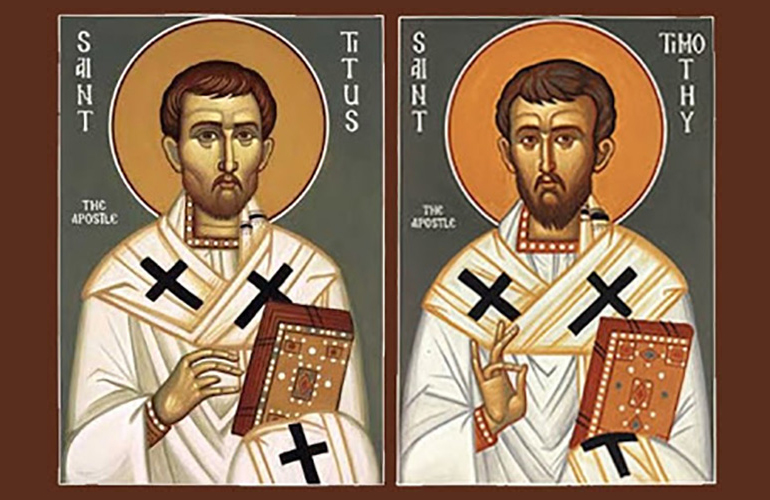
Icon of Saint Titus and Saint Timothy. Image from Timothy and Titus, Companions of Saint Paul – The Episcopal Church

Every pastor has portions of scripture that are central and that they know well and other portions that they are less familiar with and less likely to use in their preaching and teaching. One of my motivations within these reflections has been to expand my familiarity and comfort with portions of scripture I was less familiar with. To utilize a couple verses of 2 Timothy:

All scripture is inspired by God and is useful for teaching, for reproof, for correction, and for training in righteousness,so that the person of God may be proficient, equipped for every good work. 2 Timothy 3: 16-17

Yet, there is some irony in the way 1& 2 Timothy and Titus are viewed by many modern scholars. Since the nineteenth century many scholars have questioned whether these three books were written by Paul or whether they are written after Paul’s death utilizing Paul’s reputation to give force to these letters. The letters, for many, may still be scripture but they have been relegated to a secondary, or in some cases even lower, status because they may not be viewed as ‘authentically Pauline’ and coming from a later stage in the formation of the church rather than being one of the earlier witnesses to the formation of Christianity. The New Testament professors I had in seminary handed on the consensus that Pastoral letters were not Pauline and therefore received little if any attention. Because of this the very books that claim all scripture is inspired by God and useful are among the most neglected in the New Testament.

My assumption throughout these reflections will be that 1 & 2 Timothy as well as Titus are written by Paul the Apostle. I will go into more of my reasoning below, but whether they are written by Paul or a student of Paul they remain for me, and for Christianity as a whole, a part of our scriptures. To many readers of the Bible the type of discussions that scholars have about texts can be confusing. Most readers of the bible may not spend a lot of time in 1& 2 Timothy and Titus, but they also would be wary of someone questioning the authority of these books they accept as scripture. There are some portions of these letters that modern readers find jarring, especially when talking about women in the church and the existence of slavery. Like all scripture we must wrestle with what it meant in it is specific to the time and audience it is written to and what expectations we bring to our own time. Yet, for me, I find this type of wrestling with scripture, trying to understand it on its own terms and to imagine the world it is trying to create in its original environment a fruitful and life-giving process.

For most of the history of the church the Pastoral Letters were assumed to be Pauline. The only groups that did not include these letters as a part of scripture, like the followers of Marcion[1] and perhaps Valentinius, were considered heretics and their exclusion of these books were not based on any questions of authorship. Polycarp appears to reference 1 Timothy and 2 Timothy in his Letter to the Philippians dated between 110 and 135 CE and the book is heavily utilized by early church leaders like Ireneaus, Clement, and Tertullian. The first person to challenge the Pauline authorship of the Pastoral Letters was Fredrich Schleirmacher, an influential German theologian and scholar, in 1806. Schleirmacher felt there was a Pauline style that could be measured and these letters failed to meet the criteria. Many other scholars would follow Schleirmacher developing authentic Pauline themes and vocabulary to test these letters against while others would compare the events of the letters with the narration of Paul’s ministry in Acts,[2] while others simply went along with what seemed to be an emerging scholarly consensus in the nineteenth and twentieth century.[3]

The reasoning behind my engaging 1 & 2 Timothy and Titus as Pauline letters is fairly simple. First, all three letters explicitly claim to be written by Paul (1 Timothy 1:1; 2 Timothy 1:1; Titus 1:1). Although writing a letter or document under the name of an established individual was a common practice in the ancient world as was viewed as honorific rather than dishonest, for me there would have to be some decisive reason to distrust what the letters claim to be. Secondly, each letter has its own character (1 Timothy is less personal and probably intended to be heard by a congregation) but in 2 Timothy 4 and Titus 3 there are some very personal moments and a lot of people, who the original recipients of the letter were likely aware of and who would raise questions for any reader with knowledge of Paul’s time in ministry if they were created to pass off the letters as authentic.

Christian scholars who do not view these letters as authentically Pauline will typically point to a handful of reasons: the letters do not reflect Paul’s theology, the letters utilize different language than the authentic Pauline letters, the conflicts and the type of organization/hierarchy in the church are presumed to come from a later time. I appreciate and have benefited from the works of those, like James D. G. Dunn, who write works like The Theology of Paul the Apostle and take the ‘authentic Pauline letters’ as the source to identify the elements of Paul’s theology. However, Paul is not a systematic theologian and writes letters to deal with concrete issues in communities and relationships that he knew. Paul may think theologically but his letters are also shaped strongly by the context they are written to. Paul’s language changes dramatically between letters as well: Romans may share similar language to Galatians, but 1 Corinthians employs very different terms. Paul does talk of people being led astray by ‘myths and endless genealogies’ (1 Timothy 1:6) which many scholars of the late nineteenth and early twentieth centuries linked with Gnosticism[4] but we simply do not know the exact issues that these communities are dealing with. The roles of bishop and deacon outlined in these letters does not necessarily indicate a late date nor the highly institutional roles these would later become. Luke Timothy Johnson also highlights that Paul did not establish the community in Ephesus and that the letters presume the existence of these roles and only give advice about the mental and moral qualities of the people who should fill these roles. (Johnson, 2001, p. 75)

There are some difficult texts in 1 & 2 Timothy and Titus. We may wish for a Paul who continually lives out the vision of Galatians 3:28 where there is no longer Jew or Greek, slave or free, male or female. Yet, there are places, both in the Pastoral letters and in the other Pauline letters, where we look uncomfortably about what he may say about the role of women in communities, the assumptions of slavery and how slaves and masters are to relate to one another, sexuality, and several other issues. Paul is writing to his congregations almost two thousand years ago with very different assumptions, some of which Paul challenges and some of which Paul does not. Thomas Long is helpful when he states:

One could imagine many ways of relating to the emperor—pray for the emperor, not pray for the emperor, pray to the emperor, refuse to pray to the emperor, obey the emperor, resist the emperor, die for the emperor, die at the hands of the emperor—but a world without the emperor? Unimaginable. Therefore, the author of the Pastorals, given his context, will consistently offer advice about how to move the pieces on the chessboard. We sometimes lose patience with him because we expect him to throw out the chessboard and to change the game itself. (Long, 2016, p. 6)

The board we play on will look different than Paul’s, but it is fruitful to study the moves he makes based on his experience of God and the world he inhabits.

Dialogue Partners for these Reflections

Bassler, Jouette M. 1 Timothy, 2 Timothy, Titus: Abingdon New Testament Commentaries. (Nashville: Abingdon Press, 1996). Noted as (Bassler, 1996).

The Abingdon New Testament Commentaries are written to be accessible to those with some familiarity with the bible and are short enough that most readers can follow. Jouette Bassler taught at Perkins Theological Seminary at Southern Methodist University in Dallas. She comes from the perspective that the author of these letters is not Paul, but one who appreciates the pseudonymous author’s rhetorical skill and ethical and theological perspective.

Dunn, James D. G., “First and Second Letters to Timothy” and “Letter to Titus” in New Interpreter’s Bible: A Commentary in Twelve Volumes. Volume XI, pp. 789-880. (Nashville: Abingdon Press, 2000). Noted as (NIB XI).

The New Interpreter’s Bible is a good resource for pastors wanting a collection that includes the entire bible (including the apocrypha) and I have been impressed by the collection of scholars they assembled for this project.  James Dunn is a very highly respected New Testament scholar who taught for decades at the University of Durham in England. He has written heavily on Jesus, Paul, and the early church and is associated with the New Perspective on Paul which attempted to locate Paul within the matrix of Jewish thought in the first century. Dunn also views the Pastoral Letters as written by someone after Paul. The Theology of Paul the Apostle was an influential book for me when I was particularly focused on Pauline scholarship in 2005-2010.

Johnson, Luke Timothy. The First and Second Letters to Timothy: A New Translation with Introduction and Commentaries: The Achor Yale Bible. (New Haven, Yale University Press, 2001). Noted as (Johnson, 2001).

The Anchor Yale Bible Commentaries are designed to be textual commentaries with a lot of notes on the translation which I find to be helpful but are a bit clunky for a lot of readers. Luke Timothy Johnson teaches at Candler School of Theology at Emory University in Atlanta, Georgia. He is an excellent translator and thinker who is willing to challenge commonly held views. Johnson’s commentary is written from the perspective that Paul wrote 1& 2 Timothy as well as Titus (although his commentary is only on the first two letters). His introduction to all three letters and their reception by Christians throughout history is incredibly helpful.  

Long, Thomas G. 1 & 2 Timothy and Titus: Belief A Theological Commentary on the Bible. (Louisville, KY: Westminster John Knox Press, 2016) noted as (Long, 2016)

Thomas Long is a very well-know instructor of preaching who taught at Candler School of Theology, Emory University in Atlanta. The Belief Commentary series intentionally brought in theologians and non-biblical study specialists to write each volume to approach the texts from a different perspective than most traditional commentaries, an approach I’ve found to be a helpful voice. He also assumes that these letters are written by a later voice claiming to be Paul.


[1] Marcion believed that the Old Testament God was distinct from the gracious God of the New Testament and constructed a scripture that included ten letters of Paul, not including the Pastorals, and a highly modified version of Luke’s gospel. Marcion’s position was declared heretical by the church and Marcion was excommunicated by the church around 144 CE. Valentinius, a contemporary of Marcion, was a one of the early Gnostic teachers who were also viewed as heretics by the emerging church.  

[2] Ironically many scholars at the same time, and some of the same scholars, who viewed the Pastoral letters as inauthentic, viewed Luke’s narration in the book of Acts as unreliable as well.

[3] For those who want more detail on the historical reception of 1 & 2 Timothy and Titus see his excellent narration in his commentary. (Johnson, 2001, pp. 20-55)

[4] Gnosticism emerged both within and outside of Christianity in the Greco-Roman world and the term is broad covering a wide range of belief systems. Within Christianity we know of teachers like Valentinius in the mid-second century which does have a very elaborate ‘genealogy’.

Reflection on Notes on Being a Man by Scott Galloway

Reflections on Notes on Being a Man by Scott Galloway

This is a part of a selection of readings I gathered to reflect on what a healthy approach to masculine identity would look like. I navigated my own journey into a version of manhood in my late teens and early twenties successfully, but now in middle age I see a lot of young men struggling to navigate this journey and for a variety of reasons failing to launch into life. I come to this with humility and curiosity seeking those who may be able to articulate more clearly the journeys that may lead young men to discover a fulfilling life of work and relationships and to help those moving into the space of elders to support and guide them in this journey.

Scott Galloway has one of the larger media footprints of individuals who have written on masculinity recently and if you have ever heard him speak, his writing is similar. He is a good storyteller who brings together his personal experiences with the broader research that others have done on men. Notes on Being a Man is a combination of an autobiography/memoir with a frame looking at the advantages he had as a mediocre white man because society invested in him—advantages no longer present for the current generation of men.

Galloway stakes out two positive aspects of masculinity: providing and protecting. The traditional role of masculinity was to provide for their family and by extension their society. Galloway uses the shorthand of providing excess value throughout the book to talk about how an adult man should repay both their family and society for the resources invested in them as they grow. Protection is the way he reframes the strength that masculinity provides. In a world where cruelty is mistaken for courage, Galloway points to the positive value of protection that is a part of masculinity.

Notes on Being a Man is a very approachable and easy read. The cadence of the writing makes it sound like the author is having a conversation with the reader. If you are looking for something that is heavier on research this is probably not where you want to start, but if you are looking for something to have a conversation with a young man this is probably far more beneficial. I know in my own life I learned a lot from the stories of the men around me as well as the biographies of people I respected. So much of the online conversation around masculinity has been dominated by politically conservative voice and I appreciate Galloway as a political moderate contributing his thoughts to how we support and mentor the next generation of young men.

Looking Ahead

I am amazed that fourteen years and one thousand eighty posts later I am still going on this incredible journey with Sign of the Rose. I never imagined that I would have written on 447 of the 1,189 chapters in the Protestant canon of the Bible, or just over 40% of the chapters of the Bible (45.425% of the Old Testament/Hebrew Bible and 21.15% of the New Testament). Yes, I’m a geek and I keep a running excel spreadsheet that tracks this type of progress. When I initially started on the very short book of Haggai and then moved to the slightly longer story of Esther it was merely following my curiosity for parts of scripture I had rarely utilized. When I completed one of the longest books of the bible, Jeremiah, in 2014 I realized it would be good to have something less intense between projects and I decided to start a pattern of ten psalms[1] between books. Now with 140 of the 150 psalms written on I am nearing the end of this pattern. I am also trying to catch up a little on the New Testament since much of my writing has been on the Old Testament/Hebrew Bible, but I am a far better at working with Greek than Hebrew and the New Testament was, and in many ways remains, my first love. Looking ahead on the writing on the scriptures I will be looking at a collection of letters commonly called the Pastoral Letters (1 & 2 Timothy and Titus), finishing Psalms, and then starting Proverbs. 1 Timothy will come first, followed by Psalms 141-150, 2 Timothy, Proverbs 1-10, Titus, Proverbs 11-20, and then something else before finishing Proverbs. More about the Pastoral Letters and 1 Timothy coming soon, but this is an overall roadmap to this portion of my writing.

An image of the top of my spreadshee tracking chapters of the bible I've written on
An image of the top of the Spreadsheet I use as Visual Representation of the Chapters of the Bible I’ve Written on.

Another area I’ve been doing some reading and reflecting on what a healthy way of thinking about masculinity might be. On the one hand this is a personal project, something I’ve been thinking about for my two kids. I have two adult children, Aren and Connor (aka Jey) who are both in their twenties. Aren is high-functioning autistic young man and Connor is non-gender binary but presents primarily as masculine. I’ve had conversations with them around the cultural expectations of masculinity and the challenges and opportunities that have come with the rapid cultural changes which have fundamentally changed many aspects of life in the slightly over half a century I’ve been alive. On the other hand, this is an area where there is a growing awareness that young men are falling behind young women in many areas (for example education, the workforce, and relationships) for a variety of reasons. I have no illusions that I have the solutions or the influence to help young men as a group find purpose, meaning, success, happiness and fulfillment but as a father, reader, thinker, and pastor I am trying to bring together what I’ve learned both from modern and ancient thinkers both as advice for my kids, the young men I encounter in my congregation and community, and anyone who chooses to read. The other reality is, like most of my writing, I’m trying to understand what I have learned through experience, reading, and reflection. I’ve utilized this imagery before, but in many ways this site is like my personal ‘pensieve’ from the imagery of the Harry Potter books, a place where memories and learning can be collected and later looked back upon.

One of the things my congregation has heard me say on a couple occasions, only somewhat jokingly, is, “that is the next book I need to write.” The reality is that for the last couple of years I’ve been carrying inside of me at least four projects that I someday want to develop. I am still probably caught in an old paradigm of thinking in terms of books based on the way people consume media today, but I still find the book, the way that has brought together knowledge and stories for millenia, a helpful long form of reflection that requires a lot of sustained thought and effort to both read and especially to create. Two of the ‘books’ I want to spend some time developing have their origins in the writing I’ve done here. “Little Faith Ones” emerges out of my reflections on Matthew’s gospel. Even though within this space there is over three hundred pages of writing on Matthew’s gospel, there are some key ideas of the reading that I’d like to pull together into a more concise format. The other one, “The Brokenhearted God” emerged initially out of my reflections on Jeremiah, but the insight has carried throughout the rest of my reflections. What many readers have heard as anger in the Hebrew Bible/Old Testament I believe is the language of a wounded and broken heart. That is why one of the frequently utilized metaphors for the relationship between God and God’s people is that of a broken marriage. God is often portrayed as wanting the relationship back where it was prior to the betrayal, grieving, pained and angry at the loss and betrayal. I recognized several of these emotions because I experienced them going through a divorce three years prior to beginning the reflections on Jeremiah. The bible portrays God with a range of emotions that would be stunning to many Christians who grew up with the image of a stoic or unengaged God. Two are fictional projects: one science fiction, one fantasy which I have characters and a general idea of the plot for. The science fiction project’s working title is “Fire from the Heavens” and is a first contact story where an alien makes first contact with humanity in an attempt to bring humanity as an ally into an ongoing struggle and jumpstarts humanity’s movement into space. The fantasy project is dark; it is the story of a gifted young female sorcerer who is determined to gain the attention of a young man she becomes obsessed with. Desire and rejection lead her down a path of dark magic where to gain the attraction of her desired one she adopts attributes of the women he is interested in, but the magic has a dark price and taking these attributes causes the death of both these other women and a part of herself. As I mentioned, it is dark with probably as many horror elements as fantasy. Not sure if any of these will be developed in the near future or ever, but they continue to be present in my mind.

Ultimately for me writing is both a part of my vocation as a pastor and one my avocations (or hobbies) and somehow both pull on the time, creativity, and energy I have. I will turn fifty-four this month and I’ve reached a stage of my life where I am at greater peace than earlier. I’m trying to be intentional about doing the things that bring me joy: working outdoors, gardening (in the appropriate season), making time to travel a couple times a year, maintaining relationships, making and eating good food, exercise, music, and writing. I do try to create one or two posts a week, but I’m not overly concerned that I have four books sitting on my desk that I’d like to write a reflection on or that I maintain the chapter of the bible a week pace I once set as a goal. Writing is one of the many things that help bring meaning and purpose to my life and I am grateful for it. Yet, I am learning to allow the things that bring meaning and purpose to be life-giving rather than allowing my striving to turn them into one more expectation in the midst of my job, relationships, and commitments. I once heard a remark about the author Larry McMurtry that he was a writer in his natural state and if you leave him alone, he will write and the books will follow. I don’t claim to be a writer like the author of Lonesome Dove, but apparently when left alone tend to write otherwise this blog would not still be going over a thousand posts and fourteen years later. Thanks for reading. Neil   


[1] There were times I would modify this number slightly if it made sense within the divisions of the five books that make up the psalter.