Tag Archives: Masculinity

1 Timothy 2 Prayer for All and the Actions of Men and Women

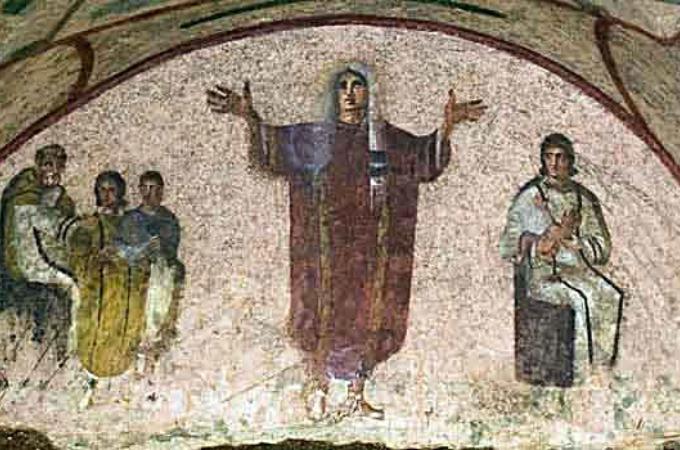
Woman in the orans position at the Catacomb of Priscilla in Rome. www.catacombepriscilla.com

1 Timothy 2: 1-7

1First of all, then, I urge that supplications, prayers, intercessions, and thanksgivings be made for everyone, 2for kings and all who are in high positions, so that we may lead a quiet and peaceable life in all godliness and dignity. 3This is right and acceptable before God our Savior, 4who desires everyone to be saved and to come to the knowledge of the truth. 5For
 there is one God;
  there is also one mediator between God and humankind,
 Christ Jesus, himself human,
  6
who gave himself a ransom for all
—this was attested at the right time.7
For this I was appointed a herald and an apostle (I am telling the truth; I am not lying), a teacher of the gentiles in faith and truth.

Among the communities that Timothy is attempting to shepherd we have already seen evidence of divisions and factions in this letter. Paul is working through Timothy to address the harmful teachings and practices which have distracted these followers of Christ from their participation in God’s mission in Ephesus and likely, as we will discuss in the next section, damaging their reputation among their neighbors. It is easy for conflict to divide the community into groups rallied around different leaders, different practices, different beliefs and beginning to view one another as enemies. Paul’s advice to this congregation begins with reshaping their prayers to be for “all.”

In my final year of seminary, twenty-two years ago, I took a course that went through Jaroslav Pelikan’s five volume treatment of the Christian Tradition where he adapts the traditional phrase lex orandi, lex credenda (literally law of prayer, law of belief). His basic point was that the way the church worshipped and prayed throughout history shaped the beliefs of the church and that many of the beliefs adopted began in local practices. Paul here is shaping their practice of prayer trusting that praying rightly will help transform some of the unhelpful beliefs. The key word in this section is the Greek word pas “all, everyone.” In contrast to praying only for my small group of believers who may look, think, act, believe and practice like me now supplications, prayers, intercessions, and thanksgivings are to be made for “all” (NRSVue everyone).  

Prayer for all may be the beginning of repairing the divisions in the community and transforming “us” and “them” into a “we.” It reminds the praying community that “all” are a part of the people we lift up in prayer and thanksgiving before God. Yet Paul does not stop with the wall of the community but pushes these prayers beyond the community walls into the public square. These communities of faith are not to withdraw from the community. As Thomas Long memorably states:

The Pastor knew well that being Easter people did not mean renouncing the world, donning white robes, going to the mountaintop, and singing “I’ll Fly Away.” Rather it meant the harder task of living the gospel every day in the rough and tumble world of pagan neighbors and worldly powers. (Johnson, 2001, p. 60)

The followers of Jesus will be confined to Israel where everyone will be expected to be faithful to the God of Israel and the law.[1] From the time of Jeremiah onwards, the faithful scattered throughout the world have been encouraged to “seek the welfare of the city where they have been sent.” (Jeremiah 29:7). Within Judaism the prayer for kings, other than the kings of Israel or Judah, goes back to at least Ezra.[2] Paul continues this practice and this will continue throughout early Christian writings. Followers of Christ would pray for the emperor, but they would not pray to the emperor which would be something they would be persecuted for in later times, but here as elsewhere Paul encourages them to find a way to be good citizens within the political order of the day.[3] There may have been some among the early followers of Jesus who were advocating for a more contentious position in relation to the empire, similar to the Jewish movements occurring in the time leading up to the Jewish War with Rome (66-73/74 CE) but Paul advocates for a quiet and peaceable life. Even Revelation, which advocates for withdrawing from Rome, does not view conflict with Rome as the role of Christians. Paul and most early Christians likely viewed Rome as a reality that would be replaced by the advent of the kingdom of God, but that coming kingdom was something they prayed for and did not revolt to bring about. Yet, Paul’s extension of the “all” to include the emperor and those in authority is probably less about appeasement and more about the expansive desire that the emperor and those in high positions would also be saved by the God who desires to save “all.”

This is the only time Paul uses the language of ‘mediator’ in relation to Christ. In Galatians the law came through a ‘mediator’[4] and this is a way that Paul distances to law from God. The only other place in the New Testament that uses mediator language for Christ is the Letter to the Hebrews where Christ is the mediator of a new covenant between God and the people.[5] Most translations will show verse five indented like poetry, and many believe this is quoting a pre-existing teaching or fragment that would be known in the community. It is likely that the mediator language was known in this community.

The language of ‘ransom’ where Christ presented his fully human self for is an evocative image with a long history of debate in Christianity. Paul and the early Christians deployed a wide range of vocabulary to try to describe what Christ’s life, death, and resurrection meant both for believers and the world. This word for ransom (Greek antilytron) is only utilized here in the New Testament,[6] although Paul can utilize the word apolytron (NRSVue ‘redemption) to similar effect in several places.[7] Ransom in Roman society was a rich image because it was the primary way a slave could be granted freedom. Roughly 10-15% of the population of the Roman Empire were slaves, many of them captives from Rome’s various wars. The proportion of people who were slaves was highest in Rome and in urban areas, so there would be a large slave population in Ephesus (see chapter six). A slave could be freed by someone paying a ransom on the slave’s behalf, and so in a community of slaves (and slave holders) the ransoming of a person would be well known. Later Christian thinkers would focus on who the ransom was paid to (God, the devil, etc.) but for early Christians the experience of bondage and the hope of freedom are what this image evokes. Once again the ransom is paid for “all.”

Paul is a witness and declarer of this new reality mediated and paid for by Christ for “all.” This is all occurring within God’s appointed (kairos) time which is not measured in the minutes, hours, days, weeks or years of chronological (from the Greek chronos) time. Paul’s phrase “I am not lying” (Greek ou pseudomai) occurs, as Luke Timothy Johnson notes, “with perhaps disconcerting frequency in Paul’s letters; in addition to Rom 9:1, see 2 Cor 11:31 and Gal 1:20.” (Johnson, 2001, p. 193) For Paul’s, and by extension Timothy’s, ministry his call to be a teacher of the faith to the Gentiles (or nations) is central to both his ministry and his authority in times of conflict.

In a time of community division where false teachings and practices have created problems Paul begins by correcting the prayers of the community. The practice of praying for “all” within and beyond the community. Seeking the welfare of the city, the empire, and its leaders as citizens of both Ephesus and the kingdom of heaven because all of creation is caught up in the mediation of Christ and the ransom of Christ. The prayers of the faithful for “all” reflect the saving desire of God for “all.”

2 Timothy 2: 8-15

  8I desire, then, that in every place the men should pray, lifting up holy hands without anger or argument, 9also that the women should dress themselves in moderate clothing with reverence and self-control, not with their hair braided or with gold, pearls, or expensive clothes, 10but with good works, as is proper for women who profess reverence for God. 11Let a woman learn in silence with full submission. 12I do not permit a woman to teach or to have authority over a man; she is to keep silent. 13For Adam was formed first, then Eve, 14and Adam was not deceived, but the woman was deceived and became a transgressor. 15Yet she will be saved through childbearing, provided they continue in faith and love and holiness, with self-control.

1 Timothy has several passages that evoke passionate discussions among modern readers, none more than the current one in relation to women in the community of faith. The text in the hands of its original readers was a tool that was helping to repair the divisions in the community, but many women may have been in environments where this text was wielded like a weapon to keep women out of leadership, to maintain power arrangements the way they are constructed, and even in some cases quoted to sanction abusive treatment. Just because a passage is difficult or has been used in a harmful manner does not mean we should ignore it. Sometimes it is precisely these difficult texts which can produce the richest dialogues.

Paul begins with speaking to men in the community and beyond. Paul’s desire that men in “all” places pray with hands lifted up to God continues the expansive theme of prayer in the previous section, and may seem initially like a contrast with the limiting words that come immediately afterwards. Yet it is worth noting what Paul is desiring and not desiring. Paul desires pray with hands raised from “all” places but also indicates that this is to be done without anger or argument. As Thomas Long frames this action:

Praying with hands open and lifted is a sign of humility and dependence on God. Men who have their hands open and raised in prayer cannot close their fists in rage. (Long, 2016, p. 72)

Anger in both ancient literature and in modern society is an emotion normally associated with men. Anger (Greek orge) is not merely a feeling of passion but the feeling or passion put into action verbally or physically. (Johnson, 2001, p. 199) As Paul has done throughout this chapter, right prayer is to lead to right belief and disposition. Instead of the anger and arguments present in the Ephesian community this posture of prayer symbolically lets go of the anger, voices are turned to prayer instead of argument, and in this posture new ways can be learned and a broken community healed. The church becomes a community that prays for not only their fellow members in the body of Christ but for “all.” In a church caught up in God’s desire that “all” will be saved, prayer is lifted up for “all” and in “all” places.

For many modern readers they can cruise along with what Paul is saying through the first eight verses of this chapter, but when he begins speaking about women everything said before can be lost for many readers. The Paul who has been committed to “all” now appears to be a different Paul who is silencing a large group within the community. As we enter these verses which have been utilized to silence women and keep them from leadership in the church I’m going to slow us down and try to engage them in the time when Paul writes them and why the same person who says in Christ there is no male and female would now speak of how women dress, how they are to be silent and submissive, and not to be in a role of teaching. The final step of any interpretation of scripture should be how we utilize this scripture in our own time and where it both challenges us and may even help us articulate what we believe and why we believe it.

When one engages writing from an author in a different time and with a different worldview than our own it can be easy to dismiss them as irrelevant, uninformed, prejudiced, and unworthy of our time or consideration. It should not be surprising that views on men and women were different almost two thousand years ago than they are today. The role of women today would be unrecognizable to my grandparent’s generation which grew up in the 1930s, and continues to evolve rapidly.[8] There are limits to what we know about life two thousand years ago, and there is lively debate about the role of women in the early church and in Roman society. What we do have is the writings of people who lived in the time around Paul and how they expressed the role of women as well as historical examples of women who did not fit the pattern expressed by these writers.

Paul is not unique in asking women to dress modestly and to let her good works be her ornamentation. This type of language is common in both Greco-Roman and Jewish writings of the time. (Johnson, 2001, p. 199) The book of James can critique the wealthy man who comes in wearing gold rings and fine clothes (James 2: 2) and 1 Peter echoes many of the things Paul prohibits here: braided hair, gold ornamentation, and fancy clothes. Although there is positive the description of the woman of substance in Proverbs 31: 10-31 who dresses in fine linen and purple (22), this is not the norm.

There are two feasible interpretations of how the women’s dress is being interpreted by others in the church and the surrounding community. One possibility, highlighted by Elsa Tamez, is that the women are attempting to appear as rich. (Long, 2016, p. 74) Clothing and ornamentation have always been a way of communicating status and prosperity and that may have been the women in Ephesian community’s intention, but there is also another role that these women may be assuming. Kathleen Corley in her book Private Women Public Meals: Social Conflict in the Synoptic Tradition draws a contrast between private women and public women. Wives, daughters, and widows were private women. Public women were sometimes thought of as prostitutes, but there were also courtesans who were educated and would be present at meals with men. In contrast to the moral piety recommended by emperor Augustus (who reigned at the time of Jesus birth) the women we know from this era include names like “Cleopatra, Julia, Poppaea, Sempronia, and Messalina who were hardly known by Romans for their virtue.” (Corley, 1993, p. 43) These women who are braiding their hair, wearing fine clothing, pearls and gold, speaking up in gatherings of men were likely being viewed by their neighbors as moving into this space of courtesans/public women and impacting the reception of these communities of Christ by their neighbors.

In the ancient world family was the foundation of society, a reality reflected in most ancient religions. Marriages in the ancient world were an economic relationship which may have romantic inclinations in contrast to modern marriages which are thought of as being held together by love and economic implications are thought of as secondary. Most marriages at this time were arranged marriages and a woman who portrays herself as a public woman and speaks freely may by dress and behavior be harming their future livelihood. We also know that one of the things Paul is writing about is a false teaching forbidding marriage (1 Timothy 4:3) likely in anticipation of Christ’s return.

There is a non-canonical book known as the Acts of Paul and Thecla which is written sometime prior to 190 CE which embraces some of the ideas Paul warns against in 1 Timothy: a life of perpetual virginity, abstinence from certain food, and world renouncing ideas. For Paul life engages with God’s work in creation and “truth and grace reverberate in the mundane realities of everyday life and relationships.” (Long, 2016, p. 80) Paul’s view of marriage as a place where men are subordinate to Christ and women are subordinate to their husband, while perhaps unpopular today is consistent in his writings. (1 Corinthians 11: 2-3; Ephesians 5: 21-33; Colossians 3: 18-25) Paul also uses a similar interpretation of Genesis 3 in 1 Corinthians 11: 8-9 and 2 Corinthians 11: 2-3 and it is also a pattern utilized by the contemporary Jewish philosopher Philo. Most modern readers will come to a different reading of Genesis, but Paul’s interpretation is consistent with his time viewing Eve as the one who was the transgressor and deceived one.

The passage ends with the statement that women will be saved through childbearing provided they continue in faith, love, holiness and self-control. In our culture this is another statement that is hard to comprehend, but in the ancient world it was much easier to hear. Children in the ancient world were associated with being blessed by God and infertility was a crisis to a woman’s identity. There is a reason the barrenness of Sarah, Rebekah, Rachel, the unnamed mother of Samson, Hannah, the wealthy Shunammite woman, and in the New Testament Elizabeth are viewed as a crisis for the woman and her place in the family. There has been a massive swing in the view of children in the past century mainly due to the shift of work away from the household and into the workplace. For most of history having children was viewed as a source of security (children would take over the home and care for aging parents) and labor from a young age. In recent years children may still be viewed as a blessing but also as a burden due to the cost of raising and educating a child to prepare them for life in the modern world. Many modern families choose not to have children to allow both partners to pursue their careers and in most places a woman’s value is no longer associated with her bearing and raising children. Thomas Long approaches this statement by saying, “childbearing is not a means of salvation for women; it is one of the arenas in which salvation occurs.” (Long, 2016, p. 81) I believe he is right that Paul views salvation as not some escape from this world but woven together with God’s actions bringing life to women, men, and children in the mundane everyday acts of provision and nurture in God’s creation.

I am a part of a church that has ordained women for fifty-five years, and I have never known a church where women could not serve as pastors. The majority of my colleagues in seminary were women and I know many excellent women who are both pastors and lay leaders in the church. Yet it took a long time for individual churches to be open to women in pastoral and other leadership roles. There are also many churches that still do not allow women to be pastors or teachers. People of faith have always had to wrestle with what portions of scripture are unique to a specific moment in history and what aspects still apply in our time. It is inescapable, both in the bible and our own time, that the surrounding culture will impact how we practice our faith but it is worth spending the time reflecting why we practice and preach the way we do.

Throughout this chapter the goal has been for the people to live a peaceful and quiet life within their society. Paul in his ministry in the Hellenistic world is conscious of the values, dress, beliefs, and behaviors of his surrounding world. In many ways Paul models what the Jesuits will later adopt in their missionary work where he utilizes the common language and attempts to find common ground between the local traditions and the gospel he is entrusted with. Paul believed women were firmly equal with men in membership in the church and identity in Christ, but Paul also did not want the actions of women and men in the community to place additional stumbling blocks for their neighbors encountering the saving God of the gospels.

I do think this uncomfortable passage still has questions for us to wrestle with in our own culture. In our time we are highly individualistic while in Paul’s time they thought primarily in terms of family and community and this passage makes me think about where we have neglected the common good for our own individual fulfillment. Paul’s discussion of prayer for “all” including political leaders has prompted me to think about how unprayerful my language can become for political leaders who I disagree with. Prayer permeates this passage and I have often moved directly into dialogue or even confrontation without prayer. The well-known proverb that ‘clothes make the man’ in combination with Paul’s words about women’s dress here allow an opportunity for considering what message our clothing and ornamentation are sending to our neighbors. I have seen in my lifetime a phenomenal change in societal dialogue around masculinity and femininity, and I do think that we as people of faith do need to consider how we shape women and men for both the world they encounter and their relationships with one another. I know a lot of young people are hesitant to have children for economic and other reasons and I think this can give us encouragement to wonder at a world where children are viewed as blessings and potential instead of an economic burden. None of these reflections have easy answers and they touch on core portions of our lives, but for me this chapter reminds me of how God’s salvation impacts “all” of life for me, my neighbor, my nation, and my world.


[1] In fairness, Israel/Judah was always in contact with other cultures, beliefs, and values.

[2] Ezra 6:10, see also Baruch 1:10-12 which prays for King Nebuchadrezzar.

[3] Romans 13: 1-7; Titus 3: 1-2.

[4] Galatians 3: 19-20.

[5] Hebrews 8:5; 9:15; 12:24.

[6] Both Mark 10:45 and Matthew 20:28 utilize the Greek word lutron which has a similar meaning.

[7] Romans 3:24; 8:23; 1 Corinthians 1: 30; Colossians 1:14.

[8] Those advocating for change may not feel that it is occurring rapidly, but from a historical perspective the opportunities for education, employment, equality, participation in the political process, leadership in religious organizations, and beyond for women are a tectonic shift in only a couple of generations.

Reflection on Notes on Being a Man by Scott Galloway

Reflections on Notes on Being a Man by Scott Galloway

This is a part of a selection of readings I gathered to reflect on what a healthy approach to masculine identity would look like. I navigated my own journey into a version of manhood in my late teens and early twenties successfully, but now in middle age I see a lot of young men struggling to navigate this journey and for a variety of reasons failing to launch into life. I come to this with humility and curiosity seeking those who may be able to articulate more clearly the journeys that may lead young men to discover a fulfilling life of work and relationships and to help those moving into the space of elders to support and guide them in this journey.

Scott Galloway has one of the larger media footprints of individuals who have written on masculinity recently and if you have ever heard him speak, his writing is similar. He is a good storyteller who brings together his personal experiences with the broader research that others have done on men. Notes on Being a Man is a combination of an autobiography/memoir with a frame looking at the advantages he had as a mediocre white man because society invested in him—advantages no longer present for the current generation of men.

Galloway stakes out two positive aspects of masculinity: providing and protecting. The traditional role of masculinity was to provide for their family and by extension their society. Galloway uses the shorthand of providing excess value throughout the book to talk about how an adult man should repay both their family and society for the resources invested in them as they grow. Protection is the way he reframes the strength that masculinity provides. In a world where cruelty is mistaken for courage, Galloway points to the positive value of protection that is a part of masculinity.

Notes on Being a Man is a very approachable and easy read. The cadence of the writing makes it sound like the author is having a conversation with the reader. If you are looking for something that is heavier on research this is probably not where you want to start, but if you are looking for something to have a conversation with a young man this is probably far more beneficial. I know in my own life I learned a lot from the stories of the men around me as well as the biographies of people I respected. So much of the online conversation around masculinity has been dominated by politically conservative voice and I appreciate Galloway as a political moderate contributing his thoughts to how we support and mentor the next generation of young men.

Review of Muscular Christianity by Clifford Putney

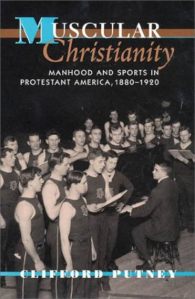
Review of Muscular Christianity: Manhood and Sports in Protestant America, 1880-1920 by Clifford Putney (2001)

This is a part of a selection of readings I gathered to reflect on what a healthy approach to masculine identity would look like. I navigated my own journey into a version of manhood in my late teens and early twenties successfully, but now in middle age I see a lot of young men struggling to navigate this journey and for a variety of reasons failing to launch into life. I come to this with humility and curiosity seeking those who may be able to articulate more clearly the journeys that may lead young men to discover a fulfilling life of work and relationships and to help those moving into the space of elders to support and guide them in this journey.

I first encountered the term ‘muscular Christianity’ in a biography of Theodore Roosevelt, and I heard echoes of some similar questions which seem to be surfacing today being a part of the rhetoric of one hundred years ago. Clifford Putney’s Muscular Christianity is an adaptation of his doctoral dissertation for his PhD studies in American History at Brandeis University. Prior to the Civil War much of the population was still engaged in agricultural or manual labor, and during the Civil War men had demonstrated their manhood in military service. But in the years at the end of the nineteenth century and the beginning of the twentieth century the population began to move into the cities. As the culture and churches began to embrace more feminine and peaceful virtues there was an increased incidence of ‘neurasthenia’-the diagnosis of the day for hysteria, depression and anxiety. In Putney’s words, which could be echoed by many Conservative voices today, “If the immigrant, the city, and rural depopulation constituted the first three horsemen of the nativist apocalypse, many considered the “modern woman” to be the fourth.” (29) Yet, one critical thing to understand about muscular Christianity in the United States is that it was a progressive movement linked to political reformers like Theodore Roosevelt, and social gospel preachers like Walter Ruashenbusch. It was a response to the “spiritual blandness” and “moral impotence” (33) of the culture of the time. Muscular Christianity was less a theological movement than a cultural one attempting to recapture both participation from men in the life of the church but also attempting to rediscover a connection between the physicality of men and faith.

Although the YMCA existed prior to the emergence of muscular Christianity, it flourished and grew phenomenally during this time. The Boy Scouts and several other nature groups for boys and young men also emerged as a way for boys to return to nature and to build character in these boys. Yet, the movement also helped to reenergize the missionary movement in the United States, particularly in encouraging young men to consider being a missionary overseas. It also led to a parallel movement for women which led to the formation of organizations like the YWCA, Girl Scouts, Campfire Girls. 

The movement would decline in the aftermath of World War I, at least among liberal Christianity. Some of this was due to the poor reception of YMCA among soldiers serving in the war who were criticized of,” using up gasoline over here to warn us fellows against the skirts, when he ought to be down here in the trenches where he belongs or get the blazes our ‘o here.” (191) Many of these muscular Christians were divided on the war, some were passivists, others began to see the war as a moral crusade. Yet, by the end of the beginning of the 1920s the movement was in decline among mainline Protestant circles. However, by the 1930s it had moved into the fundamentalist churches which encouraged the development of Christian athletes establishing Youth for Christ (1945), the Fellowship of Christian Athletes (1954) and Athletes in Action (1966).

I find Clifford Putney’s exploration of this movement in Christianity and the broader culture a helpful historical perspective for our current moment. To see the concerns of a century ago reflected in slightly different language today is an opportunity to learn from the past. I find it encouraging that muscular Christianity was a progressive movement at the turn of the century and it gives me some hope that there can be a healthy masculinity that can be involved in attempting to make the world a better place. There was an anti-intellectualism that was present in the muscular Christianity of the 1880s until 1920, even though some of its practitioners were in elite education institutions, but it did lead to organizations that led to a rediscovery of nature, a president and others who created a national parks system, and a healthier approach of physicality for both men and women. When culture and religion can feel bland or impotent for its detached intellectualism, those who explored the strenuous life promised by muscular Christianity sought a more embodied solution. Those solutions would need to look different today than a century ago, but it is helpful to realize that many of the questions and fears of today have been a part of our society and religious spaces before.

Reflection on Of Boys and Men by Richard V. Reeves

Reflections on Of Boys and Men: Why the Modern Male is Struggling. Why it Matters, and What to do about It. By Richard V. Reeves.

This is a part of a selection of readings I gathered to reflect on what a healthy approach to masculine identity would look like. I navigated my own journey into a version of manhood in my late teens and early twenties successfully, but now in middle age I see a lot of young men struggling to navigate this journey and for a variety of reasons failing to launch into life. I come to this with humility and curiosity seeking those who may be able to articulate more clearly the journeys that may lead young men to discover a fulfilling life of work and relationships and to help those moving into the space of elders to support and guide them in this journey.

Richard Reeves book Of Boys and Men was the first book that helped make sense of several intuitions I had about the way life had changed for men in relationships, in work, and in school. I initially listened to an audio version of the book in 2024 and then read and marked up a physical copy in 2025. One of the things I appreciate about Richard Reeves approach is that he continually reminds the reader that empathy is not a zero-sum game. We can be concerned about advancing equality for women and still acknowledge and address the ways men are struggling in education, relationships and the workforce and the fundamental changes in their roles in a relatively short period of time. Richard Reeves is also a person who thinks about policy and so the book not only identifies the struggles that many men face but also provides ideas for consideration in addressing the struggles.

In education at all levels men have fallen significantly behind women. Women are more likely to perform well in middle and high school, attend and graduate college, and go onto graduate level education. Part of the struggle that boys and men struggle with in education is biological. As Richard Reeves states:

Boys’ brains develop more slowly, especially during the most critical years of secondary education. When almost one in four boys (23%) is categorized as having a “developmental disability,” it is fair to wonder if it is educational institutions, rather than boys, that are not functioning properly. (8)

The lack of male educators in the school system impacts the ability of boys to learn, but it also leads to the pathologizing of normal adolescent behavior. Richard Reeves also suggests starting boys a year later in the educational progression to assist with the two to three year gap in development of key executive functions in brain activity between girls and boys, but also advocates for more male teachers, coaches, and other leadership roles within the educational system.

The workforce has fundamentally changed in recent generations and many of the jobs lost were traditionally masculine jobs that required physical strength, which has now been replaced by automation. Reeves notes that the significant effort to encourage women to be educated and work in STEM (Science, Technology, Engineering, and Mathematics) fields but the fastest growing job needs are in what Reeves labels as HEAL jobs: Healthcare, Education, Administration, and Literacy. As mentioned above he advocates for programs to encourage and fund men being trained in these HEAL jobs and notes the benefits that having men in these jobs would have for both men and women.

One of the other things I appreciated about Reeve’s attempt at balance was his willingness to criticize both the political left and right in their approach to the issue. The political right at least acknowledges that there is a problem, but their solution is to try to steer the world back to an earlier time when women were less involved in the workforce, college, and life outside the home. The political left has pathologized the problem as ‘toxic masculinity,’ viewed male problems as individual failings, been unwilling to acknowledge any biological basis for sex differences, and has been convinced that inequality can only run one way. An example of viewing the problem as individual failings would look like:

If men are depressed, it is because they won’t express their feelings. If they get sick, it is because they won’t go to the doctor. If they fail at school, it is because they lack commitment. If they die early, it is because they drink and smoke too much and eat the wrong things. For those on the political Left, then, victim-blaming is permitted when it comes to men. (109)

He also begins to reframe some of the traits that have been labelled ‘toxic’ in a more positive light. For example, the male psychology is more wired for risk, but it is also far more likely to take risks to save or protect others. He also highlights the erosion of the core institutions of work, family, and religion which guided common patterns of behavior for men and women.

I appreciate that Richard Reeves has not only provided a thoughtful approach to the problems that boys and men face but also continues to research and advocate for solutions. His work is one that several other authors are beginning to build upon and Of Boys and Men was one of the first books that attempted a balanced approach to the issues facing men. Of Boys and Men helped give me both a language to describe some of what I was seeing as well as prompting me to dig deeper and to want to know more. I found it helpful as we try to imagine a hopeful future for both men and women.

Reflections on The End of Men and the Rise of Women by Hannah Rosin

This is a part of a selection of readings I gathered to reflect on what a healthy approach to masculine identity would look like. I navigated my own journey into a version of manhood in my late teens and early twenties successfully, but now in middle age I see a lot of young men struggling to navigate this journey and for a variety of reasons failing to launch into life. I come to this with humility and curiosity seeking those who may be able to articulate more clearly the journeys that may lead young men to discover a fulfilling life of work and relationships and to help those moving into the space of elders to support and guide them in this journey.

There are some startling quotes in this book, but the one that stopped me in my tracks as we look at the future was this:

This script has played out once before in American culture. Starting in the 1970s, black men began leaving factory jobs; by 1987 only 20 percent of black men worked in manufacturing. The men who lived in the inner cities had a hard time making the switch to service jobs or getting the education needed to move into other sectors. (88)

There has been a lot of attention paid to the incarceration, unemployment, and the lack of young black men in raising children and the factors behind these men not being successful in society but when you expand the script to the plight of black men being predictive of the future of men as a whole that is bleak. I do believe that especially for men so much of their identity is tied to work and the loss of job opportunities for men without a college degree is a major factor in the failure of men in both the economy and life. Hannah Rosin’s book in 2012 was one the first one that I am aware of to notice the drastic changes occurring in the education and work space of America and she covers a wide range of impacts from the changes. From the changing dynamic of ‘hook-up culture’ in colleges, to the way the upper class still holds onto marriage as an economic advantage, the economic mobility of women and the economic stagnation of men, the drastic change in the makeup of college campuses, the increase in female violence, and the way women are breaking into the top of the job market.

I valued the combination of personal stories gained from interviews placed in the context of the seismic shift in the job and education market. As Hannah Rosin notes about the 2008-2009 Recession:

In the Great Recession, three-quarters of the 7.5 million jobs lost were lost by men. The worst-hit industries were overwhelmingly male, and deeply identified with macho: construction, manufacturing, high finance. (4)

I appreciated her candor in talking about the ‘hook-up culture’ on college campuses where women are also using it to avoid relationships which could derail their progression through college and into the workforce. Women are more educated and doing better economically in their late twenties than their male counterparts. Although college educated men and women were more likely to remain married and to ‘see-saw’ in their primary breadwinning roles, among men with only a high-school diploma the change was drastic. “In 1967, 97 percent of American men with only a high school diploma were working; in 2010, just 76 percent were.” (86) It has been common to note that this generation is not doing as well as the previous generation, but particularly for men:

In 2009, men brought home $48,000 on average, roughly the same as they did in 1969 after adjusting for inflation. In fact, as a recent report written by former White House economist Michael Greenstone discovered, the truth is even more dismal. Calling it stagnation fails to take into account the fact that fewer men are working full-time now or making any salary at all, and many more are incarcerated. If you add in those factors, the median income for men ages twenty-five to sixty-four has not only stagnated, but fallen sharply by almost $13,000 since 1969—a reduction of 28 percent. (125)

There is beginning to be an awareness of the change in the makeup of college classes, now dominated by women, but Hannah Rosin was one of the early voices who noted the vastly larger number of female applicants to college and the beginning of colleges attempting to balance the classes by giving preferential treatment to attract enough men.

What Hannah Rosin does a good job of doing is narrating the change that has occurred in society and how women have adapted while many men have failed to adapt. This is a story that need to be told, but it is also an uncomfortable story that undercuts one of the narratives I hear frequently where men are still assumed to be the ones with political and economic power. I have heard voices that refuse to believe that men are struggling, particularly from women who blazed the trail for the current generation. As Rosin states,

The closer women get to real power, the more they cling to the idea that they are powerless. To rejoice about feminist victories these days counts as betrayal. (272)

Women have made a lot of progress in my lifetime and that should be celebrated and there are still places where progress continues to be needed. Yet, we can want our young women to be successful and reach out to young men who are struggling to find a foothold in the rapidly changing geography of the job and education marketplace.

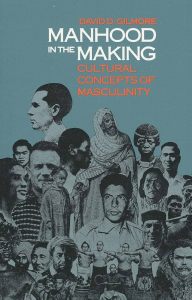
Reflections on Manhood in the Making: Cultural Concepts of Masculinity by David D. Gilmore. (1990)

This is a part of a selection of readings I gathered to reflect on what a healthy approach to masculine identity would look like. I navigated my own journey into a version of manhood in my late teens and early twenties successfully, but now in middle age I see a lot of young men struggling to navigate this journey and for a variety of reasons failing to launch into life. I come to this with humility and curiosity seeking those who may be able to articulate more clearly the journeys that may lead young men to discover a fulfilling life of work and relationships and to help those moving into the space of elders to support and guide them in this journey.

David Gilmore is an anthropologist who taught at the State University of New York whose book Manhood in the Making examines manhood as it is expressed through a number of representative cultures which have been studied by anthropologists. The groups included in the collection of studies are primarily from tribal and traditional societies which are geographically separate from larger cultural influences. With a couple of exceptions, there are expectations of a passage into manhood in these cultures and the possibility of a male child failing to navigate the expectations of manhood and being “unmanly” and unreliable in their society.  As Gilmore states,

there is a constantly recurring notion that real manhood is different from simple anatomical maleness, that it is not a natural condition that comes about spontaneously through biological maturation but rather it is a precarious or artificial state that boys must win against powerful odds. This recurrent notion that manhood is a problematic, a critical threshold that boys must pass through testing, is found at all levels of sociocultural development regardless of what other alternative roles are recognized. (11)

Or more simply, boys through culturally appropriate preparation and testing must be made into men. Simply being physically mature is not enough for the mantle of manhood. Men are made, not born. And although “being a good man” may have less focus than “being good at being a man” (30) there is in most cultures an expectation that “being good at being a man” involves providing for both kin and the larger society. “If a man rejects this provider’s role, he is said to be useless and to be dependent like a woman or like a child (Caughey 1970:69).” (73)

There are two exceptions listed in this study where the men are passive, the Tahiti and Semai. These societies with men who are conditioned to be more passive and peaceful are highlighted by some readers as an ideal for a modern society, but I don’t think these men would function well in modern society. As David Gilmore surmises as he wraps up the study, “When men are conditioned to fight, manhood is important; where men are conditioned to flight, the opposite is true.” (221) He concludes with two long statements which I will quote in their entirety because I find them very helpful:

When I started researching this book, I was prepared to rediscover the old saw that masculinity is self-serving, egotistical, and uncaring. But I did not find this. One of my findings here is that manhood ideologies always include a criterion of selfless generosity, even to the point of sacrifice. Again and again we find that “real” men are those who give more than they take; they serve others. Real men are generous, even to a fault, like the Mehinaku fisherman, the Samburu cattle-herder, or the Sambia or Dodoth Big Man. Non-men are often those stigmatized as stingy and unproductive. (229)

Men adopting the provider role provide more for their society than they take, and they will often do without so that others may have enough. One final quote from Manhood in the Making on the sacrifices men are expected to make for kin and society:

Men nurture their society by shedding their blood, their sweat, and their semen, by bringing home food for both child and mother, by producing children, and by dying if necessary in faraway places to provide safe haven for their people. This too, is nurturing in the sense of endowing or increasing. However, the necessary personal qualities for this male contribution are paradoxically the exact opposite of what we Westerners normally consider the nurturing personality. To support his family, the man has to be distant, away hunting or fighting wars; to be tender, he must be tough enough to fend off enemies. To be generous, he must be selfish enough to amass goods, often by defeating other men; to be gentle, he must first be strong, even ruthless in confronting enemies; to love he must be aggressive enough to court, seduce, and “win” a wife. (230)

I found Gilmore’s work to be helpful. At times he and his fellow anthropologists were a little overdependent on a Freudian framework, but the highlighting of the processes in these cultures to transform boys into men, something missing in any formal way in our society, and the expectation of a competent but generous masculinity in culture was helpful.

Gilmore, D. D. (1990). Masculinity in the Making: Cultural and Concepts of Masculinity. New Haven: Yale University Press.