Review of Muscular Christianity: Manhood and Sports in Protestant America, 1880-1920 by Clifford Putney (2001)
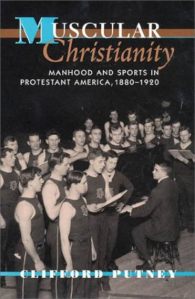
This is a part of a selection of readings I gathered to reflect on what a healthy approach to masculine identity would look like. I navigated my own journey into a version of manhood in my late teens and early twenties successfully, but now in middle age I see a lot of young men struggling to navigate this journey and for a variety of reasons failing to launch into life. I come to this with humility and curiosity seeking those who may be able to articulate more clearly the journeys that may lead young men to discover a fulfilling life of work and relationships and to help those moving into the space of elders to support and guide them in this journey.
I first encountered the term ‘muscular Christianity’ in a biography of Theodore Roosevelt, and I heard echoes of some similar questions which seem to be surfacing today being a part of the rhetoric of one hundred years ago. Clifford Putney’s Muscular Christianity is an adaptation of his doctoral dissertation for his PhD studies in American History at Brandeis University. Prior to the Civil War much of the population was still engaged in agricultural or manual labor, and during the Civil War men had demonstrated their manhood in military service. But in the years at the end of the nineteenth century and the beginning of the twentieth century the population began to move into the cities. As the culture and churches began to embrace more feminine and peaceful virtues there was an increased incidence of ‘neurasthenia’-the diagnosis of the day for hysteria, depression and anxiety. In Putney’s words, which could be echoed by many Conservative voices today, “If the immigrant, the city, and rural depopulation constituted the first three horsemen of the nativist apocalypse, many considered the “modern woman” to be the fourth.” (29) Yet, one critical thing to understand about muscular Christianity in the United States is that it was a progressive movement linked to political reformers like Theodore Roosevelt, and social gospel preachers like Walter Ruashenbusch. It was a response to the “spiritual blandness” and “moral impotence” (33) of the culture of the time. Muscular Christianity was less a theological movement than a cultural one attempting to recapture both participation from men in the life of the church but also attempting to rediscover a connection between the physicality of men and faith.
Although the YMCA existed prior to the emergence of muscular Christianity, it flourished and grew phenomenally during this time. The Boy Scouts and several other nature groups for boys and young men also emerged as a way for boys to return to nature and to build character in these boys. Yet, the movement also helped to reenergize the missionary movement in the United States, particularly in encouraging young men to consider being a missionary overseas. It also led to a parallel movement for women which led to the formation of organizations like the YWCA, Girl Scouts, Campfire Girls.
The movement would decline in the aftermath of World War I, at least among liberal Christianity. Some of this was due to the poor reception of YMCA among soldiers serving in the war who were criticized of,” using up gasoline over here to warn us fellows against the skirts, when he ought to be down here in the trenches where he belongs or get the blazes our ‘o here.” (191) Many of these muscular Christians were divided on the war, some were passivists, others began to see the war as a moral crusade. Yet, by the end of the beginning of the 1920s the movement was in decline among mainline Protestant circles. However, by the 1930s it had moved into the fundamentalist churches which encouraged the development of Christian athletes establishing Youth for Christ (1945), the Fellowship of Christian Athletes (1954) and Athletes in Action (1966).
I find Clifford Putney’s exploration of this movement in Christianity and the broader culture a helpful historical perspective for our current moment. To see the concerns of a century ago reflected in slightly different language today is an opportunity to learn from the past. I find it encouraging that muscular Christianity was a progressive movement at the turn of the century and it gives me some hope that there can be a healthy masculinity that can be involved in attempting to make the world a better place. There was an anti-intellectualism that was present in the muscular Christianity of the 1880s until 1920, even though some of its practitioners were in elite education institutions, but it did lead to organizations that led to a rediscovery of nature, a president and others who created a national parks system, and a healthier approach of physicality for both men and women. When culture and religion can feel bland or impotent for its detached intellectualism, those who explored the strenuous life promised by muscular Christianity sought a more embodied solution. Those solutions would need to look different today than a century ago, but it is helpful to realize that many of the questions and fears of today have been a part of our society and religious spaces before.

