1 Timothy 2: 1-7
1 First of all, then, I urge that supplications, prayers, intercessions, and thanksgivings be made for everyone, 2 for kings and all who are in high positions, so that we may lead a quiet and peaceable life in all godliness and dignity. 3 This is right and acceptable before God our Savior, 4 who desires everyone to be saved and to come to the knowledge of the truth. 5 For
there is one God;
there is also one mediator between God and humankind,
Christ Jesus, himself human,
6 who gave himself a ransom for all
—this was attested at the right time.7 For this I was appointed a herald and an apostle (I am telling the truth; I am not lying), a teacher of the gentiles in faith and truth.
Among the communities that Timothy is attempting to shepherd we have already seen evidence of divisions and factions in this letter. Paul is working through Timothy to address the harmful teachings and practices which have distracted these followers of Christ from their participation in God’s mission in Ephesus and likely, as we will discuss in the next section, damaging their reputation among their neighbors. It is easy for conflict to divide the community into groups rallied around different leaders, different practices, different beliefs and beginning to view one another as enemies. Paul’s advice to this congregation begins with reshaping their prayers to be for “all.”
In my final year of seminary, twenty-two years ago, I took a course that went through Jaroslav Pelikan’s five volume treatment of the Christian Tradition where he adapts the traditional phrase lex orandi, lex credenda (literally law of prayer, law of belief). His basic point was that the way the church worshipped and prayed throughout history shaped the beliefs of the church and that many of the beliefs adopted began in local practices. Paul here is shaping their practice of prayer trusting that praying rightly will help transform some of the unhelpful beliefs. The key word in this section is the Greek word pas “all, everyone.” In contrast to praying only for my small group of believers who may look, think, act, believe and practice like me now supplications, prayers, intercessions, and thanksgivings are to be made for “all” (NRSVue everyone).
Prayer for all may be the beginning of repairing the divisions in the community and transforming “us” and “them” into a “we.” It reminds the praying community that “all” are a part of the people we lift up in prayer and thanksgiving before God. Yet Paul does not stop with the wall of the community but pushes these prayers beyond the community walls into the public square. These communities of faith are not to withdraw from the community. As Thomas Long memorably states:
The Pastor knew well that being Easter people did not mean renouncing the world, donning white robes, going to the mountaintop, and singing “I’ll Fly Away.” Rather it meant the harder task of living the gospel every day in the rough and tumble world of pagan neighbors and worldly powers. (Johnson, 2001, p. 60)
The followers of Jesus will be confined to Israel where everyone will be expected to be faithful to the God of Israel and the law.[1] From the time of Jeremiah onwards, the faithful scattered throughout the world have been encouraged to “seek the welfare of the city where they have been sent.” (Jeremiah 29:7). Within Judaism the prayer for kings, other than the kings of Israel or Judah, goes back to at least Ezra.[2] Paul continues this practice and this will continue throughout early Christian writings. Followers of Christ would pray for the emperor, but they would not pray to the emperor which would be something they would be persecuted for in later times, but here as elsewhere Paul encourages them to find a way to be good citizens within the political order of the day.[3] There may have been some among the early followers of Jesus who were advocating for a more contentious position in relation to the empire, similar to the Jewish movements occurring in the time leading up to the Jewish War with Rome (66-73/74 CE) but Paul advocates for a quiet and peaceable life. Even Revelation, which advocates for withdrawing from Rome, does not view conflict with Rome as the role of Christians. Paul and most early Christians likely viewed Rome as a reality that would be replaced by the advent of the kingdom of God, but that coming kingdom was something they prayed for and did not revolt to bring about. Yet, Paul’s extension of the “all” to include the emperor and those in authority is probably less about appeasement and more about the expansive desire that the emperor and those in high positions would also be saved by the God who desires to save “all.”
This is the only time Paul uses the language of ‘mediator’ in relation to Christ. In Galatians the law came through a ‘mediator’[4] and this is a way that Paul distances to law from God. The only other place in the New Testament that uses mediator language for Christ is the Letter to the Hebrews where Christ is the mediator of a new covenant between God and the people.[5] Most translations will show verse five indented like poetry, and many believe this is quoting a pre-existing teaching or fragment that would be known in the community. It is likely that the mediator language was known in this community.
The language of ‘ransom’ where Christ presented his fully human self for is an evocative image with a long history of debate in Christianity. Paul and the early Christians deployed a wide range of vocabulary to try to describe what Christ’s life, death, and resurrection meant both for believers and the world. This word for ransom (Greek antilytron) is only utilized here in the New Testament,[6] although Paul can utilize the word apolytron (NRSVue ‘redemption) to similar effect in several places.[7] Ransom in Roman society was a rich image because it was the primary way a slave could be granted freedom. Roughly 10-15% of the population of the Roman Empire were slaves, many of them captives from Rome’s various wars. The proportion of people who were slaves was highest in Rome and in urban areas, so there would be a large slave population in Ephesus (see chapter six). A slave could be freed by someone paying a ransom on the slave’s behalf, and so in a community of slaves (and slave holders) the ransoming of a person would be well known. Later Christian thinkers would focus on who the ransom was paid to (God, the devil, etc.) but for early Christians the experience of bondage and the hope of freedom are what this image evokes. Once again the ransom is paid for “all.”
Paul is a witness and declarer of this new reality mediated and paid for by Christ for “all.” This is all occurring within God’s appointed (kairos) time which is not measured in the minutes, hours, days, weeks or years of chronological (from the Greek chronos) time. Paul’s phrase “I am not lying” (Greek ou pseudomai) occurs, as Luke Timothy Johnson notes, “with perhaps disconcerting frequency in Paul’s letters; in addition to Rom 9:1, see 2 Cor 11:31 and Gal 1:20.” (Johnson, 2001, p. 193) For Paul’s, and by extension Timothy’s, ministry his call to be a teacher of the faith to the Gentiles (or nations) is central to both his ministry and his authority in times of conflict.
In a time of community division where false teachings and practices have created problems Paul begins by correcting the prayers of the community. The practice of praying for “all” within and beyond the community. Seeking the welfare of the city, the empire, and its leaders as citizens of both Ephesus and the kingdom of heaven because all of creation is caught up in the mediation of Christ and the ransom of Christ. The prayers of the faithful for “all” reflect the saving desire of God for “all.”
2 Timothy 2: 8-15
8 I desire, then, that in every place the men should pray, lifting up holy hands without anger or argument, 9 also that the women should dress themselves in moderate clothing with reverence and self-control, not with their hair braided or with gold, pearls, or expensive clothes, 10 but with good works, as is proper for women who profess reverence for God. 11 Let a woman learn in silence with full submission. 12 I do not permit a woman to teach or to have authority over a man; she is to keep silent. 13 For Adam was formed first, then Eve, 14 and Adam was not deceived, but the woman was deceived and became a transgressor. 15 Yet she will be saved through childbearing, provided they continue in faith and love and holiness, with self-control.
1 Timothy has several passages that evoke passionate discussions among modern readers, none more than the current one in relation to women in the community of faith. The text in the hands of its original readers was a tool that was helping to repair the divisions in the community, but many women may have been in environments where this text was wielded like a weapon to keep women out of leadership, to maintain power arrangements the way they are constructed, and even in some cases quoted to sanction abusive treatment. Just because a passage is difficult or has been used in a harmful manner does not mean we should ignore it. Sometimes it is precisely these difficult texts which can produce the richest dialogues.
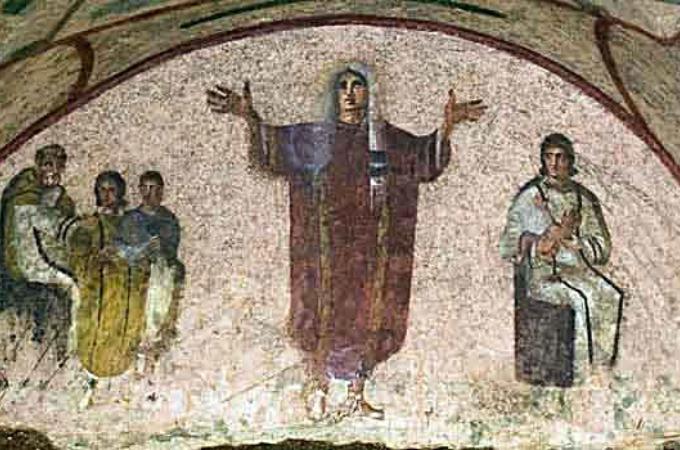
Paul begins with speaking to men in the community and beyond. Paul’s desire that men in “all” places pray with hands lifted up to God continues the expansive theme of prayer in the previous section, and may seem initially like a contrast with the limiting words that come immediately afterwards. Yet it is worth noting what Paul is desiring and not desiring. Paul desires pray with hands raised from “all” places but also indicates that this is to be done without anger or argument. As Thomas Long frames this action:
Praying with hands open and lifted is a sign of humility and dependence on God. Men who have their hands open and raised in prayer cannot close their fists in rage. (Long, 2016, p. 72)
Anger in both ancient literature and in modern society is an emotion normally associated with men. Anger (Greek orge) is not merely a feeling of passion but the feeling or passion put into action verbally or physically. (Johnson, 2001, p. 199) As Paul has done throughout this chapter, right prayer is to lead to right belief and disposition. Instead of the anger and arguments present in the Ephesian community this posture of prayer symbolically lets go of the anger, voices are turned to prayer instead of argument, and in this posture new ways can be learned and a broken community healed. The church becomes a community that prays for not only their fellow members in the body of Christ but for “all.” In a church caught up in God’s desire that “all” will be saved, prayer is lifted up for “all” and in “all” places.
For many modern readers they can cruise along with what Paul is saying through the first eight verses of this chapter, but when he begins speaking about women everything said before can be lost for many readers. The Paul who has been committed to “all” now appears to be a different Paul who is silencing a large group within the community. As we enter these verses which have been utilized to silence women and keep them from leadership in the church I’m going to slow us down and try to engage them in the time when Paul writes them and why the same person who says in Christ there is no male and female would now speak of how women dress, how they are to be silent and submissive, and not to be in a role of teaching. The final step of any interpretation of scripture should be how we utilize this scripture in our own time and where it both challenges us and may even help us articulate what we believe and why we believe it.
When one engages writing from an author in a different time and with a different worldview than our own it can be easy to dismiss them as irrelevant, uninformed, prejudiced, and unworthy of our time or consideration. It should not be surprising that views on men and women were different almost two thousand years ago than they are today. The role of women today would be unrecognizable to my grandparent’s generation which grew up in the 1930s, and continues to evolve rapidly.[8] There are limits to what we know about life two thousand years ago, and there is lively debate about the role of women in the early church and in Roman society. What we do have is the writings of people who lived in the time around Paul and how they expressed the role of women as well as historical examples of women who did not fit the pattern expressed by these writers.
Paul is not unique in asking women to dress modestly and to let her good works be her ornamentation. This type of language is common in both Greco-Roman and Jewish writings of the time. (Johnson, 2001, p. 199) The book of James can critique the wealthy man who comes in wearing gold rings and fine clothes (James 2: 2) and 1 Peter echoes many of the things Paul prohibits here: braided hair, gold ornamentation, and fancy clothes. Although there is positive the description of the woman of substance in Proverbs 31: 10-31 who dresses in fine linen and purple (22), this is not the norm.
There are two feasible interpretations of how the women’s dress is being interpreted by others in the church and the surrounding community. One possibility, highlighted by Elsa Tamez, is that the women are attempting to appear as rich. (Long, 2016, p. 74) Clothing and ornamentation have always been a way of communicating status and prosperity and that may have been the women in Ephesian community’s intention, but there is also another role that these women may be assuming. Kathleen Corley in her book Private Women Public Meals: Social Conflict in the Synoptic Tradition draws a contrast between private women and public women. Wives, daughters, and widows were private women. Public women were sometimes thought of as prostitutes, but there were also courtesans who were educated and would be present at meals with men. In contrast to the moral piety recommended by emperor Augustus (who reigned at the time of Jesus birth) the women we know from this era include names like “Cleopatra, Julia, Poppaea, Sempronia, and Messalina who were hardly known by Romans for their virtue.” (Corley, 1993, p. 43) These women who are braiding their hair, wearing fine clothing, pearls and gold, speaking up in gatherings of men were likely being viewed by their neighbors as moving into this space of courtesans/public women and impacting the reception of these communities of Christ by their neighbors.
In the ancient world family was the foundation of society, a reality reflected in most ancient religions. Marriages in the ancient world were an economic relationship which may have romantic inclinations in contrast to modern marriages which are thought of as being held together by love and economic implications are thought of as secondary. Most marriages at this time were arranged marriages and a woman who portrays herself as a public woman and speaks freely may by dress and behavior be harming their future livelihood. We also know that one of the things Paul is writing about is a false teaching forbidding marriage (1 Timothy 4:3) likely in anticipation of Christ’s return.
There is a non-canonical book known as the Acts of Paul and Thecla which is written sometime prior to 190 CE which embraces some of the ideas Paul warns against in 1 Timothy: a life of perpetual virginity, abstinence from certain food, and world renouncing ideas. For Paul life engages with God’s work in creation and “truth and grace reverberate in the mundane realities of everyday life and relationships.” (Long, 2016, p. 80) Paul’s view of marriage as a place where men are subordinate to Christ and women are subordinate to their husband, while perhaps unpopular today is consistent in his writings. (1 Corinthians 11: 2-3; Ephesians 5: 21-33; Colossians 3: 18-25) Paul also uses a similar interpretation of Genesis 3 in 1 Corinthians 11: 8-9 and 2 Corinthians 11: 2-3 and it is also a pattern utilized by the contemporary Jewish philosopher Philo. Most modern readers will come to a different reading of Genesis, but Paul’s interpretation is consistent with his time viewing Eve as the one who was the transgressor and deceived one.
The passage ends with the statement that women will be saved through childbearing provided they continue in faith, love, holiness and self-control. In our culture this is another statement that is hard to comprehend, but in the ancient world it was much easier to hear. Children in the ancient world were associated with being blessed by God and infertility was a crisis to a woman’s identity. There is a reason the barrenness of Sarah, Rebekah, Rachel, the unnamed mother of Samson, Hannah, the wealthy Shunammite woman, and in the New Testament Elizabeth are viewed as a crisis for the woman and her place in the family. There has been a massive swing in the view of children in the past century mainly due to the shift of work away from the household and into the workplace. For most of history having children was viewed as a source of security (children would take over the home and care for aging parents) and labor from a young age. In recent years children may still be viewed as a blessing but also as a burden due to the cost of raising and educating a child to prepare them for life in the modern world. Many modern families choose not to have children to allow both partners to pursue their careers and in most places a woman’s value is no longer associated with her bearing and raising children. Thomas Long approaches this statement by saying, “childbearing is not a means of salvation for women; it is one of the arenas in which salvation occurs.” (Long, 2016, p. 81) I believe he is right that Paul views salvation as not some escape from this world but woven together with God’s actions bringing life to women, men, and children in the mundane everyday acts of provision and nurture in God’s creation.
I am a part of a church that has ordained women for fifty-five years, and I have never known a church where women could not serve as pastors. The majority of my colleagues in seminary were women and I know many excellent women who are both pastors and lay leaders in the church. Yet it took a long time for individual churches to be open to women in pastoral and other leadership roles. There are also many churches that still do not allow women to be pastors or teachers. People of faith have always had to wrestle with what portions of scripture are unique to a specific moment in history and what aspects still apply in our time. It is inescapable, both in the bible and our own time, that the surrounding culture will impact how we practice our faith but it is worth spending the time reflecting why we practice and preach the way we do.
Throughout this chapter the goal has been for the people to live a peaceful and quiet life within their society. Paul in his ministry in the Hellenistic world is conscious of the values, dress, beliefs, and behaviors of his surrounding world. In many ways Paul models what the Jesuits will later adopt in their missionary work where he utilizes the common language and attempts to find common ground between the local traditions and the gospel he is entrusted with. Paul believed women were firmly equal with men in membership in the church and identity in Christ, but Paul also did not want the actions of women and men in the community to place additional stumbling blocks for their neighbors encountering the saving God of the gospels.
I do think this uncomfortable passage still has questions for us to wrestle with in our own culture. In our time we are highly individualistic while in Paul’s time they thought primarily in terms of family and community and this passage makes me think about where we have neglected the common good for our own individual fulfillment. Paul’s discussion of prayer for “all” including political leaders has prompted me to think about how unprayerful my language can become for political leaders who I disagree with. Prayer permeates this passage and I have often moved directly into dialogue or even confrontation without prayer. The well-known proverb that ‘clothes make the man’ in combination with Paul’s words about women’s dress here allow an opportunity for considering what message our clothing and ornamentation are sending to our neighbors. I have seen in my lifetime a phenomenal change in societal dialogue around masculinity and femininity, and I do think that we as people of faith do need to consider how we shape women and men for both the world they encounter and their relationships with one another. I know a lot of young people are hesitant to have children for economic and other reasons and I think this can give us encouragement to wonder at a world where children are viewed as blessings and potential instead of an economic burden. None of these reflections have easy answers and they touch on core portions of our lives, but for me this chapter reminds me of how God’s salvation impacts “all” of life for me, my neighbor, my nation, and my world.
[1] In fairness, Israel/Judah was always in contact with other cultures, beliefs, and values.
[2] Ezra 6:10, see also Baruch 1:10-12 which prays for King Nebuchadrezzar.
[3] Romans 13: 1-7; Titus 3: 1-2.
[4] Galatians 3: 19-20.
[5] Hebrews 8:5; 9:15; 12:24.
[6] Both Mark 10:45 and Matthew 20:28 utilize the Greek word lutron which has a similar meaning.
[7] Romans 3:24; 8:23; 1 Corinthians 1: 30; Colossians 1:14.
[8] Those advocating for change may not feel that it is occurring rapidly, but from a historical perspective the opportunities for education, employment, equality, participation in the political process, leadership in religious organizations, and beyond for women are a tectonic shift in only a couple of generations.

