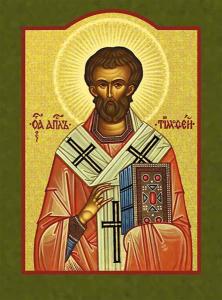
1 Timothy 4
1 Now the Spirit expressly says that in later times some will renounce the faith by paying attention to deceitful spirits and teachings of demons, 2 through the hypocrisy of liars whose consciences are seared with a hot iron. 3 They forbid marriage and abstain from certain foods, which God created to be received with thanksgiving by those who believe and know the truth. 4 For everything created by God is good, and nothing is to be rejected, provided it is received with thanksgiving, 5 for it is sanctified by God’s word and by prayer.
6 If you put these instructions before the brothers and sisters, you will be a good servant of Christ Jesus, nourished on the words of the faith and of the sound teaching that you have followed. 7 Have nothing to do with profane and foolish tales. Train yourself in godliness, 8 for, while physical training is of some value, godliness is valuable in every way, holding promise for both the present life and the life to come. 9 The saying is sure and worthy of full acceptance. 10 For to this end we toil and suffer reproach, because we have our hope set on the living God, who is the Savior of all people, especially of those who believe.
11 Command and teach these things. 12 Let no one despise your youth, but set the believers an example in speech and conduct, in love, in faith, in purity. 13 Until I arrive, give attention to the public reading of scripture, to exhorting, to teaching. 14 Do not neglect the gift that is in you, which was given to you through prophecy with the laying on of hands by the council of elders. 15 Put these things into practice, devote yourself to them, so that all may see your progress. 16 Pay close attention to yourself and to your teaching; continue in these things, for in doing this you will save both yourself and your hearers.
The apostle Paul’s ministry involved him seeding and supporting churches throughout modern day Turkey, Greece, and beyond. These churches, likely meeting in the homes of individual members, received some formation during the duration of Paul’s presence with them but as Paul’s attention is spread across a larger number of cities and churches the need for instruction becomes apparent. Thankfully for later generations, Paul did a lot of this instruction and correction through letters attempting to continue to guide and shape this young but rapidly growing and evolving church. Paul now writes to Timothy as he attempts to counter the false teachings and practices which are dividing the church in Ephesus both to encourage his younger counterpart and to support his work in correcting these beliefs which are infiltrating the life of the community.
The early Christian community did expect God to speak through the Spirit in prophecy, proclamation, and in acts of healing and power. In Corinth Paul had to counsel that congregation on how to utilize these gifts of the Spirit, but the assumption throughout Paul’s letter is that the Spirit is active and communicating with this young community of faith. Now Paul’s instructions are framed within the statement of the Spirit, presumably through prophecy, that in later times some will renounce (Greek apostesontai, where we get the English word apostate) the faith and that behind these deviant teaching are deceitful spirits and demons. Modern readers may be uncomfortable that Paul is ‘demonizing’ these false teachers, but for Paul this is a matter of critical importance to the life of the church and the individuals. The actions of these teachers is causing strife within the church, leading some down paths which are contrary to the faith, and likely leading others to walk away from these communities in conflict. Paul feels that the gospel is at stake and this is a matter of life and death. The hypocrisy of liars (Greek hupokrisei pseudologon, where our word hypocrisy comes from and ‘false words’) has cauterized the consciences of these teachers. As Jouette M. Bassler can state about the Greek word behind cauterized/seared with a hot iron:
Burning with a hot iron (Gk. Kausteriazein) was done to numb or cauterize a wound, to punish, or to identify ownership (NEB, cf 2 Tim 2:26). Any of these meanings could apply here; the essential point is one of contrast between those whose consciences are good (1:5, 19) or pure (3:9; 2 Tim 1:3) and those whose consciences are rejected. (Bassler, 1996, p. 80)
The two false teachings and practices highlighted in the letter are forbidding marriage and abstaining from certain foods. The forbidding of marriage may have led to some of the instructions on widows in chapter five, but it also fundamentally undermines the social structure of the ancient world. In the ancient world there were few opportunities for women to be self-supporting (outside of prostitution or being a courtesan among the upper class). It is possible that these teachers are anticipating the advent of Christ’s kingdom in a short period of time and view the current time as unworthy of investing in, but Paul may view their actions as turning away from God’s intent for relationships in creation. The actions of these teachers may also be causing these young churches to be viewed with suspicion by their neighbors and placing a stumbling block before those who need to hear the gospel. Paul wrestled with controversies around eating throughout his ministry, both within a Jewish context attempting to maintain the distinctive eating practices of the Jewish people and imposing dietary and other expectation on early Christians but also within the Greco-Roman world where meat was often associated with communal sacrifices to other gods. Paul explicitly wraps both marriage and eating of food under the things God created for humanity to be received with thanksgiving (Greek euchapistias, the word where our English eucharist comes from). These eucharistic gifts are made holy/sanctified (Greek hagiazetai) by God’s word and prayer. This language reminds me of Luther’s discussion of the sacraments where he connects the receiving of the physical element (water, bread, wine) with the Word and command of God.
Paul expects Timothy to place the contents of the letters before the Ephesian congregations, and in doing so Timothy is a good servant (literally deacon) of Christ Jesus. As mentioned in the previous chapter, the title of deacon and the act of serving are used interchangeably in the early church and the roles are not rigidly defined. Timothy can be a representative of Paul charged with overseeing the congregations in Ephesus, and yet always remains a servant. Timothy has received faithful teaching in contrast to the false words of the troublesome teachers operating in Ephesus. Yet, even Timothy is charged to stay away from profane teaching and ‘foolish tales’ (literally old women myths). I can understand the NRSVue’s discomfort, feeling that ‘old wives tales’ is a translation pejorative to women, but through most of history there have been ‘old wives’ tales’ that were a place where stories, beliefs, and practices, some which may have contradicted the teaching of the church and other authorities, were handed down. Critical to 1 Timothy is the Greek eusebias which means piety, religion, or as the NRSVue renders it godliness. I prefer religion here although it is also an imperfect translation since many think of this either in terms of religious belief or practice within a church. In modern American thought godliness is next to cleanliness and this term’s connection with religious practice has been lost. Piety is an important idea in the Greco-Roman world, but it’s reception in English is often limited to actions that happen in the context of worship and prayer rather than the more wholistic idea the eusebias points to. Eusebias for Paul is something that’s value far exceeds physical training, which Paul uses in several metaphors in his letters, but this term for Paul seems to encompass faith and practice, including but not limited to worship and prayer. Just as the athlete endures physical toil and suffering, so the person training in religion/godliness will endure toil and suffering from the surrounding world as it resists these practices and beliefs as well as the demonic/false teachings of those causing divisions among the community of faith. As James D. G. Dunn articulates:
The writer makes clear that such growth and development depend on training and the discipline involved (vv. 7-8); they involve hard work and sweat-inducing exertion (v. 15). Here again a choice once made has to be repeatedly reaffirmed and lived out. (NIB XI: 816)
The saying is sure (the Greek is literally faith(ful) the word pistis ho logos) and worthy of all acceptance appears for the second time highlighting the statement of faith that the faithful suffer and toil over. Previously in 1 Timothy 1: 15 the faithful saying was that Christ Jesus came into the world to save sinners. Now, their hope is in the living God who is the Savior of all people. It is a common biblical belief that the God of the bible (as well as of Israel and the people of God) is a living and active God who is actively engaged in the world. Savior, as mentioned in the first chapter, is a common Old Testament title for God and was likely utilized in the communities in Ephesus. That God is the Savior of all people may point to the idea of a universal salvation or it may be intended to expand the horizon of God’s salvation beyond Israel. The idea of God saving all being indicative of a universalistic hope is congruent with the follow on phrase which declares especially those who believe. Some readers view this phrase as correcting the previous one, but I read this as highlighting those who believe within the larger set of those who God intends to save. Although the method of argumentation is different, since the question is likely different in Ephesus, it has a similar logic to Paul’s rationale for God utilizing the faithlessness of Israel to include the Gentiles and then the grafting of the Gentiles onto the holy tree to point to God regrafting on the branches of Israel that have fallen off so that along with the Gentiles all Israel will be saved (Romans 11).
The instructions to Timothy starting in verse eleven encourage him to not only command and teach but set an example in speech and conduct. Although authenticity is a word of our time, the expectation of congruity between one’s proclamation and one’s actions was very important in rhetorical expectations of the Greco-Roman world. As Luke Timothy Johnson states:
We are reminded of how seriously ancient philosophers regarded the responsibility of teachers to live in accord with what they professed…Since philosophy in the Hellenistic period was considered to be essentially a matter of integrity of life, and since virtue was thought to be learned first and best by the imitation of living models, the teacher has no greater duty than to live in a manner consonant with the principles he enunciated. (Johnson, 2001, p. 255)
The speech, conduct, love, faith and purity which Timothy exhibits will be as crucial in his work to bring healing and wholeness to the community as the commands and teaching he does. Timothy may be young among the elders of the Ephesian church, but his example should demonstrate his worth along with the calling he has received through prophecy[1] and laying on of hands. Paul and the council of elders (presbyteriou where the term Presbyter comes from and the Presbyterian church gets its name). It is not clear whether the prophecy came at the moment of the laying on of hands by the council of elders or before, and whether this council of elders was in Jerusalem, in Ephesus, or in some other place in the Pauline mission area, but Timothy has been set aside for his ministry representing Paul, but more essentially representing Christ. Timothy is called to live a public life which bears witness to the teaching entrusted to him in word and in action which forms a powerful example for his hearers.
The formation of the overseers and deacons in the previous chapters and the expectations of Timothy in our current chapter point to the public life of those set aside for roles of leadership in the church. The life of a leader in the church expects that their faith and practice will be an example of the faith and practices they are attempting to cultivate in their communities. Yet, we live in a time where postmodernity and other forces have made talking about standards both for the church and its leaders difficult. Luke Timothy Johnson continues his statement from earlier stating:
The widespread unwillingness in contemporary Western culture to provide direct and unambiguous moral instruction or to assume responsibility for acting in a manner that can be exemplary for others would have been unintelligible in antiquity. (Johnson, 2001, p. 255)
The damage done both to the community’s reputation and the trust within the community when leaders and members do not act in a way that reflects the faith they proclaim is profound. The church has always had divisions, but only a leader who embodies the faith for the community can begin to rebuild trust and authentically proclaim the gospel. Timothy, and faith leaders who follow him into broken communities, brings light into the darkness of division, clarity into the confusion and clashes over practices and beliefs, and healing so that the gospel can be heard both in the church and in the surrounding world. Failure to attend to a life that embodies the gospel places unnecessary stumbling blocks before the entirety of the world that the living God of the gospel desires to save.
[1] Paul also mentioned the prophecy over Timothy in 1:18.

