Tag Archives: James 1

James 1: 16-27 Religion that Cares for the Vulnerable

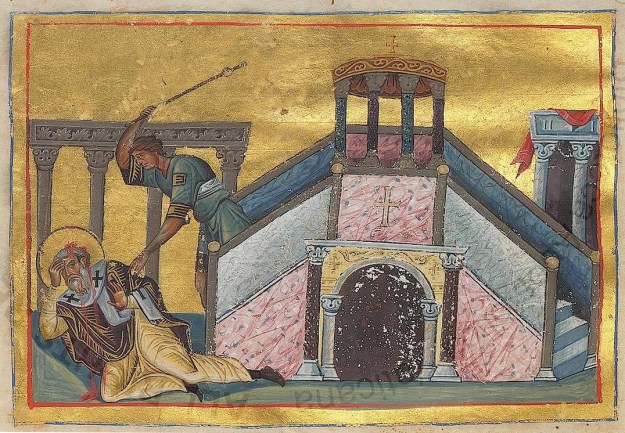
Martyrdom of James the Just By Authors of Menologion of Basil II (circa 985 AC, Constantinople), Byzantine manuscript illuminators

James 1: 16-21

Words highlighted have notes below on translation.

  16Do not be deceived, my beloved brothers and sisters. 17Every generous act of giving, with every perfect gift, is from above, coming down from the Father of lights, with whom there is no variation or shadow due to change. 18In fulfillment of his own purpose he gave birth to us by the word of truth, so that we would become a kind of first fruits of his creatures.

  19
You must understand this, my beloved brothers and sisters: let everyone be quick to listen, slow to speak, slow to anger, 20for human anger does not produce God’s righteousness. 21Therefore rid yourselves of all sordidness and rank growth of wickedness, and welcome with meekness the implanted word that has the power to save your souls.

In contrast to the desire, sin, death conception metaphor in the previous section we now have the first fruits among God’s creatures of those who have received both a birth from above and gifts from above. In contrast to desire which is from this world is generosity and every ‘perfect’ (teleios) gift which comes from the Father above. Verse seventeen is one of the frequently used verses of James, particularly in the Eastern church where it is a part of the Divine Liturgy of Saint John Chrysostom, and its sentiment that every good gift comes from above is clear. The title Father of lights likely relates to God as the creator of the sun, moon, and stars, but I also wonder if James is intentionally using the binary light and darkness to contrast the desire, sin, death path of darkness to the generosity and perfect gifts path of light. Also continuing the thought of God not being the source of temptation/testing now the Father of lights has no shadow and no variation. James does seem to lean into a more philosophical conception of God as the ultimate good and unchanging than many other parts of the scriptures, but James is also working in the binary language of the wisdom tradition: wicked/righteous, death/life, light/darkness.

God giving birth to us from above follows a similar metaphor to Jesus’s dialogue with Nicodemus in John’s gospel where one must be born from above.[1] Paul also uses the language of ‘first fruits’ to talk about both Jesus[2] and these followers of the way of Jesus.[3] Whether the word of truth is the teachings of Jesus, some direct revelation from God, or the law (Torah) is not clear, but it connects to the implanted word of verse 21 which comes from outside of us and gives birth to this new creation in the midst of the world. James is likely less concerned with the mechanism of how God transforms people from those on the path of desire, sin, and death to generosity and life than the fruits of that transformation. As Bede the Venerable, a well-known eight century English monk, stated:         

God has changed us from being children of darkness into being children of light, not because of any merits of our but by his own will, through the water of regeneration…we have become ‘the first fruits of his creatures,’ which means that we have been exalted over the rest of creation.” (Moore-Keish, 2019, p. 57)

To be the first fruits of creation for James means a transformed way of living. James in Acts is often portrayed as a peacemaker finding a way for the church and Jerusalem to accept the mission of Paul and others among the Gentiles. Anger is antithetical to James’s view of God’s righteousness. This pairs with Jesus’s teaching on anger in the Sermon on the Mount[4] where reconciliation is more important than sacrifice or worship. James, like Jesus and the prophets, does look for right practice more than right worship or right confession. The way of James is a way of listening, being slow to speak and slow to anger. Being slow to anger also echoes the characteristics of God given to Moses in Exodus 34, “The LORD, the LORD, A God merciful and gracious, slow to anger, and abounding in steadfast love and faithfulness” (Exodus 34: 6).

Throughout the New Testament there are multiple times where newborn believers are called to change their ways, particularly in relation to anger. Two examples would be:

But now you must get rid of all such things: anger, wrath, malice, slander, and abusive language from your mouth. Do not lie to one another, seeing that you have stripped off the old self with its practices and have clothed yourselves with the new self, which is being renewed in knowledge according to the image of its creator. Colossians 3: 8-10

Rid yourselves, therefore, of all malice and all guile, insincerity, envy, and all slander. Like newborn infants, long for the pure, spiritual milk, so that by it you may grow into salvation. 1 Peter 2: 1-2

These first fruits are to root out the sordidness and wickedness clearing the ground for the implanted word that brings this new growth and fruit. James uses multiple interlocking metaphors to contrast the way of death with the way of life. Birth and field metaphors come together. Unlike Jesus’s parable of the wheat and the tares[5] where the good and the unrighteous grow together, James envisions a world where the field has been cleared of the bad growth which strangles the harvest so that there can be a full harvest of the first fruits of the seeds God has sown in the lives of the faithful.

James 1: 22-27

  22But be doers of the word and not merely hearers who deceive themselves. 23For if any are hearers of the word and not doers, they are like those who look at themselves in a mirror; 24for they look at themselves and, on going away, immediately forget what they were like. 25But those who look into the perfect law, the law of liberty, and persevere, being not hearers who forget but doers who act—they will be blessed in their doing.
  26
If any think they are religious and do not bridle their tongues but deceive their hearts, their religion is worthless. 27Religion that is pure and undefiled before God the Father is this: to care for orphans and widows in their distress and to keep oneself unstained by the world.

James and Paul are often portrayed in conflict, where Paul talks about faith and James talks about works. It is plausible that James is aware of Paul’s teachings and is issuing a corrective note to those who have become overfocused on knowledge or wisdom to the exclusion of practice, but James’s language here would not be alien to Paul, “For it is not the hearers of the law who are righteous in God’s sight but the doers of the law who will be justified.” (Romans 2:13) The reformation/counterreformation debates about faith opposed to works were focused on the wrong works, from the perspective of James. For James these works continue the concern of the law, the prophets, and Jesus to care for the vulnerable, to live a life in harmony with God’s will for the world, and to show mercy. Hearing and knowledge for James are not enough, but his teaching here again echoes Jesus.

“Everyone, then, who hears these words of mine and acts on them will be like a wise man who built his house on rock.  The rain fell, the floods came, and the winds blew and beat on that house, but it did not fall because it had been founded on rock.  And everyone who hears these words of mine and does not act on them will be like a foolish man who built his house on sand.  The rain fell, and the floods came, and the winds blew and beat against that house, and it fell—and great was its fall!” Matthew 7: 24-27 parallel Luke 6: 46-49

But he said, “Blessed rather are those who hear the word of God and obey it!” Luke 11:28

James jumps to an additional metaphor of a person looking at themselves in the mirror and forgetting what they see being like the person who hears and does not act. What the NRSVue, along with most translations, render as ‘themselves’ is the Greek phrase to prospon tes geneseos, literally ‘the face of their origin (beginning).’ James may be wanting to indicate that the person looks at their ‘true self’ and then walks away from their true self into the paths that corrupt that self. But those who look at themselves in the light of God’s perfect (teleios) law of liberty and work (NRSVue act) in harmony with that law are happy/blessed their existence.

James turns to the topic of religion with two statements that look back on the previous argument and ahead to the remainder of the letter. James’s comments on bridling the tongue look back to his words of being quick to listen and slow to speak in verse nineteen and ahead to his lengthier discourse on the tongue in 3: 1-12. James’s pure and undefiled religion which cares for the vulnerable looks ahead to 2:14-17 and back to the reversals of 1:9-11.

Care for the vulnerable, particularly the orphan and the widow, is frequently highlighted in the law and the prophets:

 You shall not abuse any widow or orphan. Exodus 22:22

who executes justice for the orphan and the widow, and who loves the strangers, providing them food and clothing. Deuteronomy 10:18

James, like several of the prophets, argues for an understanding of religion that is less about acts of sacrifice in the context of the temple and centrally focused on the justice lived in society. Religion is not to bribe God with one’s gifts but instead to live in obedience with God’s will as expressed in the law. A mark of the faithfulness of one’s religious work is the way the vulnerable of the surrounding society are cared for in James’s view. A religion of unrestrained speech and ignored widows and orphans is a defiled faith to James.


[1] John 3: 1-10.

[2] 1 Corinthians 15:20.

[3] Romans 16:5; 1 Corinthians 16:15; 2 Thessalonians 2:13.

[4] Matthew 5: 21-26.

[5] Matthew 13: 24-30.

James 1: 9-15 Blessings in a World of Reversals

Texas Bluebonnets South of Dallas, TX in 2012. Photo by Jeffrey Pang, CC BY 2.0, https://commons.wikimedia.org/w/index.php?curid=26289586

James 1: 9-15

  9Let the brother or sister of humble means boast in having a high position 10and the rich in having been humbled, because the rich will disappear like a flower in the field. 11For the sun rises with its scorching heat and withers the field; its flower falls, and its beauty perishes. It is the same way with the rich; in the midst of a busy life, they will wither away.
  12
Blessed is anyone who endures temptation. Such a one has stood the test and will receive the crown of life that the Lord has promised to those who love him. 13No one, when tempted, should say, “I am being tempted by God,” for God cannot be tempted by evil and he himself tempts no one. 14But one is tempted by one’s own desire, being lured and enticed by it; 15then, when desire has conceived, it engenders sin, and sin, when it is fully grown, gives birth to death.

The message of Jesus in the gospels is full of reversals where the lowly are brought high and the mighty are brought low. The song of Mary, the Magnificat, in Luke 1:46-55 is a prime example of this theme:

He has brought down the powerful from their thrones and lifted up the lowly;he has filled the hungry with good things and sent the rich away empty. Luke 1: 52-53

Scot McKnight makes an interesting note on the childhood experience of Jesus and James, assuming James the brother of Jesus as the author of the letter:

If there is any truth to the tradition that Joseph died and left Mary a widow, James would have been part of a family in stress, and that might help explain why James sees pure religion as caring for the poor and widows (James 1:26-27). (McKnight, 2011, p. 16)

Jesus would continually use the language of reversal where the first are last and the last are first,[1] and the exalted are humbled and the humbled exalted.[2] This section also resonates strongly with Jesus’s teaching not to worry about food and drink and clothing in the Sermon on the Mount.[3] The rich disappear like the flowers of the field, just as Solomon in all his glory is not clothed like the flowers of the field. For James’s wisdom does not trust in the position and grandeur that comes from wealth, these are only transitory things which are untrustworthy and wither away. Just as Jesus could tell his disciples that one cannot serve God and wealth (Mammon), James tells the recipients of this letter that the rich will be humbled but the humble will be lifted up to a high position. The God who provides for the birds of the air and the flowers of the field provides for the brother and sister of humble means while the rich are tempted to serve wealth as their master and order their lives according to the kingdom of Mammon.

The word ‘blessed’ in verse twelve continues to indicate that James is following the pattern of Hebrew wisdom literature. The Greek Makarios is the same term used in the Beatitudes of the Sermon on the Mount and is the Greek term which translates the Hebrew ‘asre (or ‘ashrei) often rendered ‘happy’ in most translations. The word means blessed, happy, or contented and is frequently used in wisdom literature. Here those who endure temptation or testing (Greek periasmos)[4] are happy/blessed. In a similar pattern to the Beatitudes, James lifts up something that normally is not considered blessed (enduring temptation/testing) and then indicates the reward (receiving the crown of life). Yet, James is also concerned that people understand that, in his view, God is not the cause of the temptation but instead the temptation comes from a misdirected desire. On the one hand there are points in the Old Testament where God clearly does test God’s people, and throughout many portions of the Old Testament God is responsible for both the good things that happen and the bad things that happen. As I mention in my reflection on A Split in the Identity of God this perspective evolves and by the time of the New Testament there are forces, like the devil and demons, actively opposed to God’s will for the world. Yet for James the temptation is due to one’s own desire. The word translated by the NRSVue as ‘desire’ (epithumias) in moral discourse has a negative sense of ‘evil desire’ or ‘craving.’ (Green, 2025, p. 40) This is a misplaced desire. Desire can be rightly placed on God, like in Psalm 42, “As the deer longs for flowing streams, so my soul longs for you.” Here desire has been corrupted and longs for things that are not God. Like the adulterous, loose, dangerous woman in Proverbs 5,6, and 7 who is opposed to lady wisdom and lures the growing child into a dangerous liaison, now a personified desire seduces the unwise and gives birth to a child names sin who births a child named death. In contrast to the temptations/testing of faith which leads to endurance and endurance completes its work so that the person may be complete, the temptation/testing of one’s desire leads to sin which leads to death. One path leads to wisdom, completion, and life while the other leads to foolishness, sin, and death. James, like Paul, personifies sin, death, and desire. Despite the sexual metaphor of desire conceiving sin which conceives death it is telling that in James’s letter sexual activity is not an area where he counsels his audience.


[1] Matthew 20:16.

[2] Matthew 23:12; Luke 14:11; 18:14.

[3] Matthew 6: 25-34.

[4] The NRSVue is consistent in translating periasmos as temptation, while many translations alternate between testing and temptation for the word.

James 1: 1-8 The Wisdom of the Letter of James

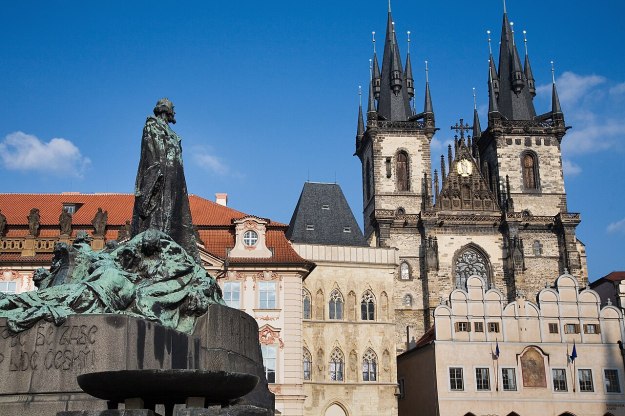
Jan Hus Memorial at Old Town Square in Prague built in 1915. Photo by Jorge Royan. Shared under CC BY-SA 3.0

James 1: 1-8

Words highlighted have notes below on translation.

 1James, a servant of God and of the Lord Jesus Christ,
  To the twelve tribes in the dispersion:
  Greetings.
  2
My brothers and sisters, whenever you face various trials, consider it all joy, 3because you know that the testing of your faith produces endurance. 4And let endurance complete its work, so that you may be complete and whole, lacking in nothing.
  5
If any of you is lacking in wisdom, ask God, who gives to all generously and ungrudgingly, and it will be given you. 6But ask in faith, never doubting, for the one who doubts is like a wave of the sea, driven and tossed by the wind. 7, 8For the doubter, being double-minded and unstable in every way, must not expect to receive anything from the Lord.

James, the author of the letter, has traditionally been understood as James the Just or James the brother of our Lord who was one of the influential early leaders of the church in Jerusalem.[1] Throughout this reflection my assumption will be that this is an early Christian letter, written in a similar time period to the letters of Paul, from a leader of the church in Jerusalem to the Jewish followers of Jesus scattered throughout the world. James introduces himself as a servant (literally slave in Greek) of God and of the Lord Jesus Christ. Although the translation of the Greek doulos as ‘servant’ in most English translations makes sense, especially with the history of how slaves were treated in the United States, it is worth noting that most of the apostles claim to be slaves/servants of Christ or God. In the ancient world a slave could exercise authority on behalf of their master, yet unlike a servant who is employed and can quit a slave was owned by the household. From a contemporary perspective in an individualistic society where personal freedom is highly valued it is worth being reminded that in the ancient world you were always bound to your family or the household you served. I do think for James the sense of obedience and servitude are an important part of how he sees the life of wisdom.

James and the author of 1 Peter are the only two New Testament authors to address their letters to the diaspora. Although at the time of the writing of James, assuming that the biblical James is the author, Israel and Jerusalem are not yet in rebellion against Rome, there are still more Jews living outside of Palestine in the diaspora than who live inside it. (Moore-Keish, 2019, pp. 20-21) At this early time, prior to 62 CE when James the Just is killed, the boundaries between Judaism and Christianity are still porous and many of the early followers of the way of Jesus Christ considered themselves a part of the Jewish people. Yet, there is also throughout the New Testament an adoption of the titles and language used for the Jewish people throughout the Old Testament to speak about the role of the new followers of Jesus throughout the church. Although James is writing in a manner that is highly reflective of the Hebrew Scriptures and Torah obedience, it is also likely that his audience may also include the churches of Paul and others among the Gentiles. James never mentions Sabbath-keeping, circumcision, or diet. Like the Gospel of Matthew, James attempts to write about a faith that is connected with Torah observance the letter is also shaped by a merciful reading of scripture which is shaped by both the teachings of Jesus and the prophetic witness before him.

Most modern translations will translate the Greek adelphos/adelphoi with ‘brothers and sisters’ rather than the generic ‘brother/brothers’ since James was addressing both men and women with the letter. What immediately strikes me as we enter into the letter of James is the way many of the early Christian writers are sharing a common vocabulary as they address the new followers of the way of Jesus Christ. James’s brief encouragement to find joy in their trials echoes Jesus’s words in the Sermon on the Mount:

“Blessed are you when people revile you and persecute you and utter all kinds of evil against you falsely on my account. Rejoice and be glad, for your reward is great in heaven, for in the same way they persecuted the prophets who were before you. Matthew 5: 11-12

Although James has been often read in opposition to Paul, his language throughout this letter often uses the same language and rhythms as Paul. Here in verses three and four you can see a similar pattern in Paul’s letter to the Romans:

And not only that, but we also boast in our afflictions, knowing that affliction produces endurance, and endurance produces character, and character produces hope, and hope does not put us to shame, because God’s love has been poured into our hearts through the Holy Spirit that has been given to us. Romans 5: 3-5[2]

In verse four we have the first appearance in the letter of the Greek teleios (NRSVue ‘mature’/NRSV ‘perfect’). This is an important word for James; the word is used twenty times in the New Testament; five of those uses occur in this short letter. Additionally, James utilized both the verbal form teleo twice and the substantive telos once. (Moore-Keish, 2019, p. 28) When I was working through Matthew’s gospel this was a word I wrestled with because I don’t believe that the word intends the sense of moral perfection that is often read into it.[3] Teleios is a word of destination and completion, and I like the NRSVue’s adoption of ‘mature’ for this word. James does want his readers to live a complete and mature life shaped by the path of God’s wisdom.

The letter of James shares many similarities with the wisdom literature in the Old Testament with its interest in shaping a life that is faithful to God’s intent as outlined in the law. Wisdom literature often contrasts the path of wisdom with the opposing path of foolishness. James contrasts the single-minded way of faith with the double-minded way of doubt. Faith and doubt are opposing ideas in James, and I believe that Joel B. Green captures the essence of James’s thought when he states that for James, “faith has more the sense of confidence.” (Green, 2025, p. 30) In the Gospel of Matthew ,faith had more the sense of openness and in Matthew’s gospel worship and doubt often coexisted, but James is approaching faith and doubt as opposites. James’s definition of faith is, ironically, incredibly close to Luther’s famous explanation of the first commandment, “We are to fear, love, and trust God above all things.” Faith and wisdom are a single-minded confidence in God and God’s ways. For those lacking in wisdom they are told to ask God confidently for the wisdom they need to lack nothing. The parallel use of ‘lacking nothing’ in verse four and ‘lacking wisdom’ five form an interesting parallel between ‘enduring trials’ and ‘asking God for wisdom.’

James targets those among his readers whose practice does not match their profession. They are double-minded because they want to be friends of God and friends of the world at the same time. (NIB XII:182) James’s thoughts echo Jesus’s words contrasting between those who try to serve two masters,[4] and it is telling that Jesus is contrasting those who serve God and wealth as James is about to contrast those of humble means and the rich.  

Martha L. Moore-Keish quotes a portion from the final letter of the Jan Hus, a reformer in Czechoslovakia (1369-1415) before he was burned at the stake that I want to close this portion of the reflection with because it wrestles with the themes of James in the concrete moment of temptation/trial:

Surely it is difficult to rejoice without perturbation, and to esteem it all joy in various temptations. It is easy to talk about it and to expound it, but difficult to fulfill it. Even the most patient and valiant soldier, knowing that on third day He would rise, conquering by His death the enemies and redeeming the elect from damnation, after the Last Supper was troubled in spirit…O most kind Christ, draw us weaklings after Thyself, for unless Thou draw us, we cannot follow Thee! Give us a courageous spirit that it may be ready; and if the flesh is weak, may Thy grace go before, now, as well as subsequently. For without Thee we can do nothing, and particularly to go to a cruel death for Thy sake. Give us a valiant spirit, a fearless heart, the right faith, a firm hope, and perfect love, that we may offer our lives for Thy sake with the greatest patience and joy. Jan Hus, from a letter written just prior to his being burned at the stake on July 6, 1415. (Moore-Keish, 2019, p. 25)


[1] Mark 6:3 indicates that Jesus has two brothers, James and Joses. James as a leader of the early church is mentioned in Acts 12:17; James plays a pivotal role in the Jerusalem council in Acts 15 (see verse 13) as well as meeting with Paul when he returns to Jerusalem in Acts 21: 17-26. Throughout Acts James is one of the leaders of the church and he often acts in a conciliatory manner between the church in Jerusalem and the Hellenistic mission of Paul and others. In Paul’s letter to the Galatians, James seems to have enough influence and power to make Peter change his behavior.

[2] See also 1 Peter 1: 6-7:  In this you rejoice, even if now for a little while you have had to suffer various trials, so that the genuineness of your faith—being more precious than gold that, though perishable, is tested by fire—may be found to result in praise and glory and honor when Jesus Christ is revealed.

[3] See my reflection on Matthew 5: 33-48 and Perfection and Blamelessness in the Bible.

[4] Matthew 6:24.