Tag Archives: First Fruit

James 1: 16-27 Religion that Cares for the Vulnerable

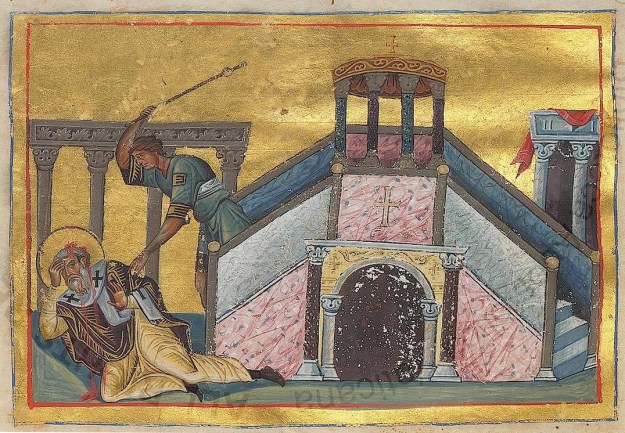
Martyrdom of James the Just By Authors of Menologion of Basil II (circa 985 AC, Constantinople), Byzantine manuscript illuminators

James 1: 16-21

Words highlighted have notes below on translation.

  16Do not be deceived, my beloved brothers and sisters. 17Every generous act of giving, with every perfect gift, is from above, coming down from the Father of lights, with whom there is no variation or shadow due to change. 18In fulfillment of his own purpose he gave birth to us by the word of truth, so that we would become a kind of first fruits of his creatures.

  19
You must understand this, my beloved brothers and sisters: let everyone be quick to listen, slow to speak, slow to anger, 20for human anger does not produce God’s righteousness. 21Therefore rid yourselves of all sordidness and rank growth of wickedness, and welcome with meekness the implanted word that has the power to save your souls.

In contrast to the desire, sin, death conception metaphor in the previous section we now have the first fruits among God’s creatures of those who have received both a birth from above and gifts from above. In contrast to desire which is from this world is generosity and every ‘perfect’ (teleios) gift which comes from the Father above. Verse seventeen is one of the frequently used verses of James, particularly in the Eastern church where it is a part of the Divine Liturgy of Saint John Chrysostom, and its sentiment that every good gift comes from above is clear. The title Father of lights likely relates to God as the creator of the sun, moon, and stars, but I also wonder if James is intentionally using the binary light and darkness to contrast the desire, sin, death path of darkness to the generosity and perfect gifts path of light. Also continuing the thought of God not being the source of temptation/testing now the Father of lights has no shadow and no variation. James does seem to lean into a more philosophical conception of God as the ultimate good and unchanging than many other parts of the scriptures, but James is also working in the binary language of the wisdom tradition: wicked/righteous, death/life, light/darkness.

God giving birth to us from above follows a similar metaphor to Jesus’s dialogue with Nicodemus in John’s gospel where one must be born from above.[1] Paul also uses the language of ‘first fruits’ to talk about both Jesus[2] and these followers of the way of Jesus.[3] Whether the word of truth is the teachings of Jesus, some direct revelation from God, or the law (Torah) is not clear, but it connects to the implanted word of verse 21 which comes from outside of us and gives birth to this new creation in the midst of the world. James is likely less concerned with the mechanism of how God transforms people from those on the path of desire, sin, and death to generosity and life than the fruits of that transformation. As Bede the Venerable, a well-known eight century English monk, stated:         

God has changed us from being children of darkness into being children of light, not because of any merits of our but by his own will, through the water of regeneration…we have become ‘the first fruits of his creatures,’ which means that we have been exalted over the rest of creation.” (Moore-Keish, 2019, p. 57)

To be the first fruits of creation for James means a transformed way of living. James in Acts is often portrayed as a peacemaker finding a way for the church and Jerusalem to accept the mission of Paul and others among the Gentiles. Anger is antithetical to James’s view of God’s righteousness. This pairs with Jesus’s teaching on anger in the Sermon on the Mount[4] where reconciliation is more important than sacrifice or worship. James, like Jesus and the prophets, does look for right practice more than right worship or right confession. The way of James is a way of listening, being slow to speak and slow to anger. Being slow to anger also echoes the characteristics of God given to Moses in Exodus 34, “The LORD, the LORD, A God merciful and gracious, slow to anger, and abounding in steadfast love and faithfulness” (Exodus 34: 6).

Throughout the New Testament there are multiple times where newborn believers are called to change their ways, particularly in relation to anger. Two examples would be:

But now you must get rid of all such things: anger, wrath, malice, slander, and abusive language from your mouth. Do not lie to one another, seeing that you have stripped off the old self with its practices and have clothed yourselves with the new self, which is being renewed in knowledge according to the image of its creator. Colossians 3: 8-10

Rid yourselves, therefore, of all malice and all guile, insincerity, envy, and all slander. Like newborn infants, long for the pure, spiritual milk, so that by it you may grow into salvation. 1 Peter 2: 1-2

These first fruits are to root out the sordidness and wickedness clearing the ground for the implanted word that brings this new growth and fruit. James uses multiple interlocking metaphors to contrast the way of death with the way of life. Birth and field metaphors come together. Unlike Jesus’s parable of the wheat and the tares[5] where the good and the unrighteous grow together, James envisions a world where the field has been cleared of the bad growth which strangles the harvest so that there can be a full harvest of the first fruits of the seeds God has sown in the lives of the faithful.

James 1: 22-27

  22But be doers of the word and not merely hearers who deceive themselves. 23For if any are hearers of the word and not doers, they are like those who look at themselves in a mirror; 24for they look at themselves and, on going away, immediately forget what they were like. 25But those who look into the perfect law, the law of liberty, and persevere, being not hearers who forget but doers who act—they will be blessed in their doing.
  26
If any think they are religious and do not bridle their tongues but deceive their hearts, their religion is worthless. 27Religion that is pure and undefiled before God the Father is this: to care for orphans and widows in their distress and to keep oneself unstained by the world.

James and Paul are often portrayed in conflict, where Paul talks about faith and James talks about works. It is plausible that James is aware of Paul’s teachings and is issuing a corrective note to those who have become overfocused on knowledge or wisdom to the exclusion of practice, but James’s language here would not be alien to Paul, “For it is not the hearers of the law who are righteous in God’s sight but the doers of the law who will be justified.” (Romans 2:13) The reformation/counterreformation debates about faith opposed to works were focused on the wrong works, from the perspective of James. For James these works continue the concern of the law, the prophets, and Jesus to care for the vulnerable, to live a life in harmony with God’s will for the world, and to show mercy. Hearing and knowledge for James are not enough, but his teaching here again echoes Jesus.

“Everyone, then, who hears these words of mine and acts on them will be like a wise man who built his house on rock.  The rain fell, the floods came, and the winds blew and beat on that house, but it did not fall because it had been founded on rock.  And everyone who hears these words of mine and does not act on them will be like a foolish man who built his house on sand.  The rain fell, and the floods came, and the winds blew and beat against that house, and it fell—and great was its fall!” Matthew 7: 24-27 parallel Luke 6: 46-49

But he said, “Blessed rather are those who hear the word of God and obey it!” Luke 11:28

James jumps to an additional metaphor of a person looking at themselves in the mirror and forgetting what they see being like the person who hears and does not act. What the NRSVue, along with most translations, render as ‘themselves’ is the Greek phrase to prospon tes geneseos, literally ‘the face of their origin (beginning).’ James may be wanting to indicate that the person looks at their ‘true self’ and then walks away from their true self into the paths that corrupt that self. But those who look at themselves in the light of God’s perfect (teleios) law of liberty and work (NRSVue act) in harmony with that law are happy/blessed their existence.

James turns to the topic of religion with two statements that look back on the previous argument and ahead to the remainder of the letter. James’s comments on bridling the tongue look back to his words of being quick to listen and slow to speak in verse nineteen and ahead to his lengthier discourse on the tongue in 3: 1-12. James’s pure and undefiled religion which cares for the vulnerable looks ahead to 2:14-17 and back to the reversals of 1:9-11.

Care for the vulnerable, particularly the orphan and the widow, is frequently highlighted in the law and the prophets:

 You shall not abuse any widow or orphan. Exodus 22:22

who executes justice for the orphan and the widow, and who loves the strangers, providing them food and clothing. Deuteronomy 10:18

James, like several of the prophets, argues for an understanding of religion that is less about acts of sacrifice in the context of the temple and centrally focused on the justice lived in society. Religion is not to bribe God with one’s gifts but instead to live in obedience with God’s will as expressed in the law. A mark of the faithfulness of one’s religious work is the way the vulnerable of the surrounding society are cared for in James’s view. A religion of unrestrained speech and ignored widows and orphans is a defiled faith to James.


[1] John 3: 1-10.

[2] 1 Corinthians 15:20.

[3] Romans 16:5; 1 Corinthians 16:15; 2 Thessalonians 2:13.
[4] Matthew 5: 21-26.

[5] Matthew 13: 24-30.

Deuteronomy 26: Bringing Story into Liturgy

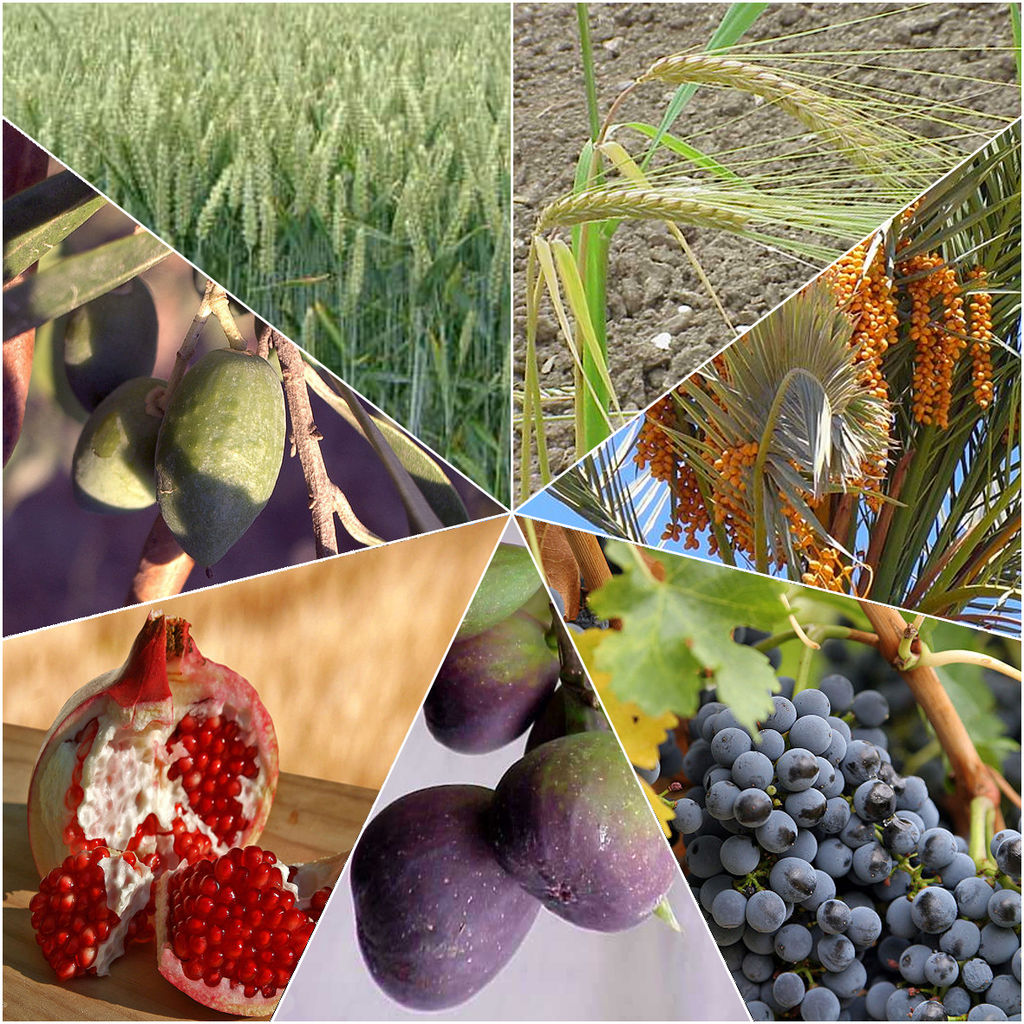
The Seven Species of the Land of Israel listed in Deuteronomy 8:8, Creative Commons Attribution 3.0

The Seven Species of the Land of Israel listed in Deuteronomy 8:8, Creative Commons Attribution 3.0

 Deuteronomy 26

1 When you have come into the land that the LORD your God is giving you as an inheritance to possess, and you possess it, and settle in it, 2 you shall take some of the first of all the fruit of the ground, which you harvest from the land that the LORD your God is giving you, and you shall put it in a basket and go to the place that the LORD your God will choose as a dwelling for his name. 3 You shall go to the priest who is in office at that time, and say to him, “Today I declare to the LORD your God that I have come into the land that the LORD swore to our ancestors to give us.” 4 When the priest takes the basket from your hand and sets it down before the altar of the LORD your God, 5 you shall make this response before the LORD your God: “A wandering Aramean was my ancestor; he went down into Egypt and lived there as an alien, few in number, and there he became a great nation, mighty and populous. 6 When the Egyptians treated us harshly and afflicted us, by imposing hard labor on us, 7 we cried to the LORD, the God of our ancestors; the LORD heard our voice and saw our affliction, our toil, and our oppression. 8 The LORD brought us out of Egypt with a mighty hand and an outstretched arm, with a terrifying display of power, and with signs and wonders; 9 and he brought us into this place and gave us this land, a land flowing with milk and honey. 10 So now I bring the first of the fruit of the ground that you, O LORD, have given me.” You shall set it down before the LORD your God and bow down before the LORD your God. 11 Then you, together with the Levites and the aliens who reside among you, shall celebrate with all the bounty that the LORD your God has given to you and to your house.

 12 When you have finished paying all the tithe of your produce in the third year (which is the year of the tithe), giving it to the Levites, the aliens, the orphans, and the widows, so that they may eat their fill within your towns, 13 then you shall say before the LORD your God: “I have removed the sacred portion from the house, and I have given it to the Levites, the resident aliens, the orphans, and the widows, in accordance with your entire commandment that you commanded me; I have neither transgressed nor forgotten any of your commandments: 14 I have not eaten of it while in mourning; I have not removed any of it while I was unclean; and I have not offered any of it to the dead. I have obeyed the LORD my God, doing just as you commanded me. 15 Look down from your holy habitation, from heaven, and bless your people Israel and the ground that you have given us, as you swore to our ancestors– a land flowing with milk and honey.”

 16 This very day the LORD your God is commanding you to observe these statutes and ordinances; so observe them diligently with all your heart and with all your soul. 17 Today you have obtained the LORD’s agreement: to be your God; and for you to walk in his ways, to keep his statutes, his commandments, and his ordinances, and to obey him. 18 Today the LORD has obtained your agreement: to be his treasured people, as he promised you, and to keep his commandments; 19 for him to set you high above all nations that he has made, in praise and in fame and in honor; and for you to be a people holy to the LORD your God, as he promised.

The twenty sixth chapter of Deuteronomy closes a long section which runs from chapter five (although many people move it back to the scene being set in Deuteronomy 4:44) through the end of this chapter. Here in the narrative Moses concludes his exposition of the commandments, statutes and ordinances of the LORD for the people of Israel. In this conclusion resides both ritual and liturgy that will continue to form the identity of the people for their life in the promised land. The manner in which the people of Israel bring in their offerings is mentioned several times throughout this portion of Deuteronomy but the way in which the author chooses to end this section liturgically explaining the significance of these practices is important to note.

In American Christianity there are several branches of the faith that are uncomfortable with the idea of a confessional creed. In a society based on individualism where the focus is on the individual’s faith and what they believe at each point in their lives the idea of a communal confession of faith seems unnecessary. I appreciate the gifts of the confessional tradition that I come out of and the way it binds me both to the manner Christians have understood the faith historically as well as locating me within a community that shares and wrestles with common confessions. Creeds have been used throughout the ages as summaries of a wider faith used in both catechetical (teaching future generations) and liturgical (worship) settings. The bible is full of these confessions of faith in both the Hebrew Scriptures and the New Testament (for example Philippians 2: 5-11) and various confessions of faith have been used as a part of the liturgy of faithful people for generations as a way of summarizing the faith. Deuteronomy 6: 21-25 is one example of a ‘credo’ a basic statement of belief to be used as a method of catechesis within the home. While in Deuteronomy 6 the focus is on the actions within the household that the parents will use to pass on the faith to their children and grandchildren and beyond, here we see confessions of faith used liturgically as a part of the telling of the story of the people of Israel. The practice of bringing the tithe and first fruits in Deuteronomy 14: 22-29 and in Deuteronomy 18:4 is now brought into a setting of worship with words that reinforce several basic parts of the understanding of the covenantal relationship the people would be expected to maintain in the promised land. Deanna Thompson outlines succinctly the key themes of the text as:
“the call for Israel to acknowledge God’s persistent care; the reminder that the land God is giving them is sheer gift; and the insistence that fundamental to Israel’s right relationship to God is the practice of attending to the needs of the stranger, the widow and the orphan.” (Thompson, 2014, p. 188)

As the offering are brought to the tabernacle or temple the people recite a brief exposition of their history which outlines their beginnings as a wandering people in Genesis, the journey to Egypt in the time of Joseph where they received the food they needed in the midst of famine, and then a brief synopsis of the Exodus experience including their oppression and liberation and being brought into the promised land. This short liturgical statement begins with the tenuousness of their situation as a landless people and later as slaves contrasted with their new but contingent identity as the covenant people of the LORD the God of Israel. The narrated history is now combined with the practice of giving which is intended to continue to form the identity of the people in their life in the land.

The liturgy in Deuteronomy 26: 1-11 focuses on re-telling the story of the people and the action of bringing the first fruit which is a result of God’s gracious provision for the people in the land. God has brought the people from being landless or oppressed to being in a land of milk and honey, therefore they are to bring in these gifts and celebrate and remember the provision of God. The focus on this first exhortation is on what God has done for Israel and now Israel is freed to enjoy the fruits of the land. In Deuteronomy 26: 12-15 the giving of the tithe Deuteronomy 14: 28-29 and a declaration that the individual has been faithful both in bringing the tithe (and not withholding a portion or using it in some other way) but also in the keeping of all of the commandments and asking the LORD to bless the peoples’ lives in the coming years.  Now the focus is on what Israel has done in response and their faithfulness to the covenant and understanding that because of their faithfulness the LORD will look down and allow them to prosper in the land. The section concludes with oaths that bind the people and the LORD the God of Israel together. The hope of this relationship is that “I will be your God, and you shall be my people; and walk only in the way that I command you, so that it may be well with you.” (Jeremiah 7: 23) As Brueggemann has helpfully outlined the italicized comments above and here now the people are to be utterly obedient to the LORD and the LORD will be utterly committed to Israel. (Brueggemann, 2001 , p. 249f)

This relationship between the LORD and the people as given in this giving and receiving of vows is to be a committed one, and perhaps the natural comparison is to the marriage vows that a couple make when they are married. This relation of the covenant to marriage will form a metaphorical background for Jeremiah (see for example Jeremiah 3) and Hosea (Hosea 2). Much of the remainder of Deuteronomy will call attention to the seriousness of Israel’s commitment in this covenant and the cost of disobedience as well as the LORD’s continuing commitment. As a people holy to the LORD their commitment is a calling. They will need to return to this covenant and recommit themselves several times throughout their story and yet there is the commitment that when they stumble and fall and recommit themselves that God will hear. They have been reminded of who they were and where they came from, how God acted to bring them graciously into this land filled with promise, how they are to respond to God’s faithfulness and the critical nature of their obedience.