James 2: 1-13
1 My brothers and sisters, do not claim the faith of our Lord Jesus Christ of glory while showing partiality. 2 For if a person with gold rings and in fine clothes comes into your assembly, and if a poor person in dirty clothes also comes in, 3 and if you take notice of the one wearing the fine clothes and say, “Have a seat here in a good place,” while to the one who is poor you say, “Stand there,” or, “Sit by my footstool,” 4 have you not made distinctions among yourselves and become judges with evil thoughts? 5 Listen, my beloved brothers and sisters. Has not God chosen the poor in the world to be rich in faith and to be heirs of the kingdom that he has promised to those who love him? 6 But you have dishonored the poor person. Is it not the rich who oppress you? Is it not they who drag you into the courts? 7 Is it not they who blaspheme the excellent name that was invoked over you?
8 If you really fulfill the royal law according to the scripture, “You shall love your neighbor as yourself,” you do well. 9 But if you show partiality, you commit sin and are convicted by the law as transgressors. 10 For whoever keeps the whole law but fails in one point has become accountable for all of it. 11 For the one who said, “You shall not commit adultery,” also said, “You shall not murder.” Now if you do not commit adultery but you murder, you have become a transgressor of the law. 12 So speak and so act as those who are to be judged by the law of liberty. 13 For judgment will be without mercy to anyone who has shown no mercy; mercy triumphs over judgment.
Bolded words have notes on translation below.
One thing I do not want to do in these reflections is to distort the simplicity of the ideas James is conveying to his readers. James maintains that claiming the faith of our Lord Jesus Christ is incompatible with actions that show favoritism to the rich over the poor. For James the faith of Jesus is a faith that keeps the whole law in a merciful manner. Like Matthew’s gospel, I think the letter of James is often misunderstood as rigid and legalistic. James is attempting to shape his readers into an authentic practice of faith which shows mercy to the neighbor without favoritism. The law is not an unbearable burden for James, but it is the law of liberty, it is the way of wisdom which leads to a whole life.
Faith is an important concept to James, especially in this chapter where it occurs thirteen times. In the previous chapter I quoted Joel Green’s note that faith for James was more akin to confidence, which makes sense in chapter one where faith is contrasted with doubt, but as James focuses intensely on faith in this chapter I find this previous definition of faith incomplete. Although two of the thirteen uses of faith in this chapter are in the first thirteen verses (the remainder are in the second half of the chapter) I want to highlight that for James, in addition to confidence, faith is connected to practice. Faith for James is connected with the Jewish idea of ‘halakha’ which in not merely about knowing but about walking in the way of the law. That is why confidence and belief are inseparable from concrete actions towards one’s neighbor.
If a person with gold rings and a person with dirty clothes comes into their synagogue[1] (NRSVue assembly) they are not to make distinctions between the two. The person with gold rings and fine clothing may not be a part of their community and they like the person in dirty clothes have come in for various reasons. James does not exclude the person whose appearance indicates wealth, he just states that granting favoritism to the wealthy visitor over the poor visitor is incompatible with the faith in Jesus. In James’s world of reversals, the poor are rich in faith and heirs of the kingdom in language that echoes the blessings of Jesus on the poor (Matthew 5:3; Luke 6:20). Ultimately the prejudices of the society around them are likely so ingrained in this gathering of people who are likely predominantly poor that James’s community needs to be instructed in the way faith causes these practices to be overturned. The rich ones are like those in the prophets who oppressed the poor, aliens, widows, and orphans as Martha L. Moore-Keish explains:
The term translated in the NRSV as “oppress” (katadunasteuo) is particularly significant, because it is the same word used by the prophets in the Greek version of the Old Testament for the oppressive actions of the rich against the poor, aliens, widows, and orphans (see Jer. 7:6; Ezek. 18:12; Amos 8:4). James 2:6 also resonates closely with the language in Proverbs about dishonoring the poor and God’s threat to take the offenders to court (e.g., Prov. 14:31; 17:5 a; 22: 23-24). In all these passages, katadunasteuo is a strong word with violent implications. “It is also significant that in the only other place the word is used in the New Testament, the ‘devil’ is the subject (Acts 10:38).” (Moore-Keish, 2019, p. 89)
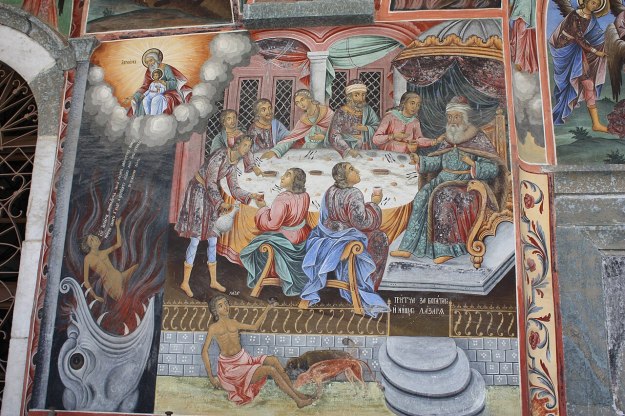
We do not know what prompts this specific warning against favoritism towards the rich in James’s letter. It is possible that this could be like Jesus’s use of the parable of the rich man and Lazarus (Luke 16: 19-31) which puts two opposing characters alongside one another as an object lesson for the audience. It is possible that James is working in a synagogue where Sadducees and Pharisees are present and his words may be echoing Jesus’s words of condemnation about the Pharisees seeking places of honor and respect (Matthew 23: 6-7). Regardless of where others in James’s community see this favoritism modeled, James views it as incompatible with the faith in Jesus.
I serve in Frisco, Texas, a very prosperous suburb of Dallas and an area where the vast majority of my congregation would be considered incredibly wealthy by the standards of James original audience. I have also spent my entire ministry in suburban areas (North Little Rock, AR, Edmond, OK, and Papillion, NE). I am aware of the tension that these words evoke in me as a person who is very intentional about how I dress and present myself. Yet, this section also has made me reflect upon a moment several years ago in my ministry here where an older member in one of my communities, who was also one of the least well off members of my community, remarked to a young woman approaching the congregation for the first time and wearing jeans that were fashionably ripped, “Girl, go put some pants on.” I apologized to the visitor and immediately pulled the member aside and was very emphatic that she could never do that again because it was the opposite of the welcome we wanted anyone to feel. I was irate because I felt like the words, which she later claimed were a joke, indicated to this woman that she was unwelcome in our midst. I would not share this story if the person who said these words was still alive and it doesn’t completely correlate with James’s words but for me it shows how even those among us with the least may look for opportunities to place themselves in a position of judgment over others.
James joins Jesus and several other New Testament authors in finding Leviticus 19:18 as the central concept of the law. As Scot McKnight says,
Several New Testament writings…quote Leviticus 19:18…Paul explicitly makes it the fundamental rule of life (Rom 12:19; 13:9; Gal 5:14), while Peter hedges in that direction (1 Pet 4:8) and John explodes into full focus on love (John 13: 34-35; 1 John 3:11; 4;17). It is not without significance that James is the only person in the New Testament after Jesus who quotes both sides of the Jesus Creed; loving God in 1:12 and 2:5 and loving others as oneself here in 2:8. (McKnight, 2011, p. 208)
Leviticus 19:18 may be the ‘royal law’ in James, but James also connects loving neighbor as requiring compliance with all the commandments. James noting of the commandments on adultery and murder may reflect Jesus’s expansion of these commandments in the Sermon on the Mount (Matthew 5: 21-30) or an exposition on Leviticus 19 which brackets the love command in verse eighteen with,
“You shall not hate in your heart anyone of your kin; you shall reprove your neighbor, or you will incur guilt yourself. You shall not take vengeance or bear a grudge against any of your people, but you shall love your neighbor as yourself: I am the Lord. Leviticus 19:17
It is plausible that James may be referring back to Leviticus 19 throughout this reflection, especially in the previous section Leviticus 19:15 is relevant:
“You shall not render an unjust judgment; you shall not be partial to the poor or defer to the great: with justice you shall judge your neighbor. Leviticus 19:15
Although, Leviticus 19:20 does deal with sexual relations with a slave, James here appeals to the commandment on adultery (along with murder) rather than the specific case highlighted in Leviticus. It is likely that James, like Jesus, expands the view of adultery beyond the limits envisioned in Exodus, Leviticus, and Deuteronomy.
The royal law on loving the neighbor as oneself, which includes adherence to the commandments, is also the law of liberty. James’s vision of a community of living and authentic faith is a place where the poor are not discriminated against, and the neighbor is loved and protected. Yet, James like the other New Testament authors view the commandments through the lens of mercy. Again, James echoes ideas Jesus articulates in the Sermon on the Mount:
“Blessed are the merciful, for they will receive mercy. Matthew 5:7
but if you do not forgive others, neither will your Father forgive your trespasses. Matthew 6:15
James is not attempting to articulate anything novel when it comes to the faith of these followers of Jesus but instead is selecting key practices which are critical to the walk of faith. Faith for James is composed of both certainty and practiced consistent with the values centered on the loving the neighbor as oneself in a merciful and life-giving way.
[1] James knows the word for church (ekklesia) and uses it in 5:14, so calling the assembly ‘your synagogue’ is intentional. As I mention in the introduction, my assumption is that James the brother of Jesus is the author of this letter and we are given a window on early Christianity contemporaneous with Paul’s letters and the boundaries between Christianity and Judaism are probably not as rigid as they will be later.