Tag Archives: Psalm 130

Psalm 131 The Humble Child of the Mothering God

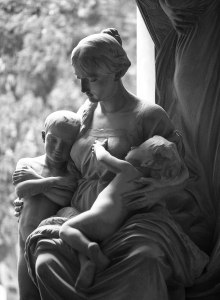
Statue of a mother with children at the Monumental Cemetery of Staglieno in Genoa. Photo by Alessandro Giudice CC by SA 4.0

Psalm 131

A Psalm of Ascents. Of David.

1O LORD, my heart is not lifted up;
  my eyes are not raised too high;
 I do not occupy myself with things
  too great and too marvelous for me.
2
But I have calmed and quieted my soul,
  like a weaned child with its mother;
  my soul is like the weaned child that is with me.
3
O Israel, hope in the LORD
  from this time on and forevermore.

This short psalm is striking for its central metaphor where the faithful one is a dependent child and LORD is the mother who is the safe and comforting place the child goes to. Jesus will later tell his disciples

Truly I tell you, unless you change and become like children, you will never enter the kingdom of heaven. Whoever becomes humble like this child is the greatest in the kingdom of heaven. Whoever welcomes one such child in my name welcomes me. Matthew 18: 3-5

Humility plays a central role in both the posture of the psalmist and the posture that Jesus is encouraging in his disciples. The hearers are encouraged to have, “Utter trust in and childlike dependence on God for life and the future.” (NIB IV: 1209) The first verse points to the humble and childlike stance of the psalmist, while the second verse introduces the central metaphor of the childlike speaker and the mothering God who comforts and quiets the speaker’s being, and the third verse expands this posture to Israel whose hope is in the nurturing presence of God.

The heart in Hebrew thought is not the seat of emotion but the seat of will and direction, so the heart not being lifted up is not about being in an exalted emotional state but instead the inner intention of the psalmist is to remain in one’s proper state. The eyes are the outward facing representation of this stance, and they are also not raised too high. The psalmist focuses on the simple things and rather than concentrate their will and striving on great and marvelous things, they rest in their dependence on God. The triple negative of the first verse demonstrates verbally the stance of humility the psalmist has towards God and the world. If this psalm comes from David, as its attribution indicates, it paints the picture of a king who understands their limits and who places honor where it belongs. The king becomes the child needing to be quieted by the nurturing mother God.

The use of feminine imagery for God is relatively rare in the bible, but it does occur. Isaiah uses a similar image of a mother and a nursing child:

Can a woman forget her nursing child, or show no compassion for the child of her womb? Even these may forget, yet I will never forget you. Isaiah 49: 15

The psalmist has been calmed and quieted in their innermost being. The Hebrew nephesh, rendered soul by the NRSVue, is the most essential part of life and the self but it does not have the sense of soul that is separate from the body and continues beyond life.[1] The Hebrew gamal translated by the NRSVue as weaned can mean either ‘sated’ or ‘weaned.’ If the word is translated ‘sated’, the image of the child is that of an infant who is relaxing after feeding where the hands and legs relax and the child may fall asleep on the mother’s breast or look up at their mother with a satisfied look. If the word is translated ‘weaned,’ as most translations do, the child is coming to the mother for comfort, nurturing, and a loving embrace instead of food. Normally in the bible the context indicates that gamal be translated as a weaned child but here the context allows for either interpretation. With the theme of humility, I like the translation of ‘sated’ with a completely dependent infant on the mother for nutrition, care, and love but ultimately either translation serves the metaphor.

The psalm concludes with the expansion to the people of Israel. The declaration for Israel to hope in the LORD echoes the identical declaration in Psalm 130:5 linking the two psalms together in their conclusions. The God who provides rescue from the desperate situation is the same God who quiets the inner being of humble on like a mother comforts her child. In de Profundis (Psalm 130) the petitioner waits on the LORD more than one who waits for morning, but in Psalm 131 the comforted child can be at peace in the present moment and know that their hope for the future is in the steady, comforting mother-like love of God which calms and quiets them both in the present and forevermore.


[1] The Greek philosophical idea of soul, which many Christians assume is the biblical idea, where the soul is imprisoned in the body and is liberated at death is not the perspective of the Old or New Testament. This enters Christian thought through theologians in the church influenced by Neo-Platonic philosophy (like Augustine).  

Psalm 130 De Profundis

A piercingly bright curtain of stars is the backdrop for this beautiful image taken by astronomer Håkon Dahle at the La Silla Observatory in Chile. Shared under CC 4.0 https://en.wikipedia.org/wiki/Night_sky#/media/File:Starry_Night_at_La_Silla.jpg

Psalm 130

A Song of Ascents.

1Out of the depths I cry to you, O LORD.
  2
Lord, hear my voice!
 Let your ears be attentive
  to the voice of my supplications!

3
If you, O LORD, should mark iniquities,
  Lord, who could stand?
4
But there is forgiveness with you,
  so that you may be revered.

5
I wait for the LORD; my soul waits,
  and in his word I hope;
6
my soul waits for the Lord
  more than those who watch for the morning,
  more than those who watch for the morning.

7
O Israel, hope in the LORD!
  For with the LORD there is steadfast love,
  and with him is great power to redeem.
8
It is he who will redeem Israel
  from all its iniquities.

Bolded words have comments on translation below.

Psalm 130  is often called De profundis from the Latin rendering of the initial words out of the depths. It is one of my personal favorites as it cries with longing for the steadfast love, forgiveness, and redemption that comes from God. Martin Luther called this psalm, “a proper master and doctor of Scripture” and he would use it as the inspiration for his song “Out of the Depths I Cry To You.”[1] Throughout the reformation the song and the psalm were commonly used at funerals, and “Out of the Depths I Cry to You” was sung at the funerals of Fredrick the Wise, John of Saxony, and Martin Luther. (LW 53:222) Psalm 130 was also sung on the afternoon before John Wesley’s transformational experience at Aldersgate. James L. Mays appropriately calls this psalm, “a succinct but powerful expression of the theme that is at the heart of Scripture: the human predicament and its dependence on divine grace.” (Mays, 1994, p. 405)  

The psalmist cries out to the LORD from the depths, a phrase that can reference the sea[2] but for many readers it is also a metaphor for a desperate situation or depression. The initial two lines start a pattern of two verses stanzas where God is referred to twice. In the first three stanzas the first time the psalmists utilize the name of God (LORD in NRSVue)[3] in the initial verse of the stanza while the second reference is the generic Adonai (Lord in NRSVue). In verses seven the name of God is utilized twice. There is a consistent belief throughout the scriptures that the LORD is a God who hears and is attentive to the voice of the faithful ones, especially in desperate times.

The rapid move in verse three to talking about iniquities implies that the desperate situation referred to by the psalmist crying out from the depths may be due to their own lack of faithfulness. The word iniquities[4] occurs more than two hundred times in the Old Testament, especially in the prophets, to describe sin and guilt. (Nancy deClaisse-Walford, 2014, p. 928) Yet, the psalmist understands that fundamental to the character of God is forgiveness. The LORD is a God who desires justice, but as James L. Mays says,

The error is to understand the LORD as a god whose principal way with human beings is to watch for iniquities. If that were the case, there would be no hope of anyone. (Mays, 1994, p. 406)

Psalm 130 is one of many places in the Old Testament where we see a God of grace. I have often said to my congregation if you go to the bible looking for a judgmental God you will find one, but if you go to scripture seeking a gracious God you find the patience, forgiveness, and steadfast love of God as a defining characteristic of the God the bible witnesses to. That the LORD is a forgiving and attentive God provides hope for this psalmist who cries out from the depths.

The third stanza with its doubled final line in verse six is what initially captured my attention with this psalm. The psalmist waits and trusts in the LORD with all their being[5] and hopes in God’s word. The verb waits in verse six is not present in Hebrew but needs to be supplied for the translation to make sense. The doubling of more than those who watch for the morning heightens the expectation of the psalm. For me these doubled lines reminded me of keeping watch while in the army at that final watch before the sun rose. I have trouble if it is cold at night getting warm but as soon as the sun comes up my body is typically able to regulate itself better and so for me the longing for sunrise is something I feel intensely in my body. This hope for God with the entirety of one’s being like waiting for the dawning of the new day is a powerful reversal from the depths that the psalm began with.

In the final two verses the psalmist moves from their own situation to that of the people of God and calls on them to hope in the LORD. Just as the LORD has redeemed and rescued the one who call on God from the depths despite their iniquities, now the LORD will redeem Israel from its iniquities and the trouble they have caused. The name of God is now linked to one of the fundamental characteristics of God, steadfast love (hesed). The calling on the name of God twice in this final stanza may be to link the name of God with the characteristic steadfast love (hesed) of God. For the God of Israel, the iniquities of the people are not the final word, steadfast love and redemption are. The God who forgives the individual and rescues them from the depths also forgives and rescues the people. The individual and the people of God wait and hope in the LORD with all their being more than those waiting and watching for the coming of the dawn.


[1] “Out of the Depths I Cry To You” although not as popular as “A Mighty Fortress” or “Lord, Keep Us Steadfast in Your Word” continues to be sung and it is hymn 600 in the songs of Evangelical Lutheran Worship.

[2] Isaiah 51:10; Ezekiel 27:34; Psalm 69:2.

[3] When the word LORD is capitalized in the NRSV or NRSVue translation of the Hebrew it indicates the four letters of the divine name YHWH (often pronounced Yahweh) are behind it. Hebrew readers will often substitute the Hebrew Adonai to avoid speaking the name of God and risking taking the name of God in vain.

[4] Hebrew ‘awonot.

[5] The Hebrew nephesh often translated soul in English is a very different concept than most modern conceptions of ‘soul.’ For Hebrew the nephesh is about life and not about something that is freed after death.