Tag Archives: James

James 3: 13-18 What Wisdom Looks Like in Action

Creation: Lady Wisdom in Creation by Connor White (Cover image for Creative Words)

James: 3: 13-18 What Wisdom Looks Like In Action

  13Who is wise and knowledgeable among you? Show by your good life that your works are done with gentleness born of wisdom. 14But if you have bitter envy and selfish ambition in your hearts, do not be arrogant and lie about the truth. 15This is not wisdom that comes down from above but is earthly, unspiritual, devilish. 16For where there is envy and selfish ambition, there will also be disorder and wickedness of every kind. 17But the wisdom from above is first pure, then peaceable, gentle, willing to yield, full of mercy and good fruits, without a trace of partiality or hypocrisy. 18And the fruit of righteousness is sown in peace by those who make peace.

James has been talking about wisdom throughout the letter, and just as faith requires faithful works for James, so wisdom requires works done in gentleness. Faithful behavior and speech is shaped by humble wisdom that seeks peace. The bible often uses wise and knowledgeable as a shorthand for teaching (McKnight, 2011, p. 299) and Deuteronomy, for example, begins with seeking wise and knowledgeable ones who can serve alongside of Moses and Joshua together:

Choose for each of your tribes individuals who are wise, discerning, and reputable, and I will make them your leaders.’  You answered me, ‘The plan you have proposed is a good one.’ So I took the leaders of your tribes, wise and reputable individuals, and installed them as leaders over you, commanders of thousands, commanders of hundreds, commanders of fifties, commanders of tens, and officials, throughout your tribes. Deuteronomy 1: 13-15.

James continues to have his gaze centered on those who are leaders of the community and instructs them on the type of fruit that leaders are expected to bear. Like Jesus, James believes that wisdom will be vindicated by her deeds (Matthew 11:19). Those deeds of gentleness emerge from the vine of wisdom.

For James wisdom and foolishness are not a passive way of thinking but are demonstrated by a life of goodness or wickedness. Like faith, for James, wisdom and or foolishness are about what they generate rather than some cognitive content. As in wisdom literature, wisdom is always tied to practices and actions. Foolishness bears envy and selfish ambition, wickedness and disorder. Jesus would rebuke Peter for putting his mind on earthly things instead of divine things (Matthew 16:23 and parallels) and here James shows the difference between an earthly, unspiritual, and devilish (or demonic) foolishness of envy and selfish ambition bearing the fruit of wickedness and disorder and wisdom from above. These earthly, unspiritual, and devilishly oriented people generate words and actions which distort and falsify the truth.

In contrast, the wisdom from above is described with seven ‘fruits’ of wisdom similar to Paul’s fruits of the Spirit (Galatians 5: 19-23). Purity only occurs here in James and in 4:8 in a verbal form (to cleanse) yet James has been seeking a faith and wisdom whose life is ethically and morally completed in mercy and humility. Peace is a central idea to this section and goes back to the Hebrew concept of shalom which is more than the absence of conflict but reflects a wholeness and harmony with God’s will for the world. In contrast to the envy and self-ambition of the earthly foolishness is the gentleness and willingness of yield of the heavenly wisdom. Mercy is strongly connected for both James and Jesus with their understandings of righteousness, and here it is connected to the fruits of wisdom. The final two characteristics are in Greek adiakritos and anypokritos. When you place an ‘a’ at the front of a Greek term it negates it or turns it into its opposite. Diakritos is to judge and so it becomes without judgement and anypokritos is ‘without hypocrisy.’ While the fruit of the earthly, unspiritual, and devilish foolishness is disorder and wickedness, the fruit of wisdom is sown in peace by peacemakers.

Another inspiration for James may be the personification of wisdom and foolishness in Proverbs 7 and 8. James has frequently utilized the patterns and language of wisdom literature in his letter and although he does not explicitly allude to the adulterous woman and lady wisdom, the contrast between this earthly, unspiritual, and devilish antiwisdom in contrast with the pure, peaceable, truthful, prudent knowledgeable, orderly, just and righteous lady wisdom of Proverbs eight. Even if James does not intend to evoke this specific image he demonstrates confidence in utilizing the practical wisdom of Proverbs and other wisdom literature to help his audience shape their lives.

The brief descriptions of James in the book of Acts describe him as a peacemaker. As Martha L. Moore-Kiesh states:

The emphasis on peacemaking comports well with the image of James, the brother of the Lord, in the book of Acts. Named there as a leader of the church in Jerusalem, James offers a compromise on an important controversy about how to respond to the “Gentiles who are turning to God” (Acts 15:19). In Acts 21, he also works to diminish conflict between Paul and certain Christian Jews in Jerusalem who are spreading rumors that Paul is teaching Jews living among the Gentiles to “forsake Moses” (Acts 21:21) (Moore-Keish, 2019, p. 135)

James was likely struggling with divisive forces in his society and within the rapidly evolving community of Jesus followers. If the letter of James was written in the late 50s or early 60s of the first century, the time between the crucifixion and resurrection and the Jewish War, when Paul and other apostles are doing successful if controversial ministry among the Gentiles, and the followers of Jesus are trying to navigate their place in Judea and the diaspora, he likely encountered several leadership struggles that threatened to divide the community. But the church of Christ in every age has struggled with those who mistook earthly for divine things, who distort and falsify the truth with their words and actions, who are driven by envy or selfish ambition and who bear fruits of wickedness and disorder. Jesus would tell his followers, “Blessed are the peacemakers, for they will be called children of God.” (Matthew 5: 9) and James points to a heavenly wisdom which bears the fruit of righteousness sown in peace by those who make peace. Just as a good tree is known by the fruit it produces, so wisdom is vindicated by its peaceful deeds.

James 3: 1-12 On the Danger of Being a Teacher and the Destructive Power of the Tongue

Harsh Bit Use on a Horse CC BY 2.0, https://commons.wikimedia.org/w/index.php?curid=2904985

James 3: 1-12

1Not many of you should become teachers, my brothers and sisters, for you know that we who teach will face stricter judgment. 2For all of us make many mistakes. Anyone who makes no mistakes in speaking is mature, able to keep the whole body in check with a bridle. 3If we put bits into the mouths of horses to make them obey us, we guide their whole bodies. 4Or look at ships: though they are so large and are driven by strong winds, yet they are guided by a very small rudder wherever the will of the pilot directs. 5So also the tongue is a small member, yet it boasts of great exploits.
  How great a forest is set ablaze by such a small fire! 6
And the tongue is a fire. The tongue is placed among our members as a world of iniquity; it stains the whole body, sets on fire the cycle of life, and is itself set on fire by hell. 7For every species of beast and bird, of reptile and sea creature, can be tamed and has been tamed by the human species, 8but no one can tame the tongue—a restless evil, full of deadly poison. 9With it we bless the Lord and Father, and with it we curse people, made in the likeness of God. 10From the same mouth comes a blessing and a curse. My brothers and sisters, this ought not to be so. 11Does a spring pour forth from the same opening both fresh and brackish water? 12Can a fig tree, my brothers and sisters, yield olives or a grapevine figs? No more can salt water yield fresh.

Words matter. For those entrusted with the authority to speak on behalf of a community, to shape its life and actions, those words they speak in teaching and leadership can shape both the faithful and the perception of the faithful in the world around them. Yet, in an age where words have increased exponentially and everyone through the existing technology can have a platform to broadcast their opinions as facts, James’s warning is even more prescient. As a person who attempts to use my words carefully, I also see the way the tools of the information age have created an age of misinformation. I saw this firsthand during the week I was writing this reflection which I will share below, but I share Luke Timothy Johnson’s view that, “We dwell in a virtual Babel of linguistic confusion and misdirection.” (NIB XII: 206) In the United States we have often highlighted the value of free speech, but I fear that we have rarely emphasized the responsibility of utilizing of freedom of speech in a way that builds up the community of faith and our surrounding world.

James’s words about the tongue are likely intended for his entire audience, but he is intentional in his decision to begin this section by addressing teachers in the community. Teachers, to utilize James’s metaphors, can be the bit and bridle which guide the community, the rudder that steers the ship of the church through the strong winds of the world or they can be the fire which burns the community to ash and ruins. They are not to be like some of the religious leaders that Jesus spoke against in Matthew’s gospel:

They love to have the place of honor at banquets and the best seats in the synagogues and to be greeted with respect in the marketplaces and to have people call them rabbi.  But you are not to be called rabbi, for you have one teacher, and you are all brothers and sisters. Matthew 23: 6-8

If James is writing in the time leading up to the Jewish War where conflict was in the air and the wood is dry and easily kindled for revolution, it is probable that James, particularly with his words in the next section, is resisting those leaders in his community and in Judea who were using words to inflame. There have always been teachers who have used their words in irresponsible, uncaring, and hurtful ways but in times of conflict we often mistake cruelty and confidence for faith. James’s earlier words where faith is contrasted with doubt may lead some readers to mistakenly believe James advocates for this type of faith, but this chapter shows how mistaken that reading of James would be. Any leader who can bless God and curse people has missed what faith is for James. Faith for James does works born of gentleness and wisdom as the following section will highlight.

James can acknowledge that we all make mistakes, and that mistakes in speaking are perhaps the most difficult to restrain. James continues to utilize the Greek teleios (NRSVue mature, NRSV perfect)[1] which is a word of goal or destination. If you can restrain your words you are complete or whole or mature, and while words are important they need to be well chosen. James introduced this in chapter 1,[2] and now focuses his writing on several commonly used images for speech. Scot McKnight shows the way the metaphors that James uses are present in the writings of other ancient authors:

Plutarch compares words let loose to boats caught by winds that shipwreck and sparks caught by winds that set off fires…Philo connects horses and bits but what strikes the reader of his On the Creation is that these are set in a context of humans being made in God’s image and having the capacity to train animals. (83-86). In his Allegorical Interpretation of Genesis, Philo connects the rudder and boat to a mind set ablaze by irrational sense like fire (3.224). (McKnight, 2011, pp. 276-277)

Yet, James is also tapping into wisdom literature’s concern for the tongue. For example:

Lying lips conceal hatred, and whoever utters slander is a fool. When words are many, transgression is not lacking, but the prudent are restrained in speech.The tongue of the righteous is choice silver; the mind of the wicked is of little worth.The lips of the righteous feed many, but fools die for lack of sense. Proverbs 10: 18-21

Death and life are in the power of the tongue, and those who love it will eat its fruits. Proverbs 18:21

A person may make a slip without intending it. Who has not sinned with his tongue? Sirach 19:16[3]

Or in Matthew’s gospel:

I tell you, on the day of judgment you will have to give an account for every careless word you utter, for by your words you will be justified, and by your words you will be condemned.” Matthew 12: 36-37

Speech is important throughout both scripture and imagery related to speech and tongues abounds in the ancient world, but James’s words about the tongue still can shock. In James’s imagery the tongue seems to have a will of its own. As Joel Green notes:

We hear James’s charge that horses and ships can be controlled by the tongue seems out of control. Notice again James’s wording: “It boasts of great things” (and not, say, “With it we boast of great things”)—as if the tongue had a mind of its own. (Green, 2025, p. 102)

The word the NRSVue translates as ‘tame’ (damazo) is a word for subduing or restraining, and tame is probably a little weak in a context where the tongue is unrestrainable. The tongue can set ablaze, is a restless evil and full of deadly poison in what may be an echo of Psalm 140:3,       “They make their tongue sharp as a snake’s, and under their lips is the venom of vipers.” I’m writing this in the week before Pentecost when tongues of fire rested on the first apostles, but as Martha L. Moore-Keish aptly states:

at Pentecost, the tongues of fire were sent by God, empowering people to speak by the power of the Spirit. The question is: Whose fiery tongues are inspiring us? Whose words are we speaking? (Moore-Keish, 2019, p. 125)

Unrestrained tongues which can curse those made in God’s image are not inspired by the wisdom from above (as the next section discusses) but are earthly, unspiritual, and devilish. They are set on fire by hell/Gehenna[4] and bring death instead of life. Many may have grown up with the proverb, “Sticks and stones may break my bones, but words will never hurt me.” But James knows better, as does scripture. As Proverbs says, death and life are in the power of the tongue.

James has earlier discussed a double-minded faith and now talks about a contradictory action by the tongue which should be as impossible as both fresh and brackish water coming from the same spring at the same time. Here the tongue is used to bless God and curse people made in the likeness of God. Just as faith of Jesus is incompatible with favoritism to the rich, it is incompatible with cursing another person. James does not limit this cursing to the community of faith, for Jewish thought would say that all humanity, male and female, are formed in God’s image. Just as fig trees cannot bear olives or vineyards figs, so the tongue of a person of faith should only flow with blessings for both God and those formed in God’s image.

As I have sat with James’s words through this week, I have also had to sit with a heartbreaking image of how true James’s words are. My congregation is in Frisco, Texas a very diverse suburb of Dallas of approximately 250,000 people. Unlike many parts of Texas, the diversity in Frisco in heavily Asian, particularly Indian, in background and I will see people from my community playing cricket across the street from my church instead of football or baseball most Sunday mornings. Our congregation is situated next to a very large Hindu temple, and our communities have had an ongoing relationship and dialogue for eighteen years. But Frisco was also on the front page of the Dallas Morning News this morning for a contentious city council meeting on Tuesday night, which I was present for, where several individuals and groups unleashed their tongues in ways that were both painful and hateful. Some of these were people with authority over a church, others were people who called themselves Christian. Much of it was political theater and may have been motivated by envy or selfish ambition, and it did bring disorder and wickedness. It did not look like the fruits of wisdom that James discusses below. In James’s time and in ours not many should be leaders and those who are must continually learn to restrain their tongues and speak words of blessing instead of cursing.


[1] For a fuller discussion of teleios see my reflection on Perfection and Blamelessness in the Bible.

[2] James 1: 19, 26.

[3] See also Proverbs 12:18; 13:3; 16:27; 18:7, 21; 26: 21; Sirach 28: 13-14, 18-22.

[4] See my reflection on Gehenna, Tartaros, Sheol, Hades, and Hell for a fuller discussion of these terms in the New Testament.
James 2:14-26 Faith Without Works is Dead

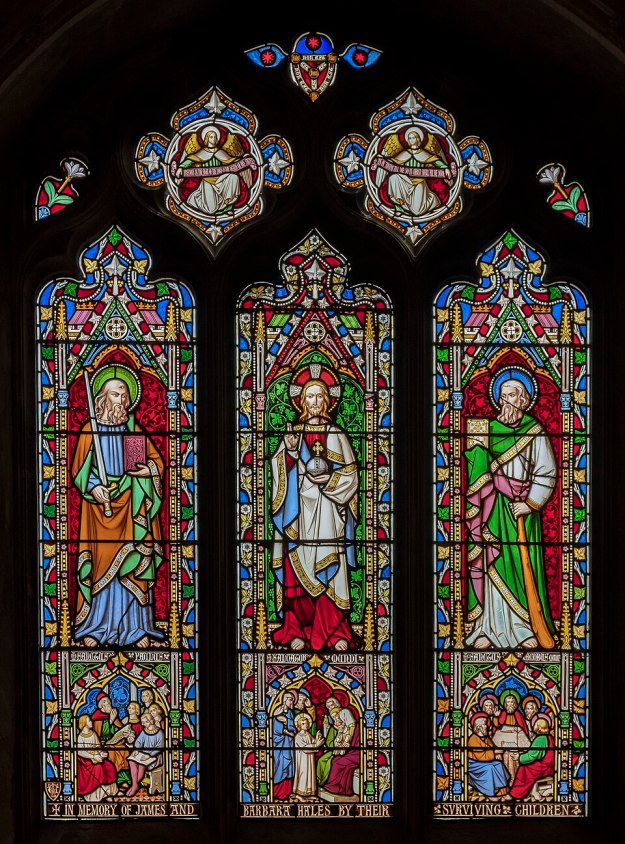
Stained Glass in Norwich Cathedral depicting St Paul, Christ (as Saviour of the world), and St James the Less. The lower panels show St Paul dictating, Jesus in the Temple, and St James at the Council of Jerusalem. The glass is by Wailes, 1852, and is in memory of James and Barbara Hales.

James 2: 14-26

  14What good is it, my brothers and sisters, if someone claims to have faith but does not have works? Surely that faith cannot save, can it? 15If a brother or sister is naked and lacks daily food 16and one of you says to them, “Go in peace; keep warm and eat your fill,” and yet you do not supply their bodily needs, what is the good of that? 17So faith by itself, if it has no works, is dead.
  18
But someone will say, “You have faith, and I have works.” Show me your faith apart from works, and I by my works will show you faith. 19You believe that God is one; you do well. Even the demons believe—and shudder. 20Do you want to be shown, you senseless person, that faith apart from works is worthless21Was not our ancestor Abraham justified by works when he offered his son Isaac on the altar? 22You see that faith was active along with his works, and by works faith was brought to completion. 23Thus the scripture was fulfilled that says, “Abraham believed God, and it was reckoned to him as righteousness,” and he was called the friend of God. 24You see that a person is justified by works and not by faith alone. 25Likewise, was not Rahab the prostitute also justified by works when she welcomed the messengers and sent them out by another road? 26For just as the body without the spirit is dead, so faith without works is also dead.

“Do this and you will live.” In Luke’s gospel these words come between the lawyer’s answer to what scripture says one must do to inherit eternal life[1] and Jesus’s parable commonly known as the Good Samaritan (Luke 10: 25-37). I reference the beginning of this well-known parable since it quotes both the commandment to love God and the love of neighbor, both of which occupy James’s attention throughout this chapter. A faith that merely knows about God for James is useless, impotent, empty, and ultimately dead.

Joel Green quotes the novelist Ursula Le Guin at the beginning of his commentary on James:

The fantasy novelist Ursula Le Guin wrote, “To learn a belief without belief is to sing a song without the tune.” She goes on: “A yielding, an obedience, a willingness to accept these notes as the right notes, this pattern as the true pattern, is the essential gesture of performance, translation, and understanding.” (Green, 2025, p. 1)

A faith that does not work on behalf of the vulnerable sister or brother may know the words of the song but it lacks the notes and the action to perform it faithfully. It may be able to echo the words of the Shema, that God is one, (Deuteronomy 6:4) but knowing God is one and loving God with all of one’s being are two different things. Stating one loves one’s neighbor and being unwilling to help the naked and hungry brother or sister would be the double-minded faith of the previous chapter.

I appreciate the inclusive goal of the NRSVue (and the NRSV that came before it) in translating the Greek adelphos as brothers and sisters, since James intends his words for both male and female listeners. Unfortunately, in verse fifteen we have one of the rare instances where the Greek does have both brothers and sisters (adelphos e adelphe) and it is likely that James wants us to intentionally focus on both men and especially women who are hungry and naked. Women had far fewer opportunities in the ancient world to provide for their needs and this is why widows in particular are linked with orphans and resident aliens throughout scriptures as a vulnerable and easily oppressed population.  James who previously stated that undefiled religion includes caring for the widows and orphans now links faith to the practices of neighbor love which provide for the needs of the naked and hungry men and women in their midst. Just as religion that does not care for widows and orphans is defiled for James, faith that merely says keep warm and eat your fill without acting in response to the needs of the neighbor is unable to save and dead.

James contrasts a faith which is merely knowledge with a faith that involves practices/works/ and deeds of mercy in a stark manner. Like wisdom literature often does we are given a choice between a wise path and a foolish path. For James the wise path is the path of the royal law of liberty, of Jesus, of Abraham and Rahab while the foolish path is that of demons. The demons know that God is one and tremble but they do not act in mercy or love toward the neighbor. James is trying to hammer the point home that faith merely as knowledge is worthless/ineffective[2] and reveals an empty[3] (NRSVue senseless) person.

James proceeds to his two examples: Abraham and Rahab. One man and one woman, one a central figure in the story of Israel and one an outsider who becomes a part of the community, but both who are reflected on in the Hebrew tradition as people who showed hospitality. Abraham is an obvious choice because of his central position in the story of the Jewish people and the likely use by people who James directs his letter at (see below). By referencing the willingness of Abraham to sacrifice his son Isaac to God in obedience to God’s instructions James may be attempting to link this action with loving God with all of one’s being. Abraham was a man of wealth who had slaves and flocks, but Rahab was a woman who lived on the edge of Jericho, a prostitute, and not a part of Israel when she shows hospitality to the Israelite spies in Joshua 2. Like the Samaritan in Jesus’s parable, she is the one who shows hospitality and mercy to God’s people in a moment of need and binds herself to God and God’s people by her actions. It is her actions (works) of hospitality (including protecting the spies) which link her to God’s community.

I want to be careful how I say this next piece because it could easily be misread, but I do think one of our mistakes as people who live in the aftermath of the optimistic view of the enlightenment, where we strive to create a better world and better society, is that we focus more on the systems that surround us than the vulnerable ones in our midst. As a Lutheran Christian I am a part of the magisterial reformation which attempted to have the church partner with the government to shape a better world. This is not a bad thing, but it is also not what James is thinking of. Luke Timothy Johnson is worth quoting at length here:

James does not rail against an economic system that oppresses the poor. Instead, he calls precisely for the formation of communities gathered by the faith of Jesus in which the poor are honored and cared for by others who are themselves “poor” in the eyes of the world. Nor does James suggest the those who are impoverished need to be relieved of their poverty before they can claim human dignity. Just the opposite. The poor have been chosen by God to be the heirs of the kingdom. To say that the poor need to get possessions to become more fully human is to accept the equation of being and having characteristic of the world. For James the hope of the poor is the God who gives every perfect gift without grudging, and a crown of glory to those who love God (1:12). (NIB XII: 200-201) emphasis mine.

Or in the words of José Antonio Olivar’s song “Cuando el pobre (When the Poor Ones”:

           When the poor ones, who have nothing, still are giving;

          when the thirsty pass the cup, water to share;

when the wounded offer others strength and healing:

          We see God, here by our side, walking our way;

          we see God, here by our side, walking our way.[4]

James does not wait for the members of his community to be wealthy before they care for the needs of the hungry, naked, and vulnerable. In James’s view this community which may have nothing still is giving and God is there providing in their poverty and walking with them in the way.

This is also the appropriate spot to discuss the different ways Paul and James deploy similar vocabulary in a very different manner for different communities and issues. Paul in Galatians 2 mentions James (along with Cephas/Peter and John) as one of the pillars of the community that sends him to the Gentiles (Galatians 2:9) only asking that he remember the poor. Some time afterward “some people from James” cause Cephas to stop eating with the Gentiles (for fear of the circumcision faction) which leads Paul to confront Cephas. In Galatians 3, along with Romans 4, Paul argues for faith in contrast to the works of the law. It is worth noting that the ‘works’ Paul is arguing against are the boundary markers like circumcision and dietary restrictions, items which James never addresses in his letter. Just as Paul dealt with ‘people from James’ it is likely that James is dealing with followers of Paul whose language of faith without works, and even Paul’s utilization of Abraham as an example of this saving faith may be causing a different problem among the Christians in the communities James is addressing. Paul and James would agree that the poor and the vulnerable are both worthy of respect[5] and should be cared for within the community. The differences between Paul and James in their language have often obscured the strong resonances that both share. These two early church leaders conducted their ministry in different communities, and both were concerned in shaping practices of faith with different challenges.


[1] The Greek zoea ion which is rendered ‘eternal life’ in most English translations, but I do not believe that is what the gospels are trying to communicate. See my discussion on Afterlife, Eternal Life, and the Kingdom of God.

[2] The Greek arge is the opposite of the Greek word erge (work/deed) [a + erge] and this is part of the wordplay that James is utilizing

[3] Kenos primary meaning is empty. It can be used metaphorically for senseless or foolish.

[4] Translated by Martin A. Seltz in Evangelical Lutheran Worship. Hymn 725.

[5] See for example Paul’s condemnation of those in Corinth whose practices at the Lord’s Supper, “show contempt for the church of God and humiliate those who have nothing.” 1 Corinthians 11: 22.