Tag Archives: Leadership

James 3: 1-12 On the Danger of Being a Teacher and the Destructive Power of the Tongue

Harsh Bit Use on a Horse CC BY 2.0, https://commons.wikimedia.org/w/index.php?curid=2904985

James 3: 1-12

1Not many of you should become teachers, my brothers and sisters, for you know that we who teach will face stricter judgment. 2For all of us make many mistakes. Anyone who makes no mistakes in speaking is mature, able to keep the whole body in check with a bridle. 3If we put bits into the mouths of horses to make them obey us, we guide their whole bodies. 4Or look at ships: though they are so large and are driven by strong winds, yet they are guided by a very small rudder wherever the will of the pilot directs. 5So also the tongue is a small member, yet it boasts of great exploits.
  How great a forest is set ablaze by such a small fire! 6
And the tongue is a fire. The tongue is placed among our members as a world of iniquity; it stains the whole body, sets on fire the cycle of life, and is itself set on fire by hell. 7For every species of beast and bird, of reptile and sea creature, can be tamed and has been tamed by the human species, 8but no one can tame the tongue—a restless evil, full of deadly poison. 9With it we bless the Lord and Father, and with it we curse people, made in the likeness of God. 10From the same mouth comes a blessing and a curse. My brothers and sisters, this ought not to be so. 11Does a spring pour forth from the same opening both fresh and brackish water? 12Can a fig tree, my brothers and sisters, yield olives or a grapevine figs? No more can salt water yield fresh.

Words matter. For those entrusted with the authority to speak on behalf of a community, to shape its life and actions, those words they speak in teaching and leadership can shape both the faithful and the perception of the faithful in the world around them. Yet, in an age where words have increased exponentially and everyone through the existing technology can have a platform to broadcast their opinions as facts, James’s warning is even more prescient. As a person who attempts to use my words carefully, I also see the way the tools of the information age have created an age of misinformation. I saw this firsthand during the week I was writing this reflection which I will share below, but I share Luke Timothy Johnson’s view that, “We dwell in a virtual Babel of linguistic confusion and misdirection.” (NIB XII: 206) In the United States we have often highlighted the value of free speech, but I fear that we have rarely emphasized the responsibility of utilizing of freedom of speech in a way that builds up the community of faith and our surrounding world.

James’s words about the tongue are likely intended for his entire audience, but he is intentional in his decision to begin this section by addressing teachers in the community. Teachers, to utilize James’s metaphors, can be the bit and bridle which guide the community, the rudder that steers the ship of the church through the strong winds of the world or they can be the fire which burns the community to ash and ruins. They are not to be like some of the religious leaders that Jesus spoke against in Matthew’s gospel:

They love to have the place of honor at banquets and the best seats in the synagogues and to be greeted with respect in the marketplaces and to have people call them rabbi.  But you are not to be called rabbi, for you have one teacher, and you are all brothers and sisters. Matthew 23: 6-8

If James is writing in the time leading up to the Jewish War where conflict was in the air and the wood is dry and easily kindled for revolution, it is probable that James, particularly with his words in the next section, is resisting those leaders in his community and in Judea who were using words to inflame. There have always been teachers who have used their words in irresponsible, uncaring, and hurtful ways but in times of conflict we often mistake cruelty and confidence for faith. James’s earlier words where faith is contrasted with doubt may lead some readers to mistakenly believe James advocates for this type of faith, but this chapter shows how mistaken that reading of James would be. Any leader who can bless God and curse people has missed what faith is for James. Faith for James does works born of gentleness and wisdom as the following section will highlight.

James can acknowledge that we all make mistakes, and that mistakes in speaking are perhaps the most difficult to restrain. James continues to utilize the Greek teleios (NRSVue mature, NRSV perfect)[1] which is a word of goal or destination. If you can restrain your words you are complete or whole or mature, and while words are important they need to be well chosen. James introduced this in chapter 1,[2] and now focuses his writing on several commonly used images for speech. Scot McKnight shows the way the metaphors that James uses are present in the writings of other ancient authors:

Plutarch compares words let loose to boats caught by winds that shipwreck and sparks caught by winds that set off fires…Philo connects horses and bits but what strikes the reader of his On the Creation is that these are set in a context of humans being made in God’s image and having the capacity to train animals. (83-86). In his Allegorical Interpretation of Genesis, Philo connects the rudder and boat to a mind set ablaze by irrational sense like fire (3.224). (McKnight, 2011, pp. 276-277)

Yet, James is also tapping into wisdom literature’s concern for the tongue. For example:

Lying lips conceal hatred, and whoever utters slander is a fool. When words are many, transgression is not lacking, but the prudent are restrained in speech.The tongue of the righteous is choice silver; the mind of the wicked is of little worth.The lips of the righteous feed many, but fools die for lack of sense. Proverbs 10: 18-21

Death and life are in the power of the tongue, and those who love it will eat its fruits. Proverbs 18:21

A person may make a slip without intending it. Who has not sinned with his tongue? Sirach 19:16[3]

Or in Matthew’s gospel:

I tell you, on the day of judgment you will have to give an account for every careless word you utter, for by your words you will be justified, and by your words you will be condemned.” Matthew 12: 36-37

Speech is important throughout both scripture and imagery related to speech and tongues abounds in the ancient world, but James’s words about the tongue still can shock. In James’s imagery the tongue seems to have a will of its own. As Joel Green notes:

We hear James’s charge that horses and ships can be controlled by the tongue seems out of control. Notice again James’s wording: “It boasts of great things” (and not, say, “With it we boast of great things”)—as if the tongue had a mind of its own. (Green, 2025, p. 102)

The word the NRSVue translates as ‘tame’ (damazo) is a word for subduing or restraining, and tame is probably a little weak in a context where the tongue is unrestrainable. The tongue can set ablaze, is a restless evil and full of deadly poison in what may be an echo of Psalm 140:3,       “They make their tongue sharp as a snake’s, and under their lips is the venom of vipers.” I’m writing this in the week before Pentecost when tongues of fire rested on the first apostles, but as Martha L. Moore-Keish aptly states:

at Pentecost, the tongues of fire were sent by God, empowering people to speak by the power of the Spirit. The question is: Whose fiery tongues are inspiring us? Whose words are we speaking? (Moore-Keish, 2019, p. 125)

Unrestrained tongues which can curse those made in God’s image are not inspired by the wisdom from above (as the next section discusses) but are earthly, unspiritual, and devilish. They are set on fire by hell/Gehenna[4] and bring death instead of life. Many may have grown up with the proverb, “Sticks and stones may break my bones, but words will never hurt me.” But James knows better, as does scripture. As Proverbs says, death and life are in the power of the tongue.

James has earlier discussed a double-minded faith and now talks about a contradictory action by the tongue which should be as impossible as both fresh and brackish water coming from the same spring at the same time. Here the tongue is used to bless God and curse people made in the likeness of God. Just as faith of Jesus is incompatible with favoritism to the rich, it is incompatible with cursing another person. James does not limit this cursing to the community of faith, for Jewish thought would say that all humanity, male and female, are formed in God’s image. Just as fig trees cannot bear olives or vineyards figs, so the tongue of a person of faith should only flow with blessings for both God and those formed in God’s image.

As I have sat with James’s words through this week, I have also had to sit with a heartbreaking image of how true James’s words are. My congregation is in Frisco, Texas a very diverse suburb of Dallas of approximately 250,000 people. Unlike many parts of Texas, the diversity in Frisco in heavily Asian, particularly Indian, in background and I will see people from my community playing cricket across the street from my church instead of football or baseball most Sunday mornings. Our congregation is situated next to a very large Hindu temple, and our communities have had an ongoing relationship and dialogue for eighteen years. But Frisco was also on the front page of the Dallas Morning News this morning for a contentious city council meeting on Tuesday night, which I was present for, where several individuals and groups unleashed their tongues in ways that were both painful and hateful. Some of these were people with authority over a church, others were people who called themselves Christian. Much of it was political theater and may have been motivated by envy or selfish ambition, and it did bring disorder and wickedness. It did not look like the fruits of wisdom that James discusses below. In James’s time and in ours not many should be leaders and those who are must continually learn to restrain their tongues and speak words of blessing instead of cursing.


[1] For a fuller discussion of teleios see my reflection on Perfection and Blamelessness in the Bible.

[2] James 1: 19, 26.

[3] See also Proverbs 12:18; 13:3; 16:27; 18:7, 21; 26: 21; Sirach 28: 13-14, 18-22.

[4] See my reflection on Gehenna, Tartaros, Sheol, Hades, and Hell for a fuller discussion of these terms in the New Testament.

Exodus 18: Jethro Models Faith, Worship and Leadership to Moses

Jethro and Moses by James Tissot (1896-1900)

Exodus 18:1-12 A Family Reunited

Jethro, the priest of Midian, Moses’ father-in-law, heard of all that God had done for Moses and for his people Israel, how the LORD had brought Israel out of Egypt. 2 After Moses had sent away his wife Zipporah, his father-in-law Jethro took her back, 3 along with her two sons. The name of the one was Gershom (for he said, “I have been an alien1 in a foreign land”), 4 and the name of the other, Eliezer1 (for he said, “The God of my father was my help, and delivered me from the sword of Pharaoh”). 5 Jethro, Moses’ father-in-law, came into the wilderness where Moses was encamped at the mountain of God, bringing Moses’ sons and wife to him. 6 He sent word to Moses, “I, your father-in-law Jethro, am coming to you, with your wife and her two sons.” 7 Moses went out to meet his father-in-law; he bowed down and kissed him; each asked after the other’s welfare, and they went into the tent. 8 Then Moses told his father-in-law all that the LORD had done to Pharaoh and to the Egyptians for Israel’s sake, all the hardship that had beset them on the way, and how the LORD had delivered them. 9 Jethro rejoiced for all the good that the LORD had done to Israel, in delivering them from the Egyptians.

 10 Jethro said, “Blessed be the LORD, who has delivered you from the Egyptians and from Pharaoh. 11 Now I know that the LORD is greater than all gods, because he delivered the people from the Egyptians,1 when they dealt arrogantly with them.” 12 And Jethro, Moses’ father-in-law, brought a burnt offering and sacrifices to God; and Aaron came with all the elders of Israel to eat bread with Moses’ father-in-law in the presence of God.

Jethro, called Reuel in chapter two, re-enters the story and brings with him Moses’ wife and two sons. While we aren’t told exactly when Zipporah returns to her father-in-law’s house with her children we last heard about her and Gershom (their first-born son) in chapter four on the journey back to Egypt. There could be any number of reasons for their separation including: to protect her and her two sons from being able to be used as captives by Pharaoh, to prevent Moses from being distracted from his task for the time, to allow Moses to establish his authority among the Hebrews without his foreign wife being present, or perhaps Zipporah was pregnant and it was easier for her to give birth away from the stresses of the exodus journey (based on Eliezar’s name) and we could imagine many other reasons but ultimately the text remains silent on this. We have a separation of an unknown period and what appears to be a joyous reunion.

The relationship of Moses to Jethro is one of respect and honor. Moses’ actions upon Jethro’s arrival convey respect and welcome. He is welcomed into their camp and into Moses’ tent with warmth. Moses tells the story of what the LORD has done and how they have journeyed to this point and Jethro offers his blessing.

One interesting thing to notice in this passage is the blessing that Jethro offers to the LORD in comparison to the first commandment. The first commandment begins with the statement of what the LORD has done in delivering the people from the land of Egypt and then states that the people are to have no other gods before the LORD. Jethro also begins with blessing the LORD who has delivered the people from the land of Egypt and then exclaims his new knowledge that the LORD is greater than all gods, because he delivered the people from the hands of Pharaoh. Here a foreigner demonstrates before the people what the faith of Israel will look like in the future. Like Melchizedek in the book of Genesis, he becomes one of the people of the nations that point to the LORD the God of Israel.

Secondly, Jethro becomes the first in the book of Exodus to offer a sacrifice to God after the departure from Egypt. This is increasingly surprising, as Carol Myers notices, since the justification give to Pharaoh multiple times in the beginning of Exodus is to let the people enter the wilderness to offer a sacrifice to the LORD their God. (Myers, 2005, p. 137) Yet, it is a priest of Midian who before Moses, Aaron and the elders models what this sacrifice to God might look like. As I mentioned when I was discussing Psalm 29 the Jewish people were not afraid to uses the praises uttered about other gods and modify them to talk about the LORD the God of Israel. Here is another time where a faithful outsider, Jethro, demonstrates to the people of God what a life of praise can look like.

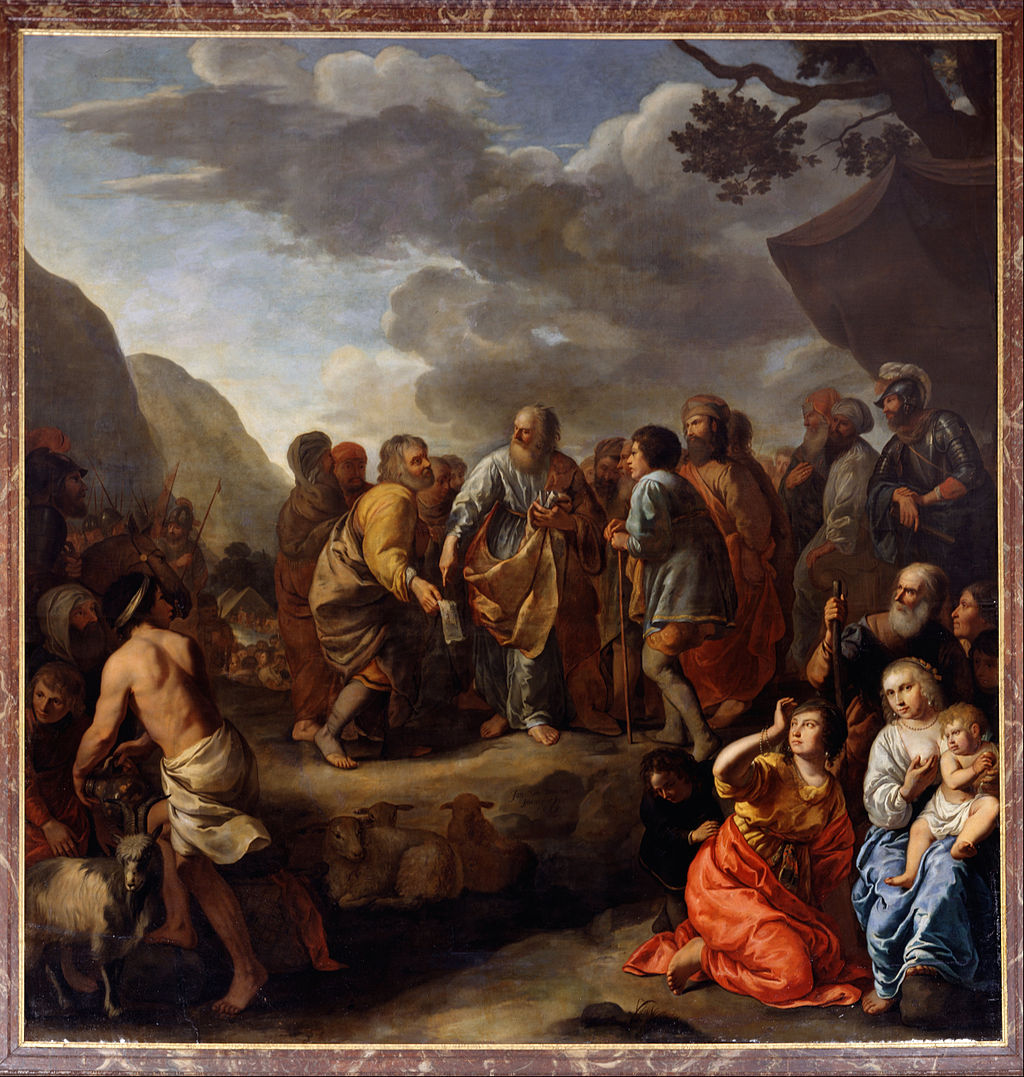
Jan van Bronchorst, Jethro Advising Moses (1659)

Exodus 18: 13-27 Jethro’s Advice to Moses

 13 The next day Moses sat as judge for the people, while the people stood around him from morning until evening. 14 When Moses’ father-in-law saw all that he was doing for the people, he said, “What is this that you are doing for the people? Why do you sit alone, while all the people stand around you from morning until evening?” 15 Moses said to his father-in-law, “Because the people come to me to inquire of God. 16 When they have a dispute, they come to me and I decide between one person and another, and I make known to them the statutes and instructions of God.” 17 Moses’ father-in-law said to him, “What you are doing is not good. 18 You will surely wear yourself out, both you and these people with you. For the task is too heavy for you; you cannot do it alone. 19 Now listen to me. I will give you counsel, and God be with you! You should represent the people before God, and you should bring their cases before God; 20 teach them the statutes and instructions and make known to them the way they are to go and the things they are to do. 21 You should also look for able men among all the people, men who fear God, are trustworthy, and hate dishonest gain; set such men over them as officers over thousands, hundreds, fifties and tens. 22 Let them sit as judges for the people at all times; let them bring every important case to you, but decide every minor case themselves. So it will be easier for you, and they will bear the burden with you. 23 If you do this, and God so commands you, then you will be able to endure, and all these people will go to their home in peace.”

 24 So Moses listened to his father-in-law and did all that he had said. 25 Moses chose able men from all Israel and appointed them as heads over the people, as officers over thousands, hundreds, fifties, and tens. 26 And they judged the people at all times; hard cases they brought to Moses, but any minor case they decided themselves. 27 Then Moses let his father-in-law depart, and he went off to his own country.

Beyond modeling a first commandment faith and a sacrificial worship to God, Jethro brings to the people of Israel and to Moses, its leader, worldly wisdom. Moses has taken the central role in leading the people out of Egypt: he is the spiritual, military, political and legal authority and the one who stands between the people and God. He is the one who everyone comes to for support, legal ruling and whenever there has been a crisis. Already Moses has had to deal with two instances of water related strife, food related anxiety, as well as the people’s first military threat. Now the people are waiting for Moses to address their needs, their internal conflicts and to hear their cries. As Carol Myers states, “Jethro notices more than the supremacy of Israel’s god; he also notices that Israel’s leader is overburdened.” (Myers, 2005, p. 137)

Within this passage we have one of only two places in the first five books of the bible (or torah) where the phrase “not good” is used. Throughout the creation narrative in Genesis one we hear God say repeatedly that is was good, but the only other place where the phrase “not good” is used is Genesis 2: 18 where God says it is ‘not good’ for the man to be alone. (Sacks, 2010, p. 128) Here also it is ‘not good’ that Moses is alone, here he needs appropriate partners for his own good and for the people’s.

The critical task of finding officers, people who can be trusted to hear the people’s concerns and to respond fairly and who are not going to be vulnerable to bribes or coercion makes the life of the people of Israel possible. Here these officers are not given the title of judge, and there are probably several reasons for that. The office of judge in the people of Israel’s history gets developed in the times between Joshua and the time of the kings and the judges are people who lead the people for a time and have more of a Moses-like role than a purely judicial one. Also, throughout the book of Exodus, the people has been referred to in a military manner. Within many military units the commanding officer has legal responsibilities for those who serve under them, for example under the Uniform Code of Military Justice (or UCMJ) which provides the basis for the legal system used in the U.S. Military the commanding officer does hear cases and assign punishment. In disciplinary matter the commanding officers is judge and jury while still being the commander. These people who will mediate the commands and instructions of Moses to the people are foundational to the emerging structure of the people.

Moses role becomes one of intercession, instruction and of finding subordinate leaders. Moses will continue to stand between the people and the LORD their God and this will become an increasingly critical role as the people continue their journey. Moses will also become the teacher of the law that is about to be given as well as interpreting the law to the people. Moses will continue to have to teach the people how they are to live and what they are to do. But Moses cannot do it on his own, he will need multiple leaders to share the burdens and responsibility of leading the people of God. Sometimes this is the hardest task: both finding and trusting these new leaders. I, and many other leaders, struggle with this portion of leadership-with equipping others who will not have the same amount of training and experience that you do. Yet, this worldly advice was deemed important enough by the people of God that it was included within their scriptures.

Making Kylo Ren Believable Again

kylo-ren_fa163069

There were several things the first time I saw Star Wars: The Force Awakens that I struggled with, partially because I have enough of a science background that it bothers me when science fiction ignores the science component, but by the second viewing I was able to relax some of those concerns and enjoy the film a little more. Yet, one of the things that I remarked after seeing Star Wars: The Force Awakens for the first time when it was released in 2015 was that Kylo Ren, the central antagonist was a weak and ineffective villain. While there were elements of the character that I liked. I could appreciate the effort of trying to create a more complex villain than Darth Vader initially appeared in the original trilogy. Yet, the petulant and insecure Kylo Ren just didn’t feel like a figure that could be the type of leader and physical representation of the First Order that Darth Vader was for the Galactic Empire. Scenes where his temper would cause him to lose control and, for example, destroy a whole set of panels on a starship simply because he received news he didn’t want portrayed a person who shouldn’t be entrusted with the level of authority he was invested with. I had trouble believing in 2015 that anyone would give such an instable individual the type of control that Kylo Ren was given over people, resources and place him in a position of being a figurehead for a credible threat.  I need to admit that now in 2017 I was wrong, Kylo Ren became a compelling villain because in 2016 we put a leader in place who displayed many of the same characteristics.

Kylo Ren continually looks back upon an idealized past where his grandfather, Darth Vader, was the figurehead of a strong empire ruled over by a powerful and cruel emperor. The empire’s brand of peace and justice was carried out through military domination and two planet killer weapons of mass destruction ominously called Death Stars. Attempting to live into this legacy and turning away from the legacy of his parents and teachers he becomes a fallen but flawed character. Continually dominated by his emotions, occasionally effective but often erratic, he needs the continual guidance of the ominous Supreme Leader Snoak.

What seemed an unbelievable character in fiction two years ago is far too familiar now. Others may not have seen it during his campaign but I could already tell that Donald Trump did not possess the temperament for the unbelievably challenging task of leading the United States in a complex and evolving world. Yet, Trump too relied upon some idealized version of simpler past that never truly existed the way he imagined it (nor would he ever define when he thought America was great). If a small fractions of the leaks coming out of the White House are true then we can see the result of living with a leader who can react unpredictably to the slightest provocation and appears to be completely involved with his own image and problems unwilling to engage the difficult work of making policy except by twitter and the hastily crafted executive order. The only question remains who is the person behind the scenes attempting to manage the actions of this unpredictable leader-is it the shadowy Steve Bannon or is it the equally sinister Vladamir Putin or maybe Trump really is the wildcard who is uncontrollable and until he is stopped we will continue walking on eggshells wondering what the next day will bring. Regardless it has made one fictional villain more believable to me, perhaps a small consolation but one has to laugh where one can.

Psalm 21- A Blessing for the King

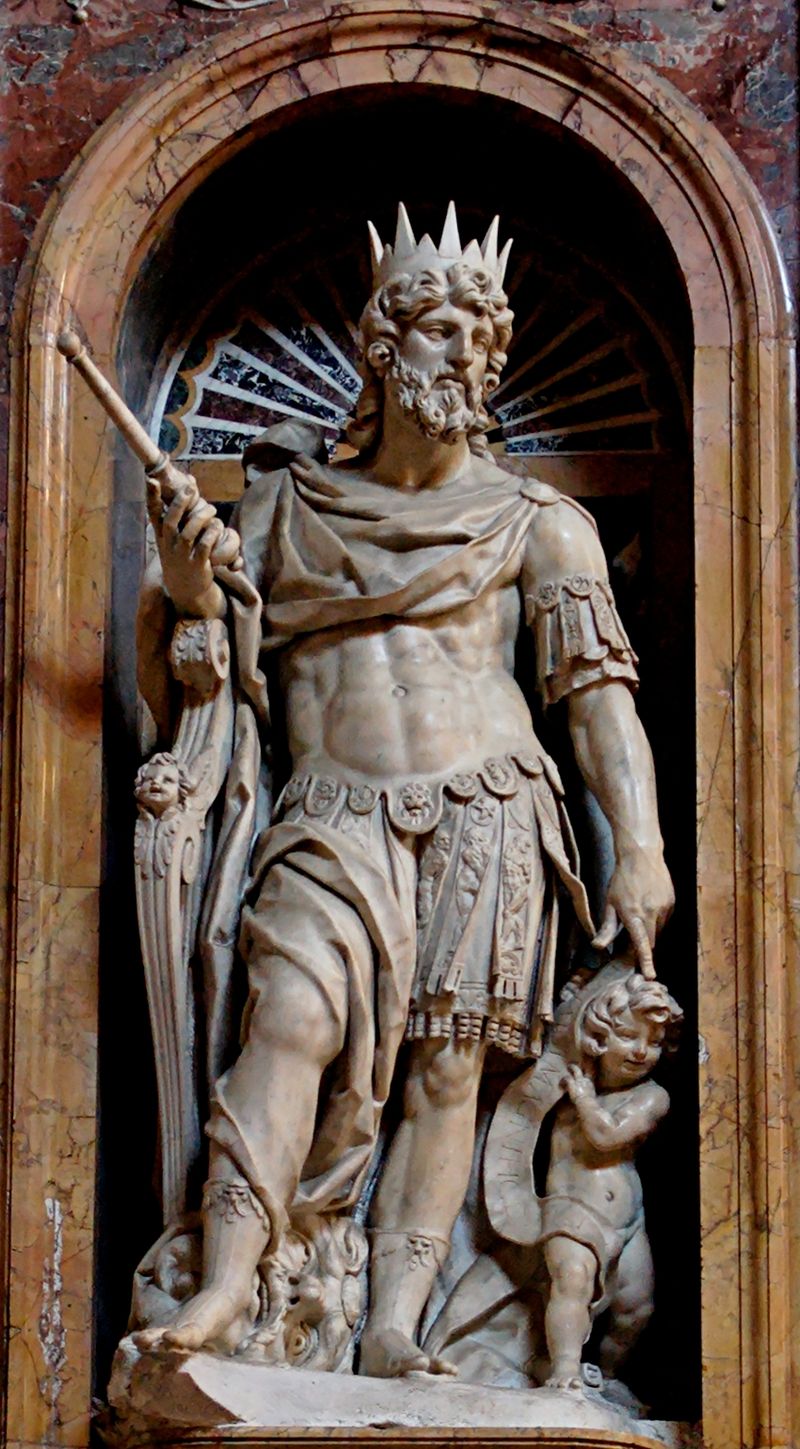
Statue of David by Nicolar Cordier in the Borghese Chapel of the Basilica di Santa Maria Maggiore

Statue of David by Nicolar Cordier in the Borghese Chapel of the Basilica di Santa Maria Maggiore

Psalm 21

<To the leader. A Psalm of David.>
1 In your strength the king rejoices, O LORD, and in your help how greatly he exults!
2 You have given him his heart’s desire, and have not withheld the request of his lips. Selah
3 For you meet him with rich blessings; you set a crown of fine gold on his head.
4 He asked you for life; you gave it to him– length of days forever and ever.
5 His glory is great through your help; splendor and majesty you bestow on him.
6 You bestow on him blessings forever; you make him glad with the joy of your presence.
7 For the king trusts in the LORD, and through the steadfast love of the Most High he shall not be moved.
8 Your hand will find out all your enemies; your right hand will find out those who hate you.
9 You will make them like a fiery furnace when you appear. The LORD will swallow them up in his wrath, and fire will consume them.
10 You will destroy their offspring from the earth, and their children from among humankind.
11 If they plan evil against you, if they devise mischief, they will not succeed.
12 For you will put them to flight; you will aim at their faces with your bows.
13 Be exalted, O LORD, in your strength! We will sing and praise your power.

At first glance we may wonder if this royal Psalm which is all about the relationship between the king’s trust and the steadfast love has to say to our time when we no longer have kings and, other than politically conservative Christians, we are reluctant to declare God’s blessing upon a political candidate. In a world with a flourishing royal establishment, which is the world of the Psalm, it does qualify the king’s leadership. Everything the king, and by extension the people, has received is an extension of God’s rich blessings from the physical crown the king wears to the long life and glory the king receives. It does place the king as the vessel of the Lord’s blessing and not the cause of the blessing itself and perhaps here is a place where some humility, which is easily lost for those tempted with power, can indeed remain. The gifts lifted up here for the king are similar to the gifts that Solomon is said to receive after his request for wisdom in 1 Kings 3. Yet, these gifts are not merely for the king but for the people by extension.

Perhaps one could impertinently state that the Psalm reflects a type of divine trickle-down economics where the king is blessed so that the nation as a whole may be blessed. The people of Israel could not imagine a representative democracy or any other modern system of government. Their frame of reference was that of a monarchy and with its nobles and officials. To pray for the life of the king may seem strange to us but it is a frequent stock petition of the time and as Rolf Jacobson can remind us, “and this blessing was not just for the king but for the nation. Short royal reigns are often symptomatic of nation turmoil, and the common folk were just as likely to suffer in such times as the nobility.” (Nancy deClaisse-Walford, 2014, p. 224) Much of the narrative of the Hebrew Bible about the people of Israel and Judah directly links the health of the nation to the faithfulness of the king in power. It is a strange thought to us who are used to our individuality but in a nation where access to biblical texts as well as literacy would have resided with the priests and the nobles the leadership of the king often set the course for the nation. When the king trusts in the LORD the nation is blessed, when the king (and by extension the people) turn to other gods they also turn away the blessings of their LORD.

The world of Israel and Judah was a dangerous and violent world and conflict was a part of life. Here, like in Deuteronomy 20 it is the LORD who is the primary force when Israel triumphs and not their military prowess or strength. I have discussed in other places the ways in which the use of God as a divine warrior can be a powerful but also a dangerous way of talking about God. Yet in the world of the Psalms it is one of the central ways of referring to God. God is the divine warrior, the shield, the fortress, the rock and many other metaphors of strength that provide comfort for the Psalmist and people of many times and places.

Those called into positions of leadership in our time could benefit from remembering that their calling does not exist to serve their benefits but instead their position is for the sake of the community. As Rolf Jacobson says well:

And the blessings that come with leadership do not exist for the advantage of the leader, but for the sake of the community and for the sake of the world. The kings of Israel and Judah never learned this lesson. And the leaders of today seem to do no better. One is reminded of the old saw that people get elected to Congress in order to do good, but end up doing well. So perhaps Jesus’ warning is still apt: From those to whom much has been given much will be expected. (Nancy deClaisse-Walford, 2014, p. 226)

In our time the final axiom of the quote could almost be reversed, that to those whom much has been given little will be expected. There has been a loss of faith in those elected to political office in our society. At the same time humility seems to be an undervalued trait in those who we tend to elect to positions of authority. Perhaps we have sought the wrong traits in our leaders. Perhaps a leader who is able to understand that the position given to him or her is indeed a gift of God, not in the sense of entitlement but instead in the sense of vocation, could have enough humility, compassion, and gratitude to use their position for the sake of the community, the people and the world. Unfortunately, it often seems that those leaders who claim their Christianity most vociferously seem to be those who view their calling as entitlement to do well instead of doing good.