
Tag Archives: judgment

James 5 Harsh Words for the Rich and Encouragement for the Faithful

Evelyn De Morgan, The Worship of Mammon (1909)

James 5: 1-6

  1Come now, you rich people, weep and wail for the miseries that are coming to you. 2Your riches have rotted, and your clothes are moth-eaten. 3Your gold and silver have rusted, and their rust will be evidence against you, and it will eat your flesh like fire. You have laid up treasure during the last days. 4Listen! The wages of the laborers who mowed your fields, which you kept back by fraud, cry out, and the cries of the harvesters have reached the ears of the Lord of hosts. 5You have lived on the earth in luxury and in pleasure; you have nourished your hearts in a day of slaughter. 6You have condemned and murdered the righteous one, who does not resist you.

James’s rhetoric may be harsh to many modern readers who were raised in a Christianity which has made its peace with the capitalistic and consumeristic culture of the United States. Over a century ago, Walter Rauschenbusch, one of the primary thinkers behind the social gospel movement which attempted to bring faith and action on behalf of the vulnerable together could say that James, “pronounces an invective against the rich which would seem intolerably denunciatory in the mouth of a modern socialist preacher.” (Moore-Keish, 2019, p. 166) Yet, James is not speaking in a language unusual to scripture. James’s language throughout his letter has been in concert with the law, wisdom literature, the prophets, and the teachings of Jesus. That it may seem “intolerably denunciatory” should give us pause. We may not inhabit a situation similar to the early Christians who James is writing to, but the discomfort should cause an honest dialogue about the world and the values we assume. Luke Timothy Johnson asks this question in an existential way when he states:

Perhaps the most serious question for Christianity in the present circumstance is whether it is any longer in a position to exercise the kind of prophetic critique of that outlook such as enunciated by James. Is it not the case that many churches are themselves so co-opted by the logic of envy and arrogance—if not strictly monetary terms, then in terms of membership and influence—that they cannot perceive that such is the way of the wisdom from below, which is earthbound, unspiritual, and demonic? (NIB XII:218)

From the very beginning of the story of Israel they were always intended to embody a different set of values and practices than Egypt and all the following empires of the world that surrounded them. The commandments, statutes and ordinances given to the Hebrew people were to create a society where the vulnerable were cared for. Many of the laws are specifically to limit the acquisition of excessive amounts of property and wealth at the expense of the neighbor. Throughout the letter, James has often referenced topics which mirror the language of Leviticus 19. Once again James speaks in concert with Leviticus 19:

You shall not defraud your neighbor; you shall not steal; and you shall not keep for yourself the wages of a laborer until morning. Leviticus 19:13

Likewise, Deuteronomy also states:

You shall pay them their wages daily before sunset, because they are poor and their livelihood depends on them; otherwise they might cry to the Lord against you, and you would incur guilt. Deuteronomy 24: 14-15

James’s tone is similar to the prophets and a person familiar with the language of the prophets will quickly pick up the language of the ‘day of the LORD’ utilized by the prophets even before the ‘last days’ are mentioned in verse three. Malachi is a good example of this language and in chapter three the oppression of hired workers and the vulnerable is tied with sorcerers, adulterers, and those whose words are false:

Then I will draw near to you for judgment; I will be swift to bear witness against the sorcerers, against the adulterers, against those who swear falsely, against those who oppress the hired workers in their wages, the widow, and the orphan, against those who thrust aside the alien and do not fear me, says the Lord of hosts. Malachi 3:5

Yet, the strongest resonance with this passage is in the words of Jesus:

But woe to you who are rich, for you have received your consolation.Woe to you who are full now, for you will be hungry. “Woe to you who are laughing now, for you will mourn and weep. Luke 6: 24-25

“Do not store up for yourselves treasures on earth, where moth and rust consume and where thieves break in and steal, but store up for yourselves treasures in heaven, where neither moth nor rust consumes and where thieves do not break in and steal. Matthew 6: 19-20

The scriptures may be speaking in the same key, but we may hear this as dissonant in our context. Many people in our time and in James’s time would look at wealth as a positive thing and there is a significant thread in scripture where God does want the people to prosper. Yet, one of the dangers to the health of the community was the acquisition of large amounts of wealth (primarily in the form of land, but also in terms of money) by a few at the expense of the rest of the community, particularly the most vulnerable members of the community. I have said before that in the United States one of our greatest idols is security, the desire to be able to ensure our own future without needing either God or the community. Wealth has become one of the most important ways of keeping score in our society and the acquisition of more wealth is often seen as a goal which surpasses all other goals. James’s counter voice is that the very wealth that we have utilized to attempt to secure our future is corroded and moth-eaten. Our bank balance sheets and acquisitive lifestyles testify against us. Those who lived in pleasure at the expense of their employees, whether landowners who failed to pay the harvester or corporations who increased their earnings while failing to pay a living wage, have now become the Pharoah and his taskmasters who the cries of the laborers testify to God against. And God hears these cries throughout the scriptures.

There has been a lively discussion on the identity of “the righteous one” James references. One common opinion is that the righteous one are the poor among the faithful who are perishing due to the injustice of their world. Another option is that the righteous one is Jesus and that the rich are somehow complicit in the crucifixion. I think it is likely that James is speaking in a manner reflected in Matthew 25: 31-46, where Jesus is met in the face of the vulnerable ones who are seen by the faithful but ignored by the unrighteous. These rich ones may feel like the world is being served to them as an all-you-can-eat banquet, but what James sees is a darker reality for those rich who live at the expense of others. They are like cattle in a feedlot being fattened for the day of slaughter. James believes, in concert with the rest of scripture, that the injustice practiced by the rich and powerful will be answered by God’s judgment.

James’s words are difficult to wrestle with in my context of an affluent suburb of Dallas, Texas but they also are important. We live in a time of increasing disparity between those at the top of the economic ladder and those at the bottom. James’s words will probably never have a hearing among those in our culture who utilize their wealth to manipulate the political or tax system to benefit their own business or bank balance, but these actions, for James, at the expense of the vulnerable in society are a form of violence and murder. For those who claim the letter of James as a part of their scriptures and a witness to faith it presents several challenges. It reminds us that our security is not to be found in laying aside silver, gold, currency or any other type of possession but in the God who hears the cries of the vulnerable. James, like the law and the prophets, sees faith as embodied throughout the entirety of life and that a faith without works on behalf of the neighbor is a dead faith. Most in my community would have been considered wealthy in James’s world, and we often underestimate the gifts we have been given to steward on behalf of the community. The scripture does has positive witnesses to wealth, for example Job mentioned in the next section, but the danger of wealth is that it becomes central to our identity and the score card by which we measure success is that it becomes possible to justify practices which may end up being legalized violence and even murder against the most vulnerable in society.

James 5: 7-12

  7Be patient, therefore, brothers and sisters, until the coming of the Lord. The farmer waits for the precious crop from the earth, being patient with it until it receives the early and the late rains. 8You also must be patient. Strengthen your hearts, for the coming of the Lord is near. 9Brothers and sisters, do not grumble against one another, so that you may not be judged. See, the Judge is standing at the doors! 10As an example of suffering and patience, brothers and sisters, take the prophets who spoke in the name of the Lord. 11Indeed, we call blessed those who showed endurance. You have heard of the endurance of Job, and you have seen the outcome that the Lord brought about, for the Lord is compassionate and merciful.
  12
Above all, brothers and sisters, do not swear, either by heaven or by earth or by any other oath, but let your “Yes” be yes and your “No” be no, so that you may not fall under condemnation.

James now returns to the brothers and sisters of his community to encourage them to stand fast and endure as they await the coming of the Lord. These final two sections are full of proverbs for the community attempting to live faithfully in the world. The world is unjust and there are rich whose actions endanger the vulnerable in the community, but James trusts that God’s judgement is near. Patience may not be the best word for the Greek makrothymia. Translators have suggested endure, persist, withstand, or stand fast as possible alternatives which capture the more active sense of the word. James utilizes two images for endurance in parallel: a farmer waiting on the growing crop and the biblical image of Job. The long wait from planting to harvest would be a part of the life of the majority of people in James’s world and there is a reason for the prevalence of this image throughout the scriptures. This is the only utilization of Job in the New Testament, and Job, like Abraham and Rahab earlier and Elijah in the following section, is utilized as a representative figure for an idea. Job may not have been passive in dealing with his situation in the narrative of Job, but he does endure and the Lord rewarded Job for his endurance.

James echoes the saying of Jesus also reflected in Matthew 5: 33-37. I think many people would long for a world where truthful speech was the norm and one of the struggles of our digitally pluralistic society is that truthful speech may be indistinguishable from partial truths, obfuscations and maliciously told lies. As I think about the issues facing society: immigration, global warming, poverty, discrimination, and many others, it is amazing the number of both conspiracy theories and misinformation that are given equal space to information that is well thought out and accepted by those working in the various fields. Perhaps reflecting on the untruth operating on his own society in the mid-1930s, Dietrich Bonhoeffer could comment in Discipleship:

There is no truth towards Jesus without truth toward other people. Lying destroys community. But truth rends false community and founds genuine fellowship. There is no following Jesus without living in the truth unveiled before God and other people. (DBWE 4: 131)

Yet even churches and communities of faith can easily become places that do not value truth but rather seek either easy accommodation or avoiding controversial topics of conversation. Even organizations that expressly claim to value truth in their mission or value statements may, by their actions demonstrate a preference for a convenient lie.

James and Jesus imagine a world where truthful speech is the norm and God has drawn near. It may take patience to see the fruit of this trust, it may involve the endurance of Job, and yet underlying the faith of Christianity is a God who values truth, who protects the vulnerable, and judges the unrighteous. James attempts to strengthen his brothers and sisters scattered throughout the world who are attempting to live truthfully and persistently awaiting the promised harvest of God’s fields.

James 5: 13-20

  13Are any among you suffering? They should pray. Are any cheerful? They should sing songs of praise. 14Are any among you sick? They should call for the elders of the church and have them pray over them, anointing them with oil in the name of the Lord. 15The prayer of faith will save the sick, and the Lord will raise them up, and anyone who has committed sins will be forgiven. 16Therefore confess your sins to one another and pray for one another, so that you may be healed. The prayer of the righteous is powerful and effective. 17Elijah was a human like us, and he prayed fervently that it might not rain, and for three years and six months it did not rain on the earth. 18Then he prayed again, and the heaven gave rain, and the earth yielded its harvest.
  19
My brothers and sisters, if anyone among you wanders from the truth and is brought back by another, 20you should know that whoever brings back a sinner from wandering will save the sinner’s soul from death and will cover a multitude of sins.

James continues with a set of final proverbs to encourage the community in their journey. Prayer is an overarching theme of the verses thirteen through eighteen and it is both the prayers of the individual and the community which enter James’s reflection. The suffering ones should pray, and asking God for what is necessary has appeared as a topic previously in James (1:5,6; 4: 2-3). It is likely that both the suffering and the cheerful are undergoing some struggles and it may be that in some cases the suffering are those who have not ‘taken courage’ while the cheerful have (McKnight, 2011, p. 433) but there will always be those whose suffering is more acute and those whose troubles are lighter. The individual may pray or sing songs of praise based on their circumstances, but the community also has a role in helping those in need. Those who are sick or carrying sins are to call the elders in the community. Much like the friends who carried the paralytic to Jesus (Mark 2: 1-12 and parallels) the elders carry the sick body or the sin sick soul to God that it may be healed. The fact that James can appeal to four people from the story of Israel (Abraham, Rahab, Job, and now Elijah) may be related to the Jewish nature of his community. Paul, whose primary audience was Gentile, can appeal to Abraham and Adam, universal figures, but James may have a fuller catalog of faithful figures he can reference by name and have a story associated with them. (Moore-Keish, 2019, p. 195) Elijah is portrayed as a character whose faithful witness and prayer did incredible things like the three and a half years without rain or the raising of the widow’s son. Yet, Elijah is also ‘human like us.’ In prayer the incredible things of Elijah are accessible to the faithful one asking for God’s healing or forgiveness for a member of the community.

The God who James witnesses to is a God who desires the return of the wanderer. James’s letter may continue to reference Leviticus 19:

 “You shall not hate in your heart anyone of your kin; you shall reprove your neighbor, or you will incur guilt yourself. Leviticus 19:17

Or may be following Proverbs, “Hatred stirs up strife, but love covers all offenses.” (Proverbs 10:12) or simply the desire of God expressed throughout the law, the prophets, the story of Israel, the psalms, and the words of Jesus that express the desire for the prodigal people to return to their God. There is always a place for redemption among the people of God. As Jesus said after the parable of the lost sheep, there is more joy in heaven over one sinner repenting than over ninety-nine righteous people who have no need of repentance (Luke 15:7).
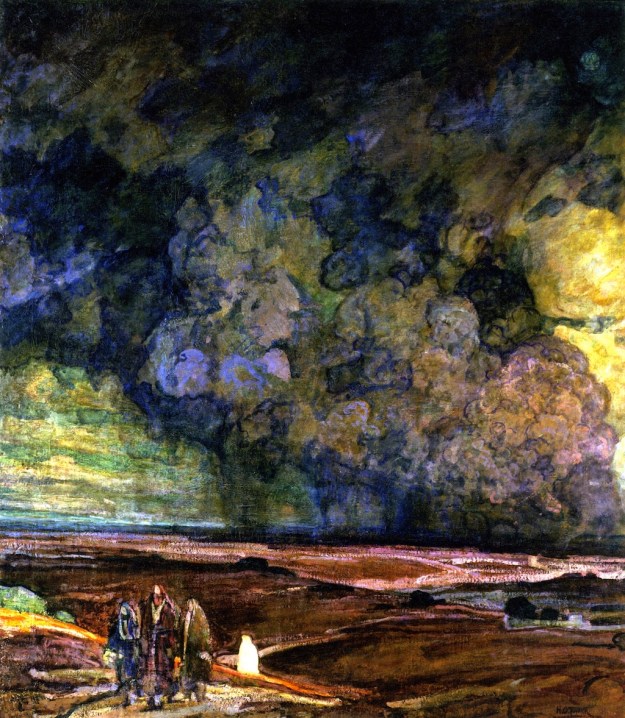
Psalm 53 Reflecting Again on the Unjust

Herny Ossawa Tanner, Sodom and Gomorrah (1920)

Psalm 53

To the leader: according to Mahalath. A Maskil of David.
1 Fools say in their hearts, “There is no God.” They are corrupt, they commit abominable acts; there is no one who does good.
2 God looks down from heaven on humankind to see if there are any who are wise, who seek after God.
3 They have all fallen away, they are all alike perverse; there is no one who does good, no, not one.
4 Have they no knowledge[1], those evildoers, who eat up my people as they eat bread, and do not call upon God?
5 There they shall be in great terror, in terror such as has not been. For God will scatter the bones of the ungodly; they will be put to shame, for God has rejected them.
6 O that deliverance for Israel would come from Zion! When God restores the fortunes of his people, Jacob will rejoice; Israel will be glad.

When I was putting together my first collection of poems to publish, Creative Words, I almost included the same poem twice. It made it through several edits by me and two editors who looked at the work. In one of my final times working through edits I discovered the duplication. I share this story because Psalm 53 is a close twin of Psalm 14, which may seem incredible when one considers that these ancient texts had to be hand copied, but in a large collection it is easy to forget what one has previously included in the collection. There are some differences, Psalm 53 indicates that it is ‘according to the Mahalath’ which probably indicates the tune or melody for the Psalm and this Psalm, unlike its twin, uses the generic ‘Elohim’ (God) throughout instead of the name of God (often indicated as LORD in English translations). Even though the poem mainly follows its twin there are some additional subtle changes that make it worth treating independently and its placement within this portion of the Psalter helps give some additional insights into reading the Psalm.

In the worldview of the ancient Middle East there is no concept of a world without God or gods but here we encounter one who functions as a practical atheist. In Hebrew, the heart is the seat of will and decision making, and so the one who says in their heart ‘There is no God’ chooses to live in a way that assumes that God or gods will not intervene in their life. The fool here is not unintelligent but instead acts in a way that does damage to the community. The lack of wisdom here is acting in a way that neglects the commitments to the community as described in the law, and instead choosing a way of life that views people as a consumable commodity that can be consumed as easily as bread. These foolish and perverse ones may be within the people of God, or they may be from other nations who are imposing their practices upon the chosen people, but the damage done by this godless lifestyle calls out for judgment.

This foolish humanity which the Psalmist finds themselves surrounded by creates an inhospitable world. The image of God looking down from heaven seeking the wise ones who live according to justice and finding only fallen, perverse evildoers who practice this metaphorically cannibalistic injustice echoes the story of the LORD’s journey to Sodom and Gomorrah. The LORD encounters hospitality from Abraham but goes to investigate the outcry of inhospitality and injustice from these towns which become synonymous with the judgment of God upon these unethical fools. The story of Sodom (Genesis 18: 16-19:29) is frequently misunderstood as being about God’s judgment on homosexuality, but what the story reflects is a society that does not practice hospitality to strangers and sees those strangers, and even residents, as resources to be exploited. The LORD was willing to accede to Abraham’s request not to destroy the city if ten righteous are found within this community, but the divine figures in the story[2] only find Lot who is willing to practice hospitality in this inhospitable place. Many modern people are uncomfortable with these stories of God judging these communities, but the faith of the Psalmist relies upon a God who does judge and does not allow for injustice to continue forever.

The Psalmist trusts that those who live this foolish life will eventually be shamed, rejected, and experience the terror that they have inflicted on others. Unlike the wise who are buried when they die, these foolish ones have their bones scattered and they lie forgotten in the earth. Perhaps the Psalmist envisions a judgment of those who have ‘eaten the people like they eat bread’ like the one associated with Sodom. Regardless of what form the judgement takes, they believe in a God who is an executor of justice and a protector of the community from these godless ones who corrupt the earth. The times of misfortune for the wise ones who live according to the covenant are temporary. The righteous can commit the judgment of the foolish injustice which dominates their world to their God who will bring about deliverance.

[1] The knowledge here is probably closer to the French word connaître, which refers to the knowing of a person rather than the knowing of a fact. As Beth Tanner notes the word is an active verb and the activity of ‘not knowing’ is active rather than passive. (Nancy deClaisse-Walford 2014, 465) This would be more active than the NRSV’s ‘Have they no knowledge.’ These evildoers actively choose not to enter into the relational knowing of God.

[2] The actors change between men at the beginning of Genesis 18, to the LORD who speaks to Abraham and finally to angels who arrive in Sodom.

Matthew 18: 21-35 A Forgiving King and Community

By Domenico Fetti – The Yorck Project (2002) 10.000 Meisterwerke der Malerei (DVD-ROM), distributed by DIRECTMEDIA Publishing GmbH. ISBN: 3936122202., Public Domain, https://commons.wikimedia.org/w/index.php?curid=150920

Matthew 18: 21-35

21 Then Peter came and said to him, “Lord, if another member of the church sins against me, how often should I forgive? As many as seven times?” 22 Jesus said to him, “Not seven times, but, I tell you, seventy-seven times.

23 “For this reason the kingdom of heaven may be compared to a king who wished to settle accounts with his slaves. 24 When he began the reckoning, one who owed him ten thousand talents was brought to him; 25 and, as he could not pay, his lord ordered him to be sold, together with his wife and children and all his possessions, and payment to be made. 26 So the slave fell on his knees before him, saying, ‘Have patience with me, and I will pay you everything.’ 27 And out of pity for him, the lord of that slave released him and forgave him the debt. 28 But that same slave, as he went out, came upon one of his fellow slaves who owed him a hundred denarii; and seizing him by the throat, he said, ‘Pay what you owe.’ 29 Then his fellow slave fell down and pleaded with him, ‘Have patience with me, and I will pay you.’ 30 But he refused; then he went and threw him into prison until he would pay the debt. 31 When his fellow slaves saw what had happened, they were greatly distressed, and they went and reported to their lord all that had taken place. 32 Then his lord summoned him and said to him, ‘You wicked slave! I forgave you all that debt because you pleaded with me. 33 Should you not have had mercy on your fellow slave, as I had mercy on you?’ 34 And in anger his lord handed him over to be tortured until he would pay his entire debt. 35 So my heavenly Father will also do to every one of you, if you do not forgive your brother or sister from your heart.”

This parable is unique to Matthew’s gospel but is well known as the parable of the unforgiving servant (or slave). In the individualistic culture of modernity it is natural that we focus primarily on this one slave who has an incredible debt forgiven, but the placement of this parable within a chapter that is focused on forgiveness and reconciliation within a community setting should alert us that something beyond an individualistic interpretation which neglects the surrounding community is insufficient. In Matthew individual actions and communal responsibility go together just like forgiveness of sins/trespasses and the forgiveness of economic debts. We have already seen Jesus model for the disciples in Matthew 6: 12-15 where in the Lord’s prayer the disciple asks for God to “forgive us our debts, as we also have forgiven our debtor.” And follows this with, “For if you forgive others their trespasses, your heavenly Father will also forgive you; but if you do not forgive others, neither will your Father forgive you.” In response to Peter’s question about forgiveness these statements are given narrative form in the parable.

Peter’s question, narratively prompted by the practices of reconciliation with a member of the community of Christ who sins against another member, about the limits of forgiveness and Jesus’ response about the expansiveness of forgiveness provide the foundation for the world of the parable. Peter’s question of limits is a practical one in discerning when a fellow member of the community is beyond redemption, when a lost sheep should remain lost of a fellow member be perpetually condemned as a Gentile and tax collector. Jesus’ answer invokes the figure of Lamech and stands in direct opposition to Lamech’s way of retaliation:

Lamech said to his wives: “Adah and Zillah, hear my voice; you wives of Lamech listen to what I say: I have killed a young man for wounding me, a young man for striking me. If Cain is avenged sevenfold, truly Lamech seventy-sevenfold.” (Genesis 4: 23-24)

Lamech, the descendant of Cain, responds to violence with greater violence, Jesus responds to sin and violence with the offer of forgiveness and reconciliation. As David Garland can state, “Under Lamech there was no limit to hatred and revenge; under Moses it was limited to an eye for an eye, a tooth for a tooth, a life for a life; under Jesus there is no limit to love, forgiveness, and mercy.” (Garland, 2001, p. 197)

Entering the parable, we have the kingdom of heaven placed alongside a king settling accounts with his slaves. Although the slavery imagined in this parable is different from slavery as it was practiced in the United States, the people ordered by the king are not merely servants who are bound by an economic arrangement that either party could terminate. The slave, their relationships and their property are ultimately the property of this king who has the power, as we will see in the parable, to dispose of as he sees fit. On the other hand, this king delegates incredible economic authority, and presumably power as well, to the first slave in particular. In settling accounts (literally settling words) with the slaves of the king only one debtor is significant enough to bear mention for the story. We can become fixated on how to communicate the value of 10,000 talents, but both the word for 10,000 is like seventy times seven, a number too high to account for and the unit of measure, a talent, is too large for most of Jesus’ hearers to ever possess. As M. Eugene Boring can state:

A talent is the largest monetary unit (20.4 kg of silver), equal to 6,000 drachmas, the wages of a manual laborer for fifteen years. “Ten thousand” (mupia,j myrias, “myriad”) is the largest possible number. Thus the combination is the largest figure that can be given. The annual tax income of Herod the Great’s territories was 900 talents per year. Ten thousand talents would exceed the taxes for all of Syria, Phoenicia, Judea, and Samaria. The amount is fantastic, beyond all calculation. (NIB VIII: 382)

For Matthew debt and sin are closely related and so it is a short jump from a question of forgiveness of sin to a narrative where an unpayable debt is owed and forgiveness is granted on account of compassion and mercy. In the narrative the king is entitled to sell of the slave, his family, and his possessions to regain as much of the impossible amount that this slave is unable to pay back. The slave prostrates himself and asks for patience, the king responds with compassion and grants a release from the loan and from the impending punishment of himself and his family.

The first slave forgiven the impossible debt then encounters another slave who is indebted to him for a realistic and repayable amount (1/600,000 of the forgiven debt if one wants to be literal). The violence of the forgiven slave’s action towards the debtor where he grabs him and is choking him as he makes his demand for repayment stands in contrast to the king’s summoning. While in the world of court political intrigue where the forgiven slave is attempting to reassert power over his subordinates may make sense in a normal kingdom (Carter, 2005, p. 373) it is anathema to the kingdom of heaven. It is helpful to remember that a parable is a narrative world based upon but not dependent upon a concrete reality, a real king or an earthly kingdom. The forgiven slave claims a power the king did not use initially, the power of violence and threat, the power to imprison and demand. The still indebted and choked slave responds to the assaulting slave with the exact stance and words used before the king, asking not for forgiveness but time. Yet, this former debtor shows no patience or mercy to the current debtor. Instead he imprisons him, perhaps to demonstrate his own power or to sooth his own ego. Regardless of the reason it impacts the community of those who serve the king.

The community knows what has happened in its midst, it grieves exceedingly the violence and injustice done to one of their own. In their grief they report it to their lord, hoping that their lord will intervene. The slaves of the king are heard and noticed, and this type of activity within the king’s reign, especially in light of the previous forgiveness, is unacceptable. The king’s will is to show mercy and to have mercy shown (perhaps a strange king but what normal king is like the kingdom of heaven). It is necessary to forgive others as one has been forgiven in this community. The forgiven slave may have a claim on the slave indebted to him, but the king of both has the final claim. The king finally responds to the previously forgiven slave in the same manner he responded to his debtor.

Some modern interpreters and many modern Christians are troubled by a God who judges. We may either believe in the distant god of modernity which is an unmoved mover, or we may imagine a god whose love excludes punishment of any kind. Neither of these gods are the God we encounter in scripture. God does take sides and God does judge and this is a corollary of God’s love for God’s people and the creation not in opposition to it. A community committed to reconciliation and doing the hard work of advocating and including lost sheep, Gentiles and tax collectors and debtors is an alternative to the ways of power in the world. The kingdom of heaven is not like a regular king, but a forgiving one. At the same time, it is still better for a millstone to be hung around the neck of those who place barriers for the little ones of the kingdom for God judges what the community cannot. The community of Christ may have the hard work of binding and loosing on earth, and God values that work, but it is always directed towards a community of forgiveness and mercy. Just as Christ is present where two or three are gathered, so the community’s cries when an individual or group does not practice forgiveness are heard by their heavenly Father. There is an edge to God’s dwelling with the community that does not practice the life God calls them to. This is the edge in the prophets’ voices as they spoke to Israel when they did not live in accordance with God’s covenant for them and this is the edge of the parable when a community or individual does not forgive as they have been forgiven.


Matthew 7: 1-6 Nonjudgmental Righteousness

Sermon on the Mount by Carl Bloch (1877)

Matthew 7: 1-6

Parallels Mark 4: 24-25; Luke 6: 37-42

1 “Do not judge, so that you may not be judged. 2 For with the judgment you make you will be judged, and the measure you give will be the measure you get. 3 Why do you see the speck in your neighbor’s eye, but do not notice the log in your own eye? 4 Or how can you say to your neighbor, ‘Let me take the speck out of your eye,’ while the log is in your own eye? 5 You hypocrite, first take the log out of your own eye, and then you will see clearly to take the speck out of your neighbor’s eye.

6 “Do not give what is holy to dogs; and do not throw your pearls before swine, or they will trample them under foot and turn and maul you.

There is a rhythm that underlies the Sermon on the Mount where the individual pieces, which are so often broken apart, attempt to flow together to form a linguistic and thematic resonance. There is a necessity to the practice of addressing things in smaller pieces but I do think it is important to hear the resonance of “Do not judge, so that you may not be judged” with “blessed are the merciful, for they will receive mercy” or the imperatives of reconciliation and peacemaking outlined in the interpretation of the commandments and the imperative in the Lord’s Prayer to “forgive us our debts, as we also have forgiven our debtors” and its restatement on forgiving trespasses and finally doing to others as you would have them do to you. This has the rhythm of wisdom literature which tells us to make the wise, or perhaps the whole/complete/authentic choice, in contrast to the hypocritical/inauthentic/self-righteous or pious choice. The Sermon on the Mount, and Matthew’s Gospel in general, is a tightly composed unit that needs to be heard and practiced together.

Matthew uses the terms hypocrite, hypocrites and hypocrisy more than the rest of the Bible combined, we saw it used three times in chapter six and again here. This is an important term for Matthew since it differentiates the practice Jesus is calling his disciples to in contrast with the practices of other groups. In the Sermon on the Mount the focus is on righteousness as it is practiced in the community, but within the individualistic way of hearing scripture most modern people use it is easy to transform communal practices of righteousness into individual acts of piety and instead of being those who hunger and thirst for righteousness who will be filled (see Matthew 5: 6) we attempt to become those whose practices of piety fill ourselves with our own self-righteousness. When righteousness is reduced to piety we find ourselves among those who Jesus has previously called hypocrites (see chapter 6) and here when we judge others by the standards we set we may be unaware (willfully or unwilfully) of out own failure to seek justice and righteousness.

When we talk about not judging so that we are not judged, we are not negating everything that has been discussed previously. We know that unreconciled anger, uncontrolled sexuality, broken relationships, untrue speech, violence and love for a limited group of people and excludes enemies are contrary to the kingdom of heaven. Exchanging piety for righteousness or attempting to secure our own future instead of trusting in God’s providence are contrary to the wisdom which is offered in these words. On the one hand there is truth to scholars who make this passage about not placing ourselves in the place of God and condemning a person or group as outside of the kingdom of heaven, but my worry about this type of interpretation is that it limits the way refraining from judging is not only about salvation/damnation matters. Matthew’s Sermon on the Mount is about imagining a community where relations are key to righteousness.

The parable of the person with a log in their eye also points to the reality that we often judge others most harshly in the areas we are least secure. Judgment is often a tool people use to compare themselves to another and to prop us their own insecurity as the critique another. Like Luke’s parable of the Pharisee and the tax collector where the Pharisee compares himself to the other by saying, “God, I thank you that I am not like other people: thieves, rogues, adulterers, or even like this tax collector.” (Luke 18: 11)which is lifted up as an example of how the disciples are not to trust in their own practices, this humorous visual of a person with a log in their eye is used to highlight the lack of self-awareness of the situation of the judging one.  Instead of comparison we are invited throughout the Sermon on the Mount to practice forgiveness and reconciliation, to value even those who we may have called enemies previously, and to learn to value the other person as a worthy part of the community.

Yet, a certain type of judgment, or perhaps better discernment, is necessary in our relations with others. The kingdom of heaven that the Sermon on the Mount proclaims encounters the kingdom of the world, not completely eliminating it. The individuals in the community may have those who label them as enemies or dangers. The community may love, pray and forgive others but it also doesn’t place the holy and precious among those who will reject or destroy it. The righteousness the community is to practice is not only practiced in a perfect world free from those who practice different values. How to be the salt of the earth and the light of the world in among others who may not value that role calls for wisdom among the people of God.

Living Brave Semester Week 3- Speaking Back to The Gremlins

Stripe

The discussion this week on empathy and self-compassion takes me back to the tension between by competent, competitive and driven side and the gracious side of me that is willing to be self-compassionate and fair with myself. I have worked for several years on learning to be more gracious with myself and others and a part of this struggle is wrestling with those internal gremlins that point out all the places where I have fallen short, where I have not lived up to my own expectations (as unrealistic as they sometimes are) or I have perceived my own weakness. It wasn’t surprising that when I took the Self Compassion inventory designed by Kristen Neff that my two highest (negative) scores were on self-judgment and isolation. When I feel weak or like I have failed the internal gremlins interpret my own actions in the worst possible light. Even though I am normally a very confident person, in those moments I do tend to isolate myself until I can get past the messages in my head. Recently I’ve learned how to speak back and to lean into that gracious side of my values to get to a more honest place with myself.

I had an experience last week where I was dealing with several frustrations and my language towards myself was becoming accusing and settling into the patterns of self-judgment that I learned at some point in my past. I was getting ready to go into an event where I would have to do a lot of mingling and introducing myself to people I didn’t know, initiating conversations and all of these energy intensive things were coming at a place where I was already exhausted by the trials of the day. I had worked through the issues, I had a solution, but I was frustrated, I knew that the solution in a different situation could have been easier and cheaper and my internal gremlins were comparing the action with the best possible solution and, of course, I was being measured and found wanting. I sat down and began to write out the things I was saying to myself and the accusations I was making and then I responded to them. My responses were from a place that I would speak to another person, how I would respond to them telling me these things after working through the same situation. That helped to me to hear a more gracious voice and to acknowledge that in a situation with a lot of stress away from home I had worked out a solution. I had reached out and sought help, something difficult for me to do, and the process of working through those feelings in a kinder way helped me be in a better place to engage the day. It also helped make clearer the number of issues that I was wrestling with and how in many ways I was already in a place where a lot of healing was occurring.

I will probably always be hard on myself. I will probably always have those critical questions come up and attack me at the points when I feel weak, but part of my own practice of self-compassion is learning to speak back to the questions. To not allow my drive for competence to lose the value of being gracious to myself and others. To embody this in the practice of writing down and responding to these questions in a way that is more grace filled and realistic. I’ve learned how to be empathetic with others and I am learning better how to be more empathetic with myself.