Category Archives: Biblical Reflections

Revelation 2 The Messages to the First Four Churches

Revelation 2: 1-7 The Message to Ephesus

1 “To the angel of the church in Ephesus write: These are the words of him who holds the seven stars in his right hand, who walks among the seven golden lampstands:

 2 “I know your works, your toil and your patient endurance. I know that you cannot tolerate evildoers; you have tested those who claim to be apostles but are not, and have found them to be false. 3 I also know that you are enduring patiently and bearing up for the sake of my name, and that you have not grown weary. 4 But I have this against you, that you have abandoned the love you had at first. 5 Remember then from what you have fallen; repent, and do the works you did at first. If not, I will come to you and remove your lampstand from its place, unless you repent. 6 Yet this is to your credit: you hate the works of the Nicolaitans, which I also hate. 7 Let anyone who has an ear listen to what the Spirit is saying to the churches. To everyone who conquers, I will give permission to eat from the tree of life that is in the paradise of God.

The next two chapters are made up of seven messages to the seven churches of Asia. While each message is directed to a specific church dealing with specific challenges these messages also allow the reader to see their own community in light of the struggles and triumphs of these churches. Each message shares a basic pattern:

Introduction
Commendation
Reproof
Call to repent
Commendation for resistance to false messages
Conclusion/Promise

All these cities shared a number of common features being a part of the Roman empire: they all had populations that mixed Romans, Greeks, and Jewish populations as well, all the Christian groups in these cities were small minorities in a sea of polytheistic religious practices including the worship of the emperor who had to navigate life in a complex world where society and religion were closely intermingled, and all of these cities were dependent on their connection to Rome for trade and it was common for local leaders to attempt to pay tribute to Rome. Contrary to what many people would guess, worshipping of the Roman emperor as a ‘god’ or a ‘son of a god’ seems to have emerged not in Rome but in the provinces where local officials were attempting to demonstrate their loyalty and curry favor with the empire.
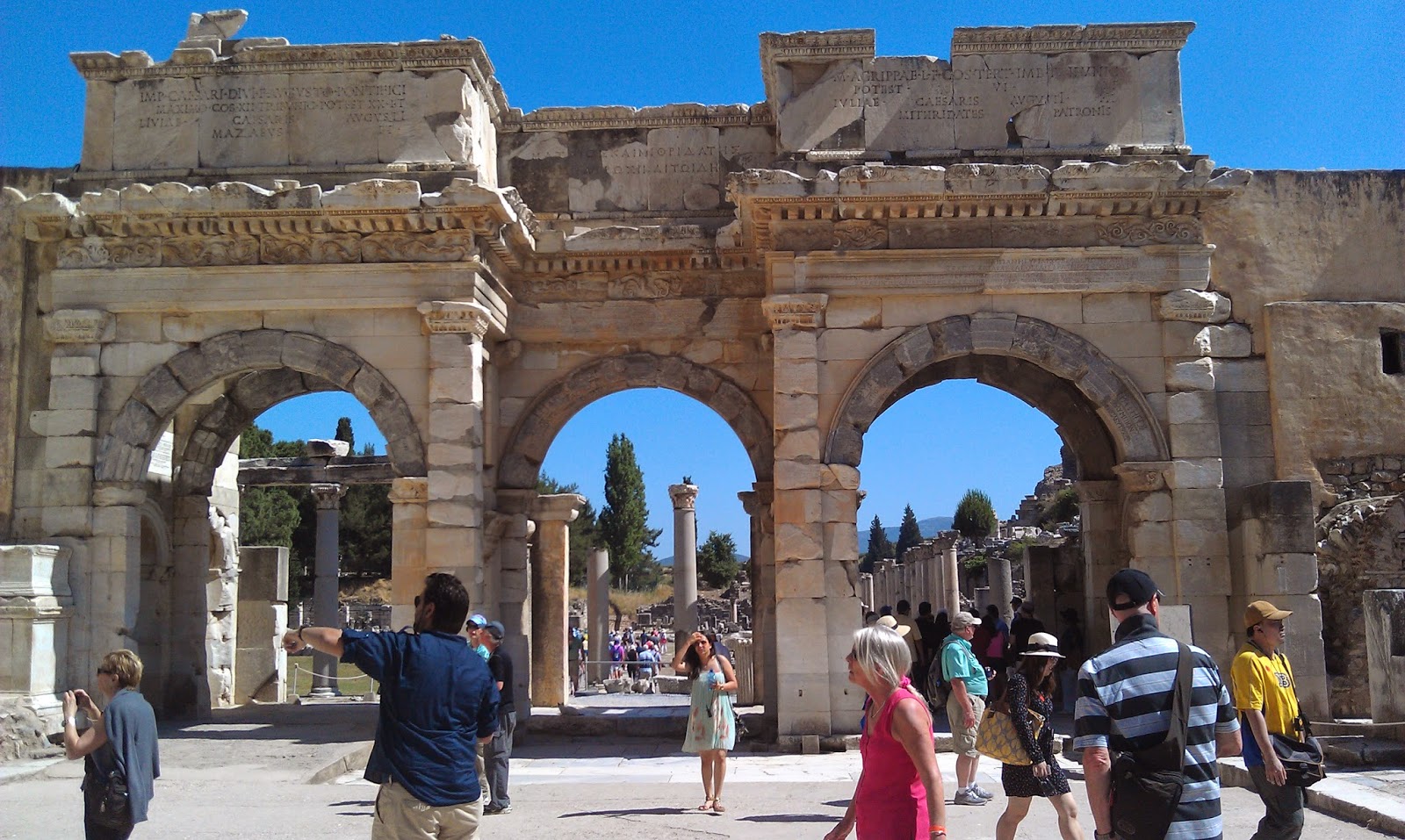
Monumental Gate in Ephesus dedicated to Emperor Caesar Augustus, son of god and high priest and the members of his family By Hawkeye58, CC BY-SA 3.0, https://commons.wikimedia.org/w/index.php?curid=3669323

Ephesus was a port city that relied upon trade. Artemis was one of the major deities worshipped in Ephesus and often being a part of a trade in the ancient world was associated with a temple. When Acts 19 relates the story of Paul being in Ephesus we can see the connection between the trade of the silversmiths, the temple of Artemis and the way in which Paul’s message was viewed not only as a different religious sect but a challenge to the economy of the city and was enough to cause a riot. Ephesus was also a port where slaves were traded along with all other forms of commerce.

In the introduction to the message of the church in Ephesus’ angel we are directed back to the image of Christ which John initially sees in Revelation 1, the seven stars and seven lampstands. The church in Ephesus is commended for its discernment between true and false apostles and their endurance in their allegiance to Jesus. Craig Koester suggests that where they have fallen is related to this: “the problem seems to be that their opposition to false teachers has led to a loss of love for other believers. Therefore, the Ephesians are called to do the work they did at first, which would have been acts of service for others.” (Koester, 2014, p. 269) This is one of the challenges Christians of many times have had to deal with. It is too common for communities that become rigid in their boundaries to become suspicious and hostile to outsiders, but Christian communities were to be communities of hospitality, service and love and yet remain true to their commitments to the gospel in a pluralistic world. They are called to repentance, to turn back to their first love and if they fail to repent they ultimately will fail to be church. The image of their lampstand being removed also means that the community has been symbolically removed.

The Nicolaitans are mentioned for the first time here. We don’t know much about this group. It is often conjectured that they were willing to eat meat offered to idols, like some of the believers Paul addressed at Corinth (1 Corinthians 8). This educated guess makes sense in a world where meat was often available at festivals (in a world before refrigeration most times when you ate meat would be at festivals and almost every festival in the ancient world would have religious aspects). Ultimately the Nicolaitans probably advocated for a less distinctive Christianity where people could still partake in the public events and trade groups associated with local and Roman customs, authorities and powers. To John this level of accommodation betrays their allegiance to the one who holds the seven stars and seven lampstands.

In the conclusion we have the first use of one of Revelation’s favored words: conquer (Greek nikao). This word has aspects of conquering in military, sporting and in the terms of remaining faithful and it will be important to watch how Revelation redefines this term in light of Christ victory (conquest). This Greek word is probably best known today in its use by the giant athletic shoe and clothing company and cultural icon Nike. Those in Ephesus are commended to conquer in light of Christ’s conquest which comes through love and steadfastness. If they conquer they are promised to eat from the tree of life which is mentioned in Genesis 3 and reappears in Revelation 22.

Revelation 2: 8-11 The Message to Smyrna

 8 “And to the angel of the church in Smyrna write: These are the words of the first and the last, who was dead and came to life:

 9 “I know your affliction and your poverty, even though you are rich. I know the slander on the part of those who say that they are Jews and are not, but are a synagogue of Satan. 10 Do not fear what you are about to suffer. Beware, the devil is about to throw some of you into prison so that you may be tested, and for ten days you will have affliction. Be faithful until death, and I will give you the crown of life. 11 Let anyone who has an ear listen to what the Spirit is saying to the churches. Whoever conquers will not be harmed by the second death.

The second message to the church in Smyrna is shorter and reflects a different situation for the church being addressed. The church in Smyrna is undergoing affliction and poverty yet their faith seems to be strong. Their steadfastness in this cultural has probably had an economic cost, but instead of storing up treasures on earth this community seems to have placed their riches in heaven where neither moth nor rust consume (Matthew 19-21). They have resisted assimilation into the ways of the empire and local culture. They may also be experiencing conflict with the Jewish community or Christians that have argued for retaining the practices of the Jewish law.

As mentioned above trade in the ancient world was also linked with both religious and political practices that many early Christians may have found troubling. There was no separation of church and state like we can discuss in modern times. Successful merchants were expected to show patronage to both the civic projects which would pay homage to the Roman empire and to show their devotion to the appropriate deities for their trade. Christians and Jews both would have resisted this. Jews within the empire were known and had some level of protection for their practice. Within the Roman empire, with its emphasis on piety, security, concord and peace, there were many who were intrigued by a religion like Judaism with its focus on the law. As Christianity and Judaism begin to move farther apart in this period the early Christians probably lost the shelter of being known as a Jewish movement and may have encountered animosity from Jewish people not wanting to be associated with what was perceived as a heretical and dangerous movement.

The term ‘synagogue of Satan’ sets up an opposition between the ‘congregation of the Lord.’ In Revelation’s time the conflict was fresh and the early Christians were a very small group within the empire. There probably was some sense of betrayal by those in the synagogues over their exclusion or perhaps even identification to authorities. Yet this term has an unfortunate history within the church. The church would in the span of two centuries move from being a small group sometimes actively persecuted within the empire and other times excluded from commerce and the broader society to an accepted and eventually the official religion of the empire. The church as a power within Roman and other societies would use this and other passages in the New Testament as justification for their later persecution of the Jewish people. The connection of the church and the synagogue would be lost only to be recently appreciated again.

This message is one of encouragement for a community either enduring or about to endure hardship. John mentions imprisonment as a part of the suffering they will endure and to remain faithful until death. In documents shortly after Revelation’s composition we start to see the early church writing about early martyrs like Polycarp, Perpetua, Felicity, Ptolemaeus and many others. Their steadfast witness would become an important illustration of the content of their hope. Those who conquer will be given the crown of life, and perhaps they will see themselves among the elders casting their crowns before the throne. The resurrection was central to the hope of the early church and the witness of those willing to be faithful unto death gave a new meaning to the word which is translated as witness (martyr). In light of the militaristic images throughout much of Revelation we see now the church in Smyrna addressed like soldiers going into battle, and yet their conquering will not be through taking other lives but in the willingness to give up their own on the model of Christ.

Revelation 2: 12-17 The Message to Pergamum

12 “And to the angel of the church in Pergamum write: These are the words of him who has the sharp two-edged sword:

 13 “I know where you are living, where Satan’s throne is. Yet you are holding fast to my name, and you did not deny your faith in me even in the days of Antipas my witness, my faithful one, who was killed among you, where Satan lives. 14 But I have a few things against you: you have some there who hold to the teaching of Balaam, who taught Balak to put a stumbling block before the people of Israel, so that they would eat food sacrificed to idols and practice fornication. 15 So you also have some who hold to the teaching of the Nicolaitans. 16 Repent then. If not, I will come to you soon and make war against them with the sword of my mouth. 17 Let anyone who has an ear listen to what the Spirit is saying to the -churches. To everyone who conquers I will give some of the hidden manna, and I will give a white stone, and on the white stone is written a new name that no one knows except the one who receives it.

The third message is addressed to the church in Pergamum and it has a two-sided message of encouragement and repentance. They are living in a culture that is opposed to the Lordship of Christ and in Antipas we see evidence of the only person in these messages who has been killed for his faith at this point. In a culture that called for them to assimilate to the practices of the community around them and to pay homage to the emperor the early Christians found themselves labeled as atheist and disturbers of the peace.

Pergamum was a city where the imperial cult was a source of pride. As mentioned above the worship of Caesar as a god was practiced more commonly throughout the provinces as a way of showing their piety, devotion and to curry favor with Rome. They established the first provincial temple dedicated to Augustus and the goddess of Rome after receiving permission to establish a sacred precinct to Augustus in 29 BCE (Koester, 2014, p. 284). Rome’s economic and military power became enshrined as a civil religion where the emperor and the might of Rome was lifted up, honored and worshipped.

Pergamum Theater By Bernard Gagnon – Own work, CC BY-SA 3.0, https://commo
ns.wikimedia.org/w/index.php?curid=42275209

The early Christians would have met strong resistance in Pergamum for their unwillingness to participate in the civic religious festivals and honors. Yet, in the midst of this there are apparently some in the community who are trying to find a way to remain connected to the society and a part of the church. There would have been strong pressure to accommodate with the culture in both eating and participating in some of these rituals.

The reference to the stories of Balak and Balaam from Numbers 22-25 may have indicated some Jewish background for this community or at least familiarity with this story from the people of Israel’s approach to the promised land. Balaam is commissioned by King Balak of Moab to curse the people of Israel as they moved toward Moab but, after the incident with a talking donkey saving Balaam from the angel of the LORD, Balaam extends three blessings to Israel. Yet, the people of Israel at Shittim begin to have sexual relations with the women of Moab and are invited to participate in the worship of other gods and this kindles the LORD’s anger at this infidelity to God’s calling of them as the LORD’s chosen people who are to have no other gods. John uses this story to chastise those who he feels have been unfaithful to their calling by participating in these practices. The Nicolaitans are mentioned in connection with this and probably are willing to take part in these festivals and eat the food offered there. John wants those in the congregation participating in this that they have aligned themselves with the forces opposed to God and that Christ will be making war against these forces.

Fornication in scripture does not always mean sexual immorality. Most frequently this term is used metaphorically to refer to idolatry (ex. Hosea 1,2, Jeremiah 3,). It can also refer to participating in commercial activities that were viewed as unfaithful (and this is a common use in Revelation). Sometimes fornication is literally fornication but frequently in the prophets and Revelation it is a metaphorical unfaithfulness through idolatrous and commercial practices.

To those who conquer there is the promise of manna and a white stone with a new name on it. Manna is the bread that the LORD fed the Israelites with in the journey in the wilderness from Egypt to the promised land (Exodus 16: 4-8). The white stone could have a couple of meanings in the society: indicating a positive vote, a token of admission or as a stone of protection like in an amulet. I find the idea of the positive vote most likely since voting in the ancient world was often done by placing a small stone in an urn and typically a white stone was a positive vote while a black stone was a negative vote. The name on the stone is probably the name of Christ but could be a new name given to the individual believer as a sign of their new identity.

Revelation 2: 18-29 The Message to Thyatira

 18 “And to the angel of the church in Thyatira write: These are the words of the Son of God, who has eyes like a flame of fire, and whose feet are like burnished bronze:

 19 “I know your works — your love, faith, service, and patient endurance. I know that your last works are greater than the first. 20 But I have this against you: you tolerate that woman Jezebel, who calls herself a prophet and is teaching and beguiling my servants to practice fornication and to eat food sacrificed to idols. 21 I gave her time to repent, but she refuses to repent of her fornication. 22 Beware, I am throwing her on a bed, and those who commit adultery with her I am throwing into great distress, unless they repent of her doings; 23 and I will strike her children dead. And all the churches will know that I am the one who searches minds and hearts, and I will give to each of you as your works deserve. 24 But to the rest of you in Thyatira, who do not hold this teaching, who have not learned what some call ‘the deep things of Satan,’ to you I say, I do not lay on you any other burden; 25 only hold fast to what you have until I come. 26 To everyone who conquers and continues to do my works to the end, I will give authority over the nations; 27 to rule them with an iron rod, as when clay pots are shattered — 28 even as I also received authority from my Father. To the one who conquers I will also give the morning star. 29 Let anyone who has an ear listen to what the Spirit is saying to the churches.

The message to the church of Thyatira is predominantly addressed to a faction within the church associated with a woman named Jezebel here. The community is growing in their practices of faithfulness, hospitality, service and endurance with exception to this group and for those who have not associated with this group the are only called to hold fast.

Jezebel is a reference to the wife of King Ahab, daughter of King Ethbaal of the Sidonians who is in direct opposition to the prophet Elijah and along with King Ahab turns Israel away from worshipping the LORD the God of Israel to worshipping Baal (I Kings 16: 30-22:40). John and this woman apparently had struggled for authority in the church and John had probably used the language of Jezebel to name her in previous incidents. The woman titled Jezebel was probably a resident member of the congregation and so that provided an additional challenge for John who was not. As mentioned above the fornication is probably a metaphorical use of the term where her followers participated in the society’s religious and commercial practices in a way that John deemed idolatrous and unfaithful. The ‘deep things of Satan’ is probably a parody of the ‘deep things of God’ where some group claims to have some deeper knowledge of God’s will or intention. As in Daniel 2:22 where God reveals the deep and hidden things or 1 Corinthians 2: 10 where the Spirit searches even the depths of God, there may have been some claim made by this group of some deeper knowledge of God’s will that John denies. In language that parallels Jeremiah 17:10, John now sets this group apart as one under God’s judgment for their deeds.

The community that conquers is now to rule alongside Christ. They will also receive the promised ruler, the morning star, who is Christ. This is also the only use of Son of God in Revelation, although Jesus will refer to God as Father, and the community who will eventually receive the morning star and Son of God cannot extend those titles to anyone else. In a society where Caesar was lifted up as a son of a god this exclusive claim that the early Christians made in their society had political consequences. Yet, they look forward to a time when the world is reversed and the faithful ones rule the nation rather than those Revelation will later label as monstrous.

The Book of Jeremiah

Jeremiah Lamenting the Destruction of Jerusalem by Rembrandt van Rijn 1630

Jeremiah is the first large work of scripture I worked through on this blog and this early work on Jeremiah remains influential on my thinking. Early in my experience in blogging there are some lessons I’ve learned about the process but below is a table of contents to make the posts on Jeremiah more accessible.

Review of Jeremiah: The Fate of a Prophet by Binyamin Lau
An Introduction to the Prophet Jeremiah
The Calling: Jeremiah 1
The Wounded God: Jeremiah 2: 1-19
Rhetorical Overkill: Jeremiah 2: 20-37
The God Who Wouldn’t Give Up: Jeremiah 3
God the Wounded Lover: Jeremiah 4: 1-4
The Siren Call: Jeremiah 4: 5-10
The Poetry of Death and Destruction: Jeremiah 4: 11-18
The Prophet’s Agony: Jeremiah 4: 19-31
Searching for the Righteous One: Jeremiah 5: 1-6
The End of the World as They Know It: Jeremiah 5: 7-17
Corrupted Justice: Jeremiah 5: 18-31
The World Turned Upside Down: Jeremiah 6: 1-8
Peace, Peace When There Is No Peace: Jeremiah 6: 9-14
The Disconnect Between Worship and Obedience: Jeremiah 6: 15-21
Not Precious Metal, Fools Gold: Jeremiah 6: 22-30
Railing Against the Temple: Jeremiah 7: 1-5
The Prophet Who Hears and the People Who Don’t: Jeremiah 7: 16-26
The City Becomes a Desolation: Jeremiah 7:27-8:3
Jeremiah 8:4-9:1 The Headstrong People and the Heartsick Prophet and God
Jeremiah 9: 2-26 Death in and of the Land
The Things that Deceive: Jeremiah 10
Jeremiah 11: From Blessing to Curse
Jeremiah 12: The Disillusioned Prophet and the God who Listens
Jeremiah 13: Weeping for Those who do not Hear
Jeremiah 14: The Broken Covenant and the Death of the Land
Jeremiah 15: Ready to Walk Away
Jeremiah 16: A Vision of Resurrection, but only through Death
Jeremiah 17: States of the Heart
Jeremiah 18: A Misshapen People
Jeremiah 19: Broken Jugs
Jeremiah 20: The Abused Prophet
Jeremiah 21: A Kingdom Laid Low
Jeremiah 22: Justice, the King, and Judgment
Jeremiah 23: A Righteous Branch and Unrighteous Prophets
Jeremiah 24: Exiles, Figs and Reversals
Jeremiah 25: Drinking the Cup of Wrath
Jeremiah 26: The Prophet, The Temple, and the Elders
Jeremiah 27: The Yoke of Babylon
Jeremiah 28: The True and False Prophets
Jeremiah 29: A Letter to the Exiles and the Recurring False Prophets
Jeremiah 30: Hope in the Midst of Hopelessness
Jeremiah 31: Out of the Nightmare A Dream for the Future
Jeremiah 32: Purchasing a Field During a Siege
Jeremiah 33: Hope in the Midst of Hopelessness
Jeremiah 34: A Broken Covenant
Jeremiah 35: The Example of the Rechabites
Jeremiah 36: The Consumed Scroll and the Indestructible Words
Jeremiah 37: The People Who Do Not Hear
Jeremiah 38: The Officials, the Prophet, the Eunuch, and the King
Jeremiah 39: The City Falls
Jeremiah 40: The Remnant
Jeremiah 41: The Murder of Gedaliah and a Shattered Hope
Jeremiah 42: A Final Prayer and a Final Response
Jeremiah 43: The Flight to Egypt
Jeremiah 44: Plummeting to the End
Jeremiah 45: The Scribe and the World Endure the Ending
Jeremiah 46: Judgment for Egypt and Hope for Jacob
Jeremiah 47: Philistia Caught in the Flood
Jeremiah 48: Against Moab
Jeremiah 49: Judgment on Other Nations
Jeremiah 50-51: The Cry Against Babylon
Jeremiah 52: Ending the Journey
A Major Completion and Transition

Revelation 1 Opening Revelation

Diego Velazquez, Saint John the Evangelist on the Island of Patmos (1619-1620)

I have struggled with how to begin this since this has seemed like a Herculean task to approach a book which has given rise to any number of wild and disparate interpretations both recently and throughout the history of the church. If the brief survey of the history of interpretation of Revelation I wrote and my own study of church history and biblical interpretation has shown me anything it is that any reading of scripture is a provisional reading that is informed by the time and position of the interpreter—and yet scripture in its own living way continues to speak across the millennia. So, it is in a sense of humility that I begin this reading of Revelation. This is a reading of one pastor who comes to this strange book with a sense of wonder and awe as we enter into the mysteries that John the Seer relates to us in his recording of this vision. I begin having some sense of where this is going because I’ve been working through the book as a whole as I attempt this beginning, so here are some aspects that inform this reading:

  • This reading is canonical in the dual sense that I am beginning with the belief that Revelation is both a part of the broader canon that Christians consider the scripture and that its placement within that canon also shapes the way we hear Revelation. The same God, the same Jesus who is witnessed to throughout the rest of the scriptures is who we encounter in Revelation. There will be portions of Revelation that can only be clear in hearing it in dialogue with the rest of scripture.
  • It is intertextual in the sense that I will often refer back to other places throughout scripture where Revelation’s images resonate. Revelation is a much clearer and richer document when one listens closely to Ezekiel, Daniel, Exodus, Psalms, Deuteronomy and the gospels and Paul’s letters. John the Seer was either a Jewish Christian or a gentile extremely well steeped in the language of the Hebrew Scriptures (Old Testament) since it is rare when Revelation does not subtly echo these scriptures.
  • That the God of Revelation is the loving God we encounter in the Hebrew Scriptures and the New Testament. This is about a God who does love the world as John 3: 16 reminds us. This is about a God who is the creator who does care about this world God created. In that sense it will be an ecological reading. It will also be a gracious reading. My work with Jeremiah and Exodus has given me some empathy for the way God’s involvement with humanity comes at a cost: God becomes brokenhearted about the state of the world and the state of God’s people.
  • The God of Revelation chooses sides and is not the unmoved mover of deist and philosophical thought. This is not a new thing in scripture. The story of the Exodus is a story of a God who chooses those who are oppressed and weak and intervenes. The book of Revelation is a similar story. Like in the book of the Exodus, we will also see God use an incredible amount of restraint allowing time and space for repentance and renewal. The cry of the saints, “How long Lord” which echoes the words of the Psalmist, indicate the cost of God’s patience and yet God will not ultimately allow the forces that work against God’s will for the world to prevail.
  • The violent language of the book of Revelation has often been a source of discomfort for interpreters, much like the more violent portions of the Hebrew Scriptures. In some ways we will see some of this language has been misinterpreted but I do think we need to wrestle with the violence that is a part of this book. Much more on this as we proceed into the images of Revelation.
  • Revelation is a profoundly anti-imperial book. Specifically, the empire of this time is the Roman empire. This also is nothing new for the scriptures. From the book of Genesis onward there has always been a suspicion of the claims of nations, kings and empires. The story of the Exodus, which is the foundational story for the Jewish people, is a story of God taking a people out of the empire of the day and creating a way for them to be a different kind of society. Revelation with its calls to ‘flee from Babylon’ stands within this tradition. In this sense it is a work that gives us a lens to understand our own interactions within our own societies, nations and world. Revelation is not the only voice within the scripture which addresses how people of faith live and work within the empire, but it is also not a lone or outlying voice in the broader scriptures.

Revelation 1:1-8

1 The revelation of Jesus Christ, which God gave him to show his servants what must soon take place; he made it known by sending his angel to his servant John, 2 who testified to the word of God and to the testimony of Jesus Christ, even to all that he saw.

3 Blessed is the one who reads aloud the words of the prophecy, and blessed are those who hear and who keep what is written in it; for the time is near.

4 John to the seven churches that are in Asia:

Grace to you and peace from him who is and who was and who is to come, and from the seven spirits who are before his throne, 5 and from Jesus Christ, the faithful witness, the firstborn of the dead, and the ruler of the kings of the earth.

To him who loves us and freed us from our sins by his blood, 6 and made us to be a kingdom, priests serving his God and Father, to him be glory and dominion forever and ever. Amen.

7 Look! He is coming with the clouds; every eye will see him,
even those who pierced him; and on his account all the tribes of the earth will wail. So it is to be. Amen.

8 “I am the Alpha and the Omega,” says the Lord God, who is and who was and who is to come, the Almighty.

Revelation, sometimes called the Apocalypse from the Greek title of the book, gets its title from the opening line which declares it is a revelation of Jesus Christ. Without entering into a long conversation about ‘apocalyptic literature’ I think perhaps a good place to start is with the meaning of the word Revelation or apocalypse. An apocalypse, in the way we normally use this term, typically means something like an event involving destruction on a catastrophic scale or something that involves the final destruction of the world. But the translation of apocalypse to revelation is telling. Revelation means something which is revealed or disclosed and that is what this book claims to be. While the book of Revelation does point to a conflict between the forces that are at work destroying the world and God’s unwillingness, as world’s Creator, to let these forces of death and destruction continue to exercise power and dominion forever it is more concerned with disclosing the images seen than anything else. The book is a book of hope filled with powerful images that continue to resonate thousands of years later. John, the named author of Revelation, writes down these visions to disclose them to church of his time and by extension to the church of our time.

The John of Revelation is probably not the same John who wrote the gospel of John and the letters of John. Ever since Dionysius of Alexandria (d. 264) showed that the two works could not come from the same person because of writing style and content the position of Revelation has been questioned. Dionysius and eventually the church accepted Revelation as a part of the canon but without apostolic authorship there would continue to be questions about the authority of Revelation. (Koester, 2014, p. 34) Yet, Revelation is a part of the collection of works we consider as our scriptures and regardless of the apostolicity of the author has been valued throughout the church’s life. John, or John the Seer as I will sometimes refer to him, attempts to put into words that which seems to defy description. His language is the language of the scriptures, what the Evangelical Lutheran Church in America (or ELCA, the denomination I am a part of) in its Book of Faith initiative would refer to the first language of faith.

John considers this a prophesy and the language of this first chapter resonates strongly with the call scenes of the prophets into service to testify to the word of the Lord (see for example Isaiah 6: 1-13; Jeremiah 1: 4-10 and Ezekiel 1:1-3:11). John’s self-understanding is probably that of a prophet, one who has been called to deliver a message on behalf of God. The prophets point to a different way of understanding the world in light of God’s revelation to them. They often are unpopular with those in authority since they are calling their hearers back to God’s alternative way of living in the world. John’s message to the church should be heard in this light. This will become clearer as we approach the letters to the seven churches in chapters two and three.

John also, like Paul and other writers of the Christian epistles, is writing a letter and this first chapter holds many similarities to letters like the letters to the Romans, Corinthians, Galatians, Philippians, etc. While John is addressing the seven churches in Asia (modern day Turkey) who we will encounter in the following chapters we will find the number seven is significant in the book of Revelation since it denotes completion or wholeness and so while this is a letter to seven specific churches it is also a letter or book to the larger church. Like the letters that Paul writes these introductions can densely packed with language that articulate key points of the author’s faith. These key affirmations include:

  • ‘from him who is and who was and who is to come’ this way of referring to God probably goes back to the divine name, “YHWH” that God gives Moses in Exodus 3: 13-22. The circular way of naming God without actually saying the name of God probably also reflects the desire not to violate the commandment about using the Lord’s name in vain (Exodus 20:7, Deuteronomy 5: 11)
  • ‘Seven spirits before the throne’ as mentioned above seven will appear continually throughout Revelation to denote completion or wholeness. Below we will see seven stars and seven lampstands and the seven spirits may well be connected to the seven eyes for the lamb or the seven churches.
  • Jesus Christ as ‘faithful witness,’ ‘first born of the dead’ and the ‘ruler of the kings of the earth’ uses several titles to refer to Jesus which each can be unpacked briefly. Jesus as faithful witness becomes the model or icon that the readers of Revelation are to emulate. The word for witness is the word which ‘martyr’ comes from and that is an important concept for Revelation. While being a faithful witness does not require death or suffering in a society that is established in a manner that is counter to God’s will it will often be uncomfortable and involve persecution. ‘First born of the dead’ resonates strongly with the Pauline language used to describe the impact of Jesus’ resurrection (Romans 8:29, Colossians 1: 15,18). ‘Ruler of the kings of the earth’ also resonates with Pauline language for who Christ ultimately is, even though the powers and principalities seem to exercise power they will also bow with everything on heaven and earth to the resurrected Christ (ex. Philippians 2: 9-11)
  • ‘to him who loves us and freed us from our sins by his blood’ again reflects the language of places like Romans 3:25 where Paul can use sacrificial language in relation to Jesus’ death on the cross. This will also be important in the gospel of John in particular in its way of describing Jesus’ death. In this light the image of Jesus as the sacrificed lamb throughout Revelation expands this image.
  • ‘made us to be a kingdom, priests serving his God and Father’ these words are a particularly audacious claim made early in the book which refers back to Exodus 19: 5-6 and point to what the role of the church is for the book of Revelation. The church is now joined to the vocation and calling of Israel, and in many ways the church becomes Israel. This is an audacious claim and yet it also points to the critical roll that John identifies for these churches receiving this message.

John then transitions into their shared hope of Christ’s return which every eye will see. Those who witnessed faithfully and those who opposed Christ will see and be confronted with the kingship of Jesus. It will be an event that impacts all the people of the earth, not only Israel or the church. Much like the closing of the book these initial confessions end like a prayer.

Finally, in this opening is the first use of ‘Alpha and Omega’ and another reference to the one ‘who is and was and who is to come.’ This is significant because in this revelation of Jesus Christ we will soon see this language paralleled in the description of Jesus and this will become one of the several places where the New Testament points to a close correlation between Jesus and the LORD the God of Israel. In the Christological controversies of the early church where they attempted to find language to talk about Jesus the New Testament’s way of using titles reserved for God for Jesus would prove decisive as the early Christians began to understand the Jesus was a revelation of the God of Israel.

Revelation 1: 9-11

9 I, John, your brother who share with you in Jesus the persecution and the kingdom and the patient endurance, was on the island called Patmos because of the word of God and the testimony of Jesus. 10 I was in the spirit on the Lord’s day, and I heard behind me a loud voice like a trumpet 11 saying, “Write in a book what you see and send it to the seven churches, to Ephesus, to Smyrna, to Pergamum, to Thyatira, to Sardis, to Philadelphia, and to Laodicea.”

John indicates his connection with the churches receiving the letter. He is one of them who shares in their struggles who live in the time in between the resurrection and Christ’s return. In this time the powers and principalities continue to call for allegiance and at times worship and yet as followers of the resurrected Christ and the LORD the God of Israel they are called to have only one God, one Lord. John is on Patmos, an island in the Aegean Sea about forty miles southwest of Miletus and Ephesus on the sea route to Corinth and Athens. John may have been sent to Patmos by regional authorities because of his testimony but he is also the only person we have a witness of being sent to Patmos and there is no evidence it was a prison colony. Yet, John is isolated from these seven communities he is writing to on that day he receives the vision. Like the prophets in the Hebrew scriptures and the apostle Paul in 1 Corinthians he is, “in the spirit” most likely on a Sunday (the day of the Lord’s resurrection) but possibly on a Saturday (the Sabbath). The voice like a loud trumpet resembles the language of Exodus 19:16 and 20:18 where God speaks to the people. Yet the voice like a trumpet is hearable as language and instructs John to write what he sees and send it on to the seven churches.

Revelation 1: 12-20

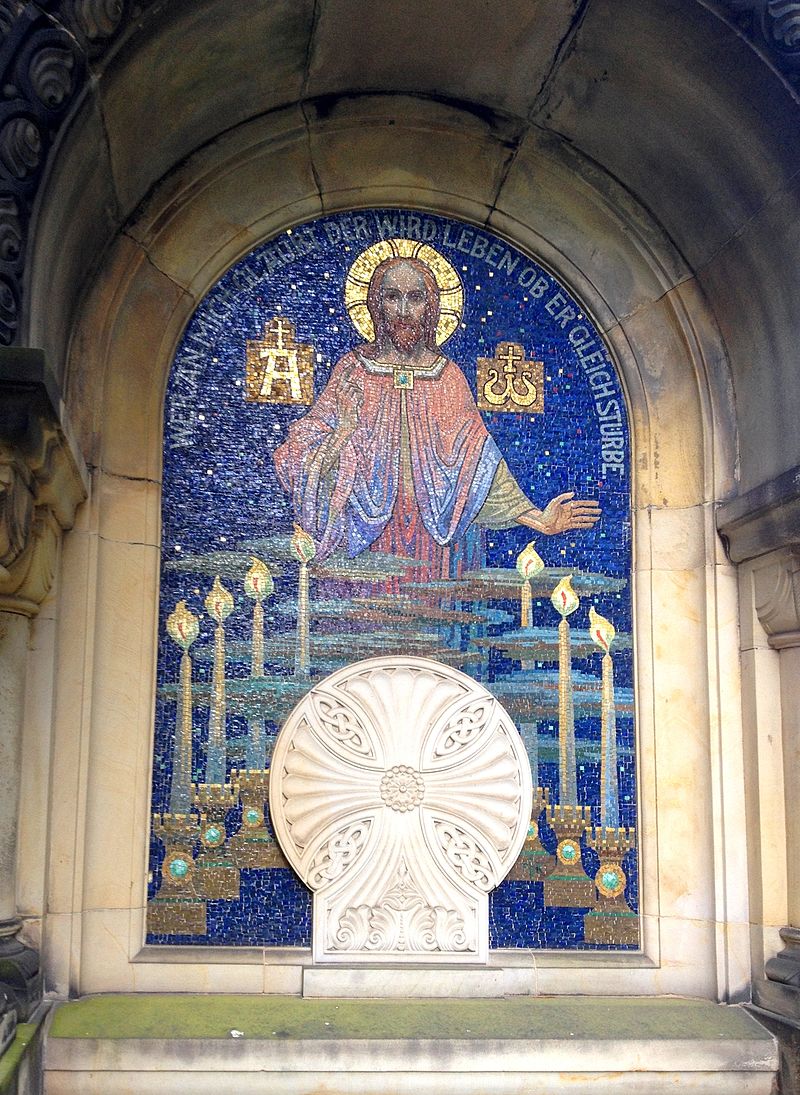
Goslar, Friedhof Hildersheimer Strasse, Grabmonument aus dem 19. Jahrhundert, Christusdarstellun nach Offenbarung

12 Then I turned to see whose voice it was that spoke to me, and on turning I saw seven golden lampstands, 13 and in the midst of the lampstands I saw one like the Son of Man, clothed with a long robe and with a golden sash across his chest. 14 His head and his hair were white as white wool, white as snow; his eyes were like a flame of fire, 15 his feet were like burnished bronze, refined as in a furnace, and his voice was like the sound of many waters. 16 In his right hand he held seven stars, and from his mouth came a sharp, two-edged sword, and his face was like the sun shining with full force.

17 When I saw him, I fell at his feet as though dead. But he placed his right hand on me, saying, “Do not be afraid; I am the first and the last, 18 and the living one. I was dead, and see, I am alive forever and ever; and I have the keys of Death and of Hades. 19 Now write what you have seen, what is, and what is to take place after this. 20 As for the mystery of the seven stars that you saw in my right hand, and the seven golden lampstands: the seven stars are the angels of the seven churches, and the seven lampstands are the seven churches.

John turns toward the voice mentioned above and the begins to write what he sees in the book we have. The vision is full of symbolism and echoes of the scriptures. ‘One like the Son of Man,’ is an image that goes back to Daniel 7:13-14, “As I watched in the night visions, I saw one like a human being (son of man) coming with the clouds of heaven. And he came to the Ancient One and was presented before him. To him was given dominion and glory and kingship, that all peoples, nations, and languages should serve him. His dominion is an everlasting dominion that shall not pass away, and his kingship is one that shall never be destroyed.” This is what is referred to when Jesus uses the ‘Son of Man’ title in the gospels. Because of this usage by Jesus in the gospels we shouldn’t be surprised that the speaker is Jesus. Yet, Jesus also has the traits of the Ancient one (God) spoken of immediately prior to the ‘Son of Man’ quotation from Daniel “As I watched, thrones were set in place, and an Ancient One took his throne, his clothing was white as snow, and the hair of his head was like pure wool; his throne was like fiery flames, and its wheels were burning fire. A stream of fire issued and flowed out from his presence. A thousand thousands served him and ten thousand times ten thousand stood attending him. The court sat in judgment and the books were opened.” (Daniel 7: 9-10) We begin to see the ways in which Revelation links Jesus to the Lord the God of Israel, something that will continue throughout this initial vision. The initial description of the resurrected Christ appearing to John is an awesome and fear inducing sight for the seer.

The sharp two-edged sword which comes out of his mouth will be a recurring image in Revelation. On the one hand, it does refer to speech as in Isaiah 49:2 when the servant of the Lord’s mouth is like a sharp sword. On the other hand, it is also the force by which Christ defeats evil, how truth overcomes the lies. The word of God is never a tame thing that should be wielded carelessly, it can cut both the church and the nations as it will here in Revelation.

John, overwhelmed by the image, falls down at the feet of the risen Christ, and unlike later when he bows down to another messenger he is not corrected. Falling at the feet of the risen Christ is an acceptable response and John is met with encouragement. “Do not be afraid” is a frequent instruction upon hearing from God or receiving God’s message. Now Jesus uses words for himself that are patterned after the words the Lord God uses, he is the ‘first and last’ paralleled to ‘Alpha and Omega’ and ‘the living one. I was dead, and see, I am alive forever and ever;” paralleled to ‘him who is and who was and who is to come.’

Jesus now holds the keys to Death and Hades. Even though in this time the forces of destruction can kill the faithful and send them to the realm of Death and Hades the book of Revelation looks towards that time when Christ claims this power and opens the realm of Death and Hades causing them to surrender those held there. Death remains real for the followers of the risen Christ, but it is not the final reality. As Paul could say, “For if we have been united with him in a death like his, we will certainly be united with him in a resurrection like his.” (Romans 6: 5)

The image of seven stars and the seven lampstands is one of the few explained images in the book of Revelation itself. The seven stars are the angels of the seven churches and the seven lampstands are the seven churches themselves. This image takes on an additional resonance when one realizes that the lampstands in the image is like the lampstand for the tabernacle and later temple (Exodus 25: 17-22). This is another place where Revelation makes an audacious connection between the churches and Israel. As mentioned above when discussing Revelation 1:6 when the calling of Israel is used now the imagery of Israel also gets linked to the churches.


Revelation’s Interpretation Through Time

An Old Woman Reading, Probably the Prophetess Hannah by Rembrandt (1631)

G.K. Chesterton once wrote, “Though St. John the Evangelist saw any strange monsters in his vision, he saw no creature so wild as one of his own commentators.”(Richard B. Hays and Stefan Alkier, 2012, p. 11) Particularly in the last couple hundred years we have seen some strange creatures emerge as interpreters of Revelation. Certain groups within Christianity, who are looking for certainty and answers, have found the book of Revelation as an irresistible puzzle to decode as they attempt to find a way to predict the future. Yet, the church has always puzzled with how to use the book of Revelation. While its original readers would have heard this as a text in a way that helped make sense of their position as a small minority in a hostile empire the position of the church in society would continue change. How does a church which eventually would become the religion of the land deal with these odd visions? Sometimes Revelation would be virtually ignored within the larger canon of the scriptures, while at other times it would capture the imagination of writers, interpreters, and artists.

John, the stated author of Revelation, probably writes somewhere between the year 80 and 100. The book of Revelation, as it is originally written, is a sharp challenge to the claims made by the Roman empire. As Christianity strove for recognition within the Roman empire Christian apologists tended to distance the anti-imperial rhetoric from the way they discussed Revelation. Revelation’s images would be used by early witnesses of the western church, like Justin Martyr and Ireneaus, in their apologetics to attempt to show how Christianity was related to Judaism. Ireneaus in his conflict with Marcion used the image of the four beasts around the throne to argue why there should be four gospels in contrast to Marcion who wanted only an edited version of Luke’s gospel along with Paul’s letters. In the eastern church the book of Revelation received even less usage. Dionysius of Alexandria (d. ca. 254) showed that the Revelation and the Gospel of John could not have been written by the same person due to literary form, writing style, and theological content. The church historian Eusebius (d. 339) listed Revelation as one of the recognized books but acknowledged that some grouped it with the rejected writings. The first known commentary on Revelation wasn’t written until the end of the second century by Victorinus of Pettau (d. 304) and this work would inform many future writings on Revelation. As Craig Koester can relate on this commentary, “In his view, the vision of the Lamb breaking the seals on God’s scroll shows that Christ reveals the meaning of Scripture through his death and resurrection (In Apoc. 1.4; 4.1-5:3; Huber, “Aspekte”). Like many modern interpreters, Victorinus observed that the beast has traits of the Roman emperors, especially Nero.” (Koester, 2014, p. 33)

In the time after the edict of Milan (313), which made Christianity tolerated throughout the Roman empire, the church had a new struggle: to define the faith. Within this struggle to articulate how they would talk about who Jesus was and how Jesus was related to God images from Revelation would continue to play their role along with the gospels and letters of Paul. Particularly the identity of Christ as the Alpha and the Omega would become decisive for the way the church would talk about Jesus in the time after the council of Nicea (325). In this time artwork of Christ victory and reign over the world would begin to integrate Revelation motifs. Yet, the Roman empire itself would be challenged by both internal and external forces and as Christianity continued to exist in this world Revelation would provide some of the theologians of the church a lens to view the world. St. Augustine’s adapted a reading of Revelation (from Tyconius) which saw a conflict between the city of God and the city of the world: interpreting both the present age but also the internal spiritual struggle between the powers of sin and grace in the life of the believer. St. Jerome, best known for his translation of the bible into Latin, created his own spiritualistic reading of Revelation where separating oneself from Babylon means resisting sin, but it may also involve retreating to a monastic lifestyle.

The Medieval Period (500-1000) would see Rome’s empire divided: North Africa would be captured by Islamic forces, Germanic kingdoms would rise in the west and the Byzantine empire would rise in the east. It was a time of plagues and instability, of invasions by Vikings from the north and Magyars from the Balkans. During this time of instability the church continued to grow in power and influence. There would be frequent calls for reform of the church but frequently these reforms would be resisted by the church’s leadership. This resistance made some turn Revelation’s vision of Babylon into a critique of the papacy—which would continue into the sixteenth century and beyond. In the late Medieval period, Joachim of Fiore’s (d. 1202) mystical view of history where there were three ages (the age of the Father, the age of the Son and the age of the Spirit) reawakened an interest in the thought of Revelation. He believed that history was progressing towards the age of the Spirit and reforming pope might lead the way into that age. In his view the seven heads of the dragon symbolized the persecutors of the church from Herod and Nero to the Muslim warrior Saladin in his own time.

The age of reform in the sixteenth century would bring about very different views about the book of Revelation. Erasmus (d. 1536) reopened the question about the status of Revelation, and Revelation held little attraction for his piety centered on the imitation of Christ. Luther (d. 1546) also questioned the place of Revelation, especially since in his view, “Christ is neither taught nor known in it.” (LW 35: 399) Yet, even as Revelation would be added at the end of the New Testament with Hebrews, James, and Jude (the other books Luther questioned) and be unnumbered we also see within the artists of Luther’s time the capturing of Revelation’s images. For example, Revelation was the only book in Luther’s German NT that was fully illustrated by woodcuts from Lucas Cranach and Philip Nicolai (d. 1608) used images from Revelation to respond to an outbreak of plague that took thousands of lives by writing “Wachet Auf,” or “Wake, awake, for night is flying.”

Although Zwingli also believed that Revelation was not a biblical book and it would be the only book in the New Testament that Calvin would not write a commentary on, the reformed church’s theological belief in an orderly history allowed many later writers to see Revelation as a part of God’s prophetic outlying of how history would unfold. In the seventeenth century figures like John Napier, Joseph Mede and even Isaac Newton became fascinated with using mathematics to attempt to decode the imagery of Revelation. They desired to see order even within the book of Revelation and that showed God’s overarching providence. The anabaptist movement was also heavily influenced by Revelation. In 1525 Thomas Müntzer would call for the common people to take up arms as instruments of the four horsemen bringing the wrath of God to the world. Müntzer’s rebellion would be dealt with brutally by the armies of the authorities. Other anabaptist communities would form communities of purity and nonviolence interpreting the book as an image of the church’s spiritual life on earth.

Music continued to be a place where the images of Revelation would resonate. Handel’s Messiah, focused on the hopeful aspects of Revelation’s imagery and worship. “The Battle Hymn of the Republic” was written by Julia Ward Howe in 1862 to advocate for the abolition of slavery and turned these images to rally support for the Northern war effort. Robert Lowery would use the image of the river at the end of Revelation for consolation in “Shall We Gather at the River.” Revelation would figure prominently in African American worship of the time and several songs, perhaps most famously, “When the Saints Go Marching In” utilize imagery from Revelation.

Futuristic interpretations begin to arise in the 1800s particularly in England and the United States. When the French Revolution brought in an era of terror and conquest rather that hope and peace, interpreters began to lose the optimism that reason would bring us into God’s kingdom and began to look for a sudden, cataclysmic return of Christ. In the United States, William Miller (d. 1849), whose theological heritage would lead to the Seventh Day Adventists, attempted to predict from Daniel and Revelation when Christ would return. When October 22, 1844, his predicted date, passed he continued to look for mistakes in his calculations and when he died in 1849 others would continue this work. One of the most popular interpretive frameworks in the United States is Dispensationalism which goes back to Nelson Darby (d. 1882) and was brought in popular form to the United States by Cyrus Scofield (d. 1921) in his Scofield Reference Bible. Two markers of this interpretation are that Revelation 4-22 prophesied times yet to come, rather than referring to events that have happened, and that the faithful church would be raptured (removed) prior to the seven years of tribulation on earth. This theology would be put into narrative form in the Late Great Planet Earth by Hal Lindsey and the Left Behind series by Timothy LaHaye and Jerry B. Jenkins.

Revelation has proved illusive to being locked into a single interpretation, and perhaps that is a part of why it resonates. Its images are powerful and poetic, and particularly for the artists and musicians of the church Revelation has provided some fertile ground. There are interpretations, like Dispensationalism, which I don’t find particularly helpful and do not make sense from the perspective of a first century audience or for the way I read scripture. As an heir of Luther’s tradition, I can understand his hesitance in assigning Revelation a place within the canon alongside the gospels and Paul’s letters, and yet I am convinced that read alongside these writings we can hear Revelation as a witness to Christ. My goal is to attempt for a reading of Revelation that can be faithful to its original intent but also continue to speak to the church in its context. I am humble enough to realize that I am a part of the long history of readers attempting to make sense of this book and yet I do believe that we need, in a time where Revelation’s imagery is all around us in popular culture. I am heavily indebted to Craig Koester for the above discussion on the history of interpretation and you can find a much fuller witness to the history of interpretation in his commentary on Revelation. (Koester, 2014, pp. 29-64)


Transitioning into Revelation

Herz-Jesu-Kirche, westseitige Teiansicht der Pendentifkuppel,Shared under Creative Commons attribution-Share alike 3.0 Germany

As a part of my personal growth and dedication to these strange, wonderful scriptures I’ve attempted to lean into some of the texts I am less familiar with and there is an unseen method to my madness. I have enough background knowledge to know that some books pull heavily on the imagery of others while others naturally flow in a narrative sequence. I’ve grown immensely in my faith and my love for the scriptures in my work with Exodus, Deuteronomy, Esther, Psalms 1-41, Ecclesiastes, Jeremiah and Haggai. I thought Song of Songs or Song of Solomon was going to be the next book I approached, and that one will probably come after Revelation and Psalms 42-50, but I attempt to listen when people ask about something specific and living in Texas people are curious about Revelation.

Revelation is the first book in the New Testament that I am going through completely here on Sign of the Rose. Part of that is intentional, as a Christian pastor I spend more time with the Gospels than any other portion of scripture and early in my ministry I wanted to go back to get a PhD in New Testament studies focusing on the Pauline letters. After fourteen years in ministry I felt very comfortable in multiple reading perspectives for large portions of the New Testament and I’ve found in particular the work of Richard B. Hays which points to the allusions of the Hebrew Scriptures in the New Testament. Like most Christian ministers my comfort with the Hebrew Scriptures (commonly called the Old Testament) was limited and so I’ve attempted to grow in this area. Ideally to approach the book of Revelation I would have preferred to work through the books of Daniel and Ezekiel first since Revelation uses imagery from both of these books frequently and Daniel, especially, is the closest in style to most of Revelation’s imagery and form.

In my tradition, Lutheran and specifically ELCA Lutheran, the book of Revelation is not often utilized. We sometimes may point out perspectives that we don’t agree with in how the imagery of Revelation is misused. Sometimes we have laughed to ourselves about various groups that have boldly posited the dates of Christ’s return. It is far easier to critique or challenge someone else’s perspectives and constructs rather than contribute one’s own. I can’t claim to speak for all Lutherans or even on behalf of one denomination, but rather as one pastor who diligently attempts to use the tools of my tradition, my own experiences and gifts of reason and knowledge and a love for these strange scriptures that point us to the God of the people of Israel and the God who the early Christians would come to know through the witness and revelation of Jesus.

I do think before moving through individual chapters it is helpful to understand how Revelation has been used (or frequently not commented on) by the church across its history so the next post in this series will look briefly at the history of interpretation. Maybe I’m the only person who finds that interesting, but it is helpful for me to understand the way the Christian church has approached this book to understand what pitfalls are there.

If you come to these posts looking for me to explain exactly how the world is going to end I want to warn you up front that you will be disappointed. Much of the misinterpretation of Revelation goes into not paying attention to the rich and allusive language of this work and attempt to lock it down into a series of events that must happen. Revelation has a powerful resonance for today’s world but not as a tool for interpreting the future, but rather as a lens to look at the present. Many recent interpreters, particularly from American and English evangelical traditions, fundamentally misread this book because they assign to God’s plan the things that are God unveiling the way humans have brought death and destruction to the world. They try to make the crucified lamb into the conquering lion rather than Revelation’s reversal of this image to turn the lion into a lamb. Yet, it still has a powerful resonance which can at times be uncomfortable-especially in the places where the United States, my home country, has attempted to emulate the parts of Rome that Revelation parodies. It also speaks to a church that finds itself in various situations: from complete acculturation with the narrative of the nation to finding itself a persecuted entity.

Ultimately, anyone reading this is entitled to their own reading of Revelation. It continues to evoke new readings in culture, art and music-some faithful and some obviously not to the author’s original message. Welcome for those journeying with me into this journey with this strange, evocative, powerful and sometimes confusing vision of John on Patmos. May these humble reflections be my own offering cast before the throne of the one who is worthy to receive glory, honor and power. (Revelation 4:11)

Psalm 41 The One Who Cares for the Poor


Artistic Reflections on the Beatitudes of Our Lord Jesus Christ by Stephanie Miles. Image from http://agatheringatthewell.blogspot.com/

Psalm 41

<To the leader. A Psalm of David.>
1 Happy are those who consider the poor; the LORD delivers them in the day of trouble.
2 The LORD protects them and keeps them alive; they are called happy in the land. You do not give them up to the will of their enemies.
3 The LORD sustains them on their sickbed; in their illness you heal all their infirmities.
4 As for me, I said, “O LORD, be gracious to me; heal me, for I have sinned against you.”
5 My enemies wonder in malice when I will die, and my name perish.
6 And when they come to see me, they utter empty words, while their hearts gather mischief; when they go out, they tell it abroad.
7 All who hate me whisper together about me; they imagine the worst for me.
8 They think that a deadly thing has fastened on me, that I will not rise again from where I lie.
9 Even my bosom friend in whom I trusted, who ate of my bread, has lifted the heel against me.
10 But you, O LORD, be gracious to me, and raise me up, that I may repay them.
11 By this I know that you are pleased with me; because my enemy has not triumphed over me.
12 But you have upheld me because of my integrity, and set me in your presence forever.
13 Blessed be the LORD, the God of Israel, from everlasting to everlasting. Amen and Amen.

The final psalm in the first book of the psalter (Psalms 1-41) begins with a beatitude (Happy/blessed are…) just like the first psalm in this collection. Psalm 1 begins by stating “Happy are those who do not follow the advice of the wicked…but their delight is in the law of the LORD” and now closing this section of the book of psalms we hear, “Happy are those who consider the poor.” The structure of the book of psalms wants to encourage us to hear the connection hear between a life that avoids the way of the wicked and delights in the law of the LORD with a life that considers the poor. Looking back at the previous forty psalms that comprise this first section of the psalter it becomes clear that one of the central messages is that God hears those who have been oppressed or isolated from their community and so the one who considers the poor models their path after the God who hears the cries of the poor and neglected of the world. This psalm begins with the one who considers the poor being able to count upon the LORD’s deliverance in their own time of trouble. A life that is blessed is one that in following the law of the LORD hears the way in which they are to be a community which cares for the weak, the widow, the orphan, the alien and all the others who are vulnerable in society.

The similarity between the beginning of this psalm and the Sermon on the Mount in Matthew 5: 3 (or Sermon on the Plain in Luke 6:20) is just one of many places of resonance between the psalms and the message of Jesus. Jesus vision of the kingdom of God reflects the law of the LORD which imagines a society where the wicked no longer take advantage of the weak. The psalms, along with the law and prophets, the gospels and the letters of Paul as well as the rest of the bible attempt to imagine for the world a different kind of community. I’m reminded of a story that the New Testament scholar Mark Allan Powell shares about the parable of the prodigal son in Luke’s gospel. He asked his American student why the son who goes to a foreign country ends up starving and they almost all point to him squandering what he had, the son’s life was his own responsibility. When he had the opportunity to ask students in Russia the majority pointed to the reality that in the story there is a famine in the land, that the person’s peril was due to external conditions in the environment. Perhaps most interestingly for the reflection on this psalm was the answer he received when he was in Tanzania about why the son was in danger of starvation: “Because no one gave him anything to eat!” and they went on to explain that:

The boy was in a far country. Immigrants often lose their money. They don’t know how things work—they might spend all their money when they shouldn’t because they don’t know about the famines that come. People think they are fools just because they don’t know how to live in that country. But the Bible commands us to care for the stranger and alien in our midst. It is a lack of hospitality not to do so. This story, the Tanzanians told me, is less about personal repentance than it is about society. Specifically, it is about the kingdom of God. (Powell, 2007, p. 27)

This is the type of society that this psalm attempts to help us imagine, a world where the poor are considered and cared for, but the psalmist doesn’t live in that world. Just because the poet believes that God delivers those who care for the vulnerable they also are honest that attempting to live righteously does not exclude them from the challenges of life or from feeling the exclusion that the poor often feel.

The poet spends most of this psalm reflection on how their own community was not a blessing to them in their time of trouble. The LORD sustains those who care for the poor on their sickbed, but now the psalmist community has only the LORD to call to for healing on their own sickbed. Perhaps their community believes that the illness is a judgment from God and therefore they are justified in their exclusion of this one. It may also be that the illness demonstrates the true nature of the community. The community seems to be a place where only those who can actively contribute are valued and where people are actively waiting on the death of the psalmist to inherit his property. At a time where the community was needed the most for the poet, they found themselves a member of an unjust society that does not consider the vulnerable and weak. The community of the speaker has become warped and close friendships revealed as fading and shallow. Yet, the LORD can bring the one who has a deadly thing fastened to him back to life.

Like in Psalm 38 the psalmist wrestles again with a connection between sin and sickness. On the one hand many modern Christians too quickly dismiss any connection when there are times when one suffers because of one’s own actions or choices. Yet, there are other times where both people too quickly and tightly assume a connection. As Rolf Jacobson shares from his own life:

Even modern agnostics or atheists prove themselves capable of making this assumption when they assume that a person’s poor health is automatically the result of poor lifestyle choices. In my own life, when I was diagnosed with cancer as a teenager, a well-meaning but misguided neighbor remarked to my mother that it was a shame she had not been feeding her family the proper, high anti-oxidant diet, or her son would not have developed cancer. Besides being incredibly unhelpful, this comment was simply wrong—the type of cancer I had is not lifestyle dependent. (Nancy deClaisse-Walford, 2014, p. 390)

Regardless of whether a person’s plight is caused by personal actions and choices or whether they simply find themselves among the weak, sick, injured, poor, or otherwise vulnerable the psalms imagine a community that can respond differently than what the writer of Psalm 41 discovers in their community.

The psalmist asks to be able to ‘repay’ those who have not acted as a supportive community in their plight and unfortunately in English we lose the double meaning of this phrase. On the one had the psalmist does desire that their health would be restored so that those waiting on their death to claim their payment from their property would have no inheritance because the psalmist continues to live. But the word translated to repay comes from the noun shalom and has the connotation of making complete, restoring, to recompense or reward. (Brueggeman, 2014, p. 200) The poet may also be pointing to being a person who can demonstrate what a righteous life looks like by in the future caring for those who failed to care for them in the present.

The LORD has cared for the one who has cared for the poor. The righteous one can point to their own life as a witness to the LORD’s action on their behalf. Even when their community failed them God proved to be faithful. And they end this psalm and this portion of the psalter with a blessing to the God who has avoided the way of the wicked, who has delighted in the law of the LORD, and who has cared for the poor.

Psalm 40 Experienced Faithfulness and the Hope of Deliverance

Extract of Herbert Boeckl’s fresco “Saint Peter’s rescue from the Lake Galilee” inside the cathedral of Maria Sall, Carinthia, Austria

Psalm 40

<To the leader. Of David. A Psalm.>
1 I waited patiently for the LORD; he inclined to me and heard my cry.
2 He drew me up from the desolate pit, out of the miry bog, and set my feet upon a rock, making my steps secure.
3 He put a new song in my mouth, a song of praise to our God. Many will see and fear, and put their trust in the LORD.
4 Happy are those who make the LORD their trust, who do not turn to the proud, to those who go astray after false gods.
5 You have multiplied, O LORD my God, your wondrous deeds and your thoughts toward us; none can compare with you. Were I to proclaim and tell of them, they would be more than can be counted.
6 Sacrifice and offering you do not desire, but you have given me an open ear. Burnt offering and sin offering you have not required.
7 Then I said, “Here I am; in the scroll of the book it is written of me.
8 I delight to do your will, O my God; your law is within my heart.”
9 I have told the glad news of deliverance in the great congregation; see, I have not restrained my lips, as you know, O LORD.
10 I have not hidden your saving help within my heart, I have spoken of your faithfulness and your salvation; I have not concealed your steadfast love and your faithfulness from the great congregation.
11 Do not, O LORD, withhold your mercy from me; let your steadfast love and your faithfulness keep me safe forever.
12 For evils have encompassed me without number; my iniquities have overtaken me, until I cannot see; they are more than the hairs of my head, and my heart fails me.
13 Be pleased, O LORD, to deliver me; O LORD, make haste to help me.
14 Let all those be put to shame and confusion who seek to snatch away my life; let those be turned back and brought to dishonor who desire my hurt.
15 Let those be appalled because of their shame who say to me, “Aha, Aha!”
16 But may all who seek you rejoice and be glad in you; may those who love your salvation say continually, “Great is the LORD!”
17 As for me, I am poor and needy, but the Lord takes thought for me. You are my help and my deliverer; do not delay, O my God.

Any deliverance we may experience during our life is provisional. That doesn’t mean that the deliverance is insignificant or unimportant, merely that there will be future crises that we encounter in our lives. The experience of God’s faithfulness and the answer to one’s prayer does not grant us a life exempt from future struggles or conflict. Yet, these experiences of God’s faithfulness can give shape to the prayers that we state when we encounter a new crisis. Our history with God’s actions on our behalf teach us to trust that God does hear our prayer and respond and gives us a hope for deliverance in the future as we endure what hardships may come.

Psalm 40 moves from praise for a past time of salvation into a prayer in a moment of crisis. Some people have broken the psalm into two pieces and dealt with it as two distinct psalms, especially since verses 13-17 comprise the entirety of Psalm 70. Yet, here they are joined into one psalm and there is wisdom in the way Psalm 40 flows. The movement from the experience of faithfulness to praise to finding oneself needing to callon God’s deliverance is a movement that is frequent in the life of faith.

The psalm begins with recollection. The petitioner remembers a time when they waited on the LORD’s deliverance and their waiting was recognized. They were drawn out of a metaphorical pit and miry bog and placed in a secure place. God was their rock and a foundation which proved trustworthy to rely upon and to build their life around. Their response to this deliverance was one of praise, of singing and or testifying to others in the community what they LORD had done for them.

As the praise of the psalmist continues they can proclaim that ‘happy’ or ‘blessed’ is the one who makes the LORD their trust. Earlier the path of happiness was for those who do not follow the wicked and delight in the law of God (Psalm 1) or for those whose sin has been forgiven (Psalm 32) and now the path of happiness is for those who trust in the LORD instead of any other object of faith. Instead of trusting in their own strength or turning aside to follow other gods the faithful one finds peace and happiness in relying on their God. Their trust has been rewarded by seeing the wondrous deeds towards the faithful community in the past and they remind themselves of the blessings they have received. The path of the ‘happy’ one is a path of gratitude for the continued provision of God throughout their life and in the life of their community.

What the psalmist believes their LORD desires is a life that is lived according to the covenant rather than sacrifice and offering. Like the prophets (see for example 1 Samuel 15: 22; Isaiah 1: 12-17; Hosea 6:6 and Amos 5: 21-24), here the psalmist recounts that the LORD desires more than merely right worship. The God of the psalms is not swayed by lavish sacrifices or offerings or worship. No sacrifice meets what God truly wants for God’s people. Instead it is a life lived in trust, praise and obedience that is desired by God. While worship, sacrifice and offering are all a part of this life they are not sufficient.

Interpretations vary on the ‘scroll of the book of the law’ in verse seven. I read this as a way of talking about a life that conforms to God’s law. Perhaps the person brings in a scroll of either a narrative of the way in which God rescued them, or the psalm itself becomes the offering, or the scroll is an accounting of how the individual has lived in accordance with God’s will. As Rolf Jacobson can state

“the psalmist delights in doing what God truly does find acceptable. And what God delights in is a life that conforms itself to God’s teaching (tôrậ; see comment on Ps. 1:2)—a life so conformed to God’s teaching that the torah is alive deep (betôk mē’āy) a person.” (Nancy deClaisse-Walford, 2014, p. 379)

Like Jeremiah 31: 31-34 and Ezekiel 36: 26-28 we have within this psalm a heart that has the covenant imprinted on it.  Their experience of living the law, of trusting in the LORD, and knowing the benefit of the LORD’s protection and provision form the content of their witness to the community of faith. Their life and their song become tied together into a public act of worship the God who has heard them.

Yet, the faithful life is not exempted from strife and trials and within this psalm the texture changes as the psalmist is again in a place where they need to call upon the LORD’s salvation. In the past they have called, and God has answered and here again they lift their cry for God’s mercy, steadfast love and faithfulness. Evils and iniquities have somehow occluded the psalmist’s ability to see God’s action on their behalf. Those who desire their hurt may be those actively working against them or seeking to profit from their misfortune or they may simply be those who take pleasure in another person’s suffering. But the psalmist prays out of the position of trusting in God’s deliverance, a trust that has been validated in the past. They are poor and needy, they are vulnerable and yet they trust that God sees their turmoil and hears their cry. They recounted waiting patiently in the past for the LORD’s deliverance and now they are in the space of waiting again. They ask for God to act quickly to restore them to the place where once again they can testify to God’s deliverance and how God has again set their feet upon the rock instead of being caught in the pit or the miry bog.


Psalm 39 There Are No Words

Image from Associated Press

Psalm 39

<To the leader: to Jeduthun. A Psalm of David.>
1 I said, “I will guard my ways that I may not sin with my tongue; I will keep a muzzle on my mouth as long as the wicked are in my presence.”
 2 I was silent and still; I held my peace to no avail; my distress grew worse,
 3 my heart became hot within me. While I mused, the fire burned; then I spoke with my tongue:
 4 “LORD, let me know my end, and what is the measure of my days; let me know how fleeting my life is.
 5 You have made my days a few handbreadths, and my lifetime is as nothing in your sight. Surely everyone stands as a mere breath. Selah
 6 Surely everyone goes about like a shadow. Surely for nothing they are in turmoil; they heap up, and do not know who will gather.
 7 “And now, O Lord, what do I wait for? My hope is in you.
 8 Deliver me from all my transgressions. Do not make me the scorn of the fool.
 9 I am silent; I do not open my mouth, for it is you who have done it.
 10 Remove your stroke from me; I am worn down by the blows of your hand.
 11 “You chastise mortals in punishment for sin, consuming like a moth what is dear to them; surely everyone is a mere breath. Selah
 12 “Hear my prayer, O LORD, and give ear to my cry; do not hold your peace at my tears. For I am your passing guest, an alien, like all my forebears.
 13 Turn your gaze away from me, that I may smile again, before I depart and am no more.”

“There Are No Words” was the headline in my morning paper as the news covered yet another school shooting, this time in Parkland, Florida. A nineteen-year-old was equipped with smoke grenades, a gas mask, and an AR-15 rifle and killed at least seventeen people. As the leader of a community of faith I had to stand before my congregation last night as we came together for an Ash Wednesday service and they looked to me for words of wisdom, words of faith, words that fit the paradox of a day that on the secular calendar celebrated Valentine’s day but on the religious calendar reminds us that, “you are dust and to dust you shall return.” There are no words that are adequate to the pain that the parents and students of Marjory Stoneman Douglas High School must feel. Sometimes we discharge our own inadequacy with platitudes or promises of prayer. I would prefer to remain silent for I know the inadequacy of any words I may say. I would prefer to not speak from my own sense of weakness and frustration at the powerlessness that we seem to have around any issue related to who may possess a weapon in our country. I wonder for the parents of previous shootings who have turned their pain into a desire to make a change only to be frustrated again and again by the politicians who seem untouched or patronizing by these parents’ desire to never again allow this to happen to another family.

This psalm speaks to me this week. The beginning of Psalm 39 is paradoxical as the speaker speaks of their silence, of their desire to hold their tongue and muzzle the mouth. The movement from silence to protesting speech to silence and back to speech reminds me of the words of Richard Lischer:

Before any prophet speaks, the prophet is absolutely positive that he or she must not speak. Moses claimed a speech impediment; Isaiah confessed his own impurity; Jeremiah appealed to his inexperience. After the temple was destroyed, the prophet Ezekiel was transported to a refugee camp at Tel Abib. There he sat for seven days stupefied among the refugees, or, as one translation has it, “in a catatonic state.” Imagine the denizens of the twentieth century, beginning with ninety-three million dead in wars, gazing up from their mass graves or through the barbed wire of their camps, stupefied, catatonic. Something has ended. Visit the Holocaust Museum or Dachau. The normative demeanor is silence. (Lischer, 2005, p. 5f.)

I don’t know what terror the psalmist feels. Their silence could come from a personal illness, a communal tragedy, events that threaten the security or the identity of their nation, or they could just be silenced by the sheer magnitude of horrors both experienced and whispered in their life. Like Job the psalmist here begins in a state of silence. They hold back their tongue for fear of uttering blasphemy against their LORD. Yet their silence does not bring healing. The unexpressed wounds on their soul continue to fester as they remain locked behind their closed mouth. The words which the poet choked down burn now within them. The unresolved injustice burns their heart. They were absolutely positive they must not speak but the words burned within them and so they utter their words of protest. They cry out to God from the unspeakable tragedy of their life and with their words they give the tragic a voice.

“LORD let me know my end, what is the measure of my days; let me know how fleeting my life is.” On a day where Christians gathered and ashes formed the sign of the cross upon their foreheads we remember that our days are a few handbreadths. Yet, we do not accept the senselessness of suffering in silence. The witness of the faithful ones of scriptures bear witness to the words that must be spoken otherwise they burn within us until we speak. We take our words and our feelings into our dialogue with our LORD. We wrestle with how things like this can happen in a world created by a loving God. These words may move us into the uncomfortable place of girding up our loins to stand before God as Job was asked to do. We may stand in the place of Jeremiah who amid his pain would say to God, “Truly you are to me like a deceitful brook, like waters that fail” (Jeremiah 15: 18) or in less poetic language to dare to say to God that God’s promises were untrue, or God’s strength was unreliable. We may cry with the psalmist, “My God, my God why have you forsaken me.” (Psalm 22: 1) for the pain must go somewhere and the character of God revealed to the people of Israel is a God who sees the misery and hears the cry of God’s people. (See for example Exodus 3: 9) The words which seemed unutterable must be spoken. In the pain of the people and from the pain of the prophet the words cannot be held back. While the measure of days still lasts these the people cannot remain speechless before their God or in the world they live in.

In verses five and six behind the translation of ‘mere breath’ and ‘for nothing they are in turmoil’ lies the Hebrew word hebel (the word behind ‘vanity’ in Ecclesiastes which literally means vapor or mist but often represent emptiness and futility). The poet lapses into the language of the wisdom traditions of the bible trying to make sense of the senseless, to give words to the unspeakable, and grasping for certainties that are not there. Outside of their faith there are no satisfactory solutions for the psalmist wrestling with the crisis which for them makes meaningless a life that once held meaning. They turn to their LORD, where their hope lies, and they dare to speak. They ask for deliverance from their transgression of speech, silence and action.

The paradoxical speech from silence continues as the psalmist feels their personal crisis is a result of some judgment of God. God is the one who is punishing them, God has sent this crisis, God is the one whose chastisement threatens to consume them. The person feels cut off from community and is vulnerable like the wandering foreigner in the land. They have no people, no family, no group other than God. They cry for God to hear, give ear, and not to remain silent. Yet, while they have no family but God they also ask for God to turn God’s gaze away. Even though God may be their only support they are unable to see from God anything other than wrath in the moment. In the confused space of a crisis where there are no adequate words they perhaps need some time in their own silence. Yet, perhaps ironically it is in this confused space where they want God to act in mercy. In a time where words seem to fall flat, and emotions are confused the poet still trusts that God hears and that ultimately God will act. They feel a mixture of self-condemnation, fear, anger, betrayal, shame, pain, and there are no immediate resolutions. They long for the day when they can smile once more, and they pray that that day is before their life ends. Yet, these words echo on days where there are ‘no words.’ The psalm ends without resolution but still with a defiant hope that the silence and speech of this psalm will not be the final word. That even during the futility of this moment and their life they might still find joy once more.

Perhaps the reason these words speak to me today is that they do not claim to have the answer. There may come a time when these words transform into different words and different actions that once again try to imagine a world where these words and feelings are not necessary. To imagine a world where a nineteen-year-old either can’t use a weapon to shatter so many families or where this type of action is somehow prevented. I know my own feelings on this issue may not be popular in Texas where I serve. When I served in the military we did place an M-16 or M-4 (which are the military versions of this rifle) into the hands of young men and women this age but always within structure and supervision. In the time of the psalms and the prophets conflict was a frequent part of the people of Israel’s story and perhaps that is why the psalms and the prophets so often dream of peace and of a world free from the implements of war. Perhaps they had seen too many times where mothers and fathers mourned the son and daughters lost in violence. Perhaps they too knew what it meant to be at the point where there are no words and yet the words they choked back burned within them. They would enter the space where they cried out and questioned God and yet knew that it was only God who might eventually heal the emptiness they felt inside. But on this day, I am running out of words and like the psalm it may not bring any resolution, yet they needed to be spoken.

Psalm 38 A Cry for Forgiveness and Healing

Psalm 38

<A Psalm of David, for the memorial offering.>
1 O LORD, do not rebuke me in your anger, or discipline me in your wrath.
2 For your arrows have sunk into me, and your hand has come down on me.
3 There is no soundness in my flesh because of your indignation; there is no health in my bones because of my sin.
4 For my iniquities have gone over my head; they weigh like a burden too heavy for me.
5 My wounds grow foul and fester because of my foolishness;
6 I am utterly bowed down and prostrate; all day long I go around mourning.
7 For my loins are filled with burning, and there is no soundness in my flesh.
8 I am utterly spent and crushed; I groan because of the tumult of my heart.
9 O Lord, all my longing is known to you; my sighing is not hidden from you.
10 My heart throbs, my strength fails me; as for the light of my eyes — it also has gone from me.
11 My friends and companions stand aloof from my affliction, and my neighbors stand far off.
12 Those who seek my life lay their snares; those who seek to hurt me speak of ruin, and meditate treachery all day long.
13 But I am like the deaf, I do not hear; like the mute, who cannot speak.
14 Truly, I am like one who does not hear, and in whose mouth is no retort.
15 But it is for you, O LORD, that I wait; it is you, O Lord my God, who will answer.
16 For I pray, “Only do not let them rejoice over me, those who boast against me when my foot slips.”
17 For I am ready to fall, and my pain is ever with me.
18 I confess my iniquity; I am sorry for my sin.
19 Those who are my foes without cause are mighty, and many are those who hate me wrongfully.
20 Those who render me evil for good are my adversaries because I follow after good.
21 Do not forsake me, O LORD; O my God, do not be far from me;
22 make haste to help me, O Lord, my salvation.

This is a song for a broken heart, a broken body or a broken spirit. The psalm cries to the LORD for mercy, for reconciliation and for renewed presence. We never hear in this psalm the sin which the author believes they are suffering from but this sin which is mentioned but never named is the perceived cause of the psalmist’s suffering. Something has come between the singer of these words and the LORD whom they cry out to. Something has, in the poet’s mind, caused God to turn away in anger and indignation. Something they believe has caused God’s disposition to them to change dramatically. They are no longer at peace with God. Their relationship with their creator has been fractured and they stand in the position of helplessness and weakness. They feel the weight of God’s judgment and perhaps their own as well upon them.

 While there is no easy or direct correlation between sin and sickness in the bible, the psalmist’s cries do ponder a connection between their physical, emotional and spiritual health. Sin can cause suffering in body and mind and the feeling of abandonment or shame can manifest in physical and emotional ways. While the psalmist language is probably in some senses metaphorical it doesn’t mean that the language of the psalm doesn’t base itself upon the actual pain that the psalmist feels. As Beth Tanner can say, “The burden of sin burns inside, and the whole body feels the strain (v.7) The insides feel faint, and the spirit is crushed (v.8); even if quiet on the outside the mind roars over the torment in one’s heart (v.8)” (Nancy deClaisse-Walford, 2014, p. 358) The poet has something they feel intensely that has separated them from the protection and provision of their God, some unspoken sin that is seen by God and makes itself known in their body and spirit. They stand in need of forgiveness and reconciliation which will also begin the healing of their mind and flesh.

The poet’s plight is heightened by the distance and judgment they now feel from their community. Friends and neighbors who one relies upon now stand at a distance. Perhaps they feel like a leper who is cut off from the community for fear of contagion or perhaps, like the friends in Job’s narrative, the neighbors and friend have decided the sickness must be a judgment of God. Friends and neighbors stand aside while enemies perceive an opportunity. The weakness of the psalmist becomes a reason for their increased isolation from the community which they also rely upon. They have no words to answer the whispers they imagine being spoken of them as the lie (actually or metaphorically) prostrate and crushed unable to rise.

Though God may have turned away in indignation, at least in the psalmist’s perception, and they feel that God is just in God’s anger they plead for mercy and restoration. They trust that God will not ultimately forsake them. They have reached the point where they are ready to let go of the sin they conceal in their breast and the burden they have carried. They wait upon the LORD for their strength to be renewed. The psalm ends with the cry for the LORD’s steadfast love to overcome the indignation rightly felt. Where the poet feels distance from God and community they call for God’s return and healing. They call out in urgency for their case is dire. They end with the cry for their salvation and we, with the psalmist, enter their time of waiting for the LORD’s action.

Psalm 37 A Song of a Wise Life

An Old Woman Reading, Probably the Prophetess Hannah by Rembrandt (1631)

Psalm 37

<Of David.>
1 א  Do not fret because of the wicked; do not be envious of wrongdoers,
 2 for they will soon fade like the grass, and wither like the green herb.
 3 ב Trust in the LORD, and do good; so you will live in the land, and enjoy security.
 4 Take delight in the LORD, and he will give you the desires of your heart.
 5 ג Commit your way to the LORD; trust in him, and he will act.
 6 He will make your vindication shine like the light, and the justice of your cause like the noonday.
 7 ד Be still before the LORD, and wait patiently for him; do not fret over those who prosper in their way, over those who carry out evil devices.
 8 ה Refrain from anger, and forsake wrath. Do not fret — it leads only to evil.
 9 For the wicked shall be cut off, but those who wait for the LORD shall inherit the land.
 10 ו Yet a little while, and the wicked will be no more; though you look diligently for their place, they will not be there.
 11 But the meek shall inherit the land, and delight themselves in abundant prosperity.
 12 ז The wicked plot against the righteous, and gnash their teeth at them;
 13 but the LORD laughs at the wicked, for he sees that their day is coming.
 14 ח The wicked draw the sword and bend their bows to bring down the poor and needy, to kill those who walk uprightly;
 15 their sword shall enter their own heart, and their bows shall be broken.
 16 ט Better is a little that the righteous person has than the abundance of many wicked.
 17 For the arms of the wicked shall be broken, but the LORD upholds the righteous.
 18 י The LORD knows the days of the blameless, and their heritage will abide forever;
 19 they are not put to shame in evil times, in the days of famine they have abundance.
 20 כ But the wicked perish, and the enemies of the LORD are like the glory of the pastures; they vanish — like smoke they vanish away.
 21 ל The wicked borrow, and do not pay back, but the righteous are generous and keep giving;
 22 for those blessed by the LORD shall inherit the land, but those cursed by him shall be cut off.
 23 מ Our steps are made firm by the LORD, when he delights in our way;
 24 though we stumble, we shall not fall headlong, for the LORD holds us by the hand.
 25 נ I have been young, and now am old, yet I have not seen the righteous forsaken or their children begging bread.
 26 They are ever giving liberally and lending, and their children become a blessing.
 27 ס Depart from evil, and do good; so you shall abide forever.
 28 For the LORD loves justice; he will not forsake his faithful ones.
    ע The righteous shall be kept safe forever, but the children of the wicked shall be cut off.
 29 The righteous shall inherit the land, and live in it forever.
 30 פ The mouths of the righteous utter wisdom, and their tongues speak justice.
 31 The law of their God is in their hearts; their steps do not slip.
 32 צ The wicked watch for the righteous, and seek to kill them.
 33 The LORD will not abandon them to their power, or let them be condemned when they are brought to trial.
 34 ק Wait for the LORD, and keep to his way, and he will exalt you to inherit the land; you will look on the destruction of the wicked.
 35 ר I have seen the wicked oppressing, and towering like a cedar of Lebanon.
 36 Again I passed by, and they were no more; though I sought them, they could not be found.
 37  ש Mark the blameless, and behold the upright, for there is posterity for the peaceable.
 38 But transgressors shall be altogether destroyed; the posterity of the wicked shall be cut off.
 39  ת The salvation of the righteous is from the LORD; he is their refuge in the time of trouble.
 40 The LORD helps them and rescues them; he rescues them from the wicked, and saves them, because they take refuge in him.

I have introduced the Hebrew letters at the beginning of each acrostic line to show the structure of this poem. The psalms frequently use acrostic poetry as a form which tends to denote a completion of thought from Aleph to Tav (or in our alphabet the equivalent would be from A to Z). Psalm 37 uses this form to express the contrast between the life of the wicked and the life of the righteous. The psalm was works in a similar way to the book of Proverbs where the words are a tool for passing on a manner of life that values the correct things. It encourages the hearer to take the long view of life as it compares the momentary success of the wicked and the way of the righteous.

Psalm 37, like much wisdom literature, wrestles with the common question of every age: Why do those who seem to be wicked often prosper and those who are faithful struggle? Or in simpler terms: Why do good things happen to bad people and bad things to good people? No psalm, poetry, proverbs or philosophy can adequately address every aspect of this fundamental question, but the poets, wise ones and prophets of the bible do attempt to give their provisional answers to these questions because they are important to how they understand what a good life looks life. In the psalms God is fundamentally trustworthy and, even when situations seem to testify otherwise, the authors trust that God’s will and God’s way will prevail. Psalm 37 attempts to make a case for faithfulness in the seeming prosperity of the faithless and for the long view of life in contrast to the ways of the wicked which focus on the immediate reward of their actions.

The psalm invites us into a life that is not dominated by worrying about how other’s actions are rewarded but rather to trust in the LORD amid the positives and negatives of life. It encourages the hearer to expand the horizon of their consideration beyond the transitory present. Throughout the psalms the LORD is trustworthy, sees the struggles of the righteous and does, in God’s time, act. The longstanding faithfulness of God is contrasted with the transitory prosperity of those who act unethically or who live wicked lives that are centered on their own interests. Vengeance and justice rest in God’s hands and it is ultimately God who will cut off the wicked, who will bring their plots and their power to an end. Their own actions will become their undoing and in time they will fade away while the righteous endure. For now, they may be imposing, like the cedars of Lebanon, but the day will come when the LORD’s ax will cut them down at the roots.

This psalm echoes in the sermon on the mount, where Jesus can state, “Blessed are the meek, for they shall inherit the earth.” (Matthew 5:5) In contrast to a worldview where one should seize all that one can this psalm offers a view of the world that outlasts those who grasp for land, wealth and power. This bit of wisdom points to a life of generosity and trust. One can lend and give generously because the righteous one can trust that the LORD will provide for their needs. They in their lives of generosity, the lives they model and hand on to their children, become a blessing to the world around them. They seek the good of the community and justice trusting that their God is a God of goodness and justice.

Psalm 37 in particular and wisdom literature in general attempts to pass on a way of life and cultivate practices that lead towards a whole life. I believe we ask this question too infrequently in our time. The question of the practices and values of a good life are questions that need to be asked as they are handed on from generation to generation. Part of the answer comes from the experiences of life. Like the psalmist we may be able to reflect upon times where someone’s power and prosperity that were accumulated in an unjust manner proved temporary. Like the psalmist we may reflect upon the way that God’s prosperity has provided for us in our own life. Reflections like this one do not deny the challenge of those who prosper while doing evil or who struggle while trying to live a righteous life. But they wrestle with these questions from the position of trust. The psalmist and those who echo this psalm believe that God is ultimately trustworthy. They believe, even when confronted by those who see prosperity in a life that goes against their values, that a life lived in the practices of wisdom and righteousness are worth living. They view life in a longer horizon than the profits of the moment or the experience of the day. Without discounting their present experience, they can set aside their anger, envy and strife because they trust that the LORD who has created the day will provide for them today and tomorrow. They sing a song of gratitude and trust and that song shapes the values and practices of the life they live.