Category Archives: Biblical Reflections

Psalm 36: The Way of God and the Way of the Wicked

Psalm 36

<To the leader. Of David, the servant of the LORD.>
1 Transgression speaks to the wicked deep in their hearts; there is no fear of God before their eyes.
2 For they flatter themselves in their own eyes that their iniquity cannot be found out and hated.
3 The words of their mouths are mischief and deceit; they have ceased to act wisely and do good.
4 They plot mischief while on their beds; they are set on a way that is not good; they do not reject evil.
5 Your steadfast love, O LORD, extends to the heavens, your faithfulness to the clouds.
6 Your righteousness is like the mighty mountains, your judgments are like the great deep; you save humans and animals alike, O LORD.
7 How precious is your steadfast love, O God! All people may take refuge in the shadow of your wings.
8 They feast on the abundance of your house, and you give them drink from the river of your delights.
9 For with you is the fountain of life; in your light we see light.
10 O continue your steadfast love to those who know you, and your salvation to the upright of heart!
11 Do not let the foot of the arrogant tread on me, or the hand of the wicked drive me away.
12 There the evildoers lie prostrate; they are thrust down, unable to rise.

Martin Luther, borrowing from St. Augustine, could talk about sin as a state of incurvatus in se (being turned/curved inward on oneself) in contrast to the will of God which curves the individual outward towards both God and neighbor. I borrow this phrase because I find it helpful in the psalms thinking about the contrast between the wicked and the righteous. The righteous one in the psalms is the one who trusts and depends on the LORD for their protection and provision through life. The righteous life is directly connected to the presence and life of God and is open to seeing the way that the LORD’s steadfast love, faithfulness, righteousness and judgements are exhibited even in the fabric of creation itself. The wicked in contrast have no fear of God before their eyes and are blind to the presence and power of God in their world and so their words and actions become curved inward on their own interests and glorification.

Psalm 36, like Psalm 1, devotes its beginning to discussing the wicked as a contrast to the type of life the faithful one is to live. However, now the character of the wicked will be contrasted with the character not of the righteous, but instead with the character of the LORD the God of Israel. The wicked are those who have transgression or rebellion speaking to them from deep inside their hearts. They are those whose inward curved lives provide an environment where sin thrives. There is no external source for their morality, there is no fear of God, for their lives are self-directed and self-governed. They believe that their words and actions are either unable to be criticized by others or are above others. They live a life oriented around their own self-interest rather than the way in which the law attempts to orient peoples’ lives around the neighbor’s interest. Their orientation on their own words, actions and interest blind them from seeing the character of God that the psalmist discusses as they turn to God’s steadfast love.

The character of God is poetically anchored in the elements of the earth through the psalm’s beautiful language. God’s steadfast love extends to the heavens and God’s faithfulness to the clouds linking these elements of God’s character into the skies above the earth while the righteousness of God and the judgments of God are linked to the highest and lowest expanses of the earth, the mountains and the deep. As in Psalm 33:5 the heavens and the earth are full of the steadfast love of God and the creation points to God’s majesty. The psalmist’s poetically opened eyes see the character and nature of God written all throughout the creation while the wicked remain only able to flatter themselves in their own eyes.

The poet behind Psalm 36 rejoices in their connection and their reliance upon God. The steadfast love of God is a precious thing to them, the shadow of God’s wings become yet another place of refuge within the psalms. God is the great provider who provides a feast in the house of the LORD and drink from the river of delight. God is, for the psalmist, the source of life itself and the light by which all things can be seen. As C. S. Lewis’s famous proverb states, “I believe in Christianity as I believe that the Sun has risen, not only because I see it but because by it I see everything else.” (Nancy deClaisse-Walford, 2014, p. 346f.) For the poet who celebrates God’s steadfast love, faithfulness, righteousness and justice the LORD becomes the very means of understanding the world and everything in it.

Even in the beauty of the psalm’s beholding of God’s character written into the structure of the cosmos there is still an allure to the blindness of the wicked. Particularly in modern times where the myth of the self-made and self-directing individual who generates their own standards of life has become the assumed orientation we would be wise to consider that this glorifies the state of incurvatus in se that Augustine and Luther warned about and the psalmist’s way of the wicked. The allure of the self-directed life means turning away from the character of God that is written on the cosmos itself. There will continue to be times where the prosperity of those who have become their own moral compass blind even the faithful to the presence of God’s steadfast love, righteousness, justice, and faithfulness. We, like the poet, continue to pray for our eyes to see God’s steadfast love on those who seek God and God’s salvation on the uprightness. We continue to seek the refuge of God’s wings when the ways of the wicked threaten us and drive us away. Perhaps there will come a day when the wicked will lie prostrate, as in prayer, so that they can heal and they too can see the character of God written on the creation itself. Yet, the lure of sin continues to turn people inward on themselves seeking their own interests and away from the steadfast love of God which permeates the entire world.

Psalm 35 Lord, Fight for Me in the Struggle

Wartburg Castle, Eisenach, Germany. Photo by Robert Scarth shared under creative commons 2.0

Psalm 35

Of David.
1 Contend, O LORD, with those who contend with me; fight against those who fight against me!
2 Take hold of shield and buckler, and rise up to help me!
3 Draw the spear and javelin against my pursuers; say to my soul, “I am your salvation.”
4 Let them be put to shame and dishonor who seek after my life. Let them be turned back and confounded who devise evil against me.
5 Let them be like chaff before the wind, with the angel of the LORD driving them on.
6 Let their way be dark and slippery, with the angel of the LORD pursuing them.
7 For without cause they hid their net for me; without cause they dug a pit for my life.
8 Let ruin come on them unawares. And let the net that they hid ensnare them; let them fall in it — to their ruin.
9 Then my soul shall rejoice in the LORD, exulting in his deliverance.
10 All my bones shall say, “O LORD, who is like you? You deliver the weak from those too strong for them, the weak and needy from those who despoil them.”
11 Malicious witnesses rise up; they ask me about things I do not know.
12 They repay me evil for good; my soul is forlorn.
13 But as for me, when they were sick, I wore sackcloth; I afflicted myself with fasting. I prayed with head bowed on my bosom,
14 as though I grieved for a friend or a brother; I went about as one who laments for a mother, bowed down and in mourning.
15 But at my stumbling they gathered in glee, they gathered together against me; ruffians whom I did not know tore at me without ceasing;
16 they impiously mocked more and more, gnashing at me with their teeth.
17 How long, O LORD, will you look on? Rescue me from their ravages, my life from the lions!
18 Then I will thank you in the great congregation; in the mighty throng I will praise you.
19 Do not let my treacherous enemies rejoice over me, or those who hate me without cause wink the eye.
20 For they do not speak peace, but they conceive deceitful words against those who are quiet in the land.
21 They open wide their mouths against me; they say, “Aha, Aha, our eyes have seen it.”
22 You have seen, O LORD; do not be silent! O Lord, do not be far from me!
23 Wake up! Bestir yourself for my defense, for my cause, my God and my Lord!
24 Vindicate me, O LORD, my God, according to your righteousness, and do not let them rejoice over me.
25 Do not let them say to themselves, “Aha, we have our heart’s desire.” Do not let them say, “We have swallowed you up.”
26 Let all those who rejoice at my calamity be put to shame and confusion; let those who exalt themselves against me be clothed with shame and dishonor.
27 Let those who desire my vindication shout for joy and be glad, and say evermore, “Great is the LORD, who delights in the welfare of his servant.”
28 Then my tongue shall tell of your righteousness and of your praise all day long.

Life can be difficult and painful and a crisis can overwhelm our ability to focus on anything beyond the anxiety and suffering of the present. The psalms speak from the height and breadth of human emotion and experience. They cry out to God to attempt to reconcile the promise of a loving God who cares for and protects us and those times those times where it seems God has turned away or abandoned us to our enemies. Yet, against all evidence that God is absent or distant the psalmist cries out zealously for the LORD to intervene and fight for them against their enemies. The poet asks for God to take sides, to not stand with their oppressors any longer. To be the God who sees and hears and acts. To be the divine warrior who rouses the armies of the heavens to defend the righteous ones and to punish the wicked and evil ones.

For some Western Christians the idea of praying for God to intervene in such an active way using such militaristic language may be initially troubling. We may be captive to the image of God which was used by many thinkers of the last several centuries who imagined god as an ‘unmoved mover’ who doesn’t become involved in the affairs of this earth, or we may imagine a philosopher’s god that remains stoic and passive but neither of these gods resembles the God portrayed throughout the scriptures. A god who refuses to judge and who is merely noncoercive love might work in a suburban life where we believe that we can secure our own future but the God of the psalmist is a God who helps those who are unable to deliver themselves. Who seeks justice for the oppressed of the earth who call upon their Lord and who hears their cries for God’s kingdom to come and God’s will to be done on earth as it is in heaven.

In Psalm 35 the poet speaks of a time where crisis is overwhelming them and they require God’s deliverance. The cry for the LORD of the heavens and the earth to contend against their enemies and to become their salvation becomes, as Brueggemann and Bellinger state it,

a passionate clinging to God when everything really speaks against God. For that reason they can rightly be called psalms of zeal, to the extent that in them passion for God is aflame in the midst of the ashes of doubt about God and despair over human beings. (Brueggeman, 2014, p. 176)

One could imagine this psalm on the lips of many faithful people throughout the history of Israel and the history of the church: Martin Luther King, Jr. and many other civil rights leaders as they received death threats or were beaten as they attempted to peacefully point towards a more just society. Martin Luther as he was hidden away at Wartburg Castle and felt like the world was falling apart around him as the gospel was misinterpreted by some and his life was sought by others. Jesus as he prayed in the garden knowing that he was going to be handed over to Pontius Pilate, beaten and then crucified. Jeremiah as he proclaimed the LORD’s judgment to the people of Judah and was met with scorn and persecution. These and countless others could easily have had these words upon their lips as they continued to trust in God in the midst of the evil and wickedness they saw in their own time and lives.

Within this cry of the psalmist is the painful language of betrayal and the confusion it can cause in a life. The opponent set a trap for them and a pit for them to fall into, and the poet doesn’t know how to answer the malicious witnesses that have risen against them. From their perspective they have done good and evil has been returned to them. They attempted to treat the other with empathy and compassion and they have received mocking and disdain. The experience of this has left a deep pain upon the soul of the psalmist as they attempt to navigate these treacherous waters they find themselves in.

The cry, “How long, O LORD” resonates as the poet waits for their deliverance. They trust that the deliverance will come as they zealously cry out to God, but they wait on the LORD’s response. They cry for God to awaken and stir, to draw near and to vindicate. They cry for justice in the face of injustice and God’s triumph over their oppression and oppressors. One of the gifts of the psalms is that they give us a model of people who lift up the cries of their heart before their God. This prayer comes from a place where others would succumb to doubt and hopelessness, but this faithful psalmist continues to zealously cry out for God’s intervention in their crisis.

Psalm 34 The Experienced Faithfulness of God

Psalm 34

Of David, when he feigned madness before Abimelech, so that he drove him out, and he went away.
1 I will bless the LORD at all times; his praise shall continually be in my mouth.
2 My soul makes its boast in the LORD; let the humble hear and be glad.
3 O magnify the LORD with me, and let us exalt his name together.
4 I sought the LORD, and he answered me, and delivered me from all my fears.
5 Look to him, and be radiant; so your faces shall never be ashamed.
6 This poor soul cried, and was heard by the LORD, and was saved from every trouble.
7 The angel of the LORD encamps around those who fear him, and delivers them.
8 O taste and see that the LORD is good; happy are those who take refuge in him.
9 O fear the LORD, you his holy ones, for those who fear him have no want.
10 The young lions suffer want and hunger, but those who seek the LORD lack no good thing.
11 Come, O children, listen to me; I will teach you the fear of the LORD.
12 Which of you desires life, and covets many days to enjoy good?
13 Keep your tongue from evil, and your lips from speaking deceit.
14 Depart from evil, and do good; seek peace, and pursue it.
15 The eyes of the LORD are on the righteous, and his ears are open to their cry.
16 The face of the LORD is against evildoers, to cut off the remembrance of them from the earth.
17 When the righteous cry for help, the LORD hears, and rescues them from all their troubles.
18 The LORD is near to the brokenhearted, and saves the crushed in spirit.
19 Many are the afflictions of the righteous, but the LORD rescues them from them all.
20 He keeps all their bones; not one of them will be broken.
21 Evil brings death to the wicked, and those who hate the righteous will be condemned.
22 The LORD redeems the life of his servants; none of those who take refuge in him will be condemned.

Psalm 34 is another acrostic poem (each line beginning with a successive letter of the Hebrew Alphabet) where the teacher passes on a robust life of trust in God’s faithfulness and presence. Its form points to the psalm being an A to Z (or Aleph to Taw) exposition of what a whole life under God’s care looks like. Faith becomes something passed on from the speaker to the hearer as they impart the wisdom they have learned from their experience of life. What they are handing on is not a naïve faith that cannot endure heartbreak, struggle and disappointment but a fully embodied faith which learns to trust in the LORD’s seeing, hearing, and action in the difficult times.

The beginning begins in blessing, a blessing that comes continually from the poet’s mouth. The blessing is not conditional upon the feelings of the moment, nor is the psalmist’s faith dependent upon never enduring hardship. Praise is the appropriate action for the one who trusts and fears the LORD. They can praise based on their experience of God’s dependability. The faithful one has learned to boast in the LORD, and it is God’s strength and power that is their foundation. As Psalm 33 reminds us it is not armies, or strength, or military might that is the place where we are to put our trust but instead we magnify the LORD and exalt his name. This places the speaker and hearers in a place where they can acknowledge, “Praise does not make God greater, but it acknowledges that God is greater than I.” (Nancy deClaisse-Walford, 2014, p. 324) The life of faith learns peace by trusting in the strength and protection and trustworthiness of their God.

The poet invites those hearing into their experience of faith. Faith has an experiential component, and here the psalm can look back upon times where the speaker cried out and they were heard. The psalmist trusted in the LORD and feared the LORD and the LORD extended protection around them. Taste and see that the LORD is good, one of my favorite lines of this psalm, is an invitation to come and experience, or in the words of the lectionary gospel reading from John for this week, to “come and see.” (John 1: 46) This may have originated as a portion of a sacrifice of thanksgiving where the invitation to taste and see the blessings of God may have been an invitation to the table. There is value in taking the time to reflect upon the provision of God throughout our lives and, whether at times like Thanksgiving or simply as a portion of a prayer before a meal, to be reminded that the things that we taste and see are ways in which God has provided for us. Happiness resides in being able to accept the things that one has as a gift rather than something one is entitled to.

The young lions, those beasts which are the strongest and seem to be able to seize their security for themselves, suffer want and hunger in contrast to the faithful ones who trust in the LORD’s provision. The continual call of instruction to those who are hearing, like a parent to a child, of what it means to fear, love and trust God above all things becomes the center of handing on this embodied and experienced faith. Those desiring to experience a fullness of life throughout their days are encouraged to seek the paths of righteousness and faithfulness in contrast to the ways of deceit and evil. They are to depart from evil, seek peace and pursue it for the LORD will actively watch over the righteous.

This care of the LORD takes on the familiar human senses. The LORD will see since the eyes of the LORD are on the righteous, God will hear because God’s ears are open to their cry and the LORD’s face will be set against those who work against God’s ways. Being a faithful one does not guarantee a life free of heartbreak or affliction, yet the LORD is present amid those experiences and does not allow those experiences to separate the faithful on from God’s steadfast love. Even though the wicked may seem to prosper there is a trust that evil itself will bring down the wicked. Perhaps this is a part of arc of the moral universe bending towards justice that Martin Luther King, Jr. and other civil rights leaders could speak of. At the foundation of this faith is a belief that goodness ultimately triumphs over evil, that righteousness will persevere long beyond wickedness and that God’s will shall eventually be done on earth as it is in heaven. I’m going to close with a quote from Peter C. Craigie I found helpful in hearing this psalm:

The fear of the Lord establishes joy and fulfillment in all of life’s experiences. It may mend the broken heart, but it does not prevent the heart from being broken; it may restore the spiritually crushed, but it does not crush the forces that create oppression. The psalm, if fully grasped, dispels the naiveté of that faith which does not contain within it the strength to stand against the onslaught of evil. (NIB IV: 815)

Psalm 33 The Earth is Full of the Steadfast Love of God

Psalm 33

 1 Rejoice in the LORD, O you righteous. Praise befits the upright.
2 Praise the LORD with the lyre; make melody to him with the harp of ten strings.
3 Sing to him a new song; play skillfully on the strings, with loud shouts.
4 For the word of the LORD is upright, and all his work is done in faithfulness.
5 He loves righteousness and justice; the earth is full of the steadfast love of the LORD.
6 By the word of the LORD the heavens were made, and all their host by the breath of his mouth.
7 He gathered the waters of the sea as in a bottle; he put the deeps in storehouses.
8 Let all the earth fear the LORD; let all the inhabitants of the world stand in awe of him.
9 For he spoke, and it came to be; he commanded, and it stood firm.
10 The LORD brings the counsel of the nations to nothing; he frustrates the plans of the peoples.
11 The counsel of the LORD stands forever, the thoughts of his heart to all generations.
12 Happy is the nation whose God is the LORD, the people whom he has chosen as his heritage.
13 The LORD looks down from heaven; he sees all humankind.
14 From where he sits enthroned he watches all the inhabitants of the earth —
15 he who fashions the hearts of them all, and observes all their deeds.
16 A king is not saved by his great army; a warrior is not delivered by his great strength.
17 The war horse is a vain hope for victory, and by its great might it cannot save.
18 Truly the eye of the LORD is on those who fear him, on those who hope in his steadfast love,
19 to deliver their soul from death, and to keep them alive in famine.
20 Our soul waits for the LORD; he is our help and shield.
21 Our heart is glad in him, because we trust in his holy name.
22 Let your steadfast love, O LORD, be upon us, even as we hope in you.
 
This psalm is a majestic psalm of praise that takes the fundamental trust throughout the psalms that God will take care of the author and the faithful ones and extends that care to all of creation. If you read Psalm 32 and 33 together then this psalm becomes the shout for joy by the righteous ones (shout for joy in 32 and rejoice in 33 translate the same Hebrew verb). Martin Luther’s well-known explanation of the first commandment that we are to “fear, love and trust God above all things.” could explain the dynamic of many psalms, but we hear in this psalm why God is trustworthy and many of the things that seem to be powerful are not. The faithful one understands that the earth is full of the steadfast love of God and that the poet’s role is to praise this creative love of God which permeates everything.

Structurally the poem is designed to give a sense of completeness. The poem’s 22 lines, mirroring the 22 letters of the Hebrew alphabet even though the poem is not acrostic, speak a complete message of God’s power and trustworthiness in all of creation. (Actemeir, 1997, p. IV:809) The act of praise is an act of hope and faith, of speaking trust amid a world that trusts in other sources of power. It protests trusting in military might, physical strength, financial resources or political power. The Psalmist can rejoice because at its heart the world is full of the steadfast love of God that nothing can separate the poet from.

The LORD is described as committed to a stance of uprightness, faithfulness, righteousness and justice. The God of the psalmist is not an unmoving or unengaged deity, but one that chooses and defends those who attempt to live in accordance with God’s will for the world. Even though the word shalom (peace, harmony) is not mentioned in this new song the poet lifts before the LORD, it underlies the trust that the one who created and ordered the world protects and guards the one who lives in righteousness and faithfulness. The words of the LORD given through the law and the prophets echo the order that the LORD has spoken into creation itself.

Psalm 33 shares a common vocabulary with Genesis 1, where the creation comes into being and is given form by the word of the LORD. In the beginning when the LORD created the heavens and the earth reverberates as the heavens are created by the word of the LORD and the host are created by the breath of God. The limits for the oceans and sea become playfully like a bottle and the LORD has storehouses that can contain the immeasurable (at least at the time of the psalm’s composition) depths of the oceans. If the world itself is an act of imagination and speaking for the LORD and the seas and the stars find their place due to the word of the LORD, then the promises uttered passed on to the psalmist are a faithful foundation to build the poet’s trust and hope upon. If earth is full of the steadfast love of God, then the psalmist can rest in the comforting embrace of that love.

Philip Melanchthon, one of Martin Luther’s close associates in the reformation, once said, “to know Christ is to know his benefits rather than his natures…” and similarly Rolf Jacobson can parallel:

the Psalter bears witness that to know the Lord is to know the benefits of being in relationship with the Lord, rather than to know the Lord’s natures. In Psalm 33, the emphasis first of all upon the relationship with that the Lord forges with humanity through the act of creation (vv. 6-7, 9, 15) and also upon the special relationship that God forged through Israel through the election of the chosen people. (v.12) (Nancy deClaisse-Walford, 2014, p. 319)

Blessed is the nation whose God is the LORD, who trusts in God rather than the military might, financial prosperity or political influence. Faith enables the individual and the faithful ones to see that the benefit of the LORD’s trustworthiness. I’ve said in other forums that I believe that the greatest idol in the United States is security and we are willing to sacrifice almost anything to that idol. We may inhabit a place where great armies and military technology can create incredible damage and vast amounts of death, but ultimately it is the LORD who looks down from heaven who can control the course of humanity. God sees all of humanity, fashions the hearts, observes the deeds, and the eyes of God watches those who trust in the LORD. Nothing can separate them from the seeing eyes and the pervading love of the LORD, not death and not famine nor anything else under the heavens.

The grace of God that can forgive sin and bring about peace and reconciliation is the same steadfast love of God that creates and fills the earth. The word of the LORD, whose utterance brought creation into being continues to shape the hearts of humanity and the course of the nations. Even though might and power may appear to reside in the strength of the military or the wealth contained within the vaults of banks or the political power of various groups these are ultimately illusions. The steadfast love of God fills the earth and faithful ones have learned to rest within this gracious presence of God’s creative might. This praise of the upright and new song of the faithful ones proclaim the trustworthiness of the LORD and stands among the blessed ones chosen for the joyous task of praising the LORD and knowing what the steadfast love of God is creating in their midst.

Psalm 32- A Psalm of Restoration

Sunrise on Halekulani, image from https://www.halekulani.com/packages/sunrise

Psalm 32

<Of David. A Maskil.>
1 Happy are those whose transgression is forgiven, whose sin is covered.
2 Happy are those to whom the LORD imputes no iniquity, and in whose spirit there is no deceit.
3 While I kept silence, my body wasted away through my groaning all day long.
4 For day and night your hand was heavy upon me; my strength was dried up as by the heat of summer. Selah
5 Then I acknowledged my sin to you, and I did not hide my iniquity; I said, “I will confess my transgressions to the LORD,” and you forgave the guilt of my sin. Selah
6 Therefore let all who are faithful offer prayer to you; at a time of distress, the rush of mighty waters shall not reach them.
7 You are a hiding place for me; you preserve me from trouble; you surround me with glad cries of deliverance. Selah
8 I will instruct you and teach you the way you should go; I will counsel you with my eye upon you.
9 Do not be like a horse or a mule, without understanding, whose temper must be curbed with bit and bridle, else it will not stay near you.
10 Many are the torments of the wicked, but steadfast love surrounds those who trust in the LORD.
11 Be glad in the LORD and rejoice, O righteous, and shout for joy, all you upright in heart.

This Psalm has often been categorized as a psalm of penitence but it would probably be better to think of this as a psalm of restoration or a psalm of grace. This psalm deals with forgiveness and the difference between carrying around a hidden sin and the freedom of that sin being confessed and forgiven by the LORD. The psalm begins, like Psalm 1, with the declaration that happy are those (the Hebrew word ‘aŝrê translated as happy has the connotation of blessed and is probably the Hebrew idea that Jesus would use in the Sermon on the Mount to express blessedness). The psalmist begins with two beatitudes declaring that the one who is forgiven and the one who the LORD does not declare immoral or wicked. Here the LORD is the one who covers the sin of the person, where the same word translated as hide in verse five talks about the individual covering up their sin. The psalm puts before the hearer the choice of the freedom of the LORD hiding the transgression and the bondage of hiding the transgression within oneself.

Verses three and four poetically describe the experience of hiding one’s iniquity within oneself. There is a physical and a psychological impact for the psalmist of this sin which they hold inside and the conceal from God and the world. There is a weight that the poet carries, a weariness that saps their energy and strength, a consuming silence that they have imposed on themselves which is slowly consuming them. The weight of the guilt becomes too great and the psalmist moves to the moment of confession where they are immediately set free. They dwell on the impact of the sin hidden, but God’s action at the sin confessed is quick and immediate in the psalm, “and you forgave the guilt of my sin.”

There is no movement of penitence, no assigned task of making the relationship right between the sinner and their God, the forgiveness is sudden, graceful and complete. We don’t know the sin that the psalmist confesses but we do sense the joy of the restored relationship in the poetic joy that follows the action of forgiveness. The reception of forgiveness becomes the reason the writer encourages faithful prayer and has a renewed sense of the LORD as their safe place and refuge. Whether the psalmist becomes a teacher giving a proverb in verse eight and nine or perhaps the voice changes to God’s voice, but either way there is a new chance to go in the correct paths without the need for harsh correction or guidance. The psalmist doesn’t need to be led like an animal ridden or pulling a cart for they are now free in their relationship. They are once again among the righteous for their iniquity has been hidden away by God. They now stand in the place of trusting the LORD and they rejoice at the restoration they have felt and received, in the gracious place they now stand within and the forgiveness given once their sin was no longer concealed by them. As Beth Tanner can state, “Just as in Psalm 1, this psalm makes a way of life outside of trust in God the foolish choice. Really, would you rather drag around all your sorrows or be surrounded at all times by God’s hesed? There hardly seems to be a choice at all” (Nancy deClaisse-Walford, 2014, p. 309) While Psalm 1 presents a choice between the way of the righteous and the wicked, Psalm 32 presents us with the choice between guilt and forgiveness. Within the world of this gracious psalm of restoration the choice is clear.

The Book of Exodus

Burning Bush by Quirill at deviantart.com

Transitioning into Exodus
Reflections After Walking Through The Book of Exodus
Exodus 1: Setting the Stage
Exodus 2: Moses’ Story Begins
Exodus 3: The Calling of Moses and the Name of God
Exodus 4: Divine Magic, Anger and the Return to Egypt
Exodus 5: The Oppression of the Israelites Increases
Exodus 6: God’s Response and Moses’ Heritage
Exodus 7: The Conflict Begins
Exodus 8: The Insignificant Brings Low the Mighty
Exodus 9: Hard Hearts and Hard Consequences
Exodus 10: Pharaoh’s Hardened Heart and the Eclipse of Ra
Exodus 11: The Final Deadly Sign
Exodus 12: Passover, Departure and a New Identity
Exodus 13: Sacrifice, Liturgy and Journey to Form a New People
Exodus 14: Passing Through the Waters
Exodus 15: The Songs at the Sea
Exodus 16: A Crisis of Trust
Exodus 17: Water and Conflict, Faith and Sight
Exodus 18: Jethro Models Faith, Worship and Leadership to Moses
Exodus 19: Arriving at Sinai to Encounter God
Exodus 20: The Decalogue
Exodus 21: Slavery, Capital Crimes and Responsibility for Property
Exodus 22: Boundaries, Trust and Reconciliation
Exodus 23: Justice, Celebration and Presence
Exodus 24: Sealing the Covenant and Approaching God at Sinai
Exodus 25: Holy Things for Holy Space
Exodus 26: The Tabernacle
Exodus 27: The Court of the Tabernacle
Exodus 28: The Vestments for the Priesthood of Aaron and His Descendants
Exodus 29: Ordination and Offerings
Exodus 30: Precious Things for the Sacred not the Secular
Exodus 31: The Artisans, The Sabbath and the Tablets
Exodus 32: The Golden Calf Threatens the Covenant
Exodus 33: Repairing the Relationship Between God and Israel
Exodus 34: Restoring the Covenant
Exodus 35-36: Beginning the Construction of the Tabernacle
Exodus 37-38: Holy Things for Holy Space
Exodus 39: Completing the Work of the Tabernacle
Exodus 40: A Hopeful Conclusion

Reflections After Walking Through the Book of Exodus

This journey through the book of Exodus was an insightful journey for me. I am thankful for what I learned from four wise teachers who have spent far longer in this book than I did: my primary companions were Rabbi Jonathan Sacks and his book Covenant and Conversation: Exodus the Book of Redemption and Carol Myers volume on Exodus for the New Cambridge Bible Commentary, but I also learned from both Terence E. Fretheim whose Exodus commentary for the Interpretation Series I read at the beginning of the journey and Walter Brueggemann whose work on Exodus is in the New Interpreter’s Bible which I read closer to the end of the journey. In addition there is the discipline of writing out the book I am working through, which takes most of a composition book in the case of Exodus. I continue to be amazed by how much I learn in this process and how much I appreciate each book I have worked through.  Here are a few reflections looking back on my writing about the forty chapters of the book of Exodus:

  • In the book of Genesis, barrenness becomes a major part of the story of the people of Israel but in Exodus this is reversed and one of the central issues that give rise to the crisis in Egypt is the fertility of the people. This is one of the many narratives of reversal in the book of Exodus and will be a place where the narrative points to the Israelites being more robust than their Egyptian overlords.
  • From an overall perspective there is a contrast drawn between the vision of the lords of Egypt, and particularly the vision of a society where Pharaoh controls life and death, and the vision of the LORD the God of Israel for the society the Jewish people are to create. Yet, even for these former captives the vision of a society the saw modeled in Egypt will continue to occupy a potent place in their imaginations.
  • There is a surprising number of places where the role of women is highlighted in Exodus. Early in the book women are the primary resistors to the policies of Pharaoh: the midwives, Moses’ mother and sister, and even the daughter of Pharaoh all in their own ways resist the policies of death decreed by the most powerful man in Egypt.
  • Moses’ actions reveal a person unable to see oppression go unanswered. Moses’ actions with killing the Egyptian abusing a Hebrew and driving off the shepherds for the daughters of the priest of Midian to be able to water their flocks demonstrate he sees and acts upon injustice. This may be one of the things God sees in Moses when he is called.
  • Moses’ resistance to the call of the LORD is worth considering. Even Moses realizes his own inadequacies and attempts to talk God out of choosing him, yet the LORD sees something in Moses that Moses is unable to see in himself. The LORD also accommodates some of Moses’ fears by allowing Aaron to partner with him in this vocation.
  • Zipporah, Moses’ wife, also becomes one who rescues Moses. This time we enter one of the strangest parts of Exodus (Exodus 4: 8-26) where God comes to kill Moses and Zipporah becomes one more woman who through her actions spare Moses’ life.
  • I had never noticed the mythic elements of the signs/plagues previously. It makes sense to read this as primarily a conflict between the LORD the God of Israel and the gods of Egypt and how the plagues systematically demonstrate the superiority of the God of Israel over these gods. They are violent, but there is also an incredible amount of restraint as the signs unfold to resist the taking of human life until the end.
  • The Exodus story is perhaps the central story for the Hebrew Scriptures and is also the metanarrative of the West and has been recast many times. The power of this story in the Hebrew Bible demonstrates how those who were once the pilgrim people can be recast as the oppressor (the new Pharaoh) at later times. This potent move even resonates today. For example, the Civil Rights movement in the United States was able to recast the Exodus narrative to their own situation where they were the people looking for the promised land, living under the oppression of the polices of the Pharaohs of their own time.
  • The God of the Exodus is a God who chooses sides. In the Exodus the LORD hears, sees and responds to the oppression of the people. The LORD also warns these former slaves not to become the oppressors or they will find themselves opposed to the LORD their God.
  • Wrestling with the hardened heart of Pharaoh and free will. Is Pharaoh a villain or a tragic character? Does he become powerless in yet another great reversal in the narrative? However one’s theological position resolves this, it is an interesting theme in the narrative.
  • Looking at the strategies of Pharaoh I was struck by their parallels to the strategies many abusers use to main control over the abused.
  • The people will be forming a new identity as the people of God and liturgy, the structuring time, eating, storytelling and the journey will all be a portion of this identity formation.
  • Just as women were critical early in the story in resisting Pharaoh, they also become important in worship. Miriam sings with the women, women are involved in the creation of the tabernacle, there are women who are stationed outside the tent of meeting. These small glimpses highlight that women had a larger role than I initially thought in the worship of the LORD the God of Israel.
  • Israel continues to have crises of trust and identity along their journey. They will struggle to live by faith as they journey through the wilderness short on water and food. They will seek the relative familiarity and security of their bondage in Egypt. They will, in the absence of Moses, try to worship in the same way that other nations do.
  • Jethro, a foreign priest, will demonstrate to Moses how fulfill priestly responsibilities (he is the first one to sacrifice to the LORD in the book) as well as how to effectively lead.
  • Israel’s vocation as a priestly kingdom, a precious treasure and a holy nation is a high calling and one worth discerning.
  • Like when I worked through Deuteronomy, I find the expansion of the law in Exodus an interesting place to look at the type of society they were attempting to create and even though we may not copy their laws it is worth thinking about what type of society we would want to envision and what laws would make that possible.
  • The God of Israel is not an unemotional God like so many people imagine. The LORD draws close enough to be wounded by the people’s betrayal with the golden calf. The relationship is broken Moses becomes the mediator between the wounded God and the people who have broken God’s trust.
  • Exodus dedicates an incredible amount of space to the narrating and construction of the tabernacle, the holy things within it, the vestments for the priests and the ritual of ordination-holy space, holy things and holy people to work in that space. There is a lot in these two long sections to reflect upon, but the construction of the space is designed as a way for God to travel with the people and to bring a little bit of heaven to earth. We continue to need holy spaces, holy things within those spaces and people set aside for the work of God to mediate this God who desires to dwell among the people.

Psalm 31- Faith, Questions and the Life of Faith

Can You Hear Me by jinzilla@deviantart.com

Psalm 31
To the leader. A Psalm of David.
1 In you, O LORD, I seek refuge; do not let me ever be put to shame; in your righteousness deliver me.
2 Incline your ear to me; rescue me speedily. Be a rock of refuge for me, a strong fortress to save me.
3 You are indeed my rock and my fortress; for your name’s sake lead me and guide me,
4 take me out of the net that is hidden for me, for you are my refuge.
5 Into your hand I commit my spirit; you have redeemed me, O LORD, faithful God.
6 You hate those who pay regard to worthless idols, but I trust in the LORD.
7 I will exult and rejoice in your steadfast love, because you have seen my affliction; you have taken heed of my adversities,
8 and have not delivered me into the hand of the enemy; you have set my feet in a broad place.
9 Be gracious to me, O LORD, for I am in distress; my eye wastes away from grief, my soul and body also.
10 For my life is spent with sorrow, and my years with sighing; my strength fails because of my misery, and my bones waste away.
11 I am the scorn of all my adversaries, a horror to my neighbors, an object of dread to my acquaintances; those who see me in the street flee from me.
12 I have passed out of mind like one who is dead; I have become like a broken vessel.
13 For I hear the whispering of many — terror all around! — as they scheme together against me, as they plot to take my life.
14 But I trust in you, O LORD; I say, “You are my God.”
15 My times are in your hand; deliver me from the hand of my enemies and persecutors.
16 Let your face shine upon your servant; save me in your steadfast love.
17 Do not let me be put to shame, O LORD, for I call on you; let the wicked be put to shame; let them go dumbfounded to Sheol.
18 Let the lying lips be stilled that speak insolently against the righteous with pride and contempt.
19 O how abundant is your goodness that you have laid up for those who fear you, and accomplished for those who take refuge in you, in the sight of everyone!
20 In the shelter of your presence you hide them from human plots; you hold them safe under your shelter from contentious tongues.
21 Blessed be the LORD, for he has wondrously shown his steadfast love to me when I was beset as a city under siege.
22 I had said in my alarm, “I am driven far from your sight.” But you heard my supplications when I cried out to you for help.
23 Love the LORD, all you his saints. The LORD preserves the faithful, but abundantly repays the one who acts haughtily.
24 Be strong, and let your heart take courage, all you who wait for the LORD.

If you are looking for a strong linear progression in the poetry of a Psalm, then this will not be the Psalm for you. Yet if you are willing to acknowledge that life and faith are rarely linear and that doubt and faith are often places which people in crisis oscillate between. If you can understand that a life of faith is a place where one calls upon the LORD and trusts in the LORD but then must inhabit the space of waiting on the LORD’s actions in the presence of enemies and persecutors who are seen and felt. Then Psalm 31 with its movement from crisis to trust to crisis to trust may be a Psalm that feels complete, honest and genuine to your experience.

Some people have wanted to break the Psalm into two separate Psalms based on the division between verse eight and nine where verses six through eight demonstrate a resolution and a trust in God and verse nine begins again in crisis which seems an even more intense. While the Psalm does have two progressions from crisis to trust and it makes sense to look at the two progressions within it, as I mentioned above life is rarely a nice linear progression from crisis to resolution. Faith and trust may be quickly followed by doubt and despair in the poet’s life. We do not know what type of crisis they are dealing with but there is this continual movement in the Psalmist’s words from the cry to the LORD in the midst of crisis where one asks for God to be the refuge or strength in their life back to the assurance of faith in who the LORD is to the petitioner.

The first four verses of the Psalm call upon God to be their refuge, the one who protects them from shame, their deliverer, their strong fortress and the one who delivers them from a trap. These are all familiar images for God. The Psalmist doesn’t ask for God’s action because of their own righteousness and honor but rather on the LORD’s righteousness and honor. The Psalmist is one who has trusted in the LORD and believes that God will deliver them from this crisis and those who seek to destroy their life and their reputation. Being put to shame, which the Psalmist asks the LORD to prevent, is not merely being embarrassed or humiliated but rather in an honor-shame based society it was to lose one’s standing in society. Dishonor in the ancient world would ruin a person’s name and often could lead to death or ‘a broken life of no hope.’ (Brueggeman, 2014, p. 157)

Verse 5 may sound familiar to many Christians because in Luke’s gospel these words are spoken by Jesus during the crucifixion (Luke 23:46). The Hebrew word for spirit (ruach) means wind, breath, or spirit (in the connotation of one’s life). In the Psalm itself the poet commits their life into God’s hands so that God may deliver them amid their crisis. In Luke’s gospel these words take on a slightly different tone because now Jesus is commending his life into the Father’s hands even as he lets go of life on the cross. The hope of the Psalmist is a hope of God’s deliverance within the span of their days, Christ calls upon God’s deliverance beyond the bounds of death.

For the Jewish people the LORD is one who sees and acts. From the foundational story of the Exodus through the remainder of the Hebrew Scriptures, the LORD is trusted in to hear, see and act for the one who is in oppression. The corporate trust of the people becomes the individual trust of the Psalmist. In this brief window into the faith of the poet in verses 6-8 we see the how the covenantal faith that they are a part of shapes their trust and expectations of their life with the LORD. Much like the green pastures and still waters of Psalm 23, the broad place of Psalm 31 is a place where the petitioner finds rest and renewal. Yet, this space of rest and renewal do not guarantee a future life free from persecution and trials.

By verse nine the language of distress returns, and it is expressed in language far more intense than originally present in the Psalm. One of the gifts of spending time with the Bible is the deep and sometimes raw honesty that can exist between God and God’s people. Jeremiah, for example, would bear God’s painful emotions to the people but would also use honesty to speak to God on behalf of the people and on behalf of his own experience. The Psalms are emotionally honest poetry, songs and prayers which don’t sanitize the experience of grief, joy, pain, disappointment, fear, distress, jubilation or regret when speaking to God. The Psalms, like all good poetry seeks to move beyond the rational part of our life and moves into the emotions that we must deal with. As Beth Tanner says

Poetry is meant to engage our memories and our imagination and in that transform our relationship with God, so the meaning of this psalm is to examine the thin line between faith and doubt that we all share as we strive to better understand and embrace our relationship with God. (Nancy deClaisse-Walford, 2014, p. 305)

The Psalmist prays for God to be the God who hears and sees and acts, like the God of the Exodus. The poet remembers the covenant and calls upon the LORD of Israel to intervene in their own struggles. The corporate faith becomes embodied in the individual struggles of faith and life. The life of the faithful one is not free of struggle and oppression, yet even in times of struggle the LORD the God of Israel is the one who the Psalmist places their trust in. The faithful one may question why God appears to not act on their behalf when they are being dishonored and threatened but they trust that their God do see, hear and act faithfully.

Exodus 40 A Hopeful Conclusion

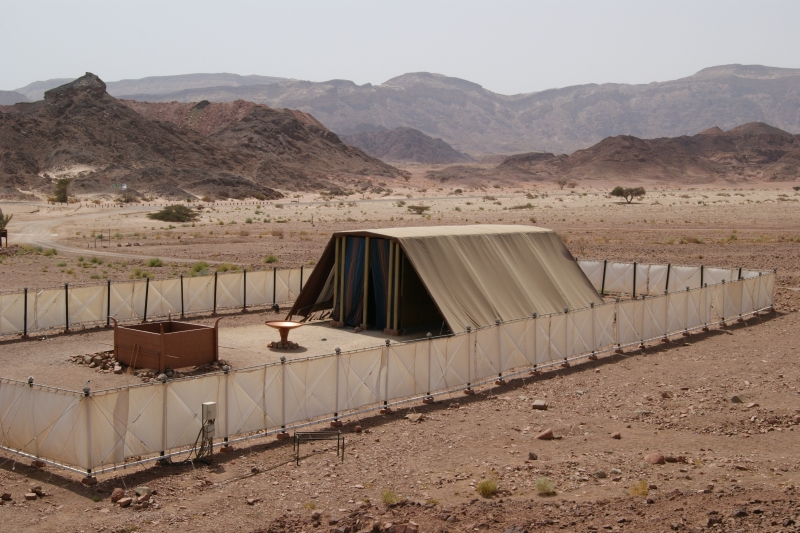
Model of the Tabernacle as seen in Timna Park, Israel shared by author through Creative Commons Attribution-Share Alike 3.0

 Exodus 40:1-33 Moses Finishes the Work of the Tabernacle

The LORD spoke to Moses: 2 On the first day of the first month you shall set up the tabernacle of the tent of meeting. 3 You shall put in it the ark of the covenant, and you shall screen the ark with the curtain. 4 You shall bring in the table, and arrange its setting; and you shall bring in the lampstand, and set up its lamps. 5 You shall put the golden altar for incense before the ark of the covenant, and set up the screen for the entrance of the tabernacle. 6 You shall set the altar of burnt offering before the entrance of the tabernacle of the tent of meeting, 7 and place the basin between the tent of meeting and the altar, and put water in it. 8 You shall set up the court all around, and hang up the screen for the gate of the court. 9 Then you shall take the anointing oil, and anoint the tabernacle and all that is in it, and consecrate it and all its furniture, so that it shall become holy. 10 You shall also anoint the altar of burnt offering and all its utensils, and consecrate the altar, so that the altar shall be most holy. 11 You shall also anoint the basin with its stand, and consecrate it. 12 Then you shall bring Aaron and his sons to the entrance of the tent of meeting, and shall wash them with water, 13 and put on Aaron the sacred vestments, and you shall anoint him and consecrate him, so that he may serve me as priest. 14 You shall bring his sons also and put tunics on them, 15 and anoint them, as you anointed their father, that they may serve me as priests: and their anointing shall admit them to a perpetual priesthood throughout all generations to come.

16 Moses did everything just as the LORD had commanded him. 17 In the first month in the second year, on the first day of the month, the tabernacle was set up. 18 Moses set up the tabernacle; he laid its bases, and set up its frames, and put in its poles, and raised up its pillars; 19 and he spread the tent over the tabernacle, and put the covering of the tent over it; as the LORD had commanded Moses. 20 He took the covenant and put it into the ark, and put the poles on the ark, and set the mercy seat above the ark; 21 and he brought the ark into the tabernacle, and set up the curtain for screening, and screened the ark of the covenant; as the LORD had commanded Moses. 22 He put the table in the tent of meeting, on the north side of the tabernacle, outside the curtain, 23 and set the bread in order on it before the LORD; as the LORD had commanded Moses. 24 He put the lampstand in the tent of meeting, opposite the table on the south side of the tabernacle, 25 and set up the lamps before the LORD; as the LORD had commanded Moses. 26 He put the golden altar in the tent of meeting before the curtain, 27 and offered fragrant incense on it; as the LORD had commanded Moses. 28 He also put in place the screen for the entrance of the tabernacle. 29 He set the altar of burnt offering at the entrance of the tabernacle of the tent of meeting, and offered on it the burnt offering and the grain offering as the LORD had commanded Moses. 30 He set the basin between the tent of meeting and the altar, and put water in it for washing, 31 with which Moses and Aaron and his sons washed their hands and their feet. 32 When they went into the tent of meeting, and when they approached the altar, they washed; as the LORD had commanded Moses. 33 He set up the court around the tabernacle and the altar, and put up the screen at the gate of the court. So Moses finished the work.

One year after the beginning of the journey the new year begins with the assembly of the tabernacle. On the first day of the first month of the second year there is a new opportunity to begin again. Just as the previous year began with the people’s position as slaves ending and their journey into the wilderness as the people of the LORD the God of Israel began, now here at the beginning of year two they witness the completion of their work for a dwelling for the LORD in their midst. The tent of meeting previously had been outside the camp and a place where only Moses and Joshua would go to. The LORD’s dream of dwelling among the people was shattered in the betrayal by Aaron and the rest of the people with the golden calf.

The craftsmen Bezalel and Oholiob and all the craftsmen and women of Israel who were a part of creating the curtains, bars, the ark, the altars, the incense and the anointing oil have completed their work. They have taken the gifts of the people, the best of precious metals, stones, fabric, spices and oils and they have used their divinely inspired talents to create this space where the LORD’s presence can inhabit. It is to be a little bit of heaven on earth, a place that can be holy because the one who will inhabit it will be holy. It is an offering of reconciliation from the people. The gifts and the work become a communal act of apology and hope that the LORD who brought them out of Egypt will come and abide in their midst.

Moses is the one who is charged with completing the work and the repetitive refrain ‘as the LORD commanded Moses’ emphasizes the obedience of Moses. The phrase occurs initially encompassing all the work and then seven additional times as it details the completion of each portion. Seven indicates completion in the bible and so the number of times the phrase is repeated is probably not a coincidence. The careful articulation also mirrors the seven days of the creation narrative and this human work of creation is offered up to the Creator of the heavens and the earth.

Moses fulfils the function that Aaron and his sons are not yet ready to perform. Moses is a holy person, a person who can go and speak to God face to face as one speaks to a friend. Moses is allowed to go into the holy spaces with the LORD. Aaron and his sons will be washed but they will still need to be ordained for their ministry to begin. In our time we are skeptical of the idea of holy people, holy place and holy things but this story points to reality that, “holy acts by holy persons in holy places give access to the liberating, healing, forgiving power of the holy God.” (Actemeir, 1997, pp. 977, Vol. 1) Moses as a holy person consecrates the act of the people, lifts up their offering to God of this place created to be holy and completes the work of the people in creating the tabernacle.

Exodus 40: 34-38 God Dwells Among the People

34 Then the cloud covered the tent of meeting, and the glory of the LORD filled the tabernacle. 35 Moses was not able to enter the tent of meeting because the cloud settled upon it, and the glory of the LORD filled the tabernacle. 36 Whenever the cloud was taken up from the tabernacle, the Israelites would set out on each stage of their journey; 37 but if the cloud was not taken up, then they did not set out until the day that it was taken up. 38 For the cloud of the LORD was on the tabernacle by day, and fire was in the cloud by night, before the eyes of all the house of Israel at each stage of their journey.

The book of Exodus ends on a hope filled note. Reconciliation has occurred to the point where God will dwell among the people. The tent of meeting becomes filled with the presence of God, the tabernacle has been accepted as a dwelling place for the holiness of the LORD of Israel. The betrayal of the golden calf has been overcome and there is a new possibility as the journey can now continue. The people of God now enter the precious and dangerous vocation of journeying with God. Moses has held together the people and the LORD through the journey from Egypt to Sinai. They are not to the promised land, but they are a people of hope. They no longer dwell under the oppression of the king of Egypt, they are a people whose God dwells among them, has established the covenant with them, and will now journey with them to the promised land. They are a people of the law which points to a new way of living, a different way than the ways of the land of Egypt they were taken out of. They are a people. They are a people who the LORD has provided for throughout their journey and promises to continue to provide for. They are a people who are expected to live a life of obedience and thankfulness for the calling they have received. Their journey continues, and they will be a people on the move. They have journeyed far but there are still many miles and many experiences that lay before they inhabit the promised land. But for now, the book of Exodus closes on a note of hope: God has forgiven. A small portion of God’s vision for the people has now been fulfilled. The journey with God continues for Moses and the people. It is a new year, a chance at a new beginning for the pilgrim people of God.

Exodus 39 Completing the Work of the Tabernacle

Erection of the Tabernacle and Sacred Vessels by Gerard Hoet (1728)

 Exodus 39: 1-31 The Vestments

Of the blue, purple, and crimson yarns they made finely worked vestments, for ministering in the holy place; they made the sacred vestments for Aaron; as the LORD had commanded Moses.

2 He made the ephod of gold, of blue, purple, and crimson yarns, and of fine twisted linen. 3 Gold leaf was hammered out and cut into threads to work into the blue, purple, and crimson yarns and into the fine twisted linen, in skilled design. 4 They made for the ephod shoulder-pieces, joined to it at its two edges. 5 The decorated band on it was of the same materials and workmanship, of gold, of blue, purple, and crimson yarns, and of fine twisted linen; as the LORD had commanded Moses.

6 The onyx stones were prepared, enclosed in settings of gold filigree and engraved like the engravings of a signet, according to the names of the sons of Israel. 7 He set them on the shoulder-pieces of the ephod, to be stones of remembrance for the sons of Israel; as the LORD had commanded Moses.

8 He made the breastpiece, in skilled work, like the work of the ephod, of gold, of blue, purple, and crimson yarns, and of fine twisted linen. 9 It was square; the breastpiece was made double, a span in length and a span in width when doubled. 10 They set in it four rows of stones. A row of carnelian, chrysolite, and emerald was the first row; 11 and the second row, a turquoise, a sapphire, and a moonstone; 12 and the third row, a jacinth, an agate, and an amethyst; 13 and the fourth row, a beryl, an onyx, and a jasper; they were enclosed in settings of gold filigree. 14 There were twelve stones with names corresponding to the names of the sons of Israel; they were like signets, each engraved with its name, for the twelve tribes. 15 They made on the breastpiece chains of pure gold, twisted like cords; 16 and they made two settings of gold filigree and two gold rings, and put the two rings on the two edges of the breastpiece; 17 and they put the two cords of gold in the two rings at the edges of the breastpiece. 18 Two ends of the two cords they had attached to the two settings of filigree; in this way they attached it in front to the shoulder-pieces of the ephod. 19 Then they made two rings of gold, and put them at the two ends of the breastpiece, on its inside edge next to the ephod. 20 They made two rings of gold, and attached them in front to the lower part of the two shoulder-pieces of the ephod, at its joining above the decorated band of the ephod. 21 They bound the breastpiece by its rings to the rings of the ephod with a blue cord, so that it should lie on the decorated band of the ephod, and that the breastpiece should not come loose from the ephod; as the LORD had commanded Moses.

22 He also made the robe of the ephod woven all of blue yarn; 23 and the opening of the robe in the middle of it was like the opening in a coat of mail, with a binding around the opening, so that it might not be torn. 24 On the lower hem of the robe they made pomegranates of blue, purple, and crimson yarns, and of fine twisted linen. 25 They also made bells of pure gold, and put the bells between the pomegranates on the lower hem of the robe all around, between the pomegranates; 26 a bell and a pomegranate, a bell and a pomegranate all around on the lower hem of the robe for ministering; as the LORD had commanded Moses.

27 They also made the tunics, woven of fine linen, for Aaron and his sons, 28 and the turban of fine linen, and the headdresses of fine linen, and the linen undergarments of fine twisted linen, 29 and the sash of fine twisted linen, and of blue, purple, and crimson yarns, embroidered with needlework; as the LORD had commanded Moses.

30 They made the rosette of the holy diadem of pure gold, and wrote on it an inscription, like the engraving of a signet, “Holy to the LORD.” 31 They tied to it a blue cord, to fasten it on the turban above; as the LORD had commanded Moses.

Perhaps the crafting of the garments for the priesthood are even more important after the incident of the golden calf in Exodus 32 to set aside Aaron and his sons for the priesthood. The directions for the vestments was outlined in Exodus 28 and I don’t have a lot to add to the earlier discussion. This is a place where the clothes do make the person.

In our modern world we don’t consider the priestly role a particularly risky one but for the Israelites there is always risk when entering the presence of the holy LORD of Israel. Yet, on behalf of the people, the priest is to put on the sacred vestments and perform their tasks. We won’t see the ordination of Moses and his sons until Leviticus 6, but as we approach the end of Exodus the vestments for their work have been created and the place where they are to minister to the LORD is ready to be presented.

Exodus 39: 32-43 The Completion of the Work

32 In this way all the work of the tabernacle of the tent of meeting was finished; the Israelites had done everything just as the LORD had commanded Moses. 33 Then they brought the tabernacle to Moses, the tent and all its utensils, its hooks, its frames, its bars, its pillars, and its bases; 34 the covering of tanned rams’ skins and the covering of fine leather, and the curtain for the screen; 35 the ark of the covenant with its poles and the mercy seat; 36 the table with all its utensils, and the bread of the Presence; 37 the pure lampstand with its lamps set on it and all its utensils, and the oil for the light; 38 the golden altar, the anointing oil and the fragrant incense, and the screen for the entrance of the tent; 39 the bronze altar, and its grating of bronze, its poles, and all its utensils; the basin with its stand; 40 the hangings of the court, its pillars, and its bases, and the screen for the gate of the court, its cords, and its pegs; and all the utensils for the service of the tabernacle, for the tent of meeting; 41 the finely worked vestments for ministering in the holy place, the sacred vestments for the priest Aaron, and the vestments of his sons to serve as priests. 42 The Israelites had done all of the work just as the LORD had commanded Moses. 43 When Moses saw that they had done all the work just as the LORD had commanded, he blessed them.

The artisans have done their work, their ministry in the creation of all the items for this holy space and the holy things to occupy the space is completed and presented to Moses. Even though the LORD’s desire to dwell among the people was placed in jeopardy by the people’s betrayal with the golden calf, they now have given and labored in the creation of this place which is a little bit of heaven on earth. They have created a mobile holy space as a pilgrim people still journeying to their promised home. It is their offering of obedience and of their treasures presented to their LORD. The work is now finished, and Moses blesses the people. The LORD has dwelt away from the people, but now the people have prepared a place in the camp for the LORD to dwell among them. As we approach the end we await to see if the LORD’s presence will occupy this space.