Tag Archives: Psalms of David

Psalm 144 Trusting God in Conflict, Yearning for God’s Blessing in Peace

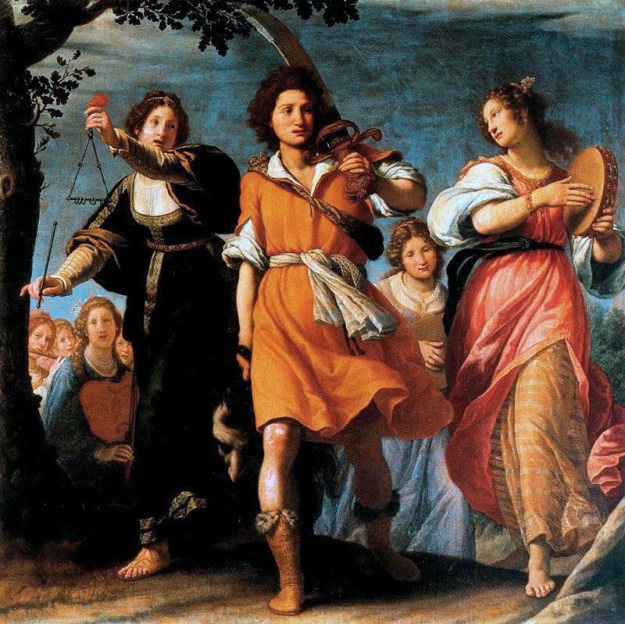
Matteo Rosselli, 1620, The Triumphant David, Galleria Palatina, Florence.

Psalm 144

Of David. 

1 Blessed be the LORD, my rock,
  who trains my hands for war and my fingers for battle,
 2
 my rock and my fortress,
  my stronghold and my deliverer,
 my shield, in whom I take refuge,
  who subdues the peoples under me.

3
 O LORD, what are humans that you regard them,
  or mortals that you think of them?
4
 They are like a breath;
  their days are like a passing shadow.

5
 Bow your heavens, O LORD, and come down;
  touch the mountains so that they smoke.
6
 Make the lightning flash and scatter them;
  send out your arrows and rout them.
7
 Stretch out your hand from on high;
  set me free and rescue me from the mighty waters,
  from the hand of foreigners,
 8
 whose mouths speak lies
  and whose right hands are false.

9
 I will sing a new song to you, O God;
  upon a ten-stringed harp I will play to you,
 10
 the one who gives victory to kings,
  who rescues his servant David.
11
 Rescue me from the cruel sword,
  and deliver me from the hand of aliens,
 whose mouths speak lies,
  and whose right hands are false.

12
 May our sons in their youth
  be like plants full grown,
 our daughters like corner pillars,
  cut for the building of a palace.
13
 May our barns be filled
  with produce of every kind;
 may our sheep increase by thousands,
  by tens of thousands in our fields,
  14
 and may our cattle be heavy with young.
 May there be no breach in the walls, no exile,
  and no cry of distress in our streets.

15
 Happy are the people to whom such blessings fall;
  happy are the people whose God is the LORD.

Bolded words have comments on translation below.

My first memory of Psalm 144 was reading it be used as a prayer by Robert E. Lee in Michael Shaara’s The Killer Angels and later in the movie adaptation of the book Gettysburg. After reading these words I suspected they were a psalm and so I pulled out my bible and searched for the words and went on to read the entire psalm. This was many years before I was called to ministry and I found the opening words of the psalm a comforting phrase during my time as an officer in the U. S. Army. Many years later I would utilize this psalm during the funeral of my grandfather, Walter Clarkson, who had retired from the Army. Yet this psalm is never utilized in the Sunday readings in the Revised Common Lectionary which is why it took its quotation in a work of historical fiction for me to initially discover it.

My educated guess as to the reason this psalm is omitted from the lectionary is its opening line where the LORD prepares the speaker, David in the attribution, for combat. A reader in the United States in the twenty first century may be able to view conflict as a distant thing, but in the world of King David and throughout the story of Israel, military conflict was a frequent reality. As N.T. Wright comments in The New Testament and the People of God:

The land of Israel is a small country…But it has an importance out of all proportion to its size. Empires have fought over it. Every forty-four years out of the last four thousand, on average, an army has marched through it, whether to conquer it, to rescue it from someone else, to use it as a neutral battleground on which to fight a different enemy, or to take advantage of its natural route for getting somewhere else to fight there instead. (Wright, 1992, p. 3)

Israel was never an empire with a massive army. The Deuteronomy 17:16 prohibits the king from going down to Egypt to acquire the horses and chariots that which many armies in the region utilized. The leaders and soldiers of Israel were expected to depend on the LORD rather than either the newest technology or the size of their army. David was a warrior king, and these initial verses make sense within the story of his life shaped by frequent moments of combat.

Psalm 144 echoes the language of several other psalms. Nancy deClaissé-Walford has a helpful summary of the echoes:

It contains echoes of a number of other psalms in the Psalter, including Pss. 8:4 in 144:3; 39: 5-6 in v. 4; 33:2 and 3 in v. 9; and 33:12 in v. 15. But most prevalent in Psalm 144 are connections to Psalm 18, another royal psalm: 18:1, 2, 34, 46, 47 to 144: 1, 2; 18:9 to v.5; 18:14 to v. 6; 18:16, 44, 45 to vv. 7, 11; and Psalm 18’s superscription to v. 10. (Nancy deClaisse-Walford, 2014, p. 984)

Many commentaries treat Psalm 144 as a collection of sayings taken from other psalms and stitched together to create a psalm for a new situation. Although it is possible that Psalm 144 was composed in this way I find it likely that the commonalities in language are reflective of the language used in worship, giving vocabulary and structure to their prayers. Both Psalm 18 and 144 are attributed to David and the commonalities may also be due to a common authorship.

Because of the similarities between Psalm 144 and Psalm 18 the NRSVue harmonizes verse two, unnecessarily in my opinion, with 18:2. This obscures the Hebrew of 144:2 which states “my hesed (steadfast love) and my fortress.” The hesed of God is a critical idea in Hebrew and although the LORD is called the rock in the previous verse, the introduction of steadfast love here makes sense within the context. God’s steadfast love and deliverance are placed alongside God’s functioning as a safe space (tower/fortress, shield, refuge) for the psalmist.

Verse three transitions to a place of wondering about God’s regard for the psalmist. The language echoes the wonder of Psalm 8:4, but the words for humans (Hebrew ‘adam) and mortals (Hebrew ben ‘enos) are both singular. “What is a man (person) that you care for them, a son of man (human) that you think of them?” They are hebel[1] (NRSVue ‘breath). Hebel is one of the favorite words of Ecclesiastes meaning breath, wind, vapor, mist. It is an evanescent word translated ‘vanity’ in Ecclesiastes. The individual human may be as temporary as the wind or mist or may pass like a shadow. Yet, God still takes notice of them and prepares them for the conflicts they must face.

Many of the themes in verses five to eight are similar to the language in Psalm 18, but here the psalmist is asking for the LORD to act where in Psalm 18 they are recounting how God acted. As the individual prepares for an upcoming conflict, they ask for God to act in powerful ways: making the mountains smoke and lightning flash (like God’s appearance at Sinai). They ask their God who is their rock, stronghold, and fortress to deliver them from a perilous situation described metaphorically as a rising flood. Yet, the threat in the moment of this psalm’s composition appears to be an external enemy, foreigners/aliens (Hebrew bene-nakar in verses 7 and 11), who are unreliable. Perhaps a treaty has been violated, or some other deceptions have placed the psalmist in a situation where they must fight this foe. If the psalm comes from King David, his reign was full of conflicts.

In response to the LORD’s anticipated action on behalf of the leader and the people the psalmist promises a new song to God. God’s deliverance of the king will be the inspiration of this new song of praise. The “evil sword” (NRSVue ‘cruel sword’) is an expression only found in this psalm. The sword has been used as a figure of speech for the words of the wicked in other psalms.[2] (Mays, 1994, p. 436) Yet, the language of this psalm seems to fit with the preparation for real and not metaphorical conflict. The impact of armed conflict on an individual, an army, and a people can be devastating and I read this psalm as asking for deliverance from the harm that the enemy’s weapons can inflict.

The psalm turns from the concerns of war to the longing for the prosperity of peace. The psalmist’s immediate concern may be God preparing them for the upcoming fight but they long to think about sons and daughters, the harvest of the field and the produce of the flocks. Verse fourteen likely speaks of the delivery of livestock without complications rather than a breech in the walls of the city (Nancy deClaisse-Walford, 2014, p. 988) but the overall sense of the verse is clear. A time when children can grow in peace, harvests are plentiful, animals are productive, and no one cries in distress. They prepare for war as they long for times of peace.

The psalm began with one word for blessing (Hebrew baruk) and the final verse now ends with another word for blessed (NRSVue ‘happy, Hebrew ‘asre). (Bellinger, 2014, p. 599) The Hebrew ‘asre[3] is frequently used in the psalms and wisdom literature and here the psalm ends with two statements beginning with ‘asre. Happy/blessed/content are the people on whom such blessings fall is linked with happy/blessed/content are the people whose God is the LORD. The psalmist proclaims that those who trust the LORD in the times of conflict will experience the blessing of the LORD in times of peace. Ultimately the psalm is one of trust that the LORD will both deliver and provide: be the rock, fortress, stronghold, and deliverer for the psalmist in their time of need and the one who gives the blessing of children, harvests, and flocks. They bless the LORD and they anticipate they will also experience blessing/happiness/contentment because they have trusted the LORD as their God.


[1] Sometimes written as hevel. In Hebrew the ‘b’ and ‘v’ sound are the same consonant. For more on this term see my comments on Ecclesiastes 1.

[2] Psalm 57:4; 64:3.

[3] The Hebrew ‘asre is translated as markarios in the Septuagint, the Greek translation of the Old Testament. This is the same Greek term used at the beginning of the Sermon of the Mount for ‘blessed’ in Matthew 5: 1-12.

Psalm 143 Seeking a Gracious God to Deliver

St. Paul Writing His Epistles probably by Valentin de Boulogne (1618-1620)

Psalm 143

A Psalm of David

1 Hear my prayer, O LORD;
 give ear to my supplications in your faithfulness;
 answer me in your righteousness.
2
 Do not enter into judgment with your servant,
 for no one living is righteous before you.

3
 For the enemy has pursued me,
 crushing my life to the ground,
 making me sit in darkness like those long dead.
4
 Therefore my spirit faints within me;
 my heart within me is appalled.

5
 I remember the days of old;
 I think about all your deeds;
 I meditate on the works of your hands.
6
 I stretch out my hands to you;
 my soul thirsts for you like a parched land.  Selah

7
 Answer me quickly, O LORD;
 my spirit fails.
Do not hide your face from me,
 or I shall be like those who go down to the Pit.
8
 Let me hear of your steadfast love in the morning,
 for in you I put my trust.
Teach me the way I should go,
 for to you I lift up my soul.

9
 Save me, O LORD, from my enemies;
 I have fled to you for refuge.
10
 Teach me to do your will,
 for you are my God.
Let your good spirit lead me
 on a level path.

11
 For your name’s sake, O LORD, preserve my life.
 In your righteousness bring me out of trouble.
12
 In your steadfast love cut off my enemies,
 and destroy all my adversaries,
 for I am your servant.

The paradox of this psalm is that the speaker comes from a stance of submissiveness in need of God’s gracious deliverance while having enough trust in the relationship with their God to address God in a demanding way. The psalmist asks for God to: Hear, give ear, answer (1) do not enter into judgment (2), do not hide your face, let me hear, teach (7-8), save (9), teach, let your spirit lead (10), preserve, bring me out (11) cut off, and destroy (12). Yet the tone of the psalm for all these petitions comes from the position of one not asking for God’s action based on their worthiness or merit, but instead as one seeking a gracious God who will act decisively on behalf of God’s servant.

The psalm begins with an appeal to two of God’s characteristics: faithfulness (‘emet) and righteousness (tzedakah) and ends with an appeal to God’s righteousness and steadfast love (hesed). Righteousness is key to the movement of the psalm as the psalmist appeals twice to God’s righteousness but declares their own inability to be righteous before God. The idea that no person is righteous before God echo some of the declarations of Job and Ecclesiastes.[1] Job and his dialogue partners who seek a reason for Job’s suffering circle around this idea of the inability of a person to stand before God and the book ends with Job in humility answering God that he cannot stand before God. Ecclesiastes seeks meaning in the emptiness the teacher feels at his accomplishments and realizes that his actions eventually bring them into judgment before God. Now this servant of God in their unworthiness asks for God to forgo judgment based on worthiness and respond to their desperate need in grace.

The servant’s position is one of weakness. As in the previous psalm they are hunted, but in this psalm they have been captured and oppressed. The language is that of being near death: life crushed into the ground, sitting in darkness like the dead, a fainting spirit and an appalled heart at their inability to resist their persecutors actions. In this vulnerable state they remember[2] times past when God acted and they thirst for God like a parched land for rain. If in this moment of metaphors of being near death or being parched like the desert if God hides God’s face the speaker will be like the dead who descend to the Pit. Their spirit/breath[3] is failing and the long to hear of God’s steadfast love (hesed) in the morning that can bring their deliverance. They lift up their whole being (NRSV soul, Hebrew nephesh) to God requiring God’s instruction that they may walk in God’s way.

The servant asks for God’s deliverance for the sake of God’s name and reputation and not for their own worthiness. It is God’s righteousness that can bring them out of trouble, God’s steadfast love that will cut off their enemies and destroy their adversaries. The title of servant/slave (Hebrew abad) ties the speaker to the household of God and although this is a title of servitude it also implies responsibility of the master of the house defending and protecting the entire household. Yet, this servant of God is completely dependent upon God for delivering them from the threshold of death and saving them from their oppressors. In their own weakness they can only hope and remember the gracious nature of their God.

The servant of God’s dependence upon receiving a gracious deliverance without being able to stand before God in righteousness provided a scriptural building block for the Apostle Paul’s concept of justification by faith. As Paul can state in Romans 3:20,” For no human will be justified before him by deeds prescribed by the law, for through the law comes the knowledge of sin.” Paul, like the psalmist, would lean into the relationship of the individual to their God relying on grace instead of justice. Like the psalmist, Paul spoke from a position of unworthiness desperate for God’s gracious deliverance of God’s servant.


[1] Job 9:2, 32; 14:3; 15:14; 22: 2-4; 25:4; Ecclesiastes 11:9; 12: 14. See also Psalm 14:3 and 130:3.

[2] Remember (zakar) is a powerful concept in Hebrew utilized over two hundred times in the Old Testament. (Nancy deClaisse-Walford, 2014, p. 982) The thing remembered becomes the central thing to the person remembering, often the one thing they are holding onto.

[3] Hebrew ruach means breath, spirit, or wind.

Psalm 142 A Cry to God for Deliverance in a Desperate Time

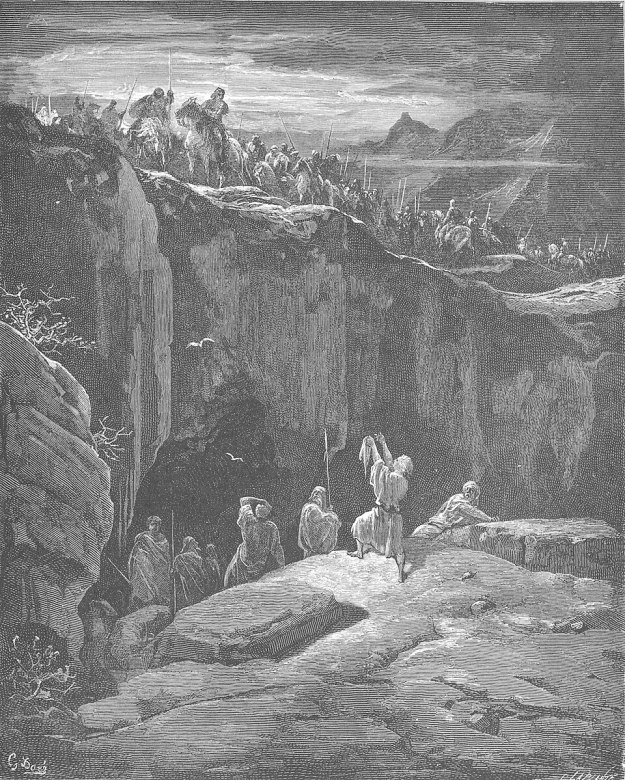
David Shows Saul How He Spared His Life (1Sam. 24:2-20) By Gustave Doré – Doré’s English Bible, Public Domain, https://commons.wikimedia.org/w/index.php?curid=10732139

Psalm 142

A Maskil of David. When he was in the cave. A Prayer. 

1 With my voice I cry to the Lord;
  with my voice I make supplication to the Lord.
 2
 I pour out my complaint before him;
  I tell my trouble before him.
 3
 When my spirit is faint,
  you know my way.

 In the path where I walk,
  they have hidden a trap for me.
 4
 Look on my right hand and see:
  there is no one who takes notice of me;
 no refuge remains to me;
  no one cares for me.

 5
 I cry to you, O Lord;
  I say, “You are my refuge,
  my portion in the land of the living.”
 6
 Listen to my cry,
  for I am brought very low.

 Save me from my persecutors,
  for they are too strong for me.
 7
 Bring me out of prison,
  so that I may give thanks to your name.
 The righteous will surround me,
  for you will deal bountifully with me.

The superscription of this psalm has two possible moments in the life of David. The first is in 1 Samuel 22 when David is in the cave at Adullam. David in this portion of his story has just departed from King Achish of Gath after pretending to be mad.[1] David arrives at Adullam alone, but later is met by family and other followers there. The alternative is when he is in the wilderness of En-gedi, fleeing from Saul’s army. This is the cave where David has the opportunity to kill Saul but only cuts off a portion of his cloak because he will not strike the LORD’s anointed one (1 Samuel 23-24). This psalm in which the speaker feels oppressed and abandoned by the community of faith could fit either situation or many other situations that people of faith have encountered.

The psalmist cries to the LORD from a moment where they feel alone, overwhelmed, and trapped. The verb for “cry to” is different from “call upon” at the beginning of Psalm 141. Here the word is the Hebrew za’aq, “which conveys the idea of crying out in acute distress and seeking deliverance.” (Nancy deClaisse-Walford, 2014, p. 978) The word occurs twice in this psalm (vs. 1,5) and only three other times in the psalms (22:5; 107: 13,19). Yet, as J. Clinton McCann, Jr. notes

Hebrew za’aq…it recalls the exodus (see Exodus 2:23); it is a crucial part of the pattern in the book of Judges (see Judges 3:9, 15; 6: 6-7); indeed, it became understood as a typical element in God’s dealing with God’s people. (NIB IV: 1247)

Within the story of Israel, when they groaned and cried out (za’aq) to God, God heard and remembered them. Now the psalmist taps into this belief and cries out to God that they may be heard and remembered. They speak their complaint and trouble from this hiding place in the wilderness where their spirit is faint, they trust that God knows the way to their refuge.

Much of the imagery of the poem is related to hunting with the psalmist as the prey being pursued. The pursuit of their enemies has left them vulnerable and alone. Enemies can lay traps but there is no one at the right hand to come to the aid of the psalmist. In the language of the poem there is no where left for them to flee, no refuge to seek, they are imprisoned by the pursuing enemy. They are brought low and do not have the power to deliver themselves. Their only hope is that God will be their refuge, bring them out of their imprisonment, and deliver them from their pursuers. They desire to be in a place where they can be in the company of the righteous again, rather than being isolated and surrounded by their oppressors. Yet, even in their distress they trust that their God will deliver, deal bountifully with them, release them from prison, and return them to their place among God’s faithful people.


[1] Achish was aware of David as an opponent when he served under Saul and was suspicious of David’s loyalties, so David pretended to be mad but ultimately departs for Adullam when he is not welcome in Achish’s house.

Psalm 141 Keep My Words and My Heart from Evil

Burning incense stick and its smoke by Atan0 shared under CC-SA 4.0 https://commons.wikimedia.org/wiki/File:Incense_stick.JPG#/media/File:Incense_stick.JPG

Psalm 141

A Psalm of David

1 I call upon you, O LORD come quickly to me;

  give ear to my voice when I call to you.

2 Let my prayer be counted as incense before you

  and the lifting up of my hands as an evening sacrifice.

3 Set a guard over my mouth, O LORD;

  keep watch over the door of my lips.

4 Do not turn my heart to any evil,

  to busy myself with wicked deeds

 in company with those who work iniquity;

  do not let me eat of their delicacies.

5 Let the righteous strike me;

  let the faithful correct me.

 Never let the oil of the wicked anoint my head,

  for my prayer is continually against their wicked deeds. 

6 When they are given over to those who shall condemn them,

  then they shall learn that my words were pleasant.

7 Like a rock that one breaks apart and shatters on the land,

  so shall their bones be strewn at the mouth of Sheol.

8 But my eyes are turned toward you, O GOD, my Lord;

  in you I seek refuge; do not leave me defenseless.

9 Keep me from the trap that they have laid for me

  and from the snares of evildoers.

10 Let the wicked fall into their own nets,

  while I alone escape.

The rich poetic imagery of the prayers of the worshipper ascending to God like the fragrant smoke of burning incense has always been a memorable aspect of this psalm. In my own practice this psalm is frequently used in evening prayer within the setting of Marty Haugen’s Holden Evening Prayer where verse two of the psalm becomes the refrain for the psalmody. Yet within the psalm there is a contrast between this slow imagery of prayers ascending like incense at the evening sacrifice and the urgent call of the psalmist for God to hear and come quickly. There are numerous verbal links with Psalm 140[1] but they are used to a different end. Psalm 140 cries out for God to deliver the psalmist from the poisonous words of violent men, but Psalm 141 calls on God to prevent the petitioner from their own heart and mouth being used for wickedness.

The psalm is linked poetically to the actions of worship: burning incense and offering a sacrifice. These words may originate during worship, or the author may view these words as a sacrifice and pleasant odor they can present before God. I appreciate the multisensory image which involves both scent and a visual image combined with the audible speaking of these words before God. If the prayer is offered at the evening sacrifice the petitioner may be hoping to partake in the holy portion of the evening sacrifice rather than the delicacies of those who work iniquity.

The psalmist called for God’s immediate action and that action is turned towards delivering them from the words and practices of the wicked. The language of the psalm is echoed in the warnings about appropriate companions scattered throughout Proverbs and many readers of this psalm believe the author has become associated with companions whose words and actions are evil. They ask God to guard their mouth and watch the door of their lips to prevent their tongue from becoming like the tongues sharp and snakes and lips with the venom of vipers in the previous psalm. Similarly, they ask God to keep their heart from evil and wicked deeds in the company of those who work iniquity. It is plausible that those the author speaks of are royalty and he may be echoing Proverbs 23:2, “Do not desire an official’s delicacies, for they are deceptive food.”

Any translation of verses five to seven of the psalm have had to smooth out the Hebrew text.[2] The NRSVue does a good job of creating a stanza that makes sense and I will follow their translation in continuing to discuss the psalm. The psalmist asks for the righteous to correct them, even striking them to discipline them. The language of anointing may indicate that the ones the psalmist speaks about are royalty and their anointing of the psalmist would be recognizing him as included in their group. Perhaps the psalmist is a prophet who has been speaking words that the princes and nobles did not want to hear, but they have attempted to entice him to join with them. Ultimately the psalmist agrees with the belief that God will not allow the wicked to prosper forever and eventually their bones will be scattered like a rock that shatters when it is cast against the ground.

They know that they are in danger of being ensnared by these wicked ones. Whether they have willingly been seduced into this position or these evil ones are attempting to trap them in words or actions, they understand that their deliverance will come from God. God can guard their mouth from words that can be used against them, turn their heart away from the acts which are contrary to God’s wisdom, or to be tempted by the delicacies that these workers of iniquity have set before them. Instead, the psalmist asks that these evil ones would fall into their own traps, ensnared in their own plots and actions. Just as Christians regularly pray “lead us not into temptation and deliver us from evil” this psalmist knows the dangers of the temptations and the lure of the evil snares set for them.

The appeal of the psalm for God to guard our lips, our hearts, and ultimately our actions in an environment of temptation is a prayer that resonates for followers of every time. Hundreds of billions of dollars are spent annually on advertising that asks us to taste the delicacies set before us. The digital world and the real world are full of traps to ensnare us in actions that we know are foolish but find enticing. The life of faith involves sending up prayers to God for words and actions that are faithful instead of wicked. We all need to be delivered from temptation. I certainly have had times where I needed divine help to restrain my tongue or to give me the strength to live according to my convictions. I have needed the correction of faithful brothers and sisters in the body of Christ. For me the psalm is a reminder that we rely on God and God’s people as we attempt to live a faithful life amid a world of temptations.


[1] Nancy deClaissé-Walford lists nine verbal connections: ““Wicked” (rasa) occurs in Pss. 140:8 and 141:4, 10; “righteousness” (sadiq) in 140:3 and 141:5; “guard, keep” (samar) in 140:4 and 141: 3, 9; “lip” (sapa) in 140:3,9 and 141:3; “malicious” (ra’) in 140: 1,2, 11 and 141:4; “LORD my Lord (YHWH’adonay) in 140:7 and 141:8; “trap” (pah) in 140:5 and 141:9; “snare” (moqes) in 140:5 and 141:9; and “lend an ear” (‘azan) in 140:6 and 141:1.” (Nancy deClaisse-Walford, 2014, p. 972)

[2] Nancy deClaissé-Walford attempts to give a closer translation to the Hebrew:

5 Let the righteous strike me with hesed and reprove me;

                let my head not refuse such oil

                Indeed continually my prayer is against their maliciousness.

6 Let their judges be hurled down into the hands of the rock,

                And then they will hear my sayings, for they are pleasant.

7 Like the furrowing and breaking up of the earth,

                our bones are scattered to the mouth of Sheol. (Nancy deClaisse-Walford, 2014, p. 973)

Psalm 140 Deliver Me From the Poisonous Words of Violent Ones

King David, the King of Israel by Gerard van Honthorst

Psalm 140

To the leader. A Psalm of David. 

1 Deliver me, O LORD, from evildoers[1];
  protect me from those who are violent,
 2
 who plan evil things in their minds
  and stir up wars continually.
 3
 They make their tongue sharp as a snake’s,
  and under their lips is the venom of vipers.  Selah

 4
 Guard me, O LORD, from the hands of the wicked;
  protect me from the violent
  who have planned my downfall.
 5
 The arrogant have hidden a trap for me,
  and with cords they have spread a net,
  along the road they have set snares for me.  Selah

 6
 I say to the LORD, “You are my God;
  give ear, O LORD, to the voice of my supplications.”
 7
 O LORD, my Lord, my strong deliverer,
  you have covered my head in the day of battle.
 8
 Do not grant, O LORD, the desires of the wicked;
  do not further their evil plot.  Selah

 9
 Those who surround me lift up their heads;
  let the mischief of their lips overwhelm them!
 10
 Let burning coals fall on them!
  Let them be flung into pits, no more to rise!
 11
 Do not let the slanderer be established in the land;
  let evil speedily hunt down the violent!

 12
 I know that the LORD maintains the cause of the needy
  and executes justice for the poor.
 13
 Surely the righteous shall give thanks to your name;
  the upright shall live in your presence.

Psalm 140 is the poetic prayer of an individual asking God to deliver them from violent adversaries. The Hebrew of the poem divides into four roughly equal parts (divided by the word selah) with a closing statement of trust.[2] The first two sections use the metaphors of venomous snakes, warfare, and hunting to describe the actions of the violent ones to the God who can deliver the psalmist. The central section turns away from the violent ones to the God who delivers the psalmist in the midst of battle. The fourth section asks for God’s judgment on these evil and violent opponents before the final two verses again return to the God who maintains the cause of the needy.

The enemies are identified only as evildoers, violent, and wicked. Although the psalmist utilizes the metaphor of warfare it is likely that the enemies’ actions may be primarily verbal with the focus on the tongue and lips in the serpent imagery and the hiding of traps for a hunter. That does not mean that the threat is not ominous. The enemies may be attempting to ensnare the psalmist through their word games in court or poison their reputation. These violent ones are stirring up conflict and evil, planning the downfall and entrapment of the faithful psalmist.

God is named at the beginning of each of the first two sections, but in the central section the name of God is called out four times.[3] The LORD is the psalmists God, and then the psalmist asks their God to hear their supplications. The word translated supplications comes from the verbal root hanan which is translated “showing favor” in Psalms 111, 112, and 123 and is part of the self-description of God in Exodus 34:6. The psalmist declares their allegiance to their God and God’s description of Godself before returning to the military metaphors where God clothes them for battle and delivers them. The psalmist closes this section by appealing to God to not grant the desires of the wicked, but instead to hear the appeals of the righteous one.

In the fourth section returns to the enemies that have risen against the psalmist. This section again returns to the verbal themes with the mischief of the lips being turned against those who speak violently against the psalmist. Now the psalmist asks God to judge them with burning coals, falling into the pit. Ultimately the psalmist asks that evil would hunt down these violent, wicked ones. As with all cries to God to judge the enemy, the enemy resides in God’s hands and not the psalmist.

The psalmist closes with a note of trust which calls again on God as the one who protects the needy and poor. The psalmist trusts that their current situation where the wicked and violent successfully oppress the righteous will not last. God hears the cry of the vulnerable and defends them. God will not allow the wicked to prosper indefinitely. The psalmist looks forward to the day when they can give thanks to the LORD for the way God has delivered them from this moment of trouble.


[1] “The Hebrew word is ‘ra, most often translated as “evil.” The word “evil” in English carries an ethical, moral tone that, while appropriate for Ps. 140, is probably not as appropriate as malicious, which means, “having, shown, or cause by malice; spiteful; intentionally mischievous or harmful.”” (Nancy deClaisse-Walford, 2014, p. 968)

[2] Clifford Allen noted that verses 1-3 contain twenty-three Hebrew words, ending with selah; verses 4-5 contain twenty-three words, ending with selah; verses 6-8 contain twenty-four words, ending with selah; verses 9-11 contain twenty-three words with verses 12-13 as a closing statement of trust. (Nancy deClaisse-Walford, 2014, p. 967)

[3] In English translations the capitalized LORD indicates that the four letters of the divine name are behind the translation (YHWH) with vowel markings indicating it is to be spoken as Adonai (Lord). In verse seven the second Lord is the Hebrew Adonai.