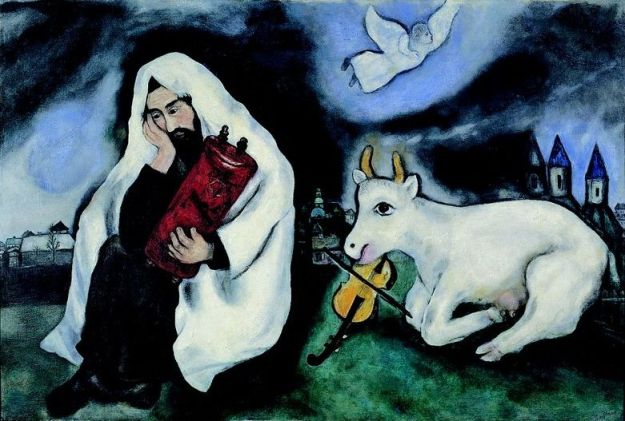
Marc Chagall, Solitude (1933)
Psalm 88
<A Song. A Psalm of the Korahites. To the leader: according to Mahalath Leannoth. A Maskil of Heman the Ezrahite.>
1 O LORD, God of my salvation, when, at night, I cry out in your presence,
2 let my prayer come before you; incline your ear to my cry.
3 For my soul is full of troubles, and my life draws near to Sheol.
4 I am counted among those who go down to the Pit; I am like those who have no help,
5 like those forsaken among the dead, like the slain that lie in the grave, like those whom you remember no more, for they are cut off from your hand.
6 You have put me in the depths of the Pit, in the regions dark and deep.
7 Your wrath lies heavy upon me, and you overwhelm me with all your waves. Selah
8 You have caused my companions to shun me; you have made me a thing of horror to them. I am shut in so that I cannot escape;
9 my eye grows dim through sorrow. Every day I call on you, O LORD; I spread out my hands to you.
10 Do you work wonders for the dead? Do the shades rise up to praise you? Selah
11 Is your steadfast love declared in the grave, or your faithfulness in Abaddon?
12 Are your wonders known in the darkness, or your saving help in the land of forgetfulness?
13 But I, O LORD, cry out to you; in the morning my prayer comes before you.
14 O LORD, why do you cast me off? Why do you hide your face from me?
15 Wretched and close to death from my youth up, I suffer your terrors; I am desperate.
16 Your wrath has swept over me; your dread assaults destroy me.
17 They surround me like a flood all day long; from all sides they close in on me.
18 You have caused friend and neighbor to shun me; my companions are in darkness.
Psalms 88 and 89 stand together at the end of book three of the book of Psalms and take us into the darkest despair of the entire book. (Nancy de Claisse-Walford, 2014, p. 668) Both prayers are appeals for help that have no resolution within the psalm and while Psalm 89 is a prayer grieving the destruction of Judah and the loss of the promises to the line of David, Psalm 88 is the prayer of an individual who is either metaphorically or physically at the point where, “Death is so near and so real that it becomes the subject of the lament.” (Mays, 1994, p. 282) This is not the type of prayer that was taught in Sunday school, nor is this psalm used in the worship of most churches. Its vision of the world is darker than many churches are comfortable with but it also speaks honestly to the experience of deep darkness that many both inside and outside the church experience. The daring language of the psalm, which is willing to declare that God is responsible for their dire circumstance, turns on the head the vision of Psalm 56:4 or Romans 8:31 as it wonders, “if God is against me, who can be for me?” The psalmist’s words break forth from the dark night of the soul where their abandonment by God and their companions leaves only darkness to know them.
The psalm is attributed to Heman the Ezrahite. It is possible that the intent is to attribute the psalm to Heman who is listed as one of the wise men who Solomon surpasses in 1 Kings 4:31 or Heman the singer, one of the Kohathites appointed by David in 1 Chronicles 6:33. It is also possible that it is the same individual referred to in both 1 Kings and 1 Chronicles (singers/psalmists would be considered wise in Hebrew society) but it is also likely that the Heman referred to in the psalm is a different person unmentioned elsewhere in scripture. Regardless of the authorship of the psalm, it speaks in the brutally honest language of the Hebrew Scriptures that many contemporary Christians have little exposure to.
The psalm begins in a pious cry out to God, crying out to God for God’s attention to the prayers of the one dependent on God’s salvation. The prayer uses three different words for ‘crying out’ to God in verse 1, 9b and 13 (NIB IV: 1027) exhausting the language of prayer as they desperately seek an answer from the God who is both their only hope of salvation and the source of their troubles. The psalm begins with language that would is the traditional language of prayer learned in worship. Yet, once the prayer begins the dam holding back the psalmist’s words breaks and their desperation and abandonment cannot be contained. The pain of the psalmist rushes forth from the shattered walls of convention and flows into an irresistibly honest prayer that emerges from the space of death, darkness, and despair.
The stakes of this prayer are incredibly high for the psalmist. The very center of their life[1] is threatened. The psalmist deploys an incredible number of words for death: Sheol, the Pit, like the dead, slain, grave, those you remember no more, cut off from your hands, in the regions dark and deep, shades (Hebrew Rephaim), Abaddon, darkness, the land of forgetfulness. Almost every line has the presence of death within this prayer. This deployment is especially striking when compared to the rest of the Hebrew Scriptures which rarely talk about death and the afterlife. In verses three to five the mentions of death indicate the serious nature of the psalmist’s petitions but the jarring realization comes in verse six when the psalmist turns their invective to God and declares that God is the one responsible for the psalmist’s situation. God may be the psalmist’s salvation but God is also, in this psalm, the psalmist’s oppressor.
The psalmist girds up their loins and stands before God in accusation declaring that God has put them at death’s door, that God’s wrath is actively overwhelming the psalmist in waves, and God has caused the alienation of the psalmist from their companions. Many Christians are not familiar with this type of accusatory language directed at God and are surprised at the directness of this psalm or Jeremiah’s accusations of God.[2] As mentioned in my comments on Psalm 86 there is a relationship between the servant and their Lord, and here the servant boldly claims that their Lord has violated their relationship. Where the servant needed protection, their Lord has overwhelmed them with wrath. Where the servant looks for a compassionate answer, the answer[3] they receive is unbearable. The actions of God have alienated the servant from both God and their companions making them, like Job, one despised and one cursed by God.
The psalmist’s eyes growing dim is not a statement of eyesight, but indicates that their vitality is failing. Physically and mentally, they are dying and yet they continue to cry out to God. They cry out from a place of “abandonment and lostness…so great that it saturates the soul so there is room for nothing else.” (Nancy de Claisse-Walford, 2014, p. 671) But it is heartbreaking that for the psalmist it is God who has cast them into this space of darkness and death and then turns away from their cries. In a series of six rhetorical questions: Do you work wonders for the dead? Do the shades rise up to praise you? Are your wonders known in the darkness, or your saving help in the land of forgetfulness? Is your steadfast love declared in the grave, or your faithfulness in Abaddon? The answer to each of these rhetorical questions in the vision of the psalmist is no! As mentioned above the Hebrew scriptures rarely talk about death and the afterlife and there is no conception of heaven and hell as destinations for the people of God in the psalms. Psalm 88 deploys this shocking set of questions to the God of life to get their either unresponsive or oppressive God to relent and deliver their servant from death or the relationship will be broken and God will be the unfaithful one who broke it. In the Psalms when the concept of death, Sheol, the Pit, or Abaddon are mentioned it is assumed that there is no longer any communication between the deceased and God.[4] The only freedom this psalm offers the psalmist is the freedom of the dead where God either does not remember or has actively cut off God’s servant. (Nancy de Claisse-Walford, 2014, p. 671) Yet the psalmist cries out to their Lord as a servant desiring to continue to serve their God in the land of the living.
The psalmist cries out one final time in verse thirteen. Their prayers come before God and even boldly confront[5] God asking God to relent. God’s anger has left the psalmist in the space of darkness and death. There is no escape for the servant from the anxiety filled and deathly state of the servant’s life. There is no answer as the psalm reaches its final gasp, there is only the cry of the servant thrown “against a dark and terrifying void” (Nancy de Claisse-Walford, 2014, p. 669) The final word of the psalm is darkness.[6] The sad final phrase is obscured by the NRSV’s translation. The NIV’s “darkness is my closest friend” or Beth Tanner’s “only darkness knows me” (Nancy de Claisse-Walford, 2014, p. 670) better captures the isolation and abandonment that the psalm closes with. We may rebel against a psalm where death and darkness have the final word, but the book of Psalms reminds us that there are times where the faithful ones of God may find themselves in the God forsaken place where God seems silent, absent, or angry; where relationships prove themselves unfaithful, and where the agonizing prayer breaks forth to God from the death’s door where no light seems to be able to penetrate the darkness of the faithful one’s world.
Nobody would choose to walk into the place of depression and suffering where death and darkness seem to be their only companion, but even people of faith may find themselves in these spaces that appear devoid of God’s steadfast love and compassion. Depression can make the world feel like a place where darkness is the sufferer’s only companion and death may cry out to them. Even faithful people can suffer from bouts of depression so deep that suicide and death seem closer than God. God does not condemn these words of the psalmist as faithless, instead they are placed within the scriptures of God’s people. From a Christian perspective we may answer the rhetorical questions of Psalm 68 differently than the psalmist: from a Christian perspective, to quote Paul, “If we live, we live to the Lord, and if we die, we die to the Lord; so then, whether we live or whether we die, we are the Lord’s.” (Romans 14:8) Yet, this psalm invites us to walk into the swampland of the soul, pitch a tent, and get to know the lay of the land. It invites us to dwell in the God forsaken place of the crucifixion without immediately jumping forward to the surprise of the resurrection. Sometimes resurrection takes time, sometimes prayers end in darkness as they await a response from God, and sometimes faithful ones walk through the valley of the shadow of death. This uncomfortable psalm invites us into an honest relationship with God that demonstrates a confrontational or defiant calling upon God to act in compassion and love rather than abandonment or wrath. We may not like that darkness has the last word and we may want a happy ending to occur within eighteen verses, but sometimes we dwell in darkness and hope for a light which we cannot see but our faith longs for.
[1] The NRSV’s ‘soul’ in verse 3 is the Hebrew nephesh which occurs frequently in the psalms but the modern idea of ‘soul’ comes from Greek thought instead of Hebrew thought. The Hebrew nephesh is closer to ‘life itself’ or ‘the essence of life.’
[2] For example: Jeremiah 15: 17-18, 20: 7-10. Particularly in Jeremiah 20 our English translations often soften the shocking language or Jeremiah.
[3] The Hebrew word translated ‘waves’ also can means ‘answer.’
[4] See for example Psalm 6:5, Psalm 30:9. The contrary point will be argued by Psalm 139:8 where even if the psalmist makes their bed in Sheol, God is present there.
[5] The Hebrew verb qdm can mean either come before or confront.
[6] The final word of the psalm is the Hebrew hoshek (darkness).