Psalm 142
A Maskil of David. When he was in the cave. A Prayer.
1 With my voice I cry to the Lord;
with my voice I make supplication to the Lord.
2 I pour out my complaint before him;
I tell my trouble before him.
3 When my spirit is faint,
you know my way.
In the path where I walk,
they have hidden a trap for me.
4 Look on my right hand and see:
there is no one who takes notice of me;
no refuge remains to me;
no one cares for me.
5 I cry to you, O Lord;
I say, “You are my refuge,
my portion in the land of the living.”
6 Listen to my cry,
for I am brought very low.
Save me from my persecutors,
for they are too strong for me.
7 Bring me out of prison,
so that I may give thanks to your name.
The righteous will surround me,
for you will deal bountifully with me.
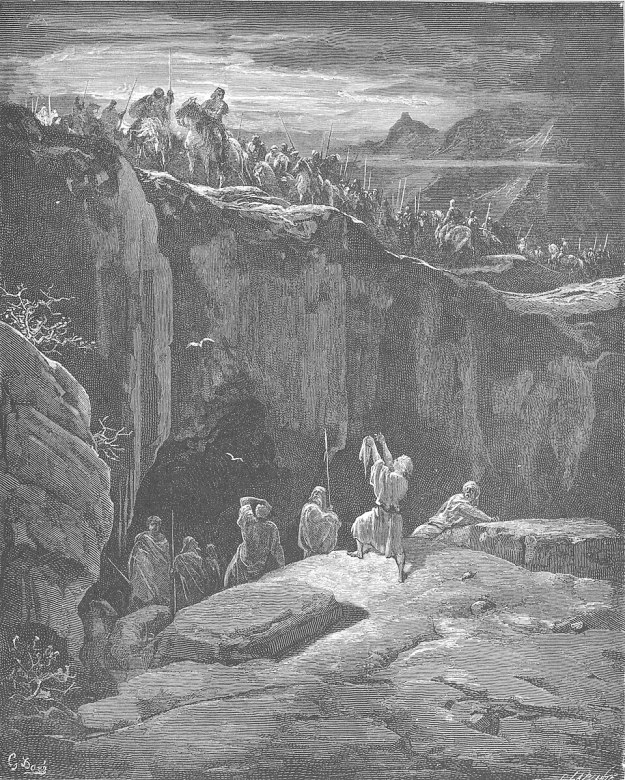
The superscription of this psalm has two possible moments in the life of David. The first is in 1 Samuel 22 when David is in the cave at Adullam. David in this portion of his story has just departed from King Achish of Gath after pretending to be mad.[1] David arrives at Adullam alone, but later is met by family and other followers there. The alternative is when he is in the wilderness of En-gedi, fleeing from Saul’s army. This is the cave where David has the opportunity to kill Saul but only cuts off a portion of his cloak because he will not strike the LORD’s anointed one (1 Samuel 23-24). This psalm in which the speaker feels oppressed and abandoned by the community of faith could fit either situation or many other situations that people of faith have encountered.
The psalmist cries to the LORD from a moment where they feel alone, overwhelmed, and trapped. The verb for “cry to” is different from “call upon” at the beginning of Psalm 141. Here the word is the Hebrew za’aq, “which conveys the idea of crying out in acute distress and seeking deliverance.” (Nancy deClaisse-Walford, 2014, p. 978) The word occurs twice in this psalm (vs. 1,5) and only three other times in the psalms (22:5; 107: 13,19). Yet, as J. Clinton McCann, Jr. notes
Hebrew za’aq…it recalls the exodus (see Exodus 2:23); it is a crucial part of the pattern in the book of Judges (see Judges 3:9, 15; 6: 6-7); indeed, it became understood as a typical element in God’s dealing with God’s people. (NIB IV: 1247)
Within the story of Israel, when they groaned and cried out (za’aq) to God, God heard and remembered them. Now the psalmist taps into this belief and cries out to God that they may be heard and remembered. They speak their complaint and trouble from this hiding place in the wilderness where their spirit is faint, they trust that God knows the way to their refuge.
Much of the imagery of the poem is related to hunting with the psalmist as the prey being pursued. The pursuit of their enemies has left them vulnerable and alone. Enemies can lay traps but there is no one at the right hand to come to the aid of the psalmist. In the language of the poem there is no where left for them to flee, no refuge to seek, they are imprisoned by the pursuing enemy. They are brought low and do not have the power to deliver themselves. Their only hope is that God will be their refuge, bring them out of their imprisonment, and deliver them from their pursuers. They desire to be in a place where they can be in the company of the righteous again, rather than being isolated and surrounded by their oppressors. Yet, even in their distress they trust that their God will deliver, deal bountifully with them, release them from prison, and return them to their place among God’s faithful people.
[1] Achish was aware of David as an opponent when he served under Saul and was suspicious of David’s loyalties, so David pretended to be mad but ultimately departs for Adullam when he is not welcome in Achish’s house.

