Psalm 145
Praise. Of David.
1 I will extol you, my God and King,
and bless your name forever and ever.
2 Every day I will bless you
and praise your name forever and ever.
3 Great is the LORD and greatly to be praised;
his greatness is unsearchable.
4 One generation shall extol your works to another
and shall declare your mighty acts.
5 They will recount the glorious splendor of your majesty,
and on your wondrous works I will meditate.
6 They will proclaim the might of your awesome deeds,
and I will declare your greatness.
7 They shall celebrate the fame of your abundant goodness
and shall sing aloud of your righteousness.
8 The LORD is gracious and merciful,
slow to anger and abounding in steadfast love.
9 The LORD is good to all,
and his compassion is over all that he has made.
10 All your works shall give thanks to you, O LORD,
and all your faithful shall bless you.
11 They shall speak of the glory of your kingdom
and tell of your power,
12 to make known to all people your mighty deeds
and the glorious splendor of your kingdom.
13 Your kingdom is an everlasting kingdom,
and your dominion endures throughout all generations.
The LORD is faithful in all his words
and gracious in all his deeds.
14 The LORD upholds all who are falling
and raises up all who are bowed down.
15 The eyes of all look to you,
and you give them their food in due season.
16 You open your hand,
satisfying the desire of every living thing.
17 The LORD is just in all his ways
and kind in all his doings.
18 The LORD is near to all who call on him,
to all who call on him in truth.
19 He fulfills the desire of all who fear him;
he also hears their cry and saves them.
20 The LORD watches over all who love him,
but all the wicked he will destroy.
21 My mouth will speak the praise of the LORD,
and all flesh will bless his holy name forever and ever.
This is the final psalm in the psalter attributed to David, and the only Davidic psalm which declares in its superscription that it is a psalm of praise. I’ve often said that attempting to adequately praise God takes us to the edge of our ability to utilize our language and one of the things poetry does is it can help us expand our language. Psalm 145 does this by utilizing the acrostic form. An acrostic poem, which utilizes the letters of the alphabet sequentially, is a poetic way of designating completion but structurally the poem does a couple other unique things. The psalm begins and ends with blessing the divine name of God, forming a pair of bookends that contains the acrostic words of praise within. Within the Masoretic Text, the Hebrew text that most translations work from, the nun line (‘n’ sound in Hebrew) is missing although it appears in most English translations as verse 13b and is included in the Qumran and other ancient documents. Barnabas Linders suggests that the elimination of the nun line is intentional with verses 10-13 being the center of the poem focusing on the kingship of God. In these verses 11-13 the Hebrew words for king (melek) and kingdom (malkut) occur four times in three verses, and it may be coincidental (since it corresponds with the order of the Hebrew alphabet) but reading from thirteen up to eleven the three letters are mlk which form both king and kingdom in Hebrew.[1] If this is the psalmist’s intent the negation of the nun line would help call attention to this. (NIB IV: 1258-1259).
Sometimes acrostic psalms can jump around topically to keep within the demands of the form, but Psalm 145 from beginning to end focuses relentlessly on utilizing its words to praise God’s name forever and ever. The poem moves smoothly from the opening act of blessing into the action to the declaration of God’s acts by the people paired with the solitary meditation and praise of the psalmist. The psalmist’s words composed for this psalm were likely intended to be utilized in a larger space of communal worship where the individual and the community can together wonder aloud about the greatness and righteousness of the LORD.
Verse eight echoes the familiar self-declaration of God in Exodus 34:6, but then pairs this with the description of God as good and compassionate. As mentioned above, verses 10-13 which focus on the kingship and kingdom of God may be intended to be read as the heart of the poem capturing the idea that the version of the Lord’s Prayer that many Christians utilize closes with, “the kingdom, the power, and the glory are yours. Forever and ever.”[2]The psalm continues by praising God’s acts of supporting those who are falling and lifting up those who are bowed down. The LORD is the one that every living thing looks to for provision and God reliably opens God’s hands to provide for the desires of all the creatures of the earth. The LORD is just and kind and near for those who call upon their God. As the psalm moves towards its closing it moves into the language of wisdom literature where God fulfills the desire of those who fear the LORD, delivering them when they cry out and watching over those who love the LORD but destroying the wicked. The psalm began with a solitary voice blessing the name of the LORD and closes with all flesh blessing the holy name of God forever and ever. Using both form and words it attempts to complete a blessing of the God who is king.
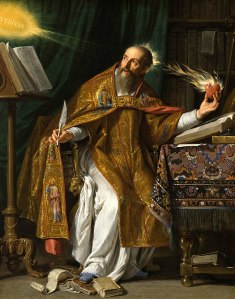
Psalm 145 has been a much-loved psalm throughout history. In the Rabbinic tradition of the Talmud Psalm 145, like the shema, (Deuteronomy 6:4-5) was to be repeated three times a day and doing this would assure one a place in the world to come. In the Dead Sea Scrolls there is a version with the refrain, “Blessed is the LORD and blessed is his name forever” likely intended for a call and response use within worship. (Nancy deClaisse-Walford, 2014, p. 990) Many Jewish and Christian leaders have viewed praise as the ultimate purpose of humanity, and Psalm 145 is a shining example of a poet and leader stretching their language to attempt to fulfill their purpose. As St. Augustine would later write in his famous Confessions, “you have made us for yourself, and our hearts are restless until they rest in you.”
[1] Most Hebrew words are based around three consonants (vowels are added later in Hebrew).
[2] In most modern translations of Matthew 6:9-13 and Luke 11: 2-4, where the Lord’s Prayer occurs, this closing is omitted. These words are in several ancient manuscripts, but not the oldest versions of Matthew and Luke and are normally present as a footnote in translations. Yet, this version is still utilized in many traditions.

