1If it had not been the LORD who was on our side —let Israel now say— 2if it had not been the LORD who was on our side, when our enemies attacked us, 3then they would have swallowed us up alive, when their anger was kindled against us; 4then the flood would have swept us away; the torrent would have gone over us; 5then over us would have gone the raging waters.
6Blessed be the LORD, who has not given us as prey to their teeth. 7We have escaped like a bird from the snare of the hunters; the snare is broken, and we have escaped.
8Our help is in the name of the Lord, who made heaven and earth.
Bolded words have notes on translation below.
The overall meaning of the psalm should be clear to any reader: the LORD is the one who is on our side and who rescues us from the perils of the world. The theme of God as strength, support, shelter, rock, shield, fortress and many other metaphors of protection and comfort occur regularly throughout the psalms and scripture in general. The theme of this fifth song of ascent is not new, but its language (somewhat dulled in English translations) is striking. Israel would not continue to exist without the LORD. Paul’s defiant statement in his letter to the church in Rome echoes the sentiment of this psalm: “What then are we to say about these things? If God is for us, who is against us?” (Romans 8:31)
Verse one and two both begin with a statement that seems conditional in English, “If it had not been the LORD who was on our side” but as Nancy deClaissé-Walford highlights,
Verses 1 and 2 both begin with if not (lûlê), forming the protasis of vv. 1-5. Lûlê, however, is only used in Hebrew to express an unreal condition. The psalm-singers are confident that the Lord is on their side. (Nancy deClaisse-Walford, 2014, p. 907)
This psalm of corporate trust in the LORD begins and ends with a confident assurance that the God of Israel has protected the people of God against her enemies. The enemies identified in verse two is identified with the collective noun humanity(‘adam). Israel and God have all humanity arrayed in opposition to them, and without God Israel would have been overwhelmed.
The psalm then uses several images that indicate that the people of God on their own are powerless before those who oppose them. Their enemy is large enough to swallow them alive, or to sweep over the life of the people,[1] to be devoured in the mouth or captured in a trap. In verse six the word rendered teeth is the same word (lason) rendered tongue in Psalm 120:2
Deliver me, O LORD, from lying lips, from a deceitful tongue.
Compared to the hunter of fowl the people of Israel are like a bird unable to free themselves from the traps their enemies have laid. On their own Israel is small and weak before the mass of humanity arrayed against them. Yet here, as in Psalm 121, their help is in the name of the LORD who makes heaven and earth. What was a confession of individual trust in Psalm 121 is now a corporate statement of trust in the creating and protecting God. As a people they ‘go with God.’
In the United States, where I live and lead a congregation, there is a reliance on self-sufficiency that is very different from the biblical faith represented in the psalms and throughout the bible. As J. Clinton McCann, Jr. aptly writes,
To profess that God is our fundamental help means to profess that we are not sufficient to create and secure our own lives and future. In short, we need help. (NIB IV: 1191)
As people of God, we believe that God is on our side and stands with us against the enemies that threaten to consume or overwhelm us. If it were only our own strength that we could rely on we would find ourselves consumed, overwhelmed, and trapped but in our own weakness we know our help comes from the one who created the heavens and the earth.
[1] In verse 4b and 5 the “us” in the verse is the Hebrew nephesh, often rendered “soul” in English translations but in Hebrew thought it is closer to the essence of life, not something that can be separated from life. J. Clinton McCann, Jr. notes the word may have originally meant neck. (NIB IV: 1190)
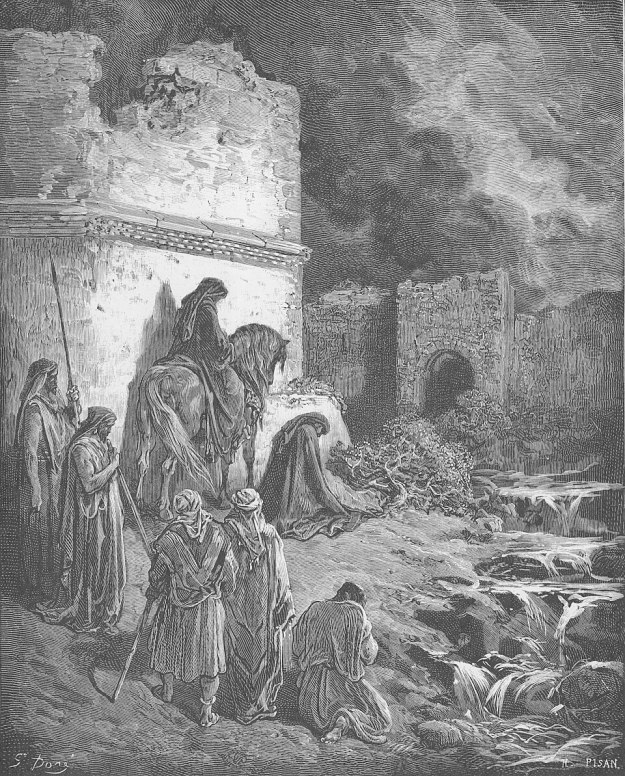
Nehemiah Views the Ruins of Jerusalem’s Walls (Neh. 2:1-20) Gustave Dore, Dore’s English Bible (1866)
Psalm 123
A Song of Ascents
1To you I lift up my eyes, O you who are enthroned in the heavens! 2As the eyes of servants look to the hand of their master, as the eyes of a maid to the hand of her mistress, so our eyes look to the LORD our God, until he has mercy upon us.
3Have mercy upon us, O LORD, have mercy upon us, for we have had more than enough of contempt. 4Our soul has had more than its fill of the scorn of those who are at ease, of the contempt of the proud.
Bolded words have notes on translation below.
If you read the psalms of ascent as a sequence, which scholars assume was a common practice during a pilgrimage to Jerusalem, there is a narrative that may underly the pattern. The psalmist begins in a place far from the city of peace surrounded by those who desire war (Psalm 120). The psalmist then departs on a journey lifting up their eyes to the hills (Mount Zion-Psalm 121). In the third song of ascent the psalmist arrives at their destination of Jerusalem (Psalm 122). Now in Jerusalem the pilgrim is joined by other pilgrims coming to the city of peace and they turn their eyes to God and lift up their complaint about the world they come from. They have left behind others in a land of people who seek conflict and speak with lying lips (Psalm 120) and now in the city of God they appeal for not only Jerusalem but the world the LORD stands in authority over.
The psalm begins with a solitary speaker lifting up their eyes to the LORD who sits on the seat of authority in heaven. The psalmist may imagine God presiding over the gods of the nations as in Psalm 82 as they address the LORD in this manner, and this may set the stage for the complaint that the people raise about the contempt and scorn they have received in the nations. The eyes of an individual pilgrim are joined by other servants and maids of the LORD their God look to their master for mercy. The Hebrew conception of the relationship between a servant or maid and their master or mistress envisions the master/mistress bearing responsibility for their subordinates. The subordinates are dependent upon their master for their provision and protection, but the expectations of the master in the psalm are conditioned by the merciful LORD their God who is master over the heavens and the earth. The identity of the LORD God as expressed by God in Exodus 34 is:
“The LORD, the LORD, a God merciful and gracious, slow to anger, and abounding in steadfast love and faithfulness, 7 keeping steadfast love for the thousandth generation, forgiving iniquity and transgression and sin, yet by no means clearing the guilty, but visiting the iniquity of the parents upon the children and the children’s children, to the third and the fourth generation.” Exodus 34: 5-7.
And the blessing of the Aaronic priests in Numbers 6:22-27 echoes the ideas of God turning God’s face in graciousness towards those who lift up their eyes to the LORD:
22The Lord spoke to Moses, saying, 23“Speak to Aaron and his sons, saying: Thus you shall bless the Israelites: You shall say to them: 24The Lord bless you and keep you; 25the Lord make his face to shine upon you and be gracious to you; 26the Lord lift up his countenance upon you and give you peace. 27“So they shall put my name on the Israelites, and I will bless them.”
The pilgrim has joined other pilgrims within the city seeking mercy from the LORD their God and they lift up their eyes and their appeal. As Walter Brueggemann notes, “Our psalmist…dares to look to heaven, not because he is worthy but because he knows that the master to whom he looks is merciful.” (Bellinger, 2014, p. 533)
The character of the people of God is expected to match the God who they serve and this informs the view of what the kings, princes, and nobles of Israel were to be. The character of God is one of the reasons that subordinates can look to those in authority over them with the expectation of receiving mercy. This psalm made me reflect on leaders I have encountered in numerous settings who I was proud to serve under. They were leaders who were invested in those who they led and were dependable. Many of them saw the way they led as connected to their faith and it was reflected not only in their actions but in the response of their subordinates to their authority.
Psalm 123 is unusual because it ends in complaint rather than thanksgiving, but it may rely on the following psalm to complete the normal pattern. The pilgrim looks at the world of people of lying lips and who seek conflict and they dare to seek in their God, “the grace that overcomes the world.” (Mays, 1994, p. 396) Before they begin their complaint they have invoked God’s mercy three times. They need God’s mercy to overcome the contempt and scorn which have overwhelmed them. Nancy deClaissé-Walford notes on the translation of verse three and four:
The word translated overwhelmed (NRSVue have had more than enough/ its fill) is from the root ‘saba’, which means, literally, “eat one’s full, be sated, have enough.” And interestingly the word translated mockery (NRSVue scorn) is from the root la’ag, which beans literally, “speak with a stammering tongue.” (Nancy deClaisse-Walford, 2014, p. 904)
Their experience of conflict and lies in their communities have overwhelmed them. They have had more of mockery and scorn than they can take and the leaders in the communities they have come from leave them crying out for God’s mercy which can overcome the mockery and scorn which overwhelms them.
J. Clinton McCann, Jr. connects the language of this complaint to the post-exilic experience of the time of Nehemiah.
As several scholars observe, the situation certainly sounds like that of the post-exilic era (see, e.g., Neh 2:19, 4:4, where “ridiculed” and “despised” represent the same Hebrew root as “contempt” in Ps 123: 3-4, “scorn” in 123:4 also occurs in Neh 2:19; 4:1 as “mocked.” (NIB IV: 1187)
The post-exilic experience of returning to the remains of the once proud city of Jerusalem and being taunted by their neighbors is a reasonable backstory for the psalm, but the experience of being overwhelmed by contempt or scorn is a common experience. If the experience is tied to the experience of Psalm 120 that also is a common experience of people longing for peace and justice in an unjust world that seeks conflict. That is one of the reasons that the psalms continue to resonate thousands of years after their composition. They may have originally spoken to a specific crisis in the pilgrim’s life but now they speak to the community of the faithful raising their eyes to God and appealing for God’s mercy which can overcome the experiences and injustices which threaten to overwhelm them.
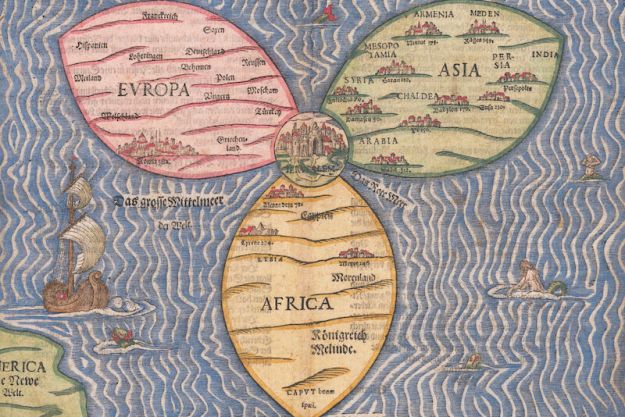
The Bünting Clover Leaf Map, by Heinrich Bünting, was published in 1581 and depicts Jerusalem as the center of the world.
Psalm 122
A Song of Ascents
1I was glad when they said to me, “Let us go to the house of the LORD!” 2Our feet are standing within your gates, O Jerusalem.
3Jerusalem—built as a city that is bound firmly together. 4To it the tribes go up, the tribes of the LORD, as was decreed for Israel, to give thanks to the name of the LORD. 5For there the thrones for judgment were set up, the thrones of the house of David.
6Pray for the peace of Jerusalem: “May they prosper who love you. 7Peace be within your walls and security within your towers.” 8For the sake of my relatives and friends I will say, “Peace be within you.” 9For the sake of the house of the LORD our God, I will seek your good.
Bolded words have notes on translation below.
If we look at the first three songs of ascent in order (Psalm 120-122) there is a suggestive narrative. The psalmist begins in a place far from the city of peace surrounded by those who desire war (Psalm 120). The psalmist then departs on a journey lifting up their eyes to the hills (Mount Zion-Psalm 121). In this third song of ascent the psalmist arrives at their destination of Jerusalem. (NIB IV:1183) This song of thanksgiving upon arriving in the city of Jerusalem, the spiritual center of their world captures the joy of a pilgrim upon reaching their long-awaited destination.
Both Isaiah 2: 2-3 and Micah 4:1-4 envision Jerusalem as being the spiritual center of the world for Jews and Gentiles, where the nations see the people living in harmony with God’s will for the world and they come to the mountain of God seeking instruction. Jerusalem becomes the pivot for a complete reordering of power in the prophetic imagination as swords become plowshares and spears become pruning hooks. The city of shalom (Jerusalem) becomes a light on the hill that the nations are drawn to learn God’s ways of peace.
The psalm is structured around the two houses that reside in Jerusalem: the house of the LORD and the house of David. The house of David occupies the central verse of the poem structurally, and the royal house occupies an important role in providing judgment for people coming to the city. As James L. Mays can highlight:
Pilgrimage season was likely a time when conflicts and disputes unsettled in the country courts were brought to the royal officials and their successors in the postexilic period. The peace of the community depended on the establishment of justice. Pilgrimage is a journey in search of justice. (Mays, 1994, p. 393)
The house of David has a crucial role in making Jerusalem a place of shalom, but the psalm also places the house of the LORD as the bookends structurally of the psalm. The place of the house of the LORD at the beginning and end encompasses the authority of the house of David. (NIB IV: 1184) 2 Samuel 7 makes a similar point when the LORD informs David that he will build a house (lineage) for David rather than David building a house for the LORD.
The psalm begins with a joyous embrace of the traditional call to go up to the house of the LORD. There is some debate about whether the perspective of the psalmist is currently in Jerusalem (are) or whether it should be translated in past tense as the psalmist remembers Jerusalem in anticipation of a journey, but I have stayed with the NRSVue’s translation of Our feet are standing. From the perspective of the pilgrim, Jerusalem is a city bound firmly together. There is some Hebrew word play in the word for bound (Hebrew habar) which is never elsewhere used for construction and always refers to human alliances or covenants. (NIB IV:1184) The psalm imagines a time where the unified tribes of Israel gather in Jerusalem as a place of festival, worship, and ultimately peace making.
The language in verse six to seven centers around shalom (peace) and Jerusalem (yeru-shalom) and the structure in Hebrew makes this even clearer by the phonetic repetition of ‘sh’ and ‘l’ sounds. As Nancy deClaissé-Walford states:
Of the ten Hebrew words that make up vv. 6 and 7, six contain the letters sin and lamed: ask (sha’alu); well-being (twice) (shalom); Jerusalem (yerushalaim); may they be at ease (yishelayu); and tranquility (shalwa)—acoustically and visually emphasizing the theme of well-being. (Nancy deClaisse-Walford, 2014, p. 901)
Jerusalem is the city of shalom, the longed-for peace absent in Psalm 120. Peace is for the city of peace, for the walls that defend the city from hostility, and for the families who are present in the city or back home. Psalm 133 will later echo this hope for peace among relatives.
Walter Brueggemann and William H. Bellinger make an important point for this prophetic imagination of the people in the context of the exile. When there is no longer a city of shalom to seek where the houses of the LORD and David reside, how are the people to function? Brueggemann points to the prophet Jeremiah (Jeremiah 29: 4-10) when he states:
”seek the welfare of the city where I have sent you in exile, and pray to the LORD on its behalf, for in its welfare you will find your welfare.” The word “welfare” of course renders the Hebrew shalom; the prophet is exhorting the deportees to pray for the shalom of the city of Babylon. (Bellinger, 2014, p. 530)
In the absence of the city, the temple, and the Davidic king it was still possible to seek peace, but it involved seeking the shalom of the place where you find yourself transplanted. Even if Jerusalem is de-centered from the world, peace can still be found in the cities where the pilgrims sojourn.
1I lift up my eyes to the hills— from where will my help come? 2My help comes from the LORD, who made heaven and earth.
3He will not let your foot be moved; he who keeps you will not slumber. 4He who keeps Israel will neither slumber nor sleep.
5The LORD is your keeper; the LORD is your shade at your right hand. 6The sun shall not strike you by day nor the moon by night.
7The LORD will keep you from all evil; he will keep your life. 8The LORD will keep your going out and your coming in from this time on and forevermore.
Notes on the bolded words below.
One of my favorite farewells is the Spanish ‘vaya con dios’ which means ‘go with God.’ The English Godspeed is similar, which comes from the middle English ‘God spede you’ which means ‘may God prosper you.’ This short but well-loved psalm may have originated as a song for pilgrims making the journey to mount Zion to worship. The departing pilgrim receives a blessing from the one wishing God’s guarding presence upon the pilgrim. It may have originated as a ‘farewell liturgy’ as James Limburg identified this psalm, (NIB IV: 1180) but for many faithful people this has become a psalm of trust which encompasses the entire life of the faithful one guarded by the God who is both personally available and cosmically powerful.
The first two verses of the psalm are spoken by the pilgrim and is spoken in first person. The individual looks to the surrounding landscape to the hills, and likely to the destination of Zion, but their help for through the dangers of the coming journey do not come from the hills but from the LORD. The LORD is both ‘my help,’ one who is personally concerned for the fate of this pilgrim departing on the journey but also ‘the LORD who made heaven and earth.’ In a common duality seen in scripture God is both powerful and attentive, over all things and concerned about the life of the faithful one who places their life in God’s hand.
In verse three the voice now shifts to the one remaining behind as the pronouns are now second person. Within the final eight verses the word rendered ‘keep’ or ‘keeper’ in the NRSVue is the Hebrew samar. The Hebrew samar is a more active concept than ‘keep’ and has the active sense of guarding and watching over. (Nancy deClaisse-Walford, 2014, pp. 895-897) Within the movement of the psalm the God who guards will not slumber during his time of protecting and watching over the pilgrim. The LORD guards Israel and the LORD will guard the faithful one. The language continues and intensifies as the LORD guards and provides a shade (Hebrew sel) for the pilgrim. The word for shade (sel) is often used in the psalter in the phrase ‘the shelter (sel) of you wings’ and may reference the image of God extending God’s wing or cloak in protection and shelter in the journey through the wilderness. The sun and moon have sometimes been thought of mythologically as forces which oppose the pilgrim’s journey but this is not necessary for the psalm for a journey through desert on the journey to Jerusalem (or any other destination).
In the Lord’s prayer the petition ‘and deliver us from evil (or the evil one)’ taps into a consistent theme with the LORD guarding the pilgrim from evil and guarding their life. In a common Hebrew merism[1] the LORD watches over the totality of the pilgrim’s journey, their departures and their returning home for this journey and their entire life.
Psalm 121 has a rich use in the worship life of the church, and it is frequently used with both baptismal liturgies and funeral services. The psalm’s use in these two moments that form the bookends of the Christian life nicely encompass the belief that God guards the person of faith throughout the totality of their life. Martin Luther would have parents teach their children to “fear, love, and trust God above all things.” This psalm echoes the trustworthiness of the God who guards the life of the faithful one. It is a blessing for the entirety of the journeys of life as people of faith go with God. Our entire life is guarded and sheltered by the God who is both personally available and cosmically powerful.
[1] A merism is a literary device which denote the totality or completeness of something.
1 In my distress I cry to the LORD, that he may answer me:
2 “Deliver me, O LORD, from lying lips, from a deceitful tongue.”
3 What shall be given to you? And what more shall be done to you, you deceitful tongue?
4 A warrior’s sharp arrows, with glowing coals of the broom tree!
5 Woe is me, that I am an alien in Meshech, that I must live among the tents of Kedar.
6 Too long have I had my dwelling among those who hate peace.
7 I am for peace; but when I speak, they are for war.
The Psalms of Ascent (Psalm 120 – 134) are fifteen psalms that may have been used as a part of the pilgrimage to Jerusalem. Jerusalem sits upon a hill so any approach to Jerusalem is always an ascent, but the ascent may also refer to the ascending of the steps of the temple. Mishnah states there are fifteen steps that lead from the Court of Women to the Court of the Israelites which correspond to the fifteen psalms. (Nancy deClaisse-Walford, 2014, p. 887) It is conceivable that a practice of reciting these fifteen short (except for Psalm 132) psalms as one approaches Jerusalem or as one ascends the steps of the temple. As this psalm indicates, this practice may help the people transition from their exile in a world of war and deceitful tongues to their homecoming in the city of peace.[1]
Too long have I had my dwelling among those who hate peace. The poet is a stranger in a strange land. They are a foreigner/alien(ger) in the midst of a people of different gods, sharp tongues, and unjust practices. Meshech and Kedar are likely metaphors for places both geographically and spiritually distant from the memory of their homeland. The situation of this psalm forms the antithesis of Psalm 133: How very good and pleasant it is when kindred live together in unity. The situation of Psalm 120 could be summarized: how traumatizing it is for one who lives as an alien among those who love division.
In language that resonates with James 3: 1-12, the psalmist describes the tongue as an instrument of violence. The psalmist may be the direct recipient of these deceitful and painful words, or they may exist in a society where the truth has disappeared.[2] Like the son in the parable of the prodigal[3] they may find themselves vulnerable and hungry in a world where no one cares. It may be ironic, as Brueggemann and Bellinger state, that the person who considers themself a person of peace would respond to these deceitful tongues with metaphorical weapons of war (Bellinger, 2014, p. 524) but the psalmist is asking for God to deliver. God is in the position to judge the people who the psalmist lives among. Yet, it is also possible that the description in verse four is merely a continuation of the description of the words of the lying lips and deceitful tongues. Sharp weapons are used metaphorically along with predatory animals to describe people hostile to the psalmist in Psalm 57:4. The broom tree is a hard wood tree known for its long burning fires. (Nancy deClaisse-Walford, 2014, p. 892)
This psalm can resonate with people of all times who attempt to live justly in an unjust world. Who seek peace (shalom) among a people whose words and actions seek conflict. As James L. Mays states about Psalm 120,
It is a poignant expression of the pilgrims’ pain over the world from which they come. It puts that world in the sharpest possible contrast to the peace they desire and seek in coming to Zion. (Mays, 1994, p. 388)
People of peace long for a homecoming where they can live in unity with their brothers and sisters who speak with truthful lips and words that heal instead of these weaponized tongues they encounter in the land of their sojourn. Pilgrimage, either physical or spiritual, is a hopeful ascent to a place of shalom.
[1] Jerusalem’s name comes from a combination of the word for city and shalom.
The Hebrew Alphabet. Hebrew reads right to left so it begins with Aleph and ends with Tet
Psalm 119
Introduction to Psalm 119
I’m going to modify my normal pattern of having the text first and then a reflection due to the length of Psalm 119 which is longer than several biblical books. Many readers find Psalm 119, “boring, repetitious, and without plot development.” (Bellinger, 2014, p. 519) Translations of this psalm lose the key organizational feature of Psalm 119 which its acrostic organization and that in combination with the length of the psalm makes it difficult for many readers to fully appreciate. Also hindering the hearing of this psalm dedicated to a “Torah piety” or “law piety” is a lingering stigma of legalism associated with Judaism. Yet, what this psalm advocates for in its language and organization is a joyful way of life organized around God’s guidance to God’s people.
I have spent far more time in Hebrew acrostic poetry in the past year than the average person spends in a lifetime having worked through Lamentations, Psalm 111, 112, and now 119 this year. Psalm 119 is the acrostic of acrostics intensifying the form to have eight lines begin with each letter of the Hebrew alphabet (from Aleph to Tav) for a total of 176 verses. The acrostic form is a way of indicating a complete poetic treatment of a topic, and the intensification of this psalm of an eight-fold acrostic is designed to convey a complete treatment of a life faithfully and joyfully lived in relation to God through the law. In addition to the eight-fold repetition of a common letter to start each group of lines are the eight synonyms for the law utilized throughout the poem: law, decrees (or statutes), ordinances, statutes, word, precepts, and promises. One of these synonyms occurs in every verse except verses 3, 37, 90 and 122. In the 176 verses there are five verses where two synonyms occur compared to the four where none occur. The repetition is intentional to reinforce the central position of the law in the relationship between God and the people.
Psalm 119 begins with the Hebrew asre (‘happy’ NRSV) which is a common word in wisdom literature, just as the acrostic is a common wisdom literature form. Psalm 1 and Psalm 19 are the other two psalms primarily associated with a ‘Torah piety’ and both psalms share both vocabulary as well as a common vision of what a wise life consists of. The similarities between Psalm 1 and Psalm 119, some of which will be noted below, were strong enough that Claus Westermann could suggest that they once formed the beginning and end of the psalter. (Bellinger, 2014, p. 520)
For the reflections below I will take each eight-verse portion of the acrostic as a unit for reflection. On the one hand the psalm is designed to be viewed as an entire unit held together by its acrostic organization and focal vocabulary. On the other hand, the psalm is daunting for its length, and I will follow the habit of many other scholars in attempting to look at the psalm in its components and then have some final reflections. Dietrich Bonhoeffer in 1939-1940 considered his work on Psalm 119 to be “the climax of his theological life.” (Bethge, 2000, p. 667) Yet even Bonhoeffer in his reflections only made it to verse twenty-one. For me this may be a high mountain to climb, but hopefully there are many more pinnacles in my life of reflection.
1 Happy are those whose way is blameless, who walk in the law of the LORD.
2 Happy are those who keep his decrees, who seek him with their whole heart,
3 who also do no wrong, but walk in his ways.
4 You have commanded your precepts to be kept diligently.
5 O that my ways may be steadfast in keeping your statutes!
6 Then I shall not be put to shame, having my eyes fixed on all your commandments.
7 I will praise you with an upright heart, when I learn your righteous ordinances.
8 I will observe your statutes; do not utterly forsake me.
As mentioned in the introduction there is a strong connection between Psalm 1, 19 and Psalm 119. They share a common vision of what leads to happiness or contentment (Hebrew asre) but they also share a common vocabulary. As J. Clinton McCann, Jr. notes, “every word of v. 1 occurs in either Psalm 1 or Psalm 19.” (NIB IV: 1168) Dietrich Bonhoeffer in his reflection on verse one uses the terms ““complete”, “whole,” undivided, unassailable” for the term the NRSV translates ‘blameless’ and he notes that Luther in his 1521 translation of the psalm says, “the wholly healthy ones.” (DBWE 15: 500) The Hebrew concept of ‘blameless’ or ‘without fault’ is not the legalistic perspective often (wrongly) attributed to Jewish thought. It is clear as you progress through the poem that the psalmist does not consider themselves without fault, and yet they desire to be steadfast in their adherence to God’s vision for the world. They are seeking a way of life in harmony with God’s will for the world, and they seek that harmony through God’s revealed will in the Torah.
Beth
9 How can young people keep their way pure? By guarding it according to your word.
10 With my whole heart I seek you; do not let me stray from your commandments.
11 I treasure your word in my heart, so that I may not sin against you.
12 Blessed are you, O LORD; teach me your statutes.
13 With my lips I declare all the ordinances of your mouth.
14 I delight in the way of your decrees as much as in all riches.
15 I will meditate on your precepts, and fix my eyes on your ways.
16 I will delight in your statutes; I will not forget your word.
Throughout the law there is a concern for passing on the practices from generation to generation. This is perhaps best illustrated in the verses that immediately follow the Shema in Deuteronomy 6:
Keep these words that I am commanding you today in your heart. Recite them to your children and talk abou them when your are at home and when you are away, when you lie down and when you rise. Deuteronomy 6: 6-7.
The book of Proverbs is also an attempt to pass on wisdom to the next generation. How are young people to keep their way pure, by remaining attentive to the word, commandments, statutes, ordinances, decrees, and precepts (all synonyms mentioned in this section). This shares a common vision with Matthew’s parable of the treasure found in the field[2] where the object (here the law) is to become the thing which the individual gives up all other things to possess and guard. It becomes the treasure of the heart, the words upon the lips, the delight of life, and that which is meditated on. The young person learns to center their life on God’s law and God’s word.
Gimel
17 Deal bountifully with your servant, so that I may live and observe your word.
18 Open my eyes, so that I may behold wondrous things out of your law.
19 I live as an alien in the land; do not hide your commandments from me.
20 My soul is consumed with longing for your ordinances at all times.
21 You rebuke the insolent, accursed ones, who wander from your commandments;
22 take away from me their scorn and contempt, for I have kept your decrees.
23 Even though princes sit plotting against me, your servant will meditate on your statutes.
24 Your decrees are my delight, they are my counselors.
For the first time the notes of lament make their way into the psalm. Living in attentive service to the way of God in the law does not guarantee a life free of struggle. Yet even in the midst of the struggle the psalmist remains focused on the ordinances of God and the way of life they outline. It is possible that Psalm 119 comes from the time of the exile where the person may have lived as an alien in the land of Babylon, but it also may come from a time where they feel alienated from the community. Even in the space where the psalmist is a stranger receiving scorn and contempt from those who have power in the land, they trust that the God who gave the law will continue to provide for this seeker after God’s decrees.
Daleth
25 My soul clings to the dust; revive me according to your word.
26 When I told of my ways, you answered me; teach me your statutes.
27 Make me understand the way of your precepts, and I will meditate on your wondrous works.
28 My soul melts away for sorrow; strengthen me according to your word.
29 Put false ways far from me; and graciously teach me your law.
30 I have chosen the way of faithfulness; I set your ordinances before me.
31 I cling to your decrees, O LORD; let me not be put to shame.
32 I run the way of your commandments, for you enlarge my understanding.
Dust, as J. Clinton McCann, Jr. notes, is elsewhere associated with death.[3] (NIB IV: 1169) The Hebrew word nephesh (NRSV soul) is not the Greek idea of a eternal soul that is separate from the physical body but rather the essence of life or center of life. Yet in a time where life is clinging to death God revives with the word. Life seeking understanding is the way of the psalmist. God can strengthen with the word, teach this student the law, and keep this seeker from shame. They know that life is found in these commandments of God, but they also seek for God to continue to enlarge their understanding of this gracious gift that God has bestowed to the people. The LORD is a God who can bring life from the dust, strength from sorrow, and honor from shame.
He
33 Teach me, O LORD, the way of your statutes, and I will observe it to the end.
34 Give me understanding, that I may keep your law and observe it with my whole heart.
35 Lead me in the path of your commandments, for I delight in it.
36 Turn my heart to your decrees, and not to selfish gain.
37 Turn my eyes from looking at vanities; give me life in your ways.
38 Confirm to your servant your promise, which is for those who fear you.
39 Turn away the disgrace that I dread, for your ordinances are good.
40 See, I have longed for your precepts; in your righteousness give me life.
The verbs that drive this section ask for the LORD to take control of the petitioner’s ways: teach, give, lead, turn the heart and eyes, confirm, and turn away from the things that lead to disgrace. The poet seeks right understanding, right willing (the heart as the seat of will), right seeing, a right practice of faith and life that leads to a wise path instead of the foolish path that leads to disgrace. The psalmist desires that which is life giving and yet knows that there are temptations which can turn the heart, eye, and mind to the path of the wicked. Yet, the psalmist desires to hold fast to the good that God has revealed to the people.
Waw
41 Let your steadfast love come to me, O LORD, your salvation according to your promise.
42 Then I shall have an answer for those who taunt me, for I trust in your word.
43 Do not take the word of truth utterly out of my mouth, for my hope is in your ordinances.
44 I will keep your law continually, forever and ever.
45 I shall walk at liberty, for I have sought your precepts.
46 I will also speak of your decrees before kings, and shall not be put to shame;
47 I find my delight in your commandments, because I love them.
48 I revere your commandments, which I love, and I will meditate on your statutes.
A note of lament returns with those who taunt the psalmist, but the dominant chord of this refrain is continued trust in God. A faithful life will always be lived in the midst of those who seek different sources of security. To those involved in the court of the king the psalmist’s trust in God’s ways may seem naïve in a world of politics and intrigue. Yet, the psalmist asks for their words of their mouth to be their LORD’s words of truth. They seek to fulfill the intention of Deuteronomy 17: 14-20 by becoming a living breathing law which continually is before the king reminding them of God’s way. This way of life, which reveres and meditates on the law is an act of love for the poet.
Zayin
49 Remember your word to your servant, in which you have made me hope.
50 This is my comfort in my distress, that your promise gives me life.
51 The arrogant utterly deride me, but I do not turn away from your law.
52 When I think of your ordinances from of old, I take comfort, O LORD.
53 Hot indignation seizes me because of the wicked, those who forsake your law.
54 Your statutes have been my songs wherever I make my home.
55 I remember your name in the night, O LORD, and keep your law.
56 This blessing has fallen to me, for I have kept your precepts.
This verse moves between the poet’s request for God to remember to the poet’s repeated remembering.[4] When God remembers in the Hebrew Scriptures it leads to God acting. For example, the story of Noah, when God sees the bow in the clouds God remembers (Genesis 9:16) or in Egypt when God hears the cries of the people God remembers (Exodus 20:8). The psalmist calls on God to remember as they are remembering God’s ordinances and God’s name. The second half of verse 54 reads literally, “in the house of my sojourning” (NIB IV: 1170) and may reflect a situation of displacement, perhaps in exile, of the psalmist. Yet, wherever the psalmist finds themselves they attempt to live a wise life which leads them into conflict with the wicked and arrogant in their midst. Perhaps in a time of exile and confusion they are attempting to hold on to the covenant while others are turning away from the way of God’s law. Yet, in the dark of the night this psalmist remembers and maintains their way of obedience.
Het
57 The LORD is my portion; I promise to keep your words.
58 I implore your favor with all my heart; be gracious to me according to your promise.
59 When I think of your ways, I turn my feet to your decrees;
60 I hurry and do not delay to keep your commandments.
61 Though the cords of the wicked ensnare me, I do not forget your law.
62 At midnight I rise to praise you, because of your righteous ordinances.
63 I am a companion of all who fear you, of those who keep your precepts.
64 The earth, O LORD, is full of your steadfast love; teach me your statutes.
It is likely that this psalm was written by a Levite, and the initial verse of this section which declares the LORD is the portion for this poet would recall the division of the land in Numbers and Joshua where the Levites do not have a share in the land, instead the LORD is their portion.[5] But if this psalm is written in exile, now the entirety of the people is left with the LORD as their portion. The poet again alludes to a situation where they need the LORD to act upon the covenant for their rescue, to remember as requested in the previous section. The poet is keeping the commandments, now they implore the LORD to do the same as they are ensnared by the cords of the wicked. The psalmist trusts the LORD and there are others who apparently share this trust, but the poem alludes to a world where the faithful are not the powerful and they are vulnerable to the actions of the wicked.
Teth
65 You have dealt well with your servant, O LORD, according to your word.
66 Teach me good judgment and knowledge, for I believe in your commandments.
67 Before I was humbled I went astray, but now I keep your word.
68 You are good and do good; teach me your statutes.
69 The arrogant smear me with lies, but with my whole heart I keep your precepts.
70 Their hearts are fat and gross, but I delight in your law.
71 It is good for me that I was humbled, so that I might learn your statutes.
72 The law of your mouth is better to me than thousands of gold and silver pieces.
The word ‘good’ (Hebrew tob) occurs six times[6] in these eight verses. The LORD is good and does good and deals well (good) with the servant of the LORD. In echo the servant desires to learn good judgment and the good law of God’s mouth and can even view it as good that they have been humbled. In contrast the arrogant have hearts that are gross and fat. Their words are lies instead of the good words of the law. This is the binary language of wisdom literature: good and wicked, faithful and foolish. Yet even the poet went astray and had to be humbled to find the good. The psalmist has not lived a perfect life and had to have a time of repentance. But now they keep the word and know the value of this treasure their LORD has provided.
Yodh
73 Your hands have made and fashioned me; give me understanding that I may learn your commandments.
74 Those who fear you shall see me and rejoice, because I have hoped in your word.
75 I know, O LORD, that your judgments are right, and that in faithfulness you have humbled me.
76 Let your steadfast love become my comfort according to your promise to your servant.
77 Let your mercy come to me, that I may live; for your law is my delight.
78 Let the arrogant be put to shame, because they have subverted me with guile; as for me, I will meditate on your precepts.
79 Let those who fear you turn to me, so that they may know your decrees.
80 May my heart be blameless in your statutes, so that I may not be put to shame.
The psalmist taps into the poetic imagery of the Hebrew scriptures of God not only as the creator of the heavens and the earth, but the craftsman or potter that fashioned each individual person. They as a creature are completely in God’s hands and even though their suffering may be at the hands of the wicked it is still tied into God’s judgments. Yet, the psalmist trusts in the attributes of God: God’s steadfast love (hesed) and mercy. The psalmist trusts that this moment where the arrogant are able to bring them shame will be reversed in God’s justice. They seek a place of leadership in the community, but they also seek a heart that is fixed on the statutes of God.
Kaph
81 My soul languishes for your salvation; I hope in your word.
82 My eyes fail with watching for your promise; I ask, “When will you comfort me?”
83 For I have become like a wineskin in the smoke, yet I have not forgotten your statutes.
84 How long must your servant endure? When will you judge those who persecute me?
85 The arrogant have dug pitfalls for me; they flout your law.
86 All your commandments are enduring; I am persecuted without cause; help me!
87 They have almost made an end of me on earth; but I have not forsaken your precepts.
88 In your steadfast love spare my life, so that I may keep the decrees of your mouth.
The perilous condition reaches its pinnacle in these eight verses as the psalmist wastes away.[7] The nephesh (NRSV soul)[8], the very life of the person and the vision of the psalmist are all failing. They wonder how much longer they can endure in this situation without God’s intervention on behalf of the faithful one. The poet needs God to act to counteract the actions of the wicked which threaten their life. The remain steadfast in their adherence to the commandments and throw themselves on the steadfast love (hesed) of their God.
Lamedh
89 The LORD exists forever; your word is firmly fixed in heaven.
90 Your faithfulness endures to all generations; you have established the earth, and it stands fast.
91 By your appointment they stand today, for all things are your servants.
92 If your law had not been my delight, I would have perished in my misery.
93 I will never forget your precepts, for by them you have given me life.
94 I am yours; save me, for I have sought your precepts.
95 The wicked lie in wait to destroy me, but I consider your decrees.
96 I have seen a limit to all perfection, but your commandment is exceedingly broad.
The poem transitions from its lowest point to its highest. The psalmist previously had been wasting away but now they turn their eyes to the eternal LORD. Their faith rests not on their own strength but the faithfulness of God and the goodness of God’s eternal law. The psalmist trusts that this law of God will provide them deliverance from the wicked who attempt to destroy them. The meaning of the word translated perfection in verse 96 (Hebrew tikla) is not entirely clear but the overall direction of the final verse is to compare the greatness of God’s commandments and ways to the transitory nature of the wicked.
Mem
97 Oh, how I love your law! It is my meditation all day long.
98 Your commandment makes me wiser than my enemies, for it is always with me.
99 I have more understanding than all my teachers, for your decrees are my meditation.
100 I understand more than the aged, for I keep your precepts.
101 I hold back my feet from every evil way, in order to keep your word.
102 I do not turn away from your ordinances, for you have taught me.
103 How sweet are your words to my taste, sweeter than honey to my mouth!
104 Through your precepts I get understanding; therefore I hate every false way.
The effusive language of these eight verses now focuses on the psalmist’s love of the law. Love is not a common word in the psalter, and it takes on a sensual tone with language similar to the Song of Songs in talking about the words being sweeter than honey. This zealous adherent to the law of God seeks to surpass their teachers and elders by focusing on God’s law as the center of their life. The psalmist may be a young person (v.9) and this may be the zeal of youth, but their direction focused in the right direction. Whatever their age, they are seeking ardently the wise way of God’s law.
Nun
105 Your word is a lamp to my feet and a light to my path.
106 I have sworn an oath and confirmed it, to observe your righteous ordinances.
107 I am severely afflicted; give me life, O LORD, according to your word.
108 Accept my offerings of praise, O LORD, and teach me your ordinances.
109 I hold my life in my hand continually, but I do not forget your law.
110 The wicked have laid a snare for me, but I do not stray from your precepts.
111 Your decrees are my heritage forever; they are the joy of my heart.
112 I incline my heart to perform your statutes forever, to the end.
This group of verses begins with the most well-known verse of the psalm, “Your word is a lamp to my feet and a light to my path.” The way or law of God is the guide for the psalmist’s life, but they remain imperiled by the actions of the wicked. Previously the LORD was lifted up as the heritage of the psalmist (NRSV portion) and now the decrees of God are the heritage of the poet. Yet even in this situation where the wicked imperil the poet they lift up an offering of praises and continue to incline their heart to the performance of God’s law. Praise and obedience continue even in threatening times.
Samekh
113 I hate the double-minded, but I love your law.
114 You are my hiding place and my shield; I hope in your word.
115 Go away from me, you evildoers, that I may keep the commandments of my God.
116 Uphold me according to your promise, that I may live, and let me not be put to shame in my hope.
117 Hold me up, that I may be safe and have regard for your statutes continually.
118 You spurn all who go astray from your statutes; for their cunning is in vain.
119 All the wicked of the earth you count as dross; therefore I love your decrees.
120 My flesh trembles for fear of you, and I am afraid of your judgments.
This section begins with the contrast between the hate of the ‘double-minded’ and the love of the law. The evildoers attempt to pull the faithful one away from the commandment, but God is the hiding place and shield, a frequent image in scripture. The psalmist fears God far more than the wicked who are valued as dross. The psalmist continues to trust that God’s judgment between the foolish/double-minded/wicked ones and themselves will come to pass.
Ayin
121 I have done what is just and right; do not leave me to my oppressors.
122 Guarantee your servant’s well-being; do not let the godless oppress me.
123 My eyes fail from watching for your salvation, and for the fulfillment of your righteous promise.
124 Deal with your servant according to your steadfast love, and teach me your statutes.
125 I am your servant; give me understanding, so that I may know your decrees.
126 It is time for the LORD to act, for your law has been broken.
127 Truly I love your commandments more than gold, more than fine gold.
128 Truly I direct my steps by all your precepts; I hate every false way.
The poet lifts us their justice (mishpat) and righteousness (tsedeq) and implores the LORD to do good (tob) and show steadfast love (hesed). Yet once again the eyes of the psalmist are in danger of failing as they watch in hope for God’s rescue and fulfillment of the promises of the law. But the psalmist cries to God that the time has indeed come to act on behalf of this one who treasures the law more than gold. Their life rests in the hands of the God of the law.
Pe
129 Your decrees are wonderful; therefore my soul keeps them.
130 The unfolding of your words gives light; it imparts understanding to the simple.
131 With open mouth I pant, because I long for your commandments.
132 Turn to me and be gracious to me, as is your custom toward those who love your name.
133 Keep my steps steady according to your promise, and never let iniquity have dominion over me.
134 Redeem me from human oppression, that I may keep your precepts.
135 Make your face shine upon your servant, and teach me your statutes.
136 My eyes shed streams of tears because your law is not kept.
The poet finds the commandments of God as wonderful, but they live in a time where the law is not kept. They are attempting to live as a faithful servant of God in an unfaithful time. They continue to long for and pant for God’s commandments and they trust that God will be faithful to them and redeem them from their trouble. Yet, they cry for the unfaithfulness of the world around them. They and perhaps a minority among the people continue to seek God’s way.
Tsadhe
137 You are righteous, O LORD, and your judgments are right.
138 You have appointed your decrees in righteousness and in all faithfulness.
139 My zeal consumes me because my foes forget your words.
140 Your promise is well tried, and your servant loves it.
141 I am small and despised, yet I do not forget your precepts.
142 Your righteousness is an everlasting righteousness, and your law is the truth.
143 Trouble and anguish have come upon me, but your commandments are my delight.
144 Your decrees are righteous forever; give me understanding that I may live.
God is righteous and God’s decrees are righteous, and this righteousness of God and God’s decrees is the repetitive image throughout this section. The servant of God may be small and despised but they are zealous for God’s ways. They continue to seek God’s righteous and good way and trust in God’s promise even though they may be insignificant. Their trust remains in the righteousness of God and God’s law.
Qoph
145 With my whole heart I cry; answer me, O LORD. I will keep your statutes.
146 I cry to you; save me, that I may observe your decrees.
147 I rise before dawn and cry for help; I put my hope in your words.
148 My eyes are awake before each watch of the night, that I may meditate on your promise.
149 In your steadfast love hear my voice; O LORD, in your justice preserve my life.
150 Those who persecute me with evil purpose draw near; they are far from your law.
151 Yet you are near, O LORD, and all your commandments are true.
152 Long ago I learned from your decrees that you have established them forever.
The psalm continues its movement from petition to trust as it oscillates through the experience of life where the faithful one is not surrounded by a community that practices the law. The ones who persecute this faithful poet are near to them but far from God’s law. The psalmist’s whole heart is crying out for God’s attention to the difference between the psalmist’s life and the lives of the ones who threaten them. Yet, ultimately, they trust in God and God’s law.
Resh
153 Look on my misery and rescue me, for I do not forget your law.
154 Plead my cause and redeem me; give me life according to your promise.
155 Salvation is far from the wicked, for they do not seek your statutes.
156 Great is your mercy, O LORD; give me life according to your justice.
157 Many are my persecutors and my adversaries, yet I do not swerve from your decrees.
158 I look at the faithless with disgust, because they do not keep your commands.
159 Consider how I love your precepts; preserve my life according to your steadfast love.
160 The sum of your word is truth; and every one of your righteous ordinances endures forever.
The psalmist continues to pray that God preserve their life. I like Nancy deClaissé-Walford’s translation of this phrase as cause me to live. (Nancy deClaisse-Walford, 2014, pp. 880-881) If God will look on their misery, rescue them, plead their cause and redeem them, then God will cause them to live according to the promises God has made. God’s mercy, justice, and precepts will cause this poet to live even in the face of their many persecutors and adversaries. The poet trusts that God’s word is truth that will triumph over the falsehoods of their oppressors.
Sin and Shin
161 Princes persecute me without cause, but my heart stands in awe of your words.
162 I rejoice at your word like one who finds great spoil.
163 I hate and abhor falsehood, but I love your law.
164 Seven times a day I praise you for your righteous ordinances.
165 Great peace have those who love your law; nothing can make them stumble.
166 I hope for your salvation, O LORD, and I fulfill your commandments.
167 My soul keeps your decrees; I love them exceedingly.
168 I keep your precepts and decrees, for all my ways are before you.
Although this penultimate group of verses begins with one final reminder of the powerful enemies who oppress the psalmist the bulk of this section is devoted to praise. Princes in a monarchical society were people with power, but the poet trust in God and God’s promises instead of princes. For the first time the word praise (hallel) occurs in the psalm. Seven times a day may reflect a regular pattern of praise or it may indicate a continual life of praise. Those who love the law have peace (shalom) and live their lives before God.
Taw
169 Let my cry come before you, O LORD; give me understanding according to your word.
170 Let my supplication come before you; deliver me according to your promise.
171 My lips will pour forth praise, because you teach me your statutes.
172 My tongue will sing of your promise, for all your commandments are right.
173 Let your hand be ready to help me, for I have chosen your precepts.
174 I long for your salvation, O LORD, and your law is my delight.
175 Let me live that I may praise you, and let your ordinances help me.
176 I have gone astray like a lost sheep; seek out your servant, for I do not forget your commandments.
The closing verse of this psalm which repetitively speaks of the psalmist’s obedience to the law is striking because of it using language used elsewhere to describe the wicked. (NIB IV: 1175) The word the NRSV translates as ‘lost’ (Hebrew ‘obed) has its root meaning in ‘perish.’ This final verse uses the familiar metaphor of God as a shepherd who seeks out the sheep. Yet, this one who has gone astray is the same one who seeks and does not forget the commandments. James L. Mays articulates the place of the poet well when he reminds us:
The word of God is given but never possessed…It is there, objectively available in all the forms of God’s communication. But it must be sought and constantly studied in prayer in order to be taught, to learn with the help of God to receive the gift of understanding. (Mays, 1994, p. 385)
This massive psalm which intensifies the acrostic form attempts to bring a sense of completeness to this treatment of life under the law, decrees (or statutes), ordinances, statutes, word, precepts, and promises of God. It is a life of seeking and learning that trusts God’s faithfulness in an unfaithful world. It is an act of faith transmitted through artistry for the purpose of teaching and worship. It is seeking the peace, the steadfast love, the mercy, and the rescue of God as the faithful one attempts to live in harmony with God’s will.
[1] I will follow the NIV’s practice of including the letter of the Hebrew alphabet which begins each of the eight verses in each section of the acrostic. I am using the NIV’s spelling for the letters of the Hebrew alphabet.
[6] ‘Dealt well’ in verse 65 and ‘is better to me’ in verse 72 are also the Hebrew tob. The NRSV translation is smoother, but it obscures this repetition.
[7] Languishes (v.81), fail (v. 82), made an end of me (v.87) are all the same word in Hebrew kalah which means waste away, fail, be finished, to be spent.
[8] See my comments on vv. 25-32 for additional reflections on the Hebrew idea of nephesh.
1 O give thanks to the LORD, for he is good; his steadfast love endures forever!
2 Let Israel say, “His steadfast love endures forever.”
3 Let the house of Aaron say, “His steadfast love endures forever.”
4 Let those who fear the LORD say, “His steadfast love endures forever.”
5 Out of my distress I called on the LORD; the LORD answered me and set me in a broad place.
6 With the LORD on my side I do not fear. What can mortals do to me?
7 The LORD is on my side to help me; I shall look in triumph on those who hate me.
8 It is better to take refuge in the LORD than to put confidence in mortals.
9 It is better to take refuge in the LORD than to put confidence in princes.
10 All nations surrounded me; in the name of the LORD I cut them off!
11 They surrounded me, surrounded me on every side; in the name of the LORD I cut them off!
12 They surrounded me like bees; they blazed like a fire of thorns; in the name of the LORD I cut them off!
13 I was pushed hard, so that I was falling, but the LORD helped me.
14 The LORD is my strength and my might; he has become my salvation.
15 There are glad songs of victory in the tents of the righteous: “The right hand of the LORD does valiantly;
16 the right hand of the LORD is exalted; the right hand of the LORD does valiantly.”
17 I shall not die, but I shall live, and recount the deeds of the LORD.
18 The LORD has punished me severely, but he did not give me over to death.
19 Open to me the gates of righteousness, that I may enter through them and give thanks to the LORD.
20 This is the gate of the LORD; the righteous shall enter through it.
21 I thank you that you have answered me and have become my salvation.
22 The stone that the builders rejected has become the chief cornerstone.
23 This is the LORD’s doing; it is marvelous in our eyes.
24 This is the day that the LORD has made; let us rejoice and be glad in it.
25 Save us, we beseech you, O LORD! O LORD, we beseech you, give us success!
26 Blessed is the one who comes in the name of the LORD. We bless you from the house of the LORD.
27 The LORD is God, and he has given us light. Bind the festal procession with branches, up to the horns of the altar.
28 You are my God, and I will give thanks to you; you are my God, I will extol you.
29 O give thanks to the LORD, for he is good, for his steadfast love endures forever.
Psalm 118 has the flow of a moment of worship with a repetition which easily leads to a responsive feel between the primary speaker and the congregation gathered. This psalm closes the Egyptian hallel psalms used during the Passover meal in the Jewish tradition and is the psalm for both Palm Sunday and Easter in the lectionary for Christians. Although we cannot know how this psalm was used in the time after its composition it does echo in all four gospels as they tell of the entry of Jesus into Jerusalem before the crucifixion as well as numerous other echoes throughout the New Testament. Martin Luther, while he was hiding at Coburg Castle during the Diet of Augsburg inscribed the words of verse seventeen on the wall as a message of confidence and reassurance. (Nancy deClaisse-Walford, 2014, p. 868) This worship like song of praise has shaped the practice and faith of countless generations of both Jewish and Christian faithful.
The opening words of Psalm 118 are words frequently used in gathering people for worship or concluding a prayer in worship in the Hebrew Scriptures. Chronicles uses nearly identical wording to close for David’s first psalm of thanksgiving when the ark of the covenant is brought into the tent of God, Solomon uses it while dedicating the temple, and Jehoshaphat uses these words in his reformation.[1] Both Psalm 106 and 107 have the same words in their opening verse. Particularly with the opening of Psalm 107 which begins book five of the psalter and Psalm 118 beginning and ending with this statement about the goodness of the LORD and the hesed (steadfast love NRSV) of God enduring forever may form both a bookend for the psalm but also for this portion of the psalter. Psalm 118 on its own and this group of psalms (107-118) can be grouped together as a reflection on the goodness and the hesed of God.
Israel, the house of Aaron, and those who fear the LORD are all to declare that the LORD’s hesed endures forever. These are the same trio of groups called upon to trust the LORD in Psalm 115: 9-11 and to the initial readers it was likely an emphatic way of referring to all of Israel, although most modern readers hear the final verse as expanding this trust and proclamation beyond Israel to ‘those who fear the LORD’ throughout the nations. For Psalm 118 the focus in the first four and final verse on the hesed of the LORD prepares the hearer of the psalm to reflect on the verses in between as demonstrating and explaining the unending hesed of the LORD.
The speaker speaks of the LORD’s rescue of them from a tight space. The Hebrew word for distress (mesar) in verse five has the sense of “narrow,” “restricted,” or “tight.” (NIB IV:1154) Knowing this fuller meaning gives a more poetic flow to the verse as the speaker is taken from a tight or narrow space into a broad place. This rescue leads the psalmist to speak in trust in confidence in the LORD’s ability to deliver from anything that mortals and rulers (princes) may array against them. As the apostle Paul will later state to the church in Rome in an echo of this psalm, “If God is for us, who is against us.” (Romans 8:31b) The psalm echoes the common image of God as a refuge against these mortals and princes arrayed against them.
These enemies poetically swarm like bees, blaze like fire among thorns and push hard against the psalmist but the LORD cuts them off and helps the faithful one in distress. The words of verse fourteen through sixteen pulls on the words of the song of Moses in Exodus 15:1-18, ancient songs of faith whose words that become relevant to the psalmist’s experience of delivery. After the ordeal which pushed the psalmist hard but the LORD delivered, they can exclaim that “I shall not die, but I shall live, and recount the deeds of the LORD.”
Throughout the Hebrew scriptures there is a primary testimony that punishment and testing all come from God. Yet, even in that testing and punishment there is mercy where God does not abandon the psalmist and allows them to both endure the moment and enter into this time of praise and triumph. There is the movement through the gates of the righteous into the worship space where the psalmist can lift up his triumphal praise with the congregation of the faithful. Verse twenty-two which speaks of the stone the builders rejected probably referred to the psalmist originally (Nancy deClaisse-Walford, 2014, p. 868) but this psalm is used multiple times in the New Testament as a way of reflecting on the rejection and exaltation of Jesus.[2] This marvelous deliverance from the tight space to the broad place allows the psalmist and those gathered with him to realize that “this is a day that the LORD has made; let us rejoice and be glad in it.”
The psalm closes with what continues to feel like a triumphal procession which continues to seek the favor of the LORD as they celebrate the moment of triumph. As mentioned above, verse twenty-six echoes in the gospel narration of Jesus’ entry into Jerusalem before his crucifixion. Even if we may not fully grasp the specifics of the worship event in the psalm where the festal procession is bound with branches, the movement towards the altar and the temple is clear. The people and the psalmist process in thanksgiving and praise to celebrate the experience of deliverance because of the hesed of God. They continue to worship the God they experience as a good God of unending steadfast love (hesed).
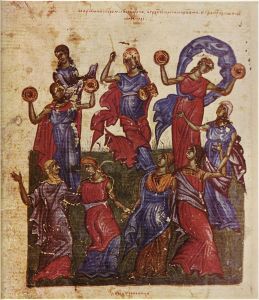
Tarnov literary and art school, Miriams Tanz, Miniatur aus dem bulfarischen Tomic Psalter (1360-1363)
Psalm 117
1 Praise the LORD, all you nations! Extol him, all you peoples!
2 For great is his steadfast love toward us, and the faithfulness of the LORD endures forever. Praise the LORD!
This is the shortest psalm in the psalter, but as James L. Mays states, “it thinks on a grand scale.” (Mays, 1994, p. 372) The people of Israel were never a world empire, nor were they a people who aggressively attempted to spread their beliefs and worship practices to the world around them. Yet, they do believe that the LORD is the God not only of Israel. The LORD created the heavens and the earth and all the peoples of the world. Just as the psalmist has encouraged the people gathered to worship to join in the hymn of all creation, now all the peoples of the nations are invited to participate in the end for which they were created: the praise of the LORD.
The motivation for the nations and peoples turning to the LORD in praise in this short psalm is not the acts of God but the character of God. The steadfast love (hesed) and faithfulness (‘emeth) of God are a frequently used pair of attributes that are rooted in God’s self-description in Exodus 34: 6-7. These attributes of the LORD are great[1] and powerful enough is the psalmist’s imagination to evoke a scene where all the nations of the earth join in proclaiming Hallelujah! (NRSV Praise the LORD)[2]
The apostle Paul quotes Psalm 117:1 in Romans 15:11 with several other references to the nations (Gentiles) praising God. This psalm helped shape his vision of a world where every knee could bow and every tongue confess that Jesus Christ is Lord to the glory of God the Father. (Philippians 2:10-11) Yet before the evangelistic movement of the early Christians into the nations there exists within the Jewish imagination a vision of a world where the nations join with them in their praise of God. Ultimately the telos[3] or end/goal of all humanity is the praise of God and in this psalm, we get to envision the world where all the nations are engaged in their proper work of praise.
[1] Brueggeman and Bellinger note that the term “great” in Hebrew is better translated might or strength with a military connotation. The term has the meaning of the strength to work one’s will. (Bellinger, 2014, p. 503)
[2] Hallelujah is the Hebrew word for praise (hallel) and shortened form of the name of God (yah) joined together.
[3] I’ve written about telos when working through the Gospel of Matthew in Perfection and Blamelessness in the Bible. I like the way Greg Lukianoff and Jonathan Haidt capture the idea of telos in The Coddling of the American Mind. “Aristotle often evaluated a thing with respect to its “telos”—its purpose, end, or goal. The telos of a knife is to cut. A knife that does not cut well is not a good knife.” (Haidt, 2018, p. 253)
1 I love the LORD, because he has heard my voice and my supplications.
2 Because he inclined his ear to me, therefore I will call on him as long as I live.
3 The snares of death encompassed me; the pangs of Sheol laid hold on me; I suffered distress and anguish.
4 Then I called on the name of the LORD: “O LORD, I pray, save my life!”
5 Gracious is the LORD, and righteous; our God is merciful.
6 The LORD protects the simple; when I was brought low, he saved me.
7 Return, O my soul, to your rest, for the LORD has dealt bountifully with you.
8 For you have delivered my soul from death, my eyes from tears, my feet from stumbling.
9 I walk before the LORD in the land of the living.
10 I kept my faith, even when I said, “I am greatly afflicted”;
11 I said in my consternation, “Everyone is a liar.”
12 What shall I return to the LORD for all his bounty to me?
13 I will lift up the cup of salvation and call on the name of the LORD,
14 I will pay my vows to the LORD in the presence of all his people.
15 Precious in the sight of the LORD is the death of his faithful ones.
16 O LORD, I am your servant; I am your servant, the child of your serving girl. You have loosed my bonds.
17 I will offer to you a thanksgiving sacrifice and call on the name of the LORD.
18 I will pay my vows to the LORD in the presence of all his people,
19 in the courts of the house of the LORD, in your midst, O Jerusalem. Praise the LORD!
Psalm 116 is the song of praise of one who has been delivered from the power of death. Throughout the psalms the LORD is the one who delivers the life (nephesh)[1] of this faithful one from the power of death. This individual praise has been brought into the practice of the Passover meal where the community now praises the LORD’s rescue of them from their death in Egypt. For Christians this psalm is traditionally read on Maundy Thursday (the Thursday before Easter) in connection with the last supper. In both the religious practice of Jews and Christians this psalm echoes a repeated theme in the psalms of a God who ransoms or save the life of the individual or people from the powers of death.[2]
Even though Deuteronomy 6:5 with its command, “You shall love the LORD your God with all your heart, with all your soul, and with all your might.” is one of the central commandments, and a part of the Shema which the people are to regularly recite, the psalms rarely refer to loving the LORD. J. Clinton McCann highlights three other psalms that reference loving God (Psalm 5:1; 32:23; and 40:16) (NIB IV: 1148) but even Psalm 40:16 refers to “those who love your salvation say continually, “Great is the LORD.” The NRSV and many other translations begin this psalm by stating “I love the LORD, because he has heard my voice and my supplications.” Yet, these translations deviate from the Hebrew which has the LORD as the subject of the verb hear. Nancy-deClaissé-Walford captures this in her translation, “I love because the LORD hears.” (Nancy deClaisse-Walford, 2014, p. 858) The rescued one is able to love because the LORD is one who saves from the time of trouble, who hears and inclines the ear of God to the one who calls upon God throughout their life.
God is the one who sustains life, but death is a constant threat throughout this poem. Death and Sheol are parallel terms for this realm or entity which attempts to lay hold of this faithful one. It is mythologized into a living being or force that can encompass with snares or afflict with pangs. This resonates with Paul usage of a personified death which is the last enemy to be defeated in 1 Corinthians 15:26. The LORD is the one who rescues the life of one who has been pulled close to the realm of death and has restored them to life. Now they walk before the LORD in the land of the living.
Even though this psalmist kept their faith in God in their time of distress other may have viewed this as a judgment from God like Job’s dialogue partners or like the enemies encountered in other psalms of lament. (Bellinger, 2014, p. 501) The psalmist may have had to dispute others who viewed their misfortune as indication of unfaithfulness or sin and who in the psalmist’s words were liars. Instead of receiving compassion from others, this one at death’s door may have received condemnation or even seen others plot to take advantage of his physical distress. Yet the psalmist’s faith was in a God who delivers from the snares of death and returns them to life.
The cup of salvation may have originated as a part of the drink offering or in an offering of thanksgiving for well being[3] but this reference to the cup of salvation likely led to the use of this psalm with the fourth cup at Passover. For Christians the linkage of the Passover with the Last Supper led to this being the traditional psalm on Maundy Thursday. Yet within the psalm this line is a part of the psalmist’s thankful reaction to the deliverance they have received. They pay their vows and the celebrate ritually what God has done for them.
Verse fifteen is a verse that is often used in a way that is opposite to its original intent. The NRSV’s translations Precious in the sight of the LORD is the death of his faithful ones makes it sound like the death of the faithful is something God welcomes when the entire direction of the psalm is about a God who rescues from death. The Hebrew yaqar translated as “precious” also has the meaning of costly or weighty. The NJPS translates this verse as grievous in the LORD’s sight. The word for faithful ones is hasid which are those who practice hesed or those who imitate God’s practice of steadfast love. Throughout the psalm the self-disclosure of God’s character in Exodus 34:6 as merciful and gracious…abounding in steadfast love and faithfulness is echoed in the Hebrew vocabulary of the psalm. For example, in verse five several of these same terms for God echo in this psalmist’s description of God.
For the psalmist the experience of rescue from the snares of death demonstrates the character of God. The psalmist lives in gratitude for the ability to love and live again. The come in worship and exaltation to the house of God and echo the Hallelujah (Praise the LORD) that the hallel psalms are named for. In knowing the deliverance of God, they have come to a fuller appreciation of the character of the God who delivers from death.
[1] The Hebrew nephesh is often translated ‘soul’ (as in verse seven and eight in the NRSV) but the modern concept of soul does not communicate the concept of nephesh. Nephesh is the essence of life or the center of life. Even in this psalm which discusses the place of the dead (Sheol) the contrast is between life and death, not life and afterlife.






 Sign of the Rose
