Tag Archives: Home

Review of The House in the Cerulean Sea by TJ Klune

Five Star Book Review
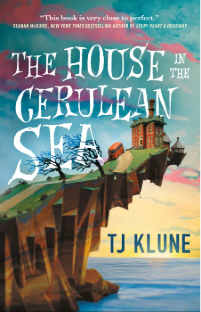
TJ Klune, The House in the Cerulean Sea

For me a five-star book is something that either I want to read again or something that is so profound it makes an immediate impact. There are lots of ways that books can be compelling: a unique idea, an interesting set of characters, a complex plot, an artistic use of the English language and more. Reading is also a subjective experience, so what appeals to me as a reader may be very different for you. I read a lot for both pleasure and work, but these short reviews are a way for me to show my appreciation for the work and the craft of the author of the reviewed work.

The House of the Cerulean Sea surprised me. It started out as a book with a pretty standard anonymous dehumanizing government agency and a main character, Linus, who as a case worker is both completely committed to the rules of the Department in Charge of Magical Youth and yet maintains the ability to see the magical youth as human. On the one hand the story is full of tropes: the dehumanizing bureaucracy, the rule follower who learns to trust his heart, an orphanage that attempts to provide children with a home, the inability of non-magic people to accept those different from them, finding one’s true family and love. The tropes are there and the story is predictable and yet sometimes tropes work because they express something fundamental to the experience of being human. Most people have experienced dehumanizing environments in some shape, not everyone is a rule follower but those who are typically find a time when the rules do not work, the desire for love, home, and acceptance are universal human needs. Sometimes we need characters that are not traditionally human to remind us of what humanity is all about.

It is the children in the story that really shine more than the two adult characters. Linus and Arthur, the caretaker of the orphanage, each have their roles to play in the protection of the children, the island, and the orphanage, but it is the way the children form a relationship with Arthur that transforms him more than anything else. Talia, a gnome, Sal, a shape shifting boy, Phee, a forest sprite, Chauncey a creature who may look monstrous but has a heart of gold, Theodore, a wyvern, and Lucy, an antichrist each in their own way and with their own language open themselves to this outsider who has come to inspect their home. Each bear their own scars from the way they have been treated by the outside world, but they help Linus find his own humanity which has been slowly smothered by his environment before coming to the island. There is an element of a love story between Arthur and Linus which they both struggle to voice and understand but for most of the story this is in the background and the children and their interactions with Linus and Arthur are in the foreground.

This is a book that at moments makes you feel. It can make you feel the desire for home, love, acceptance, and hope for a better future. It is quirky and it is not a story everyone will love. Others may be put off by the same sex relationship between Linus and Arthur. This is a quick read and seeing the children through the eyes of Linus and Arthur, I quickly found them endearing. Despite its tropes and predictability, it was really enjoyable in a comfortable and homey way.

Psalm 120 A Pilgrimage To A Place Of Peace

Pilgrim Steps Leading to the Double Gate (Southern Steps of the Temple Mount, Jerusalem) picture from 2009 by Wilson44691 – Own work, Public Domain, https://commons.wikimedia.org/w/index.php?curid=6899573

Psalm 120

A Song of Ascents.

1 In my distress I cry to the LORD, that he may answer me:

2 “Deliver me, O LORD, from lying lips, from a deceitful tongue.”

3 What shall be given to you? And what more shall be done to you, you deceitful tongue?

4 A warrior’s sharp arrows, with glowing coals of the broom tree!

5 Woe is me, that I am an alien in Meshech, that I must live among the tents of Kedar.

6 Too long have I had my dwelling among those who hate peace.

7 I am for peace; but when I speak, they are for war.

The Psalms of Ascent (Psalm 120 – 134) are fifteen psalms that may have been used as a part of the pilgrimage to Jerusalem. Jerusalem sits upon a hill so any approach to Jerusalem is always an ascent, but the ascent may also refer to the ascending of the steps of the temple. Mishnah states there are fifteen steps that lead from the Court of Women to the Court of the Israelites which correspond to the fifteen psalms. (Nancy deClaisse-Walford, 2014, p. 887) It is conceivable that a practice of reciting these fifteen short (except for Psalm 132) psalms as one approaches Jerusalem or as one ascends the steps of the temple. As this psalm indicates, this practice may help the people transition from their exile in a world of war and deceitful tongues to their homecoming in the city of peace.[1]

Too long have I had my dwelling among those who hate peace. The poet is a stranger in a strange land. They are a foreigner/alien(ger) in the midst of a people of different gods, sharp tongues, and unjust practices. Meshech and Kedar are likely metaphors for places both geographically and spiritually distant from the memory of their homeland. The situation of this psalm forms the antithesis of Psalm 133: How very good and pleasant it is when kindred live together in unity. The situation of Psalm 120 could be summarized: how traumatizing it is for one who lives as an alien among those who love division.

In language that resonates with James 3: 1-12, the psalmist describes the tongue as an instrument of violence. The psalmist may be the direct recipient of these deceitful and painful words, or they may exist in a society where the truth has disappeared.[2] Like the son in the parable of the prodigal[3] they may find themselves vulnerable and hungry in a world where no one cares. It may be ironic, as Brueggemann and Bellinger state, that the person who considers themself a person of peace would respond to these deceitful tongues with metaphorical weapons of war (Bellinger, 2014, p. 524) but the psalmist is asking for God to deliver. God is in the position to judge the people who the psalmist lives among. Yet, it is also possible that the description in verse four is merely a continuation of the description of the words of the lying lips and deceitful tongues. Sharp weapons are used metaphorically along with predatory animals to describe people hostile to the psalmist in Psalm 57:4. The broom tree is a hard wood tree known for its long burning fires. (Nancy deClaisse-Walford, 2014, p. 892)

This psalm can resonate with people of all times who attempt to live justly in an unjust world. Who seek peace (shalom) among a people whose words and actions seek conflict. As James L. Mays states about Psalm 120,

It is a poignant expression of the pilgrims’ pain over the world from which they come. It puts that world in the sharpest possible contrast to the peace they desire and seek in coming to Zion. (Mays, 1994, p. 388)

People of peace long for a homecoming where they can live in unity with their brothers and sisters who speak with truthful lips and words that heal instead of these weaponized tongues they encounter in the land of their sojourn. Pilgrimage, either physical or spiritual, is a hopeful ascent to a place of shalom.


[1] Jerusalem’s name comes from a combination of the word for city and shalom.

[2] Similar imagery is used in Psalm 10:4; 12: 1-4; and 31:8.

[3] Luke 15: 11-32.