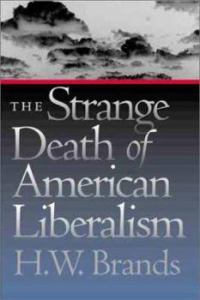
H.W. Brands. The Strange Death of American Liberalism.
For me a five-star book is something that either I want to read again or something that is so profound it makes an immediate impact. There are lots of ways that books can be compelling: a unique idea, an interesting set of characters, a complex plot, an artistic use of the English language and more. Reading is also a subjective experience, so what appeals to me as a reader may be very different for you. I read a lot for both pleasure and work, but these short reviews are a way for me to show my appreciation for the work and the craft of the author of the reviewed work.
H.W. Brands is a prolific writer and historian who teaches at the University of Texas at Austin. I first encountered his work while I was on sabbatical and became fascinated with the story of the American West and his Dreams of Eldorado: a History of the American West was an insightful introduction to many of the people and places of the history of the west. I picked up this book because the title intrigued me, but I did not expect this twenty-five-year-old book to be so insightful for our present moment in the life of America. Brands argues that going back to the founding of the United States most American were skeptical of a centralized government and Jeffersonian populism enjoyed more support than Hamilton’s view of a strong centralized national government. Liberalism in Brand’s argument is the belief that government can do many things to benefit the population which includes not only programs like Social Security or Medicare but also large infrastructure projects like the Interstate Highway System. He argues that the United States is a nation skeptical of strong government except when they need the government to protect them from enemies. During wartime Americans have accepted the necessity of the government consolidating authority that they would not accept in any other situation. In the aftermath of World War II the United States entered the Cold War which allowed the government to continue to operate with expanded powers with broad support from the people and leaders in both political parties. Brands places the death of American liberalism in the Nixon administration as the distrust in the government engendered during the Vietnam War and the disclosures of the manipulations and deceptions during the Truman, Eisenhower, Kennedy, Johnson, and Nixon administrations are revealed. This skepticism found it’s popular voicing in Reagan’s famous statement about the nine most terrifying words in the English language, “I’m from the government, and I’m here to help.” Yet, even Reagan utilized the threat of the Soviet Union to expand the foreign policy and defense spending of the United States.
H.W. Brands’s framing of American liberalism as the belief that the national government can and should do many things on behalf of the American people rather than state and local governments is helpful even if many will find it controversial. The book was published in November 2001, shortly after September 11 created another crisis which allowed the Bush and later administrations to expand the power of the government and gave birth to a short rebirth to a liberalism that could underwrite both a neo-conservative increase of government’s role in the policing of American life as well as the government’s expanded role in the healthcare system during the Obama administration. But it also explains the rise of the tea party movement in the Republican party and the eventual rise of Trump populism. It also helps to explain the isolationism that is rising among portions of the American populace that want a pull-back from American commitments to the post World War II order. Brands’s argument is provocative, and many people disagree with his conclusions, but it was insightful for me to understand why many citizens may not see the same value in the federal government’s role on behalf of its people that I do.



 Five Star Book Review
 I received an advance readers copy of the Warm Hands of Ghosts and I am a fan of Katherine Arden’s The Bear and the Nightingale series as well as her middle grade series Small Spaces. The Warm Hands of Ghosts takes the reader back to the historical fantasy genre of The Bear and the Nightingale, but this time the environment is primarily the hellish environment of Belgium in 1917 during the World War I battle for Passchendaele. Katherine Arden does a phenomenal job of presenting the environment of a world at war through the eyes of Laura and Freddie Iven. Laura begins the narrative home in Canada after several years as a field nurse for the medical corps, while her younger brother Freddie later joins the Canadian army in the trenches near Ypres. There is both a spiritualist and an apocalyptic framing of the war (particularly in a Jehovah’s Witness sense) and into the soul stealing space of war enters the beguiling but also devilish Faland. There are some similarities to the Smiling Man of the Small Spaces series, but the devil in a different context calls a different tune and plays a different game.
 Miroslav Volf has been an influential theological voice for me since his publication of Exclusion and Embrace and I have learned a great deal from his writing over the past two decades. Volf has been wrestling with the question of what makes a life worth living in his publications for the last eight years and this book feels like the successful culmination of years of writing, teaching, and seeking wise partners from his position at the Yale Divinity School and the Yale Center for Faith and Culture. His previous books on this topic (Flourishing: Why we Need Religion in a Globalized World and For the Life of the World: Theology that Makes a Difference) have helped frame the questions that now A Life Worth Living provides a guide for working through. A Life Worth Living models the class that Volf, Croasmun, and McAnnally-Linz teach at Yale, as well as at Danbury Federal Correctional Institute where they invite their seekers to consider several faith and wisdom traditions as they pose several key questions that are a part of seeking an authentic life. These questions include: What is worth wanting? What is the place of happiness in an authentic life? What is the authority are we responsible and what traditions form our vision of truth? How does a good life feel and what role do negative emotions/suffering have in the good life? What is worth hoping for? How should we live and what provides for a meaningful life? How do the various answers come together to form a life worth living? How does our good life fit within our bigger picture of the world? What do we do when we fall short of our visions of what life should be? How do we react to the suffering we experience and the suffering we encounter in the world around us?
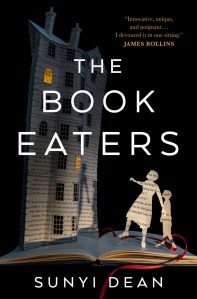 Sunyi Dean. The Book Eaters
 Sign of the Rose