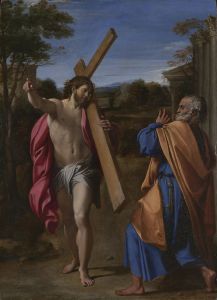
The Arrest of Christ (Kiss of Judas) by Giotto di Bondone. Scrovegni Chapel, Padua, Italy between 1304 and 1306
Matthew 26: 47-56
Parallels Mark 14:43-52; Luke 22:47-53
47 While he was still speaking, Judas, one of the twelve, arrived; with him was a large crowd with swords and clubs, from the chief priests and the elders of the people. 48 Now the betrayer had given them a sign, saying, “The one I will kiss is the man; arrest him.” 49 At once he came up to Jesus and said, “Greetings, Rabbi!” and kissed him. 50 Jesus said to him, “Friend, do what you are here to do.” Then they came and laid hands on Jesus and arrested him. 51 Suddenly, one of those with Jesus put his hand on his sword, drew it, and struck the slave of the high priest, cutting off his ear. 52 Then Jesus said to him, “Put your sword back into its place; for all who take the sword will perish by the sword. 53 Do you think that I cannot appeal to my Father, and he will at once send me more than twelve legions of angels? 54 But how then would the scriptures be fulfilled, which say it must happen in this way?” 55 At that hour Jesus said to the crowds, “Have you come out with swords and clubs to arrest me as though I were a bandit? Day after day I sat in the temple teaching, and you did not arrest me. 56 But all this has taken place, so that the scriptures of the prophets may be fulfilled.” Then all the disciples deserted him and fled.
The eleven disciples failed to keep watch and presumably during the time of their slumber Judas departed and returned with this large and armed crowd to hand over Jesus into the custody of the chief priests. Judas has moved from disciple to ‘handing over one’[1] and as we saw earlier in the Lord’s Supper he no longer addresses Jesus as ‘Lord’, which is an address which indicates faith in Matthew’s gospel, but instead as ‘Rabbi. Also the term ‘friend’ in the gospel is not a term of closeness but rather a term of distance or formality when one has acted improperly.[2] What Jesus has announced several times has now occurred, he has been handed over to the custody of the chief priests and the ‘handing over one’ is one of the twelve.
There is a sense of parallel in this scene between the crowd and those with Jesus: the large crowd arrives armed with swords and clubs lead to their location by one of their own, but when this sword armed crowd lays hands on Jesus one of those with Jesus, presumably a disciple, lays his hand on his sword to strike. This follower of Jesus still meets violence with violence and has to be told to return his sword to its place. Jesus’ ministry has been pointing to another way: where lex talionis (an eye for an eye) is replaced by turning the other cheek and where even one’s enemies are to be loved. Jesus’ disciples are not to respond to violence with violence. Jesus will not respond to the sword with the sword, nor are his disciples to take the sword and be killed by the sword. Jesus does not yield to the temptation to summon the heavenly angelic armies in overwhelming numbers.[3] Although Matthew does not cite scripture, he understands Jesus’ arrest and upcoming death as a fulfillment of the scriptures.
Jesus’ followers have put away their swords, yet the crowd that came to confront them was armed for a fight. Jesus refuses to be the ‘bandit’ messiah who fights with sword and club, that instead becomes the modus operandi of the chief priests. Jesus was maligned as being associated with ‘sinners’ but now he is handed, at the behest of the religious leaders, into the hands of sinners. He spoke in the temple during the day, but his arrest comes away from the city in the dark of night.
The disciples desert him, despite their earlier protestations of faithfulness even to the point of death. Peter remains at a distance and the ‘handing over one’ will return to the priests, but the rest of the disciples fade into the darkness only to reemerge in the light of the resurrection. Yet, throughout this passage there is a sense of necessity, that it was necessary for things to occur in this manner. The disciples, the crowd, and even the high priests and the elders are caught up in something they are unable to comprehend.
[1] This is the participle form of paradidomi which has been used throughout this section. Judas both in the gospel and beyond becomes defined by this action. He is the ‘handing over one’ or the betrayer.
19th Century Ceramic from the Rosary and St. Martin Chapel in Bruley, France
Matthew 26: 36-46
Parallels Mark 14:32-42; Luke 22:39-46
36 Then Jesus went with them to a place called Gethsemane; and he said to his disciples, “Sit here while I go over there and pray.” 37 He took with him Peter and the two sons of Zebedee, and began to be grieved and agitated. 38 Then he said to them, “I am deeply grieved, even to death; remain here, and stay awake with me.” 39 And going a little farther, he threw himself on the ground and prayed, “My Father, if it is possible, let this cup pass from me; yet not what I want but what you want.” 40 Then he came to the disciples and found them sleeping; and he said to Peter, “So, could you notstay awake with me one hour? 41Stay awake and pray that you may not come into the time of trial;the spirit indeed is willing, but the flesh is weak.” 42 Again he went away for the second time and prayed, “My Father, if this cannot pass unless I drink it, your will be done.” 43 Again he came and found them sleeping, for their eyes were heavy. 44 So leaving them again, he went away and prayed for the third time, saying the same words. 45 Then he came to the disciples and said to them, “Are you still sleeping and taking your rest? See, the hour is at hand, and the Son of Man is betrayed into the hands of sinners. 46Get up, let us be going. See, my betrayer is at hand.”
Jesus grieves. God has often been described using Greek philosophical concepts or the enlightenment idea of a detached God, but the God of the scriptures grieves. Jesus does not embrace his upcoming death calmly, like the Greek teacher Socrates, nor is Jesus portrayed as a warrior motivated by honor. Contrary to the Stoics who attempted to live self-control, discipline, and modesty becoming free from passion through apatheia this is the narrative of the passion (pathos) which means it is a narrative of suffering.[1] The God who is with us in Jesus is not a detached God unable to feel but is the God of scriptures who grieves over the situation of the world and God’s people.[2] This window into Jesus’ emotional state and prayers at Gethsemane gives us a strong contrast to the view of the heroic in the Greco-Roman world and instead gives us a look at the life of Jesus and the Father who are wrapped up in the messiness and the suffering of the world.
Jesus has already indicated that he is soon to be handed over to the chief priests, the scribes, and the elders and has also indicated that his closest disciples will all be scandalized because of him and one of the twelve will hand him over to the chief priests. Even Peter, who has insisted he will die if necessary to remain faithful to Jesus, will prove not only to be one who denies that he even knows him but also one who is not strong enough to even keep watch. Jesus goes off alone to pray, but his prayers hang in the air of Gethsemane unanswered. Jesus still refers to God as my Father, but this is a time of testing. Jesus encounters the emotion that the disciples have felt when he has indicated that he would be handed over to the authorities. During their final meal, the disciples were greatly grieved and now Jesus begins to be grieved and distressed.[3] Jesus asks for there to be another way forward. Using the metaphor for the upcoming suffering as a cup that must be drunk, Jesus uses a common image in the psalms and prophets for both judgment and consolation for the people.[4] Yet Jesus subordinates his will to the will of the Father and the option of the cup passing without being drunk remains an unanswered petition.
Peter, James and John have been unable to keep watch, even for the first watch of an hour. They prove that they are not strong enough[5] even to fulfill this request of Jesus, and they are not ready for the time of testing.[6] Jesus encourages them to pray as they keep watch and departs a second time to pray. Only Matthew includes the words to the second petition to the Father, which continues the cup metaphor but indicates that if the contents of this cup must be consumed that Jesus will submit to the will of the Father. Jesus, upon seeing the disciples sleeping on watch again, releases them[7] and departs for a final prayer. This three fold repetition, familiar to those who have read through these reflections on Matthew’s gospel, completes the cycle of prayer and prepares us for the rapid transition to the handing over of Jesus. The transition is abrupt as the disciples are roused with the announcement that the hour has ‘come near/is at hand’ when the Son of Man is handed over into the hands of sinners. It is interesting that Jesus, often accused of being a friend of tax collectors and sinners[8] now turns the accusation towards those who are coming to take him into custody. The transition between the prayers at Gethsemane and the handing over of Jesus has come near with the approach of the disciple who will hand Jesus over.
For a different style of reflection upon this passage and the upcoming crucifixion narrative see my poem Golgotha.
[1]Pathos which is behind both the English word passion and its opposite, apathy, can mean suffering or experience or emotion. When referring to rhetoric pathos was to persuade by emotional means, but when referring to the passion (pathos) narrative it is referring to the primary meaning of suffering. This is also the root of the English word pathetic.
[2] See for example Genesis 6:6, Psalm 78:40, Isaiah 63:10
[3] In verse 22 the disciples are lupeo sphodra (greatly grieved) while here Jesus is moulupeo kai ademoveo (grieved and distressed/anxious) in verse 37 and peripupos estin e psyche my eos thanatou (deeply grieved, the psyche/soul of me being like death) in verse 38.
[4] There are too many examples to list all of them, but some representative passages would include: Psalm 75:8, Isaiah 51:17-21, Jeremiah 25:15-28, and Ezekiel 23:31-33.
[5] The Greek iskuo means being strong, powerful, or able and gregopeo means to keep watch. While the disciples do fall asleep, the Greek text focuses more on the disciples not being strong enough to fulfill their task of keeping watch.
[6]Periosmos is the same term used in Matthew 6:13 in the Lord’s prayer.
[7]Aphiemi is a common word in the gospels. It can mean let go, release, but also forgive which has an interesting resonance here.
Book 26: Nathanael West, The Day of the Locust (1939)
This is a series of reflections reading through Time Magazine’s top 100 novels as selected by Lev Grossman and Richard Lacayo published since 1923 (when Time magazine was founded). For me this is an attempt to broaden my exposure to authors I may not encounter otherwise, especially as a person who was not a liberal arts major in college. Time’s list is alphabetical, so I decided to read through in a random order, and I plan to write a short reflection on each novel.
The Day of the Locust is a book that mocks the perfidious nature of Los Angeles in the 1930s. There is something in the tone of this book that reminds me of the writing of Flannery O’Connor: the ugliness of the characters and the desire to illustrate the worst characterization of reality. I can see why people enjoy this work, but it is not something I would choose to read. There is something almost postmodern in the work’s desire to choose the absurd as a focus of art, the medium is used to mock the message. Perhaps it is appropriate that throughout the book the primary narrator is working on a painting called “The Burning of Los Angeles.”
Tod, the primary character in the book, spends much of the book lusting over his neighbor Faye, but his primary desire throughout the book is to rape her, not to cultivate a relationship with her. Tod, like the author apparently, is bent on exposing her as a representative of all that is fake in Hollywood, along with her multiple relationships and some of the absurd situations. The orientation of Tod towards Faye, which continues throughout the book, was a major deterrent from being able to enjoy the work. Each character is a crude stereotype of various groups, and while this may be faithful to the way people in the 1930s viewed other groups, and perhaps it is to shine a light on this part of society, to read this book for me was to enter into characters that I couldn’t find anything redemptive in a slow-moving plot full of absurdity. It is a story of people caught in their ideas of themselves and never finding anything real, but the book itself seemed very contrived and fake to me. Others have found this work very powerful and delightful, so please make your own decisions, these brief reflections are merely a collection of my thoughts on each work.
31 Then Jesus said to them, “You will all become deserters because of me this night; for it is written,
‘I will strike the shepherd, and the sheep of the flock will be scattered.’
32 But after I am raised up, I will go ahead of you to Galilee.” 33 Peter said to him, “Though all become deserters because of you, I will never desert you.” 34 Jesus said to him, “Truly I tell you, this very night, before the cock crows, you will deny me three times.” 35 Peter said to him, “Even though I must die with you, I will not deny you.” And so said all the disciples.
The people of God throughout the scriptures have struggled to live as a community faithful to the covenant that they have been invited into. The disciples will continue this pattern during this time where the symbolic action at the Passover meal now become realized in the scandalous crucifixion of their Lord. Even Peter, for all his bold declarations, will continue to be a ‘little faith one’ who doubts, denies, and is unable to bear even the burden of staying awake with Jesus while he prays. Yet, for Matthew, the events that surround the life of Jesus are illustrated in the scriptures of Israel in predictive ways. The scattering of the scandalized disciples when their shepherd is taken from them echoes the relationship between God and God’s people in scripture, and these resonances help wrap the crucifixion narrative in the larger story of God’s relationship with God’s people and the rest of creation.
Many Christians are familiar with God and Jesus being identified as being the faithful or good shepherd of the flock. Psalm 23 may be the most familiar of these images, along with John 10 where Jesus is the good shepherd. Also resonant here is Ezekiel 34, where Israel has been cared for by unfaithful shepherds (leaders) and so God takes on the role of the true shepherd to seek out the scattered sheep. But here, Matthew, like Mark, quotes Zechariah 13:7:
“Awake, O sword, against my shepherd, against the man who is close to me!” declares the LORD Almighty. “Strike the shepherd, and the sheep will be scattered, and I will turn my hand against the little ones.
In Zechariah, the one struck is close to God, and the scattering of the sheep is because of the shepherd being lost rather than due to the unfaithfulness of previous shepherds. The words of Zechariah now become an explanation for the sheep of the shepherd[1] being scattered. David Garland catches the language of this passage, and its connection with previous imagery in the gospel, well when he states:
They will all be “scandalized” and “scattered” when their shepherd is struck. As Judas has succumbed to the lure of wealth like the seed choked by thorns (13:22), the other disciples will wilt at the first sign of persecution like the seed that landed in rocky soil. (Garland 2001, 255)
With the sudden removal of Jesus, the disciples will become ‘scandalized in’ Jesus[2] and there is within the senseless horror of the upcoming crucifixion as sense, for the gospels, of God’s active direction of this action for the sake of the sheep. Even here the prediction of the disciples’ scandalization because of Jesus’ apprehension, trial, and crucifixion is the promise of his being ‘raised up’ and going ahead of them to Galilee. The scattering of the shepherd’s flock will be followed by their regathering where the flock was initially gathered in Galilee.
Peter, along with the rest of the disciples, do not want to accept that they will be ‘scandalized’ and ‘scattered’ so easily. Peter even claims that even if it is necessary for him to die with Jesus, he will not be scandalized by him, but Jesus replies that this night he will deny him three times. Even though the disciples might seem like seeds that spring up quickly and wilt at the first sign of persecution, they are caught up in a story that is larger than themselves. Their scandalization and scattering are not final and their inability to maintain the level of steadfastness they expect of themselves is not a disqualification from being a part of what God is doing in this scene. They will be regathered together under their shepherd at the end to be led out into the rest of the world.
[1] In Greek the expression is ‘sheep of the shepherd’ rather than ‘sheep of the flock’ as the NRSV interprets. The meaning is ultimately the same.
[2] The Greek scandalize returns here in a passive form. NRSV translates this ‘become deserters.’ Scandalizo is frequently translated ‘stumbling block’ or ‘fall away’ but it is where our English word scandalize comes from. The prepositional phrase enemoi (in me) may seem a little strange in English, which is probably why most translations render this ‘because of me’
17 On the first day of Unleavened Bread the disciples came to Jesus, saying, “Where do you want us to make the preparations for you to eat the Passover?” 18 He said, “Go into the city to a certain man, and say to him, ‘The Teacher says, My time is near; I will keep the Passover at your house with my disciples.’” 19 So the disciples did as Jesus had directed them, and they prepared the Passover meal. 20 When it was evening, he took his place with the twelve; 21 and while they were eating, he said, “Truly I tell you, one of you will betray me.” 22 And they became greatly distressed and began to say to him one after another, “Surely not I, Lord?” 23 He answered, “The one who has dipped his hand into the bowl with me will betray me. 24 The Son of Man goes as it is written of him, but woe to that one by whom the Son of Man is betrayed! It would have been better for that one not to have been born.” 25 Judas, who betrayed him, said, “Surely not I, Rabbi?” He replied, “You have said so.”
26 While they were eating, Jesus took a loaf of bread, and after blessing it he broke it, gave it to the disciples, and said, “Take, eat; this is my body.” 27 Then he took a cup, and after giving thanks he gave it to them, saying, “Drink from it, all of you; 28 for this is my blood of thecovenant, which is poured out for many for the forgiveness of sins. 29 I tell you, I will never again drink of this fruit of the vine until that day when I drink it new with you in my Father’s kingdom.”
30 When they had sung the hymn, they went out to the Mount of Olives.
The basic story of the Lord’s supper is one of the most frequently heard narratives in churches that regularly celebrate communion, but sometimes that familiarity can make hearing the particularities of Matthew’s narration of this meal challenging. Most churches use a conglomeration of the language of Matthew, Mark, Luke, and 1 Corinthians in their words of institution, and other than the introducing the words occurring ‘in the night in which he was betrayed’ we often overlook the prediction of Jesus’ upcoming betrayal and the denial by the disciples. Matthew also grounds the language of this celebration in the Jewish language of covenant and the connection with the celebration of Passover heightens this covenantal understanding in Matthew’s gospel.
Matthew begins the story in a more abbreviated manner than the other gospels, but also focuses his narration on particular elements. Only Matthew brings both Greek concepts of time into the beginning of this scene. While Matthew, along with the other gospels, uses chronological time to state when this story occurs in relation to the Passover celebration on the calendar, Matthew also uses the Greek idea of kairos[1] in the information the disciples are to give to a certain man who Jesus will celebrate Passover with. Matthew’s narration also gives the impression that Jesus will be celebrating with the man along with his disciples.[2] Matthew omits the manner in which the disciples identify which ‘certain man’ they will approach, but the title they are instructed to use for Jesus with this man indicate he is probably not a person whose faith understands who he is dining with. Although Jesus has stated previously that the disciples ‘have one teacher, and they are all brothers’ (23:8) normally the address of Jesus as teacher indicates either a perspective without faith.[3]
In the evening Jesus arrives to the Passover celebration which has been prepared and reclines[4] with the twelve at the meal. During the meal Jesus announces that one of the twelve will ‘hand him over’[5] The disciples have previously been distressed when Jesus announced his ‘being handed over’ but the information that one of the twelve will be the one responsible for this causes them great distress or excessive grief and they each respond with a strong denial which expects a negative response the “Not I being (the one), Lord?” Note the title used by the eleven disciples in contrast to Judas’, “Not I being (the one), Rabbi?”[6] Throughout Matthew, those who respond to Jesus appropriately almost always address him as Lord. Jesus’ response to Judas will be identical to his later response to Caiaphas and Pilate, “You said (so).” Jesus returns to his favored ‘Son of Man’ title when he indicates he will go ‘as it has been written’ while at the same time declaring ‘woe’ on the one who is the agent of handing the Son of Man over. Woe was used previously in the ‘seven woes’ directed towards the scribes and Pharisees in Matthew 23, and now Judas in aligning with those opposed to Jesus finds himself as one under the same sentence as these Pharisees and scribes who, in Matthew’s view, are leading people astray.
Matthew, Mark, Luke and Paul all narrate the words around the bread and cup in a similar way, focusing on the bread as the body and the wine as the blood of the covenant. Matthew’s unique addition to this formula is that this blood of the covenant is for the forgiveness of sins. For Matthew, Jesus’ narrated mission spoken by the angel of the Lord is, “that he will save his people from their sins.” (1:21) We now see Matthew narrating what this forgiveness of sins will look like, and what a renewed covenant with their God will look like. At the beginning of Matthew, the announcement of Jesus’ vocation saving people from their sins immediately follows the genealogy which demonstrates their position as a people in exile awaiting deliverance. As the gospel concludes the reintroduction of the forgiveness/releasing many from their sins invites us to understand the crucifixion in the framework of the renewal of the covenant between God and the people
The language of ‘the blood of the covenant’ first emerges in relation to the people of Israel in Exodus 24 when Moses, Aaron, Nadab, Abihu and seventy elders of Israel meet on behalf of the people and Moses offers an offering and cast the blood of the offering upon them to mark the covenant relationship that the people of Israel had agreed to with the LORD God. During the Exodus narrative after the people are sprinkled with the blood of the covenant, Moses and the leaders are invited to dine with God on the mountain. (Exodus 24:9-11) The image of the blood of the covenant is also echoes in Zechariah:
As for you also, because of the blood of the covenant with you, I will set you prisoners free, O prisoners of hope. Zechariah 9:11
For the prophets, the renewal of the covenant will bring about the end of the exile and a renewed relationship between the people and their God. In the Exodus God brought the people out of Egypt to be something new and marked that relationship with the covenant. In the exile the prophets dreamed of a renewed covenant with God that brought about the end of the exile, and here this new covenant will emerge in a world dominated by Rome.
Blood coming upon the people can be both judgment and forgiveness. Previously in Matthew 23, in the seven woes against the scribe and Pharisees, the blood of the prophets testified against them:
so that upon you may come all the righteous blood shed on earth, from the blood of Abel to the blood of Zechariah son of Barachiah, whom you murdered between the sanctuary and the altar. Amen, I say to you, all this will come upon this generation. (23:35-36)
Judas will later despair of handing over innocent blood (27:4) which leads him to hang himself. Those who innocent blood testifies against find themselves in a state of woe. Yet, blood here also releases/forgives sin and the practice of sharing the bread and wine in the context of the Passover meal echoes the claim of God’s action to gather together the covenant people. Sin and debt are often held together in Matthew and this also echoes both the release from debts in the Jubilee practice of Leviticus 25 and the remission of debts in Deuteronomy 15. The multiple echoes and rich imagery of this scene existed before the church began to think liturgically and theologically about the practice of communion, but an examination of these themes can enrich both the practice and beliefs practice within communities. The practice of celebrating this meal in the church enacts covenantal relationship between God and God’s people and links the church’s action and life to the life and practices of the people of Israel. The language suggests that Matthew understands Jesus’ actions here framing Jesus’ upcoming death on the cross as a sacrificial offering that seals a new covenant relationship between God and God’s people. Just as Moses and the chief men ate and drank in the presence of God, now the disciples are (unaware) invited to dine in the presence of the ‘God who is with us’.[7] This also invites us to reconsider the traditional interpretation of Mathew 27:45 where the people ask for “his blood to come upon us.” Matthew as the most Jewish gospel, I believe, is preparing us to consider:
deeper intentionality at work here, not the intentionality of the hostile, fickle crowd, but the intentionality of the God who has sent Jesus to the lost sheep of Israel. (Hays 2016, 135)
One of the gifts of studying Matthew’s gospel is the way that listening closely continues to unlock new resonance and depth in the narration of Jesus’ life and teaching. The twelve original disciples have frequently misunderstood Jesus and have demonstrated themselves to be ‘little faith ones’ who do not fully grasp everything happening in the moment. Yet, they are continually invited to learn in participating with Jesus in these moments which will define the experience of what it means to be followers of Christ as they later begin to form communities that can practice and learn and reflect upon their faith which allows them to see what God is doing in Jesus’ life, death and resurrection.
[1] The Greek concept of kairos is the concept of ‘appointed’ specifically in Biblical though ‘divinely appointed’ time in contrast to chronos (chronological) time which is the time measured in hours and days on clocks and calendars.
[2] Matthew’s sparce narration of this scene Jesus’ instructions state ‘to/toward you to make the Passover with my disciples.” When translations state ‘at your house’ they are harmonizing with Mark and Luke.
[4] Dining in this context was done ‘reclining at the table’ with tables lower to the ground, rather than sitting elevated in chairs like most modern people assume.
[5] This is the Greek paradidomi which occurs frequently throughout the passion narrative.
[6] Rabbi was previously used in 23:8-9 as a title used by the Pharisees and not to be used by the disciples, it is also used by Judas in 26:48 when he hands Jesus over.
[7] Matthew’s gospel is bracketed by the claim of Jesus as Emmanuel, ‘God with us’ and as we’ve seen throughout this investigation this theme emerges at multiple points in the echoes and language choices of the gospel.
Julius Schnorr von Carolsfeld – Woodcut “Die Bibel in Bildern” 1860
Matthew 26:1-16
Parallel Mark 14:1-11, Luke 22:3-6, 7:36-50
When Jesus had finished saying all these things, he said to his disciples, 2 “You know that after two days the Passover is coming, and the Son of Man will be handed over to be crucified.”
3 Then the chief priests and the elders of the people gathered in the palace of the high priest, who was called Caiaphas, 4 and they conspired to arrest Jesus by stealth and kill him. 5 But they said, “Not during the festival, or there may be a riot among the people.”
6 Now while Jesus was at Bethany in the house of Simon the leper, 7 a woman came to him with an alabaster jar of very costly ointment, and she poured it on his head as he sat at the table. 8 But when the disciples saw it, they were angry and said, “Why this waste? 9 For this ointment could have been sold for a large sum, and the money given to the poor.” 10 But Jesus, aware of this, said to them, “Why do you trouble the woman? She has performed a good service for me. 11 For you always have the poor with you, but you will not always have me. 12 By pouring this ointment on my body she has prepared me for burial. 13 Truly I tell you, wherever this good newsis proclaimed in the whole world, what she has done will be told in remembrance of her.”
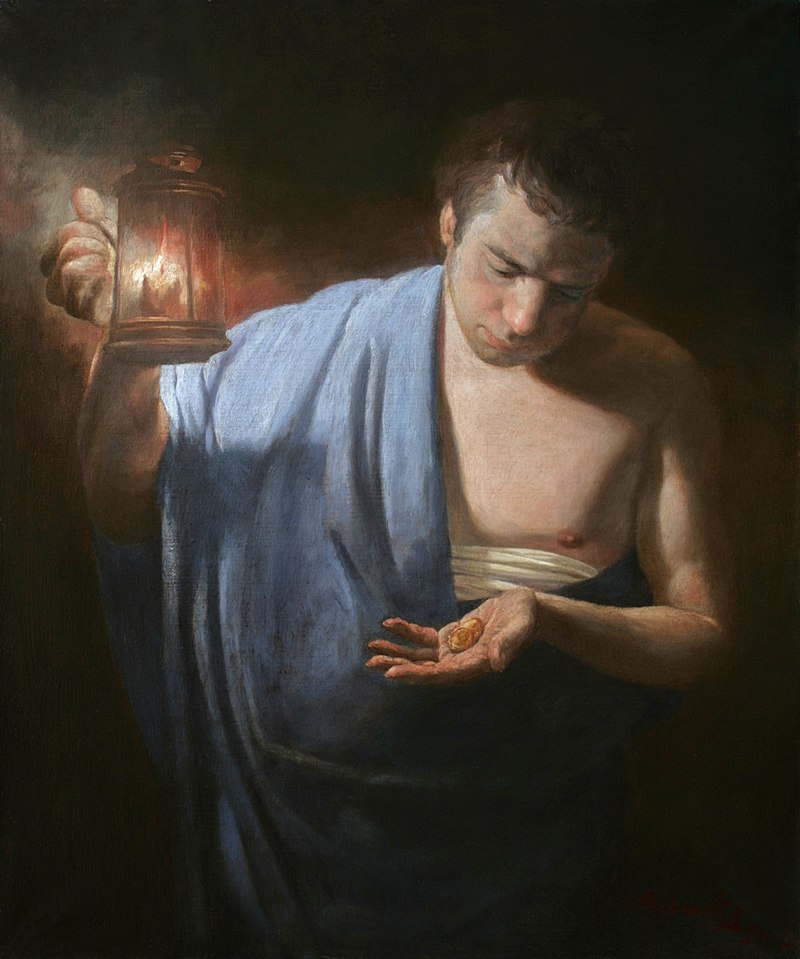
14 Then one of the twelve, who was called Judas Iscariot, went to the chief priests 15 and said, “What will you give me if I betray him to you?” They paid him thirty pieces of silver. 16 And from that moment he began to look for an opportunity to betray him.
Matthew abruptly transitions from parables to narrative by closing with a transitional formula similar to what he used in 7:28, 11:1, 13:53, and 19:1. As mentioned previously, Matthew’s language for these transitions is similar to Deuteronomy’s transitions at the end of Moses’ teaching (see Deuteronomy 31:1, 31:24 and 32:45) and many have attempted to draw a correlation between the five distinct teaching blocks in Matthew and the five books attributed to Moses (Genesis-Deuteronomy). Whether Matthew intended this structure of five teachings to point back to the first five books of the bible is an open question, but for Matthew the conclusion of these parables concludes the long blocks of teaching which form the most significant differences between Matthew and Mark, and even though Luke may share many of the teachings with Matthew they are often scattered throughout his gospel. Now the transition returns us to the basic narrative structure that Mark and Matthew share in common as we enter the passion narrative.
The passion narrative begins with a final prediction of the Son of Man’s being handed over[1] and crucified. We have just left a parable where the Son of Man comes in glory, but we quickly are returned to the quickly approaching suffering and death of the Son of Man. Jesus continues to use this title as a self-reference, and as readers we have seen the tension between Jesus and the religious leaders continue to rise and have had multiple predictions of Jesus’ upcoming betrayal, capture, and crucifixion. The gathering of the chief priests and elders in the courtyard[2] of Caiaphas to conspire to arrest Jesus in a cunning[3] way that leads to his death without provoking an uproar from the people sets the stage for the unfolding drama of the next two chapters. From the perspective of Caiaphas and these priests and elders Jesus is a dangerous influence on the people who needs to be eliminated, yet the feast of Passover with its symbolism and with the increased population in Jerusalem makes this a time where the passions of the crowd must be managed if they are to maintain control. There is the danger of an public uprising which could bring about military action by the Romans, but there is also the danger of their own authority being stolen in the midst of an uprising.
The scene quickly shifts from the courtyard of Caiaphas to the house of Simon the Leper at Bethany where Jesus is anointed by an unnamed woman. The title Christ or Messiah means ‘anointed one’ and although the title Son of God and beloved are revealed at the baptism, here in an unexpected person we see Jesus anointed. Anointing is frequently associated with both the priesthood (Exodus 29:7, Leviticus 21:10) and kings (1 Samuel 10:1, 16:13, 24:6; 1 Kings 1:39, 19:16; 2 Kings 9:3,6) and although the anointing ones in the above stories are often prophets of priests, here this unnamed woman completes this anointing of Jesus while he reclines[4] at the table. Peter has confessed that Jesus is the ‘anointed one,’ but he and the rest of the disciples (they are viewed as a group here) respond to this action indignantly.[5] Their objection is that this expensive ointment is now destroyed when it could have been sold to help the poor, and while the ministry to the poor is a significant part of Jesus’ ministry they misunderstand the implications of the woman’s actions. What they view as wasteful or destructive Jesus views as a good work.[6] Jesus also interprets her action of pouring (literally throwing in Greek) the ointment on him in light of his upcoming death and burial. She becomes the first woman to begin preparing Jesus’ body for its upcoming burial, and women will often take the lead in the passion narrative as the male disciples fail in their desire to remain steadfast during this time. The women during the crucifixion and resurrection stay closer to Jesus and become those who are the last faithful witnesses at the cross and the first at the empty tomb. This unnamed woman’s action becomes intimately connected with the proclamation of this gospel, and her action is to be told as an integral part of it. This woman is aware of the time in which she stands, unlike the disciples: she is aware that she stands in the presence of the bridegroom that will soon be taken from them (9:15) Although she remains unnamed her action is told in memory of her and highlight the actions of the many other unnamed and unremembered women who are integral to the continued proclamation of the gospel.
One of the twelve, Judas Iscariot, moves from indignation to action against the anointed one. The woman has spent and extravagant amount on the ointment, but Judas merely asks what they wish to give him to hand Jesus over to them. The price of thirty silver coins, which most likely are thirty shekels-about 120 days wage for a day laborer, is not an extravagant price. As Anna Case-Winters says well:
The woman at Bethany is “a bright foil to the dark plotting of the enemies and Judas.” Her extravagant gift in preparation for Jesus’ burial is in stark contrast to Judas’ greedy grasping after a paltry sum to hand Jesus over to die. (Case-Winters 2015, 293)
These four quick scenes which conclude Jesus’ teaching and prepare the reader for the upcoming betrayal and crucifixion of Jesus move us towards the rapidly approaching event of the Passover and the crucifixion. The chief priests and the scribes at the beginning of the gospel gave both the magi and King Herod the location of Jesus (2:5-6), now they are trying to discern his location for their own purposes. The disciples, even though they have been warned multiple times, seem unable to grasp who Jesus is or the symbolic nature of this work by the unnamed woman, but women will continue to bridge the gap between the struggles of these male disciples around the passion of Jesus and Jesus return to these disciples in Galilee. Yet, the handing over of Jesus comes from one of the twelve, one whose indignation has proven how inexpensive his loyalty to the ‘anointed one’ is.
[1] The Greek paradidomi is used throughout the gospel and particularly in the passion narrative. English translations may render it ‘hand over’ or ‘betray’ (both translations are apparent in this section).
[2] The Greek aule primarily means “courtyard, an enclosed space, open to the sky, near a house or surrounded by buildings” (BAGD, 121) While the household of Caiaphas may have been elaborate, the NRSV’s choice to translate this as palace tends to evoke for most English readers medieval imagery of castles.
[3] The Greek dolos has the darker meanings of treachery and deceit, and while stealth may cover the desire for secrecy it does not carry the negative connotations cunning, treachery or deceit may carry in English.
[4] Dining in Jesus time was done ‘reclining at the table’ with tables lower to the ground, rather than sitting elevated in chairs like most modern people assume.
[5]Aganakteo is traditionally translated indignant. Modern translations have gone to the more general term of anger, but anger is a large emotion covering a lot of more complex feelings.
[6] Greek ergazomai is work. The translation of service probably is due to some translators avoiding the terminology of good works in light of the conflict over this between reformation and Roman Catholic perspectives, but the simplest translation is good work.
If you’ve been to the welcome page of SignoftheRose you’ve seen that I have a book coming out in 2021. This is the cover artwork for that book and for me this was a chance to collaborate with my daughter Jey White. I am thrilled with how it evolved and with the finished product. I’ll be sharing more about the work in the coming weeks and I am excited to put some of my work out in a new format.
Separation of the Sheep and the Goats, 6th Century Mosaic. This file was donated to Wikimedia Commons as part of a project by the Metropolitan Museum of Art. See the Image and Data Resources Open Access Policy, CC0, https://commons.wikimedia.org/w/index.php?curid=60952241
Matthew 25: 31-46
31 “When the Son of Man comes in his glory, and all the angels with him, then he will sit on the throne of his glory. 32 All the nations will be gathered before him, and he will separate people one from another as a shepherd separates the sheep from the goats, 33 and he will put the sheep at his right hand and the goats at the left. 34 Then the king will say to those at his right hand, ‘Come, you that are blessed by my Father, inherit the kingdom prepared for you from the foundation of the world; 35 for I was hungry and you gave me food, I was thirsty and you gave me something to drink, I was a stranger and you welcomed me, 36 I was naked and you gave me clothing, I was sick and you took care of me, I was in prison and you visited me.’ 37 Then the righteous will answer him, ‘Lord, when was it that we saw you hungry and gave you food, or thirsty and gave you something to drink? 38 And when was it that we saw you a stranger and welcomed you, or naked and gave you clothing? 39 And when was it that we saw you sick or in prison and visited you?’ 40 And the king will answer them, ‘Truly I tell you, just as you did it to one of the least of these who are members of my family,you did it to me.’ 41 Then he will say to those at his left hand, ‘You that are accursed, depart from me into the eternal fire prepared for the devil and his angels; 42 for I was hungry and you gave me no food, I was thirsty and you gave me nothing to drink, 43 I was a stranger and you did not welcome me, naked and you did not give me clothing, sick and in prison and you did not visit me.’ 44 Then they also will answer, ‘Lord, when was it that we saw you hungry or thirsty or a stranger or naked or sick or in prison, and did not take care of you?’ 45 Then he will answer them, ‘Truly I tell you, just as you did not do it to one of the least of these, you did not do it to me.’ 46 And these will go away into eternal punishment, but the righteous into eternal life.”
This final parable in Matthew’s gospel builds upon the foundation laid by the previous five parables but also steps beyond them into cosmic setting of dividing the blessed ones of Father and the cursed ones. This final parable brings together imagery from across the gospel as well as several resonant images from the Hebrew Scriptures woven into a tightly woven tapestry. Like a tapestry, you can appreciate the pattern from an initial glance but when you look closely you can discern how the individual threads are brought together to form this final image. Unfortunately, I think this parable is sometimes treated like an ancient tapestry that seems out of place in the modern homes we’ve constructed and some would perhaps like to confine it to a museum as a witness to the artistic stylings of an ancient culture but for those with eyes to see and ears to hear it concludes the teaching of Matthew’s gospel and prepares us for the passion narrative which follows.
Matthew has, in the previous two parables, used imagery often associated with Israel’s relationship with their God: God as bridesmaid and God as ‘house master’ entrusting the stewardship of the household to slaves who wield great power on their master’s behalf. Now we are thrust into the cosmic sphere with the reintroduction of the title the Son of Man, in a way that closely links this title with Daniel’s introduction of this figure in Daniel 7:13-14:
As I watched the night visions, I saw one like a human being (Son of Man) coming with the clouds of heaven. And he came to the Ancient One and was presented before him. To him was given dominion and glory and kingship, that all peoples, nations, and languages should serve him. His dominion is an everlasting dominion that shall not pass away, and his kingship is one that shall never be destroyed.
Throughout the gospel the Son of Man has been linked to suffering, but here we also see it linked to glory. The suffering and glory of the Son of Man are held together in the trial before Caiaphas the high priest when Jesus states, “From now on you will see the Son of Man seated at the right hand of Power and coming on the clouds of heaven.” (26:64) But for the moment the parable looks beyond the upcoming suffering to the time when the Son of Man is seated on the throne of his glory and the peoples are gathered to him.
There are two possible readings of this parable which rotate on how one views the ones gathered and these littlest ones who their Lord is now seen through. One reading is that the Greek ethnos is translated simply as nations indicating all the nations (Jews and Gentiles) gathered before the Son of Man and sorted by how they respond to the ‘least of these.’ In this reading “the least of these who are members of my family” are the hungry, thirsty, strangers, naked, sick/weak, and prisoners of the world. The second reading translates ethnos as Gentiles understanding the ‘least of these who are members of my family” as the followers of Jesus who carry the message of Jesus to the nations. There are strengths to both readings and the text can encompass both meanings. However, most of what follows will focus on the second reading since it highlights a way of thinking about this parable less common in the church. The reading here will also move away from an individualistic way of thinking about this parable to a framework that fits within the Jewish communal ideas of righteousness and hospitality.
Although there are portions of the Hebrew Scriptures which talk about the care for those who are less fortunate in the sense of an individual’s action, like Proverbs 19:17[1]: “Whoever is kind to the poor lends to the LORD, and will be repaid in kind.“ But the individual’s actions are a part of the community which seeks to live in the covenant they have received from their God as a witness to the world. When Isaiah challenged the community to care for the hungry, the homeless, the naked, and the afflicted he could use singular pronouns to talk about the improper collective actions of the community:
Is this not the fast I choose; to loose the bonds of injustice, to undo the thongs of the yoke, to let the oppressed go free, and to break every yoke: Is it not to share your bread with the hungry, and bring the homeless poor into your house; when you see the naked, to cover them, and not to hide yourself from your own kin? Then your light shall break forth like the dawn, and your healing shall spring up quickly; your vindicator shall go before you, the glory of the LORD be your rear guard. Then you shall call, and the LORD will answer; you shall cry for help, and he will say, Here I am. If you remove the yoke from among you, the pointing of the finger, the speaking of evil, if you offer your food to the hungry and satisfy the needs of the afflicted, then your light shall rise in the darkness and your gloom be like the noonday. Isaiah 58:6-10
Israel and the church were intended to be communities of righteousness that would be lights that would illuminate the nations. Part of this expectation includes hospitality, which these new disciples were to expect in the places they go to both in Israel (10:5-15 where they are to rely on the hospitality of the villages and towns they come to) but also in the future when they are sent to go into ‘all nations.’ Particularly in Western societies we tend to read the scriptures in terms of individual responsibility, but a community of hospitality and righteousness doesn’t allow a person to remain hungry, thirsty, naked, sick/weak, or in prison without receiving care. Mark Allan Powell, when discussing the parable of the Prodigal Son in Luke, highlights this in talking to American, Russian and finally Tanzanian students for their interpretation of the parable. American students tended to highlight the son’s actions which lost his inheritance, Russian students tended to highlight the famine which brought about hunger in the land, but for me the most insightful was the answer he received in Tanzania:
The boy was in a far country. Immigrants often lose their money. They don’t know how things work—they might spend all their money when they shouldn’t because they don’t know about the famines that come. People think they are fools just because they don’t know how to live in that country. But the Bible commands us to care for the stranger and the alien in our midst. It is a lack of hospitality not to do so. This story, the Tanzanians told me, is less about personal repentance than it is about society. Specifically, it is about the kingdom of God. (Powell 2007, 27)emphasis mine
As we saw in Matthew 10:5-15, the judgment on communities that do not receive these disciples coming to them as strangers will receive a harsher judgment than Sodom and Gomorrah who failed to show hospitality to the divine visitors who entered their community.
In this cosmic parable where the Son of Man assumes his glory before all the peoples, nations and languages and some find themselves on the right[2] and others on the left judged for the way they received this unexpected divine visitation in the presence of these ‘little ones of God’s family.’ The attentive listener may hear the way Matthew has once again has pointed to the unique ways that ‘God is with us’ in these little faith ones sent out into the world needing care, welcome and compassion. It also creates a link between the beginning of the Sermon on the Mount and the two texts help interpret one another: perhaps the poor in spirit who are blessed or those who hunger and thirst for righteousness are found among those who are hungry, thirsty, strangers, naked, sick/weak, and imprisoned. The peoples of the world are blessed for how they receive these strangers and aliens in their midst. Are they the kind of society where their needs will be met or are they the type of society that hides themselves from their own kin?
The ‘blessed ones’ inherit the kingdom which was prepared for them from the ‘foundation of the cosmos.’ In hospitality they gave food to those hungering, drink to the thirst, gathered together[3] with the strangers, clothed the naked, visited the weak/sick,[4] and ‘came towards’ the ones in prison. On the one hand a community which does this towards the ‘little ones of God’s family’ probably practices this hospitality towards any strangers who find themselves in their midst, but probably in this parable they are blessed for the way they show hospitality for the least of God’s family[5] and by their actions show their righteousness. In contrast, the unrighteous do not practice this hospitality towards the strangers in their midst and find themselves left outside the kingdom of heaven. These ‘cursed ones’ have chosen the way of the devil and his angels and find themselves outside God’s promised ‘age of life’ enduring the ‘age of punishment’ or ‘age of fire.’[6]
Matthew’s gospel has continually pondered what the Jewish covenantal idea of righteousness looks like in practice for this community of Christ followers. Often this is framed in the wise/foolish framework of wisdom literature where the wise can take part in the celebration, or the master’s joy, or the kingdom prepared from the beginning of the cosmos while the foolish find themselves outside where there is weeping and gnashing of teeth. Righteousness does not look like individual piety, and there are those who may call on the name of the Lord, and who have heard the words of the Lord, but have not built their lives upon those words. This community of little ones go out as strangers among the nations expecting to see signs of the kingdom of God among those who welcome them, but conversely the nations are blessed or cursed based on the way they receive these humble messengers. Ultimately, any judgment remains in the hands of the Son of Man or God and not the disciples, the most they can do is shake the dust off their sandals. Just as the ‘housemaster’ continued to send slaves to his vineyard looking for the harvest from his vines, so the Son of Man continues to send slaves to the nations looking for the fruit of hospitality.
[6] Most translations render the Greek aion (eon) as eternal, but as throughout this translation I’ve attempted to avoid these terms which carry a lot of baggage in Christian thought. Matthew has a conception of righteousness and condemnation for wickedness which is never fully developed. For a fuller discussion see Gehenna, Tartaros, Sheol, Hades, and Hell
14 “For it is as if a man, going on a journey, summoned his slaves and entrusted his property to them; 15 to one he gave five talents,to another two, to another one, to each according to his ability. Then he went away. 16 The one who had received the five talents went off at once and traded with them, and made five more talents. 17 In the same way, the one who had the two talents made two more talents. 18 But the one who had received the one talent went off and dug a hole in the ground and hid his master’s money. 19 After a long time the master of those slaves came and settled accounts with them. 20 Then the one who had received the five talents came forward, bringing five more talents, saying, ‘Master, you handed over to me five talents; see, I have made five more talents.’ 21 His master said to him, ‘Well done, good and trustworthy slave; you have been trustworthy in a few things, I will put you in charge of many things; enter into the joy of your master.’ 22 And the one with the two talents also came forward, saying, ‘Master, you handed over to me two talents; see, I have made two more talents.’ 23 His master said to him, ‘Well done, good and trustworthy slave; you have been trustworthy in a few things, I will put you in charge of many things; enter into the joy of your master.’ 24 Then the one who had received the one talent also came forward, saying, ‘Master, I knew that you were a harsh man, reaping where you did not sow, and gathering where you did not scatter seed; 25 so I was afraid, and I went and hid your talent in the ground. Here you have what is yours.’ 26 But his master replied, ‘You wicked and lazy slave! You knew, did you, that I reap where I did not sow, and gather where I did not scatter? 27 Then you ought to have invested my money with the bankers, and on my return I would have received what was my own with interest. 28 So take the talent from him, and give it to the one with the ten talents. 29 For to all those who have, more will be given, and they will have an abundance; but from those who have nothing, even what they have will be taken away. 30 As for this worthless slave, throw him into the outer darkness, where there will be weeping and gnashing of teeth.’
This second parable, in a group of three, shifts from feminine to assumed masculine imagery and from the setting of the wedding feast to the stewardship of the household. Jesus has used this type of imagery multiple times in parables in Matthew, and although they are now organized in a different manner the theme of a lord ‘settling words’[1] with those charged with managing the household of the master. Keeping the framework of wise and foolish from the first parable, we know see these ideas cast within an economic metaphor. These slaves are entrusted with resources according to their power[2] and then the lord departs on a journey.
In this parable there are two slaves who act wisely and one who acts foolishly. The first two slaves who have greater power and receive a greater portion of the master’s possessions to manage immediately begin to work[3] with the property entrusted to them. As we encountered in 18:23-35, where slaves are also entrusted with ‘talents’, this is an extremely large measure of economic resources. These wise slaves continue to work from the moment of their master’s departure until his return as earnest stewards of the resources entrusted to them, and as faithful exercises of the power they have in the master’s household. In their work they gain[4]additional talents. They look forward to their master’s return in expectation instead of fear. They are called ‘good and faithful[5] and can enter into the joyful celebration of their master’s long-awaited return.
In contrast to the work of the wise slaves, the foolish slave responds in fear. His only work during the master’s long absence, that we are aware of, is the act of burying the master’s silver in the earth. While the wise slaves continue to sow and scatter, reap and gather for their master, the only thing this slave plants is the money itself. This slave’s icy words which accuse the master of benefiting from the work of those in his household and quick return the master’s possession from its place where it laid fruitless in the earth indicate the unwise posture of this slave. In contrast to the ‘good and faithful’ slaves who worked with the talents entrusted to them, this slave is ‘evil[6] and lazy.’ In contrast to the valorous woman of Proverbs 31 (see the previous section) this slave does eat ‘the bread of sloth’ in this time while the master is away. He avoids even the minimal option of investing the silver with the moneychangers or bankers which would not involve physical labor but would have returned some gain to the master’s household. Like the foolish bridesmaids this ‘evil and lazy’ slave finds himself on the outside of the celebration of the master’s return in the outer darkness.
Unfortunately, the best known line from this parable is the penultimate one, “For to all those who have, more will be given, and they will have an abundance; but from those who have nothing, even what they have will be taken away. Taken out of context this has often been read as a statement of the reality that the poor become poorer and the rich become richer, but this is not a proverb which can be extracted faithfully from this parable. Although the parable uses the metaphor of economics to talk about the kingdom of God, the kingdom of God as we will see in our final parable, is a place where the hungry, thirsty, the stranger, the naked, the sick, and the prisoner are all places the master is met in the world. It also forms a contrast from the reality of most of Jesus’ early followers who were not the wealthy of the world. It is important to understand that the language of the parable is the language of metaphor which creates a word comparison to highlight an aspect of the kingdom. The kingdom of heaven is certainly not an acceptance of the status quo of the power structures at work in the world, but Jesus’ parables use the experiences that his hearers would understand to point beyond themselves to a different type of household or kingdom.
At the end of the Sermon on the Mount Jesus said, “Everyone then who hears these words of mine and acts on them will be like a wise man who build his house on a rock.” (7:24) and now these slaves of the master who await the master’s return must settle their action (or lack of action) on these words. The foolish may proclaim, in the words of José A. Pagola:
Here is your gospel, your project of the reign of God, your message of love for those who suffer. We have kept it faithfully. We haven’t used it to transform our life or to introduce your kingdom to the world. We didn’t want to take chances. But here it is, undamaged. (Pagola 2012, 39)
The darkness of the earth that enclosed the entrusted silver of the master granted to do the work of the household are now matched by the outer darkness which forms the life separated from the master’s joy. The foolish in these parables are foils to those who wisely work in hopeful expectation of their master’s return. These ‘faithful and wise slaves’ that the master places over the household to work on its behalf and who are at work when their master arrives (24:45-47) are the ones who await the return of the Son of Man with persistent hope and joyful expectation.
[1] Greek suvairei logon is literally settling words and although most translations smooth this to settling accounts, the older language points to the importance of words spoken and written in agreements.
[2] Greek dunamis is a common word meaning power. Ability has nuances in English of skill or intelligence that power does not.
[3] Most translations link the action of the first two slave to the minimum option given to the final slave of ‘investing it with the moneychanger/bankers, but the word here is not trading or investing in a modern sense of financial markets but instead ‘to work.’ (Greek ergazomai) This probably is invested in the household of the master for future harvests in a primarily agricultural world rather than trading in merchandise and stock. There is an active sense that these two wise slaves’ continued work gains the additional talents.
[4] Greek kerdaivo. In English the idea of receiving has the connotation of payment for a job, but here the ‘gain’ is not held by the slaves except to return to the master’s estate.
[5] Greek pistos has been used to talk about faith throughout the gospel. While there is an element of trust in this term, to translate it ‘trustworthy’ here obscures the linkage with faith throughout Matthew.