Barent Fabritius, Saint Matthew and the Angel (1656)
When I began working through Matthew’s gospel in 2019 I had no idea how consuming this project would become. I had ideas I wanted to test, and I knew that both the length of the chapters in Matthew and the wealth of discussions of those chapters would make this a longer project than anything I had done previously, and still I was not prepared for how deep this would take me. I never intended to retranslate the gospel but as I began working through many contemporary translations I found a number of places I found other enlightening possibilities in the original Greek. I did not intend to spend two and a half years on this project, but I am also amazed at it. If you take all the posts together it is roughly 180,000 words and over 270 pages of single-spaced text. This project was a little like a black hole, consuming time that I may have devoted to other projects, but it also was a like a bright light that gave me direction and purpose, especially through 2020 and 2021 with all the changes due to COVID 19.
At this point I will create a table of contents page and print out the document with all the work behind the posts and let it sit for a bit. I think there are some profound and unique contributions to reading Matthew’s gospel and I may attempt to develop this further in the near future. Each book I have worked through has changed me a little, and this project has profoundly impacted the way I understand myself as a ‘little faith one’ attempting to follow the way of Jesus in the world. As Anna Case-Winters could say at the conclusion of her commentary on Matthew:
There is a reorientation implied. A deep engagement with the Lord’s Prayer, the Sermon on the Mount, and indeed the whole of the Gospel of Matthew is a reorienting experience. I commend the Gospel of Matthew to your reading, but it is a powerful text that must come with a warning: read it at your own risk. (Case-Winters 2015, 353)
Many people are content with a passing glance at the gospels. They may admire Jesus from a distance as a wise sage or a loving savior and may puzzle when they are asked to ‘take up their cross.’ For those who are curious, I would echo Anna Case-Winter’s warning to “read at your own risk” for it is a reorienting experience, but it is also a great gift as Matthew attempts to form us as readers of scripture, ones who have been disciples and taught, but perhaps most importantly to Matthew those who can see in Jesus the ‘God who is with us.’
Fra Angelico, Fresco in the Cloister of Mark in Florenz (1437-1445)
Matthew 28: 16-20
16 Now the eleven disciples went to Galilee, to the mountain to which Jesus had directed them. 17 When they saw him, they worshiped him; but some doubted[1]. 18 And Jesus came and said to them, “All authority in heaven and on earth has been given to me. 19 Go therefore and make disciples of all nations,[2] baptizing them in the name of the Father and of the Son and of the Holy Spirit, 20 and teaching them to obey everything that I have commanded you. And remember, I am with you always, to the end of the age.” [3]
This is Matthew’s unique and well-known conclusion to the gospel narrative, often called the Great Commission. This sending of Jesus’ disciples to all the nations brings together several themes from throughout the gospel of Matthew and puts one final exclamation point on the identity of Jesus for the gospel. These words, which have been influential for the church’s sense of mission and its development of a trinitarian language to talk about the experience of God in both Jesus and the Spirit, come with the expectation of these disciples and those who follow them forming communities that can practice the type of life that Jesus points to throughout the gospel. These communities, like the disciples who form them, will be places where the risen Christ can be worshipped but where doubt can coexist with that worship. These sent disciples remain ‘little faith ones’ who still need Christ’s presence as they go about their mission of making disciples and teaching until this eon ends and the kingdom of heaven is brought fully to earth.
Mountains have in Matthew’s gospel serve as places where the identity of Christ is revealed, the followers of Jesus are taught, and the kingdom of heaven is realized through healing and feeding. Previously on a mountain during the temptation (4:8) the devil attempted to challenge Jesus’ identity as the Son of God, and during the transfiguration (17:1-9) the divine voice affirms Jesus’ identity as, “My Son, the Beloved.”[4] The location of the mountaintop becomes a place where the disciples now learn that Jesus has been given all authority in heaven and on earth and that his identity as Son is now included with the baptismal naming of God as Father, Son, and Holy Spirit. The mountain is also a place of teaching in Matthew’s gospel, especially in reference the Sermon on Mount (Matthew 5-7). Now on the mountain these disciples who are sent to make disciples are to take the teaching they received to instruct the communities they will form in obedience to the commands of Christ. For Matthew, mountains are a place where people come to know the identity, authority and teaching of Christ and at this final sending from the mountaintop Jesus’ identity, authority and teaching are confirmed and to be taught to a new generation of disciples.
The disciples have come after hearing the message delivered by Mary Magdalene and the other Mary. The eleven traveled to Galilee and see Jesus and bow down to worship and doubt at the same time. This is only the second time in Matthew’s gospel where the word doubt has appeared,[5] and doubt and worship were paired in that occurrence as well. In Matthew 14:22-33, when Jesus walks on the water towards the disciples in the boat and Peter comes to Jesus on the water, Jesus says to Peter, “little faith one, why (have you entered) into doubt?” (my translation) As I mentioned in that section, I believe that instead of castigating Peter for experiencing doubt, perhaps he is reassuring Peter (and ‘little faith ones’ throughout the ages) that he indeed is ‘God with us’ in the midst of the storm. Now this is reinforced by the use of the word diatazo here on the mountain in Galilee after the resurrection where the disciples doubt is paired with the encouragement “I am with you always, to the end of the age. When Jesus and Peter returned to the boat the disciples worshipped, and here on the mountain they worship as well. Being a ‘little faith one’ or ‘one who doubts’ does not exclude one from being a disciple who can worship the experience of ‘God with us’ in Jesus. As M. Eugene Boring aptly states,
but they doubted…represents Matthew’s own theological understanding of the meaning of discipleship, which is always a matter of “little faith,” faith that by its nature is not the same as cocksureness, but incorporates doubts within itself in the act of worship. (NIB VIII,502)
Several English translations indicate that ‘some’ doubt, but in the Greek the indication is that all share this doubt. The resurrection event did not generate ‘perfect faith’ among the disciples, but their ‘little faith’ was enough to understand that the proper response was worship and obedience.
Throughout the gospel we have seen people bow down and worship Jesus. While the word here can simply mean to bow down and pay homage, Matthew often uses this term in scenes of “epiphanic self-manifestation” (Hays 2016, 167) which highlight the ways in which Jesus is revealed as ‘God with us’ throughout the gospel.[6] In addition to the times when the disciples worshipped after Jesus saved Peter in the storm mentioned above and the multiple approaches of people coming to Jesus to seek healing or an honor to be bestowed by Jesus[7] it is enlightening to see how Matthew uses the act of worshipping Jesus to bookend the gospel. The first to worship Jesus are the Magi (2:2, 11) and the gospel closes with both Marys worshipping Jesus (28:9) and now the disciples. As David Garland can illustrate the way Matthew uses this worship to bracket the gospel’s response to Jesus,
Their worship means the story has come full circle. The magi came to worship him as the king of the Jews in the beginning (2:2,11). At the conclusion, however, Jesus declares to his disciples that he is the supreme sovereign of the cosmos and owed unconditional obedience. Satan had only pledged to give Jesus “all the kingdoms of the world,” but Jesus grasped after nothing and has received much more through his faithful submission to the will of his heavenly Father—all authority in heaven and earth (see Ps. 2: 7-8) (Garland 2001, 270)
The commissioning of the disciples for their mission in this age has echoes of the commissioning of Joshua to lead Israel into the promised land. Jesus has already appeared as one who can on the mountain speak the law of God, and now the disciples are to carry forward all these teachings. Joshua has two separate commissions in the scriptures, and both are resonant here. First in Deuteronomy 31:23:
Then the LORD commissioned Joshua son of Nun and said, “Be strong and bold, for you shall bring the Israelites into the land that I promised them; I will be with you.”
Also, Joshua 1:7:
Only be strong, and very courageous, being careful to act in accordance with all the law that my servant Moses commanded you; do not turn from it to the right hand or to the left, so that you may be successful wherever you go.
Like the divine commissions of Joshua, now the disciples are commanded to teach new disciples obedience to the commands of Jesus, but they are also promised the presence of their Lord in their mission.
Matthew’s gospel does not have a developed “Trinitarian theology” like the later church, but the seeds that would grow into that theology are present here. Matthew’s baptismal formula which links together the identities of the Father, the Son, and the Holy Spirit reflect Matthew’s continued invitation to see how the actions of Jesus and the Holy Spirit are linked with God’s revelation. Central to the development of the church’s later doctrine of the Trinity was the question of how to talk about the identity of Christ. Matthew’s continual use of scriptural images previously reserved for God to talk about the actions of Jesus have continued to point to a rich unity in identity between Jesus and the God of Israel. As Richard B. Hays speaks forcefully,
Matthew highlights the worship of Jesus for one reason: he believes and proclaims that Jesus is the embodied presence of Gad and that the worship of Jesus is to worship YHWH—not merely an agent of facsimile or an intermediary. If we read the story within the hermeneutical matrix of Israel’s Scripture, we can draw no other conclusion. (Hays 2016, 175)
Matthew’s gospel announces the upcoming birth of Jesus with the title Emmanuel (1:23, citing Isaiah 7:14) and Matthew’s gospel concludes with an echo of this title. The gospel is bookended with the claim that in Jesus, “God is with us.” This has been pointed to throughout the narrative and is also present in the promise that, “where two or three are gathered in my name, I am there among them” (18:20) This promise that I will be with you to the end (Greek sun-telos) of the eon is where the words and images and promises of Matthew’s gospel reach their telos.[8]As Hays again can state,
beyond the simple logical implications of Jesus’ parting promise, its significance is amplified by the extensive network of scriptural intertexts it evokes. In the MT and the LXX[9] there are atleast 114 instance[10] of a formula declaring God is “with” an individual, group, or the nation of Israel. (Hays 2016, 171)
This short conclusion to Matthew’s gospel brings together several central themes to instruct the disciples in their formation of the community of Christ. They once were commanded to go only to the lost sheep of Israel, but now their commission by their risen Lord is to go to all the nations. The story of Jesus has come full circle as the disciples worship the one who is God with them as they fulfill their commission until the completion of the eon. In the gospel of Matthew, Jesus has only talked about the completion of the eon in parable form (13:22, 33, 39, 49) and the disciples ask Jesus about this again in relation to the destruction of the temple (24:3). The disciple of Jesus are not given signs which will herald the ending of the age, but they are given the promise of their Lord’s presence both in their mission and the sufferings that will come. As these ‘little faith ones’ now go out making disciples, baptizing, teaching and forming communities that can hand on the practices and faith which sees in Jesus the presence of God with us. Communities that can worship even in the midst of their doubts and questions as they, like Matthew, search for language that can bear witness to experience of the God who meets us in the crucified and resurrected Christ. Matthew has, like a scribe trained for the kingdom of heaven, brought out of the storehouse of scripture treasures old and new (13:52) for those with eyes to see and ears to hear. His act of handing on this gospel to us is a gift to teach disciples who now approach this text how to read the scriptures in light of Christ, how to practice obedience to the way of Christ and how our lives continue in the promised presence of the God who is with us.
[1] The Greek simply states that they doubted (oi de edistasan) there is no differentiation between those worshipping (proskuneo) and the doubting ones.
[2]Greek ethnos can mean either Gentiles or nations. I would agree with the translation of all nations instead of all Gentiles here (Matthew does not see an exclusion of the Jewish people from the ongoing mission).
[3] The Greek suntelieais tou aionos brings together two important words in Matthew. The first word is telos with the prefix sun attached, telos being a word of goal or end point and the combination with the prefix gives the idea of completion, closing. The translation of aion as age is appropriate if you are referring in the sense of ‘the age of man.’ This is the closing of the current eon and the initiation of the eon of the kingdom of heaven.
[4] This same title was also used in the baptism of Jesus (3:17). Although Matthew does not develop a baptismal theology for the early Christians he points to this as an activity of this community of Christ and the practice of baptism is linked to the narrative of Christ’s baptism.
[5]Matthew 21:21 in the NRSV is translated doubt, but it is the Greek diakrino instead of distazo used here and in 14:31.
[6] Matthew uses the Greek proskuneo (bow down, worship) a total of thirteen times in his gospel and almost always as an act of worship towards Jesus. In comparison Mark only uses this word twice and Luke three times.
[8]Telos means goal, end, destination, or completion.
[9] MT is the Masoretic text or the Hebrew scriptures behind the English translation of the Old Testament, the LXX or Septuagint is the Greek text of what we refer to as the Old Testament.
[10] In addition to the commission of Joshua mentioned above Hays focuses on three particular examples: Genesis 28:12-17 (God in Jacob’s dream), Jeremiah 1:8-9 in the commissioning of the prophet Jeremiah and in the hopeful message of the Prophet Haggai (Haggai 1:13).
The Resurrection of Jesus Christ by Piero della Francesca (1463)
Matthew 28: 1-15
Parallel Mark 16: 1-8, Luke 24: 1-12, John 20: 1-18
After the sabbath, as the first day of the week was dawning, Mary Magdalene and the other Mary went to see the tomb. 2 And suddenly there was a great earthquake; for an angel of the Lord, descending from heaven, came and rolled back the stone and sat on it. 3 His appearance was like lightning, and his clothing white as snow. 4 For fear of him the guards shook and became like dead men. 5 But the angel said to the women, “Do not be afraid; I know that you are looking for Jesus who was crucified. 6 He is not here; for he has been raised, as he said. Come, see the place where he lay. 7 Then go quickly and tell his disciples, ‘He has been raised from the dead, and indeed he is going ahead of you to Galilee; there you will see him.’ This is my message for you.” 8 So they left the tomb quickly with fear and great joy, and ran to tell his disciples. 9 Suddenly Jesus met them and said, “Greetings!” And they came to him, took hold of his feet, and worshiped him. 10 Then Jesus said to them, “Do not be afraid; go and tell my brothers to go to Galilee; there they will see me.” 11 While they were going, some of the guard went into the city and told the chief priests everything that had happened.
12 After the priests had assembled with the elders, they devised a plan to give a large sum of money to the soldiers, 13 telling them, “You must say, ‘His disciples came by night and stole him away while we were asleep.’ 14 If this comes to the governor’s ears, we will satisfy him and keep you out of trouble.” 15 So they took the money and did as they were directed. And this story is still told among the Jews to this day.
Matthew’s description of the empty tomb shares significant elements with the other three gospels, but Matthew’s narration also includes several distinct elements that illuminate Matthew’s message in this critical scene. Matthew continues to integrate elements that highlight this story’s connection to the imagery and narrative of the people of Israel in the scriptures. Matthew also continues to use imagery that indicates the impact of the resurrection on the creation itself. Finally, only Matthew continues to pay attention to the continued resistance of the religious leaders to the message of the resurrection as they continue to peddle false narratives about Jesus.
The two Marys who sat opposite the tomb at the entombment of Jesus now return on the morning of the third day to see the tomb. Gone are the anointing spices in Mark’s gospel and the mission to anoint the body, in Matthew they merely come to see the tomb. Perhaps Matthew wants to have these women coming in expectation of the resurrection and have these women disciples understand, or perhaps better for Matthew’s language have faith, where the male disciples did not. Matthew is the only gospel that narrated an earthquake at the end of the crucifixion scene and now Matthew again narrates an earthquake as the angel of the Lord descends. In Matthew the crucifixion and resurrections are cosmic events that impact the creation and again the creation reacts to the movement of God in the resurrection of Jesus.
Matthew continues to narrate the story of Jesus in a way that links this story to the Hebrew Scriptures. While Mark and Luke narrate the messengers as men and John has two angels that sit where the body of Jesus was laid, in Matthew the messenger is an angel of the Lord. Throughout scriptures the angel of the Lord is used as a mouthpiece of God, a mediated way for God’s message to come to God’s people. The angel of the Lord appeared to Joseph multiple times in a dream to direct him at the beginning of the story, and now at the end this angel directs the women with a message for the disciples of Jesus to gather in Galilee. The description of the angel also echoes the description of the Ancient One in Daniel 7:9 or the description of Moses’ shining face in Exodus 34:29-35 but is more subdued than the description of the Transfigured Jesus in Matthew 17: 2.
Only Matthew narrates the presence of the guards at the tomb, and their reaction to the appearance of the angel of the Lord forms a paradox for this scene. The guards placed by the religious leaders to ensure the crucified one remains entombed now become ‘like the dead’ themselves. The brute force that the religious leaders can muster and the power of death that Rome can wield are now inverted as the crucified one is announced as alive and the emissaries of the ones who called for Jesus’ death now find themselves paralyzed by fear. Some of these guards, though not all in Matthew’s narration, will later report to the chief priests what has occurred at the tomb and this will require another false narrative and another payment of silver and promise of protection to the guards. Perhaps those in Matthew’s community have heard this false explanation from other Jewish people who do not have faith in the resurrection and Matthew felt compelled to include this second story in his narration of the resurrection.
The women in Matthew, unlike in Mark’s strange ending, obey and depart to spread the message to the disciples. These women who came with the sad purpose of confirming the entombment of Jesus and perhaps paying honor to him now depart running for joy with the purpose of announcing his resurrected life only to have the joyous interruption of encountering the resurrected Jesus. The grab hold of his feet and worship him. They are told a second time not to be afraid and to depart to the brothers (disciples) of Jesus and to have them journey to Galilee where they will also see him. These two women become not only the first messengers of Jesus but also the first to worship their risen Lord. The story ends with two different groups telling two different reports of what occurred at the tomb of Jesus. The two women tell a joyful story relayed to them by both the angel of the Lord and the risen Jesus about life. Jesus said to the Pharisees and the scribes that the only sign this generation would receive would be the sign of Jonah.[1] The guards, after being paid in silver, tell a story that comes from the religious leaders and attempt to hide this sign for their generation. These chief priests, in Matthew, who feared Jesus’ disciples coming to steal the body and providing a greater deception than the first now once again prove to be deceivers and unfaithful shepherds of the people.
Wall Mosaic of the Entombment of Christ at the Church of the Holy Sepulchre, Photo shared by Antan0 under CC.
Matthew 27: 57-66
57 When it was evening, there came a rich man from Arimathea, named Joseph, who was also a disciple of Jesus. 58 He went to Pilate and asked for the body of Jesus; then Pilate ordered it to be given to him. 59 So Joseph took the body and wrapped it in a clean linen cloth 60 and laid it in his own new tomb, which he had hewn in the rock. He then rolled a great stone to the door of the tomb and went away. 61 Mary Magdalene and the other Mary were there, sitting opposite the tomb.
62 The next day, that is, after the day of Preparation, the chief priests and the Pharisees gathered before Pilate 63 and said, “Sir,[1] we remember what that impostor[2] said while he was still alive, ‘After three days I will rise again.’ 64 Therefore command the tomb to be made secure until the third day; otherwise his disciples may go and steal him away, and tell the people, ‘He has been raised from the dead,’ and the last deception would be worse than the first.” 65 Pilate said to them, “You have a guardof soldiers; go, make it as secure as you can.” 66 So they went with the guard and made the tomb secure by sealing the stone.
The conclusion of the crucifixion scene brings before Pilate two very different appeals: one comes from a rich disciple of Jesus requesting the body and one comes from the religious leaders to ensure that the elimination of Jesus’ power is completed. Ironically, it is the chief priests and the Pharisees who have understood the words that Jesus speaks about rising up while many of his disciples remained unable to hear and understand these predictions. Also, the religious leaders’ actions to prevent a deception by the disciples of Jesus will require their own deception after the resurrection. Now a rich male disciple, two women, and a guard of soldiers will witness a sealed tomb with the body of the crucified Jesus placed inside.
Joseph of Arimathea is both a disciple of Jesus and wealthy. The challenge to the rich young man in 19:21 is not universalized in the gospel for all followers of Jesus. Yet, like the woman who anoints Jesus at Bethany with a very costly ointment (26:6-13), Joseph uses this wealth in the service of preparing Jesus for his death. He provides the clean linen cloth and his own new tomb in service of Jesus. As Warren Carter notes, Joseph’s act is a courageous one. The eleven disciples presumably fled to avoid guilt by association with Jesus as he is crucified and Joseph’s request for the body to provide a proper burial could stain him with association with a crucified criminal. (Carter 2001, 539) Like Joseph the son of Jacob in the Egyptian court he refuses to be swayed by the imperial power and like Joseph, who fulfills the role of an earthly father to Jesus, he seeks to be faithful to God’s ways rather than the ways of those reigning at the time.
Two women disciples also remain keeping watch, and their mention on either side of Joseph of Arimathea strengthens the link in Matthew that these women are considered disciples as well. There is the possibility that Matthew understands these women as awaiting the resurrection, but they may also, like Joseph, be giving a final offering to the one they have followed since Galilee. Their position at the tomb at the time of Jesus’ entombment prepares for their arrival after the sabbath going to the tomb.
Even if the women are not waiting in expectation of the resurrection, the religious leaders are anticipating some action by the disciples of Jesus to fulfill their leader’s words. The chief priests are now rejoined by the Pharisees who have been absent since Matthew 22-23. Both groups of religious leaders have dealt with Jesus at various points in his ministry and attempting to ensure his legacy is ended brings these often-opposed groups together. Although the main disciples of Jesus have scattered, the religious leaders fear some or all of them returning to perpetuate the legacy of Jesus. As mentioned above, their actions to prevent deception require a new deception and their guards will prove one more witness they will need to silence. The tomb is sealed, the body prepared, and the guards and the women will wait with all of creation for the first day of the week.
[1] This is the Greek kupios which is translated Lord throughout Matthew when referring to Jesus. Although it can be the simple honorific ‘sir’ it is significant that the religious leaders now use this same address for the representative of Rome.
[2] In vs. 63 and 64 the Greek planos as a noun means deceiver or deception. It is the same word in both verses and instead of imposter I would translate vs. 63 as deceiver.
Reproduction of Carl Heinrich Bloch’s, Christ on the Cross (1870)
Matthew 27: 32-55
32 As they went out, they came upon a man from Cyrene named Simon; they compelled this man to carry his cross. 33 And when they came to a place called Golgotha (which means Place of a Skull), 34 they offered him wine to drink, mixed with gall; but when he tasted it, he would not drink it. 35 And when they had crucified him, they divided his clothes among themselves by casting lots; 36 then they sat down there and kept watch over him. 37 Over his head they put the charge against him, which read, “This is Jesus, the King of the Jews.”
38 Then two bandits were crucified with him, one on his right and one on his left. 39 Those who passed by derided[1]him, shaking their heads 40 and saying, “You who would destroy the temple and build it in three days, save yourself! If you are the Son of God, come down from the cross.” 41 In the same way the chief priests also, along with the scribes and elders, were mocking him, saying, 42 “He saved others; he cannot save himself.He is the King of Israel; let him come down from the cross now, and we will believe in him. 43 He trusts in God; let God deliver him now, if he wants to; for he said, ‘I am God’s Son.'” 44 The bandits who were crucified with him also taunted him in the same way.
45 From noon on, darkness came over the whole landuntil three in the afternoon. 46 And about three o’clock Jesus cried with a loud voice, “Eli, Eli, lema sabachthani?” that is, “My God, my God, why have you forsaken me?” 47 When some of the bystanders heard it, they said, “This man is calling for Elijah.” 48 At once one of them ran and got a sponge, filled it with sour wine, put it on a stick, and gave it to him to drink. 49 But the others said, “Wait, let us see whether Elijah will come to save him.” 50 Then Jesus cried again with a loud voice and breathed his last. 51 At that moment the curtain of the temple was torn in two, from top to bottom. The earth shook, and the rocks were split. 52 The tombs also were opened, and many bodies of the saints who had fallen asleep were raised. 53 After his resurrection they came out of the tombs and entered the holy city and appeared to many. 54 Now when the centurion and those with him, who were keeping watch over Jesus, saw the earthquake and what took place, they were terrified and said, “Truly this man was God’s Son!”
55 Many women were also there, looking on from a distance; they had followed Jesus from Galilee and had provided for him. 56 Among them were Mary Magdalene, and Mary the mother of James and Joseph, and the mother of the sons of Zebedee.
Matthew’s description of the crucifixion resonates with the poetic language of the Hebrew Scriptures which help provide words that begin to make sense of the seemingly senseless violence committed against Jesus. Matthew wants the hearer of this narrative to understand something larger than the death of an innocent man is occurring here. Matthew is not looking to provide a theological explanation of the cross or an apologetic for a crucified Messiah. Instead, Matthew narrates the scene with the language of lament in the Psalms and Lamentations hovering in the background providing a rich set of words to bear witness to the moment as scripture and all of creation responds to the death of Jesus who is sentenced to die as the King of the Jews.
Jesus, perhaps weakened excessively by the flogging which was mentioned as a passing comment in verse 26, does not carry his own cross, instead Simon of Cyrene is compelled to take up Jesus’ cross. Matthew deletes the relationship of Simon to Alexander and Rufus which is present in Mark’s gospel and these names probably do not have connection to Matthew’s community. What is significant in Matthew’s narration that Simon of Cyrene is there to take up the cross of Jesus while Simon renamed Peter is absent. Peter and the remainder of the 11 male disciples are absent from this scene and have been unable to pick up their crosses in this moment. Even if Jesus is not physically unable to carry the cross, the transferring of the cross to Simon of Cyrene may be another way to humiliate Jesus by mocking him for weakness.
On arriving at Golgotha, Matthew now indicates Jesus is given wine mixed with gall to drink. The change from myrrh in Mark to gall in Matthew brings about two changes. First, as M. Eugene Boring can state, “Mark’s helpful narcotic becomes in Matthew a cruel joke.” (NIB VIII:490) and while it is one more humiliation in the process of crucifixion it also now echoes Psalm 69:21: “They gave me poison for food, and for my thirst they give me vinegar to drink.”[2] Psalm 69 is one of the lament psalms calling on God to answer the petitioner in the midst of persecution by one’s enemies, and these psalms move beyond the polite language of a worship space to the vulnerable cry for help in the midst of trouble. Perhaps in hearing in the crucifixion echoes of the Psalms of lament, Matthew is helping his community to access these powerful cries out for God’s action in the midst of persecution.
The following sentence introduces us to the dominant echo throughout the crucifixion scene, Psalm 22. The act of crucifying Jesus is merely referred to as a comment, but then the act of dividing clothing echoes Psalm 22:18: “They divide my clothes among themselves, and for my clothing they cast lots.” A common question, that cannot be answered historically, is whether Matthew (and Mark) are bringing the narration of the crucifixion to echo Psalm 22, and for Matthew Psalm 69, because they are looking for a scriptural citation or whether the events themselves resonate strongly with the wording of these psalms which provide familiar phrases which help the author describe the event. My own opinion is that Matthew views the world in light of the imagery of scripture and as a scribe trained in the ways of the kingdom of heaven, he goes into the rich storehouse of scriptural images pulling out these treasured words which help him to adequately narrate this pivotal event in the story of Jesus.
The charge against Jesus, that he is ‘the King of the Jews,’ indicate that Rome mocks him as a political threat to the power of Pilate and, by extension, Rome. Jesus is just one more ‘messianic pretender’ in Rome’s view who continues to fan the flames of the rebellious elements of the population who are looking for God’s intervention through a kingly figure to end Rome’s imperial rule over Jerusalem and the provinces that once were the kingdom of Israel. For Matthew the identity of Jesus as the Son of David, Son of God and the Messiah/Christ are important to understanding Jesus, but the manner in which Jesus embodies each of these titles is more important than the title itself. Jesus is not the Christ/Messiah that many, even some of his own disciples, are expecting. The charge against Jesus ironically will echo many of the claims of Matthew’s gospel, but those terms have to be oriented around the life and words of Jesus.
Throughout the gospel of Matthew we have seen what Rowan Williams would describe as a “reorganization of religious language,” or Richard B. Hays would argue is a “’transfiguration,’ with emphasis on the figural dimension of Matthew’s interpretive vision.” (Hays 2016, 187) Matthew continues to pull together images from throughout the Hebrew Scriptures which both, in Matthew’s view, prefigure the events of Christ’s life but also are read in new, and often surprising ways, in light of the witness of Christ’s life. The plethora of imagery and scriptural references may be overwhelming for some readers, and many readers will engage the narrative without catching all the echoes in Matthew. Yet, Matthew in his transfiguration of the religious language of the Hebrew Scriptures is attempting to train new followers how to read the scriptures through the lens of the encounter with the God who is with us in Jesus.
The presence of the two bandits who are crucified on his left and right again call attention to the absence of his disciples, this time John and James the sons of Zebedee. In 20:20-23 the mother of James and John boldly comes to Jesus asking for her sons to occupy the place at the right and left when Jesus comes into his kingdom. James and John state they are able to drink the cup that Jesus will drink, but as the new covenant is initiated by his blood James and John are absent while two bandits who taunt Jesus, like the surrounding crowds and the chief priests and elders, now occupy the positions they claimed to be able to fill. Like Simon of Cyrene these two unnamed bandits now occupy the spots left vacant as the male disciples of Jesus fled after Jesus was handed over to the chief priests.
Matthew loves patterns of three, and this continues with the three groups that mock Jesus while ironically bearing witness to scripture’s witness to Jesus. First the passersby blaspheme Jesus, and the action of blaspheming Jesus while ‘wag their heads’ echoes Lamentations 2:15-16
All who pass along the way clap their hands at you; the hiss and wag their heads at daughter Jerusalem; “Is this the city that was called the perfection of beauty, the joy of all the earth?” All your enemies open their mouths against you; they hiss, they gnash their teeth, they cry: “We have devoured her! Ah, this is the day we longed for; at last we have seen it!”
Now the language that lamented, in Lamentation’s poetry, the destruction of Jerusalem in now applied to the death of Jesus and in a daring reframing on this language ‘those who pass along the way’ are the people of Jerusalem who mock the one who is now standing in their stead. Also standing in the background in Psalm 22 which continues to echo throughout this section. In both the taunts of the ones passing by and the chief priests, scribes and elders:
All who see me mock at me; they make mouths at me, they shake their heads; “Commit your cause to the LORD; let him deliver—let him rescue the one in who he delights!” Psalm 22; 7-8
Just as the passersby and the leaders are now recast to be those who rejoice over Jerusalem’s destruction (Lamentations) or the suffering of the righteous one (Psalm 22) they also echo Satan in the temptations. (4:1-11) Once Jesus was accused of being in league with Beelzebul by the Pharisees, (12:22-32) now Matthew places the mocking words when Satan challenged Jesus to come down from the temple are echoed by these leaders calling on him to come down from the cross. They continue to blaspheme the activity of the Spirit of God through Jesus, and they unknowingly find themselves echoing the demonic forces they once accused Jesus of being in league with.
The cry of Jesus from the cross, “Eli, Eli, lema sabachthani?” again echoes Psalm 22:1. The misunderstanding of the cry for Elijah is smoothed over by Matthew’s transliteration of the Hebrew ‘Eloi’ to a closer approximation of Elijah in Greek. Although Matthew may be the most Jewish of the gospels he is writing for a Greek speaking audience. Matthew has continually used the Greek Septuagint as his scriptural reference. We don’t know if Matthew had access to Hebrew scrolls of the scriptures or whether members in his community spoke in Hebrew, but his continued referencing of Greek and smoothing out of Hebrew words used in Mark indicates that the gospel was written to be spread through the Greek speaking world.
Throughout Matthew’s gospel Jesus has referred to himself as the Son of Man, and one of the expectations of the time was that Elijah would appear again to herald the Son of Man. Matthew understands that John the Baptist fulfilled this roll, but some of those at the cross understand this cry of desperation directed to God as an appeal for Elijah to come and initiate the coming of the kingdom of Heaven. There may be mixed opinions in the crowd, some may be continuing to mock Jesus as he remains on the cross, while others may have enough hope for the kingdom of heaven that they may be open to possibility of Elijah’s sudden appearance and vindication of Jesus’ claims. If they entertained a hope that Elijah would be the one to come and rescue Jesus, they are disappointed when he breathes his last without the prophet’s return. But this one sign that does not materialize as the crowd hopes, just like Jesus’ inability, or unwillingness, to come down from the cross, are not the only signs that point to what is occurring in this crucifixion.
Matthew wants his readers to understand that in the death of Christ they are witnessing a cosmic event. The heavens react to the crucifixion of the one who proclaimed the kingdom of heaven by becoming darkened for three hours while Jesus remains on the cross. The earth react to the death of the Son of Man by shaking and breaking open. The temple reacts to the death of the one who is ‘God with us’ by the veil of the temple which separates the Holy of Holies from the remainder of the temple is rent from top to bottom. Even the dead react as the Lord of life dies, and they emerge from their broken tombs to bear witness to many in the city. Even Rome’s emissary at the crucifixion can observe the signs at the death of the King of the Jews and declare, now without irony, “Truly[3] this man was God’s Son!”
The male disciples of Jesus are not present at the crucifixion, but women who had followed him from Galilee are. Although James and John are not present on the right and the left of Jesus, their mother is there looking on from a distance along with Mary Magdalene and Mary the mother of James and Joseph. Many people assume that Matthew, being the most Jewish gospel, by definition adopts a patriarchal and hierarchical attitude towards women, but the text of Matthew’s gospel points to a different reality for the women who were in proximity to Jesus. Matthew has included women, particularly women of questionable character in a patriarchal worldview, in the genealogy of Jesus, is the only gospel to portray women reclining at the table with Jesus and in Matthean church gatherings, often matches a masculine parable with a feminine parable, can commend a Canaanite woman as the example of ‘great faith’ in the gospel, and commend the activity of the woman who anoints him at the meal in Bethany as one whose good dead will be told in remembrance of her. (Corley 1993, 147-179) These women who have followed Jesus,[4]now take their place at the crucifixion in the absence of the male disciples. These women who have also been present at the table with Jesus, who have heard his words and seen his actions now bear witness to the crucifixion. These women disciples will also be the first to hear the message of the resurrection and will be charged with carrying this message to the male disciples to regather them to encounter the risen Christ in Galilee.
[1] Literally blasphemed (Greek blasphemeo) same word as in 26:65
[2] The connection is stronger in the Septuagint (the Greek translation of the Bible that Matthew quotes). The numbering in the Septuagint is slightly different than the Masoretic text (Hebrew) which English translations are based on. In Greek the Psalm reads, “And they gave gall in my food and for my thirst they gave me sour wine.”
[3] Frequently behind the word truly in Matthew is the Hebrew word amen, but here the Centurion uses the Greek altheia which is makes sense in the narrative since the Centurion would likely not be a Hebrew speaker.
[4] Had followed is the Greek akoloutheo which is often in Matthew a technical term for the activity of disciples. (Corley 1993, 173)
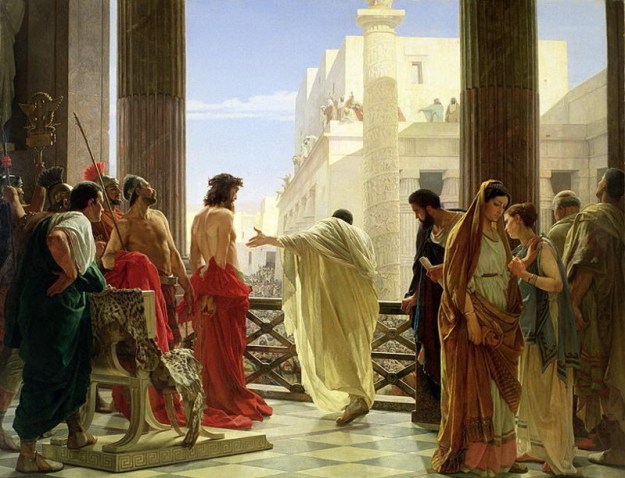
Antonion Ciseri, Ecce Homo (Behold the Man) Between 1860 adn 1880
Matthew 27:15-31
Parallel Mark 15: 6-20; Luke 23: 17-23; John 18:39-40, 19:1-3
15 Now at the festival the governor was accustomed to release a prisoner for the crowd, anyone whom they wanted. 16 At that time they had a notorious prisoner, called JesusBarabbas. 17 So after they had gathered, Pilate said to them, “Whom do you want me to release for you, JesusBarabbas or Jesus who is called the Messiah?” 18 For he realized that it was out of jealousy that they had handed him over. 19 While he was sitting on the judgment seat, his wife sent word to him, “Have nothing to do with that innocent man, for today I have suffered a great deal because of a dream about him.” 20 Now the chief priests and the elders persuaded the crowds to ask for Barabbas and to have Jesus killed. 21 The governor again said to them, “Which of the two do you want me to release for you?” And they said, “Barabbas.” 22 Pilate said to them, “Then what should I do with Jesus who is called the Messiah?”All of them said, “Let him be crucified!” 23 Then he asked, “Why, what evil has he done?” But they shouted all the more, “Let him be crucified!”
24 So when Pilate saw that he could do nothing, but rather that a riot was beginning, he took some water and washed his hands before the crowd, saying, “I am innocent of this man’s blood;see to it yourselves.” 25 Then the people as a whole answered, “His blood be on us and on our children!” 26 So he released Barabbas for them; and after flogging Jesus, he handed him over to be crucified.
27 Then the soldiers of the governor took Jesus into the governor’s headquarters,and they gathered the whole cohort around him. 28 They stripped him and put a scarlet robe on him, 29 and after twisting some thorns into a crown, they put it on his head. They put a reed in his right hand and knelt before him and mocked him, saying, “Hail, King of the Jews!” 30 They spat on him, and took the reed and struck him on the head. 31 After mocking him, they stripped him of the robe and put his own clothes on him. Then they led him away to crucify him.
The crowds and the soldiers are unable to accept Jesus’ identity but this scene continues the pattern of individuals and groups ironically bearing witness to the truth of who Jesus is. A reader who approaches with a faith that is open to Jesus’ identity will hear in this series of encounters between Pilate, the people, and the soldiers with Jesus will hear a deeper meaning behind the words and actions of the people who desire Jesus’ death. Examining Matthew’s narration of this scene immediately before the crucifixion it is helpful to look at not only the intended impact of the words and actions by both those acting on behalf of Rome and those acting on behalf of Jerusalem but the theological resonance of those words and actions within the symbolic world of Matthew’s gospel. By looking at both we can see how the most Jewish of the gospels could utter words that were used for millenia as an excuse for the persecution of the Jewish people and to reexamine how Matthew intended for the hearer of his gospel to hear these words and interpret these actions.
Although all four gospels narrate that the people ask for the release of Barabbas, several early versions of Matthew’s gospel include that Barabbas is also named Jesus. There is a choice between two men called Jesus, one called the Christ or Messiah and one called Barabbas ‘son of a father.’ One is a notorious criminal and the other, in Matthew’s view, is innocent and righteous. Barabbas is likely a person whose violent actions have been against Roman forces but we don’t have any information beyond the gospels. Matthew calls Barabbas a notorious criminal, Mark and Luke include that he was a rebel who committed murder during the insurrection and John simply call Barabbas a robber or bandit. Despite the resonance in name and titles, the people choose the wrong Jesus to be released. The guilty man goes free at the crowd’s demand and the innocent man suffers and dies.
Only Matthew’s gospel gives us an insight into the conversation between Pilate and his wife who reports that she has suffered because of a dream about Jesus. While it is unlikely that the author of Matthew would have insight into the personal life of Pilate and his wife, the addition does continue to reinforce the message of Jesus’ innocence. Even Pilate, in Matthew, will reinforce the innocence of Jesus by asking what evil he has done. Perhaps the choice between the notorious Barabbas and Jesus was a genuine attempt to sway the crowd to accept the lesser threat of Jesus called Christ, but the little we know of Pilate from Josephus and the Gospels in addition to his long term as the Roman procurator over Judea indicate he was a shrewd if sometimes brutal administrator. Yet, Pilate’s actions demonstrate a political conception of justice that has little to do with innocence of guilt and is primarily concerned with maintaining the interests of the empire which benefits from a peaceful and subdued population. As Warren Carter can memorably state we have a case of “Roman justice all washed up.” (Carter 2001, 145)
A reader with an attentive ear to the Hebrew Scriptures will also hear an echo of Deuteronomy in Pilate’s action of washing his hands to attempt to absolve himself of responsibility in the crucifixion of Jesus. As mentioned previously the concept of bloodguilt is very important in Deuteronomy and here, as happens frequently in Matthew’s gospel, it is an outsider who models something (even if imperfectly) while the leaders among the covenant people do not. Deuteronomy 21: 1-9 deals with how a community is to deal with an unsolved death that occurs near a town. In the event that justice can not be rendered to the dead person because the guilty party remains unknown:
All the elders of that town nearest the body shall wash their hands over the heifer whose neck was broken by the wadi, and they shall declare: “Our hands did not shed this blood, nor were we witnesses to it. Absolve, O LORD, your people Israel, whom you redeemed; do not let the guilt of innocent blood remain in the midst of your people Israel.” Then they will be absolved of bloodguilt. Deuteronomy 21:6-8
Instead of the elders in Jerusalem attempting to purify themselves ritually of innocent blood that will be shed, it is Pilate’s action which more closely models a concern for blood guilt. Yet, Pilate cannot separate himself from the responsibility of a death which his soldiers will preside over. Nor is there the breaking of the heifer’s neck as an act of atonement by the community and the priests are the one encouraging the people to call for the release of a notorious criminal and for the death of innocent blood. Of course, the provisions in Deuteronomy would only apply to an unsolvable death and what occurs here is a public execution.
Only Matthew’s gospel has the line which has often been used to label the Jewish people as ‘Christ killers’: “His blood be on us and on our children!” As I have mentioned frequently Matthew’s gospel is the most Jewish of the gospels, and yet through the history of the church it has also been used to justify the persecution of the Jewish people and religion. Even though Matthew’s community may wonder at the lack of faith[1] exhibited by the people in Judea and the Jewish people throughout the diaspora I doubt Matthew intends for these words to demonstrate a permanent breach between the covenant people and their God. I think it is important to slow down with these words because they have such a long history of use in ways harmful to the covenant people of God and attempt to understand what Matthew intended the message of these words to be. To explore this I will bring up three interlocking perspectives: listening to the resonance of these words with the Hebrew Scriptures, looking at the historical context and looking at the structural clues of how these words resonate within Matthew’s gospel.
One critical passage of the law which echoes throughout the scriptures is called the thirteen attributes. This list, which appears fourteen times in scripture and is echoed in many others places, (Myers 2005, 264) first appears in Exodus 34:
The LORD, The LORD, a God merciful and gracious, slow to anger, and abounding in steadfast love and faithfulness, keeping steadfast love for the thousandth generation, forgiving iniquity and transgression and sin, yet by no means clearing the guilty, but visiting the iniquity of the parents upon the children and the children’s children, to the third and fourth generation. Exodus 34: 6-7
This familiar passage, which occurs for the first time in the aftermath of the Golden Calf, is the identity that God chooses as God renews the broken covenant with the people of Israel. Actions continue to have consequences, consequences which may impact generations to come, but God’s steadfast love and faithfulness endure long beyond those consequences. Yet, scripturally, the limit to the consequences is the third and fourth generations.
Historically, Matthew’s gospel is probably written after the Jewish War of 70 C.E. where the city of Jerusalem and the temple are destroyed. Matthew probably understands the rejection and crucifixion of Jesus by the Jewish leaders and people being connected with the destruction of that time. These words and others in Matthew’s gospel may help his community to make sense in the midst of the trauma of this war and the dislocation of many early Christians from Judea and Galilee because of this conflict. This conflict which takes place approximately forty years after the crucifixion of Jesus would fit within the timeframe of the third and fourth generation.
Matthew does not consider the crucifixion the end of the story, and I do not believe that Matthew considers the destruction of the Jewish war as the end of the story between God and the covenant people. From the beginning of Matthew’s gospel, we have heard the story of Jesus as a Jewish story that is connected to the story of the nations, and yet, as the angel tells Joseph in Matthew 1:22, “he will save his people from their sins.” Matthew strengthens this linkage in the Lord’s Supper when he speaks of the cup saying, “for this is the blood of the covenant, which is poured out for many for the forgiveness of sins.” It is likely that Matthew, who so frequently weaves in both explicit and implicit references to the scriptures, expects his hearers to hear a connection between the blood of the new covenant poured out for many and the blood called for here. Just as Moses anointed the people with the blood of the covenant at the giving of the law in Exodus 24:6-8, now ironically something similar is happening with the new covenant. As Richard B. Hays can state:
But as readers we may wonder whether there is a deeper intentionality at work here, not the intentionality of the hostile, fickle crowd, but the intentionality of the God who has sent Jesus to the lost sheep of the house of Israel. (Hays 2016, 135)
Although many Christians throughout history attempted to turn the LORD the God of Israel into a God who visits iniquity for a thousand generations on the Jewish people, a God whose steadfast love and faithfulness no longer available to them, we are finally seeing a reevaluation of this in the aftermath of the Holocaust. There have been a number of theological attempts to reconcile the continuing presence of a Jewish community who remains unable to see Jesus as anything more than a teacher or a prophet, but perhaps Matthew’s option is to understand that these words may not be primarily about bringing bloodguilt upon themselves but instead is about cleansing, binding the covenant, and forgiveness of sins. Perhaps Pilate, in attempting to avoid bloodguilt, also avoids this cleansing, forgiveness and sealing of the covenant that Matthew may see occurring here.
The scene transitions abruptly as Pilate flogs and hands over Jesus to be crucified. Crucifixion in the Roman world is about killing both the person and their reputation. The attempt to destroy Jesus’ reputation began in the trial in the courtyard of Caiaphas and now continues with the mocking of the soldiers. These actions which mockingly imitate the dress and bearing of a king are used to ridicule the title of Christ/Messiah, or as the charge placed on the cross will read ‘King of the Jews.’ Yet, the soldiers are just the latest to witness to the truth even in their mocking of Jesus. The hearers of Matthew’s gospel would understand Jesus as one who is worthy to wear a robe, crown, and scepter and yet these soldiers are a part of the cruel mockery of Jesus which is intended to rob him of his reputation and honor as well as his life.
Perhaps it also illustrates something of the respective societies about the off hand way in which Matthew narrates the flogging and handing over for crucifixion of Jesus. Many cinematographers have focused heavily on the flogging and have given comparatively little time to the actual crucifixion, but Matthew merely as an afterthought can state, “after flogging Jesus.” In the ancient world flogging, and crucifixion for that matter, were known actions that were done intentionally in the public space to draw attention to the consequences of actions against those in authority. Although a person familiar with the action of crucifixion may wonder if the person flogging Jesus was a little too effective since his time on the cross was relatively short prior to death, Matthew is not concerned with this and is more concerned with the something larger that is happening in the humiliation and death of the innocent one Jesus who is called the Christ.
[1] Faith throughout Matthew’s gospel is an awareness or openness to the presence and power of the God of Israel working in and through Jesus and the approaching kingdom of heaven.
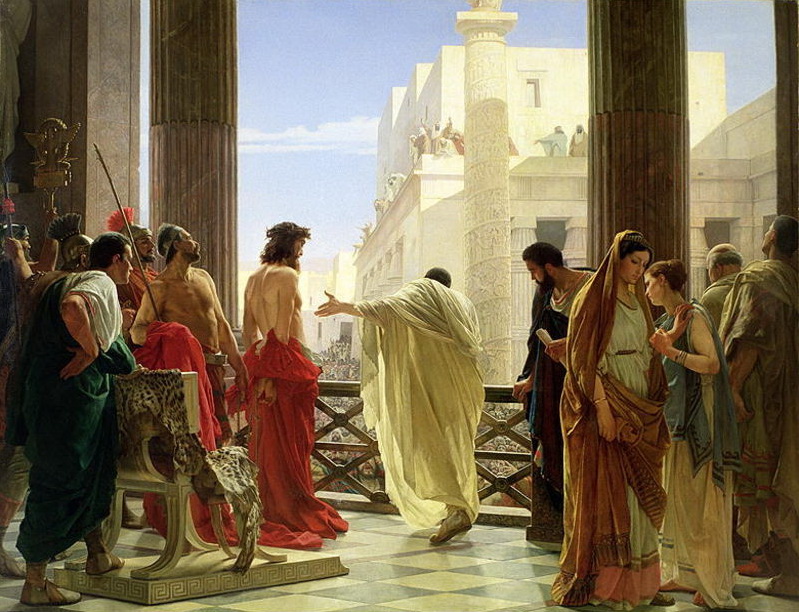
Antonio Ciseri, Ecce Homo (Behold the Man) between 1860 and 1880
Matthew 27:1-14
Parallel Mark 15:1-5; Luke 23: 1-5; John 18: 29-38; Acts 1:15-20
When morning came, all the chief priests and the elders of the people conferred together against Jesus in order to bring about his death. 2 They bound him, led him away, and handed him over to Pilate the governor.[1]
3 When Judas, his betrayer, saw that Jesuswas condemned, he repented and brought back the thirty pieces of silver to the chief priests and the elders. 4 He said, “I have sinned by betraying innocentblood.” But they said, “What is that to us? See to it yourself.” 5 Throwing down the pieces of silver in the temple, he departed; and he went and hanged himself. 6 But the chief priests, taking the pieces of silver, said, “It is not lawful to put them into the treasury, since they are blood money.” 7 After conferring together, they used them to buy the potter’s field as a place to bury foreigners. 8 For this reason that field has been called the Field of Blood to this day. 9 Then was fulfilled what had been spoken through the prophet Jeremiah,”And they tookthe thirty pieces of silver, the price of the one on whom a price had been set,on whom some of the people of Israel had set a price, 10 and they gavethem for the potter’s field, as the Lord commanded me.”
11 Now Jesus stood before the governor; and the governor asked him, “Are you the King of the Jews?” Jesus said, “You say so.” 12 But when he was accused by the chief priests and elders, he did not answer. 13 Then Pilate said to him, “Do you not hear how many accusations they make against you?” 14 But he gave him no answer, not even to a single charge, so that the governor was greatly amazed.
Throughout the Gospel of Matthew, Jesus has presented the kingdom of heaven as an alternative to the ways of the Roman Empire and the ways in which the religious authorities, who opposed him, had adapted to their place within that empire. Judas may have handed over innocent blood cheaply, but even Judas repents in the end while these religious leaders remain indifferent to the way they have failed to embody the justice that the God of Israel expects of the people in the law. Both the religious leaders and the Procurator of Rome[2] are aligned against Jesus and both participate in the crucifixion of Jesus. Yet, both ironically bear witness to portions of Jesus’ identity, and their words speak a portion of the truth.
The narrative slows down, spending more time on the events of this day, but the timing of the events of the crucifixion happens between the morning and afternoon. The gathered chief priests and elders consult/plot together to bring about Jesus’ death, and for his death to occur within the confines of the civil law they must allow Pilate to sentence Jesus to death. The crucifixion scene shows that something can be in accordance with the civil rule of the Roman empire or the religious leader’s interpretation of the Torah and still be unrighteous. The religious leaders may declare Jesus guilty of blasphemy but here even Judas know he has become the one to hand over innocent blood.
Only Matthew relates the repentance of Judas. Luke, in the book of Acts, will relate the story of Judas’ death and the naming of the field of blood, but Matthew interrupts the fast-moving progress of Jesus’ approaching hearing before Pilate with Judas’ confrontation of the chief priests and the elders. Judas perhaps understands that his fate has been linked to those who have opposed Jesus, and just as the woes of chapter 23 and the woe spoken about the ‘handing over one’ at the Last Supper are heard together, so now Judas now understands that he stands under curse for betraying innocent blood. As the law states, ““Cursed be anyone who takes a bribe to shed innocent blood.” All the people shall say, “Amen.”” (Deuteronomy 27:25)[3] Judas’ agonized confession is met by the callous indifference of the chief priests and the elders. Jesus’ innocence will be emphasized multiple times throughout this scene, and while the innocence or guilt of Jesus is not a concern for the religious leaders, as Matthew portrays them, the propriety of accepting ‘blood money’, money they gave to Judas, into the temple treasury shows the way their use of the law, in Matthew’s view, has been corrupted.
This final explicit reference to scripture is often viewed as garbled since unlike the remaining explicit quotations this text brings together Zechariah 11:13 as well as the theme of Jeremiah 32:6-15, and Jeremiah 18:1-11. Zechariah 11 has the LORD judging the sheep merchants who have sold the flock (Israel) to be slaughtered for their own profit. Zechariah, speaking to sheep merchants (leaders), says:
I then said to them, “If it seems right to you, give me my wages; but if not keep them.” So they weighed out thirty shekels of silver. Then the LORD said to me, “Throw it into the treasury”—this lordly price at which I was valued by them. So I took the thirty shekels of silver and threw it into the treasury in the house of the LORD. (Zechariah 11:12-13)
But Matthew, I believe intentionally, links this to Jeremiah’s action of buying a field of Anathoth during the siege of Jerusalem as an action of hope beyond the destruction of the moment. Matthew seems to have access to significant portions of scripture, although it is possible that he would not have a physical copy of Zechariah or Jeremiah or that he would rely upon memory in this quotation. But Matthew has also shown a willingness to pair portions of scripture to bring together two stories in an allusion, and perhaps he again brings together the unfaithfulness of the current shepherds of the temple with the hope beyond judgments of Jeremiah. This is strengthened when you add in the reference to the potter, which evokes Jeremiah 18:1-11 where the potter at the wheel becomes a metaphor for God’s ability to reshape Israel from something broken to something good.
Jesus appears before Pilate the morning after his apprehension, and once more he is handed over to another authority. The silence of Jesus may allude to the suffering servant of Isaiah 53:7-8:
He was oppressed, and he was afflicted, yet he did not open his mouth; like a lamb that is led to slaughter, and like a sheep before its shearers is silent, so he did not open his mouth. By a perversion of justice he was taken away. Who could have imagined his future? For he was cut off from the land of the living, stricken for the transgressions of the people.
On a narrative level, Jesus allows others to ironically give him titles which confirm a portion of his identity. Pilate’s title for Jesus as ‘the King of the Jews’ is not incorrect otherwise Matthew would omit the numerous references to Son of David or Messiah/Christ throughout the narrative, but for Matthew the title only tells a part of the story. Jesus replies that this title, which Pilate uses, are essentially ‘your words.’ They may not be Jesus’ words but that does not make them incorrect. The religious leaders’ accusations may also be their words, which may not be the way Jesus would articulate them but they may also be ironically correct. Pilate’s amazement may be that Jesus does not deny these words and accusations, that he may be willing to accept these titles which the Jewish leaders consider heresy. Matthew has spent much of the gospel giving us words to understand who Jesus is and narrative which help us to understand what these titles mean when referencing Jesus. Throughout the passion narrative, the actions of the crucifixion also give meaning to these words and titles and recast the way terms like Christ/Messiah, Son of David, Son of God, Son of Man, and Lord need to be heard by those who follow Jesus to the cross and beyond.
[1] Throughout this portion of Matthew, the title used for Pilate is the Greek hegemon where the English word ‘hegemony’ comes from. This word generally means one with authority over others, and while Pilate’s official title was probably Procurator or Prefect, Matthew uses this more general word for his role.
[2] Although many translations render Pilate’s title as governor, Judea once Rome assumed direct control in 6 CE, was viewed as a ‘satellite’ of the Province of Syria with a lower ranking Prefect or Procurator reigning on behalf of Rome. The military might in the region was concentrated in Syria at this time as a deterrent against the Parthian Empire.
[3] The concept of innocent blood is important in the law and several of the places where it is treated in the law will echo in the upcoming scenes: Deuteronomy 19:10-13, and Deuteronomy 21:1-9 This concept of innocent blood also emerges in both Wisdom literature and the prophets including: Psalm 106, Proverbs 1:11, 6:16-18; Isaiah 59, Jeremiah 7, 19, 22, and 26.
Parallel Mark 14:66-72; Luke 22:56-62; John 18:25-27
69 Now Peter was sitting outside in the courtyard. A servant-girl came to him and said, “You also were with Jesus the Galilean.” 70 But he denied it before all of them, saying, “I do not know what you are talking about.” 71 When he went out to the porch[1], another servant-girl[2] saw him, and she said to the bystanders, “This man was with Jesus of Nazareth.” 72 Again he denied it with an oath, “I do not know the man.” 73 After a little while the bystanders came up and said to Peter, “Certainly you are also one of them, for your accent betrays you.” 74 Then he began to curse, and he swore an oath, “I do not know the man!” At that moment the cock crowed. 75 Then Peter remembered what Jesus had said: “Before the cock crows, you will deny me three times.” And he went out and wept bitterly.
All four gospels report Peter’s denial of Jesus in the courtyard of the high priest. Peter remains a ‘little faith one.’ He is unable to remain faithful under the threat of persecution and death, even though earlier he proclaimed that even if he must die with Jesus he will not deny him. On the one hand, Peter’s lack of faith in this scene is strongly contrasted with Jesus’ faithfulness throughout the passion narrative. On the other hand, one of the underlying concerns of my work through Matthew’s gospel has been to reappraise the negative view of the disciples and the judgmental view of Jesus that underwrites this. Peter, unlike Judas, is not condemned by Jesus for his inability to hold himself to his own high standard of faithfulness. Jesus never expresses that he expects Peter to remain steadfast in this moment or condemns him. Instead, Peter and the rest of the disciples will not be permanently branded by their inability to remain faithful once their shepherd has been taken away. They will all be intentionally regathered in Galilee by their shepherd at the end of the gospel.
Peter will remain the boldest of the disciples throughout the gospels and often he is the voice that speaks for all the disciples. Previously he is the one who utters the confession that Jesus is the Christ, but also he is bold enough to (wrongly) reprove Jesus when Jesus declares that he will go to Jerusalem and suffer at the hands of the chief priests and the scribes. (16:16-23) Peter is the one who speaks at the Transfiguration (17:4) and gets out of the boat and approaches Jesus in the midst of the storm (14:22-33). Peter, unlike the rest of the disciples in Matthew, has followed Jesus as far as the courtyard of the high priest. His proximity is what leads these servants of the high priest to question his relationship to Jesus. Ironically, Peter’s rebuke of Jesus about his initial declaration about what would happen when they come to Jerusalem as well as Jesus’ declaration of Peter’s upcoming denials bear witness to Jesus’ ability to perceive how events will unfold far more accurately than Peter. Jesus’ words have proven to be accurate throughout the story and they await completion as the story ends.
Matthew continues to relate events using the gifts of an oral storyteller, and this continues with his use of the escalating pattern of three. Throughout this reading, I have tried to illustrate how Matthew tightens this pattern, which is already present in Mark, and here in this scene the three-fold denial moves from a statement to an oath, to a curse with an oath. Peter is contrasted with Jesus who often remains silent before the accusations, but when Jesus does speak his words declare who he is even when the religious leaders consider it blasphemy. Peter responds to each accusation quickly but with words that are untrue. Peter does not model the type of truthful speech that the Sermon on the Mount calls for (5:33-37) and not only swears an oath twice but even invokes a curse. Comparing Peter, or any person, with Jesus invites that person to be viewed negatively as Anna Case-Winters can demonstrate:
The contrast of his cowardice with Jesus’ courage is dramatic. At the very time Jesus stands before Caiaphas and makes a bold confession, Peter caves before a serving girl. Peter’s three denials under pressure are the reverse image of Jesus in Gethsemane. Three times he petitions God to be spared the trials ahead; three times he stands fast in his faithfulness to God and God’s will regardless of the outcome. (Case-Winters 2015, 300)
The community of the faithful is comprised of many who are ‘little faith ones.’ In times of crisis, they may fail to ‘acknowledge Jesus before others’ and instead through words or actions ‘deny Jesus before others.’ Peter is confronted by servants, and particularly ‘servant girls’ and although these servants may have had a lower standing in society than Peter as a male, these ‘servant girls’ were also aligned with the power that seemed to be stronger at the moment. In the courtyard of Caiaphas, the kingdom of heaven probably seemed a distant dream as its Messiah is abused. The disciples of Jesus work towards wholeness, but they are not perfect. Leaders like Peter will continue to need their moments of faithlessness forgiven. They will continue to need the blood of the new covenant poured out for many for the forgiveness of sins. Peter, and the rest of the community of Christ, are not disqualified by their moments of faithlessness. Instead, the covenant of God and the forgiveness it offers remains stronger and Peter along with the rest of the disciples will reemerge in Galilee on the other side of the resurrection.
[1] The Greek pulona is a vestibule which is an antechamber, hall, or lobby next to the outer door of a building.
[2] ‘Servant-girl’ is not present in verse 71, the Greek has simply that ‘another’ saw Peter.
57 Those who had arrested Jesus took him to Caiaphas the high priest, in whose house the scribes and the elders had gathered. 58 But Peter was following him at a distance, as far as the courtyard of the high priest; and going inside, he sat with the guards in order to see how this would end. 59 Now the chief priests and the whole council were looking for false testimony against Jesus so that they might put him to death, 60 but they found none, though many false witnesses came forward. At last two came forward 61 and said, “This fellow said, ‘I am able to destroy the temple of God and to build it in three days.'” 62 The high priest stood up and said, “Have you no answer? What is it that they testify against you?” 63 But Jesus was silent. Then the high priest said to him, “I put you under oath before the living God, tell us if you are the Messiah,the Son of God.” 64 Jesus said to him, “You have said so. But I tell you,
From now on you will see the Son of Man seated at the right hand of Power and coming on the clouds of heaven.”
65 Then the high priest tore his clothes and said, “He has blasphemed! Why do we still need witnesses? You have now heard his blasphemy. 66 What is your verdict?” They answered, “He deserves death.” 67 Then they spat in his face and struck him; and some slapped him, 68 saying, “Prophesy to us, you Messiah!Who is it that struck you?”
Jesus now stands alone surrounded by the religious leaders who seek his life. Peter remains at a distance with the servants[1] and the remaining disciples have disappeared into the night. The shepherd has been handed over and the flock has scattered. In contrast the scribes and the elders have gathered together around Caiaphas the high priest[2] for this moment. There is no presumption of innocence in this scene, the entire ordeal in the household of Caiaphas is orchestrated as a movement towards the humiliation and execution of Jesus as a dangerous and blasphemous threat to the people.
In our post-modern and pluralistic world, blasphemy is no longer considered a major offence, but in Jesus’ world to be called a blasphemer would be worse than being called a traitor. Throughout scripture the greatest danger is idolatry and in a worldview where one’s safety and security is tied to one’s obedience to the God of Israel, blasphemy which lead people away from their God is an offence against the community. In our more secular world capital offenses are offenses against the state: a traitor or a murder may be sentenced to death but not a person who violates the religious norms of the community. This shifted in the enlightenment of the seventeenth and eighteenth century, in the aftermath of the thirty years war which was the bloodiest conflict in Europe until the World Wars of the twentieth century. The accusation of Jesus as one who is dangerous to the beliefs of the people of Jerusalem is a serious one in this context and it will also be linked to his identity as a potential king who could challenge the claims of Rome.
In modern society we expect a semblance of respect for due process and legal adherence to the law in a court scene. Although Israel was to have a fair judgment for people regardless of circumstances what we see in this scene is a gathering to declare as a group an expected verdict. The gathering, as Matthew reports it, is not seeking truth but intentionally seeking false witnesses[3] that will corroborate the charges against Jesus. According to Deuteronomy 19:15-21 a person cannot be sentenced based on a single witness’ accusation, and that is why there is the struggle to find witnesses who can give the same story of Jesus’ supposed threat to the belief and security of the people. Ironically, this is also the passage in Deuteronomy that deals how the priests and the judges are to discern false witnesses when settling a dispute before the Lord the God of Israel. Instead, it is the priests and elders intentionally seeking false witnesses against the chosen one of God. Those who are responsible for the temple bring forward false witnesses which accuse Jesus of threatening to destroy and rebuild the temple. Although this language is used in John’s gospel by Jesus, in Matthew’s gospel, Jesus only points to the temple’s impending destruction. (24:2) Jesus’ only answer to the false witnesses and their accusations is silence.
The proceedings reach their climax when the high priest puts Jesus under oath before God to answer if he is the Messiah, the Son of God. This is an echo of Peter’s confession in 16:16 of Jesus’ identity, but Jesus only answers “You say (so)” which he uses throughout the passion narrative and then changes from the Messiah, Son of God title used by the high priest to the Son of Man title. As mentioned previously, the Son of Man is a title which is linked to the visions of Daniel, and Matthew allows us to hear Jesus quoting Daniel 7:13. To claim that Jesus is the messiah (king) and Son of God (also a kingly title, although Matthew uses it to point to something larger) places him as a political threat, but Jesus’ claim to identify with the Son of Man who comes to execute the judgment of the Lord of Israel on the nations is an even stronger claim to be linked with God’s will and power.
The high priest and later the entire Sanhedrin (council) declare Jesus has blasphemed. The irony in this passage is strong because they, in the view of the passage, are the ones who have failed to seek truth and have instead sought false witnesses. The high priest ironically asks Jesus to confess that he is who Peter confesses Jesus to be. The heavenly Father revealed this identity to Peter, but the high priest remains unenlightened and unable to see who the Son of Man is. Yet, the identification of Jesus as the Son of Man helps us to see that Matthew does not see Jesus’ upcoming crucifixion as a rejection of the Jewish people. Although the temple will be destroyed and the high priesthood will be lost, the Son of Man is a figure for regathering the elect (presumably both from Israel and the nations) from the four winds. (24:31)
Matthew may also be hearing Jesus in connection with the suffering servant of Isaiah. There is a resonance in the actions of the members of the Sanhedrin after the verdict and Isaiah 50:6:
I gave my back to those who struck me, and my cheeks to those who pulled out the beard, I did not hide my face from insult and spitting.
Matthew never explicitly links Jesus to this figure of the suffering servant, but this figure may also be one of the many scriptural allusions that Matthew uses to attempt to explain who Jesus is and why Jesus’ death resonates with the scriptures. Regardless of whether Matthew makes this additional allusion, we have several of Jesus’ titles used throughout the gospel (Messiah, Son of God, and Son of Man) being viewed as blasphemy by the religious leaders assembled at the household of Caiaphas. Just as these religious leaders ironically sought false witness, they also ironically speak the truth as they accuse and insult Jesus. Yet, those reading Matthew’s gospel are coming from a different understanding of blasphemy than the accusers of Jesus. For these religious leaders Jesus’ words and actions are a threat to the holiness of their society, but Jesus views these leaders as those who have been unfaithful sons, tenants, and unwilling guests of the wedding banquet. (21:28-22:14)
[1] The Greek hupereton is servants and not guards, the term can mean helper or assistant and can have religious or political implications, like an assistant in the synagogue or court, but not the implication of a guards whose presence is threatening in a physical sense.
[2] Although the gathering does occur physically in the household of Caiaphas, the Greek text does not have “in the house.” The NRSV adds this, and it does make the text a little easier to read, but the focus is on Caiaphas’ role rather than the location.
[3] False witness and testimony throughout this passage are the Greek psuedomarturos. Pseudo is still used in English (Pseudoscience) to denote something that is fake or lacking veracity. Martauros is where our English word ‘martyr’ comes from.