Tag Archives: Jerusalem

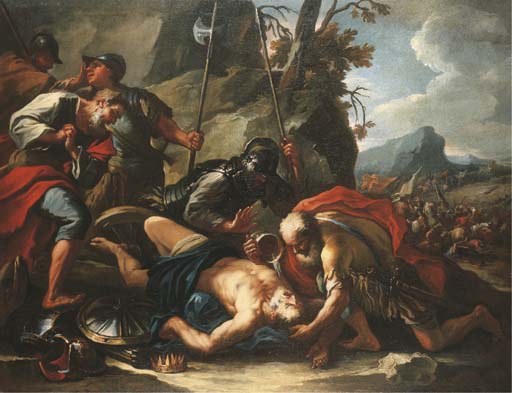
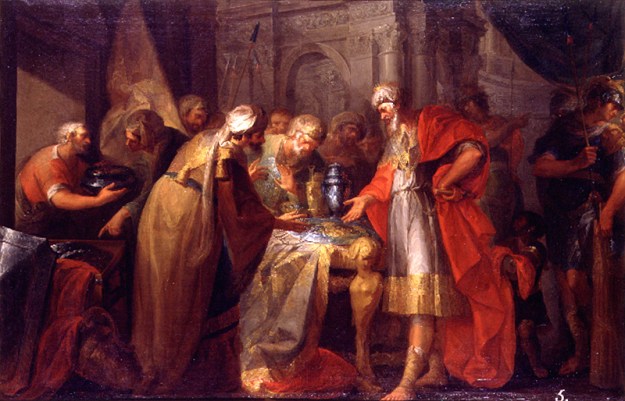
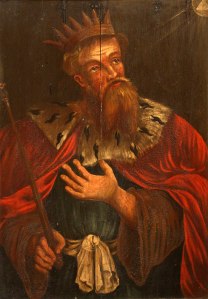
2 Kings 12 The Reign of King Jehoash/Joash of Judah

The coronation of Jehoash of Judah (c.1840), by Francesco Hayez

2 Kings 12: 1-3

 1In the seventh year of Jehu, Jehoash began to reign; he reigned forty years in Jerusalem. His mother’s name was Zibiah of Beer-sheba. 2Jehoash did what was right in the sight of the LORD all his days because the priest Jehoiada instructed him. 3Nevertheless, the high places were not taken away; the people continued to sacrifice and make offerings on the high places.

Jehoash, or Joash, is one of the kings of Judah regarded positively but there is a qualification to that assessment and when one looks closely at this narrative and the more critical parallel in 2 Chronicles 24 it leaves some questions about the totality of the reign of this king. The NIV renders the judgment of Jehoash’s reign. ”Joash did what was right in the eyes of the LORD all the years Jehoida the priest instructed him.” The NIV appears to harmonize its translation with the narrative of 2 Chronicles (see below) but even within the narrative of 2 Kings there is enough to give pause. Yes, there is a qualification that the high places are not removed but looking closely at the end of 2 King’s description of Jehoash’s reign there are enough things revealed to indicate there may be some trouble below the surface of the narration.

Jehoash’s mother is named as Zibiah of Beer-sheba. Beer-sheba would be on the southern border of Judah and geographically distant from the influence of Northern Israel which had led to the turmoil of the previous chapter. There are numerous examples of queen mothers exercising significant power in both positive and negative manners. The influence of a Jezebel or Athaliah to corrupt both Israel and Judah are matched by a queen mother like Bathsheba who uses her influence to get Solomon in anointed rather than Adonijah.

2 Kings 12: 4-16

  4Jehoash said to the priests, “All the silver offered as sacred donations that is brought into the house of the LORD—the census tax, personal redemption payments, and silver from voluntary offerings brought into the house of the LORD 5let the priests receive from each of the donors, and let them repair the house wherever any need of repairs is discovered.” 6But by the twenty-third year of King Jehoash the priests had made no repairs on the house. 7Therefore King Jehoash summoned the priest Jehoiada with the other priests and said to them, “Why are you not repairing the house? Now therefore do not accept any more silver from your donors but hand it over for the repair of the house.” 8So the priests agreed that they would neither accept more silver from the people nor repair the house.
  9
Then the priest Jehoiada took a chest, made a hole in its lid, and set it beside the altar on the right side as one entered the house of the LORD; the priests who guarded the threshold put in it all the silver that was brought into the house of the LORD. 10Whenever they saw that there was a great deal of silver in the chest, the king’s secretary and the high priest went up, cast the silver that was found in the house of the LORD into ingots, and counted it. 11They gave the silver that was weighed out into the hands of the workers who had the oversight of the house of the LORD; then they paid it out to the carpenters and the builders who worked on the house of the LORD, 12to the masons and the stonecutters, as well as to buy timber and quarried stone for making repairs on the house of the LORD, as well as for any outlay for repairs of the house. 13But for the house of the LORD no basins of silver, snuffers, bowls, trumpets, or any vessels of gold or of silver were made from the silver that was brought into the house of the LORD, 14for that was given to the workers who were repairing the house of the LORD with it. 15They did not ask an accounting from those into whose hand they delivered the silver to pay out to the workers, for they dealt honestly. 16The silver from the guilt offerings and the silver from the sin offerings was not brought into the house of the LORD; it belonged to the priests.

King Jehoash was probably involved in a number of important decisions and moments throughout his forty-year reign, but for 2 Kings the central event of his positively assessed reign is the repair of the temple. I’ve noted earlier that much of the book of Kings could have easily been the book of prophets, but it is also worth noting that the narrative of the book of Kings begins with Solomon’s construction of the temple (1 Kings 5-8) and ends with its destruction (2 Kings 25). In the ancient world the construction and maintenance of the temple and the worship in that temple was an expected part of royal piety, and while we can debate the proper balance between proper worship and faithful execution of the law both have been recently missing in Judah. As Alex Israel notes the temple is one hundred and fifty years old (Israel, 2019, p. 184) and 2 Chronicles makes explicit the damage that Athaliah has done:

7For the children of Athaliah, that wicked woman, had broken into the house of God and had even used all the dedicated things of the house of the LORD for the Baals. 2 Chronicles 24:7

Between the age of the structure and the misuse of the building it was likely in serious need of repair to be a structure worthy of the name of the LORD.

We do not know when in his reign Jehoash commanded that the taxes, payments, and specific offerings would be utilized for the repair of the temple. Jehoash began to reign at age seven and would have been heavily influenced by the priest Jehoida and others who advised him, but in his twenty-third year of his forty-year reign he is thirty years old and confronts Jehoida and the other priests about the lack of progress. There are multiple theories that have nothing to do with corruption that have plausibly explained the lack of progress: from the expectations of the priests to be the fundraisers for these taxes, payments, and offerings and limiting their appeal to their family groups, to inability of the priests to properly determine the scope of the work and effectively carry out the repairs. 2 Kings does not indicate that corruption was a part of the problem, although this is possible, nor does it indicate that the collected funds are not available. It gives Jehoash and Jehoida credit for creating a workable solution. While it is possible that the NRSVue’s translation which indicates that the process included taking the donated items and smelting them into ingots occurred at this time, the Hebrew only indicates they tied it up. The physical structure is the recipient of the repairs rather than creating the implements for the conduct of worship, and in light of the upcoming note on King Jehoash’s reign it is probably an important note. The text on the repair of the temple ends with a note that the priests still had a source of income from the guilt and sin offerings.

2 Kings 12: 17-18

  17At that time King Hazael of Aram went up, fought against Gath, and took it. But when Hazael set his face to go up against Jerusalem, 18King Jehoash of Judah took all the votive gifts that Jehoshaphat, Jehoram, and Ahaziah, his ancestors, the kings of Judah, had dedicated, as well as his own votive gifts, all the gold that was found in the treasuries of the house of the LORD and of the king’s house, and sent these to King Hazael of Aram. Then Hazael withdrew from Jerusalem.

King Hazael, first mentioned in chapter eight, captures Gath, one of the Philistine cities and then orients his forces on Jerusalem. Jehoash decides that he does not have adequate forces to resist Hazael’s force and so sets out with the treasures of Jerusalem to make peace. Military conflict in the ancient world is an economic matter and if a leader can gain a significant tribute, like the one mentioned above, without having to expend the cost and trouble of a military siege they will often take it. King Asa (1 Kings 15:18) utilized the temple resources to buy off the forces of Aram under King Ben-hadad (who Hazael later assassinated and assumed his role) and so it is only the gifts given under Jehoshaphat, Jehoram, and Ahaziah that remain in the temple.

King Jehoash’s decision to bribe King Hazael not to attack may have been a wise one, but its narration in 2 Kings is ambiguous. The people of Judah were never a great military power but there is no indication that Jehoash seeks God’s will in this decision or that he trusts in God’s deliverance. This decision also probably brings the repair of the temple to an end, at least for a time. Military conflict and siege warfare create problems not just for the king but the entire population, yet many probably viewed this move as a sign of weakness and this may contribute to King Jehoash’s assassination by his servants in the next section.

2 Kings 12: 19-21

  19Now the rest of the acts of Joash and all that he did, are they not written in the Book of the Annals of the Kings of Judah? 20His servants arose, devised a conspiracy, and killed Joash in the house of Millo, on the way that goes down to Silla. 21It was Jozacar son of Shimeath and Jehozabad son of Shomer, his servants, who struck him down, so that he died. He was buried with his ancestors in the city of David; then his son Amaziah succeeded him.

King Jehoash’s (or Joash) forty-year reign ends with his assassination by two subordinates: Jozacar son of Shimeath and Jehozabad son of Shomer. These men may have been slaves in the household of the king (the word translated servant has the primary meaning of slave) but whether they are servants or slaves it is an indication of a conspiracy[1] in the palace to end the reign of Jehoash. Brueggemann notes that in the 2 Kings narrative it could be a conspiracy by those who were faithful to Baal and the ways of Athaliah (Brueggemann, 2000, p. 423) but the 2 Chronicles 24: 17-22 telling of the end of Jehoash’s reign is very different and leads to the NIV translation noted in the beginning of the chapter:

17 Now after the death of Jehoiada the officials of Judah came and did obeisance to the king; then the king listened to them. 18 They abandoned the house of the Lord, the God of their ancestors, and served the sacred poles and the idols. And wrath came upon Judah and Jerusalem for this guilt of theirs. 19 Yet he sent prophets among them to bring them back to the Lord; they testified against them, but they would not listen.
 20 Then the spirit of God took possession of Zechariah son of the priest Jehoiada; he stood above the people and said to them, “Thus says God: Why do you transgress the commandments of the Lord, so that you cannot prosper? Because you have forsaken the Lord, he has also forsaken you.” 21 But they conspired against him, and by command of the king they stoned him to death in the court of the house of the Lord. 22 King Joash did not remember the kindness that Jehoiada, Zechariah’s father, had shown him but killed his son. As he was dying, he said, “May the Lord see and avenge!”
2 Chronicles 24: 17-22

If 2 Chronicles is accurate in its narration of the end of Jehoah’s reign it could have been out of loyalty to the LORD and the temple that these servants conspired against their king. It is plausible that 2 Kings wanted to narrate the reign of Jehoash in an overall positive manner without delving into the murky ending that 2 Chronicles narrates. If 2 Chronicles narrative is correct then Jehoash becomes a lesser version of Solomon: Solomon builds the temple and Jehoash repairs the temple, Solomon’s reign begins in wisdom, but later Solomon is led astray by his wives and Jehoash is led away by the officials of Judah. Ultimately, we only have the sources of 2 Kings and 2 Chronicles to bear witness to this time in the story of Judah, and we can do our best to place the narratives in the world the inhabited but all of our reconstructions involve some level of educated guessing.


[1] The word translated “conspiracy” here is rendered as treason in 11:14. (Brueggemann, 2000, p. 422)

Psalm 120 A Pilgrimage To A Place Of Peace

Pilgrim Steps Leading to the Double Gate (Southern Steps of the Temple Mount, Jerusalem) picture from 2009 by Wilson44691 – Own work, Public Domain, https://commons.wikimedia.org/w/index.php?curid=6899573

Psalm 120

A Song of Ascents.

1 In my distress I cry to the LORD, that he may answer me:

2 “Deliver me, O LORD, from lying lips, from a deceitful tongue.”

3 What shall be given to you? And what more shall be done to you, you deceitful tongue?

4 A warrior’s sharp arrows, with glowing coals of the broom tree!

5 Woe is me, that I am an alien in Meshech, that I must live among the tents of Kedar.

6 Too long have I had my dwelling among those who hate peace.

7 I am for peace; but when I speak, they are for war.

The Psalms of Ascent (Psalm 120 – 134) are fifteen psalms that may have been used as a part of the pilgrimage to Jerusalem. Jerusalem sits upon a hill so any approach to Jerusalem is always an ascent, but the ascent may also refer to the ascending of the steps of the temple. Mishnah states there are fifteen steps that lead from the Court of Women to the Court of the Israelites which correspond to the fifteen psalms. (Nancy deClaisse-Walford, 2014, p. 887) It is conceivable that a practice of reciting these fifteen short (except for Psalm 132) psalms as one approaches Jerusalem or as one ascends the steps of the temple. As this psalm indicates, this practice may help the people transition from their exile in a world of war and deceitful tongues to their homecoming in the city of peace.[1]

Too long have I had my dwelling among those who hate peace. The poet is a stranger in a strange land. They are a foreigner/alien(ger) in the midst of a people of different gods, sharp tongues, and unjust practices. Meshech and Kedar are likely metaphors for places both geographically and spiritually distant from the memory of their homeland. The situation of this psalm forms the antithesis of Psalm 133: How very good and pleasant it is when kindred live together in unity. The situation of Psalm 120 could be summarized: how traumatizing it is for one who lives as an alien among those who love division.

In language that resonates with James 3: 1-12, the psalmist describes the tongue as an instrument of violence. The psalmist may be the direct recipient of these deceitful and painful words, or they may exist in a society where the truth has disappeared.[2] Like the son in the parable of the prodigal[3] they may find themselves vulnerable and hungry in a world where no one cares. It may be ironic, as Brueggemann and Bellinger state, that the person who considers themself a person of peace would respond to these deceitful tongues with metaphorical weapons of war (Bellinger, 2014, p. 524) but the psalmist is asking for God to deliver. God is in the position to judge the people who the psalmist lives among. Yet, it is also possible that the description in verse four is merely a continuation of the description of the words of the lying lips and deceitful tongues. Sharp weapons are used metaphorically along with predatory animals to describe people hostile to the psalmist in Psalm 57:4. The broom tree is a hard wood tree known for its long burning fires. (Nancy deClaisse-Walford, 2014, p. 892)

This psalm can resonate with people of all times who attempt to live justly in an unjust world. Who seek peace (shalom) among a people whose words and actions seek conflict. As James L. Mays states about Psalm 120,

It is a poignant expression of the pilgrims’ pain over the world from which they come. It puts that world in the sharpest possible contrast to the peace they desire and seek in coming to Zion. (Mays, 1994, p. 388)

People of peace long for a homecoming where they can live in unity with their brothers and sisters who speak with truthful lips and words that heal instead of these weaponized tongues they encounter in the land of their sojourn. Pilgrimage, either physical or spiritual, is a hopeful ascent to a place of shalom.


[1] Jerusalem’s name comes from a combination of the word for city and shalom.

[2] Similar imagery is used in Psalm 10:4; 12: 1-4; and 31:8.

[3] Luke 15: 11-32.

Lamentations 1 The Cry of Daughter Zion

By Antoine Coypel – Susanna Accused of Adultery (1695-1696)http://www.museodelprado.es/imagen/alta_resolucion/P02247.jpg, Public Domain, https://commons.wikimedia.org/w/index.php?curid=12894461

Lamentations 1

1How lonely sits the city that once was full of people! How like a widow she has become, she that was great among the nations! She that was a princess among the provinces has become a vassal.
2She weeps bitterly in the night, with tears on her cheeks; among all her lovers she has no one to comfort her; all her friends have dealt treacherously with her, they have become her enemies.
3Judah has gone into exile with suffering and hard servitude; she lives now among the nations, and finds no resting place; her pursuers have all overtaken her in the midst of her distress.
4The roads to Zion mourn, for no one comes to the festivals; all her gates are desolate, her priests groan; her young girls grieve, and her lot is bitter.
5Her foes have become the masters, her enemies prosper, because the LORD has made her suffer for the multitude of her transgressions; her children have gone away, captives before the foe.
6From daughter Zion has departed all her majesty. Her princes have become like stags that find no pasture; they fled without strength before the pursuer.
7Jerusalem remembers, in the days of her affliction and wandering, all the precious things that were hers in days of old. When her people fell into the hand of the foe, and there was no one to help her, the foe looked on mocking over her downfall.
8Jerusalem sinned grievously, so she has become a mockery; all who honored her despise her, for they have seen her nakedness; she herself groans, and turns her face away.
9Her uncleanness was in her skirts; she took no thought of her future; her downfall was appalling, with none to comfort her. “O LORD, look at my affliction, for the enemy has triumphed!”
10Enemies have stretched out their hands over all her precious things; she has even seen the nations invade her sanctuary, those whom you forbade to enter your congregation.
11All her people groan as they search for bread; they trade their treasures for food to revive their strength. Look, O LORD, and see how worthless I have become.
12Is it nothing to you, all you who pass by? Look and see if there is any sorrow like my sorrow, which was brought upon me, which the LORD inflicted on the day of his fierce anger.
13From on high he sent fire; it went deep into my bones; he spread a net for my feet; he turned me back; he has left me stunned, faint all day long.
14My transgressions were bound into a yoke; by his hand they were fastened together;
 they weigh on my neck, sapping my strength; the LORD handed me over to those whom I cannot withstand.
15The LORD has rejected all my warriors in the midst of me; he proclaimed a time against me to crush my young men; the LORD has trodden as in a wine press the virgin daughter Judah.
16For these things I weep; my eyes flow with tears; for a comforter is far from me,
 one to revive my courage; my children are desolate, for the enemy has prevailed.
17Zion stretches out her hands, but there is no one to comfort her; the LORD has commanded against Jacob that his neighbors should become his foes; Jerusalem has become a filthy thing among them.
18The LORD is in the right, for I have rebelled against his word; but hear, all you peoples,
 and behold my suffering; my young women and young men have gone into captivity.
19I called to my lovers but they deceived me; my priests and elders perished in the city
 while seeking food to revive their strength.
20See, O LORD, how distressed I am; my stomach churns, my heart is wrung within me, because I have been very rebellious. In the street the sword bereaves; in the house it is like death.
21They heard how I was groaning, with no one to comfort me. All my enemies heard of my trouble; they are glad that you have done it. Bring on the day you have announced, and let them be as I am.
22Let all their evil doing come before you; and deal with them as you have dealt with me because of all my transgressions; for my groans are many and my heart is faint.

Poetry can be used to speak to things that are at the edge of our ability to articulate. It can be utilized to speak to moments of profound joy, of awe and wonder, of emotions like love and happiness whose meanings seem to transcend our words. Yet poetic words can be utilized in our moments of heartbreak, depression, grief, and trauma as we attempt to make sense of a world which seems senseless. Lamentations is the work of a poet or poets attempting to make sense of their reality in the aftermath of the destruction of Jerusalem in 586 BCE. The poet has seen death from war and starvation, has seen the foundations upon which their life was built collapse, and the LORD who was supposed to protect Zion has turned away. The poet attempts to make sense of the loss of the home they knew, grieve the family and friends who did not survive the siege and the beginning of the exile, and to walk among a shattered people with shattered dreams into a previously unimagined reality.

The survivors of Jerusalem not only retained the words of the prophets who warned of this reality, but they also retained the words of the prophets and poets wrestling with God, attempting to reconcile their faith with the world they experience. They are living in a disordered world, and yet in their words they attempt to bring some order into the disorder. Kathleen O’Connor in her book Jeremiah: Pain and Promise talks about the way these works written in the time surrounding the exile invite not only the contemporary generation but also future generations to enter the process of being meaning-makers.

It not only reflects the interpretive chaos that follows disasters, when meaning collapses and formerly reliable beliefs turn to dust. Jeremiah’s literary turmoil is also an invitation to the audience to become meaning-makers, transforming them from being passive victims of disaster into active interpreters of their world. (O’Connor, 2011, p. 31)

Making sense of a traumatic world-changing event is not an overnight process. It is a journey through the dark shadows of grief and fear, depression and guilt, the struggle to survive as others surrender to the end. This first poem in the book of Lamentations attempt to bring some order to the disorder and give voice to the pain and humiliation felt by the people. They, like Jeremiah and Ezekiel, understand that the tragedy is a result of their own rebellion and disobedience which have broken their relationship with the LORD who protected them. They also understand that they have no future without the LORD looking, seeing, and considering the fate of this disgraced and displaced people.

The poem has two voices, a narrator and daughter Zion. The narrator is the primary speaker for the first half of the poem and attempts to relate the fate of daughter Zion as an observer of the fall of this city personified as a woman. The poem begins with the interrogative “How?” Although in English translations the word how is used primarily as an inquiry about the state of daughter Zion: How lonely, How like a widow. The word also inquires about the manner or way in which something comes to pass: How did it happen that lonely sits the city, How did she become like a widow? How did this place of honor among the nations become dishonored? How did the princess become the vassal? What has brought about this reversal for daughter Zion and those who made their home in this great city. Something has changed that has brought about the reversal of fortunes for the city and the people.

The narrator voice in the poem has a greater detachment from the suffering and events occurring to daughter Zion. Daughter Zion may weep, but the narrator reports. Yet, the narrator’s reports begin to allude to the reason why daughter Zion weeps. In a world where women were not to have lovers, they were to be faithful to their husband, now this one who has become like a widow[1] we learn is also abandoned by her lovers and friends. Something has gone wrong in the relationships that were supposed to provide support. The narrator slips out of the metaphor to narrate Judah’s entry into exile and the suffering that comes with her displacement from the promised land into the hostile nations. The exclamation that Judah found no resting place echoes the language of the curses for disobedience in Deuteronomy 28:65. As Lamentations, like Ezekiel and Jeremiah, make sense of the catastrophe of the Babylonian exile the utilize the theological perspective of Deuteronomy.

Now the roads that pass through Jerusalem mourn the loss of the pilgrim traffic to the festivals, and the priests who officiated at the festivals groan as the young women grieve. The young women here are teenage women of marriageable age. These may be the women at greatest risk of sexual violence from the enemy soldiers who have breached the city and who now escort them into exile. They also would be the women whose potential partners died in the defense of the city or in the aftermath of the breach. Daughter Zion now returns to the poem as one with a bitter lot, whose foes are now her master, whose enemies prosper. The reason is for the first time explicitly stated by the narrator: she is being made to suffer by the LORD for her transgressions. Jeremiah, Ezekiel, and Lamentations all share a common perspective on the disastrous events. The tragedy of the siege, destruction, and exile are all a result of Judah’s disobedience to God and the curses of Deuteronomy 28 echo throughout Lamentation’s poetic remembrance.

Yael Zigler has a powerful explanation of the poetic image of the princes being like stags which find no pasture:

The verse portrays the previously powerful leadership as drained of energy, unable to find pastures or the basic means of survival. If they cannot find pasture for themselves, they certainly cannot help their people, whose sufferings are compounded by their leaders’ impotence. (Ziegler, 2021, p. 92)

Nobles, priests, and elders all failed the people in this crisis, but now they are unable to even deliver themselves. Both Jeremiah and Ezekiel had harsh words for these leaders who failed to care for the people and who compounded the upcoming crisis, but now as the world is turned upside down the powerful in Jerusalem are now impotent.

As the image once again returns to Jerusalem personified as mourning over her past riches and glories. She is isolated among the nations. Lamentations adopt a similar image to Hosea 1-3, Jeremiah 24, and particularly the harsh language of Ezekiel 16. Jerusalem’s past actions have led those who once admired her to despise her. Like the imagery of Ezekiel 16:35-43, Jerusalem is like a woman who is shamed by having her clothing taken away as an act of humiliation. The language of uncleanness enters the poem for the first time, but the uncleanness is literally in her hems at the bottom of her clothing. Whether the poem imagines her walking through the uncleanness of the world around her and it clinging to the skirts or whether it utilizes the image of menstruation[2] (which will come up with uncleanness later in the poem) without rags to catch the blood. Regardless of how exactly her uncleanness is visualized in the imagery of the poem, from the narrator’s perspective her actions which took no thought of the future, are the reason for her humiliated state. Her fall from grace was appalling and former friends and lovers are distant as daughter Zion for the first time raises her voice in the poem calling out to the LORD to “look at my affliction, for the enemy has triumphed!

The narrator concludes his portion of the poem with the enemies of Zion taking her precious things and invading her sanctuary. Nations that were not to be a part of the congregation of Israel in the law now stand in the center of the temple where even priests would not enter. The language behind invade, often rendered “come into,” often denotes sex in the Hebrew scriptures and the poetic intent of the imagery may be to communicate that this is both the pillaging and rape of Zion. (Goldingay, 2022, p. 67) Daughter Zion is stripped, humiliated, dishonored, and disgraced as her people struggle to find the food, they need for the strength to endure the ravages of the siege and now exile. For most of the first half of the poem the narrator has described her sorry state, but now she turns to the LORD and to those who see her and raises her voice to command people to look, see, and consider her.

Rather than cowering in her pitiful state, daughter Zion lifts her voice and demands to be seen. The first one she cries to is the LORD to see the state that the LORD’s fierce anger has left her in. Then she cries to those who pass by to look and see her sorrow. Former friends and lovers who pass by ashamed of her are commanded by daughter Zion to see her in all her suffering and to understand the reason for her suffering. Her betrayal of the LORD has resulted in the LORD’s actions. As Kathleen O’Connor narrates,         

Using vivid, violent verbs; she relates Yahweh’s brutal treatment of her. He sent fire; he spread a net; he turned her back; he left her devastated. Divine attacks of the female body again serve as a metaphor for the destruction of the city. (NIB VI: 1033)

In addition to the violent verbs listed above, the transgressions become a yoke which daughter Zion bears. The harsh language of daughter Zion’s appeal may also be designed to call upon the LORD to again assume the protector role. She now is the vulnerable one who needs the protection of the LORD. Like in the Psalms, the LORD may be both the cause of their suffering and the only one who can end the suffering.

The warriors, young men, daughters, and children of Zion now bear the crushing weight of the defeat of Zion by her foes. Warriors and young men have been crushed in the crucible of war and starvation, and in an image that will resonate in Isaiah 63, Joel 3, and Revelation 14 now “girl daughter Judah” is treaded as in a wine press. Daughter Zion weeps, and there is no one to comfort her or wipe away her tears. Children, perhaps orphaned by war or the first to suffer from starvation, are a prime example of the vulnerable caught in situations they cannot control.

In verse seventeen the narrator interrupts daughter Zion’s cries. This narrator can describe her isolation where no one will comfort her because the LORD has commanded her neighbors to become her foes. Yet, even beyond foes Jerusalem has become a “filthy thing” among them. “Filthy thing” (NRSV) or “unclean thing” (NIV) translates the Hebrew term nidda which refers to a “menstrual rag.” As Kathleen O’Connor states daughter Zion, “is not only ritually unclean, but she is also repulsive and dirty.” (NIB VI: 1033) Yet, rather than refute the narrator’s claim daughter Zion proclaims, “the LORD is in the right.” The woman does not deny that her suffering is justified but she also cries out the peoples once again to look and see her sufferings. Her bowels churn and her heart is wrung and death reigns both in the house and in the streets.

The enemies of Zion have seen and heard but their reaction is one of joy. In one final appeal the woman asks for the LORD to judge these enemies. That they may be judged as she was judged. That their evil may come before the LORD as her own rebellion came before the LORD. The LORD has dealt fairly if violently with her, now dealing in a similar fashion with those who abuse and taunt her. With a groaning body and a faint heart, she appeals to God out of her desolation asking for her God to look, see, and consider her words.

This acrostic poem utilizes the voice of a narrator and daughter Zion to express the pain and desolation of the collapse of the world as the people of Jerusalem gives words to the trauma of the exile. Like reading Elie Wiesel’s Night it allows a reader to encounter a small part of the tragic reality that the author encounters. Its language may at times make us uncomfortable, but we should never feel comfortable looking into the courageous act of someone trying to use words to express the inexpressible depths of their pain, their attempts to reimagine the relationship between themselves and their God in the midst of an earthshattering tragedy, and their attempts to make sense in a senseless world. One appeal of the acrostic form is that it imposes order on a chaotic world.

Any time we engage with the scriptures it is helpful to remember that there is some distance between the worldview of the exiles of Jerusalem in 586 BCE and ourselves. To appreciate the courage of the poet in their attempt to make sense of the world with words does not require us to fully endorse the use of vivid, violent verbs against a metaphorical female body. Although I cannot speak with authority about the view of masculinity of this time, I do believe one of the intentional uses of this language is to invoke in the LORD, who plays the masculine role in this imagery here and throughout the prophets, the role of protector. Jeremiah, Ezekiel, and Lamentations do not shirk from the perspective that Jerusalem’s punishment is justified but that does not prevent Jeremiah, Lamentations, and the Psalms[3] from calling out to the LORD to look, see, consider and to respond in mercy.

The first poem of Lamentations may be able to articulate the pain of daughter Zion, but it is unable to resolve that pain. Even though the poet has worked through their crisis from aleph to tav, the acrostic poem has not brought about a complete expression of the pain. Perhaps that leads to the second poem which also speaks out of the pain of defeat, grief, and an uncertain future. These poems are steps on the way to healing. They are the articulation of the pain and loss of the people of Jerusalem. The loss of home, the loss of identity, the loss of meaning. Yet, in a strange way, these poems are a part of the rediscovery of faith. The LORD is the focal point of daughter Zion’s appeal. Daughter Zion hopes for a future beyond the anger of the LORD in this moment which has brought such devastation and disgrace.


[1] Widows in the bible are not only women who have lost their husbands but also people who have lost familial support and are therefore vulnerable. A person may be a widow and have a son or son-in-law to take her into her house, but widows as a vulnerable portion of the population (like orphans and strangers/resident aliens) would be those outside the familial support structure. (NIB VI: 1029)

[2] This may be a source of discomfort for modern readers, but menstruation occupies a significant place in the law in relation to cleanness and uncleanness. Similar language appears in the prophets.

[3] Ezekiel rarely appeals to the LORD for mercy. Ezekiel tends to value obedience to the LORD and rarely protests like his older colleague Jeremiah.

Ezekiel 22 A Bloody City, Impure Ore, and No One to Stand in the Breach

Interior of the Silver Smelter of Corralitos By Philippe Rondé – Le Tour du Monde, volume 4 [1], Public Domain, https://commons.wikimedia.org/w/index.php?curid=82418139

Ezekiel 22: 1-21 The Bloody City

The word of the LORD came to me: 2 You, mortal, will you judge, will you judge the bloody city? Then declare to it all its abominable deeds. 3 You shall say, Thus says the Lord GOD: A city! Shedding blood within itself; its time has come; making its idols, defiling itself. 4 You have become guilty by the blood that you have shed, and defiled by the idols that you have made; you have brought your day near, the appointed time of your years has come. Therefore I have made you a disgrace before the nations, and a mockery to all the countries. 5 Those who are near and those who are far from you will mock you, you infamous one, full of tumult.

6 The princes of Israel in you, everyone according to his power, have been bent on shedding blood. 7 Father and mother are treated with contempt in you; the alien residing within you suffers extortion; the orphan and the widow are wronged in you. 8 You have despised my holy things, and profaned my sabbaths. 9 In you are those who slander to shed blood, those in you who eat upon the mountains, who commit lewdness in your midst. 10 In you they uncover their fathers’ nakedness; in you they violate women in their menstrual periods. 11 One commits abomination with his neighbor’s wife; another lewdly defiles his daughter-in-law; another in you defiles his sister, his father’s daughter. 12 In you, they take bribes to shed blood; you take both advance interest and accrued interest, and make gain of your neighbors by extortion; and you have forgotten me, says the Lord GOD.

13 See, I strike my hands together at the dishonest gain you have made, and at the blood that has been shed within you. 14 Can your courage endure, or can your hands remain strong in the days when I shall deal with you? I the LORD have spoken, and I will do it. 15 I will scatter you among the nations and disperse you through the countries, and I will purge your filthiness out of you. 16 And I shall be profaned through you in the sight of the nations; and you shall know that I am the LORD.

The prophet Nahum in the 7th Century BCE issues oracles against the Assyrian capital Ninevah he declares that it is a city of bloodshed. Ninevah had been responsible for the conquering of Samaria and Nahum viewed their violent actions as meriting God’s judgement. “Ah, City of bloodshed, utterly deceitful, full of booty—no end to plunder” (Nahum 3:1) Although it is not certain that Ezekiel would have known these words from a prophet a couple of decades prior to his ministry, the content of this oracle reflects similar language, although now the bloody city is Jerusalem instead of Ninevah. Ezekiel is now called to judge the city which has transformed itself by its actions from the city of God to the bloody city.

The actions of bloodshed and idolatry have led the city to this space where they stand under God’s judgment. The punishment long withheld is finally arriving and Jerusalem instead of occupying a privileged space of honor as Zion now occupies a space of mockery and dishonor before the nations. The society of Judah has unraveled. They have lost their grounding in the covenant and in this dangerous city the fundamental building block of society (the family) has broken down and the vulnerable are exploited.

Throughout the law it is clear that leaders in Judah have a responsibility to maintain justice among the citizens. Their position is one of responsibility and not primarily one of privilege. Ezekiel accuses the princes of Israel of practicing exploitation instead of justice. Family is treated with contempt, the vulnerable (aliens, orphans, and widows) are exploited, the holy things of God are profaned, dishonest words are used to spill blood, unholy actions and things are lifted up, the boundaries of decency in family and among neighbors is broken, profit is made upon the misfortune of others (by charging interest) and all of this points to the reality that the people has forgotten the LORD. The list of unrighteous actions is the opposite of the righteous man who can save his own life in Ezekiel 18:5-9 and both build upon the understanding of holiness expressed in Leviticus 18-19.

Ezekiel paints a bleak picture of the communal life of Jerusalem. When they can be referred to in a similar way to Ninevah (or Samaria and Sodom as in 16: 44-58) then they are a society that has lost its moorings. When the city of shalom (Jeru-shalom) has become the bloody city the world has turned upside down. Ezekiel’s language is evocative. He paints this blood red image of violence to demonstrate the brokenness of Jerusalem and the righteousness of God in calling for judgment. These words, which are preserved beyond the judgment may have enabled the children to look upon the actions of their parents, consider and not do likewise. (Ezekiel 18:14)

Ezekiel 22: 17-22 Israel is Dross

17 The word of the LORD came to me: 18 Mortal, the house of Israel has become dross to me; all of them, silver, bronze, tin, iron, and lead. In the smelter they have become dross. 19 Therefore thus says the Lord GOD: Because you have all become dross, I will gather you into the midst of Jerusalem. 20 As one gathers silver, bronze, iron, lead, and tin into a smelter, to blow the fire upon them in order to melt them; so I will gather you in my anger and in my wrath, and I will put you in and melt you. 21 I will gather you and blow upon you with the fire of my wrath, and you shall be melted within it. 22 As silver is melted in a smelter, so you shall be melted in it; and you shall know that I the LORD have poured out my wrath upon you.

Israel was to be a treasured possession, a priestly kingdom, and a holy nation (Exodus 19: 5-6). Just as the city of peace became the blood city, now the treasured possession has become dross. The imagery of the refinement of silver from the silver ore which contains multiple elements (copper, iron, lead and tin) becomes the metaphor for God’s action of pouring out anger to melt the elements to separate the dross from the precious metal. There is a resonance with the metaphor here and Egypt as the iron smelter which God delivered his people from (Deuteronomy 4:20) but a stronger resonance exists in Isaiah’s earlier description of Judah:

How the faithful city has become a whore! She that was full of justice, righteousness lodged in her—but now murderers! Your silver has become dross, your wine is mixed with water. Your princes are rebels and companions of thieves. Everyone loves a bribe and runs after gifts. They do not defend the orphan, and the widow’s cause does not come before them. Isaiah 1: 21-23 (emphasis mine).

Yet, Ezekiel’s image may indicate that there is nothing precious left in Israel. They are completely dross. It is only God’s action that dross which has nothing precious can emerge from the smelter as silver. Any hope for Israel’s future lies in the same God whose blast of wrath is melting the people in their current state.

Ezekiel 22: 23-31 No One to Stand in the Breach

23 The word of the LORD came to me: 24 Mortal, say to it: You are a land that is not cleansed, not rained upon in the day of indignation. 25 Its princes within it are like a roaring lion tearing the prey; they have devoured human lives; they have taken treasure and precious things; they have made many widows within it. 26 Its priests have done violence to my teaching and have profaned my holy things; they have made no distinction between the holy and the common, neither have they taught the difference between the unclean and the clean, and they have disregarded my sabbaths, so that I am profaned among them. 27 Its officials within it are like wolves tearing the prey, shedding blood, destroying lives to get dishonest gain. 28 Its prophets have smeared whitewash on their behalf, seeing false visions and divining lies for them, saying, “Thus says the Lord GOD,” when the LORD has not spoken. 29 The people of the land have practiced extortion and committed robbery; they have oppressed the poor and needy, and have extorted from the alien without redress. 30 And I sought for anyone among them who would repair the wall and stand in the breach before me on behalf of the land, so that I would not destroy it; but I found no one. 31 Therefore I have poured out my indignation upon them; I have consumed them with the fire of my wrath; I have returned their conduct upon their heads, says the Lord GOD.

This third section within the chapter continues to build upon previously used imagery and has echoes of the words of Jeremiah, Micah,[1] and especially Zephaniah. The image of princes as roaring lions was seen in chapter 19 and prophets are covering up the flaws in the society with whitewash as in chapter 13. Like many speakers these images are brought again to hearers to reinforce the injustice done by the rulers of the society.  For the first time in Ezekiel the priests are brought into the condemnation. The overall passage, as mentioned above, echoes the language of Zephaniah 3:

Ah, soiled, defiled, oppressing city! It has listened to no voice; it has accepted no correction. It has not trusted the LORD; it has not drawn near to its God. The officials within it are roaring lions; its judges are evening wolves that leave nothing until the morning. Its prophets are reckless, faithless persons; its priests have profaned what is sacred they have done violence to the law. Zephaniah 3: 1-4 (emphasis mine).

The echoes between prophets may originate in a tradition of preserving the words of the prophets and studying these words, but if we take seriously the claims that the prophets are proclaiming the word of the LORD, then they share a common source. Through multiple voices similar images and messages have attempted to break through the resistance of the people of Israel, but now the people stand at the precipice of judgment with no one to stand in the gap for them.

The narrative of the flood in the book of Genesis (Genesis 6-9) deals with God’s attempt to cleanse the land from the wickedness, corruption, and violence of humanity. Now this violence, wickedness and corruption are focused in Judah and the action of the LORD is to purify the land once again. The princes, officials, priest, and prophets have all practiced violence, corrupted the teaching of the law and profaned the holy things, shed blood for dishonest gain, and covered up the corruption in the society. The result is a society that was intended to provide justice to the poor, needy, and the alien are now exploiting those vulnerable members of society.

The LORD seeks someone who will stand in the breach before God on behalf of the land. Gary Anderson points to the way Moses filled this role for the people in both Exodus 32: 7-14 and Numbers 14: 11-20. (Anderson, 2008, p. 223) Moses after both the Golden Calf and the rebellion against Moses and Aaron stands between the people and God and calls upon God not to destroy the people, initially for the sake of the name of God and then later picking up on God’s declared identity in the aftermath of the first betrayal. There is no Moses to stand in the breach for the people, to both defend the people from the wrath of the LORD, but also to reorient the people on the way of the law.

In a time where there is no Moses to stand in the breach and the princes, prophets, officials, and priests have all betrayed the ways of God the society is disordered. There is no reform that will reorient this broken society, only the wrath of God which washes over and consumes can purify the dross into silver. When Jerusalem is bloodier than Ninevah then perhaps only the destruction of the city can bring about the healing of the land. There is no hope in Ezekiel which does not pass through the destruction of Jerusalem, the temple, the Davidic line of kings, and the loss of the land.  There are only two more chapters of Ezekiel prior to the exile of the majority of the people, and throughout the book there has been no expectation that the people would hear and respond to the words of the prophet. Ezekiel does provide a lens for the people to look backward through in the aftermath of exile once they realize that there has been a prophet among them.

[1] Jeremiah 5: 1-5, 31; Micah 3:11.

Ezekiel 16 Jerusalem as an Unfaithful Bride

Apophysis-Betrayal (1footonthedawn at deviantart.com)

Ezekiel 16:1-14 Jerusalem as an Abandoned, Rescued, and Claimed Woman

1 The word of the LORD came to me: 2 Mortal, make known to Jerusalem her abominations, 3 and say, Thus says the Lord GOD to Jerusalem: Your origin and your birth were in the land of the Canaanites; your father was an Amorite, and your mother a Hittite. 4 As for your birth, on the day you were born your navel cord was not cut, nor were you washed with water to cleanse you, nor rubbed with salt, nor wrapped in cloths. 5 No eye pitied you, to do any of these things for you out of compassion for you; but you were thrown out in the open field, for you were abhorred on the day you were born.

6 I passed by you, and saw you flailing about in your blood. As you lay in your blood, I said to you, “Live! 7 and grow up like a plant of the field.” You grew up and became tall and arrived at full womanhood; your breasts were formed, and your hair had grown; yet you were naked and bare.

8 I passed by you again and looked on you; you were at the age for love. I spread the edge of my cloak over you, and covered your nakedness: I pledged myself to you and entered into a covenant with you, says the Lord GOD, and you became mine. 9 Then I bathed you with water and washed off the blood from you, and anointed you with oil. 10 I clothed you with embroidered cloth and with sandals of fine leather; I bound you in fine linen and covered you with rich fabric. 11 I adorned you with ornaments: I put bracelets on your arms, a chain on your neck, 12 a ring on your nose, earrings in your ears, and a beautiful crown upon your head. 13 You were adorned with gold and silver, while your clothing was of fine linen, rich fabric, and embroidered cloth. You had choice flour and honey and oil for food. You grew exceedingly beautiful, fit to be a queen. 14 Your fame spread among the nations on account of your beauty, for it was perfect because of my splendor that I had bestowed on you, says the Lord GOD.

The sixteenth chapter of Ezekiel is an extended metaphor utilizing the feminine imagery commonly used for cities in the ancient world and in the bible and extending it in a provocative manner to portray Jerusalem as an unfaithful partner of the LORD.  Ezekiel is not the first prophet to utilize this type of imagery for the people of God, both Hosea in the eighth century BCE (Hosea 2) and Ezekiel’s older contemporary Jeremiah (Jeremiah 2, 3) both utilize a similar metaphor for the people of God as a whole. Yet, Ezekiel now focuses the imagery on Jerusalem and presses the metaphor in some even more shocking ways. Many recent Christians may not be familiar with these images since they are unlikely to be utilized in worship and the images are uncomfortable and even offensive. This imagery is still shocking 2,500 years later, but Ezekiel’s ministry was to a people who no longer see and hear. The explicit language of Ezekiel’s prophecy is memorable, especially in the Hebrew which is more graphic than most English translations.

Many modern Christians would prefer to ignore the imagery here and in Hosea and Jeremiah where the image of an adulterous spouse is used as a metaphor for the broken relationship between God and Israel. I can understand why many women and men would be uncomfortable in the rage directed at the metaphorical woman in these passages, but as I wrote about when I reflected on Jeremiah chapters two and three approaching this image made me reflect on the brokenhearted God that the prophet encounters. There is always danger of overgeneralizing one’s own experience but when I reflected on the language of Jeremiah in 2013 I recognized some of the pain, anger, and brokenness that I felt in 2009-2010 when the infidelity of a marital partner and her abandonment of the relationship caused similar feelings to emerge. Did I act upon that anger, no I did not, but even if in the quiet of my own room or in the hearing of a counselor I needed a place to express that hurt so that it did not explode inside of me. Before we discuss the difficulties of the imagery we also need to examine what the metaphor expresses about the betrayal that the LORD experiences and the way it causes emotional pain for the God of Israel.[1]

The prophets are called to stand between the wounded God and the wounding people. Ezekiel in this extended image utilizes the cultural practices of personifying cities and nations a female. As Katheryn Pfister Darr states:

Within Hebrew Scripture, they appear in a variety of female roles—e.g., daughters (Isa 1:8, Lam 2:18); wives (Ezekiel 16 and 23); mothers (Isai 49:14-18); and widows (Lam 1:1). These and other metaphorical depictions of cities draw upon certain (culture specific) stereotypical associations with women (e.g., barrenness and fertility; maternal devotion, nurture, and compassion; objects of familial and conjugal love; bereavement and mourning) in order to present them not as inanimate repositories of stone and mortar, but as characters in the story of Yahweh’s dealings with the world, and more specifically, with the people of Israel. (NIB VI:1222)

As a character in the story of the LORD’s dealings with the earth, Ezekiel recasts Israel’s history in a scandalous way: scandalous in the city’s origins, in the city’s reaction to the rescue and riches bestowed upon it, in the judgment of the city, and eventually in the grace shown to the city and her sisters.

The prophet is instructed to make Jerusalem’s abominations[2] known to her and then begins with a shocking birth narrative. Jerusalem’s origins are traced back to an Amorite father and Hittite mother who abandon their child leaving her laying uncared for in the afterbirth to die a rapid death. Instead of tracing the heritage back to Abraham and Sarah, Moses and Aaron, or even David who made the city his capital, this image utilizes up a polemical tone where the parents are Canaanites who represent the people that the Israelites were to have driven out. Although technically Jerusalem when it was conquered belonged to the Jebusites,[3] we have a child born to, in the eyes of the Jewish hearers, questionable parentage. In addition, the text highlights four expected actions on the arrival of a newborn: cutting the umbilical cord, bathing the infant in clean water, massaging it with a solution of salt, and wrapping it in swaddling bands. (Block, 1997, p. 475)

The parents of this child abandon it to the elements to die, and an infant without care and protection will not last long in the world. The LORD in passing by takes notice of this abandoned child and claims it. This rejected child of questionable parents is now claimed by the LORD and where once death was certain, now the LORD commands life. The narrative does not allow for any passage of time for this infant to transform into a mature young woman. The transformation between powerless infant and a woman with fully formed breast and pubic hair occurs between two occurrences of the LORD passing by. The Hebrew way of telling stories often leave gaps, and the growth, nurturing and development of this woman are unimportant to the image in the ancient imagination, although would be fascinating in our world of child psychology and adolescent development.

Nakedness was untroubling for an infant, but now with a fully developed woman has a different overtone. The LORD extends the wings of his garment over this now mature Jerusalem, a symbolic act we see Boaz do in Ruth 3:9 and enters into a covenant with the personified Jerusalem. The washing off of blood could be the original blood for this image (if there is no passage of time) or could be the menstrual blood or the bleeding after initial intercourse but now this clothed, cleaned, and oiled young woman is brought under the protective relationship of the LORD. The embroidered cloth and fine leather sandals are the clothing of a noble, but they are also the same materials used in the construction of the tabernacle.[4] The choice flour, oil and honey are also used in the offerings of the tabernacle and temple as is the gold and silver. This young woman is adorned like a queen or a priestess and is beautiful in her fine raiment and jewelry. As Daniel Block states, “this remarkable rags-to-riches story ends with an extremely important reminder: Jerusalem’s beauty was not innate—it was a gift, graciously bestowed.” (Block, 1997, p. 485)

Ezekiel 16: 15-34 The Betrayal of the Gifts of God

15 But you trusted in your beauty, and played the whore because of your fame, and lavished your whorings on any passer-by. 16 You took some of your garments, and made for yourself colorful shrines, and on them played the whore; nothing like this has ever been or ever shall be. 17 You also took your beautiful jewels of my gold and my silver that I had given you, and made for yourself male images, and with them played the whore; 18 and you took your embroidered garments to cover them, and set my oil and my incense before them. 19 Also my bread that I gave you — I fed you with choice flour and oil and honey — you set it before them as a pleasing odor; and so it was, says the Lord GOD. 20 You took your sons and your daughters, whom you had borne to me, and these you sacrificed to them to be devoured. As if your whorings were not enough! 21 You slaughtered my children and delivered them up as an offering to them. 22 And in all your abominations and your whorings you did not remember the days of your youth, when you were naked and bare, flailing about in your blood.

23 After all your wickedness (woe, woe to you! says the Lord GOD), 24 you built yourself a platform and made yourself a lofty place in every square; 25 at the head of every street you built your lofty place and prostituted your beauty, offering yourself to every passer-by, and multiplying your whoring. 26 You played the whore with the Egyptians, your lustful neighbors, multiplying your whoring, to provoke me to anger. 27 Therefore I stretched out my hand against you, reduced your rations, and gave you up to the will of your enemies, the daughters of the Philistines, who were ashamed of your lewd behavior. 28 You played the whore with the Assyrians, because you were insatiable; you played the whore with them, and still you were not satisfied. 29 You multiplied your whoring with Chaldea, the land of merchants; and even with this you were not satisfied.

30 How sick is your heart, says the Lord GOD, that you did all these things, the deeds of a brazen whore; 31 building your platform at the head of every street, and making your lofty place in every square! Yet you were not like a whore, because you scorned payment. 32 Adulterous wife, who receives strangers instead of her husband! 33 Gifts are given to all whores; but you gave your gifts to all your lovers, bribing them to come to you from all around for your whorings. 34 So you were different from other women in your whorings: no one solicited you to play the whore; and you gave payment, while no payment was given to you; you were different.

It is important to acknowledge that there are important differences between marriage in the ancient world and marriage in our current culture. Marriage in the United States in 2024 is primarily an emotional relationship with financial implications. People get married primarily for romantic reasons, and although anyone who goes through a divorce will discover the financial implications of dissolving a romantic relationship (and financial stress can be a reason that a divorce is asked for) most modern people view marriage through a romantic lens. In the ancient world, and until recently in historical terms, marriage was primarily an economic transaction which could have emotional and romantic overtones. Julia Galumbush compares marriage in ancient Israel to the suzerain/vassal treaty relationship:

Israelite marriage was, like vassaldom, a relationship of mutual obligations between two parties, one (the husband) superior and the other (the wife) inferior in terms of their legal status. As in a treaty agreement, the husband was required to protect the wife…and the wife was to obey the husband, and to refrain from sexual relationships with other men. The husband, like the suzerain was free of any such obligation of exclusivity. (NIB VI: 1223)

One can hear echoes of this type of relationship for example in the household codes of Ephesians 5:22-6:1 and Colossians 3:18-4:1, as well as the language of Ezekiel. A wife ‘loves’ a husband by being ‘obedient’ to them. There may be more to marriage than obedience in the ancient world, but this was the building block. The danger of an unfaithful woman was to pass the family inheritance to an illegitimate heir and to bring dishonor (a powerful force in the ancient world) upon the husband.

The gifts of the LORD graciously bestowed on Jerusalem have now been utilized in the practice of idolatry (metaphorically described as infidelity). They use the gifts of the LORD to ‘clothe’ and ‘feed’ the idols made from the provided gold and silver. If using the gifts that the LORD clothed his bride with to make and service both shrines and idols, the personified city practices the same disregard for children that her parents showed to her. The children which were dedicated to the LORD are now sacrificed. This may indicate the child sacrifice that the bible attributes to the worship of Molech[5] or the practices of injustice that failed to care for the vulnerable children of the LORD. Jerusalem who has been rescued from death and clothed and cared for by the LORD has misused the clothing, wealth, and food provided for her and delivers her own children to death.

The prostitution to idols extended to the image of prostitution oneself to the surrounding nations. Although this metaphorical recasting of Jerusalem’s history may not link any specific incidences of unfaithfulness with Egypt, Assyria, and Babylon (Chaldea) there are multiple instances of Judea negotiating relationships for protection and trade with each of these powers. The language in English is tidied up in the NRSV.[6] The imagery of a sexually unfulfilled woman continuing to seek new partners and even paying her partners rather than receiving payment while refusing her husband has led the reader to expect the husband to act against the wife who has misused his gifts, killed his children, and brought shame upon his household.

Ezekiel 16: 35-43a The Punishment of the Adulterous Bride

35 Therefore, O whore, hear the word of the LORD: 36 Thus says the Lord GOD, Because your lust was poured out and your nakedness uncovered in your whoring with your lovers, and because of all your abominable idols, and because of the blood of your children that you gave to them, 37 therefore, I will gather all your lovers, with whom you took pleasure, all those you loved and all those you hated; I will gather them against you from all around, and will uncover your nakedness to them, so that they may see all your nakedness. 38 I will judge you as women who commit adultery and shed blood are judged, and bring blood upon you in wrath and jealousy. 39 I will deliver you into their hands, and they shall throw down your platform and break down your lofty places; they shall strip you of your clothes and take your beautiful objects and leave you naked and bare. 40 They shall bring up a mob against you, and they shall stone you and cut you to pieces with their swords. 41 They shall burn your houses and execute judgments on you in the sight of many women; I will stop you from playing the whore, and you shall also make no more payments. 42 So I will satisfy my fury on you, and my jealousy shall turn away from you; I will be calm, and will be angry no longer. 43 Because you have not remembered the days of your youth, but have enraged me with all these things; therefore, I have returned your deeds upon your head, says the Lord GOD.

The metaphor now moves from the adulterous activity (as a metaphor for idolatry) of Jerusalem to the consequences of that activity. The four offenses that caused this response from the LORD are summarized as: (1) your lust was poured out[7] (2) your nakedness was uncovered (3) because of all your abominable idols, and (4) because of the blood of your children that you gave to them.  This metaphorical woman who has been richly clothed, given gold and silver jewelry, and well fed now is exposed without her finery. The public act of stripping is an action that occurs multiple times this metaphor of an adulterous bride is used in the prophets[8] and was likely among the practiced punishments of an adulterous woman by her husband. The public act may have indicated a withdrawal of support (a reversal of the action of covering the bride with one’s garment as indicated above). As Daniel Block mentioned, Jerusalem’s beauty was not inherent but bestowed upon it by the gracious clothing and provision of God. Now with that clothing and provision removed this metaphorical woman is not only shamed but is undesirable by her former lovers. They are the ones who perpetrate the physical violence in this image, not the scorned husband. The husband merely removes his protection and provision. The character of her former lovers is revealed when they steal from her and execute violence upon her.

The imagery is culturally specific to the practice of marriage in ancient Israel. Although a spouse in our context may want to humiliate their unfaithful partner that action is not done in this manner. Yet, within this understanding of relationships in the ancient world the image is of a God who as a husband has poured out his love (in the form of protection, rescuing from death, and provision), entered into a covenant with her and pledges Godself to her, lavishes on her benefits which are fit for a princess only to see these benefits used to promote an idolatrous lifestyle. God has loved intensely, acted graciously for a woman who was unloved by her parents, and when that grace has been treated with contempt responds jealously. Yet, at the end of this section we see a moment when the anger for the contempt that God has endured has passed and there is a hope for a future beyond the judgment. Like in Jeremiah, we will see that this moment of shame is not the end of the story and God looks to a future of reconciliation and return.

Ezekiel 16: 43b-52 The Three Wicked Sisters

Have you not committed lewdness beyond all your abominations? 44 See, everyone who uses proverbs will use this proverb about you, “Like mother, like daughter.” 45 You are the daughter of your mother, who loathed her husband and her children; and you are the sister of your sisters, who loathed their husbands and their children. Your mother was a Hittite and your father an Amorite. 46 Your elder sister is Samaria, who lived with her daughters to the north of you; and your younger sister, who lived to the south of you, is Sodom with her daughters. 47 You not only followed their ways, and acted according to their abominations; within a very little time you were more corrupt than they in all your ways. 48 As I live, says the Lord GOD, your sister Sodom and her daughters have not done as you and your daughters have done. 49 This was the guilt of your sister Sodom: she and her daughters had pride, excess of food, and prosperous ease, but did not aid the poor and needy. 50 They were haughty, and did abominable things before me; therefore I removed them when I saw it. 51 Samaria has not committed half your sins; you have committed more abominations than they, and have made your sisters appear righteous by all the abominations that you have committed. 52 Bear your disgrace, you also, for you have brought about for your sisters a more favorable judgment; because of your sins in which you acted more abominably than they, they are more in the right than you. So be ashamed, you also, and bear your disgrace, for you have made your sisters appear righteous.

Before the image moves to reconciliation a final surprising comparison is added. Jerusalem’s family tree is now expanded to show her two sisters. Samaria is an expected choice with the common history of Northern Israel (Samaria) and Judea (Jerusalem) who were once one nation of Israel. Yet, the surprising and offensive potion of this image, to the hearers in Jerusalem, is the inclusion of Sodom as a sister of Israel. Sodom is viewed within scripture as synonymous with injustice and wickedness[9] and Samaria was also viewed, from the perspective of Judea, as a nation which was judged for its idolatrous practices[10].  In Ezekiel 14: 12-20 the imagery of Abraham’s request to spare Sodom for the sake of ten righteous men[11] hangs over the statement that even the presence of three individual who epitomize righteousness would not be able to save the community or even their own families. Jerusalem has moved farther from righteousness and more towards wickedness than even irredeemable Sodom. Sodom’s practices of wickedness as recorded here are specifically that they had pride, excess of food, and prosperous ease, but did not aid the poor and needy. In this image Jerusalem has also had an excess of the best food and clothing, was given a life of ease, but in her pride did not acknowledge the gracious source of all her gifts. Jerusalem, Samaria, and Sodom were all given much, and yet in all their giftedness they did not understand that in a covenantal relationship when one is given much there is also the expectation of loyalty and faithfulness.

In a just world any reconciliation of Jerusalem must also involve a reconciliation with Sodom and Samaria who, in this metaphor, are less wicked than she. Jerusalem in a surprising way is now a part of God’s gracious action beyond the people of Judea. Yet, the proper response of the woman Jerusalem would be one of shame: she has been brought from death to life, from poverty to riches, from being unlovable to loved by the creator of the cosmos and she has thrown it all away. There is no reconciliation without an acknowledgment of her unfaithfulness and the consequences of those actions. The riches, provision, and protection are for a time removed, Jerusalem is brought lower than Sodom and Samaria. Yet, even in the judgment there we move towards an image of hope.

Ezekiel 16: 53-63 A Restoration of Fortunes

53 I will restore their fortunes, the fortunes of Sodom and her daughters and the fortunes of Samaria and her daughters, and I will restore your own fortunes along with theirs, 54 in order that you may bear your disgrace and be ashamed of all that you have done, becoming a consolation to them. 55 As for your sisters, Sodom and her daughters shall return to their former state, Samaria and her daughters shall return to their former state, and you and your daughters shall return to your former state. 56 Was not your sister Sodom a byword in your mouth in the day of your pride, 57 before your wickedness was uncovered? Now you are a mockery to the daughters of Aram and all her neighbors, and to the daughters of the Philistines, those all around who despise you. 58 You must bear the penalty of your lewdness and your abominations, says the LORD.

59 Yes, thus says the Lord GOD: I will deal with you as you have done, you who have despised the oath, breaking the covenant; 60 yet I will remember my covenant with you in the days of your youth, and I will establish with you an everlasting covenant. 61 Then you will remember your ways, and be ashamed when I take your sisters, both your elder and your younger, and give them to you as daughters, but not on account of my covenant with you. 62 I will establish my covenant with you, and you shall know that I am the LORD, 63 in order that you may remember and be confounded, and never open your mouth again because of your shame, when I forgive you all that you have done, says the Lord GOD.

The story of Israel began with God delivering them from their sojourn in Egypt, bringing them out of their slavery, guiding them and providing for them through the wilderness, and gifting them a new home in the promised land. Jerusalem may have broken their covenant with God, but the term covenant in the scriptures is a rich bond that often transcends expectations. God has bound Godself to Israel (both Samaria and Jerusalem) in a way that moves beyond the betrayal. As we see later in Ezekiel and in the later portions of Isaiah the post-exilic future of Israel will be conceived of in language evoking an new Exodus. As Ellen Davis can state:

Israel is brought to recognize YHWH through the same kind of restorative acts by which it was first constituted as a nation. These stir Israel’s memory and sense of shame at its own deeds, and the contrast between its deserving and what YHWH has done leads to a deeper understanding of this God before whom Israel stands for judgment and blessing. (Davis, 1989, p. 115)

Jerusalem long considered itself superior to its metaphorical sisters Samaria and Sodom. Yet, now she stands humiliated before not only her sisters but her longtime opponents the daughters of Aram and the daughters of the Philistines. They have fallen from their state of grace, despised their oath and broken the covenant, yet their unfaithfulness is only overcome by their God’s faithfulness. They hope for reconciliation for themselves but never imagined sharing their restoration with Sodom and Samaria. The prophet has deployed this imagery of the adulterous wife in a way that points to both the curses of disobedience to the covenant but also to the promises of renewal beyond the punishment.[12] As I discussed when reflecting on Jeremiah 3, God transcends the normal expectations where a wife who dishonors the relationship is unable to return. God refuses to give up on Jerusalem, Samaria, and in this image apparently even Sodom.[13]

To modern readers with a different view of women and marriage than the ancient world these words, especially with Ezekiel’s graphic wording, can be offensive. Ezekiel 16 is unlikely to make it into the preaching or teaching of many churches precisely because it is uncomfortable. When I began this project of looking deeply at scripture, particularly the parts of scripture rarely utilized in the teaching and preaching of the church, I knew passages like this would be difficult to wrestle with, but I also trusted there was wisdom to be gained by wrestling with these uncomfortable portions of scripture. Many of the insights I gained from wrestling with Jeremiah eleven years ago apply here as well. Ezekiel has portrayed a broken-hearted God and nowhere is that clearer than when he utilizes this relational imagery. Utilizing the imagery of love in the cultural expectations of ancient Israel God has gone far beyond the expectations of a faithful husband only to be met with the callous contempt of his rescued and treasured bride. Yet, the LORD remains unable to give up on the relationship. Beyond the shame and the pain there is a reconciliation and a new beginning. It is a new beginning that is bound to the original covenant, but it is also something new. It involves forgiveness because the actions of Jerusalem caused both shame and pain to the LORD. If we were to write this metaphor for our time we would do it differently and we should remain, at a minimum, uncomfortable with images that include violence and shaming of women. Yet, we also need to acknowledge that the metaphor was designed to cause the people of Jerusalem to feel guilt, acknowledge their unfaithfulness, and understand their upcoming exile as God’s judgment upon them. The image was offensive in its time as well and was designed to be remembered by a nation who stopped seeing and listening. The fact that this extremely long image was preserved within the prophesies of Ezekiel testifies to its impact. Otherwise, this extended image, longer half of the books in the minor prophets, would have not been continually copied in a world where physical copies required hand copying the text.

[1] Many people are not used to talking about God feeling emotions and have been raised with philosophical view of God as the ‘unmoved mover’ but this is not the picture of God presented in the scriptures. The LORD as described in the scriptures is a passionate (or jealous) God who is vulnerable to the actions of God’s people.

[2] The root t’b which is translated abomination here occurs eleven times in this chapter. (NIB VI: 1226)

[3] Joshua 18:28; Judges 19: 10-11; 1 Chronicles 11: 4-5

[4] Fine leather and embroidered cloth appear throughout the instructions for the Tabernacle in Exodus 26-28 and the construction in Exodus 36, 38-39.

[5] Leviticus 18: 21; 20:2-5; 2 Kings 23:10; Jeremiah 32:35

[6] For example, the Egyptians, your lustful neighbors would be more literally translated the Egyptians, your neighbors with huge organs. This image is expanded in an even more graphic way in 23:20.

[7] The Hebrew points to “feminine genital distillation produced at sexual arousal.” (Block, 1997, p. 500)

[8] Jeremiah 13:22, Hosea 2:9-10.

[9] In addition to the narrative of Genesis 18-19 see also Deuteronomy 29:23; Isaiah 1:9-10; 3:9; 13:19; Jeremiah 23:14; 49:18; 50:40; Lamentations 4:6; Amos 4:11; Zephaniah 2:9.

[10] From the split of Israel after the death of Solomon there is immediate and continual prophetic condemnation of the practices in Northern Israel (Samaria) beginning in 1 Kings 13 through Israel being carried captive into Assyria in 2 Kings 17.

[11] Genesis 18:16-33.

[12] See Leviticus 26, Deuteronomy 27-28 for blessings and curses which underly this imagery.

[13] Daniel Block questions whether the restoration of Sodom is a rhetorical device or whether to take the prophecy at face value. (Block, 1997, p. 513)

Ezekiel 9 The Sealing of the Righteous and the Judgment of the City

Ancient Egyptian Scribe’s Palette By Staff or representatives of Harrogate Museums and Arts service – Commons:Licensing., CC BY-SA 4.0, https://commons.wikimedia.org/w/index.php?curid=38347984

Ezekiel 9

1 Then he cried in my hearing with a loud voice, saying, “Draw near, you executioners of the city, each with his destroying weapon in his hand.” 2 And six men came from the direction of the upper gate, which faces north, each with his weapon for slaughter in his hand; among them was a man clothed in linen, with a writing case at his side. They went in and stood beside the bronze altar.

3 Now the glory of the God of Israel had gone up from the cherub on which it rested to the threshold of the house. The LORD called to the man clothed in linen, who had the writing case at his side; 4 and said to him, “Go through the city, through Jerusalem, and put a mark on the foreheads of those who sigh and groan over all the abominations that are committed in it.” 5 To the others he said in my hearing, “Pass through the city after him, and kill; your eye shall not spare, and you shall show no pity. 6 Cut down old men, young men and young women, little children and women, but touch no one who has the mark. And begin at my sanctuary.” So they began with the elders who were in front of the house. 7 Then he said to them, “Defile the house, and fill the courts with the slain. Go!” So they went out and killed in the city. 8 While they were killing, and I was left alone, I fell prostrate on my face and cried out, “Ah Lord GOD! will you destroy all who remain of Israel as you pour out your wrath upon Jerusalem?” 9 He said to me, “The guilt of the house of Israel and Judah is exceedingly great; the land is full of bloodshed and the city full of perversity; for they say, ‘The LORD has forsaken the land, and the LORD does not see.’ 10 As for me, my eye will not spare, nor will I have pity, but I will bring down their deeds upon their heads.”

11 Then the man clothed in linen, with the writing case at his side, brought back word, saying, “I have done as you commanded me.”

The idolatrous actions of the people in the previous chapter have defiled the temple of the LORD. In the previous chapters we have seen judgment declared upon the city of Jerusalem, the land, and now the temple. Ezekiel has been the obedient prophet who enacts predominantly in signs what he sees and records. Here the prophet sees the judgment of God embodied in these six men with weapons for slaughter and a scribal/priestly figure with a writing case. The glory of God has come out from the holy of holies and gives the instructions to these agents of destruction to execute God’s justice upon the rebellious occupants of the city of Jerusalem.

Ezekiel observes the scene from a position near the bronze altar originally dedicated by Solomon (1 Kings 8: 64) and moved from a central position before the entrance to the holy of holies to a north facing position under King Ahaz (2 Kings 16: 14). Looking towards the north he sees the approach of these six men with weapons of destruction and the man in linen cloth with a writing case. The men bearing ‘instruments or weapons of destruction’ are those who will execute the sentence. The approach from the north is consistent with the direction a threat from Babylon would approach Jerusalem. Linen was the fabric used for priests and one of the functions of the priestly caste was to be scribes.[1] Now this man in linen is instructed to go throughout the city and mark with a taw[2] those who moan and groan over the abominations done in the city. This mark functions like the blood on the lintels and doorposts in Exodus 12:7 or the scarlet cord on Rahab’s house in Joshua 2: 21. This scribe is to seek out those who see the actions perpetrated in the city through the LORD’s perspective and who see the incongruity between the idolatrous actions of many and the covenantal expectations of the people of God.

There is a chilling echo between this story and the destruction of Sodom and Gomorrah in Genesis 18-19. When Abraham intercedes for Sodom hoping that ten righteous persons might be found and the city not be destroyed on their behalf, God grants Abraham’s request (after an extended bargaining period by Abraham) but when the angels investigate the depravity of Solomon they remove only Lot’s family. Again, this somewhat angelic figure goes through the city to mark those saved from destruction before the destroyers proceed through the city bringing death. Ezekiel who until this point has been obedient, only protesting an action he felt would defile him (Ezekiel 4:14) now falls prostrate before the LORD and intercedes for the people. Yet, throughout the first half of Ezekiel it has become clear that it is too late for this intercession. Prophets, stand between God and the people. These individuals charged with announcing God’s judgment also love and care for this people, city, and temple. Jeremiah when he is commanded not to intercede for the people (Jeremiah 7: 16) still continues to intercede for the people, and here Ezekiel does as well. This is the fate of those called to be prophets, they are people caught between the God whom they are obedient to and the people who have broken God’s heart.

Any hope for a remnant of Jerusalem rests with those still faithful enough to bemoan the state of Jerusalem and the temple. The destroyers are tasked with the elimination of all those unmarked regardless of age or gender. One key group not included in the list are strong men and men of war. (Block, 1997, p. 308)  It is possible as Daniel Block suggests that these warriors and able-bodied men are eliminated in the military struggle against Babylon’s forces, but the parallel of old men and young men may also form an inclusive group from the old to the young. Those considered defenseless and frail, those normally under the protection of God from the strong, are included in this list because they too cannot be considered innocent by their participation in these idolatrous actions. From the point of view of Ezekiel, the defilement of idolatry has made even these vulnerable ones guilty, and they remain unmarked and selected for destruction.

The previous chapters have been dominated by visual activities, whether indescribable sites seen by the prophets or sign acts done by the prophet for others to see. Chapter nine is primarily aural. We do not follow the scribal figure or the destroyers through the city, we merely hear their summons, their instructions, Ezekiel’s intercession, the LORD’s response, and the scribal figure’s report that he has completed the LORD’s task. Yet, the instructions are dark enough to convey the gravity of the situation. The killing begins with those at the sanctuary and now the Jerusalem temple is treated like the idolatrous shrines in the high places which are destroyed. The ritualistic defilement of these unholy places is now shared by this place which was once considered holy. The actions of those in Jerusalem have made the temple no better than a high place.

This action by the scribal figure in this chapter is echoed in the sealing of the 144,000 in Revelation 7: 1-8. Although there are differences in the two visions: in Revelation both the sealer and destroyers are angels and it is a seal placed on the righteous rather than a mark, the resonance between both images is strong. In Revelation, the action is expanded to a cosmic scale, rather than the judgment upon the temple and Jerusalem here. In Revelation there are many who are sealed (a total of 144,000) but here the implication is that few are marked, and the prophet interprets this destruction as a disaster which could bring about the end of Israel.

Ezekiel’s words and actions did not bring about change among those in Jerusalem and Judah. His words clearly have gained some interest among the elders in exile with him, but Ezekiel’s commission is to declare what is given and he is not responsible for its reception. This time of judgment by God upon the unfaithfulness of the people are difficult to read and they were distressing for the people in Ezekiel’s time to hear. In the traumatic aftermath of the destruction of Jerusalem and the remnants exile in Babylon they provided an answer to the question of why this event occurred. Even though the prophet intercedes for the people he communicates that the actions of God are justified because “the guilt of the house of Israel and Judah is exceedingly great; the land is full of bloodshed and the city full of perversity.” Perhaps we, like Abraham, might want the LORD to save the city on behalf of some small representative group of the righteous who moan and groan over the abominations practiced in the city, but the God who Ezekiel transmits to us indicates that the judgment long delayed is finally occurring.

[1] The evolution of the English word clerk comes from the clerical work performed by clergy since for much of history the clergy were among the elites who could read and write.

[2] The last letter of the Hebrew alphabet, similar in appearance and sound to the English T.

Psalm 87 Mother Jerusalem

James Tissot, Reconstruction of Jerusalem and the Temple of Herod, painted between 1886 and 1894

Psalm 87

<Of the Korahites. A Psalm. A Song.>
1 On the holy mount stands the city he founded;
2 the LORD loves the gates of Zion more than all the dwellings of Jacob.
3 Glorious things are spoken of you, O city of God. Selah
4 Among those who know me I mention Rahab and Babylon; Philistia too, and Tyre, with Ethiopia — “This one was born there,” they say.
5 And of Zion it shall be said, “This one and that one were born in it”; for the Most High himself will establish it.
6 The LORD records, as he registers the peoples, “This one was born there.” Selah
7 Singers and dancers alike say, “All my springs are in you.”

This short psalm is more confusing in Hebrew than the polished English translations make it appear, but there are two primary directions that interpreters follow. The first direction that translators tend to follow is what appears in most English translations like the NRSV (above) where the song lifts up the exceptionalism of Jerusalem, and the psalmist, as a native of Jerusalem feels they are worthy of special status throughout the world. As a person born in San Antonio, Texas it reflects a similar love for their hometown that Bob Willis and the Texas Playboys do for my hometown in their classic song ‘Home in San Antone’

Haven’t got a worry, haven’t got a care
I haven’t got a thing to call my own
Though I’m out of money, I’m a millionaire
I still have my home in San Antone.

There is another tradition which Thijis Booji suggests by comparing the psalm with ancient Near Eastern parallels using the Hebrew text which suggests that the psalm may be indicating that Zion is not only a favorite of the LORD, but that Zion is the birthplace of the other nations listed in the text. (Nancy de Claisse-Walford, 2014) If you follow this translation the song would be closer to the old song:

Father Abraham had many sons, and many sons had Father Abraham
And I am one of them, and so are you, so lets all praise the Lord.

Either translation views Jerusalem as a special place and its residents as a special people. Both translations offer two interesting possibilities of viewing the world through a Jerusalem-centric lens.

If the psalm is viewing the world through the lens of Jerusalem being exceptional but not making the connection that the nations are ‘birthed’ from Zion, it is a bold statement, like the Bob Willis song, that may be without any power or prestige of the individual or the nation. Jerusalem is lifted up as more loved than all the dwellings of Jacob, and if this is written (as seems likely based upon the other nations listed) in a time after the division between Judah and Israel it would set Jerusalem above the northern tribes. It would also place Jerusalem as a place known by the superpowers (Rahab-Egypt and Babylon), regional opponents (Philistia and Tyre) and the ends of the earth at the time (Ethiopia). Assuming the speaker in verse four is God’s voice then Egypt and Babylon and the other nations “know God.” Exodus uses the language that Egypt will, “know that I am the LORD.” (Exodus 14:4)[1] The psalmist shares in the reputation of Zion as the special place protected by the Most High and rejoices in both the city and its place in God’s heart.

If the second translation is correct the psalm celebrates the familial bonds of all the earth that originate in God’s people and God’s city. In Abraham all the nations were to be blessed (Genesis 12:3) including Egypt and Babylon and to the ends of the earth.  Zion is the mother who gave birth to the psalmist, but if Zion also gave birth to the nations, then the many sons and daughters of Zion share a common bond throughout the earth. When translated in this way the psalm resonates with vision of the New Jerusalem which is a common home for all the people of God in Revelation 21:9-27. Either song celebrates the centrality of the psalmist’s home in their vision of the world and is worthy of celebration by the singers and dancers among the people. Both are visions that appear at different points in the life of the people of God and both are songs worth singing.

[1] See also Exodus 10:2, Psalm 46: 10 and 59:13 also use the powerful works of God as ways in which Egypt or the nations come to know the LORD through demonstrations of the LORD’s power.

1 Kings 5 The High Cost of Construction

Cedar of Lebanon (Cedar of God), Lebanon By © Vyacheslav Argenberg / http://www.vascoplanet.com/, CC BY 4.0, https://commons.wikimedia.org/w/index.php?curid=92872076

1 Kings 5

1 Now King Hiram of Tyre sent his servants to Solomon, when he heard that they had anointed him king in place of his father; for Hiram had always been a friend to David. 2 Solomon sent word to Hiram, saying, 3 “You know that my father David could not build a house for the name of the LORD his God because of the warfare with which his enemies surrounded him, until the LORD put them under the soles of his feet. 4 But now the LORD my God has given me rest on every side; there is neither adversary nor misfortune. 5 So I intend to build a house for the name of the LORD my God, as the LORD said to my father David, ‘Your son, whom I will set on your throne in your place, shall build the house for my name.’ 6 Therefore command that cedars from the Lebanon be cut for me. My servants will join your servants, and I will give you whatever wages you set for your servants; for you know that there is no one among us who knows how to cut timber like the Sidonians.”

7 When Hiram heard the words of Solomon, he rejoiced greatly, and said, “Blessed be the LORD today, who has given to David a wise son to be over this great people.” 8 Hiram sent word to Solomon, “I have heard the message that you have sent to me; I will fulfill all your needs in the matter of cedar and cypress timber. 9 My servants shall bring it down to the sea from the Lebanon; I will make it into rafts to go by sea to the place you indicate. I will have them broken up there for you to take away. And you shall meet my needs by providing food for my household.” 10 So Hiram supplied Solomon’s every need for timber of cedar and cypress. 11 Solomon in turn gave Hiram twenty thousand cors of wheat as food for his household, and twenty cors of fine oil. Solomon gave this to Hiram year by year. 12 So the LORD gave Solomon wisdom, as he promised him. There was peace between Hiram and Solomon; and the two of them made a treaty.

13 King Solomon conscripted forced labor out of all Israel; the levy numbered thirty thousand men. 14 He sent them to the Lebanon, ten thousand a month in shifts; they would be a month in the Lebanon and two months at home; Adoniram was in charge of the forced labor. 15 Solomon also had seventy thousand laborers and eighty thousand stonecutters in the hill country, 16 besides Solomon’s three thousand three hundred supervisors who were over the work, having charge of the people who did the work. 17 At the king’s command, they quarried out great, costly stones in order to lay the foundation of the house with dressed stones. 18 So Solomon’s builders and Hiram’s builders and the Gebalites did the stonecutting and prepared the timber and the stone to build the house.

The reign of Solomon sets in motion dramatic changes for Israel. The mobilization to build the temple is a massive undertaking requiring international cooperation for materials. Traditionally most interpreters of these early portions of Solomon’s reign have viewed the preparation and the construction of the temple as examples of the wisdom and faithfulness of Solomon to the LORD. However, there are multiple perspectives related to the temple and the building projects of Solomon and that are woven together in the report of 1 Kings on this massive undertaking which dramatically changes the religious landscape of the people.

The tabernacle constructed during the journey from Egypt to the promised land was to be a place where God could dwell among the people, but it was a tent designed to travel with the people. Once the people entered the land of Canaan there were several worship sites throughout the land, but the worship of the LORD often was modeled after the worship of the deities of the surrounding peoples. From a perspective of unifying the worship of the LORD in a common place and with a common practice the temple has the potential to be a unifying place where the name of the LORD can dwell, and the priest can hand on the law and its interpretation to the people. Israel had never before had a permanent place to worship the LORD or a place to become a central symbol of God’s presence among the people.

Yet, even when King David wants to build the temple of God during his reign he is met with the response of a God who is flattered but who refuses to be confined to a permanent place. While God indicates that David’s son will eventually build a house of cedar for the LORD, there is a thread of discomfort within the passage about God’s presence not being able to move among the people (2 Samuel 7: 1-17). The compromise in the construction is that temple will be a house ‘for the name of the LORD my God’ and not a place where God’s presence is limited to. God’s freedom will continue to expand beyond the temple. God will deign to show God’s presence in this place, but God will not be limited to only being present in this place among the people.

In the construction of a place of worship the expectation is that people will contribute their best to the endeavor. This was the practice in the construction of the tabernacle and Moses was reported to have more than enough for the project by a freewill offering (Exodus 35). Now the temple is the first public project of the Solomon regime, and it is done by the mechanism of taxation and forced labor. The temple may be a great public good, but the question of cost is subtly raised here in the text along with the broader question of what type of nation Israel is becoming. The negotiations between King Hiram and King Solomon may be necessary to secure the materials and good relations to ensure peace during the construction of the temple. Yet, the project comes with an extremely high price tag.

King Hiram of Tyre provided lumber and people skilled in construction when David established his household in Jerusalem after he conquered it. There is no indication of the cost David paid the King of Tyre for these resources and craftsmen, but this trade agreement marks the entry of Israel onto a much broader stage. Now in negotiations with the new king, Hiram continues to provide lumber and craftsmen in exchange for the agricultural produce of the land. In addition to supplying the needs of the household of Solomon, now the land must support the burden of the household of King Hiram of Tyre. Choon-Leong Seow names this section “Shady Deals and Oppressive Policies” (NIB III: 56) and it is likely that the deal cut between Solomon and this Phoenician king well versed in international trade is more favorable to the King of Tyre than the people of Israel. Looking closely at the amount of wheat and oil given it quickly becomes apparent that the numbers here are large. Roughly twice the amount of grain collected for Solomon’s household is given annually to the King of Tyre, and if you follow the Hebrew (unlike the NRSV which follows the Greek Septuagint in its translation) the 2,000 cors (almost 7,000 gallons) of oil is a wealth of agricultural resources traded for the cedar. The cedars of Lebanon are often associated with affluence and their use by the people of Israel comes at a high annual price tag. It is possible that Israel enjoyed many years of great harvests that may have made the construction projects bearable but knowing the stresses on the population by the end of Solomon’s reign we can see the beginning of the internal strain within the nation.

In addition to the cost in agricultural production is the cost in conscripted forced labor. As mentioned earlier, the people of Israel were the forced labor for construction in Egypt and this new project which in the text mobilizes over one hundred eighty thousand men for log cutting and transport, stone cutting and transport, and construction is another strain on the population. It is possible that Judah is excluded from this conscription (NIB III: 58) like it is possible they were excluded from the provision for Solomon’s household in the previous chapter, but this is assuming a differentiation between Israel and Judah. It also is a return to the ways of Egypt where the king enslaves the people and wealth of the nation is owned by the ruler.

The construction of the temple will be a focal point for the reign of Solomon and for the worship of the southern kingdom of Judah after his death. The temple of Solomon will stand as a central fixture of Jerusalem for centuries and will be a symbol of the faith of the people. Yet, the process of construction sounds some ominous notes as it becomes a public work that is done by the taxation and forced labor of the people. The suspicious part of my mind wonders if this is like the public work projects throughout the former Warsaw Pact countries where beautiful train stations, government buildings, and public spaces were constructed while the majority of the population lived in deprivation. Solomon’s early reign is rapidly changing the city of Jerusalem and the manner in which the population of the nation is governed. This place created for the name of God will be a source of public focus for many generations, but we are primed to wonder about the cost that this great building will exact not only on the wealth of the people but also on their identity.

Psalm 76 The Fearfully Powerful Defender of Peace

Let us Beat Swords Into Plowshares, a sculpture by Evgeniy Vuchetich, given by the Soviet Union to the United Nations in 1959

Psalm 76

<To the leader: with stringed instruments. A Psalm of Asaph. A Song.>
1 In Judah God is known, his name is great in Israel.
2 His abode has been established in Salem, his dwelling place in Zion.
3 There he broke the flashing arrows, the shield, the sword, and the weapons of war. Selah
4 Glorious are you, more majestic than the everlasting mountains.
5 The stouthearted were stripped of their spoil; they sank into sleep; none of the troops was able to lift a hand.
6 At your rebuke, O God of Jacob, both rider and horse lay stunned.
7 But you indeed are awesome! Who can stand before you when once your anger is roused?
8 From the heavens you uttered judgment; the earth feared and was still
9 when God rose up to establish judgment, to save all the oppressed of the earth. Selah
10 Human wrath serves only to praise you, when you bind the last bit of your wrath around you.
11 Make vows to the LORD your God, and perform them; let all who are around him bring gifts to the one who is awesome,
12 who cuts off the spirit of princes, who inspires fear in the kings of the earth.

The image of God as an incredibly powerful Divine Warrior occurs frequently throughout the scriptures. The world of the ancient Middle East was a conflicted one with war being a frequent feature as rival kings or empires competed for power, land, and wealth. The spoils of war were for most of history a significant source of income for the powerful and an incredibly dangerous upheaval for those who victims of the warriors who pillaged. Psalm seventy-six’s essence is, “our God is more fearful than the instruments and warriors of war.” In a world that is unsafe, an awesome (fearful) deity who defends the people would be a source of confidence.

The psalm centers on Jerusalem as the place where God is known. Like Isaiah 2: 2-4 and Micah 4: 1-4 there is a focus on Zion being a place where war ends, and the nations come to learn the ways of the God of Jacob. The initial verse begins with a parallel between Judah and Israel, in Judah God is known and in Israel God’s name is great. Being known in Hebrew reflects intimacy, while the honoring of God’s name as great indicates the power of God. In characteristic fashion[1] the psalm brings together the desire of God to dwell among and be known by the people with the awesome power of God where God’s name is to be held in honor. (Nancy deClaisse-Walford, 2014, pp. 609-610) The parallelism continues with the dual naming of Jerusalem (Salem and Zion) as the dwelling place of God. Salem is from the Hebrew shalom (peace, harmony with God). Zion refers to the hill on which the city is built (there are various theories on what its origin of the term, but the term has become synonymous with Jerusalem or the dwelling place of the people of God). The term for dwelling place has been used elsewhere for a lion’s den or lair and it is possible that the metaphor of God as a lion is introduced into the poetry here. (NIB IV:980) In language similar to Psalm 46, God shatters the instruments of war and perhaps war itself. The ‘flashing arrows’ are likely flaming arrows (the meaning of the first word is uncertain) and most translations indicate that the final thing shattered are the weapons of war, but the Hebrew simply states war. It is possible that the presence of the Divine Warrior shatters the personification of war itself. God stands glorious (literally shining forth) and more majestic than the mountains.[2] Now the strongest warriors have had the spoils of war taken from them and the troops are unable to stand as they sink into the sleep of death. Horse and rider lay stunned at the voice of God. The Divine Warrior who resides in Zion is a fearful foe.

The key word in verses seven through twelve is “feared” (NIB IV: 979).[3] When the Hebrew Bible speaks of the ‘awesomeness’ of God it reflects the fearful strength of this Divine Warrior who defends the people of God but also is never to be taken for granted by the people. This is why Proverbs states, “The fear of the LORD is the beginning of knowledge” (Proverbs 1:7). The God who dwells in Zion, who desires to dwell among the people of God is a God who the earth fears when that God utters judgment in anger. Yet, God’s judgment and anger is to protect the vulnerable and the oppressed of the earth. Kings and princes who attempt to seize power learn to fear God’s judgment, while for the weak this fearful one who brings an end to war is a source of powerful hope.

The chosen people were not to strive to become a military superpower that relied upon armed men and war horses to conquer the nations around them. The story of Israel is complex and their reliance upon the God of Israel does not prevent acts of seeking military conquest or attempting to build armies to defend themselves, conquer their neighbors, or to maintain control internally. The law and the prophets envision (in general) a people of peace defended and sheltered by a Divine Warrior whose dwells among the covenant people. This reliance was tested in a conflicted world. There would be kings in Judah and Israel who would raise up sizeable armies, yet in comparison the empires of Egypt, Assyria, Babylon, or Persia they would always be vulnerable militarily. Yet, I believe this psalm shares a hope with Isaiah for a time when nations learn the ways of the God of Jacob, no longer train for war, and return the implements of warfare to the tilling and harvesting of the land.

[1] For example, Genesis begins with two creation narratives, one where God creates by speaking (awesome power) and one where God dwells among creation in the Garden of Eden and talks with Adam (intimacy), these twin themes are frequently present in the Exodus narrative, the prophets, and psalms.

[2] Another challenging line for translators. The Hebrew tarep is often assumed to be a copying error since it means prey. If prey is intended here, God stands forth on the mountain of prey like a lion (see above) (Nancy deClaisse-Walford, 2014, p. 609). Hebrew poetry often has individual words or phrases that are difficult to translate because they are rarely used words or ideas.

[3] Hebrew yare– this is rendered as both awesome and fear in the NRSV.


Psalm 48 God and Zion

Panorama of the Temple Mount from the Mount of Olives by Bienchido shared under Creative Commons 4.0

 Psalm 48

<A Song. A Psalm of the Korahites.>
1 Great is the LORD and greatly to be praised in the city of our God. His holy mountain,
2 beautiful in elevation, is the joy of all the earth, Mount Zion, in the far north, the city of the great King.
3 Within its citadels God has shown himself a sure defense.
4 Then the kings assembled, they came on together.
5 As soon as they saw it, they were astounded; they were in panic, they took to flight;
6 trembling took hold of them there, pains as of a woman in labor,
7 as when an east wind shatters the ships of Tarshish.
8 As we have heard, so have we seen in the city of the LORD of hosts, in the city of our God, which God establishes forever. Selah
9 We ponder your steadfast love, O God, in the midst of your temple.
10 Your name, O God, like your praise, reaches to the ends of the earth. Your right hand is filled with victory.
11 Let Mount Zion be glad, let the towns of Judah rejoice because of your judgments.
12 Walk about Zion, go all around it, count its towers,
13 consider well its ramparts; go through its citadels, that you may tell the next generation
14 that this is God, our God forever and ever. He will be our guide forever.

In the previous two psalms we have celebrated God as our refuge (Psalm 46) and God as King (Psalm 47) and now we see God’s Kingship occupying a specific place of refuge: the city of Jerusalem and the temple. The city of Jerusalem and the temple were two central signs of God’s promised protection and presence. Although I can understand the remark of Walter Bruggemann and William H. Bellinger, Jr. that the beginning and ending of the psalm in their symmetry and structure of, “nearly equating the God of the temple with the beauty and symmetry of it.” (Brueggemann, 2014, p. 224) I tend to view the message of the psalm in a more positive light appreciating the presence of God in a holy space. There is always a danger of identifying a structure or item designated for God’s worship and glory becoming an idol in the mind of the worshipper. Yet, we do seek places where God’s presence can be felt amid a world where God’s presence may be harder to identify and God’s refuge in a world that can feel fraught with dangers. The city, the mountain and the temple should all be spaces where the LORD is praised. At its best the beauty and security of the temple and city create a little piece of heaven on earth where God’s presence seems closer. Religious buildings, from the humblest to the most elaborate, attempt to create a safe and holy place for God’s people to come together and where God’s presence is felt and communicated.

Jerusalem as city is merely stone, wood, cloth and metal inhabited by the people who dwell in and around it. Yet, in the minds of the faithful it becomes something far greater. As J. Clinton McCann, Jr. can state, “Jerusalem is important because it is God’s place; thus it can serve as a witness to God’s character.” (NIB IV: 821) It becomes a place of hope and aspiration where in the words of the prophet Isaiah:

In the days to come the mountain of the LORD’s house shall be established as the highest of the mountains, and shall be raised above the hills; all the nations shall stream to it. Isaiah 2: 2

Nancy deClaissé-Walford points to how the psalm appropriates the language of the Canaanites that was used to worship Baal. God ss the one who ascends the mountain in the north instead of Baal, Zion replaces Zaphon as the place of sanctuary and the place from which the God of Israel reigns as King over all other gods and nations. (Nancy deClaisse-Walford, 2014, p. 435) Like Psalm 29, the people transformed the language of the surrounding culture to give worship and praise to the LORD of hosts. This serves both a polemical function, the LORD is God and King instead of Baal, but also reflects the process of trying to come up with language that can be used to talk about God and the willingness of the Jewish people to repurpose imagery that seemed appropriate for their LORD.

In contrast to the hope in Isaiah 2 where the nations stream to Zion seeking teaching and wisdom, we see the kings of the earth assembling to assault Jerusalem. Yet, like Psalm 2: 1-6, the conspiring of the kings of the nations only exposes their weakness. It is possible that Psalm 48 references the failed siege of King Sennacherib of Assyria in 701 B.C.E. (2 Kings 18-19) but the psalm may be independent of this experience of liberation in the memory of the Jewish people. The kings who sought to conquer in strength flee in panic and trembling. Kings who are pictured as masculine symbols of conquest are transformed in the psalm to women in childbirth, an image in the ancient world that was the opposite of strength. Although I would disagree with the use of a woman in childbirth as an image of weakness it was a common image in the ancient world because of the intense pain and the high risk of death for women during childbirth in the ancient world. Devastating winds in ancient Israel were east winds. In Exodus 14:21 it was an east wind which drove back the Red Sea and in Jeremiah 18:17 God promise to scatter Israel before their enemy “Like the wind from the east.”

The reality of God as the refuge for the people of Zion moves from being something handed down from previous generations to the experienced reality of the city of Zion. Once they had heard of God’s steadfast love, victory and judgements but now they can rejoice because they have experienced these things. The threat from the other nations has passed and they can walk around an examine both the physical walls and barriers that surround the city but also reflect upon the God who is the true refuge for the faithful people. They will now have their own experience of God’s faithfulness to share with future generations for their God will endure forever and ever.

For those of us who hear the words of this psalm in our own time we may wonder where we go to experience the presence and protection of God? What are times where we experienced God’s power so that we could speak of our own experience of God rather than the experience of our ancestors? What language do we use to talk about God and how has it changed from the language our parents or grandparents used? What places do we consider sacred or holy and why do we consider them to be sacred?