Tag Archives: Jeremiah

Reflections after a Journey Through 2 Kings

Charles-Antoine Bridan, Relief on the Wall of Notre Dame Cathedral in Chartres (1786-1789) Isaiah speaking to King Ahaz

The practice of a sustained reflection on scripture, particularly the parts I am less familiar with, has been a big part of my growth over the past thirteen years. This is a significant part of my discipline of learning how to use the fullness of wisdom and learning in scripture and every book in its own way changes me a little. The book of Kings as a whole portion of the story of Israel and Judah from Solomon to the collapse of the Davidic line of kings, Jerusalem, and the temple tries to comprehend how the people could go from the pinnacle at the beginning of Solomon’s reign to the pit of the exile. 2 Kings begins in the middle of the stories of Elijah and Elisha and then moves through the end of the northern kingdom of Israel under Assyria and the southern kingdom of Judah under Babylon.

2 Kings provides a context for the pre-exilic prophets. The narrator of 2 Kings provides short narrations of the kings and prophets of Israel and Judah, but when this is paired with Amos, Hosea, early Isaiah (or first Isaiah), Micah, Zephaniah, Nahum, Habakkuk, Jeremiah and Ezekiel it provides multiple windows into this time. I’ve been writing on this blog about the bible since 2013 and one of the earlier books I started in 2013 was the book of Jeremiah which coincides with the final four chapters of 2 Kings. There are a total of sixteen books of the bible I have now worked through in whole or in part, and it is amazing how much I have learned and grown. When I compare what I knew about this period when I worked on Jeremiah to how I see it now it is amazing how much fuller my vision is. 2 Kings shares several connections with Isaiah and Jeremiah

Although it is an ancient story, the book of Kings narrates the struggle of remaining faithful to the LORD the God of Israel in a world of numerous alternatives. Israel and Judah struggled to maintain their distinctiveness among the nations and kings often influenced their people to follow the practices of the nations they traded and made alliances with. The book of Kings could also be the book of Prophets and particularly in the Elijah and Elisha narrative the prophetic seems to take precedence over the kings in the narrative. In Judah in 2 Kings there are some moments of hope, particularly with Jehoash, Hezekiah, and Josiah but there are also many moments where the reforms of these good kings are undone by the wickedness of the next generation. God is slow to give up on this people and eagerly looks for repentance, but by the end of the story both Israel and Judah have exhausted the patience of God.

2 Kings 25 The End of the First Temple Era in Jerusalem

Ilya Repin, Cry of the Prophet Jeremiah on the Ruins of Jerusalem (1870)

2 Kings 25: 1-21 The Destruction of Jerusalem and the Second Group of Judeans Taken Into Exile

1And in the ninth year of his reign, in the tenth month, on the tenth day of the month, King Nebuchadnezzar of Babylon came with all his army against Jerusalem and laid siege to it; they built siegeworks against it all around. 2So the city was besieged until the eleventh year of King Zedekiah. 3On the ninth day of the fourth month, the famine became so severe in the city that there was no food for the people of the land. 4Then a breach was made in the city wall; the king with all the soldiers fled by night by the way of the gate between the two walls, by the King’s Garden, though the Chaldeans were all around the city. They went in the direction of the Arabah. 5But the army of the Chaldeans pursued the king and overtook him in the plains of Jericho; all his army was scattered, deserting him. 6Then they captured the king and brought him up to the king of Babylon at Riblah, who passed sentence on him. 7They slaughtered the sons of Zedekiah before his eyes, then put out the eyes of Zedekiah; they bound him in fetters and took him to Babylon.
  8
In the fifth month, on the seventh day of the month—which was the nineteenth year of King Nebuchadnezzar, king of Babylon—Nebuzaradan, the captain of the bodyguard, a servant of the king of Babylon, came to Jerusalem. 9He burned the house of the Lord, the king’s house, and all the houses of Jerusalem; every great house he burned down. 10All the army of the Chaldeans who were with the captain of the guard broke down the walls around Jerusalem. 11Nebuzaradan the captain of the guard carried into exile the rest of the people who were left in the city and the deserters who had defected to the king of Babylon—all the rest of the multitude. 12But the captain of the guard left some of the poorest people of the land to be vinedressers and tillers of the soil.
  13
The bronze pillars that were in the house of the LORD as well as the stands and the bronze sea that were in the house of the LORD, the Chaldeans broke in pieces and carried the bronze to Babylon. 14They took away the pots, the shovels, the snuffers, the dishes for incense, and all the bronze vessels used in the temple service, 15as well as the firepans and the basins. What was made of gold the captain of the guard took away for the gold and what was made of silver for the silver. 16As for the two pillars, the one sea, and the stands that Solomon had made for the house of the LORD, the bronze of all these vessels was beyond weighing. 17The height of the one pillar was eighteen cubits, and on it was a bronze capital; the height of the capital was three cubits; latticework and pomegranates, all of bronze, were on the capital all around. The second pillar had the same, with the latticework.
  18
The captain of the guard took the chief priest Seraiah, the second priest Zephaniah, and the three guardians of the threshold; 19from the city he took an officer who had been in command of the soldiers and five men of the king’s council who were found in the city; the secretary who was the commander of the army who mustered the people of the land; and sixty men of the people of the land who were found in the city. 20Nebuzaradan the captain of the guard took them and brought them to the king of Babylon at Riblah. 21The king of Babylon struck them down and put them to death at Riblah in the land of Hamath. So Judah went into exile out of its land.

The final chapter of 2 Kings brings the first temple period of Israel to its tragic conclusion. 2 Kings 24: 18-25:30 and Jeremiah 52 are mostly identical[1] and almost certainly share a common source. There is a long tradition connecting Jeremiah and the Deuteronomic history which narrates from Joshua through the end of 2 Kings, and they share a common theological perspective. Regardless author who compiled 2 Kings shared material with the individual who collected the sayings of both Isaiah[2] and Jeremiah and the compilation of these remembrances of the prophets and the narration of the story of the kings and prophets of Israel and Judah are a part of mourning the loss of Jerusalem, the temple, and the Davidic king as well as assigning meaning to the tragedy.

Zedekiah, originally named Mattaniah, was Josiah’s third son who was introduced in 2 Kings 24:17 and who foolishly, in the view of 2 Kings, rebels against King Nebuchadnezzar and Babylon. Jerusalem was again at the center of a coalition attempting to throw off their masters and there were prophets who encouraged this rebellion as we see in Jeremiah. Alex Israel summarizes the moment well:

Nebuchadnezzar had absented himself from the region, attending to other pressing campaigns in his far-flung kingdom. But the Akkadian rebellion against Nebuchadnezzar in 595-594 BCE aroused regional hopes of overthrowing Babylonian control. Yet, again Jerusalem was the center of a southern conspiracy in which the kings of Edom, Moav, Ammon, Tyre, and Sidon convened in Jerusalem during the fourth year of Zedekiah’s rule. (Jer. 27:9, 15-18; 28:3-4.) The kings were boosted by prophets who predicted the success of the rebellion and the return of the Temple vessels to Jerusalem. One such prophet, Hannania ben Azzur, even promises the imminent restoration of the exiled king Jehoachin to Jerusalem. Hope of independence runs high. (Israel, 2019, p. 362)

The prophet Jeremiah is a lone and often unpopular voice which speaks against this rebellion and is often viewed as a traitor by many of his fellow residents of Jerusalem. Zedekiah is portrayed in Jeremiah as a king who is sympathetic to Jeremiah and seeks God’s word through him but is unable to resist the other nobles and leaders who surround him. The removal of the elites in the first exile may have made the remaining leaders a less wise and more volatile group, but ultimately between the false prophets like Hananiah and the people surrounding King Zedekiah the city and the people find themselves in revolt against Babylon.

King Nebuchadnezzar of Babylon turns his forces towards the rebellious capital of Jerusalem and entrusts his captain Nebuzaradan with dealing with this troublesome nation. Nebuzaradan’s title in the Hebrew, rav tabbahim, literally means “the chief cook” but like Potiphar in Genesis 37:36 who shares this title it probably has little to do with cooking.  As Alex Israel can note about the Hebrew verb tbh, which is behind tabbahim, “can be translated as “cook” or as “slaughter”; as such Nebuzaradan has been seared into the Jewish memory as the “chief executioner.” (Israel, 2019, p. 365) Nebuzaradan initiates a siege which lasts from the tenth month of Zedekiah’s ninth year to the ninth month of Zedekiah’s eleventh year. Near the end of this almost two year long siege the situation in Jerusalem has become so desperate that Lamentations remembers it in these harsh words:

4The tongue of the infant sticks to the roof of its mouth for thirst;
the children beg for food,but there is nothing for them.
5
Those who feasted on delicacies perish in the streets;
those who were brought up in purple cling to ash heaps.
6
For the chastisement of my people has been greater than the   punishment of Sodom, which was overthrown in a moment,
though no hand was laid on it.
7
Her princes were purer than snow, whiter than milk;
their bodies were more ruddy than coral, their form cut like sapphire.
8
Now their visage is blacker than soot; they are not recognized in the streets. Their skin has shriveled on their bones; it has become as dry as wood.
9
Happier were those pierced by the sword than those pierced by hunger, whose life drains away, deprived of the produce of the field.
10
The hands of compassionate women have boiled their own children;
they became their food in the destruction of my people.

Lamentations 4: 4-10

In this moment Zedekiah attempts to flee, fighting his was free with the remaining soldiers and is captured by the Babylonians at the plains of Jericho. The remaining army scatters which provides a reason why there are captains of the forces who will come to Gedaliah in the following section.

Nebuzaradan may be thought of as the chief butcher in the memory of the Jewish people, and he is responsible for the destruction of the walls and the temple as well as the death of the king’s sons[3] and many of the remaining leaders. However, Jerusalem has been an unreliable vassal and at the center of the rebellion against the empire. He does eliminate the remaining power structure that led the city into rebellion: the king is taken into exile blind and without heirs, the leaders of the temple, the government officers near the king, and many of the ‘people of the land’ who exercised power in Jerusalem are executed, but after the riches remaining in the temple are cut up and carted off to Babylon he also razes the city and the temple. The razing of the capital indicates the Babylon has no interest in reorganizing Judah around this unfaithful center. (Cogan, 1988, pp. 323-324)

Both 2 Kings and Jeremiah spend more time cataloging the items removed from the temple than the disposition of the remaining people. This may be structural for book of Kings which begins with Solomon taking the throne and building the temple. Now that book closes with the destruction of the temple and the removal of all the items that Solomon created for the temple. It is also plausible that the catalog of the items removed is for a hopeful time when the treasures of the temple can be returned to the people for a new temple. Jeremiah 52:30 indicates that Nebuzaradan only takes into exile seven hundred forty-five people from Jerusalem and the surrounding territory, and this number seems incredible small.[4] The entirety of the people is not displaced. A diminished people who are, in 2 Kings narration, the poorest of the land are left to care for the fields and vineyards of what remains of Judah.

2 Kings 25: 22-26 The Appointment and Assassination Gedaliah the Governor


  22 He appointed Gedaliah son of Ahikam son of Shaphan as governor over the people who remained in the land of Judah, whom King Nebuchadnezzar of Babylon had left. 23 Now when all the captains of the forces and their men heard that the king of Babylon had appointed Gedaliah as governor, they came with their men to Gedaliah at Mizpah, namely, Ishmael son of Nethaniah, Johanan son of Kareah, Seraiah son of Tanhumeth the Netophathite, and Jaazaniah son of the Maacathite. 24 Gedaliah swore to them and their men, saying, “Do not be afraid because of the Chaldean officials; live in the land, serve the king of Babylon, and it shall be well with you.” 25 But in the seventh month, Ishmael son of Nethaniah son of Elishama, of the royal family, came with ten men; they struck down Gedaliah so that he died, along with the Judeans and Chaldeans who were with him at Mizpah. 26 Then all the people, high and low, and the captains of the forces set out and went to Egypt, for they were afraid of the Chaldeans.

Nebuzaradan appoints Gedaliah to be the governor over what remains of Judah. Gedaliah’s grandfather was the secretary in the time of Josiah (2 Kings 22:3) and his father Ahikam was sent along with his grandfather to the prophet Huldah seeking God’s guidance. Ahikam also had protected Jeremiah in the past (Jeremiah 26:24) and Jeremiah supported Gedaliah. Nebuzaradan was aware of Jeremiah’s stance on the war (Jeremiah 40:4) and it is conceivable that Nebuzaradan chose Gedaliah because of his proximity to Jeremiah.[5] The remaining leaders of fighting men came to Gedaliah and received an offer of clemency if they would serve the land and remain loyal to Babylon.

Jeremiah 4041 goes into a longer narration of the plot against Gedaliah. Johanan son of Kareah comes and informs Gedaliah that Ishmael son of Nethaniah is engaged with the Ammonite king in a plot to kill Gedaliah.[6] Johanan offers to kill Ishmael but Gedaliah refuses to believe the warning and is killed by Ishmael and his men. The remaining exiles view the murder of the governor as the final nail in the coffin of Judah as a nation and reverse the Exodus by fleeing to Egypt. Jeremiah informed the people not to flee, but Johanan and the commanders take the remaining people including Jeremiah into exile. (Jeremiah 4243)

2 Kings 25: 27-30 A Brief Note of Hope for the Line of David

  27In the thirty-seventh year of the exile of King Jehoiachin of Judah, in the twelfth month, on the twenty-seventh day of the month, King Evil-merodach of Babylon, in the year that he began to reign, released King Jehoiachin of Judah from prison; 28he spoke kindly to him and gave him a seat above the other seats of the kings who were with him in Babylon. 29So Jehoiachin put aside his prison clothes. Every day of his life he dined regularly in the king’s presence. 30For his allowance, a regular allowance was given him by the king, a portion every day, as long as he lived.

King Evil-merodach (aka Amel-marduk) was the son and successor of Nebuchadnezzar and at the beginning of his reign he shows favor to Jehoiachin. This is a small moment of hope at the ending of this tragedy. The English, released…from prison, misses some of the parallels in the Hebrew phrase that literally means “raised the head.” This is the same phrase used in the dreams of Pharoah’s servants in Genesis 40:13[7] and indicates assuming power and authority again. A generation later the grandson of Jehoiachin, Zerubbabel will be one of the leaders of the generation that returns to Jerusalem to rebuild the temple.[8]


[1] Jeremiah 52: 28-30 gives additional details about the people deported and omits the governorship and assassination of Gedaliah which Jeremiah deals with in more detail in Jeremiah 40-41.

[2] As mentioned above the crossover between 2 Kings 1819 and Isaiah 36-37.

[3] The murder of the king’s sons before blinding Zedekiah is intended as a torment where the last thing Zedekiah sees is the ending of his line.

[4] Jeremiah also has significantly smaller numbers for the initial exile. See Jeremiah 52:28-29.

[5] This is not explicit in Jeremiah, and it is also possible that Gedaliah was also known as a voice who opposed the war.

[6] Killing Gedaliah would destabilize the region and the Ammonite king may have seen this as an opportunity.

[7] The second servant does have his head raised up in being executed, but the situation of Jehoiachin parallels the first servant who returns to his office as the chief cupbearer.

[8] 1 Chronicles 3: 17-19 gives the lineage of Zerubbabel as the grandson of Jechoniah. Ezra 2:1 and Haggai 2:4 indicate that Zerubbabel is one of the leaders who return to rebuild the temple.

2 Kings 24 The Last Kings of Judah and the Initial Exile


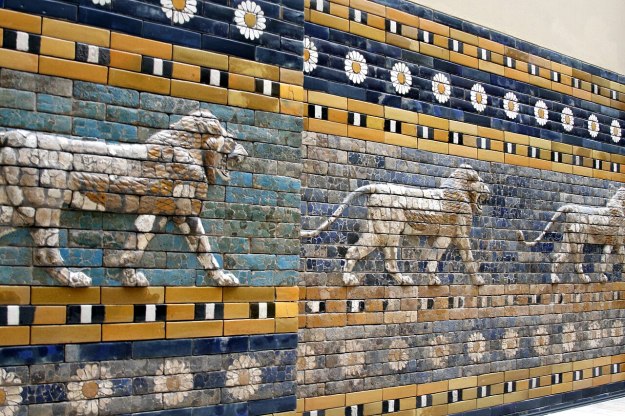
Striding lions from the Processional Street of Babylon. Exhibited at the Pergamon Museum in Berlin.

2 Kings 24: 1-7 The Reign of Jehoiakim  

 1In his days King Nebuchadnezzar of Babylon came up; Jehoiakim became his servant for three years, then turned and rebelled against him. 2He sent against him bands of the Chaldeans, bands of the Arameans, bands of the Moabites, and bands of the Ammonites; he sent them against Judah to destroy it, according to the word of the LORD that he spoke by his servants the prophets. 3Surely this came upon Judah at the command of the LORD, to remove them out of his sight, for the sins of Manasseh, for all that he had committed, 4and also for the innocent blood that he had shed, for he filled Jerusalem with innocent blood, and the LORD was not willing to pardon. 5Now the rest of the deeds of Jehoiakim and all that he did, are they not written in the Book of the Annals of the Kings of Judah? 6So Jehoiakim slept with his ancestors; then his son Jehoiachin succeeded him. 7The king of Egypt did not come again out of his land, for the king of Babylon had taken over all that belonged to the king of Egypt from the Wadi of Egypt to the River Euphrates.

Jehoiakim was installed by Pharaoh Neco to replace his younger brother Jehoahaz who Neco took into imprisonment at Riblah. Jehoiakim begins his reign as a vassal of Egypt but during his eleven years as king the situation dramatically shifts as Nebuchadnezzar of Babylon becomes the dominant power in the region forcing Egypt’s influence to recede back beyond the Wadi of Egypt. The forces of Babylon (Chaldeans,[1] Arameans, Moabites, and Ammonites) raid into Judah, and although the siege of Jerusalem will not occur until Jehoiakim’s sons brief reign, the forces that will bring about the end of the time of Judah are in motion.

Jehoiakim appears frequently in the book of Jeremiah in a negative light. The king is portrayed as living in luxury while the nation struggles, mistreating the poor and executing those who speak against his policies.[2] The king executes Uriah son of Shemiah who prophecies in a manner similar to Jeremiah and Jeremiah is protected by some of the officials, including Ahikam son of Shaphan (secretary during the time of Josiah)[3] Jeremiah sends a scroll with God’s words to Jehoiakim but in contrast to his father Josiah who tore his clothes in mourning Jehoiakim tore (same verb in Hebrew) the scroll after it was read and cast it into the fire.[4]

Jeremiah declares the Jehoiakim will die “the death of a donkey…dragged off and thrown out beyond the gates of Jerusalem.” (Jeremiah 22:19) 2 Kings states that Jehoiakim slept with his ancestors indicating a normal death and burial. Jehoiakim rebels against Babylon after being a vassal for three years, likely in response to a defeat in Egypt which Nebuchadnezzar returns to Babylon to give his forces time to recover and rebuild. This time the rebellion of Judah does not go unpunished, and this leads to the first siege of Jerusalem by Babylon. Jehoiakim is roughly thirty-six when he dies so it is possible that he is killed by elements within Jerusalem seeking a different leader to attempt to negotiate with the threat of Babylon.

2 Kings 24: 8-17 The Reign of Jehoiachin and the First Siege of Jerusalem

  8Jehoiachin was eighteen years old when he began to reign; he reigned three months in Jerusalem. His mother’s name was Nehushta daughter of Elnathan of Jerusalem. 9He did what was evil in the sight of the LORD, just as his father had done.
  10
At that time the servants of King Nebuchadnezzar of Babylon came up to Jerusalem, and the city was besieged. 11King Nebuchadnezzar of Babylon came to the city while his servants were besieging it; 12King Jehoiachin of Judah gave himself up to the king of Babylon: himself, his mother, his servants, his officers, and his palace officials. The king of Babylon took him prisoner in the eighth year of his reign.

  13
He carried off all the treasures of the house of the LORD and the treasures of the king’s house; he cut in pieces all the vessels of gold in the temple of the LORD that King Solomon of Israel had made, all this as the LORD had foretold. 14He carried away all Jerusalem, all the officials, all the warriors, ten thousand captives, all the artisans and the smiths; no one remained except the poorest people of the land. 15He carried away Jehoiachin to Babylon; the king’s mother, the king’s wives, his officials, and the elite of the land, he took into captivity from Jerusalem to Babylon. 16The king of Babylon brought captive to Babylon all the men of valor, seven thousand, the artisans and the smiths, one thousand, all of them strong and fit for war. 17The king of Babylon made Mattaniah, Jehoiachin’s uncle, king in his place and changed his name to Zedekiah.

The short reign of Jehoiachin is significant because it marks a critical change for Judah. Jehoiachin inherits the troubles his father inflamed by rebelling against Babylon and reigns briefly over a besieged city. We know that the king and his royal household surrender on March 16 (the second of Adar) 597 BCE and the royal household, warriors, artisans and smiths are taken into exile while the remainder of the people remain under the charge of Zedekiah. This initial exile of the leaders, elites, and skilled members of the population are the setting of the narrative at the beginning of Daniel. We also know that the prophet Ezekiel was among those exiled.[5] The city of Jerusalem and the temple remain but ten thousand people and the riches of the temple and royal household are removed into Babylon.

This creates a new situation for Judah which now has two centers of life: one in exile in Babylon and one remaining in the land. Jeremiah will be the prophet remaining in the land while Ezekiel will emerge to be the prophet for those in exile. The prophet Jeremiah will receive a vision of two baskets of figs, one very good and one rotten, and in this vision the good figs will be Jehoiachin, and the people taken into exile who God views favorable and the rotten figs are Zedekiah and those remaining in Jerusalem.[6] Ezekiel also shares this perspective that the population in exile will be the population of Judah that endures.

2 Kings 24: 18-20 The Reign and Rebellion of Zedekiah

  18Zedekiah was twenty-one years old when he began to reign; he reigned eleven years in Jerusalem. His mother’s name was Hamutal daughter of Jeremiah of Libnah. 19He did what was evil in the sight of the LORD, just as Jehoiakim had done. 20Indeed, Jerusalem and Judah so angered the LORD that he expelled them from his presence.

  Zedekiah rebelled against the king of Babylon.

Zedekiah is left in charge of the remnant in Jerusalem. The final line of the chapter strikes the critical note for Zedekiah’s reign. He is portrayed in Jeremiah as a king who does seek the prophet’s words but is ultimately unable or unwilling to resist his advisors who lead him into conflict with Babylon. Jehoahaz, Jehoiakim, Jehoiachin, and Zedekiah all reign under the thumb of external powers, Egypt for Jehoahaz and Jehoiakim initially and then Babylon for Jehoiakim through Zedekiah. Yet for the narrator of 2 Kings all of this is a part of God’s action to judge the unfaithfulness of Judah which reaches its climax under Manasseh but extends back to Solomon and beyond. Judah and Jerusalem are expelled from the presence of God because of their disobedience in 2 Kings. Zedekiah’s rebellion sets Babylon in motion to be the instrument of that judgment.


[1] Although we think of Babylon as the empire, the Chaldeans were the dominant people of this empire. All ancient empires were coalitions of groups and so the presence of Arameans, Moabites, and Ammonites (neighbors of Judah) are not surprising.

[2] See Jeremiah 22.

[3] 2 Kings 22:3.

[4] Jeremiah 36: 20-26.

[5] Ezekiel would receive his call as a prophet while in exile (Ezekiel 1). Kish the grandfather of Mordecai (uncle of Esther) was also among this group of exiles in Esther 2:5-6. Many scholars view the book of Daniel as a later book written well after the exile, but the setting of the initial chapters of the book are this initial exile of the elites to Babylon.

[6] Jeremiah 24.

2 Kings 22 King Josiah and the Rediscovery of the Law

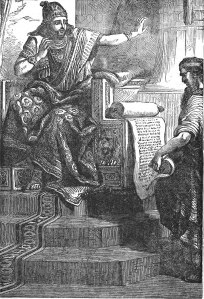
Josiah Hearing the Book of the Law (1873) Unknown author – The story of the Bible from Genesis to Revelation

2 Kings 22

 1Josiah was eight years old when he began to reign; he reigned thirty-one years in Jerusalem. His mother’s name was Jedidah daughter of Adaiah of Bozkath. 2He did what was right in the sight of the LORD and walked in all the way of his father David; he did not turn aside to the right or to the left.

  3
In the eighteenth year of King Josiah, the king sent Shaphan son of Azaliah son of Meshullam, the secretary, to the house of the LORD, saying, 4Go up to the high priest Hilkiah and have him add up the entire sum of the silver that has been brought into the house of the LORD that the keepers of the threshold have collected from the people; 5let it be given into the hand of the workers who have the oversight of the house of the LORD; let them give it to the workers who are at the house of the LORD repairing the house, 6that is, to the carpenters, to the builders, to the masons; and let them use it to buy timber and quarried stone to repair the house. 7But no accounting shall be asked from them for the silver that is delivered into their hand, for they deal honestly.”
  8
The high priest Hilkiah said to Shaphan the secretary, “I have found the book of the law in the house of the LORD.” When Hilkiah gave the book to Shaphan, he read it. 9Then Shaphan the secretary came to the king and reported to the king, “Your servants have melted down the silver that was found in the house and have delivered it into the hand of the workers who have oversight of the house of the LORD.” 10Shaphan the secretary informed the king, “The priest Hilkiah has given me a book.” Shaphan then read it aloud to the king.
  11
When the king heard the words of the book of the law, he tore his clothes. 12Then the king commanded the priest Hilkiah, Ahikam son of Shaphan, Achbor son of Micaiah, Shaphan the secretary, and the king’s servant Asaiah, saying, 13Go, inquire of the LORD for me, for the people, and for all Judah, concerning the words of this book that has been found, for great is the wrath of the LORD that is kindled against us, because our ancestors did not obey the words of this book to do according to all that is written concerning us.”
  14
So the priest Hilkiah, Ahikam, Achbor, Shaphan, and Asaiah went to the prophet Huldah the wife of Shallum son of Tikvah son of Harhas, keeper of the wardrobe; she resided in Jerusalem in the Second Quarter, where they consulted her. 15She declared to them, “Thus says the LORD, the God of Israel: Tell the man who sent you to me: 16Thus says the LORD: I will indeed bring disaster on this place and on its inhabitants—all the words of the book that the king of Judah has read. 17Because they have abandoned me and have made offerings to other gods, so that they have provoked me to anger with all the work of their hands, therefore my wrath will be kindled against this place, and it will not be quenched.’ 18But as to the king of Judah who sent you to inquire of the LORD, thus shall you say to him: ‘Thus says the LORD, the God of Israel: Regarding the words that you have heard, 19because your heart was penitent and you humbled yourself before the LORD, when you heard how I spoke against this place and against its inhabitants, that they should become a desolation and a curse, and because you have torn your clothes and wept before me, I also have heard you, says the LORD. 20Therefore, I will gather you to your ancestors, and you shall be gathered to your grave in peace; your eyes shall not see all the disaster that I will bring on this place.’ ” They took the message back to the king.

The thirty-one years of King Josiah’s reign in Jerusalem are a final window of hope for Judah. Even though as readers of 2 Kings we know that shortly after Josiah’s death we will reach the end of the story of the kings of the line of David and enter into the time of exile in Babylon, for the author of 2 Kings this is a moment of hope for a rediscovery of faithfulness, restoration of the temple, recommittal to the covenant, and even a hope for the reunification of Israel and Judah. The parallel telling of the story of the reign of King Josiah in 2 Chronicles 34-35 has the reformation of Josiah beginning in his twelfth year, but for 2 Kings the critical event is the discovery of the law in the eighteenth year[1] which initiates a period of repentance for the king and a recommittal to the covenant.

The characterization of King Josiah as one who ‘did not turn aside to the right or the left’ echoes the language of Deuteronomy calling for covenant obedience.[2] His obedience to the covenant links him to Moses, and then the text continues to link him to his ancestor David. Then the text takes us to the repair of the temple in language which parallels the actions of King Jehoash in 2 Kings 12: 1-16. In inquiring of the LORD through the prophet he, like his great-grandfather Hezekiah who sought God’s word through the prophet Isaiah. By his actions Josiah is shown embodying the actions of the good kings and leaders that have come before him. Although the prophet Jeremiah is not mentioned in this narrative, we also know that Jeremiah’s ministry begins in the thirteenth year of Josiah’s reign.[3]

The king sends Shaphan, the scribe or secretary, to the high priest Hilkiah[4] to instigate the utilization of the funds brought into the temple for the temple’s repair. As mentioned above, the narrative is similar to the rebuilding under Jehoash, but at this moment there is a critical discovery that is shared by Hilkiah with Shaphan and eventually with the king, the rediscovered book of the law. Shaphan reads this book to the king who responds by rending his garments in an act of mourning and repentance. Walter Brueggemann draws an insightful contrast between this action by Josiah and an opposite reaction by his son Jehoiakim:

Josiah, the good king, hears the scroll and tears his garment in a dramatic act of repentance (22:11). In Jeremiah 36:23, Jehoiakim, Josiah’s son who is a bad king, hears the scroll of Jeremiah and “cuts” the scroll and not his garments; that is, he does not repent but seeks to dispose of the troublesome scroll. (Brueggemann, 2000, p. 545)

Yet Josiah as a king who upon hearing the words of the law humbles himself and seeks God’s guidance is the model of what a good king is supposed to be.

The book of the law mentioned in this portion of 2 Kings has traditionally been thought of as Deuteronomy in some form. Deuteronomy is the only book among the torah[5] that specifically expects worship being concentrated in the city that God places God’s name upon. Deuteronomy also has lengthy sections of ‘curses’ that result from covenant disobedience. (Cogan, 1988, p. 294) We will never know whether the ‘law’ is Deuteronomy, the torah as a whole, or some proto-Deuteronomic document[6] but what 2 Kings wants us to understand is that Josiah received these words as the covenantal expectations of God and responded to them with the appropriate repentance and rigor.

The high priest Hilkiah, the scribe Shaphan, as well as Ahikam and Achbor are sent to the prophetess Hulda to seek God’s will. Ahikam, the son of Shaphan may be the son of the secretary and another advisor to the king, although some scholars are confused by Ahikam’s position in the list ahead of his father if they are related.[7] Ahikam son of Shaphan will be instrumental in preserving the prophet Jeremiah’s life during the reign of Jehoiakim.[8] In contrast Achbor’s son Elnathan will be charged with capturing the prophet Uriah and returning him to King Josiah for execution.[9] Like Josiah and Jehoiakim fathers and sons can take very different paths.

Hulda is the only woman prophet mentioned in either Israel or Judah, and yet she is trusted by the king and his men to speak the words of the LORD. Her message is ominous and hopeful. It is ominous because the king has heard the threats for covenant disobedience in the law correctly and the actions, particularly of Manasseh, have kindled an unquenchable wrath in God against the people. It is also hopeful because the actions of the king have been seen and appreciated by God. The king’s heart was penitent (literally soft in Hebrew) and tore his clothes and wept. God has postponed the disaster and held back the wrath during the reign of Josiah.

The humility and repentance of the king open the possibility for the repentance of the people. God’s judgment has been postponed, and there remains a hope that continued obedience can avert the disaster on the horizon. Jeremiah will continue to testify to the people after Josiah’s death to try to prevent the destruction that comes with this judgment enacted through the Babylonians. Yet Jeremiah will also see that the reforms enacted by Josiah will not change the heart of the people. Just as the people, in the narrative of 2 Kings, were quick to embrace the corruption of Manasseh the reforms of Josiah will unfortunately not survive his death. Yet 2 Kings wants to continue to celebrate this final good king who like Moses, David, Jehoash, and Hezekiah attempted to follow God’s will and to turn neither to the left or right.  


[1] King Josiah would be roughly twenty-six at the time of the discovery of the law in the text.

[2] Deuteronomy 5:32; 17:20; 28:14.

[3] Josiah would have been 21-22 at the call of Jeremiah, five years before the rediscovery of the book of the law. Jeremiah is portrayed as a young, ‘only a boy’ in the narrative of his call. Jeremiah 1:6.

[4] Hilkiah is also the name of the prophet Jeremiah, but Jeremiah’s father is a priest at Anathoth, and it is likely that he is the son of a different Hilkiah than the high priest in this story.

[5] Genesis, Exodus, Leviticus, Numbers, and Deuteronomy.

[6] Scholars of the source critical school popular in the middle 20th century were focused on trying to find the source material behind the text. They had some good insights but ultimately, they tended to divide up the text into sections rather than engage the text as it has been received.

[7] Age does normally grant a person higher respect and status in ancient cultures, but Ahikam may also be a contemporary and valued advisor to this king who began his reign as a young boy.

[8] Jeremiah 26: 24.

[9] Jeremiah 26:22.

Introduction to Lamentations

Jeremiah Lamenting the Destruction of Jerusalem by Rembrandt van Rijn 1630

I have intentionally worked my way through several books normally overlooked by Christian readers and leaders in our scriptures. The book of Lamentations for most of its history would qualify as an underutilized book within the scriptures we share with our Jewish Ancestors. Although there has been some recent scholarly interest in these five poems, for the average person of faith the name of the book is probably enough to scare the casual reader away. Yet, I do believe that we neglect the breadth of scripture to our own detriment. Over the thirteen years I’ve been writing on signoftherose I’ve gained a much greater appreciation for the wisdom of Hebrew poetry and the open and honest dialogue between God and God’s people that our scriptures capture.

Having worked through Psalms 1-110 and Song of Songs (or Song of Solomon) has given me a much greater appreciation of Hebrew poetry, and Lamentations is poetry. Lamentations is five poems, four of which are structured as acrostics[1] which move sequentially through the twenty-two letters of the Hebrew alphabet and the final poem’s twenty-two lines while not acrostic matches the twenty-two verse format of an acrostic. The acrostic form is often used to denote the completion of a thought, but due to the tragic event that evokes these poems it is also may be a tool to provide structure during a traumatic time.

Gwen Sayler and Ann Fritschel, my Hebrew Bible instructors twenty-five years ago at Wartburg Seminary used to joke that the answer to any question in the Hebrew Scriptures was likely to be the Babylonian exile. This event reshaped the Hebrew people when the Davidic king is sent into exile as well as the people. They mourn the loss of their land, the temple, and Jerusalem. Having worked through both Jeremiah and Ezekiel, which bracket Lamentations in the Christian arrangement of scriptures, has involved me dwelling in the writings of this period around 587 BCE. Lamentations current position after Jeremiah is due to the traditional attribution of these poems to Jeremiah.

The Hebrew name of this short book of poems is Eikha which comes from the first word of the first poem. Eikha is the elongated form of the word eikh which means “how?” How has this disaster happened to the people. This question would consume the two long prophetic books of Jeremiah and Ezekiel, the Deuteronomic historical retelling of the narrative of 1 & 2 Kings which climaxes at the exile at the end of the narrative, and several psalms most notably Psalm137. How has the relationship between God and God’s people come to this point where the central symbols of the people have collapsed: the Davidic monarchy, the city of Jerusalem (Zion), the land, and the temple built by Solomon. As the people find themselves as strangers in strange lands they have to rediscover what it means to be the people of the covenant.

Lamentations is a book with theological implications, but it is not attempting to be systematic. It is emotional, as it should be. Its voice is the voice of the wounded people of a lost city seeing through tear-filled eyes. It may be utilizing structure to help make sense of the chaotic, but it is a book shaped by grief and broken hearts. As John Goldingay states, “Lamentations is a “mandate to question.”” (Goldingay, 2022, p. 30) Theologically Lamentations assumes, like much of Hebrew literature, that the God of Israel is responsible for everything that occurs. Although Lamentations understands that the cause of the exile is the covenant unfaithfulness of Israel to their God, they protest and plead with God to change God’s mind and reverse the punishment they are receiving. Ultimately for the poet or poets of Lamentations their physical and emotional problems are a result of their relational problems with their God.

Resources Used For This Journey

Harvey Cox and Stephanie Paulsell, Lamentations and The Song of Songs. Belief Commentary on the Bible. Louisville: Westminster John Knox Publishing Company,2012.

The Belief Commentary series is a theological commentary written by theologians rather than biblical scholars. Harvey Cox did the Lamentations half of this commentary and uses Lamentations as a springboard into a wide range of theological topics. I read this commentary initially when I was working through Song of Songs.

John Goldingay, The Book of Lamentations. (New International Commentary on the Old Testament series). Grand Rapids: William B. Eerdman’s Publishing Company, 2022.

The NICOT series of commentaries have often been helpful textual commentaries, and when looking for a volume to assist with the language as well as the historical background these have often been helpful. John Goldingay is a scholar who has written extensively on Jeremiah and the literature associated with Jeremiah.

Kathleen M. O’Connor, “Book of Lamentations” in The New Interpreter’s Bible. Volume VI. Nashville, Abingdon Press, 1996.

The NIB is a solid all-around commentary on the entire bible and apocrypha. It is designed for pastors and those leading in congregations, so it does not normally engage the textual issues as deeply as the NICOT or Anchor Bible commentaries.

Ziegler, Yael, Lamentations: Faith in a Turbulent World. Maggid Studies in Tanakh. Jerusalem. Maggid Books, 2021.

When I can I attempt to utilize a Jewish scholar when reading the scriptures that we share. The Maggid Studies I have utilized in the past have been approachable but also provide a window into perspectives that most Christian scholars may not explore.


[1] Chapter three is acrostic but instead of one verse per letter there are three verses.

The Line of Kings in Matthew compared with the Hebrew Scriptures

Giovanni Francesco Barberi (il Guercino), King David (1651)

United Kingdom of Israel

David (1010-970 BCE)

Replaced Saul,

Narrative of David runs from 1 Samuel 16-1 Kings 1 in the 1 &2 Samuel, 1 & 2 Kings telling of Israel’s story. It runs from 1 Chronicles 11-22 in Chronicles telling of Israel’s story. David is attributed as the author of much of the book of Psalms and is mentioned frequently throughout the scriptures as a model of what a king should be and as a figure from which the hope for the people will come.


  1. Solomon (970-922 BCE)

Narrative of Solomon is told in 1 Kings 3-11 in the 1 & 2 Kings telling of Israel’s story. It runs from 1 Chronicles 11-22 in Chronicles telling of Israel’s story. Solomon is the attributed author of some of the Psalms, the book of Proverbs, Ecclesiastes and the Song of Songs (although he is probably not the author of these varied works as judged by the language). Builds the first temple, initially favored by God but there is an underlying critique of Solomon’s reign in the scriptures and he eventually turns away from the way of the Lord.

Kingdom of Judah

  1. Rehoboam (922-915)

Narrative of Rehoboam is told in 1 Kings 12, 14:21-31 in the 1 & 2 Kings telling of Israel’s story. It runs from 2 Chronicles 9-12 in Chronicles telling of Israel’s story. He is viewed as an unwise and unfaithful king whose arrogance causes a split in the nation of Israel.


  1. Abijah (Abijam) (915-913)

Narrative of Abijah (Abijam)is told in 1 Kings 15: 1-8 in the 1 & 2 Kings telling of Israel’s story. It occurs in 2 Chronicles 13 in Chronicles telling of Israel’s story. Kings and Chronicles have a very different view of Abijah, Kings narrates that he continued in the sins of his father (Rehoboam) while Chronicles narrates him as a heroic figure that defies the king of Israel.


  1. Asa (Asaph in Matthew) (913-873)

Narrative of Asa is told in 15: 9-24 in the 1 & 2 Kings telling of Israel’s story. It runs from 2 Chronicles 13-16 in Chronicles telling of Israel’s story. His 41-year reign is viewed positively in both chronicles and he is viewed as a person who does what is right in the sight of the LORD. His only other mention is as the creator of the cistern into which the prophet Jeremiah will be thrown into (long after Asa’s death)


  1. Jehoshapat (873-849)

Narrative of Jehoshapat is told in 1 Kings 22: 41-50 in the 1 & 2 Kings telling of Israel’s story. It runs from 2 Chronicles 17-20 in Chronicles telling of Israel’s story. His 25 years reign is also viewed positively in both narratives.


  1. Jehoram (Joram in Matthew) (849-843)

Narrative of Jehoram is told in 2 Kings 8: 16-24 the 1 & 2 Kings telling of Israel’s story. It occurs in 2 Chronicles 21 in Chronicles telling of Israel’s story. Viewed as a king who betrayed the reforms of his father and grandfather and returned the people to worshipping other gods. Elijah the prophet enters the narrative during the reign of Jehoram.


Ahaziah (843-842) neglected in Matthew’s genealogy

Narrative of Ahaziah is told in 2 Kings 8: 23-29, 9:27 in the 1 & 2 Kings telling of Israel’s story. It occurs in 2 Chronicles 22 in Chronicles telling of Israel’s story. His one-year reign is viewed negatively in both narratives and he is killed by Jehu son of Nimshi. With only reigning one year it is perhaps an understandable negation from Matthew’s line, but the genealogy would go through Ahaziah.


Athaliah (842-837) neglected in Matthew’s genealogy

Mother of Ahaziah, seizes the throne after her son’s murder. Narrative of Athaliah is told in 2 Kings 11 in the 1 & 2 Kings telling of Israel’s story. It runs from 2 Chronicles 22:10-23:21 in Chronicles telling of Israel’s story. Joash is preserved in the line of kings after she orders the death of royal family of Judah.  Since Athaliah was a queen rather than a king this wouldn’t normally appear in a genealogy. However, Matthew did include several women previously who would normally be overlooked.


Joash (837-800) neglected in Matthew’s genealogy

Narrative of Joash is told in 2 Kings 11:4-12, 17-21 and 12: 1-21 in the 1 & 2 Kings telling of Israel’s story. It occurs in 2 Chronicles 24 in Chronicles telling of Israel’s story. Joash is kept alive and mentored by the priest Jehoiada and for most of his life did what was right in God’s sight. He is famous for repairing the temple but Chronicles states that late in his life, after Jehoiada dies and under the influence of the nobles of Judah, he returns to the ways of the unrighteous kings. This is perhaps the most unusual negation.


Amaziah (800-783) neglected in Matthew’s genealogy

Narrative of Amaziah is told in 2 Kings 14: 1-22 in the 1 & 2 Kings telling of Israel’s story. It occurs in 2 Chronicles 25 in Chronicles telling of Israel’s story. Amaziah is listed in 2 Kings as one who did what was right in the site of the LORD but the major event in both narratives is his failed battle with Israel where the wall of Jerusalem is breached and the gold and silver from the temple and the king’s house are stolen. Another unusual negation.


  1. Uzziah (Azariah in 2 Kings) (783-742)

Narrative of Uzziah/Azariah is told in 2 Kings 15: 1-7 in the 1 & 2 Kings telling of Israel’s story. It occurs in 2 Chronicles 26 in Chronicles telling of Israel’s story. Uzziah did what was right in the site of the LORD with some qualifications in both 2 Kings and 2 Chronicles. In 2 Chronicles he is afflicted with leprosy after attempting to offer a sacrifice himself instead of through the priests.  Uzziah’s reign is also at the beginning of Isaiah’s time as a prophet (or first Isaiah, Isaiah 1 and 6 mention Uzziah) as well as the time of Amos and Hosea. Also, the prophet Zechariah mentions an earthquake in the time of king Uzziah (Zechariah 14:6)


  1. Jothan (742-735)

Narrative of Jothan is told in 2 Kings 15: 32-38 in the 1 & 2 Kings telling of Israel’s story. It occurs in 2 Chronicles 27 in Chronicles telling of Israel’s story. Jothan is listed as a king who did right in the eyes of the LORD but who did not eliminate the practices of the people that were displeasing to God in the view of 2 Kings and 2 Chronicles. His reign is described as prosperous and peaceful. The ministries of Micah and Hosea occur in part during the reign of Jothan.

  1. Ahaz (735-727 or 715)

Narrative of Ahaz is told in 2 Kings 16 in the 1 & 2 Kings telling of Israel’s story. It occurs in 2 Chronicles 28 in Chronicles telling of Israel’s story. Ahaz is a king who did not do what was right in the site of the lord in the narratives and is oppressed by Israel, the Edomites and the Philistines. Ahaz appeals to Assyria for help and attempts to bribe Assyria with items from his house and the officials in tribute, but Assyria rebuffs their call for aid. Isaiah 7 is during the reign of King Ahaz and Isaiah 14:28 begins an oracle in the year of Ahaz’ death.


  1. Hezekiah (727 or 715 to 687)

Narrative of Hezekiah is told in 2 Kings 18-20 in the 1 & 2 Kings telling of Israel’s story. It occurs in 2 Chronicles 29-32 in Chronicles telling of Israel’s story. Hezekiah is a righteous king and reigns during an important transition in the region. The Assyrian empire conquers Israel and marches on Judah, but their conquest is stopped, and Judah survives. King Hezekiah is attributed with ensuring that Proverbs 25-29 are preserved. Isaiah records the Assyrian invasion by King Sennacherib of Assyria and the dialogue between God, Isaiah, and Hezekiah as well as a later illness of Hezekiah and Hezekiah’s interaction with envoys from Babylon in Isaiah 36-39. The prophets Hosea and Micah also conclude their ministries during Hezekiah’s reign.


  1. Manasseh (687-642)

Narrative of Manasseh is told in 2 Kings 21: 1-18 in the 1 & 2 Kings telling of Israel’s story. It runs from 2 Chronicles 33: 1-20 in Chronicles telling of Israel’s story. Manasseh is listed as one of the kings who did evil by adopting the practices of the surrounding nations and worshipping other gods. Jeremiah 15:4 lists the evils of Manasseh as the reason for the judgment against Judah.


  1. Amos (Amon) (642-640)

Narrative of Manasseh is told in 2 Kings 21: 19-26 in the 1 &2 Samuel, 1 & 2 Kings telling of Israel’s story. It runs from 2 Chronicles 33: 21-25 in Chronicles telling of Israel’s story. He also did what was evil in God’s sight and was killed by the servants in his house or the people of the land depending on whether you read Chronicles or Kings.


  1. Josiah (640-609)

Narrative of Josiah is told in 2 Kings 22:1-23:30 in the 1 & 2 Kings telling of Israel’s story. It runs from 2 Chronicles 34-35 in Chronicles telling of Israel’s story. Josiah is remembered as the great reformer king who reintroduced the law to Judah. He dies in a battle against Pharaoh Neco, which seems to have been an unnecessary battle. Josiah’s reign is a time of great hope in Judah and there are even hopes of a new Israel, this is after the northern kingdom is conquered by Assyria, which practices the law and worships at the temple in Jerusalem. The optimism of the reforms of King Josiah are the context for the beginning of Jeremiah’s long ministry. Jeremiah soon sees the reforms are not changing the people and begins to warn that judgment is coming.


Jehoahaz (609) neglected in Matthew’s genealogy

Jehoahaz’ three-month reign is told in 2 Kings 23: 31-35 and 2 Chronicles 36: 1-4. He is enthroned by the people but deposed by Egypt and Egypt replaces him with his brother Eliakim who changes his name to Jehoiachim. Judah is now caught between the rising empire of Babylon in the north and Egypt in the south. Jehoahaz would not be in the genealogy of Jesus as Matthew traces it.


Jehoiachim (Eliakim) (609-598)

Jehoiachim’s reign is told briefly in 2 Kings 23: 36-24:7 and 2 Chronicles 36: 5-8.  In the eleven years he reigned Judah is caught between Babylon and Egypt. Jehoiachim serves Babylon for a time but then rebelled and was taken in chains to Babylon. Many of the proclamations of the prophet Jeremiah occur during the reign of Jehoiachim. The removal of Jehoiachim also sets the context for the beginning of the book of Daniel, where Daniel is among the young nobles brought to Babylon.


  1. Jehoiachin (598-597)

The son of Jehoiachim who is only eight or eighteen during his brief reign. His reign is told in 2 Kings 24: 8-18 and 2 Chronicles 36: 9-10. At the end of the reign is the deportation to Babylon of the officials, warriors, artisans, smiths and anyone who might exercise leadership among the people and a weak administration under his uncle Mattaniah, renamed Zedekiah. Jeremiah refers to Jehoiachin as Coniah.


Zedekiah (597-586)

Zedekiah is placed in his position by Babylon to attempt to retain peace among the remnant of Judah. His reign and the fall of Judah is told in 2 Kings 24: 18-30 (includes the governorship of Gedaliah) and 2 Chronicles 36: 11-21. More of Jeremiah’s proclamations come during the time of Zedekiah, in the final gasps of Judah and Jerusalem before Babylon’s final invasion and exile, than at any other time. Jerusalem is destroyed in 586 and more of the population is brought into exile in Babylon. There is a final rebellion during the governorship of Gedaliah) but the remnant of Judah that survives goes into exile in Babylon. The book of Jeremiah narrates the collapse of Judah in Jeremiah 34-44 and 52.

The Book of Jeremiah

Jeremiah Lamenting the Destruction of Jerusalem by Rembrandt van Rijn 1630

Jeremiah is the first large work of scripture I worked through on this blog and this early work on Jeremiah remains influential on my thinking. Early in my experience in blogging there are some lessons I’ve learned about the process but below is a table of contents to make the posts on Jeremiah more accessible.

Review of Jeremiah: The Fate of a Prophet by Binyamin Lau
An Introduction to the Prophet Jeremiah
The Calling: Jeremiah 1
The Wounded God: Jeremiah 2: 1-19
Rhetorical Overkill: Jeremiah 2: 20-37
The God Who Wouldn’t Give Up: Jeremiah 3
God the Wounded Lover: Jeremiah 4: 1-4
The Siren Call: Jeremiah 4: 5-10
The Poetry of Death and Destruction: Jeremiah 4: 11-18
The Prophet’s Agony: Jeremiah 4: 19-31
Searching for the Righteous One: Jeremiah 5: 1-6
The End of the World as They Know It: Jeremiah 5: 7-17
Corrupted Justice: Jeremiah 5: 18-31
The World Turned Upside Down: Jeremiah 6: 1-8
Peace, Peace When There Is No Peace: Jeremiah 6: 9-14
The Disconnect Between Worship and Obedience: Jeremiah 6: 15-21
Not Precious Metal, Fools Gold: Jeremiah 6: 22-30
Railing Against the Temple: Jeremiah 7: 1-5
The Prophet Who Hears and the People Who Don’t: Jeremiah 7: 16-26
The City Becomes a Desolation: Jeremiah 7:27-8:3
Jeremiah 8:4-9:1 The Headstrong People and the Heartsick Prophet and God
Jeremiah 9: 2-26 Death in and of the Land
The Things that Deceive: Jeremiah 10
Jeremiah 11: From Blessing to Curse
Jeremiah 12: The Disillusioned Prophet and the God who Listens
Jeremiah 13: Weeping for Those who do not Hear
Jeremiah 14: The Broken Covenant and the Death of the Land
Jeremiah 15: Ready to Walk Away
Jeremiah 16: A Vision of Resurrection, but only through Death
Jeremiah 17: States of the Heart
Jeremiah 18: A Misshapen People
Jeremiah 19: Broken Jugs
Jeremiah 20: The Abused Prophet
Jeremiah 21: A Kingdom Laid Low
Jeremiah 22: Justice, the King, and Judgment
Jeremiah 23: A Righteous Branch and Unrighteous Prophets
Jeremiah 24: Exiles, Figs and Reversals
Jeremiah 25: Drinking the Cup of Wrath
Jeremiah 26: The Prophet, The Temple, and the Elders
Jeremiah 27: The Yoke of Babylon
Jeremiah 28: The True and False Prophets
Jeremiah 29: A Letter to the Exiles and the Recurring False Prophets
Jeremiah 30: Hope in the Midst of Hopelessness
Jeremiah 31: Out of the Nightmare A Dream for the Future
Jeremiah 32: Purchasing a Field During a Siege
Jeremiah 33: Hope in the Midst of Hopelessness
Jeremiah 34: A Broken Covenant
Jeremiah 35: The Example of the Rechabites
Jeremiah 36: The Consumed Scroll and the Indestructible Words
Jeremiah 37: The People Who Do Not Hear
Jeremiah 38: The Officials, the Prophet, the Eunuch, and the King
Jeremiah 39: The City Falls
Jeremiah 40: The Remnant
Jeremiah 41: The Murder of Gedaliah and a Shattered Hope
Jeremiah 42: A Final Prayer and a Final Response
Jeremiah 43: The Flight to Egypt
Jeremiah 44: Plummeting to the End
Jeremiah 45: The Scribe and the World Endure the Ending
Jeremiah 46: Judgment for Egypt and Hope for Jacob
Jeremiah 47: Philistia Caught in the Flood
Jeremiah 48: Against Moab
Jeremiah 49: Judgment on Other Nations
Jeremiah 50-51: The Cry Against Babylon
Jeremiah 52: Ending the Journey
A Major Completion and Transition

Deuteronomy 28 Blessings and Curses

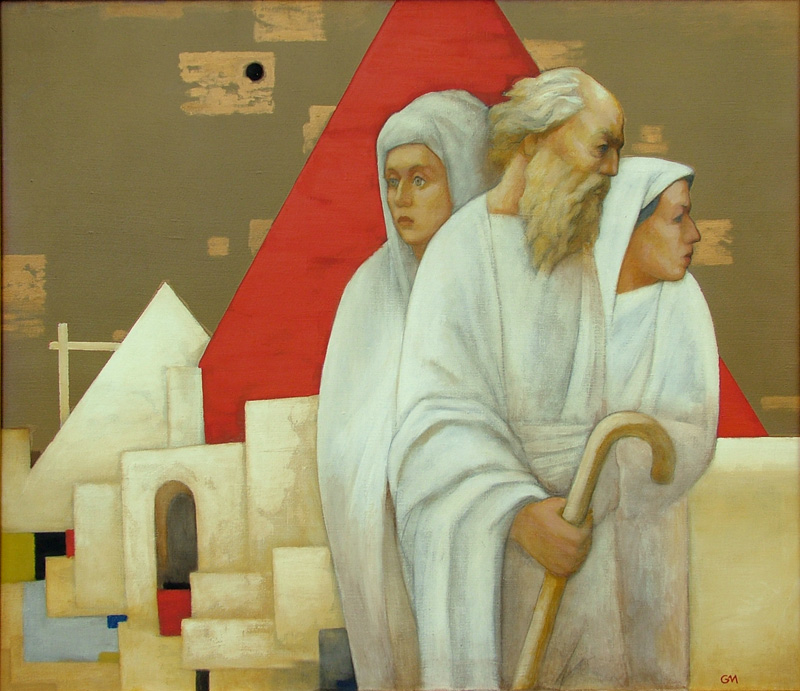
Grigory Mekheev, Exodus (2000) artist shared work under Creative Commons Attribution-Share Alike 3.0

Grigory Mekheev, Exodus (2000) artist shared work under Creative Commons Attribution-Share Alike 3.0

Deuteronomy 28: 1-14 Blessings for Obedience

1 If you will only obey the LORD your God, by diligently observing all his commandments that I am commanding you today, the LORD your God will set you high above all the nations of the earth; 2 all these blessings shall come upon you and overtake you, if you obey the LORD your God:
 3 Blessed shall you be in the city, and blessed shall you be in the field.
 4 Blessed shall be the fruit of your womb, the fruit of your ground, and the fruit of your livestock, both the increase of your cattle and the issue of your flock.
 5 Blessed shall be your basket and your kneading bowl.
 6 Blessed shall you be when you come in, and blessed shall you be when you go out.
 7 The LORD will cause your enemies who rise against you to be defeated before you; they shall come out against you one way, and flee before you seven ways. 8 The LORD will command the blessing upon you in your barns, and in all that you undertake; he will bless you in the land that the LORD your God is giving you. 9 The LORD will establish you as his holy people, as he has sworn to you, if you keep the commandments of the LORD your God and walk in his ways. 10 All the peoples of the earth shall see that you are called by the name of the LORD, and they shall be afraid of you. 11 The LORD will make you abound in prosperity, in the fruit of your womb, in the fruit of your livestock, and in the fruit of your ground in the land that the LORD swore to your ancestors to give you. 12 The LORD will open for you his rich storehouse, the heavens, to give the rain of your land in its season and to bless all your undertakings. You will lend to many nations, but you will not borrow. 13 The LORD will make you the head, and not the tail; you shall be only at the top, and not at the bottom– if you obey the commandments of the LORD your God, which I am commanding you today, by diligently observing them, 14 and if you do not turn aside from any of the words that I am commanding you today, either to the right or to the left, following other gods to serve them.
 
Deuteronomy closes this section with a series of blessings and curses. The previous chapter gives instructions for Simeon, Levi, Judah, Issachar, Joseph and Benjamin to stand on Mount Gerazim to proclaim the blessings. Although the ancient world had a much stronger view of blessings and curses than we do in our culture they are not quite these magic words that linger in the air and take on a power to bless or smite, rather they are a continual reminder of the contingent nature of the blessings that the LORD has promised. Israel does not have a true freedom in the sense of being able to choose its own destiny but it does, according to Deuteronomy, have a choice of which destiny it will live into. The reward for covenant obedience is that they will be materially blessed in this life, their harvests will be good, their flocks and herds will grow, they will have children and good health.

In an American context it would be easy to misread Deuteronomy as some sort of prosperity gospel for individuals, but this would be to miss much of what Deuteronomy is saying. Yes, in the author of Deuteronomy’s view the people (as a community) will be blessed if they are obedient. That obedience involves a harsh set of justice requirements and the continual care for the oppressed in their midst. It involves an acknowledgment that their blessings come from the LORD their God who brought them out of the Egypt and to this land of milk and honey. It is a way of thinking that is simple, and one that other books of the bible do challenge (for example in the book of Job which revolves around the righteous sufferer and in Matthew, Mark and Luke where prosperity is viewed with suspicion) yet it is a perspective that helps many people make sense of their lives, and probably helped the people Deuteronomy is written to initially make sense of their lives.

The people will often fail to diligently observe all the commandments and the much larger portion of this chapter is dedicated to the consequences for disobedience. Perhaps as we approach the following fifty three verses of curses, which seem oppressive and distasteful in our time, we can suspend our judgment and wonder about the experiences of the people who would hear these words.


Deuteronomy 28: 15-68 Curses for Disobedience

      15 But if you will not obey the LORD your God by diligently observing all his commandments and decrees, which I am commanding you today, then all these curses shall come upon you and overtake you:
 16 Cursed shall you be in the city, and cursed shall you be in the field.
 17 Cursed shall be your basket and your kneading bowl.
 18 Cursed shall be the fruit of your womb, the fruit of your ground, the increase of your cattle and the issue of your flock.
 19 Cursed shall you be when you come in, and cursed shall you be when you go out.
       20 The LORD will send upon you disaster, panic, and frustration in everything you attempt to do, until you are destroyed and perish quickly, on account of the evil of your deeds, because you have forsaken me. 21 The LORD will make the pestilence cling to you until it has consumed you off the land that you are entering to possess. 22 The LORD will afflict you with consumption, fever, inflammation, with fiery heat and drought, and with blight and mildew; they shall pursue you until you perish. 23 The sky over your head shall be bronze, and the earth under you iron. 24 The LORD will change the rain of your land into powder, and only dust shall come down upon you from the sky until you are destroyed.
      25 The LORD will cause you to be defeated before your enemies; you shall go out against them one way and flee before them seven ways. You shall become an object of horror to all the kingdoms of the earth. 26 Your corpses shall be food for every bird of the air and animal of the earth, and there shall be no one to frighten them away. 27 The LORD will afflict you with the boils of Egypt, with ulcers, scurvy, and itch, of which you cannot be healed. 28 The LORD will afflict you with madness, blindness, and confusion of mind; 29 you shall grope about at noon as blind people grope in darkness, but you shall be unable to find your way; and you shall be continually abused and robbed, without anyone to help. 30 You shall become engaged to a woman, but another man shall lie with her. You shall build a house, but not live in it. You shall plant a vineyard, but not enjoy its fruit. 31 Your ox shall be butchered before your eyes, but you shall not eat of it. Your donkey shall be stolen in front of you, and shall not be restored to you. Your sheep shall be given to your enemies, without anyone to help you. 32 Your sons and daughters shall be given to another people, while you look on; you will strain your eyes looking for them all day but be powerless to do anything. 33 A people whom you do not know shall eat up the fruit of your ground and of all your labors; you shall be continually abused and crushed, 34 and driven mad by the sight that your eyes shall see. 35 The LORD will strike you on the knees and on the legs with grievous boils of which you cannot be healed, from the sole of your foot to the crown of your head. 36 The LORD will bring you, and the king whom you set over you, to a nation that neither you nor your ancestors have known, where you shall serve other gods, of wood and stone. 37 You shall become an object of horror, a proverb, and a byword among all the peoples where the LORD will lead you.
 38 You shall carry much seed into the field but shall gather little in, for the locust shall consume it. 39 You shall plant vineyards and dress them, but you shall neither drink the wine nor gather the grapes, for the worm shall eat them. 40 You shall have olive trees throughout all your territory, but you shall not anoint yourself with the oil, for your olives shall drop off. 41 You shall have sons and daughters, but they shall not remain yours, for they shall go into captivity. 42 All your trees and the fruit of your ground the cicada shall take over. 43 Aliens residing among you shall ascend above you higher and higher, while you shall descend lower and lower. 44 They shall lend to you but you shall not lend to them; they shall be the head and you shall be the tail.
      45 All these curses shall come upon you, pursuing and overtaking you until you are destroyed, because you did not obey the LORD your God, by observing the commandments and the decrees that he commanded you. 46 They shall be among you and your descendants as a sign and a portent forever. 47 Because you did not serve the LORD your God joyfully and with gladness of heart for the abundance of everything, 48 therefore you shall serve your enemies whom the LORD will send against you, in hunger and thirst, in nakedness and lack of everything. He will put an iron yoke on your neck until he has destroyed you. 49 The LORD will bring a nation from far away, from the end of the earth, to swoop down on you like an eagle, a nation whose language you do not understand, 50 a grim-faced nation showing no respect to the old or favor to the young. 51 It shall consume the fruit of your livestock and the fruit of your ground until you are destroyed, leaving you neither grain, wine, and oil, nor the increase of your cattle and the issue of your flock, until it has made you perish. 52 It shall besiege you in all your towns until your high and fortified walls, in which you trusted, come down throughout your land; it shall besiege you in all your towns throughout the land that the LORD your God has given you. 53 In the desperate straits to which the enemy siege reduces you, you will eat the fruit of your womb, the flesh of your own sons and daughters whom the LORD your God has given you. 54 Even the most refined and gentle of men among you will begrudge food to his own brother, to the wife whom he embraces, and to the last of his remaining children, 55 giving to none of them any of the flesh of his children whom he is eating, because nothing else remains to him, in the desperate straits to which the enemy siege will reduce you in all your towns. 56 She who is the most refined and gentle among you, so gentle and refined that she does not venture to set the sole of her foot on the ground, will begrudge food to the husband whom she embraces, to her own son, and to her own daughter, 57 begrudging even the afterbirth that comes out from between her thighs, and the children that she bears, because she is eating them in secret for lack of anything else, in the desperate straits to which the enemy siege will reduce you in your towns.
      58 If you do not diligently observe all the words of this law that are written in this book, fearing this glorious and awesome name, the LORD your God, 59 then the LORD will overwhelm both you and your offspring with severe and lasting afflictions and grievous and lasting maladies. 60 He will bring back upon you all the diseases of Egypt, of which you were in dread, and they shall cling to you. 61 Every other malady and affliction, even though not recorded in the book of this law, the LORD will inflict on you until you are destroyed. 62 Although once you were as numerous as the stars in heaven, you shall be left few in number, because you did not obey the LORD your God. 63 And just as the LORD took delight in making you prosperous and numerous, so the LORD will take delight in bringing you to ruin and destruction; you shall be plucked off the land that you are entering to possess. 64 The LORD will scatter you among all peoples, from one end of the earth to the other; and there you shall serve other gods, of wood and stone, which neither you nor your ancestors have known. 65 Among those nations you shall find no ease, no resting place for the sole of your foot. There the LORD will give you a trembling heart, failing eyes, and a languishing spirit. 66 Your life shall hang in doubt before you; night and day you shall be in dread, with no assurance of your life. 67 In the morning you shall say, “If only it were evening!” and at evening you shall say, “If only it were morning!”– because of the dread that your heart shall feel and the sights that your eyes shall see. 68 The LORD will bring you back in ships to Egypt, by a route that I promised you would never see again; and there you shall offer yourselves for sale to your enemies as male and female slaves, but there will be no buyer.

One of my practices as I write these reflections is to physically write out the text. I have done this for Haggai, Esther, Jeremiah, Psalms 1-10 and now most of the way through Deuteronomy. This is a challenging text to listen to as you write it, but it is not the first time I have approached a text like this. What the text reminded me of was the end of Jeremiah, particularly Jeremiah 46-51 where the curses are uttered towards all the nations around Judah. Even though it is unusual in our time to think about dedicating this much energy to a ‘hex’ or ‘curse’ it is not unusual in the ancient world: both in Israel and in the cultures around them. Many ancient texts end with a long set of curses for failing to observe the commands or view of the text, but Deuteronomy does not end here. While this is the closing of this central portion of Deuteronomy that deals with the law, in the narrative of Deuteronomy Moses is still going to renew the covenant one more time, promise them that even in the midst of the curses that there is still an option to return to the LORD, a challenge to choose the way of blessing and life, the setting up Joshua as a successor and establishing practices for reminding the people of this law, Moses’ song and Moses’ final blessing. Yet, there is no avoiding the discomfort that a passage like this causes modern people.

I am amazed at the ways I have seen people misuse this text, for example the text in verses 56 and 57 (which is very reminiscent of Jeremiah) which talks about parents eating their own children within the context of a land under siege I have seen it twisted by a person trying to discredit the bible to God commanding parents to eat their children (which never happens). I can understand why people would misread these curses, but let’s take a little time to try to understand what is going on here. The great fear of the author of Deuteronomy is that the people when they enter the promised land will forget the covenant and turn aside to worship other gods. If they do this they lose their identity as being Israel, and with that they lose the land, their prosperity, and everything else. If scholars are correct that Deuteronomy, like many other books, reach their final form during the Babylonian exile then this portion in verses 47-57 makes a lot of sense. It does not parallel any of the blessings but does reflect the experience of the siege of Jerusalem and the departure into exile. As harsh as this language is, it may reflect the process of meaning making that is a part of the recovery from trauma. In her well written book interpreting the book of Jeremiah from the perspective of trauma and recovery Kathleen O’Connor can write about the rhetoric of responsibility and survival by saying:

If the world is ever to be trustworthy, victims need interpretation. For their lives to rest on the most minimal order, they must have meaning, interpretation, explanation, even if the explanation is ephemeral, inadequate, partial or outright wrong. Explanation puts order back in the world…. He (Jeremiah) claims without qualification that God is still in charge of the world; God controls events and governs justly. But perhaps even more important and surprising, when he places responsibility upon the people, he gives people a sense of control. (O’Connor, 2011, p. 43f.)

Amazingly in these curses, perhaps in a period where the world seems out of control, the people of Israel and Judah can find a sense of control and things they can do to return to their former state. The answer may be incomplete or there may be times where it doesn’t adequately address the complexity of the situation. Yet, in a time of a crisis of belief and life where the people are seeking an answer the simple answer is often the one that people cling to. In an option where they could either say their God is powerless or that they themselves were under judgment it was an easier option, at least for those who would become the remnant, to claim that they were the party that failed the covenant. This reflection is not likely to convince the person who does not have God as a central part of their life but to those who consider themselves the faithful they may find great comfort in it.

As I mentioned above, the great fear voiced throughout Deuteronomy is that the people will forget the covenant in their prosperity. They will begin to trust in their own work or in the practice of the nations around them. The narrative that follows beginning in Joshua and running through 2 Kings bears out this fear. If Deuteronomy does have its origins in a speech of Moses, then it is conceivable that this fear of what would happen after his death could be a pressing anxiety for Moses on behalf of this people. Wherever Deuteronomy emerges from in time and history, the form we have it now does spend a lot of energy on these curses in a way that encourages the people to remain faithful. Also remember this is more of an aural document (written for the ear) than a textual one. Even though it is recorded it was to be read to the people and then repeated emphasis on the consequences are probably intended to encourage one more time obedience.

The book of Deuteronomy does have a very binary manner of looking at the world. There is either Mount Ebal, the mountain of curses, or Mount Gerazim, the mountain of blessings. Reality is probably closer to the valley between the two. Even though God is portrayed harshly in Deuteronomy, and other places as well, this wrath of God is never the primary thing. Even though this chapter is dominated by curses for disobedience, the continuing unfolding of this narrative will show how often God attempts to get the people to turn away from the practices that are leading them to destruction. God will be the heartbroken one often in the story going forward, and yet a God who does not judge is an apathetic god, not the passionate God of the Bible. Yet, just as these curses are not the end of Deuteronomy, nor are the experiences of destruction and loss the end of God’s calling for the people. As the final chapters will make clear there is always the possibility for the people’s return and the LORD’s forgiveness.

Deuteronomy 24: Divorce, Purity and Justice

"Ten Commandments by A.Losenko (?)" by Anton Losenko - http://www.university.kiev.uawww.uer.varvar.ru/arhiv/gallery/klassitsizm/losenko/losenko13.html. Licensed under Public Domain via Wikimedia Commons - https://commons.wikimedia.org/wiki/File:Ten_Commandments_by_A.Losenko_(%3F).jpg#/media/File:Ten_Commandments_by_A.Losenko_(%3F).jpg

“Ten Commandments by A.Losenko (?)” by Anton Losenko – http://www.university.kiev.uawww.uer.varvar.ru/arhiv/gallery/klassitsizm/losenko/losenko13.html. Licensed under Public Domain via Wikimedia Commons – https://commons.wikimedia.org/wiki/File:Ten_Commandments_by_A.Losenko_(%3F).jpg#/media/File:Ten_Commandments_by_A.Losenko_(%3F).jpg

Deuteronomy 24:1-5  Divorce, Remarriage and Wedded Bliss

1 Suppose a man enters into marriage with a woman, but she does not please him because he finds something objectionable about her, and so he writes her a certificate of divorce, puts it in her hand, and sends her out of his house; she then leaves his house 2 and goes off to become another man’s wife. 3 Then suppose the second man dislikes her, writes her a bill of divorce, puts it in her hand, and sends her out of his house (or the second man who married her dies); 4 her first husband, who sent her away, is not permitted to take her again to be his wife after she has been defiled; for that would be abhorrent to the LORD, and you shall not bring guilt on the land that the LORD your God is giving you as a possession.
 5 When a man is newly married, he shall not go out with the army or be charged with any related duty. He shall be free at home one year, to be happy with the wife whom he has married.

As a person who has gone through a divorce (I share some of my reflections on this here, here and here) I found it interesting that this is really the only place that divorce is discussed in the law for the general population. There are the prohibitions of a priest marrying a divorced woman in Leviticus 21 and the ability of a divorced daughter of a Levite to return to her father’s home and eat of his food in Leviticus 22: 13 but otherwise the reality of divorce is simply assumed. Numbers 30, for example can discuss that the vows a divorced woman makes are bound to her, while a married woman the husband (or if unmarried the father) may nullify the vows-but divorced women are an assumption as is their remarriage. We saw that in Deuteronomy 22: 13-30 a couple situations (the false accusation of lost virginity before marriage or a virgin who is violated and the man pays the bride price for her) where a woman cannot be divorced but in the Hebrew Bible divorce seems mainly to be an assumed option for men. Here the issue of divorce comes up in the complicated issue of a woman who is divorced, remarries, is either widowed or divorced again and a prohibition against her remarrying her first husband.

Here, as in the discussions of blood guilt in Deuteronomy 19, 21 and 22, the concern is for contaminating the land. The re-unification of first husband with the now defiled ex-wife (notice that the husband is not considered defiled since polygynous weddings were accepted in Israel). This is an issue that receives the strong condemnation of being ‘abhorrent to the LORD.’ In the author of Deuteronomy’s ordered world this is simply something that is not to be done.

Deuteronomy discusses things from a male-centered perspective and it is inconceivable that a woman would ask for a divorce. A husband may release the woman from the relationship, but not the other way around in the ancient world. In releasing the woman from the relationship he also removes her from her means of support. For women in the ancient world there were limited options of support, so a divorced woman would be property-less, and if she wasn’t accepted back into her father’s home (and this may have been an issue of shame so severe that a family would not re-accept their child) then she either must re-marry, or be reduced to begging, or prostitution. Even with the provisions to care for the vulnerable outlined below, being a divorced woman in the ancient world would put one at a severe economic disadvantage.

This passage takes on a life in two other significant places in the Bible, the first being Jeremiah 3 where God is cast in the role of the husband who wants to re-take the wife who abandoned her marriage.  God refuses to abandon God’s love for God’s adulterous people (using the language of Jeremiah) and is willing to set aside the past for the possibility of something new. The other place this passage comes up is in Mark 10, and its parallel in Matthew 19, where Jesus is asked by a group of Pharisees whether divorce is lawful. Jesus interestingly reframes the issue that the man who divorces commits adultery against the divorced wife and the woman who divorces (not a conceived possibility in Deuteronomy) commits adultery against her former husband.

Divorce is a difficult issue in ancient times and in modern times. The church has often been a place where divorced men and women were excluded or made to feel like second class citizens. In earlier times, even though my own divorce was not something I wanted or did anything to cause, I would not have been permitted to serve as a pastor within my denomination. There are other denominations where this still would be the case. I have certainly had verses like Titus 1: 6 where it refers to a bishop being, “someone who is blameless, married only once, whose children are believers, not accused of debauchery and not rebellious.” Texts like this are difficult, but essential to wrestle with in a world where we also find divorce as an assumed reality. As we as individuals and churches struggle with issues of relationship like divorce and sexuality it is important to exercise wisdom and compassion. Divorce is something I wouldn’t wish on my worst enemy, even in modern times it is an incredible emotional, financial and spiritual drain on a person. While a man or woman who is divorced in our society has opportunities to re-invent themselves they need communities to care for them while they and the affected families are in very vulnerable states.

The final line in this section links back to Deuteronomy 20 where a person who is recently married is exempted from military service. Here the issue is expanded slightly giving a one-year window where a newly married man is freed from military service.  Here the language can be read that the exemption is so that the wife may be happy, which would be an uncommon acknowledgment of the value of women’s feeling in the ancient world. From a person who served in the Army this is would have interesting implications if it were applied in modern times (and I would think in times of conflict the marriage rate would skyrocket to avoid wartime service), yet in the world of Deuteronomy it makes sense. It is essential for the man to have the ability to ensure a future descendent who will carry on his name and inheritance in Israel. I also wonder how effective this was in practice when the elites would have been able to marry multiple times, and perhaps prevent themselves the risk of military action. Again, very different from the experience of the modern military which is filled with stories of people being married immediately before deployment.

Deuteronomy 24: 6-22: Purity and Justice

  6 No one shall take a mill or an upper millstone in pledge, for that would be taking a life in pledge.
 7 If someone is caught kidnaping another Israelite, enslaving or selling the Israelite, then that kidnaper shall die. So you shall purge the evil from your midst.
 8 Guard against an outbreak of a leprous skin disease by being very careful; you shall carefully observe whatever the levitical priests instruct you, just as I have commanded them. 9 Remember what the LORD your God did to Miriam on your journey out of Egypt.
 10 When you make your neighbor a loan of any kind, you shall not go into the house to take the pledge. 11 You shall wait outside, while the person to whom you are making the loan brings the pledge out to you. 12 If the person is poor, you shall not sleep in the garment given you as the pledge. 13 You shall give the pledge back by sunset, so that your neighbor may sleep in the cloak and bless you; and it will be to your credit before the LORD your God.
 14 You shall not withhold the wages of poor and needy laborers, whether other Israelites or aliens who reside in your land in one of your towns. 15 You shall pay them their wages daily before sunset, because they are poor and their livelihood depends on them; otherwise they might cry to the LORD against you, and you would incur guilt.
 16 Parents shall not be put to death for their children, nor shall children be put to death for their parents; only for their own crimes may persons be put to death.
 17 You shall not deprive a resident alien or an orphan of justice; you shall not take a widow’s garment in pledge. 18 Remember that you were a slave in Egypt and the LORD your God redeemed you from there; therefore I command you to do this.
 19 When you reap your harvest in your field and forget a sheaf in the field, you shall not go back to get it; it shall be left for the alien, the orphan, and the widow, so that the LORD your God may bless you in all your undertakings. 20 When you beat your olive trees, do not strip what is left; it shall be for the alien, the orphan, and the widow. 21 When you gather the grapes of your vineyard, do not glean what is left; it shall be for the alien, the orphan, and the widow. 22 Remember that you were a slave in the land of Egypt; therefore I am commanding you to do this.
This portion of chapter 24 deals predominantly with protecting the vulnerable within the community from exploitation, but within this passage is also a provision for protection from skin disease. The guarding against the “leprous” skin disease, which we honestly don’t know what this disease is-it isn’t what would be medically categorized as leprosy (also known as Hansen’s disease).  The mention of Miriam and Aaron’s speaking against Moses where Miriam is afflicted with this skin disease (Numbers 12) is an interesting narrative linkage that the text makes. Miriam (not Aaron, perhaps because of his role as priest) is placed outside the community, yet the community waits for seven days when she is healed and is able to be re-united with the community. Leviticus 13 and 14 go into great detail for the priests on how they are to diagnose and deal with these skin diseases and it was a significant issue in the community. There are numerous places where lepers are lifted up as a part of the narrative throughout the bible, too many to address here, and apparently this was a significant issue among the people of Israel they had to guard against.

The remainder of the chapter deals with caring for the vulnerable in the community. Verse 6, dealing with taking a mill or millstone in pledge prevents a person’s livelihood from being taken which would not only prevent the repayment of the debt but also imperil the person’s ability to live. To take a person’s livelihood is to deprive them of life. In a similar way they are not to be a society where a person is taken captive or sold into slavery, this was not a practice the people of Israel were to tolerate and this is probably behind the command to not allow kidnapping. In verse 6 the people of Israel are prevented from depriving another Israelite of livelihood and in verse 7 they are prevented from depriving another person of freedom.

In Deuteronomy 23: 19-20 there is already a prohibition against charging interest on debt to another Israelite, but Deuteronomy spends even more time on the issue of debt here. This must have been a pressing issue among the people. As Deanna Thompson can state these laws reveal, “a fundamental respect for the dignity of the neighbor; even if he stands in need of money.” (Thompson, 2014, p. 178)  A person was to respect the neighbor’s property and to wait outside the home to receive a pledge (preventing the lender from voyeuristically deciding what among their neighbor’s property they would confiscate). Nor may a person’s means of being warm at night be taken away. As the prophet Amos can criticize in his time:

They lay themselves down beside every altar on garments taken in pledge;
 and in the house of God they drink wine bought with fines they imposed. Amos 2:8

In any society the poor and vulnerable are likely to be preyed upon by those in power and debt can become a burden that they cannot ever emerge from. Yet, Israel was to be a society that cared for the poor in their midst and did not allow a neighbor to become permanently enslaved or burdened by their debt. In a similar manner the following verses relating to paying the poor and needy laborers daily and not holding onto wages for it could put their livelihood at risk. In a society where the poor are preyed upon by ‘payday loans’ and high interest rates on purchases, higher prices for goods and pay schedules that benefit the business but may not benefit the employee we have a lot we could learn from this view of economic justice based upon being a covenant people.

When I first encountered liberation theology[i] the idea of a “preferential option for the poor” it troubled me, because it seemed that God was picking one group over another. The reality is that the God of the Bible does pick, and that this is a faithful witness to the God we come to know.  As Miroslav Volf can state eloquently:

Consider, second, God’s partiality. In the biblical traditions, when God looks at a widow, for instance, God does not see “a free and rational agent,” but a woman with no standing in society. When God looks at a sojourner, God does not see simply a human being, but a stranger, cut off from the network of relations, subject to prejudice and scapegoating. How does the God who “executes justice for the oppressed” act toward widows and strangers? Just as God acts toward any other human being? No. God is partial to them. God “watches over the strangers” and “upholds the orphan and the widow” (Psalm 147: 7-9) in a way that God does not watch over and uphold the powerful.
Why is God partial to widows and strangers? In a sense, because God is partial to everyone—including the powerful, whom God resists in order to protect the widow and the stranger. (Volf, 1996, p. 221f.)

God seeks justice, but not revenge. We live in a revenge culture, if a person harms me there is the desire to make sure that this could never happen again. In the United States, and much of the world, this also informs foreign policy. Revenge in interpersonal conflicts is addressed here, where the idea of “if you hurt me, I will not only hurt you but all those close to you” is forbidden. A person is to be penalized for their own offense, not their children or parents. Justice ultimately seeks to establish an end to the cycle of punishment. In our own society where children of parents who are in prison are often set up to follow in their footsteps by the lack of opportunities and support for a different path maybe we too can imagine how we could imagine a society where children are not punished for the mistakes of the parents and vice versa.

These commands to help the vulnerable, highlighted in the widow, alien and orphan, are brought into the narrative of liberation of the people from their slavery. In Exodus 23: 9 we hear for the first time this command brought into the narrative “You shall not oppress a resident alien; you know the heart of an alien, for you were aliens in the land of Egypt.” The people are to remember their own situation was not one where they ‘pulled themselves up by their bootstraps’ but instead a gift of their covenant identity with their LORD. They are given concrete ways to enact this justice towards the vulnerable. They are to be shown justice, not taken advantage of. These landless ones are to have a method of living off the plentiful harvest that the people are promised in the land. They are to be different than the world they knew in Egypt, or the societies they see around them. “The neighbor—especially the neighbor in need—lives in a world governed not by the ruthless “iron law” of the market or by the unencumbered autonomy of the powerful, but by the same God who curbed Pharaoh.” (Brueggemann, 2001 , p. 240f.) Throughout their life, they would struggle with this view of justice. The prophets would often cry about the way the widow, orphans and the resident aliens were being denied justice, being oppressed by practices designed to keep them poor and being denied their rights within the land. The vision was a noble one, and yet, justice is a hard dream to achieve. Yet, even though dreams of justice may be difficult to achieve in reality it does not free us from the struggle of attempting to live into the vision of justice that God calls us to.

[i] Liberation theology is a broad term for theological perspectives that came out of various experiences of oppression. Liberation theology started with the experience of base communities in Latin America among the poor, but also now are experienced in black liberation theology, feminist liberation theology and many other branches of theology which utilize the experience of oppression as a lens to encounter God and God’s action towards the world.

Mark’s Portrait of Jesus and the World He Lived In: Part 3

Mark’s Portrait of Jesus and the World He Lived In: Part 3 Second Temple Judaism: Pharisees, Sadducees and Zealots, oh my

James Tissot, Reconstruction of Jerusalem and the Temple of Herod, painted between 1886 and 1894

James Tissot, Reconstruction of Jerusalem and the Temple of Herod, painted between 1886 and 1894

The time of Jesus’ ministry takes place within a time scholars call Second Temple Judaism. Second Temple Judaism is named this simply because it is the time after the destruction of the first temple when the city of Jerusalem is captured and destroyed by the Babylonian empire in 588 BCE and the time after the temple is rebuilt as a part of the rebuilding of Jerusalem and the return from exile of some of the Jewish people beginning in 520-515 BCE. The world would change dramatically for the Jewish people over the 500 years preceding the time of Jesus’ life but with one exception (the time after the Maccabean Revolt (140 BCE). By the time of Jesus, the Jewish people have been under Roman rule (although indirectly ruled by client kings)since Pompey’s invasion in 63 CE.  For the time around Jesus’ life you will see some of the religious and political power struggles continuing to play out on the pages of the gospels between Pharisees, Sadducees, Zealots, Herodians and other groups that are trying to figure out how to live out their political and religious philosophies in the context of Roman and Herodian rule.

The Pharisees

James Tissot, Woe Unto You Scribes and Pharisees

James Tissot, Woe Unto You Scribes and Pharisees

The Pharisees and the Sadducees are both political and religious movements that go back to the time of the Maccabean revolt. Both at various times would occupy greater or lesser authority based upon the ruler at the appropriate time, but by the time of Jesus the Pharisees and Sadducees have been in conflict for well over 100 years. The Pharisees according to the Jewish historian Josephus, a Pharisee himself, had more of their support in the common people and probably more in the rural areas, like Galilee, than within the city of Jerusalem itself (although there were certainly Pharisees within Jerusalem). Politics and religion are not separate in the ancient world, so the Pharisees exercise both political and religious authority. The Pharisees were more centered on the reading of the scriptures and the practicing of those scriptures as boundary markers for the people in contrast to the world around them.

The Pharisees are often only looked at from a Christian perspective for their disagreements with Jesus, and they are present from very early in the narrative of Jesus because they are present in Galilee where Jesus begins his ministry. You often see the conflicts with Jesus center around the tabernacle, reading of scripture, and particularly Sabbath and other distinctive practices that served as boundary markers in the Pharisees eyes for the Jewish people from the Gentiles. Both they and the Sadducees emerge from a time of forced Hellenization of the Jewish people under the Selucid Empire and to they hold onto these boundary markers as distinctive practices of every faithful Jew. For the Pharisees they attempt to heighten the religious practice of the people in order to bring about a closer coherence with God’s torah, God’s law. Instead of being focused primarily on the priestly practices of the temple they were focused on the actions of the everyday person to live a holy and righteous life.

The Pharisees did believe in the resurrection of the dead, which is a belief that emerges in the time of Second Temple Judaism. They were not in the positions of power and yet they believed that ultimately God would intervene and set the world right and the righteous would share in this world that God had liberated. With their focus more on individual practices, the reading of scriptures centered around the synagogues and their practice of trying to discern God’s will through the law they would survive the collapse of the temple in the wake of the First Jewish Revolt against Rome in 70 CE and eventually evolve into Rabbinic Judaism.

 The Sadducees

James Tissot, The Chief Priests Take Counsel Together (1886-1894)

James Tissot, The Chief Priests Take Counsel Together (1886-1894)

There is the old saying that the Sadducees didn’t believe in the resurrection so they were sad, you see-and while memorable the saying misses the point. The Sadducees, while they didn’t believe in the resurrection, were far from sad. They were predominantly the priestly class that were in a politically and economically more affluent position than their Pharisee counterparts. For the Sadducees, they understood that God was blessing them in their current life and that were the ones charged with maintaining the temple worship and sacrifice to God. For them the center of their life flows out of the first five books of the Bible and they become the cultic leaders of the temple, offering sacrifices and living a holy life in a priestly manner. The Sadducees to maintain their political power do have to maintain relationship with the Roman powers of the day, whether Herod the Great at the time of Jesus’ birth or Pontus Pilate at the time of Jesus’ crucifixion. They are accused by the Pharisees of being collaborators at times, but with their focus on maintaining the temple function and sacrifice they see that as their primary task.

The Sadducees do come into Jesus when he enters into Jerusalem because Jesus does challenge the temple as the source of Jewish authority. For the Sadducees maintaining the temple and by extension Jerusalem are at the center of their life. When the temple is destroyed in the First Jewish Revolt against Rome in 70 CE the Sadducees begin to fade away. Without the temple and its worship they lose their reason for existing and do not have the distributed power base or the focal points of the Torah and the synagogue to be able to recast their identity as easily as the Pharisees do.

Essenes

A much smaller group that do not play directly into the story of Jesus but who have come to prominence with the discovery of the Dead Sea Scrolls are the Essenes. The Essenes pulled away in a monastic way from society and formed smaller groups of dedicated disciples who were practicing a more rigorous form of Judaism. There appears to be both and ascetic and mystical side to the Essenes and they consider the temple compromised to the point where the only option is to separate themselves and form a new community of the righteous.

Zealots

Describe by Josephus as the ‘fourth philosophy’ the zealots were those who felt that the Roman Empire was to be resisted by force. The time of Jesus’ life was not a peaceful one and the zealots make their way into the story in a number of ways. In both Mark and Matthew the apostle Simon is known  as Simon the Cananaean but Luke he is know as Simon the Zealot and it is certainly possible that among the followers Jesus there were former freedom fighters. It is also possible that Judas Iscariot’s title may refer to the Sicarii, the knife men and assassins who targeted Roman targets. Perhaps it is Luke’s gospel with the parable of the Good Samaritan, where the man is beaten up by the side of the road by bandits (who may well have been freedom fighters-the road from Jerusalem to Jericho was very instable much like the airport road in Bagdad) but many of Jesus’ teachings at the end of his ministry seem to be directed specifically against the revolutionary messages that the zealots were spreading even in his day. Perhaps this could be one reason, although this will never be more than suggestive, why Judas makes the decision to betray Jesus.

Focal Points of Jewish Identity

The Temple by Radojavor@deviantart.com

The Temple by Radojavor@deviantart.com

Throughout the history of the Jewish people they had different focal points of identity and authority (I deal with this more in depth in my posts of The Place of Authority, particularly parts 1-5). Family and tribe, land, the temple, Jerusalem, the Davidic king and the Torah and more broadly the scriptures at various points become the focal point of Jewish identity. Among the groups in conflict in Jesus day there are different variations on these points of identity. For the Sadducees for example the temple is a central point, for the Pharisees it focuses more on the Torah and the scriptures, and for the zealots there is a focus both on the land and the hope for a Davidic messiah that will lead them out of their captivity under Rome. Within the focal points are various practices and beliefs that help center each group and reinforce these beliefs.  Judaism had adapted to various situations throughout its life that would enable them to place their focus in different places to maintain their identity. The situation after the destruction of the temple would again be a time where the focus would again become focused on the Torah and on the Hebrew scriptures and the debating on what they would mean for their identity.  This was not the first time the Hebrew people encountered this challenge, previously in the Babylonian exile they had to reengage their stories to figure out who they were as the people of God.

Jesus and Jeremiah

Those who have read much in this blog know I spent an extended period of time with the book of Jeremiah, and because of that time there are a number of ways in which Jesus embodies parts of the prophet’s life and struggle. Both Jesus and Jeremiah stand at the edge of a major crisis in their respective times where there are people calling for resistance to the empires of their day, Babylon in the time of Jeremiah and Rome in the time of Jesus. Both would struggle with the temple and its hierarchy that had a vested interest in things remaining the way they were. Both would be considered traitors by their own people. Jesus is seen by those around him as a prophet, that is not to limit his identity to that but he was seen as at least that by most of the people of his time.  In Mark when Jesus asks, who do people say that I am the response is , “John the Baptist; and others, Elijah; and still others, one of the prophets.” (Mark 8.28) but I found in intriguing that the Gospel of Matthew this is expanded to include Jeremiah specifically mentioned as one of the prophets.  Jesus comes into conflict with both the Pharisees and the Sadducees in his day and will ultimately be crucified by Rome under the title the King of the Jews, but the primary reason for his crucifixion in Matthew, Mark and Luke is his opposition to the temple and his challenge to both the Sadducees and the Pharisees sources of authority.

Jesus’ Temple Problem in the Gospel of Mark

The Gospel of Mark dedicates most of chapters 11, 12 and 13 to Jesus’ struggle with the temple and it’s authorities in his time. After the entry into Jerusalem, the following day Jesus curses a fig tree a symbol of the Jewish people and then proceeds to turn over the tables in the temple, quoting Isaiah as the vision for what the temple should be (Isaiah 56.7) and Jeremiah for what the temple has become (Jeremiah 7.11).  On the way out of town Jesus and his disciples pass the now withered fig tree and in the text that follows Jesus says, “if you say to this mountain, ‘Be taken up and thrown into the sea,’ and you do not doubt in your heart, but believe that what you say will come to pass it will be done for you.” (Mark 11. 23) Jesus is probably not talking about an abstract mountain, but rather the temple mount where they have just come from.  Later in chapter 12 after Jesus  had warned his disciples to beware of the scribes that devour widows houses we encounter the story of the poor widow who gives the two small copper coins. Perhaps this is simply a parable of the widow’s piety who gives all she haves to live on or perhaps this is a condemnation of the temple which devour all she had to live on.  Regardless of how this passage is interpreted in the following passage at the beginning of Mark 13 Jesus must deal with his own followers becoming impressed by the temple structure and Jesus remarks to them that the temple will be thrown down and they are not to place their trust in it, but they are not to become revolutionaries like many others who will be led astray.

Jesus will also struggle with both sets of religious authorities particularly in these chapters which lead up to the crucifixion narrative. Jesus has challenged their authority and they attempt to undermine his authority and shame him or have reason to accuse him of being a revolutionary. Jesus is eventually accused by the high priests and the elders who are assembled of blasphemy, of claiming authority for himself that rested either with the religious authorities or specifically with the God of Israel. Jesus will be a voice struggling within the Jewish people of his day for how people were to order their lives as the people of God and ultimately his vision would not be embraced by the leaders of his day. But for his followers Jesus would in various ways become the focal point of his follower’s devotion to God. As Richard B. Hays argues in his recent work Reading Backwards: Figural Christology and the Fourfold Gospel Witness (Hays, 2014) each of the gospel writers envision Jesus as embodying the mystery of God (Mark), the fulfillment of the hope of the Hebrew Scriptures (Matthew), the one who redeems the chosen people of God (Luke) and the embodiment of the Jewish temple, sacrifice and festivals (John).  It is to Mark as an interpreter of the Jewish story that we will turn next.