Author Archives: Neil

Matthew 14: 34-36 To Know Christ is to Know His Benefits

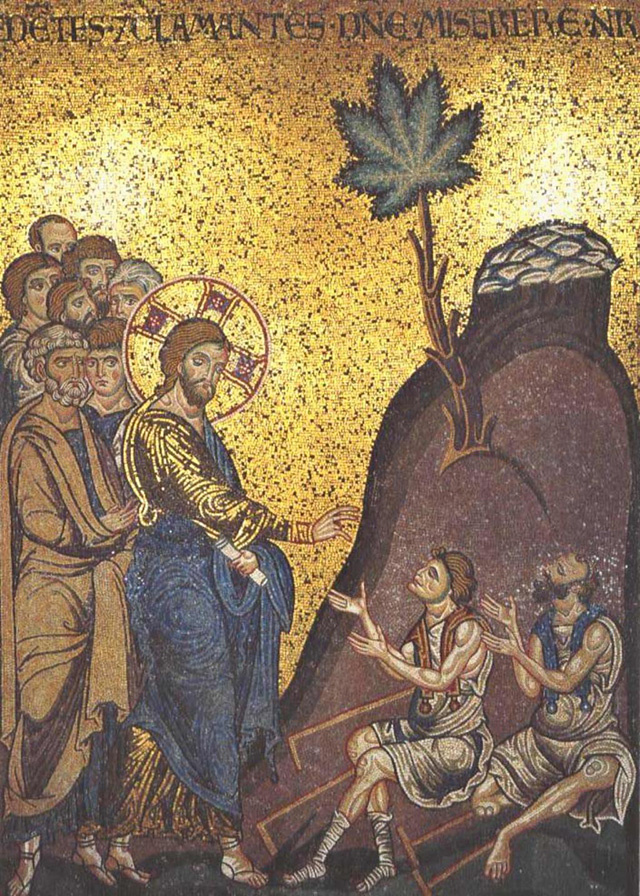
Jesus Healing the Blind From 12th Century Basilica Catedrale di Santa Maria Nouva di Monreale in Sicily.

Matthew 14: 34-36

Parallels Mark 6: 53-56

34 When they had crossed over, they came to land at Gennesaret. 35 After the people of that place recognized him, they sent word throughout the region and brought all who were sick to him, 36 and begged him that they might touch even the fringe of his cloak; and all who touched it were healed.

This short little transition may not seem to add much to Matthew’s narration, but Matthew (like most ancient writers) does not waste words. Even small additions to the narrative can point to important links and serve a structural point in oral storytelling. Matthew follows the pattern of Mark’s narration and slightly reduces the length of Mark’s narration, but Matthew’s decision to keep these transitional stories of healing is revealing.

The reformer Philip Melanchthon famously said, “To know Christ is to know his benefits.” As we compare this scene in Matthew to others in the gospel, I think this is a helpful frame to see some of the structure that underlays Matthew’s narration. At the end of the previous chapter (13: 54-58) the people of Jesus’ hometown knew Jesus’ family but they were unable to accept the wisdom he brought or to have faith in his ability to bring God’s kingdom to them and there were very few healings done there. In contrast in Gennesaret, which is close to Capernaum where Jesus has done many acts of power, the people come and they send word to the neighboring places to bring the ones who need healing. These demonstrations of the power of Jesus play an important part of understanding who Jesus is and a receptiveness to these acts point to the nature of faith and prepare the disciple to hear Jesus’ teaching. Matthew used a scene of healing many to prepare the reader to hear the Sermon on the Mount, (4: 23-25) and a description of the healing serves as an demonstration to John the Baptist’s disciples sent to inquire if Jesus is the one they are expecting. (11: 4-6) The neglecting of these demonstrations of power by Chorazin, Bethsaida and Capernaum have placed themselves below Tyre, Sidon and Gomorrah in the coming judgment (11: 20-24). The two other brief insertions of healing are both preceded by a miracle for an outsider (the healing of the Centurion’s servant/child before 8:14-17 and the healing of the Canaanite woman’s daughter prior to 15: 29-31—both possessing faith not seen in Israel). Structurally both this passage and 15: 29-31 are also bracketed by feeding miracles which also highlight Matthew’s organization (and by extension Mark’s organization since they share the structure of these chapters). One additional linkage that Matthew highlights is the healing of the woman with the flow of blood (9:20-22) who touches the fringe of his garment and hears that ‘her faith has made you well.’

These short readings highlight one of the primary ways that Matthew’s gospel wants us to understand what faith in Jesus looks like. Faith is an openness to the kingdom of heaven’s power at work in Christ, and to amend slightly Melanchthon’s wording: to know Christ is to remain open to his benefits or works. The crowd at Nazareth knows Christ primarily according to his family and are not open to his wisdom or works, the Pharisees, the scribes and soon the Sadducees in the narrative will judge Jesus’ works by their expectation of what the works should be, but those of faith are open to the works as they appear. They

trust that even the fringe of his garment, if touched, can heal/save (the Greek sozo translated healing means both) them completely.


Fortune

The Prophet (nogard86 at deviantart.com)

Fortune

Ascend all you augurs and astrologers in agony but not antipathy
Beings banished at the behest of barons and bureaucrats beyond
Chance the chanting of your cadence clear into crystalline caves
Divining the design of destiny; you dabble and daub and deliberate
Echoing Elohim or Eros or the Ennead, earth and energy enervated
Fulfilled filter for future fortunes, fool fount of the fates
Grasping for grace, grappling with gods;griping, grousing gazer
Haruspex of Helen, hold hard the heel of Hermes, ye harbingers of hell
Inspiration or Justification, Karma or Kairos come at last
Magus, medium, medicine man, necromancer, obfuscator, ovate
Plundered prophet promising to prevail in profusely promulgated prayer
Recalling in a rasp revelation released or read rapturously
Scanned in the stars as you stand, stumbled upon softly is the surge of sea
Totem trying to thrive, timing the turning of the tarot or tea leaves
Universal venture of wanting, ye xenophiles yearning for zen

This was a challenge for the Common Language Project: had to be less than thirty lines and use the following thirty words without change to tense or form: agony, ascend, behest, cadence, chance, clear, crystalline, daub, design, destiny, echoing, filter, fool, fulfilled, grace, heel, last, plundered, prevail, rasp, revelation, scanned, stand, stumbled, surge, thrive, timing, totem, trying and venture. An enjoyable afternoon challenge.

Matthew 14: 22-33 Little Faith One

Extract of Herbert Boeckl’s fresco “Saint Peter’s rescue from the Lake Galilee” inside the cathedral of Maria Sall, Carinthia, Austria

Matthew 14: 22-33

Parallels Mark 6: 45-52; John 6: 16-21

22 Immediately he made the disciples get into the boat and go on ahead to the other side, while he dismissed the crowds. 23 And after he had dismissed the crowds, he went up the mountain by himself to pray. When evening came, he was there alone, 24 but by this time the boat, battered by the waves, was far from the land, for the wind was against them. 25 And early in the morning he came walking toward them on the sea. 26 But when the disciples saw him walking on the sea, they were terrified, saying, “It is a ghost!” And they cried out in fear. 27 But immediately Jesus spoke to them and said, “Take heart, it is I; do not be afraid.”

28 Peter answered him, “Lord, if it is you, command me to come to you on the water.” 29 He said, “Come.” So Peter got out of the boat, started walking on the water, and came toward Jesus. 30 But when he noticed the strong wind, he became frightened, and beginning to sink, he cried out, “Lord, save me!” 31 Jesus immediately reached out his hand and caught him, saying to him, “You of little faith, why did you doubt?” 32 When they got into the boat, the wind ceased. 33 And those in the boat worshiped him, saying, “Truly you are the Son of God.”

This is the story within Matthew that initiated some of my questions about the way that Matthew’s gospel had been translated and interpreted. This well known story with Matthew’s unique addition of Peter coming to Jesus upon the water is a common image on stained glass windows and paintings in churches, and while it is often an image of hope: of Jesus who rescues those sinking in the stormy waters. Yet, it also is often paired with a condemnation of Peter who doubts in the face of the strong wind. I never anticipated my discomfort with the traditional translation of ‘you of little faith’ in this scene becoming this project which became a much larger examination of the gospel as a whole and its history of interpretation, but often one question leads to many others.

Normally when Matthew takes a story present in Mark (assuming Mark as the first of the gospels written) he shortens it to quickly move us to the instruction by Jesus, which comprises many of the additions in Matthew’s gospel, but here Matthew adds and entire scene of Peter getting out of the boat and coming to Jesus. One of the things to pay attention to when there are parallel narrations of an event is the places where an author introduces new or unique elements because they often give critical insights into what the gospel writer wants to express about who Jesus is and the nature of following him. Matthew has structurally placed this narrative in roughly the middle of the gospel and almost doubled the length that Mark (and John) dedicate to this story. It is also worth remembering that this is the second time Jesus has done the incredible upon the sea and there are unique aspects in both stories in Matthew’s careful narration that invite us to hear this story and the story of Jesus calming the storm in Matthew 8: 23-27 together.

Jesus compels the disciples to get into the boat, presumably a boat owned by one of the disciples, and after the feeding of the 5,000 remains to dismiss the crowds. The Greek enagkasen is more forceful than the NRSV’s translation of ‘made’, Jesus compels or forces the disciples to embark on the boat and sends them on their own into the waters to travel to the other side while he dismisses the crowds. Jesus goes up a mountain to be alone in prayer, but in this time the situation of those on the boat changes. The disciples in Matthew 8: 23-27 felt alone in the midst of the storm while Jesus slept, but now they are isolated from Jesus as the wind become hostile towards them and the boat is tormented under the waves. The wind and waves become, in the narration, active entities working against the disciples on the sea and from evening until the fourth watch of night, traditionally 3 am-6 am, the disciples struggle on their own against the elements. I think it is helpful to notice in this narration that there is a significant time of struggle for the disciples and it takes time for Jesus to move from the mountain where he is praying to the shore and across the many stadia (great distance in the NRSV) that the disciples are out upon the sea.

In Mark’s narration of this story Jesus intends to pass the disciples by, which may be an allusion to God passing by Moses to reveal who he is, but Matthew removes this highlighting the destination of Jesus being these ones on the boat. There are plenty of hints that Matthew shares with Mark, and some unique to Matthew, that point to the identity of Jesus, but Matthew has the boat squarely in Jesus direction of movement as the disciple see him approaching. In the midst of struggling against the wind and waves for hours and seeing what they perceive is a phantom or a ghost (Greek phantasma) their response is to cry out in fear. Jesus’ response to ‘be of good courage, I am, fear not’ is crafted to again alert the reader that more is happening than meets the eye. The initial command to ‘be of good courage’ or ‘take heart’ is a normal response to the cry of fear, but the next two statements are theologically rich. I am (NRSV it is I) is the same language that John’s gospel uses in all the I am sayings (I am the bread of life, I am the good shepherd, I am the way, the truth, and the life, etc.)  and Jesus declaration that ‘I am’ in John 18: 6 causes the soldiers step back and fall to the ground when arresting Jesus. The phrase ‘I am’ recalls the name of God in Exodus 3:14 and while it can simply be the first person pronoun with the being verb in normal speech, in scriptures this frequently causes the hearer to ask about the person’s relationship to the LORD the God of Israel. In addition, this linked with the command ‘Fear not’ or as it is commonly rendered ‘do not be afraid’[1] is also commonly associated with a divine message either from an angel or directly from God.  As we wondered in Matthew 8, ‘what sort of man is this?’ we are now again directed to wonder about the identity of the one approaching his disciples upon the water. The wind and the waves are unable to prevent this one who proclaims ‘I am, fear not’ from approaching.

Matthew is the only gospel who includes the story of Peter approaching Jesus on the water, and this is where Peter begins to stand out among the disciples and be a major actor in the narrative. In the coming chapters Peter will become the one out of the twelve who speaks and acts in answer to Jesus questions and will become the one who represents in many ways the community. Peter moves down from the boat and towards Jesus upon the water, but he sees the strong wind which has been against the boat and he begins to sink. The word translated sink (Greek katapontizesthai) can also mean drown, so Peter in this narrative is experiencing true peril in the midst of his fear as he cries out “Lord, save me.” Just as the disciples in Matthew 8 cried out ‘Lord save us’ as they were in the windstorm on the sea, now Peter echoes this rich phrase with resonance between Israel and the people of God (see comments on 8:25) to Jesus as he finds himself overwhelmed by the wind, waves and water. Immediately Jesus responds by extending his hand and taking hold of him.

This is the third of five uses of oligopistos (NRSV ‘you of little faith’) in Matthew’s gospel, a phrase always used in relation to those following Jesus. Rendering this term ‘you of little faith’ while correct adds a negative connotation that doesn’t need to be there (try saying ‘you of little faith’ without it sounding judgmental) and I do believe that ‘little faith one’ is a better translation. Jesus in this narrative has moved directly toward the boat, told the disciples to be of good courage because of his presence, and told Peter to come to him in the midst of the wind and waves. I know I am pushing against the interpretive tradition of this phrase, but I do believe that Jesus is fond of his ‘little faith ones’ and in this particular story of Peter. Instead of castigating Peter for experiencing doubt, perhaps he is reassuring Peter (and ‘little faith ones’ throughout the ages) that he indeed is ‘God with us’ in the midst of the storm. This is reinforced by the use of the word diatazo here which is only used one other time in Matthew’s gospel, on the mountain in Galilee after the resurrection where the disciples doubt is paired with the encouragement “I am with you always, to the end of the age.”[2] Like the disciples on the mountain, who even in their doubt worship, so the disciples here worship saying “You are the Son of God.” As I mentioned when discussing the Son of’ titles for Jesus the Son of God title has relationship to the identity of Jesus being the Davidic King, but Matthew also pushes the boundaries of that title to include something greater in relation to the God of Israel. For Matthew, Jesus is one who is worthy of worship by the disciples, like the God of Israel.[3] The wind and the waves which threaten the disciples are stopped by his presence and we are invited beyond the wondering of ‘what sort of man is this’ the disciples voiced when Jesus calmed the storm before to the stance of worship this one who meets his little faith ones in their doubts and trouble and saves them.

[1] Anna Case-Winters notes that this is the fourth of seven significant texts with the message “do not be afraid” (1:20; 8:26; 10: 31; 14: 27; 17: 7; 28:5; 28:10). Note that all of these except 10:31 are in some manner a theophany (angel of the Lord appearing to Joseph in a dream, the two water narratives, the transfiguration and the resurrection. (Case-Winters, 2015, p. 194)

[2] Matthew 21: 21 in the NRSV “if you have faith and do not doubt” is the other place doubt occurs in English in the gospel, but the Greek word behind it is different: diakrino

[3] This is reinforced when you realize that Matthew uses proskuneo (to prostrate, worship) more than Mark and Luke combined and when you look at the thirteen times it is used (The Magi ‘paying homage’ 2:2, 8, 11; the women and disciples at the resurrection worshipping Jesus 28: 9, 17 and the temptation narrative where ultimately instead of worshipping Satan, Jesus quotes Deuteronomy 6:13 where one is to worship the Lord only. (Hays, 2016, p. 396 n. 52)

Matthew 14: 13-21 Bread in the Wilderness

Mosaic at the Church of the Multiplication of the Loaves and Fishes at Tabgha near the Sea of Galilee

Matthew 14: 13-21

Parallels: Mark 6: 32-44; Luke 9: 10b-17; John 6: 1-15

13 Now when Jesus heard this, he withdrew from there in a boat to a deserted place by himself. But when the crowds heard it, they followed him on foot from the towns. 14 When he went ashore, he saw a great crowd; and he had compassion for them and cured their sick. 15 When it was evening, the disciples came to him and said, “This is a deserted place, and the hour is now late; send the crowds away so that they may go into the villages and buy food for themselves.” 16 Jesus said to them, “They need not go away; you give them something to eat.” 17 They replied, “We have nothing here but five loaves and two fish.” 18 And he said, “Bring them here to me.” 19 Then he ordered the crowds to sit down on the grass. Taking the five loaves and the two fish, he looked up to heaven, and blessed and broke the loaves, and gave them to the disciples, and the disciples gave them to the crowds. 20 And all ate and were filled; and they took up what was left over of the broken pieces, twelve baskets full. 21 And those who ate were about five thousand men, besides women and children.

The rejection in Nazareth and the death of John the Baptist puts both Jesus and the crowds in motion and they both arrive in the wilderness. Jesus and his disciples get into a boat and come to an uninhabited place along the sea, and the crowds abandon the towns to follow him on foot. Matthew shortened version of this story (if Mark’s narration is the original) continues to invite the followers of Jesus to reflect upon his identity by echoing other portions of both Matthew’s narration of Jesus’ life and scriptures. The feeding of the five thousand men, plus women and children, is unique among the miracle stories of Jesus because it is the only one included in all four gospel accounts.

The wilderness was where John the Baptist began his story, where Jesus was baptized and where Jesus was tempted. People once came into the wilderness to see John the Baptist instead of Herod (see comments on 11: 7-15), but now the come seeking Jesus. Jesus has compassion on this large crowd and begins to heal those who are sick. Matthew drops Mark’s allusion to Ezekiel 34 where the crowd is like sheep without a shepherd, but the contrast with the compassion Jesus shows towards the crowd and the fear Herod Antipas shows highlights the contrast in relations between these ‘kings of Israel.’ Matthew also drops the teaching of the crowds, but since Jesus teaching the crowds in parables comprises the previous chapter this is not necessary to Matthew’s narration. Now in the absence of John the Baptist and instead of Herod Antipas, the large crowd journeys over land to meet Jesus in this wilderness place.

The defining story of the Hebrew people is the Exodus and central to the people’s journey through the wilderness is the provision of bread by God on that journey. In this wilderness the people are now fed by Jesus, he becomes the one who makes an excessive amount of bread in the wilderness. Like the woman who folded the yeast into three measures of flour (13: 33) he prepares a feast to this great crowd. This story also resonates with the final meal that Jesus will share with his disciples where again he will bless and break bread to be distributed (26:26-30). Matthew, following Mark’s structure, will have Jesus do two feedings of large crowds in the wilderness. (15: 32-39) In both feeding stories the disciples of Jesus in addition to distributing the bread are also invited to wonder about the one who can provide an abundant feast where all are satisfied in a wilderness place. Like God providing for the people in the Exodus or promising a great feast on the mountain of the Lord (Isaiah 25: 6-9) we are invited to consider who Jesus is in relation to God. He is more than a prophet like John the Baptist and more than a king like Herod even if those in his homeland cannot recognize it.

The Air is Heavy


The air is heavy as it fills my lungs with its leaden weight
For in this springtime of the year in addition to the pollen,
The heavy perfume of the earth reawakening from its slumber
The emergence of wildflowers and bees and leave on the trees
Comes the weight of our fears over the death of the world we know
While the rest of creation emerges from its wintry hibernation
We confine ourselves to our modern caves repaying sabbaths missed
While the bird songs fill the morning light, we sing a dirge
Like children caught between dance and death we are unsatisfied
And we grieve the world transformed in ways we didn’t forsee

The air is heavy as the alveoli slowly force it back into the sky above
Breathing out the pain and the sadness, the life and the death
As each lobe automatically works to push the moist carbon dioxide
Through the bronchi and trachea to be expelled out of the mouth
Carrying on its respiration a heavy prayer for some lighter air
When we gathered in great numbers to sing and dance and jump
Sitting at the banquet table eating rich food and drinking well aged wine
Eating the marrow of life and drinking the wine strained clear
Never thinking that death could swallow this up so quickly
And the shroud would lie over so many people from so many nations

The air that bears the unweighable virus can seem so heavy
As we try to launch our saline filled cries up into the heavens
Waiting behind the high fortifications of our walls for the day
When we can open the gates in joyous celebration and lightness
For the air is no longer heavy and we can breathe freely again
For the shroud has been removed and death is swallowed up
And prayers are finally answered as tears are wiped away
The city’s life which has been placed in a coma awakens
As our lungs fill with the warm but lighter air of summer

Matthew 14: 1-12 The Death of John the Baptist

By Jean Benner – [1], Public Domain, https://commons.wikimedia.org/w/index.php?curid=23152785

Matthew 14: 1-12

Parallel Mark 6: 14-29; Luke 9: 7-9

1 At that time Herod the ruler heard reports about Jesus; 2 and he said to his servants, “This is John the Baptist; he has been raised from the dead, and for this reason these powers are at work in him.” 3 For Herod had arrested John, bound him, and put him in prison on account of Herodias, his brother Philip’s wife, 4 because John had been telling him, “It is not lawful for you to have her.” 5 Though Herod wanted to put him to death, he feared the crowd, because they regarded him as a prophet. 6 But when Herod’s birthday came, the daughter of Herodias danced before the company, and she pleased Herod 7 so much that he promised on oath to grant her whatever she might ask. 8 Prompted by her mother, she said, “Give me the head of John the Baptist here on a platter.” 9 The king was grieved, yet out of regard for his oaths and for the guests, he commanded it to be given; 10 he sent and had John beheaded in the prison. 11 The head was brought on a platter and given to the girl, who brought it to her mother. 12 His disciples came and took the body and buried it; then they went and told Jesus.

Immediately after Jesus is not received in his hometown, Matthew narrates the death of John the Baptist. Herod Antipas may, like his father Herod the Great, want to be the ‘King of the Jews’ but his actions run contrary to the vision expressed in the law for how a king is supposed to be. He also is sharply contrasted with Jesus in the coming narrative: while Herod fears the crowd Jesus has compassion on them, while the death of one who came ‘neither eating of drinking’ occurs at a feast at Herod’s birthday party, Jesus will provide a banquet in the deserted place for thousands. This story of sex, intrigue and power demonstrates the nature of the kingdom of rulers like Herod. The kingdom that Jesus and John pointed to is an alternative to this Herodian tragedy.

Herod Antipas is the tetrarch, he ruled a quarter of his father’s former kingdom including Galilee. His brother Herod II, also known as Herod Philip, was the husband of Herodias not to be confused with Philip II the ruler of Trachonitis. We learned in Matthew 11:2 that John the Baptist was in prison and now we hear the reason that Herod Antipas took notice of this prophet. The divorce of Herod II and Herodias is also mentioned in Josephus and we know that eventually Herod Antipas married Herodias, but their marriage would have been a scandal among the people of Galilee. Unfortunately, rulers often feel above the law that their followers adhere to. Jesus will speak against divorce multiple times in Matthew and, like John, he wouldn’t have endorsed a brother marrying his brother’s wife serving as the king of the region where Jesus’ ministry begins.

Rulers making wild declarations which have lasting consequences are common characters throughout the bible and these rulers are bound by their words. Herod makes Herodias’ daughter a promise to give her what she asks for. Generations earlier Esther when given a similar opportunity by King Ahaseurus uses the opportunity to save the people and to bring about the death of Haman, the enemy of her people (Esther 5:3, Mark’s parallel telling of this uses identical language in Herod’s and Ahaseurus’ promises) but here the daughter of Herodias asks only for the death of the prophet. Herod Antipas is bound by his rash promise and the presence of those reclining at the table with him.

Herod expresses a belief that John the Baptist has been raised from the dead to his children (NRSV renders the word servants), which points to an understanding of the resurrection of the righteous which would have been an idea shared by the Pharisees and the followers of Jesus. I don’t believe that Herod Antipas would’ve considered himself a Pharisee, but he probably had enough in common with them for them to work together when it served their interests. This may lie behind the collaboration between Pharisees and Herodians in 22:16.

Matthew shortens Mark’s narration of the death of John the Baptist’s, but it does serve  important functions in Matthew’s narration of Jesus’ ministry. By coming immediately after the rejection in Jesus’ hometown it demonstrates the resistance to the kingdom of heaven and the cost that prophets and messiahs will pay. It also ends John the Baptist’s role in the story. In Matthew, Jesus and John share identical language in their proclamation but have different roles. Yet, we also will hear others understand Jesus in terms of John the Baptist (16:14). John’s disciples have come to Jesus before, and now they come to Jesus a final time with the news of John’s death, which sets Jesus in motion. Jesus will withdraw to a deserted place, perhaps to grieve and perhaps to avoid Herod Antipas. Herod will stay at his celebration with those who have seen Herodias’ daughter dance and John the Baptist beheaded with the crowds outside. Jesus in going to the deserted place will find the crowds coming and seeking him like sheep without a shepherd, or at least without a good shepherd.

Matthew 13: 54-58 Rejecting Wisdom

By Meister der Kahriye-Cami-Kirche in Istanbul – The Yorck Project (2002) 10.000 Meisterwerke der Malerei (DVD-ROM), distributed by DIRECTMEDIA Publishing GmbH. ISBN: 3936122202., Public Domain, https://commons.wikimedia.org/w/index.php?curid=155126

Matthew 13: 54-58

Parallels Mark 6: 1-6a; Luke 4: 16-30

54 He came to his hometown and began to teach the people in their synagogue, so that they were astounded and said, “Where did this man get this wisdom and these deeds of power? 55 Is not this the carpenter’s son? Is not his mother called Mary? And are not his brothers James and Joseph and Simon and Judas? 56 And are not all his sisters with us? Where then did this man get all this?” 57 And they took offense at him. But Jesus said to them, “Prophets are not without honor except in their own country and in their own house.” 58 And he did not do many deeds of power there, because of their unbelief.

The rejection of Jesus by those in his hometown or country (Greek patrida literally fatherland is behind both words in this narrative) fits within the overall flow of the gospel of Matthew’s structure which existed prior to the chapter divisions and this short narrative of the rejection in Nazareth combined with the death of John the Baptist set the stage for the next group of stories of Jesus’ power and reflections on faith. Throughout the parables we have been warned that many will not have ears to hear, eyes to see or hearts to understand. For the people of Jesus’ hometown familiarity with the relations of Jesus becomes the ‘stumbling block’ or ‘scandal’ (Greek skandalizo) which makes them unable to receive the wisdom that Jesus offers them, presumably in parables.

Earlier in response to the crowd, notably after the disciples of John the Baptist come to him. Jesus would say, “Yet wisdom is vinidicated by her deeds.” (11:19) Now the ones in his hometown recognize both wisdom and the deeds of power, and yet they are unable to receive him. Their unbelief (literally unfaith or lack of faith) it not due to the lack of justification for faith, the wisdom and deeds of power are known and demonstrated even here. There may not be a large number of deeds of power where ‘all the sick’ will be healed as in other places but that is because their lack of faith. As I argued in talking about faith in Matthew’s gospel, faith is an openness or awareness to what God is doing in the world through the presence of Jesus. They are in a synagogue, they can perceive the wisdom and even the deeds of power, but they are unable to connect those realities to the kingdom of heaven’s presence in this one whose father was a laborer (we may associate carpenters with craftsmen, but in this time the Greek tekton is merely a builder/laborer) whose mother and brothers they can name and whose sisters are known among them.

There may be many reasons that people reject wisdom, many stumbling blocks that can cause them to fall, but this is still a world in which the harvest will occur. The seed may fall on the path, or the rocky soil or among the thorns but the sower continues to sow. The weeds and the wheat will grow up together, the mustard seed is sown among the massive field, and the yeast is hidden among the three measures of flour. One discovers a treasure, one a pearl of surpassing value, others good and bad fish that need to be sorted. Yet, even in the midst of no faith Jesus is still able to do something according to Matthew. In a change from Mark’s language where the lack of faith in his hometown makes Jesus unable to do any deeds of power (except for healing a few sick people), in Matthew’s gospel Jesus doesn’t do deeds of power there and the reason is ambiguous. Perhaps it is by choice, why do deeds of power where hearts cannot understand, eyes cannot see and ears cannot hear, perhaps their lack of openness to the kingdom creates a resistance to God’s activity in that place. Regardless there are other fields to tend to and so Jesus and his disciples go where the people are ready to be fed.

Video Reflection 5: On Creativity

1 Corinthians 12: 4-13

4 Now there are varieties of gifts, but the same Spirit; 5 and there are varieties of services, but the same Lord; 6 and there are varieties of activities, but it is the same God who activates all of them in everyone. 7 To each is given the manifestation of the Spirit for the common good. 8 To one is given through the Spirit the utterance of wisdom, and to another the utterance of knowledge according to the same Spirit, 9 to another faith by the same Spirit, to another gifts of healing by the one Spirit, 10 to another the working of miracles, to another prophecy, to another the discernment of spirits, to another various kinds of tongues, to another the interpretation of tongues. 11 All these are activated by one and the same Spirit, who allots to each one individually just as the Spirit chooses. 12 For just as the body is one and has many members, and all the members of the body, though many, are one body, so it is with Christ. 13 For in the one Spirit we were all baptized into one body — Jews or Greeks, slaves or free — and we were all made to drink of one Spirit.

As I was thinking about what we needed in a time like this I started reflecting about the role I’ve tried to play as a leader of this community and what attributes I try to model as a leader, and although I’m not one who normally goes for catch phrases what I ended up with were my 5 c’s: Calm, Centered, Connected, Creativity and its cousin Curiousity. Apologies for the alliteration but I do try to remain calm in times of crisis, and I’ve walked through some in my times as a leader as an adult. I try to remain centered in the things that ground me, my faith, my love of scripture, the people I love. I try to remain connected with the people I am gifted to serve however I can to the best of my ability, while still taking times to rest and care for myself. But I want to focus on these last two today: Creativity and its cousin Curiosity.

I’ve had a fascination with creativity and curiosity for years and I’m thankful for some of the places it has led me in my life. I can talk about this for a long time, but some quick reflections today:

  • Some of us may be at the point where we are growing bored (or maybe we’ve been bored for days now). The good news is that this can be a place where curiosity and creativity can play. When we are constantly busy it is hard for us to get curious about something, to invest the time and resources it takes to be creative. Also crises can be a place where necessity forces us to consider new and creative ways of doing things.
  • Creativity is scary, vulnerable and full of terrifying firsts. It was terrifying when I started writing, when I started recording video (especially since I’m self-conscious about how I look in pictures and video), Elizabeth Gilbert gives a lot of reasons not to be creative, which I’ll read (if you want all the reasons see the video) but ultimately it is scary, scary, scary
  • Creativity looks different in different people. My medium is words, Adam has a great eye for photography. Maybe you organize things or paint or skate or dance, or who knows what the gift God’s spirit has placed within you. Jack Gilbert, the poet reportedly once told a student in one of his classes, “Do you have the courage? Do you have the courage to bring forth this work? The treasures that are hidden within you are hoping you will say yes.”Elizabeth Gilbert, Big Magic, 7
  • “I believe this is one of the oldest and most generous tricks the universe plays on us human beings, both for its own amusement and ours: The universe buried strange jewels deep within us all, and then stands back to see if we can find them.” Big Magic, 8

I’m going to close today with a poem that I wrote years ago, but that still is one of my favorites of these gifts I never knew was buried inside me, it’s a poem called Creative Words (click on the title to link to the poem)


Video Reflection 4: On Prayer during this time of Social Distancing

Psalm 5: 1-3, 11-12
Give ear to my words, O LORD; give heed to my sighing.
2 Listen to the sound of my cry, my King and my God, for to you I pray.
3 O LORD, in the morning you hear my voice; in the morning I plead my case to you, and watch.

11 But let all who take refuge in you rejoice; let them ever sing for joy. Spread your protection over them, so that those who love your name may exult in you.
12 For you bless the righteous, O LORD; you cover them with favor as with a shield.

Matthew 6: 6-13
6 But whenever you pray, go into your room and shut the door and pray to your Father who is in secret; and your Father who sees in secret will reward you. 7 “When you are praying, do not heap up empty phrases as the Gentiles do; for they think that they will be heard because of their many words. 8 Do not be like them, for your Father knows what you need before you ask him.
9 “Pray then in this way: Our Father in heaven, hallowed be your name. 10 Your kingdom come. Your will be done, on earth as it is in heaven. 11 Give us this day our daily bread. 12 And forgive us our debts, as we also have forgiven our debtors. 13 And do not bring us to the time of trial, but rescue us from the evil one.

Romans 8: 26-27
26 Likewise the Spirit helps us in our weakness; for we do not know how to pray as we ought, but that very Spirit intercedes with sighs too deep for words. 27 And God, who searches the heart, knows what is the mind of the Spirit, because the Spirit intercedes for the saints according to the will of God.

Reflection
Today I want to give you some resources for prayer. There is not an incorrect way to pray, God knows the needs of our hearts before we voice them, but sometimes it helps to have some resources to give words to our prayers. Sometimes there are portions of scriptures like the Psalms, or the Lord’s Prayer that can help us. But here are some other prayers for this time:
The first one come from our hymnal, Evangelical Lutheran Worship on p. 76

O God, where hearts are fearful and constricted, grant courage and hope. Where anxiety is infectious and widening, grant peace and reassurance. Where impossibilities close every door and window, grant imagination and resistance. Where distrust twists our thinking, grant healing and illumination. Where spirits are daunted and weakened, grant soaring wings and strengthened dreams. All these things we ask in the name of Jesus Christ, our Savior and Lord. Amen.

These next prayers come from a little resource that many pastors have that is a supplement to the hymnal called Pastoral Care which has resources and prayers for various situations. While I normally will pray without referencing this, sometimes it is helpful to have prayers for various situations. Here are a few:
Prayer to be recited with a child who is anxious:

Gentle Jesus, stay beside me through this day (night). Take away my pain. Keep me safe. Help me when I’m afraid. Make my body strong again and my heart glad. Thank you for your love that surrounds me.

Another couple prayers which are written for morning but can be adapted for any time of day:

O God, you have called your servants to ventures of which we cannot see the ending, paths as yet untrodden, through perils unknown. Give us faith to go out with good courage, not knowing where to go, but only that your hand is leading us and your love supporting us, through Jesus Christ our Lord. Amen.

We give you thanks to you, heavenly Father, through Jesus Christ your dear Son, that you have protected us through the night from all harm and danger. We ask that you would also protect us today from sin and all evil, so that our life and actions may please you. Into your hands we commend ourselves: our bodies, our souls, and all that is ours. Let your holy angels be with us, so that the wicked for may have no power over us.

Praying for those who are caregivers in this time:

Holy and compassionate God, you send to us in our need those who care for us and look out for our lives. Bless them in their love for us. Bless the hands of those who work for our health. Bless the minds of those who search for our healing. Bless the feet of those who come to us in our need. Bless the eyes of those who look after us. Bless the hearts of all who serve; fill them with compassion and patience; and work through all of them for the betterment and well-being of all your children, through Jesus Christ our Lord.

Merciful God, your healing power is everywhere about us. Strengthen those who work among the sick; give them courage and confidence in all they do. Encourage them when they are overwhelmed with many pressing needs or when their efforts seem futile. Increase their trust in your power to bring life and wholeness even in the midst of death and pain and crying. May they be thankful for every sign of health you give, and humble before the mystery of your healing grace; through Jesus Christ our Lord.

Tears and Gears

By Tangopaso – Own work, Public Domain, https://commons.wikimedia.org/w/index.php?curid=16753688


As the gears of the machine we’ve wired ourselves into grinds to a screeching halt
This system which was fueled by sweat and creativity and occasionally lubricated by blood
Whose thrums and hums we’ve synched the rhythm of our lives and thoughts to
And we find ourselves in this forced sabbatical as time seems to slow to a crawl
And the machine which daily accepted our offerings closes its gaping maw
Perhaps we wonder if we were merely a parasite on this clunking monstrosity
Maybe we might discover that we were engaged in a symbiotic relationship
Or we may perceive that the machine was slowly but steadily feeding on us
That the lifeblood it gave was more precious than the benefits it provided
And we were merely living batteries tied into the matrix that we powered

The machine is down for maintenance and perhaps we are as well
And when it restarts, which will inexorably occur when this pause ends
What will the relationship between our tears and its gears be?
Will we give our blood and sweat so willingly, be wired in so completely?
Will it be lifegiving to synch our energies to the beat of its mechanical heart?
Or will our relationship change, will the machine change, will we?
What will this unscheduled maintenance for both mean for we and it?
May this forced sabbatical allow us time to listen to the rhythm of our souls
The beat of our own heart, the feelings of our mind, and the language of our body