Author Archives: Neil

Video reflection 3: Caring for Ourselves and Others

Romans 12: 14-21

14 Bless those who persecute you; bless and do not curse them. 15 Rejoice with those who rejoice, weep with those who weep. 16 Live in harmony with one another; do not be haughty, but associate with the lowly; do not claim to be wiser than you are. 17 Do not repay anyone evil for evil, but take thought for what is noble in the sight of all. 18 If it is possible, so far as it depends on you, live peaceably with all. 19 Beloved, never avenge yourselves, but leave room for the wrath of God; for it is written, “Vengeance is mine, I will repay, says the Lord.” 20 No, “if your enemies are hungry, feed them; if they are thirsty, give them something to drink; for by doing this you will heap burning coals on their heads.” 21 Do not be overcome by evil, but overcome evil with good.

Psalm 133

1 How very good and pleasant it is when kindred live together in unity!

2 It is like the precious oil on the head, running down upon the beard, on the beard of Aaron, running down over the collar of his robes.

3 It is like the dew of Hermon, which falls on the mountains of Zion. For there the LORD ordained his blessing, life forevermore.


It is Thursday of the first full week of physical distancing, and I know that life has changed around us. Perhaps you have kids who are home from school for a second week in a row with nowhere to go, perhaps you are going a little bit stir crazy, perhaps tempers or anxiety sometimes gets the better of you.  I want to give the opportunity to pause and think about how we care for ourselves in this time, and how we might care for one another when we can’t be physically close.

A friendly reminder that you need to care for yourself, if you are an introvert take some time to read or watch TV or play a video game to recharge your batteries if you are locked in a house with others. If you are an extrovert, this time may be hard on your but reach out to friend through phone or skype, schedule times to get out of the house when weather permits. I do think that for several weeks our lives are going to be interrupted, so if you have to stay home try to schedule times to do things that are life giving.

Don’t obsess over the news or the stock market, I’m not saying not to stay informed but don’t spend your day looking at a screen which is giving you bad news all the time. I know there is grieving in this time about the way things are changed, and that is ok. If you are like me you have plans that were made and now have changed.

If only kindred could only live together in unity all the time or we could always live in harmony but have patience with one another. Nobody has lived through something like this for a long time.

A couple new notes: with the libraries closing we do have a couple opportunities at the church. If you need access to a computer, office space or wi-fi we can make one of our classrooms available for a workspace (Monday-Thursday). Please contact the office for availability. Also one of our library volunteers brought in a shelf of books that are from the public library for various age ranges which if you need reading material are available.

Grey Days

There was a time when the rain fell softly every day
When the cool dampness soaked beyond flesh and bone
And the cold water dimmed the fire of my soul
While the earth around me seemed to drink in the drops
Bursting forth into forests of deep green that blocked out the sun
I am a creature of the sun baked plains and the heat of summer
And the life in the forest made the air too heavy to breathe
Now I’ve returned to my natural habitat, to the place where I can thrive
Perhaps a place to hot and dry for many but it warms my bones
And in this place the fire of my soul was rekindled and burns brightly
Yet, on those grey days where the thunder rumbles and clouds collect
And the lightning flashes across the sky announcing the coming
Of the large grey drops that drench the earth and flood the plains
For a time I am returned to the dampness of that forested place
And the fire within sputters under the impact of the downpour
But in this place of dust and sun the rains last only for a time
Shortly to be replace by the arid heat and the drying wind
But without the grey days, without the chilling rain and cool wind
The life of the plains shrivels and dies and even the creatures of the sun
Need those times of being soaked soul, flesh and bone
To enjoy the life in the midst of the valley of the sun

Originally published: https://signoftherose.org/2016/12/05/grey-days/

Matthew 13: 44-53 Treasures Old and New

By Brocken Inaglory – Own work, CC BY-SA 3.0, https://commons.wikimedia.org/w/index.php?curid=2655938

Matthew 13: 44-53

44 “The kingdom of heaven is like treasure hidden in a field, which someone found and hid; then in his joy he goes and sells all that he has and buys that field.

45 “Again, the kingdom of heaven is like a merchant in search of fine pearls; 46 on finding one pearl of great value, he went and sold all that he had and bought it.

47 “Again, the kingdom of heaven is like a net that was thrown into the sea and caught fish of every kind; 48 when it was full, they drew it ashore, sat down, and put the good into baskets but threw out the bad. 49 So it will be at the end of the age. The angels will come out and separate the evil from the righteous 50 and throw them into the furnace of fire, where there will be weeping and gnashing of teeth.

51 “Have you understood all this?” They answered, “Yes.” 52 And he said to them, “Therefore every scribe who has been trained for the kingdom of heaven is like the master of a household who brings out of his treasure what is new and what is old.” 53 When Jesus had finished these parables, he left that place.

This final set of three parables with a bonus image wraps up this block of teaching the crowds and disciples in parables. The careful hearer will hear several resonances between these images, which are unique to Matthew’s gospel, and other teachings of Jesus earlier in the gospel. Those who are scribes trained for the kingdom of heaven (literally disciple scribes of the kingdom of heaven) have learned from both the wisdom of scripture and the teaching of Jesus and have a rich storehouse of wisdom to bring forth into their life. As I continue to sit with these images I am aware that many have been unearthing the treasures hidden here for almost 2,000 years but I still find a rich storehouse of treasures waiting the patient seeker.

The first two images contrast with the previous earthy images in the extravagant image that is likened to the kingdom of heaven. The previous images have been very earthy, related to fields and baking, but here we are dealing with the discovery of treasures and pearls. The kingdom of heaven is like a treasure or a storehouse of treasure hidden in a field which compels that person to sell all they have to possess. The image of treasure may remind the attentive disciple to the words of Jesus in Matthew 6: 19-21 about storing up treasures in heaven rather than treasures on earth and about one’s heart being where one’s treasures are or Matthew 19:21 where Jesus in conversation tells a rich young man to sell his possessions to have treasure in heaven. The person in the parable is completely invested in their decision to purchase the field and possess the treasure. They have given up what they have to live on to possess the treasure, and while we might naturally think of this person selling off the treasure to live more abundantly the story ends with the person owning the field, the treasure and nothing else.

In a similar way the image of the person purchasing a pearl of great value takes us into an extravagant image that most of the people in Jesus’ audience couldn’t imagine. There is no undisputed mention of pearls in the Hebrew scriptures (the NRSV translates Job 28: 18 ‘the price of wisdom is above pearls’ but the words translated pearls is the Hebrew p’ninim which means jewels), but Matthew has used the image of casting ‘pearls before swine’ in Matthew 7:6. Pearls are produced by a non-kosher animal but wouldn’t be forbidden to wear by Jewish people, the problem with pearls is at this time they are more valuable than any other ‘fine jewels.’ They were simply unavailable for the average person. They may never see a pearl except in depictions of the very wealthy, much less one of exceeding value. (Levine, 2014, pp. 146-148) In modern settings we normally anticipate a person who is a merchant purchasing something of high value in order to sell it at a high cost, but few of us can imagine risking everything on one high priced item that literally bankrupts us, but the parable again shows no interest in selling the pearl. The person who was a merchant now gives all to possess this pearl of exceeding value that is qualitatively different from any other pearl or gemstone. Both individuals who sell everything desire to possess the discovered treasure and find themselves willing to empty out their storehouses to make space for this one thing.

The third image, which is given with interpretation, returns to the familiar realm of most of the people around Jesus, the image of fishing. The net thrown into the sea is a dragnet, not the small circular net cast into the sea for targeted fishing indicated earlier in the gospel. It is a net pulled behind or between boats gathering everything indiscriminately that is not too small for the net.  Nor does the Greek indicate that it caught fish of every kind, instead it simply says ‘all kinds/races gathered together’ (pantos genous sunagagouse). We may hear the echo of Jesus’ call to Peter and Andrew when he told them he would have them fish for people in Matthew 4: 19 and the explanation of this final parable indicates that it is indeed people instead of fish being sorted. In the explanation the angels are the sorters who gather the good ones into vessels and the bad ones are cast out into the fire. I do believe that Matthew wants us to hear that there is a consequence for failing to be righteous instead of evil, good instead of bad, having one’s hearts and treasures not invested in the approaching kingdom of heaven. Even in their way parables both conceal and reveal they are intended for those with ears to hear to become scribes learning the ways of the kingdom of heaven.

Matthew unearths some of these treasures for us to see and conceals others for those who trained to hear the scriptures of Israel in light of the new reality of the kingdom of heaven’s approach in Jesus. Matthew is trying to train us how to read scripture in the light of Jesus’ teaching and wisdom and give us a map to the storehouse of treasure or the pearl of exceeding value. Scribes trained to marvel at the pearls of wisdom contained in some of these earthy tales of sowing, baking and fishing and to delight in the presence of the kingdom in unexpected ways in the midst of the world. Perhaps that is a part of the reason that patient seekers continue to unearth unexpected treasures in these parables 2,000 years later.

Video Reflection 2 During COVID 19, Body of Christ

Romans 12: 4-13

4 For as in one body we have many members, and not all the members have the same function, 5 so we, who are many, are one body in Christ, and individually we are members one of another. 6 We have gifts that differ according to the grace given to us: prophecy, in proportion to faith; 7 ministry, in ministering; the teacher, in teaching; 8 the exhorter, in exhortation; the giver, in generosity; the leader, in diligence; the compassionate, in cheerfulness.

9 Let love be genuine; hate what is evil, hold fast to what is good; 10 love one another with mutual affection; outdo one another in showing honor. 11 Do not lag in zeal, be ardent in spirit, serve the Lord. 12 Rejoice in hope, be patient in suffering, persevere in prayer. 13 Contribute to the needs of the saints; extend hospitality to strangers.


We are only the body of Christ together, we need one another in this time. We all have different needs and those needs may change as we go through this time.  We are trying to anticipate those needs and I’ve been talking to lot’s of people over the last couple days, but I can use your help.


Today I have a couple very pragmatic and practical things in this reflection. First I’ve attached the directory, and we’ve also placed it online at https://rejoicefrisco.com/Pages/DirectoryUpdate.htm which is under the about us tab at the top of the website. First I’d like you to check your information is correct and if you either don’t have a picture or would like to change your picture you can email a new picture to communications@rejoicefrisco.com. What I’d like you to consider is looking at the people around you in the directory and call, email or text someone you know and someone you don’t know well. Doesn’t need to be much, could be something as simple as “This is Neil (or insert your name), just wanted to let you know I was thinking about you today.” It’s a simple act of staying connected to your brothers and sisters in Christ.


Secondly, I asked Adam to create a link on our website to request or to offer assistance. We don’t know exactly what the next several weeks will bring, but there may be needs that arise in our congregation or in our community. Perhaps someone is close to running out of toilet paper and someone else has a case, perhaps someone needs help with something at their home. The link on our website is https://rejoicefrisco.com/Pages/Assistance.htm and it is one of the rotating links on our main page. Please feel free to share this in the local community. We’ve reached out to a couple local organizations, like schools, but we also wanted to be ready to adjust as we move through this uncharted time.


Being that today is St. Patrick’s day and while people may not be drinking green beer today, we can close today with a prayer attributed to St. Patrick.


St. Patrick’s Prayer


I arise today
Through the strength of heaven;
Light of the sun,
Splendor of fire,
Speed of lightning,
Swiftness of the wind,
Depth of the sea,
Stability of the earth,
Firmness of the rock.

I arise today
Through God’s strength to pilot me;
God’s might to uphold me,
God’s wisdom to guide me,
God’s eye to look before me,
God’s ear to hear me,
God’s word to speak for me,
God’s hand to guard me,
God’s way to lie before me,
God’s shield to protect me,
God’s hosts to save me
Afar and anear,
Alone or in a multitude.

Christ shield me today
Against wounding
Christ with me, Christ before me, Christ behind me,
Christ in me, Christ beneath me, Christ above me,
Christ on my right, Christ on my left,
Christ when I lie down, Christ when I sit down,
Christ in the heart of everyone who thinks of me,
Christ in the mouth of everyone who speaks of me,
Christ in the eye that sees me,
Christ in the ear that hears me.

I arise today
Through the mighty strength
Of the Lord of creation.

Tomorrow we will broadcast our normal Wednesday night service as our video. I will send out the words and the song that comes from our hymnal but since Joyous Light, the service we use, falls outside our normal copyright license I cannot make the music available. If you’d like to take a copy of the service you can pick one up at church for your use, the building will be open 9-3 today and tomorrow.

My Responsibility to my Neighbor amid Coronavirus, Covid-19

 Psalm 121:1

<A Song of Ascents.>
I lift up my eyes to the hills — from where will my help come?
2 My help comes from the LORD, who made heaven and earth.
3 He will not let your foot be moved; he who keeps you will not slumber.
4 He who keeps Israel will neither slumber nor sleep.
5 The LORD is your keeper; the LORD is your shade at your right hand.
6 The sun shall not strike you by day, nor the moon by night.
7 The LORD will keep you from all evil; he will keep your life.
8 The LORD will keep your going out and your coming in from this time on and forevermore.

So in an attempt to keep some normalcy in the midst of the abnormal situation we find ourselves within I am going to be doing a short update and reflection each day about how my faith helps me understand how I am to respond in the midst of the situation. I’ll share about the plan for this week at the end of this reflection but today I want to talk about my responsibility to my neighbor:

We all know the two great commandments: to love the Lord our God with all our heart, soul, mind and strength and to love our neighbor as ourselves. We trust in God, but we are also called to live responsibly in respect to our neighbors. I’ve seen a lot of things online that are not helpful, where people mock the careful actions of social distancing.

Martin Luther did deal with the issue of a pandemic in his writings. Now the pandemic in the 1500s was Bubonic plague and thankfully we are not facing something as lethal as that was for Europe, but his frame of reference is how we treat our neighbor and our responsibility to our neighbor.

In the same way we must and we owe it to our neighbor to accord him the same treatment in other troubles and perils, also. If his house is on fire, love compels me to run to help him extinguish the flames. If there are enough other people around to put the fire out, I may either go home or remain to help. If he falls into the water or into a pit I dare not turn away but must hurry to help him as best I can. If there are others to do it, I am released. If I see that he is hungry or thirsty, I cannot ignore him but must offer food and drink, not considering whether I would risk impoverishing myself by doing so. A man who will not help or support others unless he can do so without affecting his safety or his property will never help his neighbor Martin Luther’s Basic Theological Writings, 742-743

Others may have seen the following quote from this work circulating over the last couple days, but if you haven’t its worth sharing:

Therefore I shall ask God mercifully to protect us. Then I shall fumigate, help purify the air, administer medicine, and take it. I shall avoid places and persons where my presence is not needed in order not to become contaminated and thus perchance infect and pollute others, and so cause their death as a result of my negligence. If God should wish to take me, he will surely find me and I have done what he has expected of me of others. If my neighbor needs my, however, I shall not avoid place or person but will go freely…See, this is such a God-fearing faith because it is neither brash nor foolhardy and does not tempt God. Martin Luther’s Basic Theological Writings 749

We do what we can to protect ourselves and our neighbor, but if my neighbor has a need a part of our calling as Christians is to respond on our neighbor’s behalf.

I’m always looking for things particularly well said, and I found this poem by Lynn Ungar written at the end of last week profound and beautiful.

Pandemic

What if you thought of it
as the Jews consider the Sabbath—
the most sacred of times?
Cease from travel.
Cease from buying and selling.
Give up, just for now,
on trying to make the world
different than it is.
Sing. Pray. Touch only those
to whom you commit your life.
Center down.

And when your body has become still,
reach out with your heart.
Know that we are connected
in ways that are terrifying and beautiful.
(You could hardly deny it now.)
Know that our lives
are in one another’s hands.
(Surely, that has come clear.)
Do not reach out your hands.
Reach out your heart.
Reach out your words.
Reach out all the tendrils
of compassion that move, invisibly,
where we cannot touch.

Promise this world your love–
for better or for worse,
in sickness and in health,
so long as we all shall live.

–Lynn Ungar 3/11/20

We are all in this together and we are all in this with God where our help comes from

Some updates about things coming this week:
Here is what I am planning for video  discussions:
Monday- My responsibility to my neighbor
Tuesday-Staying connected as community
Wednesday-Our normal Wednesday night Lenten service digital
Thursday-Caring for ourselves and others in this time
Friday-Spiritual practice- Prayer
Sunday-Virtual worship

We also just set up on our website a place where people could ask for items or volunteer items in case of needs as they arrive. We are coordinating with the groups that have used our building and the local schools to see how we can work together to meet the needs at this time.  Not sure how this will evolve but we’ve created a space for this.


Matthew 13: 24-43 Parables of Weeds, Seeds and Leaven

Close up view of Wheat, shared by user Bluemoose on Wiki Commons under Creative Commons 2.0

Matthew 13: 24-43

24 He put before them another parable: “The kingdom of heaven may be compared to someone who sowed good seed in his field; 25 but while everybody was asleep, an enemy came and sowed weeds among the wheat, and then went away. 26 So when the plants came up and bore grain, then the weeds appeared as well. 27 And the slaves of the householder came and said to him, ‘Master, did you not sow good seed in your field? Where, then, did these weeds come from?’ 28 He answered, ‘An enemy has done this.’ The slaves said to him, ‘Then do you want us to go and gather them?’ 29 But he replied, ‘No; for in gathering the weeds you would uproot the wheat along with them. 30 Let both of them grow together until the harvest; and at harvest time I will tell the reapers, Collect the weeds first and bind them in bundles to be burned, but gather the wheat into my barn.'”

31 He put before them another parable: “The kingdom of heaven is like a mustard seed that someone took and sowed in his field; 32 it is the smallest of all the seeds, but when it has grown it is the greatest of shrubs and becomes a tree, so that the birds of the air come and make nests in its branches.”

33 He told them another parable: “The kingdom of heaven is like yeast that a woman took and mixed in with three measures of flour until all of it was leavened.”

34 Jesus told the crowds all these things in parables; without a parable he told them nothing. 35 This was to fulfill what had been spoken through the prophet: “I will open my mouth to speak in parables; I will proclaim what has been hidden from the foundation of the world.”

36 Then he left the crowds and went into the house. And his disciples approached him, saying, “Explain to us the parable of the weeds of the field.” 37 He answered, “The one who sows the good seed is the Son of Man; 38 the field is the world, and the good seed are the children of the kingdom; the weeds are the children of the evil one, 39 and the enemy who sowed them is the devil; the harvest is the end of the age, and the reapers are angels. 40 Just as the weeds are collected and burned up with fire, so will it be at the end of the age. 41 The Son of Man will send his angels, and they will collect out of his kingdom all causes of sin and all evildoers, 42 and they will throw them into the furnace of fire, where there will be weeping and gnashing of teeth. 43 Then the righteous will shine like the sun in the kingdom of their Father. Let anyone with ears listen!

One of the dangers of attempting to interpret parables which are designed both to reveal and to conceal comes with the pinning down the imagery to a meaning. Like a butterfly collector which pins their captures where they can be displayed only to realize the now deceased insect loses the life it once demonstrated, it may still be beautiful but is no longer a dynamic thing. As I have worked through the gospel of Matthew I have attempted to provide a coherent and plausible reading, but the perspective I write from is not the only one and others will and have found other dynamic readings in these verbal portraits of Jesus’ life and teaching. Yet, there are a number of interpretations of both Matthew’s gospel in general and these parables in particular which are not helpful (and may even be toxic) or would not make sense to people in either Jesus’ or Matthew’s audience in the first century middle east. Perhaps these reflections can help us metaphorically see some readings which look like wheat but are really just weeds that occupy the field hiding the fruit of the wheat from us.

It is important to pay attention to structure for clues in how we are to hear these parables and I’ve tried to group these together in ways that make sense to helping us have ears to hear. Matthew likes patterns of three and this is highlighted here by the placement of three parables followed by an explanation of the first parable. Between the three parables and the explanation is another explanation of why Jesus speaks in parables. The joining together of the parables in a group of three points to an interconnection in the imagery and understanding of the stories. Even though Matthew only includes an explanation for the first parable in this group, it is placed there by Matthew to be a key not only for the first parable but for a way of hearing all three parables. Similarly, the first parable of the chapter also provides a window into hearing all the parables gathered together in this chapter.

The opening parable of good seed, weeds and a field again places hearers to the familiar world of sowing and agriculture, yet it introduces an almost comic element when an enemy is responsible for sowing weeds among the field. Anyone who has done any type of agriculture work from a personal garden to industrial farming knows that weeds come whether they are sown or not, no one needs to sow tares; yet, in the world of this story, an enemy does just that. The wheat and the weeds grow up together in the field and the removal of one may mean the uprooting of the other. The householder, or the master of the house, has their slaves wait until the harvest time where the reapers can gather both wheat and weeds separately for different locations.

Matthew’s interpretation points to a world where the children of the kingdom and the children of evil live together. Matthew’s gospel repeatedly references a time of sorting or judgment where the righteous and the unrighteous are separated and God (or those sent by God like the angels) are responsible for that sorting. The gospel of Matthew has pointed to a vision for a community that lives out of a merciful but demanding righteousness and the community the gospel was written for lived in a world where many outside the community followed different visions for what a faithful life looked like. Matthew’s community may have also experienced competing expectations for what righteousness within the community and this parable may have allowed them to accept that both the church and the world were a mixed body until God separates weed from wheat, or in a later images the good fish from the bad fish and the sheep from the goats. As the imagery of the salt and light from Matthew 5: 13-16 point to the individuals and community are called to live out there calling and not to concern themselves with the disposition of the world around them. While they will be recognizable when mature by the fruit they produce, in contrast to the tares, they are not in charge of the time of harvest or the harvest itself. Ultimately any ingathering and separation is the responsibility of God and not the disciples.

The second parable again has the image of sowing in a field but this time what is sown is a mustard seed. Unfortunately, many interpreters get caught up on the mustard seed as being something undesirable in the field but the evidence this claim is built upon is pretty flimsy. Often the connection is made to Pliny the Elder, a Roman naturalist and philosopher, who said of mustard: “It grows entirely wild, though it is improved by being transplanted; but on the other hand when it has been once sown it is scarcely possible go get the place free of it, as the seed when it falls germinates at once.” Often missed is when Pliny also states mustard is “extremely beneficial for health”, helpful for the treatment of “snake and scorpion bites, toothache, indigestion, asthma, epilepsy, constipation, dropsy, lethargy, tetanus, leprous sores” and other illnesses (Levine, 2014, pp. 175-177) Nor was mustard looked upon as a bad or non-kosher thing.  The word translated shrub by the NRSV (and many translations) is the Greek laxanon which is a vegetable or garden herb. Perhaps the rendering of this a shrub adds to the perception of it uselessness which, in the case of brassica nigra “black mustard” grows into a plant of eight to ten feet when properly cultivated. Matthew has the vegetable (laxnon) become a tree (dendron) which may point in a mocking manner to imagery of great trees that represented empires in Ezekiel 31 and Daniel 4 but this is probably not the primary image that the parable draws us to.

If the field continues to be the world and the sower continues to be the Son of Man, which the parallel imagery invites, then the small thing planted in the field is something of use to the entire world.  As Amy Jill-Levine can state:

the mustard plant offers more than a single person can use. The invitation to partake is a universal one, as the birds so neatly demonstrate. Instead of looking at the plant as a noxious weed, we might be better off seeing it as a part of the gifts of nature; something so small, allowed to do what it naturally does, produce prodigious effects. (Levine, 2014, p. 181)

Maybe instead of being the weed no one wants in the field maybe the mustard seed is that which gives rise to a plant which once it emerges grows prodigiously producing with both curative and flavor producing properties meant to be shared among the creation of God, both birds of the air and the people of the earth. Perhaps, like the trees on either side of the river of life in Revelation 22, this small seed emerges as something for feeding creation and healing the nations. Perhaps this is part of the reason faith the size of a mustard seed can move mountains for little faith ones (Matthew 17: 20)

Likewise the parable of the yeast has several unfortunate interpretations which misunderstand the place of leaven in Jewish culture. Amy Jill-Levine is again instructive here: “Leaven is not itself “impure”; if it were, Jews would not have to remove it from their homes at Passover, because they would never have used it in the first place.” (Levine, 2014) The cakes used on the altar  for the sacrifice of well-being were leavened (Leviticus 7: 13) and so leaven is not the ‘corrupting agent’ that sometimes interpretations make it out to be.

Leaven at this time is not the packets of yeast we think of in our time but a sourdough starter and the woman does not mix it into the flour, she hides it in the flower (Greek enkrypto where we get encryption or cryptology from). It is also helpful to realize that three measures of flour would be between forty and sixty pounds of flour, which again would be far more than one person could consume. There is a resonance with the story in Genesis 18 where Abraham encounters three men, who we learn to be a divine visitation, and instructs Sarah to make ready three measures of choice flour and proceeds with the bread and a calf, curds and milk to present a feast.  One of the images for the end of the age is of a great banquet, see for example Isaiah 55, and this woman in hiding the yeast in the three measures of flour is beginning the preparation for the feast to come.

In line with the previous two parables, if we want to move this towards an allegory, it would probably make sense to consider the flour the world with something hidden in it by a baker. If you want to proceed allegorically then the woman also represents the Son of Man, which may seem unsettling at first but we’ve already had Jesus adopt the character of Wisdom, and ultimately, as Anna Case-Winters can state,

It is interesting that many commentators and interpreters who work with these parables frequently draw an analogy between God and the male sowers in to of the parables (vv. 3 and 24) but do not draw an analogy between God and the female baker (v. 33) (Case-Winters, 2015, p. 180)

The position of this parable as the third in a series of three also invites us to see this is the image that Matthew has been moving us towards with the two previous parables.

Matthew also follows these parables by returning again to the reason for parables, which both reveal and conceal. As Frank Kermode observed, “Parable, it seems may proclaim a truth as a herald does and at the same time conceal truth like an oracle.” (Hays, 2016, p. 101) The dullness of the people, and the disciples even, may be tiresome and yet this may be the best way for the seed to be sown among those it can take root in.  Things hidden are proclaimed and yet they are proclaimed veiled in stories that require ears to hear and eyes to see and hearts to comprehend. They can continue to amaze and astonish as living things that fly just beyond our capture and demonstrate the beauty of the kingdom of heaven.

I believe these parables can continue to surprise and even delight us in their strange way of illuminating the kingdom of heaven’s place in our world. I’m hesitant to pin them down but perhaps I might point to some lessons that listening to these parables might teach us. First, they require patience, seed is allowed to grow until harvest, a seed grows to a bush and flour rises after leaven is added, none of which occur when we constantly unearth the seeds or disturb the flour. We may not always be directly involved in the state of the kingdom, if the Son of Man sows the seeds and hides the leaven we might just be observing something magical expanding in the world around us as a metaphor of the kingdom. But in the end the seeds and leaven, field and flour are all directed toward the final goal: harvests gathered into barns, bushes which produce flavorful and healing spices, and enough bread for a great celebration. We live in a world of good and evil living together and we may long for a time when all the “all causes of sin and all evildoers”(literally all scandals/causes of stumbling and the ones doing the works of this age) are removed and where the righteous ones shine like the sun but that rests in God’s time and judgment, but the world in which the parables are spoken, seeds are sown and flour rises to create bread for celebration requires the patience to live in a world where the kingdom of heaven emerges from the field of the world in unexpected ways.


Song of Creation

By NASA, ESA, and the Hubble Heritage Team (STScI/AURA) – http://hubblesite.org/image/3471/news_release/2015-01, Public Domain, https://commons.wikimedia.org/w/index.php?curid=38165284


What is the palette in which the master artist dipped the brush that painted in colors?
Or what thunderous notes did the creator sing to tune the sun and stars and quasars?
Which no eye would see, nor any ear hear, nor thought comprehend for millions of years
Where the colors spoken into being or where did they burst onto the scene with the elements
Did spirits or angels go to gather them together at their master’s directing like treasure hunters
Or was it the act of a solitary composer working in silence waiting to create an audience
Crafting the depths of the universe and sprinkling brilliant light into the blackness of the abyss
Singing into the silence of space a symphonic composition whose melodies gave form and shape
Whose beat marked the passage of days and millennia as the spheres turned and the cosmos shone.

What runes were hidden deep within the caverns of the earth which are the hidden signature
Of the master artist waiting to be discovered by those who peer deeply into the painting?
What fingerprints might remain from the act of raising the mountains and carving canyons?
Do the notes of the songbird echo some piece of the melody of the maker, a reflected praise?
Or the whale song of the deep form a baseline with the rumble of the continental drift?
Might the human drive of curiosity be the imprint of the master’s image on the creature?
The drive to delight in the possibilities of the palette of the painting they reside within
The desire to listen to the melody of the cosmos in all its wide range of sounds
To develop eyes to see and ears to hear and minds to comprehend their place in the picture
To join the song and dance in delight at the magic of the universe’s echo of the song it learned
At the knee of its creator and which it continues to sing as it wonders at its majesty

Matthew 13: 1-23 Parable of the Sower

Red Clawson Wheat Seeds, image from https://greatlakesstapleseeds.com/products/red-clawson-wheat

Matthew 13: 1-23

Parallel: Mark 4: 1-20; Luke 8: 4-15

That same day Jesus went out of the house and sat beside the sea. 2 Such great crowds gathered around him that he got into a boat and sat there, while the whole crowd stood on the beach. 3 And he told them many things in parables, saying: “Listen! A sower went out to sow. 4 And as he sowed, some seeds fell on the path, and the birds came and ate them up. 5 Other seeds fell on rocky ground, where they did not have much soil, and they sprang up quickly, since they had no depth of soil. 6 But when the sun rose, they were scorched; and since they had no root, they withered away. 7 Other seeds fell among thorns, and the thorns grew up and choked them. 8 Other seeds fell on good soil and brought forth grain, some a hundredfold, some sixty, some thirty. 9 Let anyone with ears listen!”

10 Then the disciples came and asked him, “Why do you speak to them in parables?” 11 He answered, “To you it has been given to know the secrets of the kingdom of heaven, but to them it has not been given. 12 For to those who have, more will be given, and they will have an abundance; but from those who have nothing, even what they have will be taken away. 13 The reason I speak to them in parables is that ‘seeing they do not perceive, and hearing they do not listen, nor do they understand.’ 14 With them indeed is fulfilled the prophecy of Isaiah that says:

‘You will indeed listen, but never understand, and you will indeed look, but never perceive.15 For this people’s heart has grown dull, and their ears are hard of hearing, and they have shut their eyes; so that they might not look with their eyes, and listen with their ears, and understand with their heart and turn — and I would heal them.’

16 But blessed are your eyes, for they see, and your ears, for they hear. 17 Truly I tell you, many prophets and righteous people longed to see what you see, but did not see it, and to hear what you hear, but did not hear it.

18 “Hear then the parable of the sower. 19 When anyone hears the word of the kingdom and does not understand it, the evil one comes and snatches away what is sown in the heart; this is what was sown on the path. 20 As for what was sown on rocky ground, this is the one who hears the word and immediately receives it with joy; 21 yet such a person has no root, but endures only for a while, and when trouble or persecution arises on account of the word, that person immediately falls away. 22 As for what was sown among thorns, this is the one who hears the word, but the cares of the world and the lure of wealth choke the word, and it yields nothing. 23 But as for what was sown on good soil, this is the one who hears the word and understands it, who indeed bears fruit and yields, in one case a hundredfold, in another sixty, and in another thirty.”

In Matthew’s gospel we are almost at the midpoint of the gospel when we encounter this first block of parables. This is the third of the blocks of teaching in Matthew (previously we have encountered the Sermon on the Mount and the Mission Discourse) but now we encounter three groups of parables grouped together with explanations of why Jesus teaches the crowd in this manner and explanation to the group of disciples. This first parable and explanations is mainly shared between Mark, Matthew and Luke with Matthew adding the text alluded to in Mark.

Our word parable comes from the Greek prefix para (along-side, together with) combined with the verb balo (to cast, to throw) and in Greek they are stories that cast two things alongside one another metaphorically. They are related to a long practice within and outside the bible of mashal, short stories used in instruction and teaching. They are not necessarily allegories where individual items represent something else (although the parable of the sower and the parable of the weeds below are disclosed as allegories by the interpretation provided in the gospels). Most of the parables we encounter will stand on their own without interpretation often acting like metaphors placing two things alongside each other to either reveal (or perhaps conceal) something about what Jesus is saying.

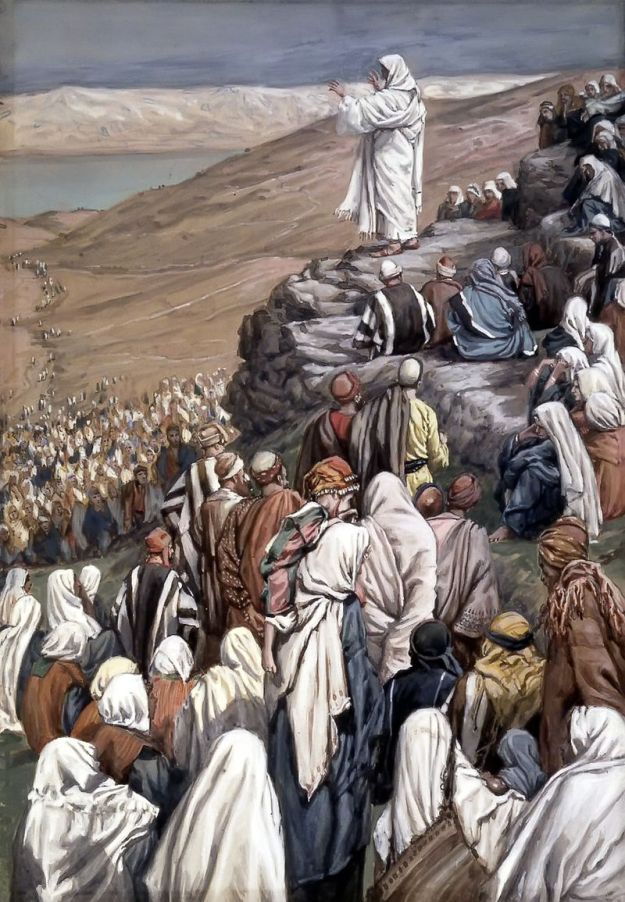
Unlike the Sermon on the Mount or the Mission Discourse where the primary audience is the disciples, now the primary audience is the crowds which approach Jesus. The teaching takes place while the crowd stands on the shoreline in Matthew while Jesus, and presumably his disciples, sits on a boat. It is likely that Jesus, like most storytellers, probably used these stories on multiple occasions and that they were an important part of his method of addressing the crowds that sought him. As a reader of the parables we are invited into the role of the disciple who has been given to know the secrets (literally mysteries) of the kingdom of heaven rather than the crowds who stand on the shoreline and many of whom, in the words of this first parable, will not grow deep roots or will endure only while it does not provoke trouble or tribulation.

Vincent van Gogh, The Sower with a Setting Sun

In contrast to the other parables in this chapter the parable of the sower is not placed alongside the kingdom of heaven explicitly in its proclamation. The short story told to the crowd simply begins in the familiar picture of a person sowing seed in anticipation of an eventual harvest. Without jumping ahead to the explanations that the gospels provide let’s look at this short story on its own. Hand sowing is done for wheat, barley and other grains and would’ve reflected one of the primary means of farming in the Middle East. Many of the festivals of the Jewish people are oriented around the harvest times for these sown crops and they were essential for the diet of the people Jesus speaks to. Although modern farming attempts to remove some of the variables in the soil by introducing fertilizers, planting at a preset depth and field preparation, even modern farmers will see areas of a field underproduce while others produce abundantly. But the sower in this parable casts the seed upon the field and its surroundings indiscriminately and the seed falls both in areas expected to provide growth and those that would be typically avoided (hardened paths or areas of brambles and thorns). The reality of rocks and undesired plants growing in a field may have been unavoidable, and yet, the sowing in portions of the field that are not anticipated to be good earth is probably intended to be the portion of the parable which introduces the dissonance to normal, more careful practices of preserving one’s seed where harvest is most likely.

Following the parable are two sets of explanations to the disciples. The audience has changed and those who are in the presence of Jesus are the ‘little faith ones’ who continue to follow him through his work and proclamation. The disciples, even in Matthew which has a more positive evaluation of them than Mark’s gospel, hardly prove to be paragons of understanding and yet it fits within the paradoxical world that Jesus proclaims where the Father has, “hidden these things from the wise and revealed them to infants.” (Matthew 11: 25). These ‘little faith ones’ are given the mysteries of the kingdom of heaven. Matthew takes the allusion in Mark to Isaiah 6: 9-11 and makes it explicit. Isaiah 6: 9-11 is a part of the call of Isaiah which is less frequently heard where God says to Isaiah that paradoxically the lack of reception for Isaiah’s prophecy is a part of the divine plan. Here Isaiah and this first parable are brought together to speak to the reality of that God’s proclamation often falls upon dull hearts, closed ears and shut eyes. The call still goes for those who have ears to hear, eye to see and hearts to turn and yet even in the midst of places where the harvest is great, there will be surprising places where the word of the kingdom is not received, where faith is not found, or where the depth of understanding is shallow or where distractions or alternative values strangle the nascent faith.

The explanation of this parable as an allegory provides a key to understanding the parable. This may not be the only way that the parable was heard, but as readers we are invited to hear ourselves with the disciples as those who receive the mysteries of the kingdom of heaven. The seed becomes the word of the kingdom, the proclamation of Jesus or the proclamation done by his disciples, which goes out into the world. We have already seen times where Jesus’ message is received with hostility and resistance and this will continue to be a reality, including later in this chapter in Jesus’ hometown. For those who are charged with casting this word into a waiting world one of the gracious pieces of this parable is that reception is not their responsibility. They are not responsible for preparing the soil, they are merely sowers casting the seed into the receptive or unreceptive earth. Some of the proclamation may have no perceived effect and lay lifeless on the ground to be snatched away by the forces opposed to the kingdom, at other times there may be a joyous reception followed be dashed hopes as the shallowness of the faith is revealed as times become difficult, sometimes other persuasive alternatives will turn people away from the kingdom. I’ve always found the description of the thorny ground as ‘the cares of the world and the lure of wealth’ enlightening for I think many modern Christians who follow a prosperity understanding of the gospel would think that being wealthy and being engaged in the world are fertile soil rather than soil that grows strangling weeds. Nonetheless, there continues to be a harvest for the times the proclamation meets those receptive, who are people where the seed can germinate and bear fruit and continue to give life to the world around them. In our modern mechanical understandings of farming, which reflect our modern understandings of our world, the farmer would probably force the field to yield its harvest, but these artificial methods have their cost to the long-term health of the field. Perhaps we modern proclaimers have also tried to force a reception of the kingdom only to find it shallow, choked or non-existent. Perhaps, in this ancient wisdom there is a permission to a more cooperative approach where both the seed and soil must work together and the sower in not ultimately responsible for the harvest, for that lies in the hands of the Father. Like in the Mission Discourse the sower, when they find a field that is not receptive to the seed, is simply to shake off the dust and proceed on to another field where the seed may thrive.

Cooperating with Creativity: A Reflection

Blue Dancers by Edgar Degas, 1899

“Creativity is the relationship between the human being and the mysteries of inspiration” Elizabeth Gilbert, Big Magic, Creative Living Beyond Fear

There are times where creativity seems like a divine gift, something external and strange and magical that comes from some unknown space in the cosmos. Normally these are times where I let creativity take the lead, where I allow curiosity around a phrase or an idea to lead the way. During these times the providential provision of resources and words can be delightful if a little scary. There are times where my words both reflect me and something that is not like me at all, even when there is truth in the strangeness. I enjoy cooperating with creativity whatever spirit it may be, letting it flow through me and guide me, surprise and startle. Sometimes I can almost stand back and watch it dance and spin and leap and all I can do is simply try to record the joy or lament of the dance. As one who is not a dancer, I am at best an uninformed commenter on the art and yet sometimes the comments themselves capture some of the beauty whether dark or savage or light or joyous or somber.

There are times where creativity seems like some strange reserve of energy within me, like the old Polynesian idea of mana or the Chinese concept of qi. Feeling like some vital energy that is a part of me and that expending it in a forced manner leaches strength from the very marrow of my being. When it feels like a time-constraints force me to be creative in an urgent matter it almost feels like I am doing violence to creativity and to myself at the same time. It is like this thing which can be separate from me is somehow conjoined, that we feed off the same energy. Not like some unwelcome parasite that simply leeches its victim for its own purposes but some type of symbiotic relationship where the creativity, genius, daemon, muse or whatever name you give it cannot do its work without your participation in the dance with it. When it is forced to dance a dance it no longer wants to dance or is not ready for, then I, as its partner, am the one whose head pounds, whose muscles burn and whose soul aches.

Creativity can be elusive but she can be a delight. Sometimes she stays away for days on end, or perhaps it is me who has been away on some other journey, too distracted by the alluring entertainment on some screen or some pressing task at work or home. Sometimes she comes when the time is not right and by the time I can give her my full attention she is off dancing somewhere out of site. I’m not sure what creativity is or how it works, I’m just trying to learn how to cooperate with it. To be attentive to its call, to listen to the music it chooses, to observe the dance, to do my part as a recorder of these mysteries of inspiration. I try to work diligently but not to force or bend it to my will, that seems to do damage to both of us. Perhaps it is something deep within me, perhaps it is something else, perhaps it is in some strange way both. I may never know, and perhaps to know would steal away the magic and delight, like knowing some illusionist’s trick. So, for now I’ll let this dance end as the music fades and leave this reflection for others to see. Perhaps serendipity may allow this to be that providential provision that another curious observer needs as their creativity calls its tune.

The Suburbs of Hell

Mauricio Garcia Vega “Visita al infierno’ shared by artist under Creative Commons 3.0

All those eyes intent on me. Devouring me. What? Only two of you? I thought there were more; many more. So this is hell. I’d never have believed it. You remember all we were told about the torture-chambers, the fire and brimstone, the “burning marl.” Old wives’ tales! There’s no need for red-hot pokers. HELL IS OTHER PEOPLE!” Jean-Paul Sartre, No Exit

“Hell is a state of mind – ye never said a truer word. And every state of mind, left to itself, every shutting up of the creature within the dungeon of its own mind – is, in the end, Hell.” C.S. Lewis, The Great Divorce

What if the existentialists were wrong seeing in others eyes the mirror that condemns themselves?
That their self-directed focus loosed the bonds of the compassion experienced in community
Their desire to liberate themselves from the plight of humanity became their own chains
Which they forged like Marley in Dickens’ Christmas Carol when their neighbor no longer mattered
Their revelation became the great unseeing of their place within the covenant of the commonwealth
Where they looked at the unenlightened with disdain seeking to isolate themselves in their suffering
As they moved into the suburbs of hell to discover what one slowly but inexorably uncovers
That the mirror that condemns oneself is the looking glass of one’s own crafting they gaze into
Discovering in their loneliness that hell is a dungeon of one’s own mind that they are locked within
And the only key to salvation, though it goes against every practice they’ve embraced, every dogma
Is the other people they feared would see them as they are and would deem them unlovable

Perhaps they, like the denizens of C.S. Lewis’ vision, looked with disgust and moved themselves
Further and further away from the city, further away from the possibility of looking into another’s eye
As they move further and further into the wilderness to build their utopias in their grey worlds
Building the walls higher around their stately grounds along roads that no one travels
Locking themselves inside their places of paranoia and safety, hoarding their treasure like dragons
And still Amazon delivers to these unmapped places all the possessions which come to possess
Houses full of unopened boxes with smiles upon the side for people who no longer smile
“I think therefore I am” proclaimed their apostle Descartes as they declared the world outside false
No need for the flames of the lake of fire nor demonic torturers and devilish prison wardens
They in their own self-flagellation willingly wield the red-hot pokers unwilling to accept forgiveness
Remaining locked inside their self-imposed sentence of solitary confinement for unknown offenses

The Vision

Creek babbling through Benvoulin wetlands in Kelowna, British Columbia, Canada, Capture from video shared by Extemporalist under Creative Commons 1.0 https://en.wikipedia.org/wiki/File:Creek_babbling_through_Benvoulin_wetlands.webm

The Vision

The stream burbled patiently singing its tune
As the sun shone in a ray through the break in the trees
While dragonflies danced and frogs played
In the early summer’s warmth of this peaceful place
My secret place where others rarely enter
A space to commune with the undisturbed world
To delight in the slow and steady rhythm of the creator
Where every mote of dust reflects magic and light
And heaven and earth are not so far apart
This thin space where sometimes epiphanies occurs

Into this peaceful space emerges a hawk, proud and strong
Soaring in to rest upon the branch an ancient oak tree
And it watches me watching it with knowing eyes
A herald of the mystery that awaits unveiling in that space
Rustling through the underbrush another unexpected guest
Emerging with his royal blue head from the undergrowth
Strutting into this magical place with his myriad eyes
As he quickly expands his tailfeathers in proud display
Looking imperially at the human who happens to be
In this space where creation came to play in delight
To dance in the joy of the creator’s masterwork

As nature continued to roll back her curtain of majesty
Rolling out her green carpet to await the celebration
Out of the mystery steps lady wisdom cloaked in green
With her escorts, a stag on her left and a wolf on her right
The frogs cease their croaking chorus
Dragonflies circle to land on the cat lilies
The peacock bows his proud blues head
the hawk swoops down to land upon her shoulder
While I stand transfixed by this moment of mystery
All watch as she brings forth an egg from her cloak
Which she cradles in her hands like the greatest treasure
As the creation watches this miracle of new birth

Somehow, I know to look away not to look unmediated
At the divine drama unfolding in this beautiful place
But from the reflection of the stream I see her lay
The dormant egg into a thick blanket of green grass
And from the bed of green emerges red, yellow, blue and orange
As nature’s nest burns and yet remains unconsumed
And I wonder if I, like Moses, stand on sacred ground
As the new chick emerges with a cry of victory
From fire and light and ash the new phoenix emerges
Spreading its wings towards the waiting sky
Looking to its dominion among the heavens

Before it flies away from this place it scooped
By the woman’s gentle hands and they share a second
As all the earth bows in this moment of mystery
Wolf and stag bend low, peacock and hawk
Even the trees themselves seem to stoop
As creation lifts its joyous song and the resurrection
The revelation that magic has not left the creation
And I, on behalf of humanity lie upon the verdant ground
In wonder and awe as a witness of this sight

As quickly as it was revealed it is concealed
Nature closes her curtain and the world returns
To the chorus of frogs and the dance of dragonflies
The woman and her escorts are gone
Back behind the shroud of the ancient trees of the forest
The phoenix disappears into the heavens
Shining as radiant and dazzling as the beaming sun
Yet, I remain stunned at this dream, this vision
Wondering at what I have seen as the memories fade
And so, I grab my pen and write furiously
Trying to capture the essence of the epiphany
Of the magic and mystery at work in the world
Masked but to those who sit in the thin spaces
Where heaven and earth are not so far apart