Tag Archives: Imprecatory Psalms

Psalm 139 Asking the God who Knows and Sees Me to Respond to the Injustice on Earth

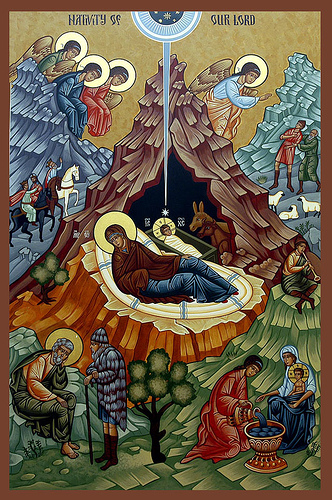
The Nativity of Christ, Icon by Ranosonar

Psalm 139

To the leader. Of David. A Psalm

1O Lord, you have searched me and known me.
2
You know when I sit down and when I rise up;
 you discern my thoughts from far away.
3
You search out my path and my lying down
 and are acquainted with all my ways.
4
Even before a word is on my tongue,
 O Lord, you know it completely.
5
You hem me in, behind and before,
 and lay your hand upon me.
6
Such knowledge is too wonderful for me;
 it is so high that I cannot attain it.

7
Where can I go from your spirit?
 Or where can I flee from your presence?
8
If I ascend to heaven, you are there;
 if I make my bed in Sheol, you are there.
9
If I take the wings of the morning
 and settle at the farthest limits of the sea,
10
even there your hand shall lead me,
 and your right hand shall hold me fast.
11
If I say, “Surely the darkness shall cover me,
 and night wraps itself around me,”
12
even the darkness is not dark to you;
 the night is as bright as the day,
 for darkness is as light to you.

13
For it was you who formed my inward parts;
 you knit me together in my mother’s womb.
14
I praise you, for I am fearfully and wonderfully made.
 Wonderful are your works;
 that I know very well.
15
My frame was not hidden from you,
 when I was being made in secret,
 intricately woven in the depths of the earth.
16
Your eyes beheld my unformed substance.
 In your book were written
 all the days that were formed for me,
 when none of them as yet existed.
17
How weighty to me are your thoughts, O God!
 How vast is the sum of them!
18
I try to count them—they are more than the sand;
 I come to the end—I am still with you.

19
O that you would kill the wicked, O God,
 and that the bloodthirsty would depart from me—
20
those who speak of you maliciously
 and lift themselves up against you for evil!
21
Do I not hate those who hate you, O Lord?
 And do I not loathe those who rise up against you?
22
I hate them with perfect hatred;
 I count them my enemies.
23
Search me, O God, and know my heart;
 test me and know my thoughts.
24
See if there is any wicked way in me,
 and lead me in the way everlasting.

Psalm 139 is a paradox. The first eighteen verses in poetic and beautiful imagery describe the psalmists experience of being fully known by God. The language of the final six verses describes the psalmist’s reaction to the jarring reality that there are many who oppose the ways of God. Many readers of this psalm are surprised at the sudden change from the sense of wonder and awe in the first three stanzas of the psalm to the imprecatory voice of the final stanza. Most readers may be familiar with the first eighteen verses while the final six will rarely appear in the worship of most churches. Some scholars feel that these verses were later added into the beautiful and comforting message of God’s full knowledge and encompassing of the speaker, but I feel the psalm makes sense as we have received it as I will share below.

A key word in this psalm is “known/knowledge” which occurs seven times (vv. 1-2, 4, 6, 14, 23 twice) and while the seven occurrences may be random, Hebrew poetry like to utilize numerical occurrence to make a point. Seven is traditionally a number of completeness. So, in addition to the thematic complete knowledge of God it may also be structurally reinforcing this message. (NIB IV: 1235) The verbs attributed to God including “know,” “search,” and “test” often appear in imagery when God is described as a judge, and this image of God is often used when one is calling on God for intervention or help. (Mays, 1994, pp. 426-427) Throughout the psalm the psalmist wrestles with the reality that they are known, searched, and tested completely by God and yet the wicked ones who resist God’s way still endure and God is called to judge these ones who the psalmist ‘hates’ (see below).

In the first stanza God knows the psalmist’s thoughts, words, and actions completely. Whether the psalmist is coming or going, waking or sleeping, standing or sitting, God knows their path, their thoughts, and even the words that have not left their mouth. They live their life surrounded by God’s presence and comforted by God’s touch. They respond in an appropriate sense of awe and wonder that the God who created the heavens and the earth can know them. The psalm is not interested in constructing a doctrine of omnipotence and omnipresence but instead deploys its language to try to express their wonder that God knows them, comforts them, is present with them and protects them.

The second stanza continues the wonder at God’s presence throughout the creation. The most surprising line of this stanza is that the psalmist includes God’s presence in Sheol, a place in other psalms where people are cut off from God’s hand (Psalm 88). Yet, for the psalmist even this place where God had been thought absent God is present. Heaven to Sheol, from the rising sun to the farthest edges of the sea, and even in the darkest night they are seen and known by God. There is nowhere in all creation, the heavens, the earth and under the earth, where they can escape God’s spirit or God’s sight. For the psalmist this is an awe-inspiring reality but primarily in a comforting rather than an ominous sense.

The third stanza turns the reflections to God’s deep involvement throughout the duration of their life. The beautiful language of God knitting the psalmist together in their mother’s womb, shaping and forming them for their life in God’s presence and protection. They wonder at their body and mind created by the hand of God and the days of their life are numbered according to God’s plan. The psalmist is less concerned with an idea or predestination than poetically describing the wonder at their life shaped by God’s hands and lived within God’s presence.

It may be a paradox, but for me the first three stanzas set up the final stanza. The psalmist looks upon God’s active presence in their own life and experience and then turns outward to the world where injustice and wickedness persist. The language does not seem to indicate that the psalmist is personally under threat or attack but instead seems to be broken-hearted by the ways in which others are treating God and God’s commandments. They are heartsick by the idolatry and injustice they see at work in the world and they call upon the God who is profoundly present throughout their life to extend that presence throughout the world and judge the wicked and those who oppose God’s ways. The language of ‘kill’ and ‘hate’ are jarring to our ears. The word translated ‘hate’ (Hebrew sane’) refers to an emotional aversion to something or someone. (Nancy deClaisse-Walford, 2014, p. 966) Throughout the psalms and wisdom literature in the bible the wicked pose a threat, leading astray others from following God’s way and threatening the peace of the society. The psalmist in their own way is calling on God for God’s will to be done on earth. The God who is present throughout the life of the psalmist and whose spirit is present throughout the world is asked to judge the earth and be as deeply involved throughout the creation as they perceive God being within their own life. Like the other psalms calling on God to judge an enemy, the enemy is committed into God’s hands. Yet the psalmist joins those throughout the generations calling upon God to establish God’s justice on earth and to heal the society from the damage done by the wicked, the bloodthirsty, those who speak maliciously, and who rise up against God.

Psalm 137 Crying For God’s Vengeance by the Rivers of Babylon

By the Waters of Babylon, painting by Arthur Hacker, c. 1888

Psalm 137

1By the rivers of Babylon—
  there we sat down, and there we wept
  when we remembered Zion.
2
On the willows there
  we hung up our harps.
3
For there our captors
  asked us for songs,
 and our tormentors asked for mirth, saying,
  “Sing us one of the songs of Zion!”

4
How could we sing the LORD’s song
  in a foreign land?
5
If I forget you, O Jerusalem,
  let my right hand wither![1]
6
Let my tongue cling to the roof of my mouth,
  if I do not remember you,
 if I do not set Jerusalem
  above my highest joy.

7
Remember, O LORD, against the Edomites
  the day of Jerusalem’s fall,
 how they said, “Tear it down! Tear it down!
  Down to its foundations!”
8
O daughter Babylon, you devastator!
  Happy shall they be who pay you back
  what you have done to us!
9
Happy shall they be who take your little ones
  and dash them against the rock!

The deportation to Babylon is one of the pivotal events in the story of the Jewish people. The Deuteronomic history (Joshua, Judges, 1&2 Samuel and 1&2 Kings) ends with exile as does the retelling of the story of Israel and Judah by the author of 1&2 Chronicles. Two of the three major prophets, Jeremiah and Ezekiel, have their ministries in the time immediately before and after the final deportation.[2] The Gospel of Matthew when it organizes the genealogy of Jesus breaks the second and third groups of generations at the deportation to Babylon. There are pre-exilic experiences of Judaism and post-exilic experiences and scholars often divide texts into pre-exilic and post-exilic texts. The loss of the Davidic king, the city of Jerusalem, the temple destroys many of the central features of Jewish life and requires a reorganization for the people of their identity and their faith. Psalm 137 taps into the grief, confusion, anger, and desire for revenge of the refugees of Jerusalem arriving at the rivers of Babylon crying out their jagged words to God through their tears.

Zion, the destination of the Songs of Ascent (Psalms 120-134), is a smoldering ruin. The songs of Zion, like Psalm 46 and 48, were full of a confidence that God was in the midst of the city and would defend it from harm by breaking bows, shattering spears, and burning shields (Psalm 46: 9). Yet the prophet Ezekiel declared that God has departed the temple and the city because of the idolatry of the people (Ezekiel 10). The city of peace (Yeru-shalom) has become the casualty of war, and the survivors of the siege and deportation sit as strangers in the land of their enemy grieving their loss, questioning their future, resisting their captor’s taunts, and shedding tears as they remember their lost home. There are no songs of mirth that can come from the heavy hearts of these grieving and shattered people. Their captors may taunt them desiring to hear their songs of Zion where the God of Israel promised to defend the city so they can mock the absence of their God, and so they hang their harps on the willow trees and no songs of joy and praise are able to emerge from the broken hearts of the captive people.

The people are committing themselves to ‘never forget’ the city and what occurred there. They may eventually have to settle down and make their home by the rivers of Babylon, but they can no more forget Jerusalem than their right hand. If they forget Jerusalem, they ask to lose their power to act and speak. Looking at this poem through the lens of Elisabeth Kübler-Ross’s stages of grief the first six verses rest within the space of depression but in verse seven they turn to anger.

Psalm 137 is an imprecatory psalm, like Psalm 58 and 109, and it will probably not make its way into the worship bulletins or the sermons of many churches, but it has something to teach us. This is the language of the broken heart crying out in its pain against those who have wounded it. There is a reason that Jeremiah and Ezekiel spend so much ink crying for revenge against those who participated in the destruction of Jerusalem (Jeremiah 46-51, Ezekiel 24-32). Jeremiah’s harshest words are directed to Babylon (Jeremiah 50-51) while Jeremiah, Ezekiel, and Obadiah (Jeremiah 49: 7-11; Ezekiel 25: 8-11; 35; Obadiah 10-14) bear witness to the betrayal of Edom.[3]

Nancy deClaissé-Walford speaks about revenge by saying:

The basic human desire for revenge when we or those we love have been wronged. God does not ask us to suppress these emotions, but rather to speak about them in plain and heartfelt terms. (Nancy deClaisse-Walford, 2014, p. 957)

Yet I suspect that many people of faith would be troubled by the graphic and violent language that the people call for against their enemies. It is only in this psalm that the Hebrew asre (NRSVue ‘happy’), so often an indicator of wisdom literature, is deployed to call for violence against one’s enemies. It is easy for those who have lived in peace to find the language of killing the children of one’s enemies repulsive but it is likely that these survivors saw their own children die of starvation during the siege, brutality during the conquest of the city, or abused and killed on their journey to Babylon. Their red-hot anger is an honest if uncomfortable emotion. A traumatized people call for their oppressors to experience what they have experienced, and rather than suppressing those feelings they exclaim them to God in plain and heartfelt terms. They may wonder if God hears their cries any longer but they have no other place to direct their raw rage about a world that no longer makes sense, where their children endured starvation, death, brutality, and trauma.

Miroslav Volf relates a story recorded by Željko Vukovic from the conflict between the Serbs and Croats in Bosnia.

I am a Muslim, and I am thirty five years old. To my second son who was just born, I gave the name “Jihad.” So he would not forget the testament of his mother—revenge. The first time I put my baby at the breast I told him, “May this milk choke you if you forget.” So be it. The Serbs taught me to hate. For the last two months there was nothing in me. No pain, no bitterness. Only hatred. I taught these children to love. I did. I am a teacher of literature. I was born in Ilijaś and I almost died there. My student, Zoran, the only son of my neighbor, urinated into my mouth. As the bearded hooligans standing around laughed, he told me: “You are good for nothing else, you stinking Muslim woman…” I do not know whether I first heard the cry of felt the blow. My former colleague, a teacher of physics, was yelling like mad, “Ustasha, ustasha…”And kept hitting me. Wherever he could. I have become insensitive to pain. But my soul it hurts. I taught them to love and all the while they were making preparations to destroy everything that is not of the Orthodox faith. Jihad—war. This is the only way… ” (Volf, 1996, p. 111)

Thankfully most of us have never experienced the level of degradation and dehumanization expressed by this Muslim woman or by these Jewish survivors, but the rage and the anger will go somewhere. It can be handed on as an inheritance over the generations, as is done by this mother who names her son Jihad and continues among the Jewish people in their desire to never again find themselves enduring another Holocaust, or it can be lifted up in imprecatory cries to God like in this psalm.

Ellen Davis’s chapter on the cursing psalms in Getting Involved with God: Rediscovering the Old Testament (Davis, 2001, pp. 23-29) has been influential on my thinking about the imprecatory psalms, like this one. She proposes three possible uses for psalms like this one when we are angry, and one, if we have the courage to encounter these words when we are not. First, they can give us words to wrap around our anger when we are not able to find adequate words on our own. She shares the advice a professor once gave her after a betrayal, “Go into the chapel when no one else is around and shout these at the top of your lungs.” This practice allowed her to both vent and release the anger but hearing herself speak these words she also could hear the self-righteousness and pettiness in her petitions. Secondly, the psalms function as divinely given ‘counselors’ and teach us that vengeful anger is one mode of access to God. We can come to know that God who created us for life together is also outraged by those who destroy community or deny justice. Thirdly, the cry is a cry for God to act which allows the petitioner to bypass acting personally against the one who harmed us. We demand our enemy be driven into God’s hands, but we are not in control of what happens there or how God brings about this justice and reconciliation. Finally, she suggests if we are reading when we feel none of the feelings in the psalm to turn it around and to ask if there is anyone in the community or among God’s people who may want to pray these words about me? (Davis 2001, 26-29)

My prayer is that no one reading these words ever encounters the dehumanizing experiences which call into question their identity and their faith like these refugees remembering Zion by the rivers of Babylon, mourning the loss of their homes, their neighbors, their society, and likely their children. Yet at some point we all know the desire for revenge on those who have wounded us and those we love. Many will encounter events which reshape their identity and may challenge their faith. Others will long for a home and a safety that no longer exist. They may not be able to sing the songs of their God with a heavy heart, at least not the ones full of praise and joy. At that point the jagged words of Psalm 58, 109, and 137 may be closer to the words their hearts need to speak as they grieve, question, and wrestle. They may need to know that this space of heartbrokenness and rage where they wish for vengeance on those who caused the pain is not a space they need to hide from God, but instead people of faith for millennia have voiced these words calling for judgment but entrusting vengeance to the Lord. They can no more forget the object of their grief than their right hand nor may they be able to speak of anything else in this moment of pain. Yet God’s people trust that God hears the words of these refugees from the world they knew, when they were safe and loved before that world collapsed around them and that God can lead them beyond this moment. They may long with Isaiah for a time when the tears of this moment are wiped away and the death causing action on this world cease:

And he will destroy on this mountain the shroud that is cast over all peoples, the covering that is spread over all nations;he will swallow up death forever. Then the Lord God will wipe away the tears from all faces, and the disgrace of his people he will take away from all the earth, for the Lord has spoken. Isaiah 25: 7-8


[1] Hebrew literally: “If I forget Jerusalem, forget my right (hand).”

[2] There are two deportations under Babylon. The initial deportation (598/597 BCE) takes the king (Jehoiakim) and many of the leaders, artisans, priests, and other elites of the land. The prophet Ezekiel is one of those taken into exile with this initial group and his declarations come from this space in the exile. The prophet Jeremiah is still with the remnant in Jerusalem. Those left behind rebel against Babylon and in 586 BCE after a crippling siege the city wall is broken down, the temple and city destroyed, and much of the remnant is taken into exile in Babylon. For more detail see my post on the Babylonian Empire.

[3] Edom is one of the nations who met with King Zedekiah in Jerusalem (Jeremiah 27:3). It is likely that these kings were negotiating a defensive alliance against Babylon, but when Babylon besieges Jerusalem Edom seizes the opportunity to participate in the destruction and pillaging of their neighbor.