Tag Archives: God

Psalm 119 An Artistic Articulation of Life Under the Law

The Hebrew Alphabet. Hebrew reads right to left so it begins with Aleph and ends with Tet

Psalm 119

Introduction to Psalm 119

I’m going to modify my normal pattern of having the text first and then a reflection due to the length of Psalm 119 which is longer than several biblical books. Many readers find Psalm 119, “boring, repetitious, and without plot development.” (Bellinger, 2014, p. 519) Translations of this psalm lose the key organizational feature of Psalm 119 which its acrostic organization and that in combination with the length of the psalm makes it difficult for many readers to fully appreciate. Also hindering the hearing of this psalm dedicated to a “Torah piety” or “law piety” is a lingering stigma of legalism associated with Judaism. Yet, what this psalm advocates for in its language and organization is a joyful way of life organized around God’s guidance to God’s people.

I have spent far more time in Hebrew acrostic poetry in the past year than the average person spends in a lifetime having worked through Lamentations, Psalm 111, 112, and now 119 this year. Psalm 119 is the acrostic of acrostics intensifying the form to have eight lines begin with each letter of the Hebrew alphabet (from Aleph to Tav) for a total of 176 verses. The acrostic form is a way of indicating a complete poetic treatment of a topic, and the intensification of this psalm of an eight-fold acrostic is designed to convey a complete treatment of a life faithfully and joyfully lived in relation to God through the law. In addition to the eight-fold repetition of a common letter to start each group of lines are the eight synonyms for the law utilized throughout the poem: law, decrees (or statutes), ordinances, statutes, word, precepts, and promises. One of these synonyms occurs in every verse except verses 3, 37, 90 and 122. In the 176 verses there are five verses where two synonyms occur compared to the four where none occur. The repetition is intentional to reinforce the central position of the law in the relationship between God and the people.

Psalm 119 begins with the Hebrew asre (‘happy’ NRSV) which is a common word in wisdom literature, just as the acrostic is a common wisdom literature form. Psalm 1 and Psalm 19 are the other two psalms primarily associated with a ‘Torah piety’ and both psalms share both vocabulary as well as a common vision of what a wise life consists of. The similarities between Psalm 1 and Psalm 119, some of which will be noted below, were strong enough that Claus Westermann could suggest that they once formed the beginning and end of the psalter. (Bellinger, 2014, p. 520)

For the reflections below I will take each eight-verse portion of the acrostic as a unit for reflection. On the one hand the psalm is designed to be viewed as an entire unit held together by its acrostic organization and focal vocabulary. On the other hand, the psalm is daunting for its length, and I will follow the habit of many other scholars in attempting to look at the psalm in its components and then have some final reflections. Dietrich Bonhoeffer in 1939-1940 considered his work on Psalm 119 to be “the climax of his theological life.” (Bethge, 2000, p. 667) Yet even Bonhoeffer in his reflections only made it to verse twenty-one. For me this may be a high mountain to climb, but hopefully there are many more pinnacles in my life of reflection.

Aleph[1]

1 Happy are those whose way is blameless, who walk in the law of the LORD.

2 Happy are those who keep his decrees, who seek him with their whole heart,

3 who also do no wrong, but walk in his ways.

4 You have commanded your precepts to be kept diligently.

5 O that my ways may be steadfast in keeping your statutes!

6 Then I shall not be put to shame, having my eyes fixed on all your commandments.

7 I will praise you with an upright heart, when I learn your righteous ordinances.

8 I will observe your statutes; do not utterly forsake me.

As mentioned in the introduction there is a strong connection between Psalm 1, 19 and Psalm 119. They share a common vision of what leads to happiness or contentment (Hebrew asre) but they also share a common vocabulary. As J. Clinton McCann, Jr. notes, “every word of v. 1 occurs in either Psalm 1 or Psalm 19.” (NIB IV: 1168) Dietrich Bonhoeffer in his reflection on verse one uses the terms ““complete”, “whole,” undivided, unassailable” for the term the NRSV translates ‘blameless’ and he notes that Luther in his 1521 translation of the psalm says, “the wholly healthy ones.” (DBWE 15: 500) The Hebrew concept of ‘blameless’ or ‘without fault’ is not the legalistic perspective often (wrongly) attributed to Jewish thought. It is clear as you progress through the poem that the psalmist does not consider themselves without fault, and yet they desire to be steadfast in their adherence to God’s vision for the world. They are seeking a way of life in harmony with God’s will for the world, and they seek that harmony through God’s revealed will in the Torah.

Beth

9 How can young people keep their way pure? By guarding it according to your word.

10 With my whole heart I seek you; do not let me stray from your commandments.

11 I treasure your word in my heart, so that I may not sin against you.

12 Blessed are you, O LORD; teach me your statutes.

13 With my lips I declare all the ordinances of your mouth.

14 I delight in the way of your decrees as much as in all riches.

15 I will meditate on your precepts, and fix my eyes on your ways.

16 I will delight in your statutes; I will not forget your word.

Throughout the law there is a concern for passing on the practices from generation to generation. This is perhaps best illustrated in the verses that immediately follow the Shema in Deuteronomy 6:

Keep these words that I am commanding you today in your heart. Recite them to your children and talk abou them when your are at home and when you are away, when you lie down and when you rise. Deuteronomy 6: 6-7.

The book of Proverbs is also an attempt to pass on wisdom to the next generation. How are young people to keep their way pure, by remaining attentive to the word, commandments, statutes, ordinances, decrees, and precepts (all synonyms mentioned in this section). This shares a common vision with Matthew’s parable of the treasure found in the field[2] where the object (here the law) is to become the thing which the individual gives up all other things to possess and guard. It becomes the treasure of the heart, the words upon the lips, the delight of life, and that which is meditated on. The young person learns to center their life on God’s law and God’s word.

Gimel

17 Deal bountifully with your servant, so that I may live and observe your word.

18 Open my eyes, so that I may behold wondrous things out of your law.

19 I live as an alien in the land; do not hide your commandments from me.

20 My soul is consumed with longing for your ordinances at all times.

21 You rebuke the insolent, accursed ones, who wander from your commandments;

22 take away from me their scorn and contempt, for I have kept your decrees.

23 Even though princes sit plotting against me, your servant will meditate on your statutes.

24 Your decrees are my delight, they are my counselors.

For the first time the notes of lament make their way into the psalm. Living in attentive service to the way of God in the law does not guarantee a life free of struggle. Yet even in the midst of the struggle the psalmist remains focused on the ordinances of God and the way of life they outline. It is possible that Psalm 119 comes from the time of the exile where the person may have lived as an alien in the land of Babylon, but it also may come from a time where they feel alienated from the community. Even in the space where the psalmist is a stranger receiving scorn and contempt from those who have power in the land, they trust that the God who gave the law will continue to provide for this seeker after God’s decrees.

Daleth

25 My soul clings to the dust; revive me according to your word.

26 When I told of my ways, you answered me; teach me your statutes.

27 Make me understand the way of your precepts, and I will meditate on your wondrous works.

28 My soul melts away for sorrow; strengthen me according to your word.

29 Put false ways far from me; and graciously teach me your law.

30 I have chosen the way of faithfulness; I set your ordinances before me.

31 I cling to your decrees, O LORD; let me not be put to shame.

32 I run the way of your commandments, for you enlarge my understanding.

Dust, as J. Clinton McCann, Jr. notes, is elsewhere associated with death.[3] (NIB IV: 1169) The Hebrew word nephesh (NRSV soul) is not the Greek idea of a eternal soul that is separate from the physical body but rather the essence of life or center of life. Yet in a time where life is clinging to death God revives with the word. Life seeking understanding is the way of the psalmist. God can strengthen with the word, teach this student the law, and keep this seeker from shame. They know that life is found in these commandments of God, but they also seek for God to continue to enlarge their understanding of this gracious gift that God has bestowed to the people. The LORD is a God who can bring life from the dust, strength from sorrow, and honor from shame.

He

33 Teach me, O LORD, the way of your statutes, and I will observe it to the end.

34 Give me understanding, that I may keep your law and observe it with my whole heart.

35 Lead me in the path of your commandments, for I delight in it.

36 Turn my heart to your decrees, and not to selfish gain.

37 Turn my eyes from looking at vanities; give me life in your ways.

38 Confirm to your servant your promise, which is for those who fear you.

39 Turn away the disgrace that I dread, for your ordinances are good.

40 See, I have longed for your precepts; in your righteousness give me life.

The verbs that drive this section ask for the LORD to take control of the petitioner’s ways: teach, give, lead, turn the heart and eyes, confirm, and turn away from the things that lead to disgrace. The poet seeks right understanding, right willing (the heart as the seat of will), right seeing, a right practice of faith and life that leads to a wise path instead of the foolish path that leads to disgrace. The psalmist desires that which is life giving and yet knows that there are temptations which can turn the heart, eye, and mind to the path of the wicked. Yet, the psalmist desires to hold fast to the good that God has revealed to the people.

Waw

41 Let your steadfast love come to me, O LORD, your salvation according to your promise.

42 Then I shall have an answer for those who taunt me, for I trust in your word.

43 Do not take the word of truth utterly out of my mouth, for my hope is in your ordinances.

44 I will keep your law continually, forever and ever.

45 I shall walk at liberty, for I have sought your precepts.

46 I will also speak of your decrees before kings, and shall not be put to shame;

47 I find my delight in your commandments, because I love them.

48 I revere your commandments, which I love, and I will meditate on your statutes.

A note of lament returns with those who taunt the psalmist, but the dominant chord of this refrain is continued trust in God. A faithful life will always be lived in the midst of those who seek different sources of security. To those involved in the court of the king the psalmist’s trust in God’s ways may seem naïve in a world of politics and intrigue. Yet, the psalmist asks for their words of their mouth to be their LORD’s words of truth. They seek to fulfill the intention of Deuteronomy 17: 14-20 by becoming a living breathing law which continually is before the king reminding them of God’s way. This way of life, which reveres and meditates on the law is an act of love for the poet.

Zayin

49 Remember your word to your servant, in which you have made me hope.

50 This is my comfort in my distress, that your promise gives me life.

51 The arrogant utterly deride me, but I do not turn away from your law.

52 When I think of your ordinances from of old, I take comfort, O LORD.

53 Hot indignation seizes me because of the wicked, those who forsake your law.

54 Your statutes have been my songs wherever I make my home.

55 I remember your name in the night, O LORD, and keep your law.

56 This blessing has fallen to me, for I have kept your precepts.

This verse moves between the poet’s request for God to remember to the poet’s repeated remembering.[4] When God remembers in the Hebrew Scriptures it leads to God acting. For example, the story of Noah, when God sees the bow in the clouds God remembers (Genesis 9:16) or in Egypt when God hears the cries of the people God remembers (Exodus 20:8). The psalmist calls on God to remember as they are remembering God’s ordinances and God’s name. The second half of verse 54 reads literally, “in the house of my sojourning” (NIB IV: 1170) and may reflect a situation of displacement, perhaps in exile, of the psalmist. Yet, wherever the psalmist finds themselves they attempt to live a wise life which leads them into conflict with the wicked and arrogant in their midst. Perhaps in a time of exile and confusion they are attempting to hold on to the covenant while others are turning away from the way of God’s law. Yet, in the dark of the night this psalmist remembers and maintains their way of obedience.

Het

57 The LORD is my portion; I promise to keep your words.

58 I implore your favor with all my heart; be gracious to me according to your promise.

59 When I think of your ways, I turn my feet to your decrees;

60 I hurry and do not delay to keep your commandments.

61 Though the cords of the wicked ensnare me, I do not forget your law.

62 At midnight I rise to praise you, because of your righteous ordinances.

63 I am a companion of all who fear you, of those who keep your precepts.

64 The earth, O LORD, is full of your steadfast love; teach me your statutes.

It is likely that this psalm was written by a Levite, and the initial verse of this section which declares the LORD is the portion for this poet would recall the division of the land in Numbers and Joshua where the Levites do not have a share in the land, instead the LORD is their portion.[5] But if this psalm is written in exile, now the entirety of the people is left with the LORD as their portion. The poet again alludes to a situation where they need the LORD to act upon the covenant for their rescue, to remember as requested in the previous section. The poet is keeping the commandments, now they implore the LORD to do the same as they are ensnared by the cords of the wicked. The psalmist trusts the LORD and there are others who apparently share this trust, but the poem alludes to a world where the faithful are not the powerful and they are vulnerable to the actions of the wicked.

Teth

65 You have dealt well with your servant, O LORD, according to your word.

66 Teach me good judgment and knowledge, for I believe in your commandments.

67 Before I was humbled I went astray, but now I keep your word.

68 You are good and do good; teach me your statutes.

69 The arrogant smear me with lies, but with my whole heart I keep your precepts.

70 Their hearts are fat and gross, but I delight in your law.

71 It is good for me that I was humbled, so that I might learn your statutes.

72 The law of your mouth is better to me than thousands of gold and silver pieces.

The word ‘good’ (Hebrew tob) occurs six times[6] in these eight verses. The LORD is good and does good and deals well (good) with the servant of the LORD. In echo the servant desires to learn good judgment and the good law of God’s mouth and can even view it as good that they have been humbled. In contrast the arrogant have hearts that are gross and fat. Their words are lies instead of the good words of the law. This is the binary language of wisdom literature: good and wicked, faithful and foolish. Yet even the poet went astray and had to be humbled to find the good. The psalmist has not lived a perfect life and had to have a time of repentance. But now they keep the word and know the value of this treasure their LORD has provided.

Yodh

73 Your hands have made and fashioned me; give me understanding that I may learn your commandments.

74 Those who fear you shall see me and rejoice, because I have hoped in your word.

75 I know, O LORD, that your judgments are right, and that in faithfulness you have humbled me.

76 Let your steadfast love become my comfort according to your promise to your servant.

77 Let your mercy come to me, that I may live; for your law is my delight.

78 Let the arrogant be put to shame, because they have subverted me with guile; as for me, I will meditate on your precepts.

79 Let those who fear you turn to me, so that they may know your decrees.

80 May my heart be blameless in your statutes, so that I may not be put to shame.

The psalmist taps into the poetic imagery of the Hebrew scriptures of God not only as the creator of the heavens and the earth, but the craftsman or potter that fashioned each individual person. They as a creature are completely in God’s hands and even though their suffering may be at the hands of the wicked it is still tied into God’s judgments. Yet, the psalmist trusts in the attributes of God: God’s steadfast love (hesed) and mercy. The psalmist trusts that this moment where the arrogant are able to bring them shame will be reversed in God’s justice. They seek a place of leadership in the community, but they also seek a heart that is fixed on the statutes of God.

Kaph

81 My soul languishes for your salvation; I hope in your word.

82 My eyes fail with watching for your promise; I ask, “When will you comfort me?”

83 For I have become like a wineskin in the smoke, yet I have not forgotten your statutes.

84 How long must your servant endure? When will you judge those who persecute me?

85 The arrogant have dug pitfalls for me; they flout your law.

86 All your commandments are enduring; I am persecuted without cause; help me!

87 They have almost made an end of me on earth; but I have not forsaken your precepts.

88 In your steadfast love spare my life, so that I may keep the decrees of your mouth.

The perilous condition reaches its pinnacle in these eight verses as the psalmist wastes away.[7] The nephesh (NRSV soul)[8], the very life of the person and the vision of the psalmist are all failing. They wonder how much longer they can endure in this situation without God’s intervention on behalf of the faithful one. The poet needs God to act to counteract the actions of the wicked which threaten their life. The remain steadfast in their adherence to the commandments and throw themselves on the steadfast love (hesed) of their God.

Lamedh

89 The LORD exists forever; your word is firmly fixed in heaven.

90 Your faithfulness endures to all generations; you have established the earth, and it stands fast.

91 By your appointment they stand today, for all things are your servants.

92 If your law had not been my delight, I would have perished in my misery.

93 I will never forget your precepts, for by them you have given me life.

94 I am yours; save me, for I have sought your precepts.

95 The wicked lie in wait to destroy me, but I consider your decrees.

96 I have seen a limit to all perfection, but your commandment is exceedingly broad.

The poem transitions from its lowest point to its highest. The psalmist previously had been wasting away but now they turn their eyes to the eternal LORD. Their faith rests not on their own strength but the faithfulness of God and the goodness of God’s eternal law. The psalmist trusts that this law of God will provide them deliverance from the wicked who attempt to destroy them. The meaning of the word translated perfection in verse 96 (Hebrew tikla) is not entirely clear but the overall direction of the final verse is to compare the greatness of God’s commandments and ways to the transitory nature of the wicked.

Mem

97 Oh, how I love your law! It is my meditation all day long.

98 Your commandment makes me wiser than my enemies, for it is always with me.

99 I have more understanding than all my teachers, for your decrees are my meditation.

100 I understand more than the aged, for I keep your precepts.

101 I hold back my feet from every evil way, in order to keep your word.

102 I do not turn away from your ordinances, for you have taught me.

103 How sweet are your words to my taste, sweeter than honey to my mouth!

104 Through your precepts I get understanding; therefore I hate every false way.

The effusive language of these eight verses now focuses on the psalmist’s love of the law. Love is not a common word in the psalter, and it takes on a sensual tone with language similar to the Song of Songs in talking about the words being sweeter than honey. This zealous adherent to the law of God seeks to surpass their teachers and elders by focusing on God’s law as the center of their life. The psalmist may be a young person (v.9) and this may be the zeal of youth, but their direction focused in the right direction. Whatever their age, they are seeking ardently the wise way of God’s law.

Nun

105 Your word is a lamp to my feet and a light to my path.

106 I have sworn an oath and confirmed it, to observe your righteous ordinances.

107 I am severely afflicted; give me life, O LORD, according to your word.

108 Accept my offerings of praise, O LORD, and teach me your ordinances.

109 I hold my life in my hand continually, but I do not forget your law.

110 The wicked have laid a snare for me, but I do not stray from your precepts.

111 Your decrees are my heritage forever; they are the joy of my heart.

112 I incline my heart to perform your statutes forever, to the end.

This group of verses begins with the most well-known verse of the psalm, “Your word is a lamp to my feet and a light to my path.” The way or law of God is the guide for the psalmist’s life, but they remain imperiled by the actions of the wicked. Previously the LORD was lifted up as the heritage of the psalmist (NRSV portion) and now the decrees of God are the heritage of the poet. Yet even in this situation where the wicked imperil the poet they lift up an offering of praises and continue to incline their heart to the performance of God’s law. Praise and obedience continue even in threatening times.

Samekh

113 I hate the double-minded, but I love your law.

114 You are my hiding place and my shield; I hope in your word.

115 Go away from me, you evildoers, that I may keep the commandments of my God.

116 Uphold me according to your promise, that I may live, and let me not be put to shame in my hope.

117 Hold me up, that I may be safe and have regard for your statutes continually.

118 You spurn all who go astray from your statutes; for their cunning is in vain.

119 All the wicked of the earth you count as dross; therefore I love your decrees.

120 My flesh trembles for fear of you, and I am afraid of your judgments.

This section begins with the contrast between the hate of the ‘double-minded’ and the love of the law. The evildoers attempt to pull the faithful one away from the commandment, but God is the hiding place and shield, a frequent image in scripture. The psalmist fears God far more than the wicked who are valued as dross. The psalmist continues to trust that God’s judgment between the foolish/double-minded/wicked ones and themselves will come to pass.

Ayin

121 I have done what is just and right; do not leave me to my oppressors.

122 Guarantee your servant’s well-being; do not let the godless oppress me.

123 My eyes fail from watching for your salvation, and for the fulfillment of your righteous promise.

124 Deal with your servant according to your steadfast love, and teach me your statutes.

125 I am your servant; give me understanding, so that I may know your decrees.

126 It is time for the LORD to act, for your law has been broken.

127 Truly I love your commandments more than gold, more than fine gold.

128 Truly I direct my steps by all your precepts; I hate every false way.

The poet lifts us their justice (mishpat) and righteousness (tsedeq) and implores the LORD to do good (tob) and show steadfast love (hesed). Yet once again the eyes of the psalmist are in danger of failing as they watch in hope for God’s rescue and fulfillment of the promises of the law. But the psalmist cries to God that the time has indeed come to act on behalf of this one who treasures the law more than gold. Their life rests in the hands of the God of the law.

Pe

129 Your decrees are wonderful; therefore my soul keeps them.

130 The unfolding of your words gives light; it imparts understanding to the simple.

131 With open mouth I pant, because I long for your commandments.

132 Turn to me and be gracious to me, as is your custom toward those who love your name.

133 Keep my steps steady according to your promise, and never let iniquity have dominion over me.

134 Redeem me from human oppression, that I may keep your precepts.

135 Make your face shine upon your servant, and teach me your statutes.

136 My eyes shed streams of tears because your law is not kept.

The poet finds the commandments of God as wonderful, but they live in a time where the law is not kept. They are attempting to live as a faithful servant of God in an unfaithful time. They continue to long for and pant for God’s commandments and they trust that God will be faithful to them and redeem them from their trouble. Yet, they cry for the unfaithfulness of the world around them. They and perhaps a minority among the people continue to seek God’s way.

Tsadhe

137 You are righteous, O LORD, and your judgments are right.

138 You have appointed your decrees in righteousness and in all faithfulness.

139 My zeal consumes me because my foes forget your words.

140 Your promise is well tried, and your servant loves it.

141 I am small and despised, yet I do not forget your precepts.

142 Your righteousness is an everlasting righteousness, and your law is the truth.

143 Trouble and anguish have come upon me, but your commandments are my delight.

144 Your decrees are righteous forever; give me understanding that I may live.

God is righteous and God’s decrees are righteous, and this righteousness of God and God’s decrees is the repetitive image throughout this section. The servant of God may be small and despised but they are zealous for God’s ways. They continue to seek God’s righteous and good way and trust in God’s promise even though they may be insignificant. Their trust remains in the righteousness of God and God’s law.

Qoph

145 With my whole heart I cry; answer me, O LORD. I will keep your statutes.

146 I cry to you; save me, that I may observe your decrees.

147 I rise before dawn and cry for help; I put my hope in your words.

148 My eyes are awake before each watch of the night, that I may meditate on your promise.

149 In your steadfast love hear my voice; O LORD, in your justice preserve my life.

150 Those who persecute me with evil purpose draw near; they are far from your law.

151 Yet you are near, O LORD, and all your commandments are true.

152 Long ago I learned from your decrees that you have established them forever.

The psalm continues its movement from petition to trust as it oscillates through the experience of life where the faithful one is not surrounded by a community that practices the law. The ones who persecute this faithful poet are near to them but far from God’s law. The psalmist’s whole heart is crying out for God’s attention to the difference between the psalmist’s life and the lives of the ones who threaten them. Yet, ultimately, they trust in God and God’s law.

Resh

153 Look on my misery and rescue me, for I do not forget your law.

154 Plead my cause and redeem me; give me life according to your promise.

155 Salvation is far from the wicked, for they do not seek your statutes.

156 Great is your mercy, O LORD; give me life according to your justice.

157 Many are my persecutors and my adversaries, yet I do not swerve from your decrees.

158 I look at the faithless with disgust, because they do not keep your commands.

159 Consider how I love your precepts; preserve my life according to your steadfast love.

160 The sum of your word is truth; and every one of your righteous ordinances endures forever.

The psalmist continues to pray that God preserve their life. I like Nancy deClaissé-Walford’s translation of this phrase as cause me to live. (Nancy deClaisse-Walford, 2014, pp. 880-881) If God will look on their misery, rescue them, plead their cause and redeem them, then God will cause them to live according to the promises God has made. God’s mercy, justice, and precepts will cause this poet to live even in the face of their many persecutors and adversaries. The poet trusts that God’s word is truth that will triumph over the falsehoods of their oppressors.

Sin and Shin

161 Princes persecute me without cause, but my heart stands in awe of your words.

162 I rejoice at your word like one who finds great spoil.

163 I hate and abhor falsehood, but I love your law.

164 Seven times a day I praise you for your righteous ordinances.

165 Great peace have those who love your law; nothing can make them stumble.

166 I hope for your salvation, O LORD, and I fulfill your commandments.

167 My soul keeps your decrees; I love them exceedingly.

168 I keep your precepts and decrees, for all my ways are before you.

Although this penultimate group of verses begins with one final reminder of the powerful enemies who oppress the psalmist the bulk of this section is devoted to praise. Princes in a monarchical society were people with power, but the poet trust in God and God’s promises instead of princes. For the first time the word praise (hallel) occurs in the psalm. Seven times a day may reflect a regular pattern of praise or it may indicate a continual life of praise. Those who love the law have peace (shalom) and live their lives before God.

Taw

169 Let my cry come before you, O LORD; give me understanding according to your word.

170 Let my supplication come before you; deliver me according to your promise.

171 My lips will pour forth praise, because you teach me your statutes.

172 My tongue will sing of your promise, for all your commandments are right.

173 Let your hand be ready to help me, for I have chosen your precepts.

174 I long for your salvation, O LORD, and your law is my delight.

175 Let me live that I may praise you, and let your ordinances help me.

176 I have gone astray like a lost sheep; seek out your servant, for I do not forget your commandments.

The closing verse of this psalm which repetitively speaks of the psalmist’s obedience to the law is striking because of it using language used elsewhere to describe the wicked. (NIB IV: 1175) The word the NRSV translates as ‘lost’ (Hebrew ‘obed) has its root meaning in ‘perish.’ This final verse uses the familiar metaphor of God as a shepherd who seeks out the sheep. Yet, this one who has gone astray is the same one who seeks and does not forget the commandments. James L. Mays articulates the place of the poet well when he reminds us:

The word of God is given but never possessed…It is there, objectively available in all the forms of God’s communication. But it must be sought and constantly studied in prayer in order to be taught, to learn with the help of God to receive the gift of understanding. (Mays, 1994, p. 385)

This massive psalm which intensifies the acrostic form attempts to bring a sense of completeness to this treatment of life under the law, decrees (or statutes), ordinances, statutes, word, precepts, and promises of God. It is a life of seeking and learning that trusts God’s faithfulness in an unfaithful world. It is an act of faith transmitted through artistry for the purpose of teaching and worship. It is seeking the peace, the steadfast love, the mercy, and the rescue of God as the faithful one attempts to live in harmony with God’s will.


[1] I will follow the NIV’s practice of including the letter of the Hebrew alphabet which begins each of the eight verses in each section of the acrostic. I am using the NIV’s spelling for the letters of the Hebrew alphabet.

[2] Matthew 13:44.

[3] Psalm 22: 15, 29.

[4] The NRSV obscures this by translating v. 52  “When I think on your ordinances from of old” instead of  “I have remembered your ordinances.”

[5] Numbers 18:20; Joshua 15:13; 18:7; 19:9.

[6] ‘Dealt well’ in verse 65 and ‘is better to me’ in verse 72 are also the Hebrew tob. The NRSV translation is smoother, but it obscures this repetition.

[7] Languishes (v.81), fail (v. 82), made an end of me (v.87) are all the same word in Hebrew kalah which means waste away, fail, be finished, to be spent.

[8] See my comments on vv. 25-32 for additional reflections on the Hebrew idea of nephesh.

Psalm 116 The God Who Delivers From Death

The Last Supper by Pascal Adolphe Dagnan-Bouvret

Psalm 116

1 I love the LORD, because he has heard my voice and my supplications.

2 Because he inclined his ear to me, therefore I will call on him as long as I live.

3 The snares of death encompassed me; the pangs of Sheol laid hold on me; I suffered distress and anguish.

4 Then I called on the name of the LORD: “O LORD, I pray, save my life!”

5 Gracious is the LORD, and righteous; our God is merciful.

6 The LORD protects the simple; when I was brought low, he saved me.

7 Return, O my soul, to your rest, for the LORD has dealt bountifully with you.

8 For you have delivered my soul from death, my eyes from tears, my feet from stumbling.

9 I walk before the LORD in the land of the living.

10 I kept my faith, even when I said, “I am greatly afflicted”;

11 I said in my consternation, “Everyone is a liar.”

12 What shall I return to the LORD for all his bounty to me?

13 I will lift up the cup of salvation and call on the name of the LORD,

14 I will pay my vows to the LORD in the presence of all his people.

15 Precious in the sight of the LORD is the death of his faithful ones.

16 O LORD, I am your servant; I am your servant, the child of your serving girl. You have loosed my bonds.

17 I will offer to you a thanksgiving sacrifice and call on the name of the LORD.

18 I will pay my vows to the LORD in the presence of all his people,

19 in the courts of the house of the LORD, in your midst, O Jerusalem. Praise the LORD!

Psalm 116 is the song of praise of one who has been delivered from the power of death. Throughout the psalms the LORD is the one who delivers the life (nephesh)[1] of this faithful one from the power of death. This individual praise has been brought into the practice of the Passover meal where the community now praises the LORD’s rescue of them from their death in Egypt. For Christians this psalm is traditionally read on Maundy Thursday (the Thursday before Easter) in connection with the last supper. In both the religious practice of Jews and Christians this psalm echoes a repeated theme in the psalms of a God who ransoms or save the life of the individual or people from the powers of death.[2]

Even though Deuteronomy 6:5 with its command, “You shall love the LORD your God with all your heart, with all your soul, and with all your might.” is one of the central commandments, and a part of the Shema which the people are to regularly recite, the psalms rarely refer to loving the LORD. J. Clinton McCann highlights three other psalms that reference loving God (Psalm 5:1; 32:23; and 40:16) (NIB IV: 1148) but even Psalm 40:16 refers to “those who love your salvation say continually, “Great is the LORD.” The NRSV and many other translations begin this psalm by stating “I love the LORD, because he has heard my voice and my supplications.” Yet, these translations deviate from the Hebrew which has the LORD as the subject of the verb hear. Nancy-deClaissé-Walford captures this in her translation, “I love because the LORD hears.” (Nancy deClaisse-Walford, 2014, p. 858) The rescued one is able to love because the LORD is one who saves from the time of trouble, who hears and inclines the ear of God to the one who calls upon God throughout their life.

God is the one who sustains life, but death is a constant threat throughout this poem. Death and Sheol are parallel terms for this realm or entity which attempts to lay hold of this faithful one. It is mythologized into a living being or force that can encompass with snares or afflict with pangs. This resonates with Paul usage of a personified death which is the last enemy to be defeated in 1 Corinthians 15:26. The LORD is the one who rescues the life of one who has been pulled close to the realm of death and has restored them to life. Now they walk before the LORD in the land of the living.

Even though this psalmist kept their faith in God in their time of distress other may have viewed this as a judgment from God like Job’s dialogue partners or like the enemies encountered in other psalms of lament. (Bellinger, 2014, p. 501) The psalmist may have had to dispute others who viewed their misfortune as indication of unfaithfulness or sin and who in the psalmist’s words were liars. Instead of receiving compassion from others, this one at death’s door may have received condemnation or even seen others plot to take advantage of his physical distress. Yet the psalmist’s faith was in a God who delivers from the snares of death and returns them to life.

The cup of salvation may have originated as a part of the drink offering or in an offering of thanksgiving for well being[3] but this reference to the cup of salvation likely led to the use of this psalm with the fourth cup at Passover. For Christians the linkage of the Passover with the Last Supper led to this being the traditional psalm on Maundy Thursday. Yet within the psalm this line is a part of the psalmist’s thankful reaction to the deliverance they have received. They pay their vows and the celebrate ritually what God has done for them.

Verse fifteen is a verse that is often used in a way that is opposite to its original intent. The NRSV’s translations Precious in the sight of the LORD is the death of his faithful ones makes it sound like the death of the faithful is something God welcomes when the entire direction of the psalm is about a God who rescues from death. The Hebrew yaqar translated as “precious” also has the meaning of costly or weighty. The NJPS translates this verse as grievous in the LORD’s sight. The word for faithful ones is hasid which are those who practice hesed or those who imitate God’s practice of steadfast love. Throughout the psalm the self-disclosure of God’s character in Exodus 34:6 as merciful and gracious…abounding in steadfast love and faithfulness is echoed in the Hebrew vocabulary of the psalm. For example, in verse five several of these same terms for God echo in this psalmist’s description of God.

For the psalmist the experience of rescue from the snares of death demonstrates the character of God. The psalmist lives in gratitude for the ability to love and live again. The come in worship and exaltation to the house of God and echo the Hallelujah (Praise the LORD) that the hallel psalms are named for. In knowing the deliverance of God, they have come to a fuller appreciation of the character of the God who delivers from death.


[1] The Hebrew nephesh is often translated ‘soul’ (as in verse seven and eight in the NRSV) but the modern concept of soul does not communicate the concept of nephesh. Nephesh is the essence of life or the center of life. Even in this psalm which discusses the place of the dead (Sheol) the contrast is between life and death, not life and afterlife.

[2] Psalm 30:3; 33:19; 49:15; 56:13; and 86:13.

[3] Although the offering of thanksgiving for well-being outlined in Leviticus 7:11-18 does not have a drink element with it.

Psalm 113 The God On High Who Lifts The Lowly

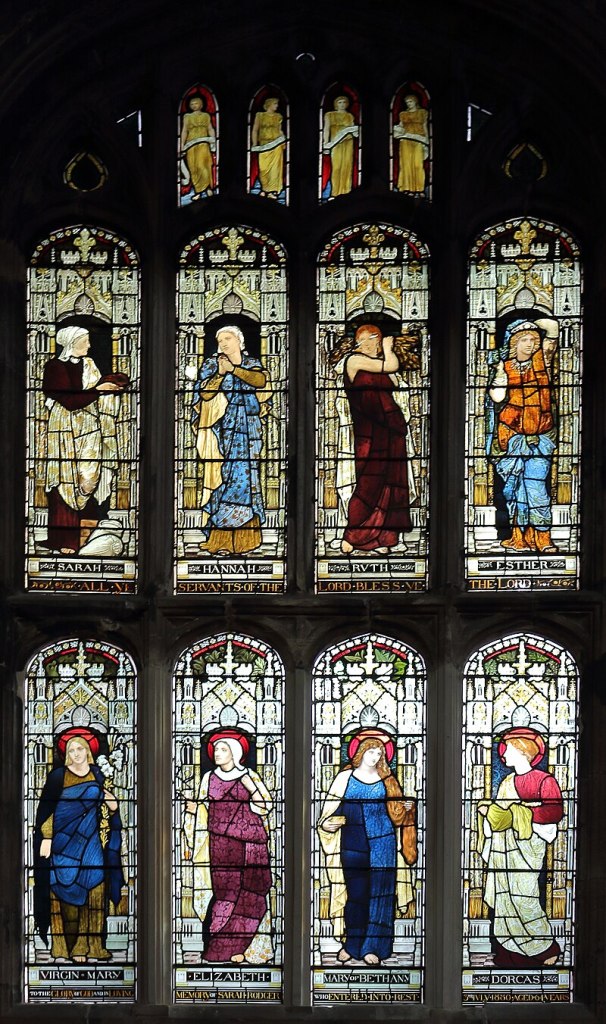
Window on the south wall of St Andrews just outside the Feilden chapel, by Henry Holiday and depicting Holy Women of the Old and New Testaments: Sarah, Hannah, Ruth and Esther in the top four panels and the Virgin Mary, Elizabeth, Mary of Bethany and Dorcas in the lower. By Rodhullandemu – Own work, CC BY-SA 4.0, https://commons.wikimedia.org/w/index.php?curid=73469366

Psalm 113

1 Praise the LORD! Praise, O servants of the LORD; praise the name of the LORD.
2
 Blessed be the name of the LORD from this time on and forevermore.
3
 From the rising of the sun to its setting, the name of the LORD is to be praised.
4
 The LORD is high above all nations and his glory above the heavens.
5
 Who is like the LORD our God, who is seated on high,
6
 who looks far down on the heavens and the earth?
7
 He raises the poor from the dust and lifts the needy from the ash heap,
8
 to make them sit with princes, with the princes of his people.
9
 He gives the barren woman a home, making her the joyous mother of children. Praise the LORD!

The God of the songs and stories of Israel is a God who turns the world upside down. The LORD of Israel is the one who is high above all nations and lords yet this God raises up the “triad of the wretched” (Bellinger, 2014, p. 490) the poor, the needy, and the barren. This is the LORD on high who lifts up the lowly. Psalm 113 echoes this paradoxical reality in Hebrew thought: the LORD is high above all things, and the LORD looks down and sees the lowliest of all things.

Psalm 113 begins and ends with Hallelujah (NRSV Praise the LORD!). Unlike the previous two psalms it is not an acrostic, instead it is a short poem with two easily discerned parts. In the first four verses the praising and honoring of the LORD is the focus. Verse five forms pivot where the psalmist asks, “Who is like the LORD our God, who is seated on high.” The final four verses consider how this LORD who is seated on high cares for the lowly.

The praise of the LORD in the first four verses continually mentions the LORD and the name of the LORD as the focus of the praise of the servants of the LORD. The name of the LORD, enshrined in the commandment to “not make wrongful use the name of the LORD your God,” (Exodus 20:7, Deuteronomy 5:11) is critical to the proper reverence of the God of Israel. Names in the ancient world were powerful things and this God whose name is to be praised at all times (from this time on forevermore and from the rising of the sun to its setting) was due the reverence afforded to the name of the LORD.[1] This God who is above all things and whose name is worthy of reverence is seated on high.

The LORD on high lifting up the lowly is easily seen in the English translations, but when the Hebrew is rendered in a more literal translation[2] the parallel is even clearer as J. Clinton McCann Jr. shows:

A more literal translation captures the effect; God “makes God’s self high in order to sit,” (v.5b) “makes God’s self low in order to see,” (v. 6a) “causes the poor to arise” (v.7a), “makes exalted the needy…to cause them to sit with princes.” (NIB IV: 1139)

God intervenes in the life of the poor, the needy and the barren woman. God uses God’s position and power to lift up the lowly. This is the God of Sarah. Rebekah, and Rachel in the book of Genesis, these formerly barren women who became the joyous mothers of children. This is the God of the exodus who took a poor and needy people out of their captivity through the wilderness into the promised land. This is the God who hears the song of Hannah (1 Samuel 2) and Mary (Luke 1:46-55) which both share common themes with the second half of Psalm 113.

Psalm 113 in modern Jewish life is the first of the “Egyptian Hallel” psalms which are utilized in the Passover celebration. It is possible that this was the psalm that Jesus and his followers sang before they went out to the Mount of Olives after the Last Supper (Mark 14:26). The Psalm resonates strongly with many of the themes of the ministry of Jesus, just as it resonates with the story, songs, and the law. As Deuteronomy reminds the people:

For the LORD your God is God of gods and Lord of lords, the great God, mighty and awesome, who is not partial and takes no bribes, who executes justice for the orphan and the widow, and who loves the strangers, providing them with food and clothing. (Deuteronomy 10: 17-18)

This short psalm captures a central theme of the Hebrew and Christian scriptures: the paradox that the God who is high over all things sees and lifts up the lowly.


[1] The four letters of the divine name given to Moses in Exodus 3:14 are behind the English translation of LORD in all capitol letters. The practice of translating this LORD comes from the practice of using the vowel pointings for ‘Adonai” (Hebrew lord) on the consonants in Hebrew so that the reader knows not to utter the name of the LORD the God of Israel.

[2] Translators have to make a difficult choice when rendering a language into another of how to balance the literal meaning of the words with the different syntax and expectations of the language they are translating into. A “wooden” or “literal” translation is often difficult to read or understand because Hebrew sentences often do not include elements that most English readers are used to.

Psalm 112 An Authentic Life Shaped by Wisdom

The Presentation of the Torah By Édouard Moyse – Own work Musée d’art et d’histoire du Judaïsme, CC BY-SA 4.0, https://commons.wikimedia.org/w/index.php?curid=41893002

Psalm 112 

1Praise the LORD! Happy are those who fear the LORD, who greatly delight in his commandments.
2Their descendants will be mighty in the land; the generation of the upright will be blessed.
3Wealth and riches are in their houses, and their righteousness endures forever.
4They rise in the darkness as a light for the upright; they are gracious, merciful, and righteous.
5It is well with those who deal generously and lend, who conduct their affairs with justice.
6For the righteous will never be moved; they will be remembered forever.
7They are not afraid of evil tidings; their hearts are firm, secure in the LORD.
8Their hearts are steady, they will not be afraid; in the end they will look in triumph on their foes.
9They have distributed freely, they have given to the poor; their righteousness endures forever; their horn is exalted in honor.
10The wicked see it and are angry; they gnash their teeth and melt away; the desire of the wicked comes to nothing.

Psalm 112 and Psalm 111 share a lot of commonalities. Both are acrostic poems with each cola beginning with successive letters of the Hebrew alphabet. They share commonalities in vocabulary[1] with each other and with wisdom literature in general. If Psalm 111 is the beginning of wisdom then Psalm 112 would be a life lived in wisdom. The fear of the LORD[2] here leads to a delighting in the commandments of the LORD and a life that is authentic and in harmony with God, society, and the creation.

Like Psalm 111 and 113, the first word of the psalm is Hallelujah (NRSV Praise the LORD). The acrostic poem begins with the second word asre (NRSV happy) which is a common indicator of wisdom literature. Like Psalm 1, which also begins with asre we are examining the contrast between a righteous life in harmony with God’s will for the world and a wicked life in conflict with God’s will. The Hebrew asre often translated ‘happy’ or ‘blessed’ or even ‘contented’ but the concept in Hebrew thought is closer to ‘wholeness’ or ‘completeness.’ This integrated life is a life of shalom, itself a word that has a much larger function than the standard English translation of peace. The way of wholeness and completeness is the way of wisdom. Those who ‘fear’ the LORD greatly delight in the LORD’s commandments. This is not a burdensome set of commands but the boundaries which provide the safe space where an individual can live a whole and integrated life.

The blessings of this whole person reflect the ideals of Hebrew thought. Abraham when he begins his journey with God is promised descendants, a blessing, house, land and prosperity and through his household all the nations will be blessed. For the ‘happy’ ones who follow the way of wisdom their descendants are mighty, their generation is blessed, their households are prosperous, and their righteousness endures. The Hebrew scriptures trust that God will provide for the righteous ones who follow God’s ways. Those who fear, love, and trust the LORD above all things will find that they have enough and even an abundance beyond what they need.

These wise and righteous ones reflect the God who they worship and serve. In Psalm 111 the LORD’s righteousness endures forever, and in verse three now the righteousness of these ‘happy’ ones endures forever. In Psalm 111 God was characterized as gracious and merciful and now these ones who fear the LORD are also gracious, merciful, and righteous. They become the image of the LORD they fear, obey, and worship. They become a light that reflects the light of the LORD for the upright in the darkness of the world.

This life of faithfulness is a life of generosity. They do not hoard what they have but deal generously and lend. They distribute freely and give to the poor trusting that God will provide what they need. They conduct their affairs in justice/righteousness[3] and that justice/righteousness has a gracious and merciful character. Their practices remain constant throughout their lives and they are examples who are remembered of a life well lived. They trust in the LORD and even in evil/wicked times they remain secure in their trust. Their horn, which is reflective of power and status, is exalted in honor.

In classical wisdom literature duality these ‘happy’ ones are contrasted with the wicked. The wise and the wicked are opposing ways of life. The wise life is generous and merciful while the wicked one does not care for the poor, does not live generously, and may aggressively attempt to take advantage of both the vulnerable and the generous righteous ones. Yet, the anger and aggression of the wicked melts away before the sustaining power of the LORD that the wise ones fear. The desire of the wicked comes to nothing.[4]

The way of wisdom in the Hebrew scriptures is a way of life that lives in harmony with God’s commandments. The law and wisdom are connected in Hebrew thought. The law provides the vision of a society where the weak are protected and harmony and peace are possible. A way that is wise fears and reverences the LORD, the God of Israel and reflects the generous and merciful nature of that God. It trusts that even when the wicked seem to prosper that their foolish path will lead to their demise.


[1] Nancy deClaissé-Walford notes eleven key terms and phrases that occur in both relatively short psalms including: fear, delight in, upright, good, gracious, merciful, righteousness, remember, steady, give, and for all time. (Nancy deClaisse-Walford, 2014, p. 843)

[2] See the discussion of the Hebrew word yare translated fear in English in my notes on Psalm 111.

[3] The Hebrew tsaddik is a key idea in the Hebrew Scriptures. Both justice and righteousness emerge from the family of terms in Hebrew, like the Greek dikaios/dikaisune.

[4] This is the same word that ends Psalm 1, ‘abad which means to perish.

Psalm 111 The Beginning of Wisdom

An Old Woman Reading, Probably the Prophetess Hannah by Rembrandt (1631)

Psalm 111

1Praise the LORD! I will give thanks to the LORD with my whole heart, in the company of the upright, in the congregation.
2Great are the works of the LORD, studied by all who delight in them.
3Full of honor and majesty is his work, and his righteousness endures forever.
4He has gained renown by his wonderful deeds; the LORD is gracious and merciful.
5He provides food for those who fear him; he is ever mindful of his covenant.
6He has shown his people the power of his works, in giving them the heritage of the nations.
7The works of his hands are faithful and just; all his precepts are trustworthy.
8They are established forever and ever, to be performed with faithfulness and uprightness.
9He sent redemption to his people; he has commanded his covenant forever. Holy and awesome is his name.
10The fear of the LORD is the beginning of wisdom; all those who practice it have a good understanding. His praise endures forever.

The next three psalms all begin with the word Hallelujah.[1] Psalms 111 and 112 are also acrostic poems with each cola[2] beginning alphabetically with the next letter of the Hebrew alphabet (after the initial Hallelujah). Most previous acrostic poems have been by verse, but here there are twenty-two cola after the initial word. The acrostic form was used in the book of Lamentations to provide a sense of order to the disordered world of the poet, but in the Psalms acrostic poems are often used to focus on wisdom, describing how life should be lived. For most Hebrew people the organizing center of wisdom is the law (torah) which will be the focus of the acrostic of acrostic poems, Psalm 119. For Psalm 111 the beginning of wisdom is the fear (see below) of the LORD and that is organized around the ‘works of the LORD’ and the ‘works of the people’ in response to the LORD.

A key word for the poem is ‘works’ (Hebrew ma’asim) which occurs in verses 2, 6, and 7 with the same root being used in 4 (NRSV wonderful deeds) and a synonym being used in verse 3. Then the same word is used in verse 8 and 10 (NRSV practice, perform) for the faithful ones responding to the work of the LORD. Wisdom here is recognizing the ‘works of the LORD’s hands’ which are established ‘forever and ever’ and ‘working’ in faithfulness and uprightness. The psalmist when referring to the ‘wonderful deeds’ of God likely has in mind the defining story of the Hebrew people, the exodus where God brings the people out of Egypt and into the promised land.[3] Yet, God’s provision of food, mindfulness to the covenant, demonstrating God’s power before the nations, and granting the people a heritage or inheritance from the nations is an ongoing action. God is known by what ‘works’ God has done, or as Philip Melanchthon would famously say in the 1500s, “that to know Christ is to know his benefits.” (Melanchthon, 2014, p. 24)

The best-known line of this psalm is “the fear of the LORD is the beginning of wisdom.” The Hebrew word for fear (yare’) encompasses a larger meaning than our English fear. As Nancy deClassé-Walford states it also means:

“awe, reverent, respect, honor.” It appears in Hebrew as a synonym for “love.” (‘ahab, Deut 10:12); “cling to” (dabaq, Deut 10:20); and “serve” (‘abad, Deut 6:13; Josh 24:14) (Nancy deClaisse-Walford, 2014, p. 841)

Knowing the ‘works’ of God and performing these works should lead to honor and awe, respect and honor, service and love. Wisdom that has good understanding can, to use Martin Luther’s explanation of the first commandment, “fear, love, and trust God above all things.” The ‘fear of the LORD’ leads the poet to ‘give thanks to the LORD with their whole heart.’ This is what a wisely practiced life looks like.


[1] ‘Praise the LORD” (NRSV). Hallelujah is a compound word of the verb to praise (hallel) and the first half of the name of God (yah from Yahweh). Some scholars believe that the final verse of Psalm 113 was originally the opening verse of Psalm 114 which would make four psalms which begin with Hallelujah, but as we have received the text we have three psalms beginning with Hallelujah and with Psalm 113 opening and closing with the word.

[2] Hebrew poetry breaks lines into cola. This is often reflected in the printing of poetic portions of scripture in how they are displayed. Psalm 111 in most bibles is easily divided this way because each on begins alphabetically with the next letter of the Hebrew alphabet (excluding verse 1a ‘Hallelujah’). In this poem the cola are marked by punctuation (comma, semi-colon, or period).

[3] Wonderful deed (Hebrew nipla’ot) is often used to refer to God’s works at that time (Exodus 3:20; 15:11; Psalm 77: 11, 14). (NIB IV:1133)

Lamentations 2 Speaking Up For Daughter Zion

Christ and the Sinner by Andrey Mironov -2011 Oil on Canvas, CC BY-SA 4.0, https://commons.wikimedia.org/w/index.php?curid=30518018

Lamentations 2

1How the Lord in his anger has humiliated daughter Zion! He has thrown down from heaven to earth the splendor of Israel; he has not remembered his footstool in the day of his anger.
2The Lord has destroyed without mercy all the dwellings of Jacob; in his wrath he has broken down the strongholds of daughter Judah; he has brought down to the ground in dishonor the kingdom and its rulers.
3He has cut down in fierce anger all the might of Israel; he has withdrawn his right hand from them in the face of the enemy; he has burned like a flaming fire in Jacob, consuming all around.
4He has bent his bow like an enemy, with his right hand set like a foe; he has killed all in whom we took pride in the tent of daughter Zion; he has poured out his fury like fire.
5The Lord has become like an enemy; he has destroyed Israel. He has destroyed all its palaces, laid in ruins its strongholds, and multiplied in daughter Judah mourning and lamentation.
6He has broken down his booth like a garden, he has destroyed his tabernacle; the LORD has abolished in Zion festival and sabbath, and in his fierce indignation has spurned king and priest.
7The Lord has scorned his altar, disowned his sanctuary; he has delivered into the hand of the enemy the walls of her palaces; a clamor was raised in the house of the LORD as on a day of festival.
8The LORD determined to lay in ruins the wall of daughter Zion; he stretched the line; he did not withhold his hand from destroying; he caused rampart and wall to lament; they languish together.
9Her gates have sunk into the ground; he has ruined and broken her bars; her king and princes are among the nations; guidance is no more, and her prophets obtain no vision from the Lord.
10The elders of daughter Zion sit on the ground in silence; they have thrown dust on their heads and put on sackcloth; the young girls of Jerusalem have bowed their heads to the ground.
11My eyes are spent with weeping; my stomach churns; my bile is poured out on the ground because of the destruction of my people, because infants and babes faint
 in the streets of the city.
12They cry to their mothers, “Where is bread and wine?” as they faint like the wounded
 in the streets of the city, as their life is poured out on their mothers’ bosom.
13What can I say for you, to what compare you, O daughter Jerusalem? To what can I liken you, that I may comfort you, O virgin daughter Zion? For vast as the sea is your ruin; who can heal you?
14Your prophets have seen for you false and deceptive visions; they have not exposed your iniquity to restore your fortunes, but have seen oracles for you that are false and misleading.
15All who pass along the way clap their hands at you; they hiss and wag their heads
 at daughter Jerusalem; “Is this the city that was called the perfection of beauty, the joy of all the earth?”
16All your enemies open their mouths against you; they hiss, they gnash their teeth, they cry: “We have devoured her! Ah, this is the day we longed for; at last we have seen it!”
17The Lord has done what he purposed, he has carried out his threat; as he ordained long ago, he has demolished without pity; he has made the enemy rejoice over you, and exalted the might of your foes.
18Cry aloud to the Lord! O wall of daughter Zion! Let tears stream down like a torrent day and night! Give yourself no rest, your eyes no respite!
19Arise, cry out in the night, at the beginning of the watches! Pour out your heart like water
 before the presence of the LORD! Lift your hands to him for the lives of your children, who faint for hunger at the head of every street.
20Look, O LORD, and consider! To whom have you done this? Should women eat their offspring, the children they have borne? Should priest and prophet be killed in the sanctuary of the Lord?
21The young and the old are lying on the ground in the streets; my young women and my young men have fallen by the sword; in the day of your anger you have killed them, slaughtering without mercy.
22You invited my enemies from all around as if for a day of festival; and on the day of the anger of the LORD no one escaped or survived; those whom I bore and reared my enemy has destroyed.

Within these first two connected poems there are three primary figures: the narrator (or the poet), daughter Zion (Jerusalem personified) and the LORD who was once the divine protector of daughter Zion but has now become her humiliator and destroyer. In the first poem (Lamentations 1) the voice of the poem was split equally between the narrator (poet) and daughter Zion. The narrator in Lamentations one attempted to remain detached and narrate the plight of the broken relationship between daughter Zion and the LORD, while daughter Zion spoke out of the desolation of herself and her people. Ultimately throughout the poems of Lamentations the LORD remains an unspeaking figure, but that does not mean that daughter Zion’s words spoken to both the LORD and those she once believed as friends go unheard and her plight goes unobserved. In this second poem the narrator, once content with reporting on her fall, can no longer remain a detached observer. Her plight has undone him and now he steps into the space between daughter Zion and the God of Israel.

An important difference between the first and second poem is the way the narrator refers to the God of Israel. In English translations of the Hebrew Scriptures when the English word LORD is capitalized throughout the word[1] the four Hebrew consonants for the name of God (YHWH) given to Moses is behind the translation with the vowels pointed to tell the speaker to pronounce the word as ‘Adonai.’[2] Yet, if you look closely at your English translation you should notice that most of the occurrences of Lord in this poem are not capitalized throughout. There are six occurrences of the divine name, but every other time it is ‘Adonai’ which is normally translated Lord. This can be as simple as calling someone “Sir” or “master” in deference or it can be an indication of rank, but it is not the normal way the prophets, poets, and narrators of the Hebrew Scriptures refer to God. Combining this observation with the content of the poem there seems to be a gap introduced between the narrator and the LORD.

Perhaps to the poet this Lord who has become an enemy is no longer acting like the LORD the God of Israel is supposed to act. Previously this narrator pointed out the unfaithfulness of daughter Zion but looking upon her desperate plight he cannot remain silent. He is committed to raising his voice the Lord may hear him. Roughly half of the utilizations of the word ‘Zion’ in the book of Lamentations occur in this second poem. (Goldingay, 2022, p. 84) This narrator steps into the space between Zion and her Lord and demands the Lord to see the impact of his anger. Perhaps this mighty God does not realize the damage that has been done and so this poet in forceful verbs attempts to gain a hearing for daughter Zion who has been humiliated and thrown down from heaven to earth. Like a child throwing a tantrum Jerusalem (or the temple)[3] has been kicked about unremembered in the wrath of this God. This Lord has destroyed, broken down, and brought down to the ground. He cut down and removed his restraining hand from daughter Zion’s enemies, but rather than passively allowing her enemies to triumph the Lord has become her enemy, burning and consuming, drawing back his bowstring to strike, killing and pouring out his fury like fire. That which was supposed to stand forever has been carelessly dismantled like a booth or tent. Stronghold and temple, kings and priests, young and old, men and women, walls and dwellings all lay ruined. Yet, in the midst of all this devastation there is no word of the LORD coming to the prophets. God’s voice remains silent as God’s devastation leaves the elders of Zion and the young girls of Jerusalem sitting on the ground in silence. The elders and the young girls represent the two extremes of the population, and the poet wants us to see a shattered people reduced to sitting in the dust of the earth in sackcloth and mourning.

In Lamentations 1:20 daughter Zion stated that “her stomach churned within her,” and now this narrator forced to hear her plea and see her plight shares her emotional reaction. In verse eleven the poet reports that his eyes are spent with weeping; my stomach churns; my bile is poured out on the ground. The poet cannot stay detached in the face of this violence against his own people. He is one of them. The children who are dying are the future of his people. The suffering of these young children with nothing to eat and nothing to drink has turned his stomach. Mothers who are powerless to prevent the starvation of their own children fill their eyes with tears. His words may not be able to comfort daughter Zion, but perhaps they can rouse her Lord to pay attention to the damage his unrestrained wrath has done. Daughter Zion through the first poem was referred to by the narrator in third person, but now he sees, and she is now the ‘you’ of his direct address. Daughter Zion who in the previous poem was implied to be adulterous has become virgin daughter Zion, one who is suffering innocently.

The poet points to the prophets who failed by giving the people false visions that allowed them to persist in their disobedience. They covered over the failings in the relationship between the people and their God and perhaps worked against prophets like Jeremiah who attempted to speak the truth. Yet, these now silent prophets are replaced by enemies who gloat at the way they have destroyed Jerusalem. The poet knows that it is the Lord who opened his mouth and allowed this to happen. The enemies who waited for this day did not know they were participating in the premeditated act of destruction unleashed by the anger of their God.  

The narrator calls for the walls of the city to cry out to the Lord as the poet himself is crying out. The identity of their God is one who sees and hears, and their only deliverance is in God turning from God’s action. This destroyed wall of Jerusalem becomes a ‘wailing wall’. (Goldingay, 2022, p. 113) The city and the poet refuse to remain silent amid their weeping and stomach-turning reality. They now stand together calling on their Lord to once again be the LORD who rescues, delivers, protects, and provides.

Kathleen O’Connor views the voice of the poem returning to daughter Zion in verse twenty (NIB VI: 1043) but the poem is not explicit about a voice change and for me retaining the entire poem in the narrator’s voice makes logical sense. This narrator who once stood observing both daughter Zion’s disobedience and punishment now has come to her side and asks the LORD (and it is the divine name used here) to look and consider if God’s actions are just or proportional. The question to whom have you done this is even more direct in Hebrew. Kathleen O’Connor indicated that even ‘who have you ever treated (‘alal) like this’ needs to be strengthened because ‘alal suggests affliction and abuse. (NIB VI: 1043) and the word for children (‘ol ale) parallels this word for affliction. Even in English the implication of the Lord being responsible for a starvation so vast that it forces women into cannibalism, creating a reality where priests and prophets are slain in the holy place of the temple and that young and old die indiscriminately is a bold claim, but it is also a claim that fits within the language of Jeremiah and the Psalms. The young men and young women have died in the streets, the future itself is dying, and it is the Lord’s fault. Instead of allowing the people to celebrate the festivals to the LORD, now it is the enemies who are invited to Jerusalem to celebrate. But the LORD, the protector, has transformed in his fury into the Lord who is now the enemy of daughter Zion, and by extension the narrator who speaks up for her.

These poems in Lamentations attempt to make sense of a reality turned on its head. Their world has collapsed. Jerusalem, the king, the priests and prophets, the temple, and the land have all been devastated. Children, men and women in their prime, and the elders have all fallen victim to starvation and the sword. As Kathleen O’Connor states eloquently:

They (the poems of Lamentations) create a rhetoric of fury, a swirling language of pain, distrust, and betrayal, both divine and human. In this language what is awry and causes unspeakable suffering is the way that God relates to humans, the way God has abandoned covenant mutuality and faithfulness. This causes profound rage. (NIB VI:1043)

Yet, even in this profound rage the poet and the city cry out to the Lord. The desire God to turn from God’s anger and see the devastation God has wrought and to repent. They may feel that God’s actions and anger have gone too far, that God has abandoned God’s covenant responsibilities just as they had done. This second acrostic poem is an exercise of attempting to bring order to a disordered world. Of utilizing words to speak of a suffering which surpasses what words can communicate. Their world, their home, their lives, and their relationship with their God is broken. They speak these words into the silence of the void waiting for an answer from their LORD which they have not received.


[1] Many printings of English bibles will use drop cap for this where the first L is in the normal font size and the ORD drops down one font size.

[2] In Hebrew the vowels were added later and are above and below the consonants. This is done to not casually pronounce the divine name in keeping with the commandment of not using the name of the LORD your God in vain.

[3] Footstool often is used to refer to the cover of the ark of the covenant and by extension the temple or Zion as a whole.

Introduction to Lamentations

Jeremiah Lamenting the Destruction of Jerusalem by Rembrandt van Rijn 1630

I have intentionally worked my way through several books normally overlooked by Christian readers and leaders in our scriptures. The book of Lamentations for most of its history would qualify as an underutilized book within the scriptures we share with our Jewish Ancestors. Although there has been some recent scholarly interest in these five poems, for the average person of faith the name of the book is probably enough to scare the casual reader away. Yet, I do believe that we neglect the breadth of scripture to our own detriment. Over the thirteen years I’ve been writing on signoftherose I’ve gained a much greater appreciation for the wisdom of Hebrew poetry and the open and honest dialogue between God and God’s people that our scriptures capture.

Having worked through Psalms 1-110 and Song of Songs (or Song of Solomon) has given me a much greater appreciation of Hebrew poetry, and Lamentations is poetry. Lamentations is five poems, four of which are structured as acrostics[1] which move sequentially through the twenty-two letters of the Hebrew alphabet and the final poem’s twenty-two lines while not acrostic matches the twenty-two verse format of an acrostic. The acrostic form is often used to denote the completion of a thought, but due to the tragic event that evokes these poems it is also may be a tool to provide structure during a traumatic time.

Gwen Sayler and Ann Fritschel, my Hebrew Bible instructors twenty-five years ago at Wartburg Seminary used to joke that the answer to any question in the Hebrew Scriptures was likely to be the Babylonian exile. This event reshaped the Hebrew people when the Davidic king is sent into exile as well as the people. They mourn the loss of their land, the temple, and Jerusalem. Having worked through both Jeremiah and Ezekiel, which bracket Lamentations in the Christian arrangement of scriptures, has involved me dwelling in the writings of this period around 587 BCE. Lamentations current position after Jeremiah is due to the traditional attribution of these poems to Jeremiah.

The Hebrew name of this short book of poems is Eikha which comes from the first word of the first poem. Eikha is the elongated form of the word eikh which means “how?” How has this disaster happened to the people. This question would consume the two long prophetic books of Jeremiah and Ezekiel, the Deuteronomic historical retelling of the narrative of 1 & 2 Kings which climaxes at the exile at the end of the narrative, and several psalms most notably Psalm137. How has the relationship between God and God’s people come to this point where the central symbols of the people have collapsed: the Davidic monarchy, the city of Jerusalem (Zion), the land, and the temple built by Solomon. As the people find themselves as strangers in strange lands they have to rediscover what it means to be the people of the covenant.

Lamentations is a book with theological implications, but it is not attempting to be systematic. It is emotional, as it should be. Its voice is the voice of the wounded people of a lost city seeing through tear-filled eyes. It may be utilizing structure to help make sense of the chaotic, but it is a book shaped by grief and broken hearts. As John Goldingay states, “Lamentations is a “mandate to question.”” (Goldingay, 2022, p. 30) Theologically Lamentations assumes, like much of Hebrew literature, that the God of Israel is responsible for everything that occurs. Although Lamentations understands that the cause of the exile is the covenant unfaithfulness of Israel to their God, they protest and plead with God to change God’s mind and reverse the punishment they are receiving. Ultimately for the poet or poets of Lamentations their physical and emotional problems are a result of their relational problems with their God.

Resources Used For This Journey

Harvey Cox and Stephanie Paulsell, Lamentations and The Song of Songs. Belief Commentary on the Bible. Louisville: Westminster John Knox Publishing Company,2012.

The Belief Commentary series is a theological commentary written by theologians rather than biblical scholars. Harvey Cox did the Lamentations half of this commentary and uses Lamentations as a springboard into a wide range of theological topics. I read this commentary initially when I was working through Song of Songs.

John Goldingay, The Book of Lamentations. (New International Commentary on the Old Testament series). Grand Rapids: William B. Eerdman’s Publishing Company, 2022.

The NICOT series of commentaries have often been helpful textual commentaries, and when looking for a volume to assist with the language as well as the historical background these have often been helpful. John Goldingay is a scholar who has written extensively on Jeremiah and the literature associated with Jeremiah.

Kathleen M. O’Connor, “Book of Lamentations” in The New Interpreter’s Bible. Volume VI. Nashville, Abingdon Press, 1996.

The NIB is a solid all-around commentary on the entire bible and apocrypha. It is designed for pastors and those leading in congregations, so it does not normally engage the textual issues as deeply as the NICOT or Anchor Bible commentaries.

Ziegler, Yael, Lamentations: Faith in a Turbulent World. Maggid Studies in Tanakh. Jerusalem. Maggid Books, 2021.

When I can I attempt to utilize a Jewish scholar when reading the scriptures that we share. The Maggid Studies I have utilized in the past have been approachable but also provide a window into perspectives that most Christian scholars may not explore.


[1] Chapter three is acrostic but instead of one verse per letter there are three verses.

Psalm 104 Praise the Great God of Creation

Sun over Lake Hawea in New Zealand By Michal Klajban – Own work, CC BY-SA 4.0, https://commons.wikimedia.org/w/index.php?curid=78855569

Psalm 104

 1Bless the LORD, O my soul. O LORD my God, you are very great. You are clothed with honor and majesty,
 2wrapped in light as with a garment. You stretch out the heavens like a tent,
 3you set the beams of your chambers on the waters, you make the clouds your chariot, you ride on the wings of the wind,
 4you make the winds your messengers, fire and flame your ministers.
 5You set the earth on its foundations, so that it shall never be shaken.
 6You cover it with the deep as with a garment; the waters stood above the mountains.
 7At your rebuke they flee; at the sound of your thunder they take to flight.
 8They rose up to the mountains, ran down to the valleys to the place that you appointed for them.
 9You set a boundary that they may not pass, so that they might not again cover the earth.
 10You make springs gush forth in the valleys; they flow between the hills,
 11giving drink to every wild animal; the wild asses quench their thirst.
 12By the streams the birds of the air have their habitation; they sing among the branches.
 13From your lofty abode you water the mountains; the earth is satisfied with the fruit of your work.
 14You cause the grass to grow for the cattle, and plants for people to use, to bring forth food from the earth,
 15and wine to gladden the human heart, oil to make the face shine, and bread to strengthen the human heart.
 16The trees of the LORD are watered abundantly, the cedars of Lebanon that he planted.
 17In them the birds build their nests; the stork has its home in the fir trees.
 18The high mountains are for the wild goats; the rocks are a refuge for the coneys.
 19You have made the moon to mark the seasons; the sun knows its time for setting.
 20You make darkness, and it is night, when all the animals of the forest come creeping out.
 21The young lions roar for their prey, seeking their food from God.
 22When the sun rises, they withdraw and lie down in their dens.
 23People go out to their work and to their labor until the evening.
 24O LORD, how manifold are your works! In wisdom you have made them all; the earth is full of your creatures.
 25Yonder is the sea, great and wide, creeping things innumerable are there, living things both small and great.
 26There go the ships, and Leviathan that you formed to sport in it.
 27These all look to you to give them their food in due season;
 28when you give to them, they gather it up; when you open your hand, they are filled with good things.
 29When you hide your face, they are dismayed; when you take away their breath, they die
 and return to their dust.
 30When you send forth your spirit, they are created; and you renew the face of the ground.
 31May the glory of the LORD endure forever; may the LORD rejoice in his works —
 32who looks on the earth and it trembles, who touches the mountains and they smoke.
 33I will sing to the LORD as long as I live; I will sing praise to my God while I have being.
 34May my meditation be pleasing to him, for I rejoice in the LORD.
 35Let sinners be consumed from the earth, and let the wicked be no more. Bless the LORD, O my soul. Praise the LORD!

This psalm and its predecessor are linked by their common opening and closing, “Bless the LORD, O my soul (nephesh).”  The pairing of these psalms reminds me of a table prayer that I taught my children as they were growing up, “God is great, God is good, and we thank God for our food.”  As Rolf A. Jacobson can state,

Whereas the central theological witness of Psalm 103 is that God is good (that is, the Lord is a God of hesed), the driving witness of Psalm 104 is that God is great. (Nancy deClaisse-Walford, 2014, p. 774)

This psalm looks in doxological wonder at the beauty, majesty, and order of God’s creation and exuberantly pours out praise at the greatness of the God who created the heavens and the earth. Like earlier psalms that marveled in the intricate connections and scale of creation, the psalmist joins their voice as a humble offering amidst the chorus of creation.

When modern people talk of creation our typical mode of thought is scientific and explanatory. The debate between creationists who try to limit God’s creation to the seven days of Genesis 1 and evolutionists arguing for a natural evolution of the universe are both framed by the language of modernity, a language which would be foreign to the scriptures. The biblical way of approaching the creation is the language of poetry and praise, wonder and curiosity. The entire direction of both the biblical narratives of creation in Genesis 1-2 and the places where the bible poetically wonders at the creation is oriented on giving praise, honor, glory, and majesty to the God of creation. This poem shares the characteristic joyfulness of the faithful ones throughout the scriptures reflecting on God’s own joy at the good creation.

Both Psalm 104 and the Genesis narratives utilize and subvert the mythological language found in the creation myths throughout the Middle East. While the Lord’s chambers are established upon the waters, an image of chaos throughout the Middle Eastern mythologies, both Genesis and the Psalms have the LORD bringing order out of chaos in a non-violent manner. Light and heavens, waters and wind, fires and flames, clouds and earth all become ordered to form the dominion of God and all the elements are brought together to build and serve the order of God. The waters rise up like a garment and though they can cover the mountains they flee at God’s rebuke and are bound and contained. The chaotic waters that threatened to flood the earth become the lifegiving seas and waters which provide for the plants of the earth and the animals of the field.

The psalmist delight’s in “God’s superabundant liberality”[1] and imagines God looking with delight upon the majestic creation. The lens of the psalmist begins his reflection on the works[2] of God’s hands with agricultural images that would likely be closest to their daily experience. God causes grass to grow for cattle, and plants that people harvest that bring forth the food that people eat. God is great and God is good, and they thank God for the food that God provides. God provide for the necessities of life but also for the joyous things: wine to gladden the human heart, oil for the human face, and bread to strengthen the heart.[3] Yet, the reflection on the works of God do not end with the immediate benefits for human society. God provides for the trees and the birds that live in them, wild goats and rabbits. There is a time for everything, daytime and nighttime for humanity and the creatures of the forest, days marked by the sun and seasons marked by the moon. The lion, the representative great beast of the forest, humanity works in the city and fields, and Leviathan the great beast of the sea all joins in the noise of creation calling out to God. Leviathan, the great chaos monster that was a threat to the gods in other societies, is now merely a plaything of the LORD. The great lion of the forest and the dragon of the sea have been tamed by the creating LORD upon whom both depend.  Lion, humanity, and Leviathan all know that God is great, and God is good, and it is the LORD who they thank for the food that God provides in due season.

Yet, the creation is dependent upon God’s continual attention and sustainment. Hebrew thought has no conception of the modern image of a god who created the universe as a clockmaker creates a clock, winds it up and then departs. The creation remains dependent upon God’s face being turned towards it and God’s breath[4] residing within and animating the creature. Humanity and all creation are completely dependent upon the continued provision of the LORD which animates the creatures and renews the face of the ground. The face of the ground looks up in adoration at the face of the LORD which provides for it. The earth trembles at the attention of the LORD and the touch of God’s finger upon the mountain causes them to smoke.

The psalmist sings his song amid the majesty of creation as an offering to the LORD. The penultimate line where the psalmist asks for “sinners to be consumed from the earth, and let the wicked be not more” may seem like a discordant note to end the psalm with, but within the ordered world of creation and God’s justice and righteousness there is no space for those who undermine the order of creation. Hebrew wisdom does separate good from evil, righteous from sinners, wise from foolish, and the faithful from the wicked. Yet, the LORD is both good and great, providing life, food, and joy for all of creation, and the psalmists humble meditation tries to with their humble offering of praise to bring a little joy to the creator. Their whole life[5] is involved with blessing and praising the good and great God of creation.

Cecil Alexander’s joyous song “All Things Bright and Beautiful” echoes the emotion and orientation of this psalm:

All things bright and beautiful, all creatures great and small, all things wise and wonderful, the Lord God made them all.

And in the final verse of this song, after reflecting on creation from the smallness of flowers to the majesty of the mountains, Cecil Alexander’s words come back to the human standing amid the wonders of God’s works:

God gave us eyes to see them, and lips that we might tell how great is God Almighty, who has made all things well.

Or in the words of the psalmist, Bless the LORD, O my soul (nephesh). Praise the LORD. May our eyes, lips, and entire being continually live in wonder at the greatness of the creation that God’s hands formed, at the faithfulness of God continuing to look upon the face of the earth and sending forth the ruach (wind, spirit, breath) which continues to animate and sustain the creation and to respond in praise.


[1] John Calvin’s term. (Bellinger, 2014, p. 446)

[2] Works, Hebrew ‘asa, is an important concept in the poem which is sometimes translated make (s)/made (v. 4, 19, 24b) and other times as works (v. 13, 31). (NIB VI: 1096)

[3] Worth noting that the heart in Hebrew is not the instrument of emotion but of will and decision.

[4] This is the Hebrew ruach which can also mean spirit or wind. All creation in both Genesis 1 and Psalm 104 is dependent upon the ruach which originates in God. English translates ruach as breath and spirit in successive verses obscuring this connection.

[5] Hebrew nephesh is not simple the Greek concept of soul but encompasses all of life.

Psalm 102 The Song of One Suffering in Solitude

Job (oil on canvas) by Bonnat, Leon Joseph Florentin (1833-1922)

Psalm 102

A prayer of one afflicted, when faint and pleading before the LORD.
 1Hear my prayer, O LORD; let my cry come to you.
 2Do not hide your face from me in the day of my distress. Incline your ear to me; answer me speedily in the day when I call.
 3For my days pass away like smoke, and my bones burn like a furnace.
 4My heart is stricken and withered like grass; I am too wasted to eat my bread.
 5Because of my loud groaning my bones cling to my skin.
 6I am like an owl of the wilderness, like a little owl of the waste places.
 7I lie awake; I am like a lonely bird on the housetop.
 8All day long my enemies taunt me; those who deride me use my name for a curse.
 9For I eat ashes like bread, and mingle tears with my drink,
 10because of your indignation and anger; for you have lifted me up and thrown me aside.
 11My days are like an evening shadow; I wither away like grass.
 12But you, O LORD, are enthroned forever; your name endures to all generations.
 13You will rise up and have compassion on Zion, for it is time to favor it; the appointed time has come.
 14For your servants hold its stones dear, and have pity on its dust.
 15The nations will fear the name of the LORD, and all the kings of the earth your glory.
 16For the LORD will build up Zion; he will appear in his glory.
 17He will regard the prayer of the destitute, and will not despise their prayer.
 18Let this be recorded for a generation to come, so that a people yet unborn may praise the LORD:
 19that he looked down from his holy height, from heaven the LORD looked at the earth,
 20to hear the groans of the prisoners, to set free those who were doomed to die;
 21so that the name of the LORD may be declared in Zion, and his praise in Jerusalem,
 22when peoples gather together, and kingdoms, to worship the LORD.
 23He has broken my strength in midcourse; he has shortened my days.
 24“O my God,” I say, “do not take me away at the midpoint of my life, you whose years endure throughout all generations.”
 25Long ago you laid the foundation of the earth, and the heavens are the work of your hands.
 26They will perish, but you endure; they will all wear out like a garment. You change them like clothing, and they pass away;
 27but you are the same, and your years have no end.

 28The children of your servants shall live secure; their offspring shall be established in your presence.

Psalm 102 is described in its superscription as a prayer of one afflicted, when faint and pleading before the LORD. This type of description is unusual among the psalms. It doesn’t indicate an author to attribute the psalm to, nor does it give instructions for its performance or a reference to a scriptural story that the psalm comes from. This psalm of a suffering one who is alienated from their body, from society, and ultimately from God may have been intended as a psalm that any suffering individual could recite at times where their situation seemed hopeless, and God’s help seemed far away. Imagery of impermanence, loneliness, pain, and shame permeate the complaint of the psalm, but like many psalms of complaint there is a turn towards hope. The psalmist intuits that the answer, “to human finitude and mortality is divine infinitude and immortality.” (Nancy deClaisse-Walford, 2014, p. 754)

The opening language of the psalm resonates with appeals throughout the psalter as Rolf A. Jacobson notes:

The opening appeal to be heard employs language quite typical of these entreaties—hear my prayer, let my cry come unto you (39:12), do not hide your face (27:9; 143:7), turn your ear towards me (31:2; 71:2), make haste to answer me (69:17; 143:7) (Nancy deClaisse-Walford, 2014, p. 751)

Although Rolf Jacobson attributes this to intentionally creating a generic composition for use in the community, the use of familiar language may also reflect a person shaped in the communal worship which utilizes these psalms. The language of prayer and faith is shaped in the worshipping community which shaped the psalmist’s faith and life. Yet, now in a time when the author is alienated from their own physical body, from the community, and from God, they turn to the words that shaped their life when they were physically, socially, and religiously whole.

The psalm moves between personal complaints about their own health and isolation, “I complaints” in Westermann’s terminology, complaints about the actions of isolation and persecution by those in the psalmist’s society, “they complaints”, and complaints about the way that God is treating the psalmist, “you complaints.”[1] The personal complaints begin with an image of transience that reminds me of Ecclesiastes frequently used term hebel (vanity, emptiness). Hebel literally means smoke, mist, or vapor but is often used metaphorically to refer to the emptiness of life.[2] Now for the psalmist their days pass away like smoke and their bones burn like a furnace. Their life down to their very bones is going up in smoke while their heart withers like grass and they are too far gone to even eat the bread that could give them strength.  Their songs have turned to groans and their body now is transforming into a (barely) living skeleton. We don’t know if they were suffering from an illness, but they attribute their suffering to God’s judgment upon them. Their suffering is also done in isolation, they are like an unclean owl of the wastelands or a lonely bird on a roof. These lonely images of birds heighten the feeling of the psalm, for the sufferer is not only weak but they are abandoned.

The social complaints are also sharply worded as the psalmist’s unnamed name is synonymous with a curse among their enemies. Their personal weakness and isolation are viewed in the society as a curse from God, and enemies have taken advantage of this weakness. The only nourishment left for this abandoned one is the bread of ashes and the drink of tears.  Yet, behind both the physical pain and suffering and the social isolation is the LORD. We are never told of any sin that this poet has committed, but they view their suffering because of God’s anger and distance. In the words of the psalm God has cast the suffering one aside and yet hope resides in God repenting from God’s attitude towards the psalmist, turning the face and hearing with the ear and responding with grace and healing.

In contrast to the evanescent position of the psalmist is the strength and might of the LORD. The psalmist now joins his fate to the action of God to have compassion on Zion. It is possible that this psalm originates in the time of the exile where there is hope for the rebuilding of Zion and rescue the people from the destitute position as exiles in a foreign land. Yet, even without the context of the Babylonian exile, the turn to hope is based on the faithfulness of God for the people and a belief that God’s anger lasts only a moment, but God’s favor is for a lifetime.[3] The poet’s strength may have been broken in the middle of their life by God’s action, but if God wills it will be renewed. The heavens and the earth which seem so permanent to humanity are like a garment that can easily be changed by the powerful and permanent God. God will continue to endure and only in God can this suffering one hope to find a renewed physical, social, and religious life. The psalmist claims their familial bond to the LORD the God of Israel and now awaits the parental turning of their God to the children of God’s servants.


[1] Rolf A. Jacobson notes this helpful pattern citing Westermann, The Psalms (54-57). (Nancy deClaisse-Walford, 2014, p. 752)

[2] Psalm102 does not use the term hebel but the combination of words of impermanence create a similar resonance for me as Ecclesiastes.

[3] Psalm 30:5.

Communio: A Poem


 candle

There are times when the words and symbols spark
Lighting up our world, illuminating the dark
And in our mundane world magic appears
To strengthen resolve or to calm our fears
With a community of saints on holy ground
Where the remnants of ancient faith are found
 
In those rare times, you can almost feel
The mystery hiding behind the real
Where good and evil struggle and strive
And God and the devil are still alive
Where water and wine and flesh and stone
Unite us together. We are not alone
 
Where God’s presence has come to earth to dwell
And deep runs the water in the spiritual well
Where hope emerges from the pain
And the drought ends in heavenly rain
Where we see again the world made new
And the magic returns to me and to you