
Tag Archives: Hallelujah psalms

Psalm 147 The Praise of God’s People

Ripples (or Capillary Waves) in Water By Roger McLassus, CC BY-SA 3.0, https://commons.wikimedia.org/w/index.php?curid=513043

Psalm 147

1 Praise the LORD!
 How good it is to sing praises to our God,
 for he is gracious, and a song of praise is fitting.
2 The LORD builds up Jerusalem;
 he gathers the outcasts of Israel.
3 He heals the brokenhearted
 and binds up their wounds.
4 He determines the number of the stars;
 he gives to all of them their names.
5 Great is our Lord and abundant in power;
 his understanding is beyond measure.
6 The LORD lifts up the downtrodden;
 he casts the wicked to the ground.

7 Sing to the LORD with thanksgiving;
 make melody to our God on the lyre.
8 He covers the heavens with clouds,
 prepares rain for the earth,
 makes grass grow on the hills.
9 He gives to the animals their food
 and to the young ravens when they cry.
10 His delight is not in the strength of the horse
 nor his pleasure in the speed of a runner,
11 but the LORD takes pleasure in those who fear him,
 in those who hope in his steadfast love.

12 Extol the LORD, O Jerusalem!
 Praise your God, O Zion!
13 For he strengthens the bars of your gates;
 he blesses your children within you.
14 He grants peace within your borders;
 he fills you with the finest of wheat.
15 He sends out his command to the earth;
 his word runs swiftly.
16 He gives snow like wool;
 he scatters frost like ashes.
17 He hurls down hail like crumbs—
 who can stand before his cold?
18 He sends out his word and melts them;
 he makes his wind blow, and the waters flow.
19 He declares his word to Jacob,
 his statutes and ordinances to Israel.
20 He has not dealt thus with any other nation;
 they do not know his ordinances.
 Praise the LORD!

Bolded words have notes on translation below.

In the final five ‘Hallelujah’ psalms the praise of God radiates outwards. The previous psalm began with the praise of an individual, and now the praise moves to Jerusalem and Israel. From the prayer of the faithful person in Psalm 146 to the song of the faithful people in Psalm 147 the praise of God expands. Yet, even within this psalm there is a hint to the continuing expansion of God’s praise to come.

The psalm is composed of three stanzas, each with combine to call the people of Jerusalem to praise the LORD. The first stanza (vv. 1-6) begins the call to praise and lists several reasons for the praise of God. The initial verse points back to the gracious character of God but in the second and third verse we move to the gracious actions of God on behalf of the community of Israel. Many interpreters view the language of ‘gathering the outcasts of Israel’ placing this poem within a post-exilic time when the people are returning to Jerusalem after the Babylonian exile. The language of the psalm is similar to the language of Isaiah 40-66 and other post-exilic prophets and the brokenhearted whose wound are bound may be those who have endured the exile. Yet the vision of the psalmist moves from the people to the cosmos as the creator God numbers and names the stars. The God who lifts up the downtrodden and brings justice to curb the actions of the wicked is the same God who oversees the heavens and the earth.

The creation imagery continues in the second stanza (vv. 7-11). The people can sing with thanksgiving for the way God oversees the provision for all of the earth. The proper weather allows for the plants and animals to flourish, and the cries of the young raven are heard just as Israel’s cries for help. Throughout the last two psalms the weakness of humanity has been contrasted with the strength of God. Here as the strength of the horse or the speed of the human runner is not what God seeks, but those who place their fear and hope in him instead of their own strength, military strength,[1] or the strength of any beast of the earth.

In the third stanza all of Jerusalem is called to join in the Hallelujah. Israel was never a major military power, and especially if this psalm comes from a post-exilic context the people were unable to defend themselves against the empires of the day. It is the LORD that strengthens their defenses and protects their children. Just as God provides for the grass of the field and the ravens of the air, God provides the wheat for the people of Israel. God is in the commanding position of God’s word going out to the earth and accomplishing rapidly that what it intends to do. In language that resonates with God’s answer from the whirlwind in Job 38 we see the weather as a visible sign of God’s incredible power. Wind in verse eighteen is the Hebrew ruach which can also mean breath or spirit, and while wind is likely the primary meaning intended in this verse of weather-related imagery, God’s spirit also goes forth into the earth. Yet God’s power over the width and breadth of creation becomes known specifically in God’s revelation to Israel. The entire creation may witness the actions of God, but Israel has the words of God given in their specific revelation of the law. Israel occupies a special place in God’s world because they are the bearers of the word and law of God. They praise the LORD for their unique insight into the power, character, and will of God.

J. Clinton McCann, Jr. elegantly point to the belief underlying this psalm and many other psalms when he states:

At the heart of the biblical faith is the astounding claim that the power that has strewn the stars into their courses (v. 4) is the same power that—or better who—“heals all the brokenhearted” (v.3), “lifts up the downtrodden” (v.6), and declares an intelligible, personal, life-giving word to Israel (vv. 19-20). In short, our trust—indeed, our hope—is that the power behind the universe has a personal face that is turned toward us in “steadfast love” (v.11b). (NIB IV:1269)

As a part of the people of God, we claim insight into the character of God, God’s actions in the world, and God’s will for our lives, our society, and ultimately the ordering of the entire world. Praise enters the space of wonder that the God who creates the heavens and the earth responds to the need of the faithful people. Yet our cries and the cries of the raven are both heard by God. Here the people of God are called to praise the LORD, but in the coming psalms our songs join the symphony of creation in praising the LORD.


[1] Horses are primarily thought of as a military asset owned by the king rather than something a normal person would own for transportation or farm labor in the bible.
Psalm 146 The Praiseworthy God

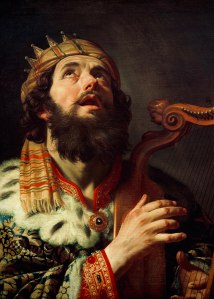
King David, the King of Israel by Gerard van Honthorst

Psalm 146

1 Praise the LORD!
 Praise the LORD, O my soul!
2 I will praise the LORD as long as I live;
 I will sing praises to my God all my life long.

3 Do not put your trust in princes,
 in mortals, in whom there is no help.
4 When their breath departs, they return to the earth;
 on that very day their plans perish.

5 
Happy are those whose help is the God of Jacob,
 whose hope is in the LORD their God,
6 who made heaven and earth,
 the sea, and all that is in them;
 who keeps faith forever;
 7 who executes justice for the oppressed;
 who gives food to the hungry.

The LORD sets the prisoners free;
 8 the LORD opens the eyes of the blind.
The LORD lifts up those who are bowed down;
 the LORD loves the righteous.
9 The LORD watches over the strangers;
 he upholds the orphan and the widow,
 but the way of the wicked he brings to ruin.

10 The LORD will reign forever,
 your God, O Zion, for all generations.
 Praise the LORD!

Bolded words have comments on translation below.

The psalter closes with five psalms that begin and end with the familiar Hebrew word Hallelujah (NRSVue Praise the LORD!). These final five psalms form a closing note of praise on this songbook of the faithful people. Throughout the experiences of the individual authors in various times, the underlying belief in the praiseworthiness of the LORD the God of the people has remained present. The questions of faith, the laments and heartbreaks, of the psalms all await God’s answer and resolution but even in the darkest moments the LORD is the one who the psalmists cry out to. Now as we move towards the conclusion of the psalter these final psalms send us out praising the LORD with all our being[1] for the duration of one’s entire life.

Psalm 146 moves from praising the LORD with all one’s being and days to the antithesis: trusting in rulers and human beings. Human leaders are necessary throughout society. Yet there is a tendency that continues in society to make leaders a source of ultimate trust. I am writing these words on the day of a midterm election in the United States where leaders and parties have attempted to portray themselves as trustworthy and their opponents as wicked. In this psalm the contrast is between the reliable and unending governance of God and “the transient incompetence of human governors.” (Mays, 1994, p. 440) Many religious leaders throughout history have stated that whatever we place our trust in is our god. Martin Luther, for example, in his Large Catechism framed it this way:

A “god” is the term for that to which we are to look for all good and in which we are to find refuge in all need. Therefore, to have a god is nothing else than to trust and believe in that one with your whole heart. As I have often said, it is the trust and faith of the heart alone that make both God and an idol. If your faith and your trust are right, then your God is the true one. Conversely, where your trust is false and wrong, there you do not have the true God. For these two belong together, faith and God. Anything on which your heart relies and depends, I say, that is really your God. (Luther, 2000, p. 386)

The psalm quickly turns from the foolish path of trusting in princes and mortals to the wise path of those whose help and hope is the God of Jacob. The Hebrew ‘asre (NRSVue happy) is a very common word in wisdom literature contrasting the wise path that leads to happiness/contentment/blessedness with the foolish path that leads to ruin. Those who trust in mortal perish, those whose hope is in God prosper.

The psalm then focuses on who this trustworthy God is and the character of God. The LORD is the creator of the heavens, the earth, the seas, and all that inhabits all these domains. This God who is the creator of all is a God who keeps faith forever. Many of the actions of keeping faith involve God’s care for the vulnerable: providing the justice for the oppressed, food to the hungry, freedom for prisoners, sight for the blind, lifting up those who are bowed down, watching over the strangers, and upholding the orphan and widow. This LORD of justice loves the righteous but brings the wicked to ruin (a traditional wisdom literature contrast). In contrast to the transient incompetence of human rulers, the LORD of justice who cares for the vulnerable will reign forever. This creator of heaven and earth, sea and all who fill them is worthy or praise, and the psalmist ends as they began: Hallelujah (Praise the LORD).


[1] The Hebrew nephesh translated ‘soul’ by the NRSVue does not have the sense of ‘soul’ as something separate from bodily existence that is characteristic of Greek thought. The Hebrew idea is something closer to the essence of life.

Psalm 112 An Authentic Life Shaped by Wisdom

The Presentation of the Torah By Édouard Moyse – Own work Musée d’art et d’histoire du Judaïsme, CC BY-SA 4.0, https://commons.wikimedia.org/w/index.php?curid=41893002

Psalm 112 

1Praise the LORD! Happy are those who fear the LORD, who greatly delight in his commandments.
2Their descendants will be mighty in the land; the generation of the upright will be blessed.
3Wealth and riches are in their houses, and their righteousness endures forever.
4They rise in the darkness as a light for the upright; they are gracious, merciful, and righteous.
5It is well with those who deal generously and lend, who conduct their affairs with justice.
6For the righteous will never be moved; they will be remembered forever.
7They are not afraid of evil tidings; their hearts are firm, secure in the LORD.
8Their hearts are steady, they will not be afraid; in the end they will look in triumph on their foes.
9They have distributed freely, they have given to the poor; their righteousness endures forever; their horn is exalted in honor.
10The wicked see it and are angry; they gnash their teeth and melt away; the desire of the wicked comes to nothing.

Psalm 112 and Psalm 111 share a lot of commonalities. Both are acrostic poems with each cola beginning with successive letters of the Hebrew alphabet. They share commonalities in vocabulary[1] with each other and with wisdom literature in general. If Psalm 111 is the beginning of wisdom then Psalm 112 would be a life lived in wisdom. The fear of the LORD[2] here leads to a delighting in the commandments of the LORD and a life that is authentic and in harmony with God, society, and the creation.

Like Psalm 111 and 113, the first word of the psalm is Hallelujah (NRSV Praise the LORD). The acrostic poem begins with the second word asre (NRSV happy) which is a common indicator of wisdom literature. Like Psalm 1, which also begins with asre we are examining the contrast between a righteous life in harmony with God’s will for the world and a wicked life in conflict with God’s will. The Hebrew asre often translated ‘happy’ or ‘blessed’ or even ‘contented’ but the concept in Hebrew thought is closer to ‘wholeness’ or ‘completeness.’ This integrated life is a life of shalom, itself a word that has a much larger function than the standard English translation of peace. The way of wholeness and completeness is the way of wisdom. Those who ‘fear’ the LORD greatly delight in the LORD’s commandments. This is not a burdensome set of commands but the boundaries which provide the safe space where an individual can live a whole and integrated life.

The blessings of this whole person reflect the ideals of Hebrew thought. Abraham when he begins his journey with God is promised descendants, a blessing, house, land and prosperity and through his household all the nations will be blessed. For the ‘happy’ ones who follow the way of wisdom their descendants are mighty, their generation is blessed, their households are prosperous, and their righteousness endures. The Hebrew scriptures trust that God will provide for the righteous ones who follow God’s ways. Those who fear, love, and trust the LORD above all things will find that they have enough and even an abundance beyond what they need.

These wise and righteous ones reflect the God who they worship and serve. In Psalm 111 the LORD’s righteousness endures forever, and in verse three now the righteousness of these ‘happy’ ones endures forever. In Psalm 111 God was characterized as gracious and merciful and now these ones who fear the LORD are also gracious, merciful, and righteous. They become the image of the LORD they fear, obey, and worship. They become a light that reflects the light of the LORD for the upright in the darkness of the world.

This life of faithfulness is a life of generosity. They do not hoard what they have but deal generously and lend. They distribute freely and give to the poor trusting that God will provide what they need. They conduct their affairs in justice/righteousness[3] and that justice/righteousness has a gracious and merciful character. Their practices remain constant throughout their lives and they are examples who are remembered of a life well lived. They trust in the LORD and even in evil/wicked times they remain secure in their trust. Their horn, which is reflective of power and status, is exalted in honor.

In classical wisdom literature duality these ‘happy’ ones are contrasted with the wicked. The wise and the wicked are opposing ways of life. The wise life is generous and merciful while the wicked one does not care for the poor, does not live generously, and may aggressively attempt to take advantage of both the vulnerable and the generous righteous ones. Yet, the anger and aggression of the wicked melts away before the sustaining power of the LORD that the wise ones fear. The desire of the wicked comes to nothing.[4]

The way of wisdom in the Hebrew scriptures is a way of life that lives in harmony with God’s commandments. The law and wisdom are connected in Hebrew thought. The law provides the vision of a society where the weak are protected and harmony and peace are possible. A way that is wise fears and reverences the LORD, the God of Israel and reflects the generous and merciful nature of that God. It trusts that even when the wicked seem to prosper that their foolish path will lead to their demise.


[1] Nancy deClaissé-Walford notes eleven key terms and phrases that occur in both relatively short psalms including: fear, delight in, upright, good, gracious, merciful, righteousness, remember, steady, give, and for all time. (Nancy deClaisse-Walford, 2014, p. 843)

[2] See the discussion of the Hebrew word yare translated fear in English in my notes on Psalm 111.

[3] The Hebrew tsaddik is a key idea in the Hebrew Scriptures. Both justice and righteousness emerge from the family of terms in Hebrew, like the Greek dikaios/dikaisune.

[4] This is the same word that ends Psalm 1, ‘abad which means to perish.