Category Archives: Psalms

Psalm 111 The Beginning of Wisdom

An Old Woman Reading, Probably the Prophetess Hannah by Rembrandt (1631)

Psalm 111

1Praise the LORD! I will give thanks to the LORD with my whole heart, in the company of the upright, in the congregation.
2Great are the works of the LORD, studied by all who delight in them.
3Full of honor and majesty is his work, and his righteousness endures forever.
4He has gained renown by his wonderful deeds; the LORD is gracious and merciful.
5He provides food for those who fear him; he is ever mindful of his covenant.
6He has shown his people the power of his works, in giving them the heritage of the nations.
7The works of his hands are faithful and just; all his precepts are trustworthy.
8They are established forever and ever, to be performed with faithfulness and uprightness.
9He sent redemption to his people; he has commanded his covenant forever. Holy and awesome is his name.
10The fear of the LORD is the beginning of wisdom; all those who practice it have a good understanding. His praise endures forever.

The next three psalms all begin with the word Hallelujah.[1] Psalms 111 and 112 are also acrostic poems with each cola[2] beginning alphabetically with the next letter of the Hebrew alphabet (after the initial Hallelujah). Most previous acrostic poems have been by verse, but here there are twenty-two cola after the initial word. The acrostic form was used in the book of Lamentations to provide a sense of order to the disordered world of the poet, but in the Psalms acrostic poems are often used to focus on wisdom, describing how life should be lived. For most Hebrew people the organizing center of wisdom is the law (torah) which will be the focus of the acrostic of acrostic poems, Psalm 119. For Psalm 111 the beginning of wisdom is the fear (see below) of the LORD and that is organized around the ‘works of the LORD’ and the ‘works of the people’ in response to the LORD.

A key word for the poem is ‘works’ (Hebrew ma’asim) which occurs in verses 2, 6, and 7 with the same root being used in 4 (NRSV wonderful deeds) and a synonym being used in verse 3. Then the same word is used in verse 8 and 10 (NRSV practice, perform) for the faithful ones responding to the work of the LORD. Wisdom here is recognizing the ‘works of the LORD’s hands’ which are established ‘forever and ever’ and ‘working’ in faithfulness and uprightness. The psalmist when referring to the ‘wonderful deeds’ of God likely has in mind the defining story of the Hebrew people, the exodus where God brings the people out of Egypt and into the promised land.[3] Yet, God’s provision of food, mindfulness to the covenant, demonstrating God’s power before the nations, and granting the people a heritage or inheritance from the nations is an ongoing action. God is known by what ‘works’ God has done, or as Philip Melanchthon would famously say in the 1500s, “that to know Christ is to know his benefits.” (Melanchthon, 2014, p. 24)

The best-known line of this psalm is “the fear of the LORD is the beginning of wisdom.” The Hebrew word for fear (yare’) encompasses a larger meaning than our English fear. As Nancy deClassé-Walford states it also means:

“awe, reverent, respect, honor.” It appears in Hebrew as a synonym for “love.” (‘ahab, Deut 10:12); “cling to” (dabaq, Deut 10:20); and “serve” (‘abad, Deut 6:13; Josh 24:14) (Nancy deClaisse-Walford, 2014, p. 841)

Knowing the ‘works’ of God and performing these works should lead to honor and awe, respect and honor, service and love. Wisdom that has good understanding can, to use Martin Luther’s explanation of the first commandment, “fear, love, and trust God above all things.” The ‘fear of the LORD’ leads the poet to ‘give thanks to the LORD with their whole heart.’ This is what a wisely practiced life looks like.


[1] ‘Praise the LORD” (NRSV). Hallelujah is a compound word of the verb to praise (hallel) and the first half of the name of God (yah from Yahweh). Some scholars believe that the final verse of Psalm 113 was originally the opening verse of Psalm 114 which would make four psalms which begin with Hallelujah, but as we have received the text we have three psalms beginning with Hallelujah and with Psalm 113 opening and closing with the word.

[2] Hebrew poetry breaks lines into cola. This is often reflected in the printing of poetic portions of scripture in how they are displayed. Psalm 111 in most bibles is easily divided this way because each on begins alphabetically with the next letter of the Hebrew alphabet (excluding verse 1a ‘Hallelujah’). In this poem the cola are marked by punctuation (comma, semi-colon, or period).

[3] Wonderful deed (Hebrew nipla’ot) is often used to refer to God’s works at that time (Exodus 3:20; 15:11; Psalm 77: 11, 14). (NIB IV:1133)

The Book of Psalms 1-110

Love is Not a Victory March by Marie -Esther@deviantart.com

BOOK I  (Psalms 1-41)

Psalm 1: Poetry and Law
Psalm 2: The Lord’s Messiah
Psalm 3: Hope in the Heart of Brokenness
Psalm 4: Finding a Space in the Blessing
Psalm 5: The God Who Hears and Protects
Psalm 6: How Long, O Lord
Psalm 7: The God Who Judges
Psalm 8: The Soul Searcher’s Psalm
Psalm 9: Praising the God of Justice and Might
Psalm 10: Calling on God to be God
Psalm 11: Confident Faith in the Midst of Trouble
Psalm 12: Save Us From Ourselves
Psalm 13: The Cry from the God Forsaken Place
Psalm 14: The Wisdom of Holding to the Covenant
Psalm 15: Entering the Sacred Presence of God
Psalm 16: Remaining Faithful in a Pluralistic Setting
Psalm 17: An Embodied Prayer
Psalm 18: Royal Thanks at the End of the Journey
Psalm 19: Creation, the Law and a Faithful Life
Psalm 20: In the Day of Trouble
Psalm 21: A Blessing for the King
Psalm 22: A Desperate Cry to God
Psalm 23: The LORD as Shepherd, Host and Destination
Psalm 24: The Coming of the LORD
Psalm 25: The Struggle of Faith from Aleph to Tav
Psalm 26: Liturgy of the Falsely Accused
Psalm 27: Faith in an Age of Anxiety
Psalm 28: Can You Hear Me LORD?
Psalm 29: The Thundering Voice of God
Psalm 30: The Life of Praise
Psalm 31: Faith, Questions and the Life of Faith
Psalm 32: A Psalm of Restoration
Psalm 33: The Earth is Full of the Steadfast Love of God
Psalm 34: The Experienced Faithfulness of God
Psalm 35: Lord, Fight for Me in the Struggle
Psalm 36: The Way of God and the Way of the Wicked
Psalm 37: A Song of a Wise Life
Psalm 38: A Cry for Forgiveness and Healing
Psalm 39: There Are No Words
Psalm 40: Experienced Faithfulness and the Hope of Deliverance
Psalm 41: The One Who Cares for the Poor

BOOK II (Psalms 42-72)

Psalm 42 Thirsting for God in an Arid Time
Psalm 43 Calling for God’s Love among a Loveless People
Psalm 44 Demanding a Fulfillment of God’s Covenant Promises
Psalm 45 A Love Song among the Psalms
Psalm 46 A Mighty Fortress
Psalm 47 God Assumes Kingship Over Creation
Psalm 48 God and Zion
Psalm 49 Wealth, Wisdom and Death
Psalm 50 Recalled to the Covenantal Life
Psalm 51 Seeking the Possibility of Redemption
Psalm 52 The Wicked Will Not Prosper Forever
Psalm 53 Reflecting Again on the Unjust
Psalm 54 A Cry for Deliverance
Psalm 55 A Desperate Prayer from an Unsafe Environment
Psalm 56 Trusting God in the Midst of Trouble
Psalm 57 Fleeing to the Steadfast Love and Faithfulness of God
Psalm 58 A Jagged Prayer for Vengeance
Psalm 59 God’s Steadfast Love as an Alternative to the Dog-Eat-Dog Worldview
Psalm 60 A Plea for God’s Return to the People
Psalm 61 A Life Dependent on God
Psalm 62 Truly Faith Surrounds My Troubles
Psalm 63 Hungering and Thirsting 
Psalm 64 Protect the Innocent One from the Words of the Wicked
Psalm 65 A Song of Thanksgiving to a Gracious Creator
Psalm 66 Formed by Steadfast Love
Psalm 67 A Blessing for the Earth
Psalm 68 God as Warrior and Protector of the Powerless
Psalm 69 A Cry for Deliverance from Unjust Suffering
Psalm 70 God Help Me Quickly
Psalm 71 A Prayer for Help Shaped by a Life of Worship
Psalm 72 Leading God’s Covenant People

Book III (Psalms 73-89)

Psalm 73 When Faith is Challenged
Psalm 74 A Psalm When the World Collapses
Psalm 75 God’s Answer to the Boastful and Arrogant
Psalm 76 The Fearfully Powerful Defender of Peace
Psalm 77 Searching for God in a Shattered World
Psalm 78 Telling History to Change the Future
Psalm 79 Words of Pain and Hope in a National Crisis
Psalm 80 A People Waiting for God’s Forgiven
Psalm 81 Hear! O People
Psalm 82 The God Who Upholds Justice for the Vulnerable
Psalm 83 A Fearful Prayer for Deliverance
Psalm 84 Better is One Day in the House of God
Psalm 85 Waiting for God’s Kingdom to Come
Psalm 86 A Servant’s Plea For Their Lord’s Deliverance
Psalm 87 Mother Jerusalem
Psalm 88 Only Darkness Knows Me
Psalm 89 Shattered Worlds and Broken Symbols

Book IV (Psalms 90-106)

Psalm 90 Remembering the Character of God in Crisis
Psalm 91 Enfolded in God’s Protection
Psalm 92 Song of the Sabbath
Psalm 93 God the King
Psalm 94 Thy Kingdom Come
Psalm 95 Lifting Up Voices and Listening in Silence
Psalm 96 A New Song of God’s Triumph
Psalm 97 The Righteous Reign of God
Psalm 98 A Joyous Song of God’s Salvation
Psalm 99 The Universal King Worshipped by a Particular People
Psalm 100 Know the LORD is God and We are God’s

Psalm 101 A Leader Shaping a Community of Character
Psalm 102 The Song of One Suffering in Solitude
Psalm 103 A Meditation on the Steadfast Love of God
Psalm 104 Praise the Great God of Creation
Psalm 105 Give Thanks to the Faithful God of Our Story
Psalm 106 Confessing the Unfaithfulness of the People of God

Book V (Psalms 107-150)

Psalm 107 The God of Steadfast Love Who Rescues
Psalm 108 Old Words Brought Together For A New Time
Psalm 109 A Prayer for God’s Vengeance
Psalm 110 A Psalm of Enthronement

Psalm 110 A Psalm of Enthronement

Stained Glass window at the Melkite Catholic Annunciation Cathedral in Roslindale, MA depicting Christ the King with the regalia of a Byzantine Emperor

Psalm 110

Of David. A Psalm.
1The LORD says to my lord, “Sit at my right hand until I make your enemies your footstool.”
2The LORD sends out from Zion your mighty scepter. Rule in the midst of your foes.
3Your people will offer themselves willingly on the day you lead your forces on the holy mountains. From the womb of the morning, like dew, your youth will come to you.
4The LORD has sworn and will not change his mind, “You are a priest forever according to the order of Melchizedek.”
5The LORD is at your right hand; he will shatter kings on the day of his wrath.
6He will execute judgment among the nations, filling them with corpses; he will shatter heads over the wide earth.
7He will drink from the stream by the path; therefore he will lift up his head.

Psalm 110 is repeatedly referenced in the New Testament[1] as a way of demonstrating that Jesus is the Messiah and that as the Messiah, he is more important even than David. Yet this psalm so important to early Christians is heard differently by Jewish readers. Within these reflections I’ve tried to hold both Christian and Jewish voices in conversation, and I think that both can help us gain a fuller picture of the scriptures that we share. This enthronement psalm shares similar themes to Psalm 2. Both psalms view this newly anointed lord as the chosen vessel of the LORD the God of Israel. The king may be seated at the right hand[2]

As an enthronement psalm for a Davidic king, these words would likely come from a court prophet or singer to be spoken as God’s words over the new king. The prophet or singer refers to the new king as ‘my lord’ because they serve that king. The capitalization of the letters in the other occurrences of LORD in this psalm indicate that it refers to the divine name, YHWH, and the vowels are pointed around the letters to indicate to the speaker to say ‘Lord’ (or Adonai in Hebrew) instead of the divine name. YHWH speaks through the prophet to the new king and invites the king into this position of honor and promises to fight on the new king’s behalf. Verse three is full of textual difficulties, as Nancy deClaissé- Walford states, the

words appear to be an elevated description of the newly enthroned monarch, obeyed willingly by the people and endowed with strength and stamina—the dew of your childhood—which emanate from the splendor of holiness.” (Nancy deClaisse-Walford, 2014, p. 836)

Although there were both royal and priestly roles in the world of the Davidic kings, the kings of Israel did have priestly functions. Now the king is linked to the ancient figure of Melchizedek who comes from Salem, and who is also a king, and blesses Abraham by God Most High. This King of Salem becomes the priestly model for the King of Jerusalem, likely built on the same spot generations later. This installation of the new king in both a royal and priestly role integrates this new leader into their privileged place in God’s ordering of the world. (Mays, 1994, p. 352)

The ancient world was a violent place, and the Davidic kings were expected to lead the nation to both safety and military victory. Yet, Israel was never to be a military power,[3] and their strength resided in the God who executes judgment among the nations. The language of ‘filling the nations with corpses’ and ‘shattering heads over the wide earth’ continues the elevated description of the power behind the new monarch and the power behind the throne that ultimately controls the fate of the nations. The LORD, the God of Israel, will provide the stream beyond the path of the new king allowing this king to lift up his head in honor and strength.

Christian readers will hear this psalm through the lens of Christ, and ‘sitting at the right hand of the Father’ becomes a way that the church will talk about the honored and powerful position of Jesus for the church and the world. Jesus takes on the role of king for Christians and this led to the persecution of many early followers of Jesus who refused to pay honor to the divinity of Caesar. The book of Hebrews also highlights the way Jesus fulfils the role of the priesthood for Christians.[4] In liturgical churches the final Sunday of the church year is Christ the King Sunday which celebrates the way Jesus is enthroned at the right hand of God, but instead of being a conquering king he was a crucified messiah. Revelation 19: 11-16 is the closest the New Testament gets to the militaristic language of verse five and six of this psalm. The quotation of this psalm by Jesus in his conflicts with the Pharisees in Matthew 22:44 and parallels probably was not viewed as a convincing argument by his opponents and most Jewish leaders, if they utilize this psalm today, would be waiting for a return of a Davidic ruler who can rule from the power of the LORD the God of Israel and bring the nation back to a place of security. As large of a role as this psalm plays in the New Testament, I don’t believe that it plays a similar role in the thought of contemporary Judaism.


[1] Matthew 22:44; Mark 14:62; 16:19; Luke 22:69; Acts 2:34-35; 7:55; Romans 8:34; Ephesians1:20; Colossians 3:1; Hebrews 1:3,13; 8:1; 10:12; 1 Peter 3:22

[2] Being seated at the right hand is a position of honor and power. It is interesting that in Psalm 109 the psalmists asks for an accuser to take this position for the wicked person. The name Benjamin comes from a conjunction of the Hebrew word for son (bin) and right hand (yamin).  

[3] Deuteronomy 17: 14-20 which sets the limits on a king for Israel indicates that the focus is not to be on building a stronger military but instead on a ruler being faithful to the LORD and the covenant.

[4] Particularly Hebrews chapters 5 and 7.

Psalm 109 A Prayer For God’s Vengeance

From Susan Harris Anger and art// A Rage to Paint https://www.susanharrisart.com/blog

Psalm 109

To the leader. Of David. A Psalm.
1Do not be silent, O God of my praise.
2For wicked and deceitful mouths are opened against me, speaking against me with lying tongues.
3They beset me with words of hate, and attack me without cause.
4In return for my love they accuse me, even while I make prayer for them.
5So they reward me evil for good, and hatred for my love.
6They say, “Appoint a wicked man against him; let an accuser stand on his right.
7When he is tried, let him be found guilty; let his prayer be counted as sin.
8May his days be few; may another seize his position.
9May his children be orphans, and his wife a widow.
10May his children wander about and beg; may they be driven out of the ruins they inhabit.
11May the creditor seize all that he has; may strangers plunder the fruits of his toil.
12May there be no one to do him a kindness, nor anyone to pity his orphaned children.
13May his posterity be cut off; may his name be blotted out in the second generation.
14May the iniquity of his father be remembered before the LORD, and do not let the sin of his mother be blotted out.
15Let them be before the LORD continually, and may his memory be cut off from the earth.
16For he did not remember to show kindness, but pursued the poor and needy and the brokenhearted to their death.
17He loved to curse; let curses come on him. He did not like blessing; may it be far from him.
18He clothed himself with cursing as his coat, may it soak into his body like water, like oil into his bones.
19May it be like a garment that he wraps around himself, like a belt that he wears every day.”
20May that be the reward of my accusers from the LORD, of those who speak evil against my life.
21But you, O LORD my LORD, act on my behalf for your name’s sake; because your steadfast love is good, deliver me.
22For I am poor and needy, and my heart is pierced within me.
23I am gone like a shadow at evening; I am shaken off like a locust.
24My knees are weak through fasting; my body has become gaunt.
25I am an object of scorn to my accusers; when they see me, they shake their heads.
26Help me, O LORD my God! Save me according to your steadfast love.
27Let them know that this is your hand; you, O LORD, have done it.
28Let them curse, but you will bless. Let my assailants be put to shame; may your servant be glad.
29May my accusers be clothed with dishonor; may they be wrapped in their own shame as in a mantle.
30With my mouth I will give great thanks to the LORD; I will praise him in the midst of the throng.
31For he stands at the right hand of the needy, to save them from those who would condemn them to death.

This process of reflecting on scripture, particularly the parts of scripture that the church rarely utilizes, has opened my eyes to a far more dynamic and honest relationship between God and God’s people. Sometimes that dynamic and honest relationship is uncomfortable for people who grew up, like me, in churches where prayer was always a calm and measured practice. Psalm 109 rarely will find its way into a church bulletin or a sermon, but this psalm of imprecation that prays for harm to come to a wicked person provides a fertile place for discussion of the relationship between ourselves, others who have wronged us, and God. Anger and the desire for vengeance are powerful emotions, and too often we as people of faith have refused to give voice to these human feelings. Yet, these feelings will find their way into our lives and into the culture around us.

In a situation where the relationships that shape our society are shattered the faithful ones cry out to God. They name the brokenness that they encounter. They name those who have wronged them. But the brokenness of the world and the person who has brought about the suffering are placed into God’s hands. The person lifting up this cry to God has no ability to determine what God will do with the prayer and the ‘wicked one.’ Here, instead of suppressing the reality of suffering and pain or taking vengeance into their own hands, the faithful one cries out in desperation to God to act on their behalf.

Ellen Davis’s chapter on the cursing psalms in Getting Involved with God: Rediscovering the Old Testament (Davis, 2001, pp. 23-29) has shaped a lot of my thinking about the imprecatory (or cursing) psalms in general and this psalm in particular. The language of the bible shapes should shape our practices of faith, and the psalms and the prophets can give us language to articulate our honest feelings in our conversations with God. These may not be the more attractive offerings of thanksgiving or praise, but these words and feelings we also commit to God’s steadfast love. Ellen Davis shared the advice she received from a professor to take the imprecatory psalms into the chapel at a time when it was unoccupied and pray them at full voice. The experience helped her to move beyond her hurt and begin the needed journey to forgiveness. She remarks afterwards,

For the cursing psalms confront us with one of our most persistent idolatries, to which neither Israel nor the church has ever been immune: the belief that God has as little use for our enemies as we do, the desire to reduce God to an extension of our own embattled and wounded egos. (Davis, 2001, p. 26)

God cares for both the faithful and the wicked. Yet, that does not mean that the crimes of the wicked are not noticed by God. Psalm 109 anticipates a God who both hears this petition and acts upon it. The wicked and deceitful seem to have no problem using their words to shatter or their lies to cause harm to both the individual and the community. There are times when the innocent are surrounded by words of hate or attacked without justification. There are situations where love is repaid with hate and good with evil. As I was working through this psalm, I was reading Elie Wiesel’s Night where he shares his experience of being a young Jewish boy whose hope and faith were broken in Auschwitz in 1944 and Suzanne Collins, Sunrise on the Reaping which continues the fictional Hunger Games series where children are put into a fatal game for the entertainment of the powerful. Both the historical and the fictional may be extreme examples of a world where wickedness has triumphed over kindness, but the origin story of the people of Israel is the story of a God who rescued them from oppression and slavery. It is a story of a God who heard their cries and acted for their rescue from that a world without steadfast love.

One of the keys to hearing this psalm occurs in verse six. Most English translations being the verse with “They say” which places the most extreme portions of the psalm in the mouths of the adversary. Yet, there is no textual support in Hebrew for the words “they say.” (Bellinger, 2014, p. 473) Even if these words are put into the mouth of the adversary, the psalmist still wishes for these words that the adversary pulls around themselves like a cloak may become the garment they wear every day and soak into their body like water or oil all the way to the bones. Whether you read these words as being spoken by or toward the adversary, this brokenhearted prayer ascends to God bearing the hurt and brokenness of the psalmist’s world asking for God to intervene on the psalmist’s behalf and answer the psalmist’s pain.

The Hebrew word hesed, often translated steadfast love when coming from God or kindness (as in verse 12 and 16) when coming from other people, is a key idea throughout the Old Testament. Hesed is tied to the covenant between God and God’s people, as well as the covenant between the people of God. Central to the accusation of this individual is their failure to show hesed.

For he did not remember to show kindness (hesed), but pursued the poor and needy and the brokenhearted to their death. Verse 16.

Hesed is the glue that holds the Hebrew society together. It is both the proper relationship between God and God’s people but also the proper relationship among the people. When hesed is not present, the poor, needy, and brokenhearted die. The implications of a person living in disregard for the standards of society may be fatal. This could apply to a nobleman in Jerusalem who takes advantage of the vulnerable or a businessperson or politician who uses their influence in a way that impacts the physical and emotional health of others. The bible’s way of thinking assumes a common obligation between humanity and creation to care for one another. I once heard Rolf Jacobson remark that the Ten Commandments and the law in general were about, “my neighbor’s best life.”

The words directed at the wicked adversary are sharp. That a wicked person would be appointed against him, someone to accuse him on his right hand, when he is tried to be found guilty (Hebrew wicked), and that his prayers would be sin (either missing the mark or something refused by God). That his life would be short and another would claim his position, that even his wife and children would bear the repercussions of his fall. The adversary created a world without hesed (kindness) for the psalmist and now may the world fail to show him hesed. That the sins of his ancestors would be remembered and yet his memory fade. In Hebrew I don’t think there could be a stronger curse than to encounter a world devoid of hesed.

 One verse of this psalm has entered the political dynamics of the United States. I first encountered a bumper sticker with Psalm 109:8, “May his days be few, may another seize his position” referring to Barak Obama. The psalm is used to appear to be prayerful and cursing at the same time. Psalm 109:8 may have been utilized before Barak Obama, but I have seen it used to piously point to Donald Trump and Joe Biden since. It is unlikely that most people who have worn this psalm proudly on a shirt, button, or on their car read the entirety of the psalm, but unfortunately in the polarized and angry political climate the vengeful desires against not only those in power but their entire family would probably be embraced by many. Verse eight is also the only verse of this psalm that appears in the New Testament, in Acts 1:20, when Peter makes the case for replacing Judas. Yet, the use in the New Testament bears no desire for vengeance on Judas, merely understands the psalm as authorizing the search for a new disciple to fill the twelfth position after Judas’s death.

How do we use this rarely utilized psalm. My first reflection comes from Dietrich Bonhoeffer in his The Prayerbook of the Bible:

So the psalm of vengeance leads to the cross of Jesus and to the love of God that forgives enemies. I cannot forgive the enemies of God by myself, only the crucified Christ can; and I can forgive through him. So the carrying out of vengeance becomes grace for all in Jesus Christ. (DBWE 5:175)

Bonhoeffer takes the traditional Lutheran law-gospel hermeneutic where the psalm of vengeance (as law) pushes us to the love of God in Christ (gospel). As Ellen Davis mentioned earlier our inability to see anything redeemable in our enemies does not preclude God from acting in mercy and grace towards them. But Ellen Davis also has a wise if uncomfortable way of utilizing these psalms of cursing:

If you have the courage (and it will take some), try turning the psalm a full 180 degrees, until it is directed at yourself, and ask: Is there anyone in the community of God’s people who might want to say this to God about me—or maybe, about us? (Davis, 2001, p. 28)

We may not feel oppressed. We may not have anything we need to forgive in another, but perhaps there is someone who we have wronged. Whose futures have we, intentionally or unintentionally, harmed? Whose wives and children have learned to curse our names as individuals or as a group? Whose reputations have we destroyed? In her own way she encourages this use of the psalm as law which highlights the places where we also have not shown hesed.

Yet even a psalm of cursing ends with thanks to the God who defends the needy and saves from those who would condemn. Ultimately hesed, so important to this psalm and the Old Testament in general, is one of the defining characteristics of God. God is both the model of what hesed looks like, but also the one who intervenes when hesed is not found. This psalm has demonstrated all the differences between the world of oppression the psalmist lives in and the world God intends for God’s people. It resonates with the Lord’s prayer which calls out to God for God’s kingdom to come and God’s will to be done on earth as it is in heaven.

Psalm 108 Old Words Brought Together For A New Time

Nehemiah View the Ruins of jerusalem’s Walls, Gustav Dore 1866

Psalm 108

A Song. A Psalm of David.
 1My heart is steadfast, O God, my heart is steadfast; I will sing and make melody. Awake, my soul!
 2Awake, O harp and lyre! I will awake the dawn.
 3I will give thanks to you, O LORD, among the peoples, and I will sing praises to you among the nations.
 4For your steadfast love is higher than the heavens, and your faithfulness reaches to the clouds.
 5Be exalted, O God, above the heavens, and let your glory be over all the earth.
 6Give victory with your right hand, and answer me, so that those whom you love may be rescued.
 7God has promised in his sanctuary: “With exultation I will divide up Shechem, and portion out the Vale of Succoth.
 8Gilead is mine; Manasseh is mine; Ephraim is my helmet; Judah is my scepter.
 9Moab is my washbasin; on Edom I hurl my shoe; over Philistia I shout in triumph.”
 10Who will bring me to the fortified city? Who will lead me to Edom?
 11Have you not rejected us, O God? You do not go out, O God, with our armies.
 12O grant us help against the foe, for human help is worthless.
 13With God we shall do valiantly; it is he who will tread down our foes.

Psalm 108 brings together portions of two psalms attributed to David for a new time. Most interpreters believe that Psalm 57: 7-11 and Psalm 60: 5-12 were written before they were later joined together in the current psalm. This is a common practice in scripture where a key idea or phrase is utilized in multiple contexts[1] but here the entirety of the psalm is a composition of two previous psalms. Psalm 57: 7-11 forms the initial five verses while Psalm 60: 5-12 forms the final eight verses. Based on the position of Psalm 108 in book five of the Psalter the new situation may involve the return of the people to their home after the exile, but even without knowing a concrete situation for the invocation of these words from earlier psalms it points to the long-standing resonance and vitality of these words in the life of the people.

The heart (the organ of will in Hebrew) is steadfast and the proper response to the steadfast love of God is for the entirety of one’s being to respond in praise and song. The steadfast love (hesed) and the faithfulness of God are beyond measure and the psalmist’s gift of song echoes the chorus of a grateful creation to its creator. The joyous ending of Psalm 57 introduces the petition of verse six which initiates the quotation of Psalm 60.

The psalms are spoken from the embodied experience of the covenant people, and that experience involves times where God’s promise and presence feel distant. The beloved ones of God have always understood their continued existence was contingent on God’s continual provision. As in a previous time the people do not need a stronger army or a better military technology, they need the God who reigns over both Israel and the surrounding nations, to come to their aid. As J. Clinton McCann Jr. can articulate.

Their prayer is not that of the powerful, who seek to claim God’s sanction of the status quo. Rather, their prayer is the desperate prayer of those who turn to God as the only possible hope in an apparently hopeless situation (v. 11) (NIB IV:918)

If these words reemerge in the fragile situation of the post-exilic return to Jerusalem where the people are threatened by hostile neighbors, the reminder that Moab, Edom, and Philistia are all under God’s claim[2] is a source of comfort. Yet, the people who claim the title of ‘those whom you love’ now feel the abandonment of God. God no longer goes out with the people or defends them, but they cry out to God for God’s renewed favor.

The psalms understand the dependence of the people upon God’s continual provision but also speak eloquently about the perception of God’s absence. This psalm utilizes two previously utilized psalms to speak of the trust in God’s steadfast love and faithfulness in a time where they feel endangered by God’s absence. Yet, the perception of God’s distance causes the beloved ones of God to cry out to God for deliverance from their current distress. For they can do nothing on their own, but with God they shall do valiantly.


[1] For example, 1 Chronicles 16 brings together Psalm 105: 1-11 and Psalm 106: 35-36, of Isaiah 2: 2-4 is repeated in Micah 4: 2-3. There are numerous other examples of parallels.

[2] The designation of Moab as washbasin, Edom as a place where shoes are hurled, and Philistia as one that the LORD shouts in triumph over may be intended as an insult to these nations, but it also may simply be a way of designating that they too remain under God’s control. Moab, Edom, and Philistia all incur words of judgment in the prophets (Ezekiel 25, Jeremiah 4748, Obadiah 12-13).  

Psalm 107 The God of Steadfast Love Who Rescues

Rembrandt, Christ in the Storm (1633)

Psalm 107

 1O give thanks to the LORD, for he is good; for his steadfast love endures forever.
 2Let the redeemed of the LORD say so, those he redeemed from trouble
 3and gathered in from the lands, from the east and from the west, from the north and from the south.
 4Some wandered in desert wastes, finding no way to an inhabited town;
 5hungry and thirsty, their soul fainted within them.
 6Then they cried to the LORD in their trouble, and he delivered them from their distress;
 7he led them by a straight way, until they reached an inhabited town.
 8Let them thank the LORD for his steadfast love, for his wonderful works to humankind.
 9For he satisfies the thirsty, and the hungry he fills with good things.
 10Some sat in darkness and in gloom, prisoners in misery and in irons,
 11for they had rebelled against the words of God, and spurned the counsel of the Most High.
 12Their hearts were bowed down with hard labor; they fell down, with no one to help.
 13Then they cried to the LORD in their trouble, and he saved them from their distress;
 14he brought them out of darkness and gloom, and broke their bonds asunder.
 15Let them thank the LORD for his steadfast love, for his wonderful works to humankind.
 16For he shatters the doors of bronze, and cuts in two the bars of iron.
 17Some were sick through their sinful ways, and because of their iniquities endured affliction;
 18they loathed any kind of food, and they drew near to the gates of death.
 19Then they cried to the LORD in their trouble, and he saved them from their distress;
 20he sent out his word and healed them, and delivered them from destruction.
 21Let them thank the LORD for his steadfast love, for his wonderful works to humankind.
 22And let them offer thanksgiving sacrifices, and tell of his deeds with songs of joy.
 23Some went down to the sea in ships, doing business on the mighty waters;
 24they saw the deeds of the LORD, his wondrous works in the deep.
 25For he commanded and raised the stormy wind, which lifted up the waves of the sea.
 26They mounted up to heaven, they went down to the depths; their courage melted away in their calamity;
 27they reeled and staggered like drunkards, and were at their wits’ end.
 28Then they cried to the LORD in their trouble, and he brought them out from their distress;
 29he made the storm be still, and the waves of the sea were hushed.
 30Then they were glad because they had quiet, and he brought them to their desired haven.
 31Let them thank the LORD for his steadfast love, for his wonderful works to humankind.
 32Let them extol him in the congregation of the people, and praise him in the assembly of the elders.
 33He turns rivers into a desert, springs of water into thirsty ground,
 34a fruitful land into a salty waste, because of the wickedness of its inhabitants.
 35He turns a desert into pools of water, a parched land into springs of water.
 36And there he lets the hungry live, and they establish a town to live in;
 37they sow fields, and plant vineyards, and get a fruitful yield.
 38By his blessing they multiply greatly, and he does not let their cattle decrease.
 39When they are diminished and brought low through oppression, trouble, and sorrow,
 40he pours contempt on princes and makes them wander in trackless wastes;
 41but he raises up the needy out of distress, and makes their families like flocks.
 42The upright see it and are glad; and all wickedness stops its mouth.
 43Let those who are wise give heed to these things, and consider the steadfast love of the LORD.

This psalm of thanksgiving divides into four representative manners by which the faithful have been saved by their God: hunger and thirst, imprisonment and oppression, sickness and nearing death, and bombarded by wind and waves upon the sea. These four life threatening events are matched to the four cardinal directions of the compass in most English translations.[1] The LORD, the God of Israel, is the one who rescues from the wilderness of the desert and the dangers of the sea, from the bondage and oppression as well as sickness because of sinful ways. God responds to the cries of a lost and scattered people and provides them food and drink, recovery and rescue.

Like many psalms, this psalm focuses on the steadfast love (hesed) of God. God’s unending steadfast love is the reason for the song, but the steadfast love is recognized through the redemption that has been received. The desert wastes were a theme of both the people’s original journey from Egypt to the promised land, and an exilic theme as God promises the people a new exodus leading them from exile to their home. The land of Israel is bordered by the Syrian and Arabian deserts to the east as well as the Saharan desert to the south. Although there are fertile places in the Middle East, and much of Israel is a productive land, any extended travel over land involves traversing the desert. Within the desert waste it is very easy to become lost, and both food and water are precious commodities away from one’s home. Yet in the song they cry to the LORD and there is an immediate (in the progression of the text) reply to the cry of distress. The LORD hears the hungry and thirsty and satisfies them with good things. The LORD hears the lost and leads them on a straight path to a town where they can receive shelter and nourishment. Although hunger and thirst play a significant role in the narrative of the exodus and the words of the prophets pointing to a return to the promised land it is only mentioned here in the psalms, with the exception for hungering and thirsting for God (Psalm 42,43). (Mays, 1994, p. 345)

The second tribulation that the people cry out from is imprisonment and oppression. This also echoes the original situation of the people at the beginning of the exodus as well as the exile, yet the only other psalm that mentions imprisonment is Psalm 142. Here the imprisonment is because they rebelled and spurned the words of God and likely reflects the experience of the community in exile rather than one individual imprisoned, yet even this experience of imprisonment and oppression the people call, and God responds. No bronze doors or iron bars can prevent the LORD from rescuing the people of God when they cry out for deliverance.

The sickness experienced, like the imprisonment in the previous section, is a result of sin and iniquity. The Hebrew term translated sickness (‘awal) means ‘foolish ones.’ (Nancy deClaisse-Walford, 2014, p. 818) The petitioner is suffering as a result of their own actions, and they are at the point where they can no longer eat and stand at the gate of death. Yet even the gate of death is not too far for the LORD to hear their call and respond in steadfast love. Sickness and imprisonment, hunger and thirst, being lost in the desert and even lost at sea the people of God remainonly a cry away from the experience of the steadfast love of God.

Finally, the faithful are rescued from calamity on the sea. Seafaring was not a large part of Hebrew culture and the only other psalm speaking about the sea is Jonah’s prayer in Jonah 2. Yet, like the wanderers lost in the desert these seafarers are lost in the wind and waves of the sea. Once again, the mighty wonders of the LORD on the sea may terrify, but the LORD’s mighty deliverance is reason for praise. Sailors are reduced to reeling like drunkards until the LORD delivers them from the wind and waves which threaten their ship and their lives. The action of Jesus to still the wind and the waves with a word[2] echoes the obedience of the waves and wind to the LORD in verse twenty-nine. The LORD brings those lost at sea back to a haven.

Martin Luther captures the essence of this psalm which responds to all the LORD has done when he states, “For all of this I owe it to God to thank and praise, serve and obey him.” (Luther, 1978, p. 25) Later hymnwriters would try to lift up their thanks in songs like William Whitings “Eternal Father, Strong to Save” and Martin Rinkhart’s “Now Thank We All Our God.” For God has led God’s people through desert and sea, sickness and suffering. Yet, God can also turn the fertile places to infertile. The princes who wield power are humbled before the power of the LORD, but the humble crying out for deliverance are saved. The God of the psalms is the God who created and sustains the heavens and the earth. This God can turn the current reality in creation upside down: deserts can become fertile, while rivers can run dry, storms can be stilled, and even the chaotic sea tamed. The Weak can turn to their God of steadfast love for deliverance but the proud and foolish princes may find their way frustrated by the same God. Wisdom to the psalmist is considering the steadfast love of God which does amazing things for the faithful ones who cry out for deliverance.


[1] No Hebrew Manuscript has ‘south’ in verse three. Instead in Hebrew the word is sea, and several other translations also have sea (including the Septuagint and the Vulgate). 

[2] Matthew 8: 23-27, Mark 4: 35-41, Luke 8: 22-25.

Psalm 106 Confessing the Unfaithfulness of the People of God

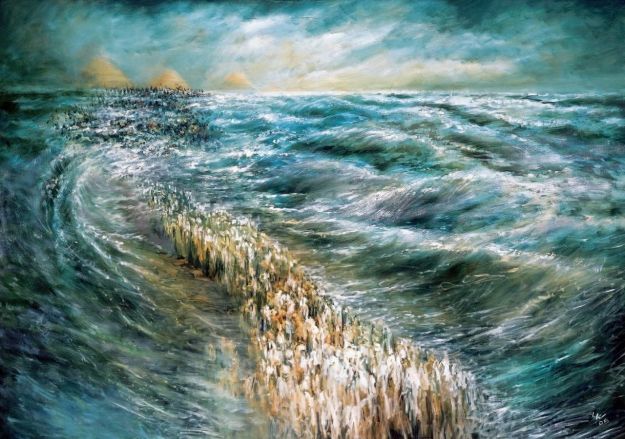
Grigory Mekheev, Exodus (2000) artist shared work under Creative Commons Attribution-Share Alike 3.0

Psalm 106

1Praise the LORD! O give thanks to the LORD, for he is good; for his steadfast love endures forever.
 2Who can utter the mighty doings of the LORD, or declare all his praise?
 3Happy are those who observe justice, who do righteousness at all times.
 4Remember me, O LORD, when you show favor to your people; help me when you deliver them;
 5that I may see the prosperity of your chosen ones, that I may rejoice in the gladness of your nation, that I may glory in your heritage.
 6Both we and our ancestors have sinned; we have committed iniquity, have done wickedly.
 7Our ancestors, when they were in Egypt, did not consider your wonderful works; they did not remember the abundance of your steadfast love, but rebelled against the Most High at the Red Sea.
 8Yet he saved them for his name’s sake, so that he might make known his mighty power.
 9He rebuked the Red Sea, and it became dry; he led them through the deep as through a desert.
 10So he saved them from the hand of the foe, and delivered them from the hand of the enemy.
 11The waters covered their adversaries; not one of them was left.
 12Then they believed his words; they sang his praise.
 13But they soon forgot his works; they did not wait for his counsel.
 14But they had a wanton craving in the wilderness, and put God to the test in the desert;
 15he gave them what they asked, but sent a wasting disease among them.
 16They were jealous of Moses in the camp, and of Aaron, the holy one of the LORD.
 17The earth opened and swallowed up Dathan, and covered the faction of Abiram.
 18Fire also broke out in their company; the flame burned up the wicked.
 19They made a calf at Horeb and worshiped a cast image.
 20They exchanged the glory of God for the image of an ox that eats grass.
 21They forgot God, their Savior, who had done great things in Egypt,
 22wondrous works in the land of Ham, and awesome deeds by the Red Sea.
 23Therefore he said he would destroy them — had not Moses, his chosen one, stood in the breach before him, to turn away his wrath from destroying them.
 24Then they despised the pleasant land, having no faith in his promise.
 25They grumbled in their tents, and did not obey the voice of the LORD.

 26Therefore he raised his hand and swore to them that he would make them fall in the wilderness,
 27and would disperse their descendants among the nations, scattering them over the lands.
 28Then they attached themselves to the Baal of Peor, and ate sacrifices offered to the dead;
 29they provoked the LORD to anger with their deeds, and a plague broke out among them.
 30Then Phinehas stood up and interceded, and the plague was stopped.
 31And that has been reckoned to him as righteousness from generation to generation forever.
 32They angered the LORD at the waters of Meribah, and it went ill with Moses on their account;
 33for they made his spirit bitter, and he spoke words that were rash.
 34They did not destroy the peoples, as the LORD commanded them,
 35but they mingled with the nations and learned to do as they did.
 36They served their idols, which became a snare to them.
 37They sacrificed their sons and their daughters to the demons;
 38they poured out innocent blood, the blood of their sons and daughters, whom they sacrificed to the idols of Canaan; and the land was polluted with blood.
 39Thus they became unclean by their acts, and prostituted themselves in their doings.
 40Then the anger of the LORD was kindled against his people, and he abhorred his heritage;
 41he gave them into the hand of the nations, so that those who hated them ruled over them.
 42Their enemies oppressed them, and they were brought into subjection under their power.
 43Many times he delivered them, but they were rebellious in their purposes, and were brought low through their iniquity.
 44Nevertheless he regarded their distress when he heard their cry.
 45For their sake he remembered his covenant, and showed compassion according to the abundance of his steadfast love.
 46He caused them to be pitied by all who held them captive.
 47Save us, O LORD our God, and gather us from among the nations, that we may give thanks to your holy name and glory in your praise.
 48Blessed be the LORD, the God of Israel, from everlasting to everlasting. And let all the people say, “Amen.” Praise the LORD!

Psalms 105 and 106 form two complementary but very different lenses to examine the history of God and God’s people. Like the yin and yang in Chinese philosophy represents two opposite but connected forces, these two psalms are connected by an understanding of God’s steadfast love operating throughout the story of Israel, but where Psalm 105 is a psalm which accentuates the positive aspect of the relationship Psalm 106 eliminates the positive aspects of the relationship from the side of Israel. (Nancy deClaisse-Walford, 2014, p. 796) God has remained faithful despite Israel’s history of unfaithfulness. Psalm 106 reminds us that any telling of the story of God’s people is a story of a people who are disobedient and unworthy of the steadfast love they have received, and the psalmist cries out to God not because they are worthy but because the LORD is a God nature is to be a God who is merciful and gracious, slow to anger, and abounding in steadfast love and faithfulness. (Exodus 34:6)

The confession of Psalm 106 emphasizes the unworthiness of God’s people of receiving the gracious actions of God on their behalf. It echoes the sentiment of Isaiah standing before God stating, “Woe is me! I am lost, for I am a man of unclean lips, and I live among a people of unclean lips; yet my eyes have seen the King, the LORD of hosts.” (Isaiah 6:5) For the psalmist, the LORD is good, and God’s steadfast love endures forever but in contrast none of the people of God can utter the mighty works of God without the realization that they are a people of unclean lips and actions. Yet, this psalmist joins himself to the people in need of rescue and God’s unmerited provision and protection. Happy/blessed[1] are those who observe justice is “an ironic beatitude”[2] (Nancy deClaisse-Walford, 2014, p. 801) since the remainder of the psalm will demonstrate how the people have failed to observe justice and maintain righteousness throughout their journey with God. The psalmist longs to enjoy the prosperity of God’s chosen ones, the gladness of the people of God, and the glory of God’s heritage but they also know that they and their ancestors have fallen short of their calling as the people of God. Instead of living in justice they have lived in iniquity, instead of righteousness they have produced wickedness. The psalmist’s words of confession place them before God needing forgiveness and redemption. Unworthy of grace but longing for it. This is an act of remembering what has been forgotten that they may learn from the mistakes of their ancestors and live into their calling under the covenant.

Even in Egypt, surrounded by the fearful power of God’s signs and wonders to bring this enslaved people out of their bondage to Pharoah, the people take God’s actions on their behalf for granted. Once they arrive at the Red Sea, they fail to trust in the God who delivered them from Egypt and again God acts for their deliverance, but early in this telling God is acting for the sake of God’s name. These mighty acts in Egypt and at the Red Sea bring a momentary faithfulness and trust in the LORD, but quickly the people resort to grumbling against both God and God’s emissaries. The psalm narrates in quick succession the rebellions of Israel articulated in Numbers 11-17 and the creation of the Golden Calf in Exodus 32. All of Israel’s rebellions are tied to their forgetfulness of the mighty works God had done on their behalf to bring them out of Egypt and to sustain them in the wilderness. Moses stands in the breach for the people and intercedes with God on their behalf, calling God back to God’s self-articulated identity in Exodus 34:6-7 and God continues to bring them to the promised land.

On arriving in the promised land, the people continue to forget what their God has done to bring them out of Egypt and through the wilderness and ‘they despised the pleasant land’ which leads to the generation falling in the wilderness prior to the entry into the promised land. They intermarry with women of Moab and begin to adopt the practices of the Moabites, including the worship of Baal of Peor (Numbers 25) when Aaron’s son Phineas zealously fights against the idolatrous actions of the people and turns aside God’s wrath. Even Moses is made bitter and claims to bring forth the waters at Meribah instead of continuing to point to God’s action of provision (Numbers 20).

Even when the people occupy the promised land under Joshua, they fail to carry out the LORD’s instructions for their claiming of the land. They do not drive the people out and they eventually intermarry with the residents of the land and adopt their practices. This brief retelling of the people’s history of unfaithfulness only alludes to the cyclical nature of disobedience and rescue articulated in Judges when it indicates that ‘Many times he delivered them.’ Throughout this narrative poem the people’s unrighteousness has been contrasted with God’s continuing actions of faithfulness to come to the people’s deliverance in their time of disaster and need.

The final verses of the poem indicate a time where they are in exile among the nations, and yet even in this exile away from the land God has caused them to be pitied by their captors. They long for a time when God acts to gather them from among the nations and bring them home, not because they have earned God’s favor but due to God’s gracious and forgiving nature. The final verse closes both this psalm and book four of the psalter. Psalms 105 and 106 belong together as two narrations of the history of God and God’s people and it is worth noting that while the psalm in 1 Chronicles 16 appointed by David begins with Psalm 105: 1-11 it ends with Psalm 106:35-36. These two narratives which close book four demonstrate that praise and the confession are two halves of the songs and stories of the people of God. God is a gracious God of steadfast love and faithfulness and yet the people and their ancestors have sinned and fallen short of their calling as the people of God.  

The scriptures that both Christians and our Jewish ancestors have inherited are a deeply varied collection of works that attempt to make sense of the encounter between the people of God, the world around them, and the God who has called them. The reality that our scriptures include a narration of Israel’s story that does not attempt to hide their history of unfaithfulness is exceptional because many ancient histories[3] attempt to hide the stories that paints a nation in an unflattering light. Confession is a part of the life of the people of Go and I believe that in a world that attempts to conceal or deny any foolishness, wickedness, or unfaithfulness it is essential for people of faith to begin with the reality that we have fallen short of God’s vision for our lives. We have failed to fear, love, and trust God above all things and that has led us not to love our neighbors as ourselves. Yet, the God of the scriptures is a God who is merciful and gracious who often responds not as we deserve but out of the abundance of God’s steadfast love and faithfulness.


[1] The Hebrew ‘asre is typically an indication of wisdom literature contrasting the way of the good/just/righteous/wise with the bad/unjust/evil/foolish. Is often translated ‘happy’ in the Old Testament. In Greek it is translated as markarios which is rendered ‘blessed’ in the New Testament (see for example the Sermon on the Mount).

[2] Rolf A. Jacobson captures this term insightfully since ‘beatitude’ comes from ‘blessed’ which is what ‘asre points to.

[3] This is not exclusive to ancient retellings of history as the ongoing debate about how to teach history in my own country shows. History can easily fall into propaganda and all true historical narratives have both heroic and tragic elements. Yet, history is often closely tied to identity and in an age of bespoke realities, to use a phrase I learned from studying social media, we often shape our historical remembrances to fit our preferred view of our group. We, like the ancient Israelites, also stand in need of narratives of confession.

Psalm 105 Give Thanks to the Faithful God of Our Story

Grigory Mekheev, Exodus (2000) artist shared work under Creative Commons Attribution-Share Alike 3.0

Psalm 105 

1O give thanks to the LORD, call on his name, make known his deeds among the peoples.
 2Sing to him, sing praises to him; tell of all his wonderful works.
 3Glory in his holy name; let the hearts of those who seek the LORD rejoice.
 4Seek the LORD and his strength; seek his presence continually.
 5Remember the wonderful works he has done, his miracles, and the judgments he has uttered,
 6O offspring of his servant Abraham, children of Jacob, his chosen ones.
 7He is the LORD our God; his judgments are in all the earth.
 8He is mindful of his covenant forever, of the word that he commanded, for a thousand generations,
 9the covenant that he made with Abraham, his sworn promise to Isaac,
 10which he confirmed to Jacob as a statute, to Israel as an everlasting covenant,
 11saying, “To you I will give the land of Canaan as your portion for an inheritance.”
 12When they were few in number, of little account, and strangers in it,
 13wandering from nation to nation, from one kingdom to another people,
 14he allowed no one to oppress them; he rebuked kings on their account,
 15saying, “Do not touch my anointed ones; do my prophets no harm.”
 16When he summoned famine against the land, and broke every staff of bread,
 17he had sent a man ahead of them, Joseph, who was sold as a slave.
 18His feet were hurt with fetters, his neck was put in a collar of iron;
 19until what he had said came to pass, the word of the LORD kept testing him.
 20The king sent and released him; the ruler of the peoples set him free.
 21He made him lord of his house, and ruler of all his possessions,
 22to instruct his officials at his pleasure, and to teach his elders wisdom.
 23Then Israel came to Egypt; Jacob lived as an alien in the land of Ham.
 24And the LORD made his people very fruitful, and made them stronger than their foes,
 25whose hearts he then turned to hate his people, to deal craftily with his servants.
 26He sent his servant Moses, and Aaron whom he had chosen.
 27They performed his signs among them, and miracles in the land of Ham.
 28He sent darkness, and made the land dark; they rebelled against his words.
 29He turned their waters into blood, and caused their fish to die.
 30Their land swarmed with frogs, even in the chambers of their kings.
 31He spoke, and there came swarms of flies, and gnats throughout their country.
 32He gave them hail for rain, and lightning that flashed through their land.
 33He struck their vines and fig trees, and shattered the trees of their country.
 34He spoke, and the locusts came, and young locusts without number;
 35they devoured all the vegetation in their land, and ate up the fruit of their ground.
 36He struck down all the firstborn in their land, the first issue of all their strength.
 37Then he brought Israel out with silver and gold, and there was no one among their tribes who stumbled.
 38Egypt was glad when they departed, for dread of them had fallen upon it.
 39He spread a cloud for a covering, and fire to give light by night.
 40They asked, and he brought quails, and gave them food from heaven in abundance.
 41He opened the rock, and water gushed out; it flowed through the desert like a river.
 42For he remembered his holy promise, and Abraham, his servant.
 43So he brought his people out with joy, his chosen ones with singing.
 44He gave them the lands of the nations, and they took possession of the wealth of the peoples,
 45that they might keep his statutes and observe his laws. Praise the LORD!

Although there is no superscript to introduce Psalm 105, verses 1-15 of this psalm appear in the mouth of King David in 1 Chronicles 16: 8-22 combined with several other psalms. This quote of this psalm at the arrival of the ark of the covenant in the tent David set up for it in Jerusalem is one possible background for the composition of this psalm narrating God’s gracious actions on behalf of the covenant people. Within book four of the psalter this psalm pairs with Psalm 106 which closes book four as well as Psalm 103 and 104 which preceded it. Psalm 103 gives thanks to the LORD because God is good (hesed), Psalm 104 gives thanks to the God who is great in relation to the creation, and now Psalm 105 celebrates the covenant faithfulness of God to God’s people in a narration of their history. Psalm 105 and Psalm 106 form complementary narrations of the history of God’s faithfulness. Throughout Psalm 105 there is no mention of the faithless moments in Israel’s history with the LORD the God of Israel, nor is there any moment of reflection upon God’s reaction to those moments of faithlessness. Unlike the other historical psalms[1] that is not the purpose of this psalm. Psalm 106 will contrast the faithfulness of God with the faithlessness of the people.

Once again, the people are summoned to give thanks and praise the LORD for the things that God has done and to remember the works, miracles, and judgments. The covenant throughout this Psalm appears to be the covenant with Abraham in relation to God giving the people the land of Canaan. Even though the second half of the psalm will deal with God’s mighty works in the Exodus narrative the Sinai covenant is never mentioned. Instead the focal point of the promise is the covenant with Abraham confirmed with Jacob (aka Israel) and the statute here and everlasting covenant is one sided. God promises protection and the land as an inheritance for this family set aside by God.

The people in the time of Abraham, Isaac, and Jacob wander this land as strangers (Hebrew gerim) who are reliant upon the LORD for protection. Abraham would claim before the Hittites that he was a “stranger and alien residing among them”[2] and this reality of the patriarchs and the people in Egypt being ‘strangers’ forms the ethical reaction to ‘strangers’ in Deuteronomy: “You shall also love the stranger, for you were strangers in the land of Egypt.[3] Yet here the focus of the narrative is not upon the ethical responsibility of the people, but the gracious protection of God. God does not allow the settled nations to touch his anointed people or to harm the prophets.[4]

The backstory of the psalm continues through the narrative of Genesis, arriving to the story of Joseph who is sent ahead by God to Egypt to provide bread for the people in a time of famine. Even here, although Joseph is sold as a slave, the mention of the role of the brothers of Joseph in his sojourn in Egypt is obscured. Instead, it is the LORD who tests him through these ordeals. Joseph becomes a heroic figure who endures slavery and imprisonment only to rise to become the lord of the house of Pharoah. Yet, even at the end of this brief retelling of the Joseph story Jacob/Israel is an alien in the land of Ham.[5]

At the midpoint of the psalm the narrative shifts from the stories of Genesis to the stories of Exodus. Exodus remembers the duration of the sojourn of the people in Egypt as four hundred thirty years[6] and during this time they had not only been protected by God but prospered, emerging as a people great in number and feared by their Egyptian overlords. Moses and Aaron are sent to be God’s voice to the people and to Pharoah. The number and order of the plagues are different from the narration of Exodus 7-12 and Psalm 78:44-51. It is possible that this is a separate tradition recounting the Exodus narrative, but I believe it is also likely that the constraints of the poetic form of this psalm are responsible for the truncated nature of this retelling.

Yet, the truncated nature of the retelling of the signs and miracles performed in Egypt are extravagant compared to the narration of the journey from Egypt to the promised land. As mentioned above, the giving of the covenant at Sinai as well as the disobedience of the people is omitted. The forty years of wandering in the wilderness is reduced to eight verses or one stanza of the psalm and as throughout the psalm the focus is on God’s presence, protection, and provision for the people. God provided protection by the cloud and the fire, provided mana from heaven, quails for the camp, and water from the rock, and brought them to the long-promised land of the covenant.

Songs can play a crucial role in helping people to remember their story, and this Psalm helps to remind the people where they come from. Throughout this psalm they are sustained by protection and provision of the LORD through works, miracles, and judgments which demonstrate the faithfulness of the LORD to the people. Any narration of a story makes choices about what to include and what to exclude based upon the intent of the story, or in this case poem or song. The focus upon God’s continual faithfulness and provision may choose to exclude the faithless moments of the people, and yet this psalm stands within a collection of psalms and narratives which reinforce, strengthen, and complete its narration. Yet, the focal imagery of the past three psalms of God being a God of goodness and steadfast love, God being a God of greatness in relation to the creation, and finally God being a God of steadfast love and greatness towards the covenant people mutually reinforce each other.


[1] Psalm 78, 106, 136.

[2] Genesis 23:4.

[3] Deuteronomy 10:19.

[4] Presumably for the purpose of the Psalm the patriarchs are the prophets.

[5] The tradition of Egypt coming from Noah’s son Ham is traced back to Genesis 10:6 where Cush (Ethiopia), Egypt, Put, and Canaan trace their lineage to this survivor of the ark in the Hebrew telling of their history.

[6] Exodus 12:40.

Psalm 104 Praise the Great God of Creation

Sun over Lake Hawea in New Zealand By Michal Klajban – Own work, CC BY-SA 4.0, https://commons.wikimedia.org/w/index.php?curid=78855569

Psalm 104

 1Bless the LORD, O my soul. O LORD my God, you are very great. You are clothed with honor and majesty,
 2wrapped in light as with a garment. You stretch out the heavens like a tent,
 3you set the beams of your chambers on the waters, you make the clouds your chariot, you ride on the wings of the wind,
 4you make the winds your messengers, fire and flame your ministers.
 5You set the earth on its foundations, so that it shall never be shaken.
 6You cover it with the deep as with a garment; the waters stood above the mountains.
 7At your rebuke they flee; at the sound of your thunder they take to flight.
 8They rose up to the mountains, ran down to the valleys to the place that you appointed for them.
 9You set a boundary that they may not pass, so that they might not again cover the earth.
 10You make springs gush forth in the valleys; they flow between the hills,
 11giving drink to every wild animal; the wild asses quench their thirst.
 12By the streams the birds of the air have their habitation; they sing among the branches.
 13From your lofty abode you water the mountains; the earth is satisfied with the fruit of your work.
 14You cause the grass to grow for the cattle, and plants for people to use, to bring forth food from the earth,
 15and wine to gladden the human heart, oil to make the face shine, and bread to strengthen the human heart.
 16The trees of the LORD are watered abundantly, the cedars of Lebanon that he planted.
 17In them the birds build their nests; the stork has its home in the fir trees.
 18The high mountains are for the wild goats; the rocks are a refuge for the coneys.
 19You have made the moon to mark the seasons; the sun knows its time for setting.
 20You make darkness, and it is night, when all the animals of the forest come creeping out.
 21The young lions roar for their prey, seeking their food from God.
 22When the sun rises, they withdraw and lie down in their dens.
 23People go out to their work and to their labor until the evening.
 24O LORD, how manifold are your works! In wisdom you have made them all; the earth is full of your creatures.
 25Yonder is the sea, great and wide, creeping things innumerable are there, living things both small and great.
 26There go the ships, and Leviathan that you formed to sport in it.
 27These all look to you to give them their food in due season;
 28when you give to them, they gather it up; when you open your hand, they are filled with good things.
 29When you hide your face, they are dismayed; when you take away their breath, they die
 and return to their dust.
 30When you send forth your spirit, they are created; and you renew the face of the ground.
 31May the glory of the LORD endure forever; may the LORD rejoice in his works —
 32who looks on the earth and it trembles, who touches the mountains and they smoke.
 33I will sing to the LORD as long as I live; I will sing praise to my God while I have being.
 34May my meditation be pleasing to him, for I rejoice in the LORD.
 35Let sinners be consumed from the earth, and let the wicked be no more. Bless the LORD, O my soul. Praise the LORD!

This psalm and its predecessor are linked by their common opening and closing, “Bless the LORD, O my soul (nephesh).”  The pairing of these psalms reminds me of a table prayer that I taught my children as they were growing up, “God is great, God is good, and we thank God for our food.”  As Rolf A. Jacobson can state,

Whereas the central theological witness of Psalm 103 is that God is good (that is, the Lord is a God of hesed), the driving witness of Psalm 104 is that God is great. (Nancy deClaisse-Walford, 2014, p. 774)

This psalm looks in doxological wonder at the beauty, majesty, and order of God’s creation and exuberantly pours out praise at the greatness of the God who created the heavens and the earth. Like earlier psalms that marveled in the intricate connections and scale of creation, the psalmist joins their voice as a humble offering amidst the chorus of creation.

When modern people talk of creation our typical mode of thought is scientific and explanatory. The debate between creationists who try to limit God’s creation to the seven days of Genesis 1 and evolutionists arguing for a natural evolution of the universe are both framed by the language of modernity, a language which would be foreign to the scriptures. The biblical way of approaching the creation is the language of poetry and praise, wonder and curiosity. The entire direction of both the biblical narratives of creation in Genesis 1-2 and the places where the bible poetically wonders at the creation is oriented on giving praise, honor, glory, and majesty to the God of creation. This poem shares the characteristic joyfulness of the faithful ones throughout the scriptures reflecting on God’s own joy at the good creation.

Both Psalm 104 and the Genesis narratives utilize and subvert the mythological language found in the creation myths throughout the Middle East. While the Lord’s chambers are established upon the waters, an image of chaos throughout the Middle Eastern mythologies, both Genesis and the Psalms have the LORD bringing order out of chaos in a non-violent manner. Light and heavens, waters and wind, fires and flames, clouds and earth all become ordered to form the dominion of God and all the elements are brought together to build and serve the order of God. The waters rise up like a garment and though they can cover the mountains they flee at God’s rebuke and are bound and contained. The chaotic waters that threatened to flood the earth become the lifegiving seas and waters which provide for the plants of the earth and the animals of the field.

The psalmist delight’s in “God’s superabundant liberality”[1] and imagines God looking with delight upon the majestic creation. The lens of the psalmist begins his reflection on the works[2] of God’s hands with agricultural images that would likely be closest to their daily experience. God causes grass to grow for cattle, and plants that people harvest that bring forth the food that people eat. God is great and God is good, and they thank God for the food that God provides. God provide for the necessities of life but also for the joyous things: wine to gladden the human heart, oil for the human face, and bread to strengthen the heart.[3] Yet, the reflection on the works of God do not end with the immediate benefits for human society. God provides for the trees and the birds that live in them, wild goats and rabbits. There is a time for everything, daytime and nighttime for humanity and the creatures of the forest, days marked by the sun and seasons marked by the moon. The lion, the representative great beast of the forest, humanity works in the city and fields, and Leviathan the great beast of the sea all joins in the noise of creation calling out to God. Leviathan, the great chaos monster that was a threat to the gods in other societies, is now merely a plaything of the LORD. The great lion of the forest and the dragon of the sea have been tamed by the creating LORD upon whom both depend.  Lion, humanity, and Leviathan all know that God is great, and God is good, and it is the LORD who they thank for the food that God provides in due season.

Yet, the creation is dependent upon God’s continual attention and sustainment. Hebrew thought has no conception of the modern image of a god who created the universe as a clockmaker creates a clock, winds it up and then departs. The creation remains dependent upon God’s face being turned towards it and God’s breath[4] residing within and animating the creature. Humanity and all creation are completely dependent upon the continued provision of the LORD which animates the creatures and renews the face of the ground. The face of the ground looks up in adoration at the face of the LORD which provides for it. The earth trembles at the attention of the LORD and the touch of God’s finger upon the mountain causes them to smoke.

The psalmist sings his song amid the majesty of creation as an offering to the LORD. The penultimate line where the psalmist asks for “sinners to be consumed from the earth, and let the wicked be not more” may seem like a discordant note to end the psalm with, but within the ordered world of creation and God’s justice and righteousness there is no space for those who undermine the order of creation. Hebrew wisdom does separate good from evil, righteous from sinners, wise from foolish, and the faithful from the wicked. Yet, the LORD is both good and great, providing life, food, and joy for all of creation, and the psalmists humble meditation tries to with their humble offering of praise to bring a little joy to the creator. Their whole life[5] is involved with blessing and praising the good and great God of creation.

Cecil Alexander’s joyous song “All Things Bright and Beautiful” echoes the emotion and orientation of this psalm:

All things bright and beautiful, all creatures great and small, all things wise and wonderful, the Lord God made them all.

And in the final verse of this song, after reflecting on creation from the smallness of flowers to the majesty of the mountains, Cecil Alexander’s words come back to the human standing amid the wonders of God’s works:

God gave us eyes to see them, and lips that we might tell how great is God Almighty, who has made all things well.

Or in the words of the psalmist, Bless the LORD, O my soul (nephesh). Praise the LORD. May our eyes, lips, and entire being continually live in wonder at the greatness of the creation that God’s hands formed, at the faithfulness of God continuing to look upon the face of the earth and sending forth the ruach (wind, spirit, breath) which continues to animate and sustain the creation and to respond in praise.


[1] John Calvin’s term. (Bellinger, 2014, p. 446)

[2] Works, Hebrew ‘asa, is an important concept in the poem which is sometimes translated make (s)/made (v. 4, 19, 24b) and other times as works (v. 13, 31). (NIB VI: 1096)

[3] Worth noting that the heart in Hebrew is not the instrument of emotion but of will and decision.

[4] This is the Hebrew ruach which can also mean spirit or wind. All creation in both Genesis 1 and Psalm 104 is dependent upon the ruach which originates in God. English translates ruach as breath and spirit in successive verses obscuring this connection.

[5] Hebrew nephesh is not simple the Greek concept of soul but encompasses all of life.

Psalm 103 A Meditation on the Steadfast Love of God

A Frosty Morning By USFWS Mountain-Prairie – A Frosty Morning, Public Domain, https://commons.wikimedia.org/w/index.php?curid=110781726

Psalm 103

Of David.
 1Bless the LORD, O my soul, and all that is within me, bless his holy name.
 2Bless the LORD, O my soul, and do not forget all his benefits —
 3who forgives all your iniquity, who heals all your diseases,
 4who redeems your life from the Pit, who crowns you with steadfast love and mercy,
 5who satisfies you with good as long as you live so that your youth is renewed like the eagle’s.
 6The LORD works vindication and justice for all who are oppressed.
 7He made known his ways to Moses, his acts to the people of Israel.
 8The LORD is merciful and gracious, slow to anger and abounding in steadfast love.
 9He will not always accuse, nor will he keep his anger forever.
 10He does not deal with us according to our sins, nor repay us according to our iniquities.
 11For as the heavens are high above the earth, so great is his steadfast love toward those who fear him;
 12as far as the east is from the west, so far he removes our transgressions from us.
 13As a father has compassion for his children, so the LORD has compassion for those who fear him.
 14For he knows how we were made; he remembers that we are dust.
 15As for mortals, their days are like grass; they flourish like a flower of the field;
 16for the wind passes over it, and it is gone, and its place knows it no more.
 17But the steadfast love of the LORD is from everlasting to everlasting on those who fear him, and his righteousness to children’s children,
 18to those who keep his covenant and remember to do his commandments.
 19The LORD has established his throne in the heavens, and his kingdom rules over all.
 20Bless the LORD, O you his angels, you mighty ones who do his bidding, obedient to his spoken word.
 21Bless the LORD, all his hosts, his ministers that do his will.
 22Bless the LORD, all his works, in all places of his dominion. Bless the LORD, O my soul.

This poem of blessing and praise attempts to capture the fulness of God’s steadfast love and compassion from the experience of the individual, the community of the faithful, and all of creation. This psalm is not an acrostic[1] but like an acrostic poem it is twenty-two lines long and it is likely that the author is using form to denote a whole or complete treatment of the steadfast love and compassion of God. In twenty-two lines the poet covers a remarkable breath of issues. Rolf A. Jacobson can state,

Psalm 103 is a wide-reaching hymn of praise that reaches out and touches most of the great theological issues of life and faith—sin and forgiveness, sickness and health, oppression and vindication, God’s election of Israel and the gift of the law, God’s transcendence and God’s mercy, human mortality and divine immortality, and the reign of God. (Nancy deClaisse-Walford, 2014, p. 759)

This psalmist joins its voice with the hosts of heaven and the works of God’s creation in lifting their humble blessing on the God of steadfast love and compassion.

This is a psalm where a little knowledge of Hebrew can bring a lot of richness to one’s reading because translations restrict the meaning of some key Hebrew ideas. “Bless,” Hebrew barak, originally meant to bow in homage to one’s king or lord and it does not have the connotation of providing a gift or benefit that the English bless/blessing has. This poem or praise or worship is framed by “bless” and the imperative to “bless” begins with the psalmist and then extends to the heavens and earth joined by the psalmist’s “soul.” “Soul” in Hebrew thought, Hebrew nephesh, is not the Greek idea of a soul which is different from the body but instead is the essence of life and the totality of oneself. It is not only the spiritual Greek “soul” which is to praise God but the center of one’s life and everything else that is a part of the psalmist joined in the action of praising God’s name.

Martin Luther’s contemporary Philip Melanchthon once stated memorably in his Loci Communes, “that to know Christ is to know his benefits.” (Melanchthon, 2014, p. 24) Now this psalm attributed to David[2] reflects on several of the primary characteristics of God and their benefits for the psalmist and all of creation. The thirteen attributes articulated in Exodus 34: 6-7 provide the language for much of reflection on God’s characteristics throughout the scriptures. In the aftermath of the golden calf, God has chosen not to destroy the people of Israel and declares to Moses:

The LORD passed before him, and proclaimed,

“The LORD, the LORD,

a God merciful and gracious,

slow to anger,

and abounding in steadfast love and faithfulness,

7 keeping steadfast love for the thousandth generation,

 forgiving iniquity and transgression and sin,

yet by no means clearing the guilty,

but visiting the iniquity of the parents upon the children

and the children’s children,

to the third and the fourth generation.”

The psalmist begins with the LORD’s action of forgiving iniquity which is linked to the healing of diseases. The word for diseases can refer to illness, weakness, or pains that come from hunger, famine, disease, or old age (Nancy deClaisse-Walford, 2014, p. 763) and the cause of  ‘disease’ is often a punishment for iniquity in Hebrew thought.[3] Yet, it is the forgiveness of the LORD which brings about the rescue from death for this poet. The rescue from the Pit may be a time when their life was at death’s door or it may be a metaphor for God’s rescue from a time of urgency, but regardless the psalmist has benefited from the forgiving nature of the LORD for the LORD’s servant and the poet understands the benefits they have received from their God.

Instead of crowning the psalmist with gold or silver they are crowned with steadfast love and mercy. Steadfast love and mercy are traits associated with God and God has reached into the divine character to place these traits upon the servant of the LORD. Steadfast love, Hebrew hesed, is the central feature attributed to God and hesed is the root of the New Testament concept of the grace of God. Hesed is a relational love and within this psalm God’s hesed is for those who fear him. Hebrew thought is covenantal in nature and the steadfast love of God is tied to the fear, honor, and respect of God’s people. Transgressions can be removed but the mercy of God is only known in relationship with the LORD. Frequently in the psalms hesed is paired with faithfulness, but in this psalm and other psalms relating to human sin and divine anger resolved by faithfulness it may instead be paired with compassion/mercy. [4](Mays, 1994, p. 328) The psalmist trusts that God’s hesed and mercy/compassion will prevail over any anger at the transgressions of either the psalmist or the people.

The dimensions of the “steadfast love”/hesed of God and the forgiveness of God are measured by the vastness of the heavens. The vertical distance between the heavens and the earth are used metaphorically to speak of the unmeasurable hesed of God. Yet, although English translations obscure this, the length of the heavens is used to envision God’s forgiveness of transgressions. The Hebrew behind “as far as the east is from the west,” is literally rendered as distant as the sunrise (rising) is from the sunset (setting). The compassion/mercy of the LORD is compared to the compassion of a father for their child. God’s steadfast love and forgiveness are as vast as can be comprehended and yet God’s compassion is as tender and intimate as what one hopes to experience within the family.

The immeasurability of the steadfast love of God and the forgiveness of God is contrasted by the impermanence of God’s human servants. The psalm picks up the play on words of Genesis 3:18 “you are dust, and to dust you shall return.”[5] The impermanence of humanity is poetically rendered by the metaphors of dust and grass, flowers and wind. In contrast to the impermanence of humanity is the permanence of the hesed of God which lasts from everlasting to everlasting to those who live in faithfulness to the covenant and obedience to the commandments. The steadfast love of God in Hebrew is a relational concept and the gracious, eternal, and forgiving love of God is tied to the fear, respect, obedience, and faithfulness of the servant.

The psalm ends where it begins, in ‘blessing’ the LORD. The blessings begin with the angels and the hosts and ministers of the LORD and then extends to all the works of God’s hands (the creation of God) and finally resides in the voice of this poet praising God in harmony with all creation. The psalmist has seen the way God has crowned their life with the attributes of God, and they have come to celebrate the benefits of living in a relational covenant of steadfast love and compassion/mercy with their God. Martin Luther would later echo the sentiment of the psalmist in reflecting on God’s act of creation when he stated, “For all this I owe it to God to thank and praise, serve and obey him. This is most certainly true.” (Luther, 1978, p. 25) Like the psalmist we can reflect upon the benefits of this life lived in blessing and praise of God, we can marvel at the immeasurable depth of God’s steadfast love and forgiveness, and we can strive to live in faithful obedience to the God whose love and compassion shape our lives.


[1] In an acrostic poem each line begins with a successive letter in the alphabet. In Hebrew there are twenty-two letters and a multiple of twenty-two is often a clue that a psalm or other Hebrew poetry is acrostic. Acrostic poetry tends to denote dealing with a topic in a complete manner.

[2] Some scholars attribute this psalm to a post-monarchical period and point to the reference to Moses instead of a king as evidence of this reaching back to a pre-Davidic period for a foundation for their faith. Although this historical reconstruction is possible, it is also possible that a psalm written by David, particularly before he is king, would refer back to the last common leader of the people of Israel and the creator of the law.

[3] Although this is not absolute. Within Deuteronomic thought suffering and illness is linked to iniquity, but there are significant counter voices like Job which challenge this linkage.

[4] Psalm 51:1; 77: 7-10.

[5] The name Adam in Genesis 3 is taken from the Hebrew word for soil/ground adamah. In both the psalm and Genesis 3 the word for dust is aphar, but even though the Hebrew utilizes two words in the wordplay the connection between the two words is clear in Genesis 3.