Category Archives: Biblical Reflections

Matthew 21: 12-17 Turning Tables and the Temple Upside Down

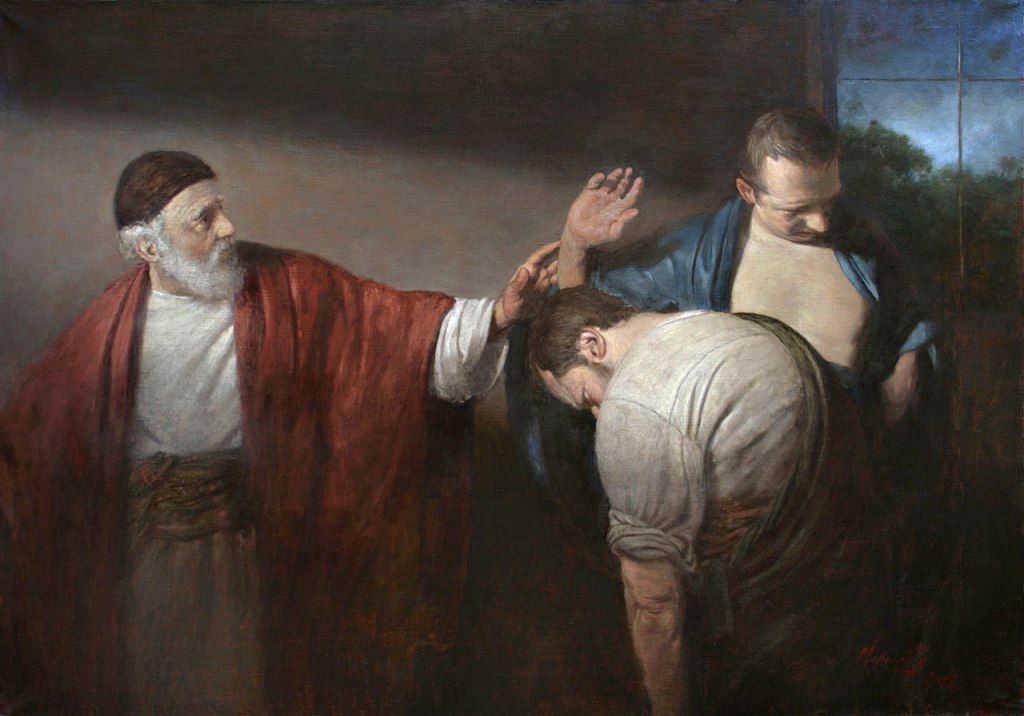
By Andrey Mironov 777 – Own work, CC BY-SA 4.0, https://commons.wikimedia.org/w/index.php?curid=24847288

Matthew 21: 12-17

Parallel Mark 11:15-17; Luke 19: 45-56; John 2: 13-17

12 Then Jesus entered the temple and drove out all who were selling and buying in the temple, and he overturned the tables of the money changers and the seats of those who sold doves. 13 He said to them, “It is written,

‘My house shall be called a house of prayer’; but you are making it a den of robbers.”

14 The blind and the lame came to him in the temple, and he cured them. 15 But when the chief priests and the scribes saw the amazing things that he did, and heard the children crying out in the temple, “Hosanna to the Son of David,” they became angry 16 and said to him, “Do you hear what these are saying?” Jesus said to them, “Yes; have you never read,

‘Out of the mouths of infants and nursing babies you have prepared praise for yourself’?”

17 He left them, went out of the city to Bethany, and spent the night there.

Jesus’ entry to Jerusalem culminates at the temple in Matthew’s gospel, and Matthew’s narration of this scene adds a lot of rich symbolism to the way Mark and Luke narrate this brief scene. Like the previous scene, many people remember this scene the way John narrates it with Jesus making a whip of cords to drive the moneychangers out of the temple (and John’s location of this event near the beginning of the gospel), but in Matthew, Mark and Luke this begins the direct conflict between Jesus and the temple authorities. Matthew in particular highlights many Davidic and prophetic themes in this purification of the temple.

Jesus has entered Jerusalem in a way that models Israel’s vision of an ideal king, and the rare good kings in Israel and Judah were responsible for bringing about reform in the temple. For example, Hezekiah’s repair and reform of the temple is narrated:

Hezekiah said, “Listen to me, Levites! Sanctify yourselves, and sanctify the house of the LORD, the God of your ancestors, and carry out the filth from this holy place. For our ancestors have been unfaithful and have done what is evil in the sight of the LORD our God; they have forsaken him, and have turned away their faces from the dwelling of the LORD, and turned their backs. 2 Chronicles 29: 5-6

The connection between this scene in 2 Chronicles and Matthew is strengthened when you realize that in the Septuagint (the Greek translation of the Hebrew Scriptures) the word translated ‘carry out’ in 2 Chronicles is the same word translated ‘drove out’ in Matthew. The Greek word ekballo, which is used in both places, is more commonly translated in Matthew ‘cast out’ and is the term used when Jesus exorcises demons. While Matthew wants us to understand that Jesus is purifying the temple, he may also be communicating that Jesus is performing an exorcism on the temple. The action is further explained by joining together two pieces of scripture in quotation. The first is Isaiah 56:7:

These I will bring to my holy mountain, and make them joyful in my house of prayer; their burnt offerings will be accepted on my altar; for my house will be called a house of prayer for all peoples.

Isaiah 56 combines a vision of an expansive hope where foreigner and eunuchs once excluded from the temple are now included while the ‘sentinels and shepherds’ (Israel’s leaders-both religious and political) are condemned for their blindness. This is joined to Jeremiah 7:

Here you are, trusting in deceptive words to no avail. Will you steal, murder, commit adultery, swear falsely, make offerings to Baal, and go after other gods that you have not known, and then come and stand before me in this house which is called by my name, and say, “We are safe!”—only to go on doing all these abominations? Has this house, which is called by my name, become a den of robbers in your sight? You know, I too am watching, says the LORD. Jeremiah 7: 8-11

Matthew is the only gospel when Jesus asks the disciples, “Who do people say the Son of Man is?” to specifically include the prophet Jeremiah as a portion of the answer (16: 14) and Matthew’s narration of the conflict between Jesus and the temple and the temple authorities echoes Jeremiah’s conflict with the temple and its leaders in his time. Both temples will be destroyed (the temple in Jeremiah’s time by Babylon, about 30 years after Jesus’ death the temple will be destroyed by Rome). Matthew will transition rapidly between prophetic and kingly allusions for Jesus throughout the crucifixion narrative, but this is not new in Matthew’s gospel. Just as the crowds in Matthew 16:14 (and entering Jerusalem in the previous section) could understand Jesus in terms of a prophet, Peter in 16:16 can highlight that ‘Messiah’ is an appropriate title for Jesus, and the crowds (as well as a foreigners (15:22) and the blind (9:27, 20:30)) can understand Jesus as the ‘Son of David.’

The moneychangers and dove sellers are replaced in the temple by the blind and the lame. Although Jesus is well known for his healing of the blind and the lame, this action is also symbolically rich when contrasted with David’s story. In 2 Samuel 5, the Jebusites who David conquers to take control of Jerusalem taunt David saying: “You will not come in here, even the blind and the lame will turn you back”  (2 Sam. 5: 6) and when David conquers Jerusalem the phrase is now turned around to exclude the blind and the lame from Jerusalem and David’s house (perhaps excluding those Jebusites who were maimed in the battle). Yet, Jesus entering the temple makes space for the blind and the lame, and just as Isaiah 56 expanded the house of God to the previously limited eunuchs and foreigners, now the blind and lame are now made whole and enter into the temple of God with Jesus. Children are also present, just as they have been present throughout the section immediately prior to entering Jerusalem (18: 1-9; 19: 13-15) speaking the words the crowds shouted upon entering Jerusalem.

Jesus has upset the sacrificial system in the temple and has directly overturned the world of the chief priests and the scribes who are responsible for the temple. They are indignant (I translated this term as resentful earlier with the disciples (20:24) and indignant or resentful work here as well).There is probably an element of political danger with the proclamation of Jesus as ‘Son of David’ that may endanger not only Jesus, but they may feel, justly, that anyone acting like a king could be a danger to not only themselves and their followers but to the temple and the city as well. Yet, their conflict with Jesus will often ignore the actions of Jesus (both the symbolic and the healings) and focus on authority. Yet, Jesus invites them to wonder at what is happening in their midst and to hear scripture in a new way. They hear in the crowds proclamation danger, instead of hearing Psalm 8:3

Out of the mouths of infants and nursing babies you have prepared praise for yourself’[1]

which helps the attentive reader understand that this is a time for praise because God is at work in the world and in the temple. Matthew quickly ends the day by taking Jesus and his followers outside Jerusalem to Bethany where he spends the night before returning to the temple again the following day.

[1] This is Psalm 8:2 in English/Hebrew, Matthew follows the Septuagint’s wording rather than the Hebrew text behind the NRSV and other translations. The versification in the Septuagint is different from most English translations in the Psalms, here it is only one verse difference but in other places it can be off by a chapter.

Matthew 21: 1-11 The Entry into Jerusalem

Matthew 21: 1-11

Parallels Mark 11: 1-10; Luke 19: 28-40; John 12: 12-29

When they had come near Jerusalem and had reached Bethphage, at the Mount of Olives, Jesus sent two disciples, 2 saying to them, “Go into the village ahead of you, and immediately you will find a donkey tied, and a colt with her; untie them and bring them to me. 3 If anyone says anything to you, just say this, ‘The Lord needs them.’ And he will send them immediately.” 4 This took place to fulfill what had been spoken through the prophet, saying,

5 “Tell the daughter of Zion, Look, your king is coming to you, humble, and mounted on a donkey, and on a colt, the foal of a donkey.”

6 The disciples went and did as Jesus had directed them; 7 they brought the donkey and the colt, and put their cloaks on them, and he sat on them. 8 A very large crowd spread their cloaks on the road, and others cut branches from the trees and spread them on the road. 9 The crowds that went ahead of him and that followed were shouting,

“Hosanna to the Son of David! Blessed is the one who comes in the name of the Lord! Hosanna in the highest heaven!”

10 When he entered Jerusalem, the whole city was in turmoil, asking, “Who is this?” 11 The crowds were saying, “This is the prophet Jesus from Nazareth in Galilee.”

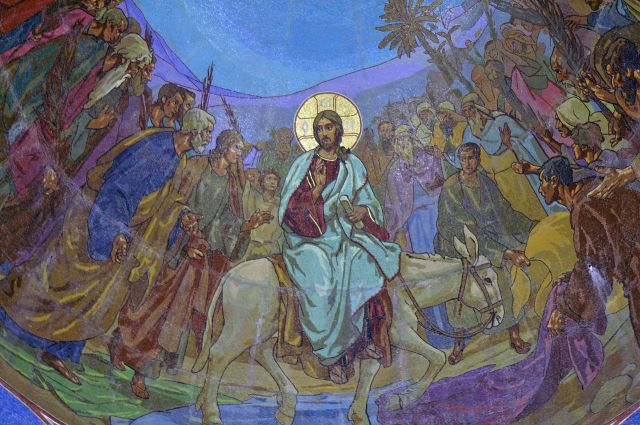
The entrance to Jerusalem, celebrated at the beginning of Holy Week in liturgical churches, is often viewed as a triumphal procession, which in one way it is, but this rich prophetically symbolic event is sometimes lost amid the palm branches and joyous songs. The entrance to Jerusalem initiates the final section of the gospel which narrates the time between the entrance to Jerusalem and the resurrection. This even is narrated by all four gospels, but only in John are the branches mentioned to be the palms which give the liturgical celebration of Palm Sunday its name. Even though this initiates a new section as Jesus enters into conflict with the religious leaders in Jerusalem, Matthew as a skillful editor and storyteller weaves in numerous threads that connect this scene and the coming conflicts, parables, events and ultimately the crucifixion and resurrection to the teaching, parables, healings, and conflicts that have been a part of the ministry in Galilee and the approach to Judea.

The first connecting thread which ties this scene to the preceding narration in Matthew is the continued presence of doubling. Just as in the previous section where two blind men are healed (and this links the final scene of the narrative prior to entering to Jerusalem to scenes throughout Jesus’ ministry) now in this initial scene of the Jerusalem narrative we have two disciples sent to retrieve two animals. Just as Matthew begins his gospel with a genealogy which ties the gospel to the story of Israel, now Matthew begins his narration of the events that lead to Jesus’ death by connecting it structurally with the narration of Jesus’ ministry.

Throughout this journey through Matthew I have linked Jesus’ vision of the kingdom of heaven with the vision God intended for Israel as an alternative community to the ways of Egypt, Assyria, Babylon and now Rome. This insight helps hold together both sides of Jesus’ action of coming into Jerusalem on ‘a donkey and on a colt, the foal of a donkey.’ While David Garland is right to identify Jesus’ action of riding a donkey into Jerusalem with this action by previous claimants to the throne of David[1] and with the expectations of the actions of the awaited messiah (Garland 2001, 213) but Warren Carter is also correct that this act is “making an ass out of Rome” in entering Jerusalem in a way that is a parody of the Roman triumphs, victories and arrivals of a governor or emperor. (Carter 2005, 413) The vision of what a king of Israel is to be, according to the law as outlined in Deuteronomy 17: 14-20 ,is the opposite of the ways the kings and rulers of nations like Egypt and Rome acted. The problem Israel experienced is that the kings of Israel often imitated the kings of the empires rather than the vision of God for Israel. Even the disciples of Jesus will struggle to understand what it means for Jesus to be the Christ (messiah) as they think of ‘earthly things’ rather than ‘heavenly things.’ Jesus’ birth caused Herod to be frightened and all Jerusalem with him, and now his entry the city is shaken (this is the Greek seio, where the English seismic comes from, this will also be used for the earthquake at the death and resurrection of Jesus) by this act of approaching on a donkey and a colt, surrounded by the crowds that have approached Jerusalem in his presence. The people of Jerusalem, the urban center where now Pilate sits as the emissary of Caesar instead of Herod and they understand the prophetic significance of the actions and words of Jesus and his followers.

Matthew makes explicit what Mark implied about the biblical symbolism by weaving together Isaiah 62:11 and Zechariah 9:9. While most readers probably assume Matthew’s use of scripture is merely predictive (pointing to texts from the Hebrew scriptures which demonstrate how Jesus fulfills scripture) but Matthew’s rich weaving of scripture can, for the careful reader, help illuminate a deeper engagement with what Jesus’ actions mean. As we begin this section of the story in Jerusalem Isaiah 62 and Zechariah will be two of the texts which help provide language which can explain what Jesus’ actions and eventual death will mean in this final section of Matthew. Isaiah 62 is a song of the restoration of Zion, and although Jesus’ actions will challenge the religious authorities in Jerusalem, this approach is ‘for Zion’s sake’ (Isaiah 62:1). This passage in Isaiah talks about the ending of Israel’s long exile and captivity to other empires. The specific verse which begins this intertwined quotation (the portion Matthew uses is underlined) is:

The LORD has proclaimed to the end of the earth: Say to daughter Zion “see your salvation has comes; his reward is with him, and his recompense is before him. (Isaiah 62:11)

Matthew is a careful editor, when he quotes scripture and brings together verses it is intentional rather than a scribal error. Matthew seems to have access to the Septuagint (the Greek translation of the New Testament) as he is writing this and is very skilled in reading texts. The remainder of this text comes from Zechariah 9:9 which Matthew slightly modifies (again what Matthew uses is underlined):

Rejoice greatly, O daughter Zion! Shout aloud, O daughter Jerusalem! Lo, your king is coming to you; triumphant and victorious is he, humble, and mounted on a donkey, on a colt, the foal of a donkey.

Matthew leaves off the note of triumph and victory from this quotation, even as he carefully includes the two animals (which again works in Matthew’s doubling pattern). Zechariah will continue to echo in Matthew’s narration of the passion narrative, especially in the Lord’s Supper where both the language of the blood of the covenant and striking the shepherd are rich echoes of Zechariah.

This blended quotation also allows Matthew to reintroduce the adjective ‘meek’ when referring to Jesus (NRSV humble, the Greek praus is the same term used in 5:5 and 11:29). Jesus’ actions help us understand this important term for Matthew, it does not mean silence or temerity but rather it refers to those who wait upon the Lord to deliver them rather than rising up in resistance. If there is a triumph here, the triumph belongs to the Lord, the God of Israel, rather than any king. But for Matthew we have God’s action on behalf of Israel and the ‘God who is with us’ in Jesus blended together in a way that defies easy categorization. Jesus may embody titles like savior (which may be why the beginning of Isaiah 62:11 is used), messiah/Christ/king, Son of David, and prophet, but none of them adequately describe the totality of Jesus in Matthew. Each may illustrate some amount of openness to God’s work in Jesus’ presence, but they also remain open to misinterpretation.

The crowds who enter with Jesus can declare Jesus as ‘Son of David,’ ‘one who speaks in the name of the Lord’ and ‘prophet’ which illuminates that they understand in part who Jesus is, unlike Jerusalem which quakes at his approach. Although Matthew does not specify, this crowd which enters Jerusalem with Jesus is probably not the same crowd that calls for his crucifixion. It is likely that it is the crowds from the urban center of Jerusalem who do not, at the urging of the religious leaders in the city, embrace Jesus’ words and actions. It is possible that some of the approaching crowd become disillusioned with the way Jesus embodies these titles, like Judas Iscariot who moves from a disciple to one who betrays. This scene probably reflects those who have journeyed with Jesus to Jerusalem in this festival season who enter as outsiders to the city. The people of Jerusalem may have heard stories of Jesus’ ministry and work, but in Matthew this is the first time and only time that Jesus comes to Jerusalem.

Unlike in Mark, where Jesus withdraws to Bethany after arriving at the temple late in the day, we will see Jesus immediately move from one symbolically rich action in the approach of the city directly to the symbolically rich action of clearing out the money changers and animal sellers in the temple. From a perspective where this action parodies the Roman practice of a victory parade where the conqueror proceeds to the temple to offer a sacrifice, we see Matthew joining the action on entry together with the action in the temple. But from the prophetic and Jewish perspective there is the action of Jesus embodying what a king is supposed to be. For Matthew’s narration of these linked scenes the figure of David will stand in the background of the narration as Jesus is acclaimed as Son of David, and particularly in the next scene there are some clever allusions to David’s capture of Jerusalem. But hauntingly the people entering with Jesus describe him as a prophet who is entering a city with a reputation for rejecting prophets. While David was often thought of as a prophet, especially as he is attributed with many of the Psalms, we see in Jesus one who brings together the role of prophet and king in a way not seen in Israel, with the possible exception of Moses.

[1] Absalom is riding a mule in 2 Samuel 18:9 when he dies during his rebellion against David, Solomon rides a mule to is anointing in 1 Kings 1: 33

Matthew 20: 29-34 Opening Eyes on the Way to Jerusalem

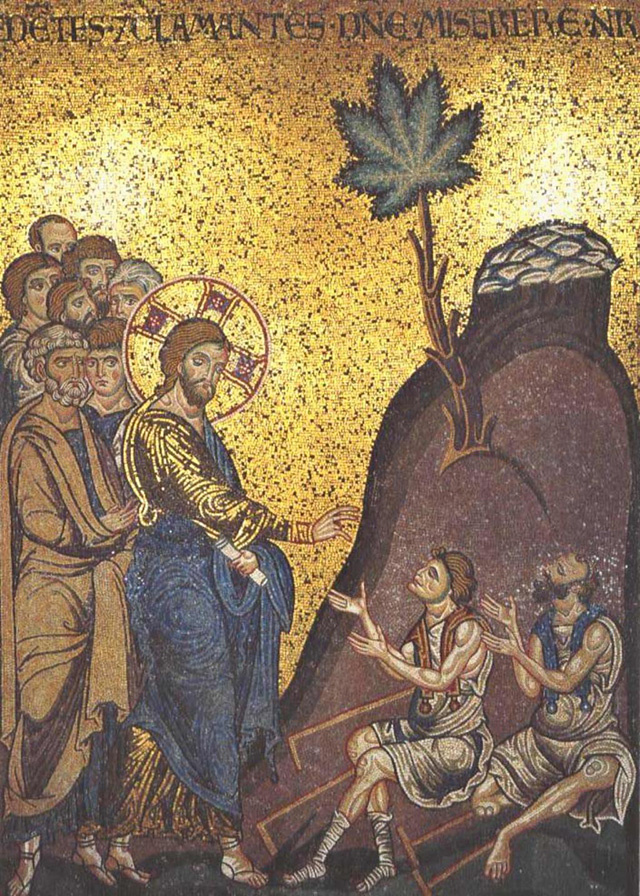
Jesus Healing the Blind From 12th Century Basilica Catedrale di Santa Maria Nouva di Monreale in Sicily.

Matthew 20: 29-34

Parallel Mark 10: 46-52; Luke 18: 35-43

29 As they were leaving Jericho, a large crowd followed him. 30 There were two blind men sitting by the roadside. When they heard that Jesus was passing by, they shouted, “Lord, have mercy on us, Son of David!” 31 The crowd sternly ordered them to be quiet; but they shouted even more loudly, “Have mercy on us, Lord, Son of David!” 32 Jesus stood still and called them, saying, “What do you want me to do for you?” 33 They said to him, “Lord, let our eyes be opened.” 34 Moved with compassion, Jesus touched their eyes. Immediately they regained their sight and followed him.

Matthew is a careful narrator bringing together the pieces of Jesus’ story in a way that illustrates connections across the gospel and bringing enhanced meaning to each individual scene. The first disciples called to follow Jesus are two sets of brothers, (4:18-22) and the last who follow are two blind men enabled to see. Just as the request of the demons possessing two men make a request of Jesus (8: 28-34) is closely followed by the previous healing of two blind men (­9:27-31) so this healing of the two blind men is preceded by the formal request of the mother of James and John (see previous section). This pattern of twos provide clues to the oral structure underlying Matthew’s narration and provide signposts that allow the hearer to pay attention to commonalities in the stories. This narration of healing the two blind men outside of Jericho closes the gathering of Jesus’ followers in Galilee and on the road to Jerusalem. Its use of the Son of David title for Jesus recalls the previous usages of this title in the gospel[1] and prepares us for the crowds proclamation of this title as Jesus enters Jerusalem.

Jesus begins his final approach to Jerusalem making his way up from Jericho and a great crowd is with him. The crowds, like the disciples with the children, are a barrier for these two blind men to be in the presence of Jesus, but the use of both ‘Lord’ and ‘Son of David’ in their address to Jesus prepare us for Jesus’ eventual granting of their request. Previously when Jesus healed two blind men he ordered them to be silent, but instead they go and spread news about Jesus to the surrounding district. Here, the great crowds attempt to silence the two blind men only results in the blind men shouting greatly for mercy from the Lord, the Son of David. Matthew uses Hosea 6:6, “I desire mercy, not sacrifice.” as a key to understanding a merciful interpretation of scripture,[2] and just as the merciful are blessed and will receive mercy, Jesus responds with healing to numerous requests for mercy.[3] Jesus responds to this request for mercy with compassion.[4]

In contrast to the previous scene where the audacious request of the mother of James and John for a position of honor for her sons is met with a paradoxical partial fulfillment which points to James and John suffering, in this scene the request for mercy is met with healing. The response of Jesus to both the mother of James and John and the two blind men is and identical “What do you will (Greek theleo). There is irony in these two stories placed next to one another where disciples are unable to see what they ask, where these blind men are aware of their blindness and ask to be able to see. Despite the attempts to silence them by the crowds, they are invited into the presence of Jesus, touched by him, and have their eyes opened. Unlike the previous healing of blind men where faith was a primary portion of the story, the question of faith is unaddressed but assumed by both the titles used and the persistence of these blind men who become followers on the road to Jerusalem. Ironically, the words that the crowds attempt to silence from these two blind men becomes their shout as they surround Jesus to enter Jerusalem.

[1] The two blind men in 9:27 and the Canaanite woman in 15:22 use this title asking for healing and the crowd wonders could this be the Son of David in 12:23. For a fuller discussion of the use of the Son of David title see Son of David, Son of God, Son of Man Titles in Matthew’s Gospel.

[2] See 9:13 and 12:7

[3] 5:7 in the Sermon on the Mount; healings after requests for mercy: 2 Blind men (9:27-31), Canaanite woman (15: 21-28), Father of the moonstruck son (17:14-21) see also the request for mercy in the parable of the unforgiving slave (18:30-32)

[4] Previously Jesus has had compassion for the crowds (9:36, 14:18, and 15:32) but not for individuals. Compassion also is the expected action of the unforgiving slave in the parable (18:27)

Matthew 20: 17-28 Greatness in the Kingdom

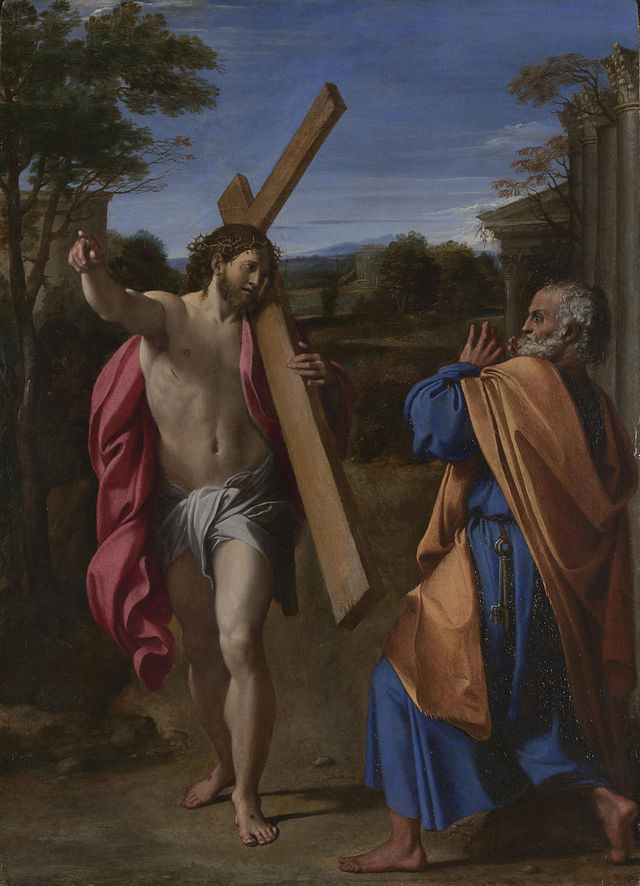
Domine, quo Vadis? by Annibale Carracci, 1062

Matthew 20: 17-28

Parallels Mark 10: 32-45; Luke 18: 31-34, 22: 24-27

17 While Jesus was going up to Jerusalem, he took the twelve disciples aside by themselves, and said to them on the way, 18 “See, we are going up to Jerusalem, and the Son of Man will be handed over to the chief priests and scribes, and they will condemn him to death; 19 then they will hand him over to the Gentiles to be mocked and flogged and crucified; and on the third day he will be raised.”

20 Then the mother of the sons of Zebedee came to him with her sons, and kneeling before him, she asked a favor of him. 21 And he said to her, “What do you want?” She said to him, “Declare that these two sons of mine will sit, one at your right hand and one at your left, in your kingdom.” 22 But Jesus answered, “You do not know what you are asking. Are you able to drink the cup that I am about to drink?” They said to him, “We are able.” 23 He said to them, “You will indeed drink my cup, but to sit at my right hand and at my left, this is not mine to grant, but it is for those for whom it has been prepared by my Father.”

24 When the ten heard it, they were angry with the two brothers. 25 But Jesus called them to him and said, “You know that the rulers of the Gentiles lord it over them, and their great ones are tyrants over them. 26 It will not be so among you; but whoever wishes to be great among you must be your servant, 27 and whoever wishes to be first among you must be your slave; 28 just as the Son of Man came not to be served but to serve, and to give his life a ransom for many.”

Central to the organization of the last three chapters of Matthew’s gospel has been a response to ‘greatness’ in the kingdom of heaven. Jesus is not a Messiah (king) like the kings of the nations but instead is one who comes to serve instead of serving. The world imagined by the kingdom of heaven is an alternative to the worldview of the nations of the earth, and in this world reoriented has drastic implications for these disciples of Jesus as they consider the shape of their own lives. Even as we stand at the threshold of closing Jesus’ ministry of teaching and prepare to enter the narration of the final week in Jerusalem the disciples and those around them continue to require a conversion of their imaginations (to use Richard B. Hays’ terminology) to embody this new society as an alternative to the ways of the nations.

The section begins with the final foretelling of Jesus’ coming betrayal, condemnation, humiliation, and crucifixion. Two previous times[1] (three if you count the words spoken to Peter, James, and John after the Transfiguration) Jesus has foretold the events that will occur in Jerusalem and been met with resistance, distress and now misunderstanding. As people who are able to read and hear this narrative repeatedly and who understand the narrative in light of the resurrection it is easy to become judgmental of the disciple’s inability to understand a crucified and resurrected messiah, but the disciples, like all the other characters of Matthew’s gospel, attempt to make sense of Jesus’ identity, actions, and words from within the worldview they inherited from their society. Perhaps one of the reasons that Matthew’s gospel is more charitable to the disciples than Mark’s is a pastoral understanding (in the sense of the responsibility for the forming of a community) of the need for patience as the kingdom’s worldview slowly begins to transform the engrained ways of the nations.

In Matthew’s gospel it is the mother of James and John who makes the request rather than the two disciples themselves. This, perhaps for Matthew, provides a little space between the disciples in the narrative who have just heard for the fourth time (since James and John were at the Transfiguration) about the upcoming death of Jesus. The mother comes and prostrates herself before Jesus which may be simply ‘bowing down or paying honor’ but within Matthew’s continued usage of the Greek proskuneo it is also used at times in an ambiguous way where ‘worship’ is implied and there is a revelation of Jesus being ‘God with us.’[2] Regardless the mother of James and John shows some openness to who Jesus is, but she and her sons continue to construct that identity in terms of the rulers of the nations. She comes to ask ‘a certain thing/something’ of Jesus (translations often translate this as a favor but this ritualistic request has a greater weight than asking for a favor) and Jesus responds to her request with “What is your will/desire?” (the Greek theleo is often translated as wish, but wishing in English is more ephemeral than this term for willing something to be) Her request for positions of high honor in the coming kingdom of Jesus for her sons shows both insight into a portion of Jesus’ identity and a misunderstanding of greatness in the kingdom of heaven. A ritual request for a declaration is a powerful and binding thing, and so if Jesus makes this statement he, as a king, is bound to it.[3] Jesus could deal with her, her sons, and later the disciples in a harsh way, but Jesus instead uses the moment as one more opportunity to talk about greatness in the kingdom of heaven.

Jesus addresses the request by trying to help James and John understand the request that is made. In the context of having foretold his own death in Jerusalem we are introduced to the idea of ‘drinking the cup’ that Jesus is about to drink. This will be resonant image in both the Hebrew scriptures and in the passion narrative that will begin in the coming chapter. In the Hebrew Scriptures drinking the cup (particularly the cup of the LORD) often used in the prophets as the language of suffering[4] but as Warren Carter notes it can also denote the LORD’s provision or deliverance.[5] (Carter 2005, 402) It may seem paradoxical that suffering and salvation are joined together in an image, but this is after all a kingdom where those who ‘want to save their life will lose it, and those who lose their life for my sake will find it.’ (16:25 emphasis on life is intentional, see below) In the coming passion narrative the cup will feature in both the last supper (26:27-29) and a Gethsemane. (26:39-46) Ultimately Jesus, after asking if they are powerful enough to drink the cup he is to drink, partially grants their request in an odd way. James and John will share both the suffering and the life that is to come, but their ability to fill the spots to the left and right of Jesus in his kingdom are not his to grant. Matthew’s linkage of this scene with the crucifixion is also echoed by the placement of the bandits who are crucified with him, “one on his right and one on his left.”

The response of the remaining ten disciples to James and John is often translated as ‘angry’ or ‘indignant’ which are typically used to translate the Greek aganakteo, but I am going to risk using a more precise word ‘resentful.’ While indignant may be a word that expresses anger or annoyance at unfair treatment, I think it is a word that is outside most of our emotional vocabulary. I do think we need to work on teaching the skill of “labeling our emotions with a nuanced vocabulary.” (Brackett 2019, 19) and anger is a large emotion which covers many of what Marc Brackett describes as low pleasantness high energy emotions. Resentful is a word in English that most people understand that captures the anger or annoyance at unfair treatment that the older indignant represents. I also think that it is an understandable emotion in terms of the requested honor and partially favorable response that James and John have received. All of the disciples are still viewing Jesus’ message from within the worldview they inherited from their parents and the society around them, and even now Jesus continues to patiently reorient them to the very different values of the kingdom of heaven.

Jesus directly engages the worldview of the nations and their perceptions of greatness and contrasts them to the values of the kingdom of heaven. Instead of the values of the nations where the rulers lord it over their followers and the great ones exercise authority over (this doesn’t have the negative implication in modern English that tyrants does: the Greek is a conjunction of the prefix kata (according to) and ekousia (authority)) the great in the kingdom of heaven are servants and the first is a slave. Throughout this section the disciples have been told they need to be humble like a child placed in their midst (18:4) instead of a rich young man (19:16-30 a person who has every advantage in that society) who would need to give away his possessions to embrace the kingdom. Jesus embodies these values for his disciples and his serving instead of being served will be the model for them to emulate.

Early in my ministry I once caused a minor controversy in a class I was teaching when I stated that Mark (and Matthew) by extension did not have any atonement theology where Christ died for our sins to redeem us. Ultimately Matthew and Mark do not have any type of atonement theology like Anselm of Canterbury talks about in Cur Deus Homo (Why God Became Man one of the classic texts of medieval classic atonement theology) but here in 20:28 we do have the only introduction of the idea of ransom in Matthew (and its parallel in Mark). In the Hebrew scriptures the idea of ransom is often used in the context of freeing the people of Israel from their captivity under other nations (Exodus 6:6; Isaiah 43:1-7; 44:22) and while this may be connected with the sins of the people which led to their exile, this is not an individualistic salvation from one’s sins. Throughout Matthew, from the beginning when the angel of the Lord tells Joseph, “he will save his people from his sins” (1:21) I have written about this in terms of Jesus bringing about the end of the exile of the chosen people. Although Stanley Hauerwas comments on this passage are an interesting place to begin discussion:

Rather, he has ransomed us from the very temptations he resisted in the desert, to make possible our participation in the only politics that can save us. He has brought to an end our slavery to the politics based on fear of death, making it possible for us to be servants to one another and the world. (Hauerwas 2006, 179-180)

The temptation to define power in the ways of the nations of the world is to fall into the devilish temptation that Jesus avoided. Jesus’ kingdom does not involve the death and destruction of his enemies, but for those he has patiently worked upon to transform their values and worldview it is the beginning of a new way of understanding power. The great in the kingdom of heaven are the servants of the world, the first are slaves. Or in Martin Luther’s famous paradox from the Freedom of a Christian:

A Christian is a perfectly free lord of all, subject to none. A Christian is a perfectly dutiful servant of all, subject to all (Luther 1989, 596)

What the Son of Man uses in ransom in his psuche which is normally translated elsewhere as ‘soul’ but as I discussed in 10:39 and 16: 25-26  in Hebrew thought the soul is not detachable from one’s life but is the very essence of it. There is no body/soul duality that would become engrained in later Christian vocabulary. To give up one’s psuche is to give up everything of oneself. Just as the disciples earlier could state they gave up everything in following Jesus while thinking of their possessions and relationships, now Jesus demonstrates a world where one’s entire being is placed completely in the service of God. As Paul could say in his letter to the Romans:

I appeal to you, brothers and sisters, by the mercies of God, to present your bodies as a living sacrifice, holy and acceptable to God. Romans 12: 1

[1] Matthew 16:21; 17:22-23 (17:12)

[2] See the fuller discussion in Matthew 14:22-33

[3] At least in terms of the rulers of the nations: think for example of how the words of King Ahasuerus throughout the book of Esther bound him or how King Darius in Daniel 7 is bound by his own ordinance. These stories would be a part of the worldview of both the mother and the sons in this story.

[4] Isaiah 51: 17; Jeremiah 25:15-38; Jeremiah 49:12; Ezekiel 23: 32-34; Habakkuk 2: 15-16; see also Psalm 75:8

[5] See particularly Psalm 16:5 and Psalm 116:3

Matthew 20: 1-16 The Good House Master

the Parable of the Vineyard,by Andrey Mironov, CC BY-SA 4.0, https://commons.wikimedia.org/w/index.php?curid=24843092

Matthew 20: 1-16

“For the kingdom of heaven is like a landowner who went out early in the morning to hire laborers for his vineyard. 2 After agreeing with the laborers for the usual daily wage, he sent them into his vineyard. 3 When he went out about nine o’clock, he saw others standing idle in the marketplace; 4 and he said to them, ‘You also go into the vineyard, and I will pay you whatever is right.’ So they went. 5 When he went out again about noon and about three o’clock, he did the same. 6 And about five o’clock he went out and found others standing around; and he said to them, ‘Why are you standing here idle all day?’ 7 They said to him, ‘Because no one has hired us.’ He said to them, ‘You also go into the vineyard.’ 8 When evening came, the owner of the vineyard said to his manager, ‘Call the laborers and give them their pay, beginning with the last and then going to the first.’ 9 When those hired about five o’clock came, each of them received the usual daily wage. 10 Now when the first came, they thought they would receive more; but each of them also received the usual daily wage. 11 And when they received it, they grumbled against the landowner, 12 saying, ‘These last worked only one hour, and you have made them equal to us who have borne the burden of the day and the scorching heat.’ 13 But he replied to one of them, ‘Friend, I am doing you no wrong; did you not agree with me for the usual daily wage? 14 Take what belongs to you and go; I choose to give to this last the same as I give to you. 15 Am I not allowed to do what I choose with what belongs to me? Or are you envious because I am generous?’ 16 So the last will be first, and the first will be last.”

This parable, which is unique to Matthew’s gospel, expands on Jesus’ paradoxical proverb about many who are first being last and the last being first. In Matthew, this parable is the final parable prior to entering Jerusalem and is preceded by the parable of the lost sheep and the unforgiving servant in Matthew 18. The world imagined in the parable is jarring for those committed to the capitalistic worldview of our time or the worldview of the nations in Jesus’ time. Each of the three parables in Matthew 18-20 are told specifically in answer to the disciples’ questions about greatness or forgiveness and unlike earlier parables are not explained by Jesus. We are invited not only into the worldview of the disciples of Jesus, but into these short stories which are designed to challenge their assumptions as they begin to embody a different kind of society amidst the nations.

I am making several translational choices that make the story less readable to a casual modern reader but highlight some of the different assumptions and values of the world Jesus spoke to. Our imagination around land and time are different than the ancient world, especially for those who dwell in cities and whose primary place of income is a workplace that is no longer connected with agriculture. For most of history the home was the primary place where economics occurred, and the ‘house master’ was responsible for the stewardship of the economics of their land. What many translations render as a ‘landowner’ is the Greek oikodespotes (oikos- home, this is the word at the root of the modern idea of economy and economics and despot-where our modern word despot comes from, meaning ruler, lord or master) I am rendering more literally as ‘house master.’  Jesus has been referred to himself a ‘house master in 10:25 when he states, “If they have called the master of the house (oikodespotes) Beelzebul, how much more will they malign those of his household.” This term will also appear in Matthew 24:43 in the context of Jesus warning his disciples to stay awake like a house master who does not know when a thief is coming.

While the house master is responsible for both household and land, this does not indicate that the house master will be wealthy or elitist. We may think in modern terms of a person with land and property as the master of an estate with servants to do their bidding, and while that might be the case of this house master we need not assume that it is the case. We only hear of one person who works directly for the house master in this parable, and while many interpreters assume that the house master is wealthy and going into the marketplace to hire workers would be below him, that is an assumption that the house master oversees a large household with many servants or slaves that work for him. It is worth remembering that a part of the Jewish hope is for everyone is to live securely in their own land. Whether 1 Kings 4: 25 is accurate that under Solomon everyone had their own vine and fig tree, the prophetic hope resonates with this image:

But they shall all sit under their own vines and under their own fig trees, and no one shall make them afraid; for the mouth of the LORD has spoken. Micah 4:4, see also Zechariah 3: 10

Regardless of the whether the house master is wealthy or merely owns a vineyard, we will see in the parable that this individual acts in a way that is very unusual in the disciples’ worldview and in ours.

In the modern western culture we imagine time in the way we measure it on a clock, watch or cell phone with the day broken into precise hours, minutes and seconds, and while many work hours outside of the eight hour, 9 a.m.-5 p.m. we often think of the forty hour week as a standard for work. The workday in the ancient world is constructed around daylight hours, and here in the world of this parable we have an approximately twelve-hour workday. The house master goes out during the fourth watch (before dawn) into the marketplace to find workers, and while some translations smooth the agreed upon wage to ‘the usual daily wage’ I believe most readers can understand the agreement for a concrete price, a denarius, even if they may not be able to precisely fix the value of this payment in modern equivalents. The agreement for a specific payment by both the house master and the workers is important to this story. To render the times when the house master returns to the market place as nine o’clock, noon, three o’clock and five o’clock assumes our precise relationship with time and can give the illusion of something resembling our normal workday, the more literal third hour, sixth hour, ninth hour, and the eleventh hour, reminds us that the workday is long and it may remind us that time was not measured by clocks, but by the movement of the sun.

A vineyard, unlike grain crops sown in a field, require constant tending. Most commentators assume that the house master has gone to bring in workers for the harvest, but that may not be the assumption of those in Jesus’ time hearing this parable. The reality that there are workers throughout the day who are without work (most English translations place a value judgment on their translations on the laborers when they state they are ‘standing idle’ but the Greek agroi literally means without work) the laborers answer that no one was hiring along with the quick agreement on a wage may indicate a time where the supply of workers exceeded demand. Also, as Amy Jill-Levine notes, “The householder continues to go to the market, but the parable makes no explicit mention of the need for more labor.” (Levine 2014, 226) Perhaps, something very strange is happening with this house master who continues to bring more workers into their vineyard to work. The harvest may indeed be great, or the house master may indeed be generous.

Sometimes this parable is quickly allegorized to talk about grace and ‘salvation’ or the assumption is made that those who are in the vineyard early are the Pharisees and/or Sadducees but reading the context of the story I want to suggest two different frames for this story. All of the parables in Matthew 18-20 are in response to the questions of the disciples, and this parable follows Peter’s question, “What then will we have?” so likely Matthew is not concerned with groups outside the followers of Jesus, but precisely the imagination and actions of those whom Jesus has called from the fishing boats, marketplace or wherever they have come from to follow him. But it is also helpful to remember that Jesus is using a commonly used image for Israel, the vineyard (see Isaiah 5, Jeremiah 7) to tell a very Jewish parable. Christians may be conditioned to continually question ‘what thing we might do to have eternal life’ (see my discussion of this question in the previous section) but rather than spiritualizing the parable to concern the afterlife, what if it is concerned with how members of the kingdom of heaven relate to one another. As Dr. Levine can again state insightfully, “To those who ask today, “Are we saved?” Jesus might well respond, “The better questions is, ‘Do your children have enough to eat?’ of ‘Do you have a shelter for the night?’” (Levine 2014, 216)

I am going against the grain assuming that the ‘house master’ is good, since many would side with the workers in the parable around issues of fairness or justice. When the parable is spiritualized to be about the afterlife is removes the scandal from the parable, but it also misses the fruit that is hanging from the vines to be gathered. When the house master orders his steward to pay the workers at the end of the day he is acting in accordance with the expectations of the law (Lev. 19: 13, Deut. 24: 14-15) and Deuteronomy 24: 15 is particularly worth noting in this context:

You shall pay them (poor and needy laborers) daily before sunset, because they are poor and their livelihood depends on them; otherwise they might cry to the LORD against you and you would incur guilt.

In our capitalistic worldview a person who works longer should receive a better payment, and the first should not be treated as equal with those who came last but should receive better compensation for more time spent in labor. When the lord (and the Greek here is kurios which is normally translated lord) of the vineyard calls his steward to distribute payment beginning with the last and going to the first we receive a verbal cue that something is about to be turned upside down. Those who the house master sent into the vineyard at the eleventh hour receive a denarius setting up the expectations of earlier workers and the listeners of a greater reward for those present from early morning. Yet, there is something different in this house master who acts according to the vision of the kingdom of heaven, and who can claim to be good (this is the Greek agathos which is translated good twice in the previous story and the translation of generous in many translations obscures the linkage with the character of God, see previous section) This parable invites us into a world where the lord of the vineyard, which is now closely linked to the LORD the God of Israel (who is good) models a world where a house master goes continually in the marketplace looking for workers to ensure they have work that pays in a timely manner and ensures that children have enough to eat and workers can find shelter for the night. Perhaps this kingdom of heaven is about a world where all the laborers can have enough to eat, and God provides sufficiently for all instead of a world where laborers are only satisfied in the afterlife. When we hear a person address another as ‘friend’ we may assume intimacy, but in Matthew’s gospel the term ‘friend’ is used in a setting of formality when another has acted improperly. (see also 22:12, 26: 50) What is smoothly translated ‘are you envious’ is the phrase ‘or is the eye of you wicked/evil’ and the ‘evil eye’ in ancient cultures was to curse or wish harm on another, but here the house master declares that this action, which in opposition to the good, is uncalled for. In the values of the kingdom of heaven, where the last are first and the first are last, the master of the house goes out to ensure that as many workers as possible receive the opportunity to work, to provide for their families, and to have shelter for the night. Until a time when all can rest under their own vines and fig trees the house master works to provide out of their goodness for the laborers in the marketplace.

We live in a society that is very defensive of its individualistic and capitalistic values and is quick to label things that value the needs of the society above the individual or the workers above profit as socialist, communist, or Marxist. Ultimately the values that Jesus points to are older than either capitalism or Marxism, or the individualism that evolved from the Enlightenment. Jesus’ vision of the kingdom of heaven conflicts with all of the ways we are used to framing our identity in our post-Enlightenment, modern (or postmodern) secular age. It does not fit neatly into our labels and titles but instead invites our imaginations into a new way of viewing our world, our society, and our neighbors. Although Jesus does point to a reality beyond this world, his teaching and parables are mainly concerned with how we live in relation to others within life. Jesus’ suggestion of a house master who provides out of his goodness for the laborers in the marketplace conflicts with our ideas of fairness. Yet, the richness of these short narratives that Jesus tells is the way they poetically challenge our imaginations to conceive of the world in a new way, with a different set of principles and visions. Disciples who look at the world hierarchically have to be reoriented to a world where the last are first and the first are last. Disciples, ancient and modern, have struggled with their inability to embrace the world imagined in the kingdom of heaven.

Afterlife, Eternal Life and the Life of the Kingdom

Domine, quo Vadis? by Annibale Carracci, 1062

When most people who grow up in a Christian church talk about eternal life they are talking about ‘going to heaven’ or what happens to the ‘soul’ after death. Many Christians who faithfully come to worship each week do not realize that this is not the primary direction of Christian hope, instead most of this idea comes from the interaction of Greek philosophical worldview and the language of Christianity. Unfortunately, this focus on the soul’s ascent to be with God in heaven has transformed the profoundly grounded hope of the early followers of Christ into an otherworldly escapism which is often disconnected the horizontal dimension of faith which involve my neighbors and the world.

The Jewish covenantal understanding of their faithful relationship with God and their neighbor is the foundation upon which Jesus builds his vision of life under the kingdom of heaven. Despite Matthew’s frequent use of the kingdom of heaven, instead of the kingdom of God as predominant in Mark and Luke, what Jesus is referring to is God’s kingdom coming to earth. The entire direction of the New Testament’s hope is God’s coming to dwell among God’s people on earth. This is not unique to the New Testament, throughout the Hebrew Scriptures there is in the tabernacle and the temple a place where God can dwell among the people, the prophets dream and the psalms sing about the transformations that will come into the world when God reigns not only among Israel but among all the peoples. Just as the people of Israel were to be an alternative community among the empires of Egypt, Assyria, Babylon, Persia and Rome, these followers of Christ were to be an alternative community with alternative values to Rome or whatever society they found themselves within. When Paul, for example, in Philippians 3: 20 can state that, “our citizenship is in heaven, and it is from there we are expecting a Savior, the Lord Jesus Christ.” He is talking about living as person of an alternative community, the kingdom of heaven, and embodying those values within the space of the Roman empire and teaching others to do the same. Paul’s descriptions of the future glory in Romans 8: 18-27 beautifully dreams the interactive way that the unveiling of the children of God, those who are living under God’s calling and have been transformed for the sake of the world, is precisely for the liberation of the creation (not an escape from it). It is also why Paul ends 1 Corinthians, with the exception of the final travel plans and greeting, with a long discussion about the implication of the resurrection of Christ for the resurrection of all people. Paul is specifically arguing against a ‘non-bodily’ and ‘non earthly’ resurrection, even though many in the Hellenistic (Greek speaking) world would have embraced the idea of the ‘salvation of the soul’ willingly and viewed this bodily resurrection as scandalous. The book of Revelation is often thought of as the destruction of the earth, but what it narrates is the final coming of God to earth and the last but futile resistance of the forces aligned against God’s coming kingdom.

When the gospels speak of ‘eternal life’, the phrase that is translated is the Greek zoe aion. Zoe is where we get the feminine name Zoe from and it means ‘life.’ Aion is where we get the English word ‘eon’ from and while it is often translated ‘eternal’ but when most Christians think of ‘eternal life’ they think of life in heaven. For another perspective on how to think about the term ‘eon,’ it occurs as a noun at the end of Matthew’s gospel, “I am with you always, to the end of the age.” While some might argue that Jesus really is talking about being with the disciples for ‘eternity,’ what I believe Jesus is telling the disciples is, “I will be will be with you to the end of this age” which will end when the kingdom of heaven/God comes to earth.

In Matthew, Mark and Luke when zoe aion is only used when either the rich young man (all three gospels) or in Luke when a scribe asks (Luke 10:25) Jesus always points them back to the commandments of how they are to live in this life. In both cases the question is not about how to get to heaven, but how to participate in the life of the kingdom of God in the present and Jesus’ answer reflects that earthly reality. John’s gospel uses this term more than the other three gospels combined, but John has long been associated with a ‘realized eschatology’ where the promises of God’s kingdom are already being realized. For example, in John 17 Jesus can state,

since you have given him authority over all people, to give eternal life to all whom you have given him. 3 And this is eternal life, that they may know you, the only true God, and Jesus Christ whom you have sent. (John 17: 2-3)

“Eternal life” in John’s gospel is already realized in knowing Jesus and the God who sends Jesus. This life is revealed by participating in the faith and life of Jesus

While the New Testament can use a diverse set of language to talk about the approaching of God’s kingdom to this world, the movement is always God’s movement towards the world instead of the escape of the soul to join God. There are at best hints of some immediate experience of an afterlife and they often come in parables (like the rich man and Lazarus in Luke’s gospel) or when Jesus (again in Luke) tells the bandit on the cross “today you will be with me in paradise.” Portions of the church in the last several decades have begun to rediscover the centrality of the resurrection and the coming of God to dwell among the earth instead of the otherworldly focus of much of the church in the previous centuries. It is a subject that pastors and teachers have to approach delicately because it is a drastic change to the imaginations of many of the faithful, but it also invites the faithful into a closer relationship with the world and with the neighbors God has placed within it. In Paul’s rich language it is a call to join in the groaning labor pains of creation while we and the world await the redemption of our bodies. (Romans 8:23)

Matthew 19: 16-30 The Life of the Coming Age

Matthew 19: 16-30

Parallel Mark 10: 17-31; Luke 18: 18-30

16 Then someone came to him and said, “Teacher, what good deed must I do to have eternal life?” 17 And he said to him, “Why do you ask me about what is good? There is only one who is good. If you wish to enter into life, keep the commandments.” 18 He said to him, “Which ones?” And Jesus said, “You shall not murder; You shall not commit adultery; You shall not steal; You shall not bear false witness; 19 Honor your father and mother; also, You shall love your neighbor as yourself.” 20 The young man said to him, “I have kept all these; what do I still lack?” 21 Jesus said to him, “If you wish to be perfect, go, sell your possessions, and give the money to the poor, and you will have treasure in heaven; then come, follow me.” 22 When the young man heard this word, he went away grieving, for he had many possessions.

23 Then Jesus said to his disciples, “Truly I tell you, it will be hard for a rich person to enter the kingdom of heaven. 24 Again I tell you, it is easier for a camel to go through the eye of a needle than for someone who is rich to enter the kingdom of God.” 25 When the disciples heard this, they were greatly astounded and said, “Then who can be saved?” 26 But Jesus looked at them and said, “For mortals it is impossible, but for God all things are possible.”

27 Then Peter said in reply, “Look, we have left everything and followed you. What then will we have?” 28 Jesus said to them, “Truly I tell you, at the renewal of all things, when the Son of Man is seated on the throne of his glory, you who have followed me will also sit on twelve thrones, judging the twelve tribes of Israel. 29 And everyone who has left houses or brothers or sisters or father or mother or children or fields, for my name’s sake, will receive a hundredfold, and will inherit eternal life. 30 But many who are first will be last, and the last will be first.

This encounter with the young man with an abundance of possessions provides a rich opportunity to reconsider several elements of Matthew’s gospel in a fuller light. Unfortunately Matthew’s usage of the kingdom of heaven in many places and what many translations render as ‘eternal life’ combined with the long history of the church’s proclamation about heaven being a place where one’s soul departs to after death makes this passage sound like it is primarily concerned about life after death, but that presents a stumbling block to hearing what is at stake in the dialogue between this young man, Jesus, and the disciples. All of the gospels are primarily concerned with life on earth, and while Jesus’ teaching does have an element of judgment and reward beyond this age it is, Jesus never focuses on Gehenna or heaven as destinations but is instead focused on the kingdom of heaven’s approach to earth. It is the interaction between the alternative values of the kingdom of heaven and the values of the empires of the earth that leaves both the wealthy young man and Jesus’ disciples perplexed.

The someone who approached Jesus, who we later learn is a wealthy young man, asks Jesus about what ‘good he might do in order that he might have the life of the coming age.’ There is a lot in this first line that needs unpacking and perhaps much acquired baggage that many modern Christians must leave behind so they might enter into a richer hearing of this interaction. The young man’s addresses to Jesus as ‘teacher’ should alert us that the young man’s understanding of who Jesus is comes from the perspective of how he views him within the structures of society and not with eyes that are open to who Jesus is. In Matthew’s gospel the term teacher[1] prepares us that this young man will leave unsatisfied even though Jesus will extend the invitation to this man to follow him. The question about ‘what good I might do’ (many translations limit this to state what good ‘deed’ he might do, but the question is broader than a single good ‘deed’) ‘in order that I might[2] have the life of the coming age.’ This young man has seen something of the life that Jesus and his disciples are living and he comes seeking a way that he might share with them in their experience of the kingdom of heaven’s approach. Before we encounter Jesus’ answer, let’s examine this idea of the ‘life of the coming age.’

When most Christians hear this story they think the young man is asking Jesus what he needs to do to get to heaven, but what this young man sees is the life that Jesus is partaking of now and he is asking how he can partake of it. The primary reason I render this ‘the life of the coming age’ is that our understanding of ‘eternal life’ often obscures what the New Testament is talking about (see Afterlife, Eternal Life and the Life of the Kingdom). This young man knows there is something missing in his own life, and he has come to Jesus who he sees as a teacher who can give him the answer that will fill the emptiness that apparently his possessions and current life are not.

Jesus’ initial response to the young man both points back to the center of the Jewish faith but also invites the hearer question Jesus’ identity beyond being only a teacher. The Shema (Deuteronomy 6:4-5) is the central confession of the Jewish people where they confess “The LORD is our God, the LORD is one” (or alone as the NRSV renders) and the Psalms and the prophets often link the LORD as the one who is good.[3] While the young man is called to center of God and God’s commandments as the revelation of goodness, we have also seen throughout Matthew’s gospel the continual drawing of Jesus’ authority and God’s authority close together and so the question of “Why do you ask me what is good?” also asks “how do you see my words and God’s words linked?” The young man is still viewing Jesus through the lens of a teacher, so he focuses only on the keeping of the commandments by asking a clarifying question of “which ones?”

Jesus’ answer joins Leviticus 19:18 to the commandments dealing with one’s relationship with others, emphasizing the communal nature of this life that the young man is desiring to enter into with the interesting omission of the command on coveting. The young man still realizes something is missing and desires what he is lacking, and this is where the command of coveting enters the discussion. Jesus’ final words to this young man are, “If you will/desire (Greek thelo) to be whole/complete (this is again the Greek telios[4]), go…” Will/desire has a stronger force than simply wishing for wholeness, there is an active element of the heart (the instrument of will in Hebrew thought) working towards that end. Again, we often think of perfection in terms of an individualistic moral perfection which would be alien to biblical thought which is communal. The term wholeness or completeness better captures what Jesus is offering this young man. The young man realizes something is missing, but what he fails to comprehend is that finding this new treasure will mean giving up all that he owns to possess it like the one who finds a treasure in a field or the merchant who finds a pearl of exceeding value. (13:44-46) The command to sell his possessions, give to the poor, and having a storehouse in heaven echoes the Sermon on the Mount when it talks about possessions (6:19-21) but it also is accompanied by the calling that the disciples received (4: 18-22) The lure of wealth (13: 22) perhaps chokes the seed of this calling to follow Jesus and the young man departs disappointed and the disciples remain perplexed.

As the young man departs, Jesus turns to his disciples who even though they have left behind their lives to follow him still remain bound to thinking in the terms of the empires of this world. If a person who is young, wealthy, Jewish and male has great difficulty entering the kingdom of heaven, a person who in the eyes of Judaism has every privilege, then how can a humble child? The values of this kingdom are truly upside down: where the last are first and the first are last. The saying about the camel passing through the eye of a needle is not about some mythical gate where a camel must be unburdened and kneel down to pass through (that is a story about a gate that never existed and obscures the meaning of the image) but instead the image points to an impossibility. A camel cannot pass through the eye of a needle, nor do a rich men give up their wealth and privilege without divine intervention. Yet, with the advent of the kingdom of heaven God is at work making incredible things possible.

Peter, on behalf of the disciples, asks what their reward is for what they have given up. Peter still thinks in the value system of the world and is focusing on what he and the other disciples have left behind instead of what they have gained. I do not say this as a critique of Peter, few if any followers of Jesus completely unlearn the values of the world they grew up with, but Jesus points Peter and the disciples to the ‘renewal of all things’ where they will have positions of honor and the investment they made in the kingdom of heaven will be revealed as they participate in this life of the coming age. But being the greatest in the kingdom is like being a child (18:1-5) or a servant  or slave (20:26-27), it is the upside down values of a kingdom which approaches the earth, of a Lord who serves, where the first are last and the last are first. This vision of the kingdom taps into the hope for the regathering of all of Israel, but as we will learn at the end of the gospel it will continue with the spread beyond Israel to all the nations.

[1] In Matthew when someone refers to Jesus as teacher it often indicated either that the person is challenging Jesus’ authority or that their insight into who Jesus is (faith) is not open to the answer he will give them (8: 18, 9:11; 12: 38; 17: 24; 22:16; 22:24; 22:36).

[2] The verb is an aorist (undefined) subjunctive which is the mood of possibility often expressed with ‘may’ or ‘might’ (Mounce 1993, 282-283)

[3] See for example Psalm 34:8; 100:5; 119: 68; 135: 3; 136:1; Jeremiah 33:11; Lamentations 3: 25, 28 and Nahum 1:7

[4] I’ve written about telios in both Perfection and Blamelessness in the Bible and when I discuss Matthew 5:48

Matthew 19: 13-15 Infants of the Kingdom of Heaven

By Carl Bloch – The Athenaeum: Home – info – pic, Public Domain, https://commons.wikimedia.org/w/index.php?curid=25991809

Matthew 19: 13-15

Parallels Mark 10: 13-16; Luke 18: 15-17

13 Then little children were being brought to him in order that he might lay his hands on them and pray. The disciples spoke sternly to those who brought them; 14 but Jesus said, “Let the little children come to me, and do not stop them; for it is to such as these that the kingdom of heaven belongs.” 15 And he laid his hands on them and went on his way.

This beloved passage is often taught in Sunday schools to demonstrate Jesus’ care for children and when I was growing up was often accompanied by the song ‘Jesus loves the little children.’ While the sentiment of Jesus caring about children remains true, the placing of this story in Matthew’s gospel also highlights the barriers that adults often place between families seeking blessing for their young children and Jesus. The question of divorce and relationships naturally flows to the question of children and their place within the community. As we saw in Matthew 18:1-5, even when Jesus is directly addressing the disciples the crowds and the presence of children is never far away from Jesus and those with him. Communities of ‘little faith ones’ are to be places where ‘little children’ are welcome, for the kingdom of heaven is for them as well.

In this kingdom of heaven where the first are last and the last are first a rich man has a difficult time entering the kingdom (those who in the society have the highest value) but infants (the Greek paidion is an infant or very young child) are those who belong naturally. The disciples are still learning how to discern the boundaries of this community and become the very stumbling blocks Jesus mentions in the previous chapter when he places a child in their midst. The disciples don’t merely ‘speak sternly’ to the crowd, the Greek epitimao is rebuke. This is what Jesus does to the wind on the sea (8:26) or to cast out a demon (17:18), or when he orders crowds not to make him known (12:16). Perhaps more directly it is what Peter does to Jesus when Jesus foretells his death (18:22) and what the crowds will do to attempt to silence the two blind men crying out for Jesus’ intervention. (20:31) The disciples are attempting to silence these infants and those who bring them, but Jesus’ voice overrules them. Matthew removes the indignation that Jesus’ expresses in Mark, and perhaps for Matthew we see Jesus continuing to model and teach for his disciples the way they are to embody. Little ones are not to have barriers placed before them, disciples are not to become stumbling blocks (see 18: 6-10) and babies and young children have a place in this kingdom.

This community of Jesus is an alternative to the ways communities that formed the imaginations of the crowds and the disciples. Children become an example for adults of what the kingdom of heaven is like and the greatest in the kingdom of heaven is like a humble child (18:3), lost sheep are sought after while the rest of the herd is left on the mountain (18:12-14), sinners are sought after multiple times with the chance of reconciliation and those who exclude others invoke their lord’s anger (18:15-35). It is a community where women are protected in relationship at the cost of formerly assumed rights by men to dissolve a relationship (19:1-12) and children have a place in the kingdom while rich, able bodied men find it impossible (outside of God’s intervention) to enter. It is a strange place where those who renounce their maleness (as eunuchs do) and who are separated from the normal path of marriage and procreation have a place in this kingdom of heaven, and those who renounce family and fields will receive a hundred fold and encounter the life of this new age.

Matthew 19: 1-12 Relationships and the Kingdom Revisited

James Tissot, Sermon on the Beatitudes (1886-96)

Matthew 19: 1-12

When Jesus had finished saying these things, he left Galilee and went to the region of Judea beyond the Jordan. 2 Large crowds followed him, and he cured them there.

3 Some Pharisees came to him, and to test him they asked, “Is it lawful for a man to divorce his wife for any cause?” 4 He answered, “Have you not read that the one who made them at the beginning ‘made them male and female,’ 5 and said, ‘For this reason a man shall leave his father and mother and be joined to his wife, and the two shall become one flesh’? 6 So they are no longer two, but one flesh. Therefore what God has joined together, let no one separate.” 7 They said to him, “Why then did Moses command us to give a certificate of dismissal and to divorce her?” 8 He said to them, “It was because you were so hard-hearted that Moses allowed you to divorce your wives, but from the beginning it was not so. 9 And I say to you, whoever divorces his wife, except for unchastity, and marries another commits adultery.”

10 His disciples said to him, “If such is the case of a man with his wife, it is better not to marry.” 11 But he said to them, “Not everyone can accept this teaching, but only those to whom it is given. 12 For there are eunuchs who have been so from birth, and there are eunuchs who have been made eunuchs by others, and there are eunuchs who have made themselves eunuchs for the sake of the kingdom of heaven. Let anyone accept this who can.”

Even though chapter nineteen begins with the notation that ‘Jesus had completed these words’ which normally signals the end of a block of teaching and the movement into narrative, there is are several strong links in chapters nineteen and twenty to the teaching in chapter eighteen. These next two chapters continue to have Jesus help the community to discern the values they are to embody in the world while narratively moving Jesus into position for the final week in Jerusalem. While chapter eighteen is directed to the disciples, even though the crowds are not far away as evidenced by the presence of a child who can be pulled into their midst, but now the focus expands to the large crowds which are back and with them comes the Pharisees. Jesus continues to heal and teach and embody the kingdom of heaven as he moves through this region of Judea beyond the Jordan. Jesus’ ministry continues to be to the lost sheep of the house  of Israel as he bypasses Samaria on his journey south. Jesus only mention of Samaria and the Samaritans in Matthew is his command for the disciples not to go to them, “Go nowhere among the Gentiles, and enter no town of the Samaritans, but go rather to the lost sheep of the house of Israel.” (Matthew 10: 5-6)

The test of the Pharisees provides an opportunity for Jesus to teach the crowds, the Pharisees and his disciples how to read scripture and to interpret the law. This is not an idle question, but as Warren Carter can identify, “Questions of marriage, divorce, and remarriage are life-and-death matters, as John the Baptist found out (14: 1-12)” (Carter 2005, 378) In Matthew’s gospel we will later see the disciples of the Pharisees and the Herodians to attempt to entrap Jesus (22: 15-22) and as I’ve alluded one of the reasons both John and Jesus probably find themselves in conflict with the Pharisees (and Sadducees) is the way they have accommodated themselves to the political powers represented by the Herods and Rome. The placement of the Pharisees now asking a question to entrap Jesus about divorce opens the possibility that they also informed Herod Antipas of John’s condemnation of Herod’s relationship with Herodias.

Matthew’s gospel has already stated Jesus’ beliefs on divorce, which are rearticulated here, in the Sermon on the Mount (5: 31-32) and it is probable that the Pharisees are aware of this position, and select this question of whether it is ‘lawful’ for a man to divorce his wife for any reason expecting him to restate this position and perhaps alienate many men who are following him. Deuteronomy 24: 1-4 is the one place in the law where divorce is discussed for the general population of the people of Israel:

Suppose a man enters into a marriage with a women, but she does not please him because he finds something objectionable about her, and so he writes her a certificate of divorce, puts it in her hand, and sends her out of his house; Deuteronomy 24:1

Divorce is, in Deuteronomy 24 and in the position of the Pharisees in this narrative, an assumed option of any man who has a wife who does not ‘please him.’ We know that there are various perspectives within Judaism about what would provide justification for a man to divorce his wife, but in the question the Pharisees are testing Jesus with a question where there assumption is that it is ‘lawful.’ Jesus previously has quoted Deuteronomy 24 but then goes on to say to those listening:

But I say to you that anyone who divorces his wife, except on the ground of unchastity, causes her to commit adultery; and whoever marries a divorced woman commits adultery. (5: 32)

Here Jesus goes back to the creation narrative for his answer referencing both Genesis 1:27 where God made them male and female and Genesis 2:24 where a man leaves father and mother and is joined to his wife and they become one flesh. These Pharisees interpret the law differently and point back to the commandment of Moses which they believe gives them permission to write a certificate of dismissal and divorce their spouse for any cause. Jesus’ attributes this to Moses’ accommodation to the ‘hard-heartedness’ of the people and continues to point to a community where divorce is only an option for men in rare circumstances.

As in 5: 31-32, The Greek term porneia which is translated unchastity by the NRSV is open to debate about its exact meaning: illicit sexual relations with a person other than the spouse, premarital unchastity (this is the assumption behind Joseph’s initial decision to quietly divorce Mary prior to the angel of the Lord, and Joseph is considered a righteous man (1:18-21)) or even (in relation to Leviticus 18) being married too closely in family relations (an incestuous marriage in the eyes of the law). In Greek this term is a general term relating to sexual misconduct, but it is a different term than moicheoo which is translated adultery in this passage. I’ve assumed throughout these reflections that Mark’s gospel is older than Matthew’s and the addition of the “except for unchastity” between the two gospels demonstrates (along with Paul’s discussion in 1 Corinthians about Christians married to non-Christian spouses whose spouses choose to divorce) demonstrates that even within the formation of the Christian cannon there is already a deliberation and adaptation about the prohibition against divorce.

What the disciples’ reaction highlights is the manner in which Jesus’ reframing of marriage alters the renunciation of rights for the male involved in the marriage. Marriages in the ancient world were primarily economic relationships where women were dependent upon men for their status, their linkage to the land and their property, and when men dissolve this relationship it places women in a challenging position of being isolated from their status, land and home. There is a costliness for husbands in committing their life and resources without reservation to one individual. I don’t say this to ignore the sacrifices that women make in relation to marriage, but instead I want to highlight the leveling of the relationship by Jesus and others who argued for a restrictive view of divorce in the ancient world. This renunciation of a man’s right to request a divorce on their terms is enough for his disciples to contemplate celibacy as a better economic option. We know that at least Peter is married (Jesus healed his mother-in-law in 8:15) and presumably other disciples were as well. Jesus’ appeal to eunuchs is also another place where Jesus challenges this perception of masculinity. Eunuchs are viewed as emasculated men, people who have lost a fundamental part of their identity and do not fit neatly into the category of male or female. Eunuchs, in Deuteronomy 23:1, are prevented from being a part of the assembly of the Lord and from the priesthood (Leviticus 21:20). Yet Isaiah 56:4-5 includes the promise for eunuchs who hold fast to the LORD’s name a place within God’s house. Jesus, siding with Isaiah, announces that there is a place within God’s household for those who by birth, by being made a eunuch by others, or who renounce marriage (and procreation) for the sake of the kingdom of heaven, but that is not the path for everyone. For those who choose the path of marriage and procreation there is a renunciation of the privilege of maleness to terminate that relationship, except in extreme cases, because one’s partner does not ‘please them.’ Jesus’ reinterpretation of the commandment goes to the heart of God’s intent in creation where the creation of male and female are both the image of God and their joining together in marriage is a joining of their identities in the eyes of God. Yet, for the man there is the choice to renounce their maleness, through celibacy, as another option in pursuing the kingdom of heaven.

Matthew 18: 21-35 A Forgiving King and Community

By Domenico Fetti – The Yorck Project (2002) 10.000 Meisterwerke der Malerei (DVD-ROM), distributed by DIRECTMEDIA Publishing GmbH. ISBN: 3936122202., Public Domain, https://commons.wikimedia.org/w/index.php?curid=150920

Matthew 18: 21-35

21 Then Peter came and said to him, “Lord, if another member of the church sins against me, how often should I forgive? As many as seven times?” 22 Jesus said to him, “Not seven times, but, I tell you, seventy-seven times.

23 “For this reason the kingdom of heaven may be compared to a king who wished to settle accounts with his slaves. 24 When he began the reckoning, one who owed him ten thousand talents was brought to him; 25 and, as he could not pay, his lord ordered him to be sold, together with his wife and children and all his possessions, and payment to be made. 26 So the slave fell on his knees before him, saying, ‘Have patience with me, and I will pay you everything.’ 27 And out of pity for him, the lord of that slave released him and forgave him the debt. 28 But that same slave, as he went out, came upon one of his fellow slaves who owed him a hundred denarii; and seizing him by the throat, he said, ‘Pay what you owe.’ 29 Then his fellow slave fell down and pleaded with him, ‘Have patience with me, and I will pay you.’ 30 But he refused; then he went and threw him into prison until he would pay the debt. 31 When his fellow slaves saw what had happened, they were greatly distressed, and they went and reported to their lord all that had taken place. 32 Then his lord summoned him and said to him, ‘You wicked slave! I forgave you all that debt because you pleaded with me. 33 Should you not have had mercy on your fellow slave, as I had mercy on you?’ 34 And in anger his lord handed him over to be tortured until he would pay his entire debt. 35 So my heavenly Father will also do to every one of you, if you do not forgive your brother or sister from your heart.”

This parable is unique to Matthew’s gospel but is well known as the parable of the unforgiving servant (or slave). In the individualistic culture of modernity it is natural that we focus primarily on this one slave who has an incredible debt forgiven, but the placement of this parable within a chapter that is focused on forgiveness and reconciliation within a community setting should alert us that something beyond an individualistic interpretation which neglects the surrounding community is insufficient. In Matthew individual actions and communal responsibility go together just like forgiveness of sins/trespasses and the forgiveness of economic debts. We have already seen Jesus model for the disciples in Matthew 6: 12-15 where in the Lord’s prayer the disciple asks for God to “forgive us our debts, as we also have forgiven our debtor.” And follows this with, “For if you forgive others their trespasses, your heavenly Father will also forgive you; but if you do not forgive others, neither will your Father forgive you.” In response to Peter’s question about forgiveness these statements are given narrative form in the parable.

Peter’s question, narratively prompted by the practices of reconciliation with a member of the community of Christ who sins against another member, about the limits of forgiveness and Jesus’ response about the expansiveness of forgiveness provide the foundation for the world of the parable. Peter’s question of limits is a practical one in discerning when a fellow member of the community is beyond redemption, when a lost sheep should remain lost of a fellow member be perpetually condemned as a Gentile and tax collector. Jesus’ answer invokes the figure of Lamech and stands in direct opposition to Lamech’s way of retaliation:

Lamech said to his wives: “Adah and Zillah, hear my voice; you wives of Lamech listen to what I say: I have killed a young man for wounding me, a young man for striking me. If Cain is avenged sevenfold, truly Lamech seventy-sevenfold.” (Genesis 4: 23-24)

Lamech, the descendant of Cain, responds to violence with greater violence, Jesus responds to sin and violence with the offer of forgiveness and reconciliation. As David Garland can state, “Under Lamech there was no limit to hatred and revenge; under Moses it was limited to an eye for an eye, a tooth for a tooth, a life for a life; under Jesus there is no limit to love, forgiveness, and mercy.” (Garland, 2001, p. 197)

Entering the parable, we have the kingdom of heaven placed alongside a king settling accounts with his slaves. Although the slavery imagined in this parable is different from slavery as it was practiced in the United States, the people ordered by the king are not merely servants who are bound by an economic arrangement that either party could terminate. The slave, their relationships and their property are ultimately the property of this king who has the power, as we will see in the parable, to dispose of as he sees fit. On the other hand, this king delegates incredible economic authority, and presumably power as well, to the first slave in particular. In settling accounts (literally settling words) with the slaves of the king only one debtor is significant enough to bear mention for the story. We can become fixated on how to communicate the value of 10,000 talents, but both the word for 10,000 is like seventy times seven, a number too high to account for and the unit of measure, a talent, is too large for most of Jesus’ hearers to ever possess. As M. Eugene Boring can state:

A talent is the largest monetary unit (20.4 kg of silver), equal to 6,000 drachmas, the wages of a manual laborer for fifteen years. “Ten thousand” (mupia,j myrias, “myriad”) is the largest possible number. Thus the combination is the largest figure that can be given. The annual tax income of Herod the Great’s territories was 900 talents per year. Ten thousand talents would exceed the taxes for all of Syria, Phoenicia, Judea, and Samaria. The amount is fantastic, beyond all calculation. (NIB VIII: 382)

For Matthew debt and sin are closely related and so it is a short jump from a question of forgiveness of sin to a narrative where an unpayable debt is owed and forgiveness is granted on account of compassion and mercy. In the narrative the king is entitled to sell of the slave, his family, and his possessions to regain as much of the impossible amount that this slave is unable to pay back. The slave prostrates himself and asks for patience, the king responds with compassion and grants a release from the loan and from the impending punishment of himself and his family.

The first slave forgiven the impossible debt then encounters another slave who is indebted to him for a realistic and repayable amount (1/600,000 of the forgiven debt if one wants to be literal). The violence of the forgiven slave’s action towards the debtor where he grabs him and is choking him as he makes his demand for repayment stands in contrast to the king’s summoning. While in the world of court political intrigue where the forgiven slave is attempting to reassert power over his subordinates may make sense in a normal kingdom (Carter, 2005, p. 373) it is anathema to the kingdom of heaven. It is helpful to remember that a parable is a narrative world based upon but not dependent upon a concrete reality, a real king or an earthly kingdom. The forgiven slave claims a power the king did not use initially, the power of violence and threat, the power to imprison and demand. The still indebted and choked slave responds to the assaulting slave with the exact stance and words used before the king, asking not for forgiveness but time. Yet, this former debtor shows no patience or mercy to the current debtor. Instead he imprisons him, perhaps to demonstrate his own power or to sooth his own ego. Regardless of the reason it impacts the community of those who serve the king.

The community knows what has happened in its midst, it grieves exceedingly the violence and injustice done to one of their own. In their grief they report it to their lord, hoping that their lord will intervene. The slaves of the king are heard and noticed, and this type of activity within the king’s reign, especially in light of the previous forgiveness, is unacceptable. The king’s will is to show mercy and to have mercy shown (perhaps a strange king but what normal king is like the kingdom of heaven). It is necessary to forgive others as one has been forgiven in this community. The forgiven slave may have a claim on the slave indebted to him, but the king of both has the final claim. The king finally responds to the previously forgiven slave in the same manner he responded to his debtor.

Some modern interpreters and many modern Christians are troubled by a God who judges. We may either believe in the distant god of modernity which is an unmoved mover, or we may imagine a god whose love excludes punishment of any kind. Neither of these gods are the God we encounter in scripture. God does take sides and God does judge and this is a corollary of God’s love for God’s people and the creation not in opposition to it. A community committed to reconciliation and doing the hard work of advocating and including lost sheep, Gentiles and tax collectors and debtors is an alternative to the ways of power in the world. The kingdom of heaven is not like a regular king, but a forgiving one. At the same time, it is still better for a millstone to be hung around the neck of those who place barriers for the little ones of the kingdom for God judges what the community cannot. The community of Christ may have the hard work of binding and loosing on earth, and God values that work, but it is always directed towards a community of forgiveness and mercy. Just as Christ is present where two or three are gathered, so the community’s cries when an individual or group does not practice forgiveness are heard by their heavenly Father. There is an edge to God’s dwelling with the community that does not practice the life God calls them to. This is the edge in the prophets’ voices as they spoke to Israel when they did not live in accordance with God’s covenant for them and this is the edge of the parable when a community or individual does not forgive as they have been forgiven.