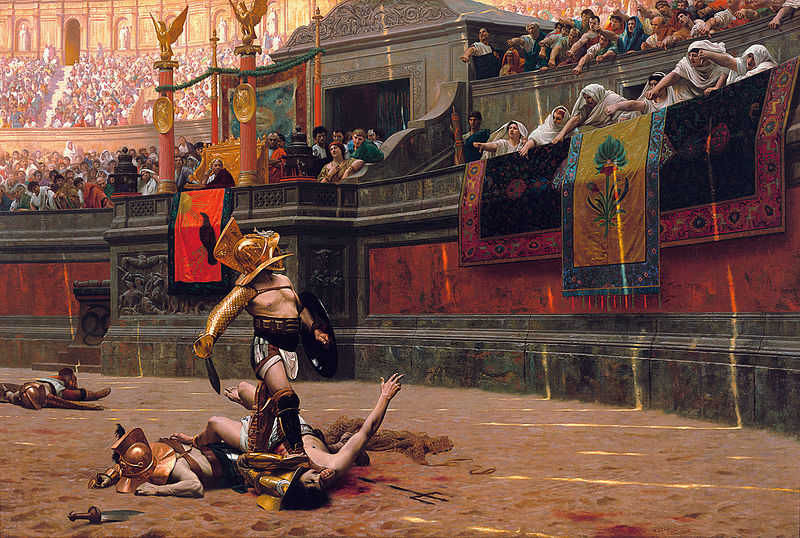
Living Brave Semester Reflection 4- The Challenge of Comparison

By Ivana - Own work, CC BY-SA 3.0, https://commons.wikimedia.org/w/index.php?curid=486540

Inside the Roman Amphitheater at Pula, Istria region of Croatia By Ivana – Own work, CC BY-SA 3.0, https://commons.wikimedia.org/w/index.php?curid=486540

In 2007 I applied to several schools to enter a PhD program in New Testament. These were all really competitive programs like Duke University and Emory University but I felt really good about applying at that point in my life. I was a young pastor who had done extremely well academically in my Master’s degree, I had three years of ministry experience (required in my denomination), I had been given an opportunity to teach with a seminary professor a joint presentation on ways of reading Paul and I felt like this was supposed to be my calling. When I received the notifications from each program that I had not been accepted I took it pretty well. I knew the congregation I served had just undergone a massive upheaval and probably needed the stability I was providing and I figured it was just not the right time. A couple years late it was time to apply again, this time to a new set of schools-perhaps less elite but still really good schools and I figured I met the entry criteria for their doctoral programs. It was a time where I was looking for a way out of my current, highly stressful calling (same congregation as earlier, but after a lot of dealing with conflict) and I just felt like this was what I was supposed to be doing. When the letters came again saying that I had not been accepted it hit me to my core. Somehow, in my mind, I no longer measured up. I was constantly comparing myself to those who had been selected, those who had the academic opportunities or credentials. I wanted to be what I was not.

I had to rediscover who I was, I had to become much more of a scrapper. On the one hand, as a pastor I have always been well respected but for many people that was the only arena they saw me in and I wanted to engage that academic side. Life circumstances changed which made this even harder and I had to make some challenging choices in the years that came afterwards. It wasn’t until 2012 that I really began to experiment with writing again and over the past several years I have discovered the joy I get out of it and the gifts I have for it. Yet, there is always that self-critical part of me that compares what I have done with others.

Brené Brown talks about the box seats where the ones who set the rules for the arena sit. For me this was occupied by the academics, particularly those I had respect for. I felt like my own ability to write and contribute had been denied because I didn’t have the correct pedigree or degrees. I know this was as much a limitation I placed upon myself by my comparison of myself with the image I had of them. I’ve gotten a lot better but I still place myself continually in comparison with the best attributes in others and often forget about my own gifts. I still at times feel like I am having to ask for permission to have a place in the arena, but I’m getting better at moving past the comparisons, as unrealistic as they may be, and enter that place. There are times my own internal voices take me back to that time when I heard those who occupied the seats that I felt could allow me entry into the academic arena told me, “my voice was not needed in that place.” Well at least that was the message I received.

When I look at what I write, I am proud of it. I am proud of both the volume and the quality of what I have written. I have also enjoyed the freedom to engage a number of projects that are very different. There may come a time when I need to focus on my work being seen in a larger way, but for now I am writing and learning and that has made a world of difference. It may be a smaller arena, but it is mine, and for now I can be proud of the work I have done and show myself a little grace and compassion without needing to measure up to someone else’s standards.

Deuteronomy 28 Blessings and Curses

Grigory Mekheev, Exodus (2000) artist shared work under Creative Commons Attribution-Share Alike 3.0

Grigory Mekheev, Exodus (2000) artist shared work under Creative Commons Attribution-Share Alike 3.0

Deuteronomy 28: 1-14 Blessings for Obedience

1 If you will only obey the LORD your God, by diligently observing all his commandments that I am commanding you today, the LORD your God will set you high above all the nations of the earth; 2 all these blessings shall come upon you and overtake you, if you obey the LORD your God:
 3 Blessed shall you be in the city, and blessed shall you be in the field.
 4 Blessed shall be the fruit of your womb, the fruit of your ground, and the fruit of your livestock, both the increase of your cattle and the issue of your flock.
 5 Blessed shall be your basket and your kneading bowl.
 6 Blessed shall you be when you come in, and blessed shall you be when you go out.
 7 The LORD will cause your enemies who rise against you to be defeated before you; they shall come out against you one way, and flee before you seven ways. 8 The LORD will command the blessing upon you in your barns, and in all that you undertake; he will bless you in the land that the LORD your God is giving you. 9 The LORD will establish you as his holy people, as he has sworn to you, if you keep the commandments of the LORD your God and walk in his ways. 10 All the peoples of the earth shall see that you are called by the name of the LORD, and they shall be afraid of you. 11 The LORD will make you abound in prosperity, in the fruit of your womb, in the fruit of your livestock, and in the fruit of your ground in the land that the LORD swore to your ancestors to give you. 12 The LORD will open for you his rich storehouse, the heavens, to give the rain of your land in its season and to bless all your undertakings. You will lend to many nations, but you will not borrow. 13 The LORD will make you the head, and not the tail; you shall be only at the top, and not at the bottom– if you obey the commandments of the LORD your God, which I am commanding you today, by diligently observing them, 14 and if you do not turn aside from any of the words that I am commanding you today, either to the right or to the left, following other gods to serve them.
 
Deuteronomy closes this section with a series of blessings and curses. The previous chapter gives instructions for Simeon, Levi, Judah, Issachar, Joseph and Benjamin to stand on Mount Gerazim to proclaim the blessings. Although the ancient world had a much stronger view of blessings and curses than we do in our culture they are not quite these magic words that linger in the air and take on a power to bless or smite, rather they are a continual reminder of the contingent nature of the blessings that the LORD has promised. Israel does not have a true freedom in the sense of being able to choose its own destiny but it does, according to Deuteronomy, have a choice of which destiny it will live into. The reward for covenant obedience is that they will be materially blessed in this life, their harvests will be good, their flocks and herds will grow, they will have children and good health.

In an American context it would be easy to misread Deuteronomy as some sort of prosperity gospel for individuals, but this would be to miss much of what Deuteronomy is saying. Yes, in the author of Deuteronomy’s view the people (as a community) will be blessed if they are obedient. That obedience involves a harsh set of justice requirements and the continual care for the oppressed in their midst. It involves an acknowledgment that their blessings come from the LORD their God who brought them out of the Egypt and to this land of milk and honey. It is a way of thinking that is simple, and one that other books of the bible do challenge (for example in the book of Job which revolves around the righteous sufferer and in Matthew, Mark and Luke where prosperity is viewed with suspicion) yet it is a perspective that helps many people make sense of their lives, and probably helped the people Deuteronomy is written to initially make sense of their lives.

The people will often fail to diligently observe all the commandments and the much larger portion of this chapter is dedicated to the consequences for disobedience. Perhaps as we approach the following fifty three verses of curses, which seem oppressive and distasteful in our time, we can suspend our judgment and wonder about the experiences of the people who would hear these words.


Deuteronomy 28: 15-68 Curses for Disobedience

      15 But if you will not obey the LORD your God by diligently observing all his commandments and decrees, which I am commanding you today, then all these curses shall come upon you and overtake you:
 16 Cursed shall you be in the city, and cursed shall you be in the field.
 17 Cursed shall be your basket and your kneading bowl.
 18 Cursed shall be the fruit of your womb, the fruit of your ground, the increase of your cattle and the issue of your flock.
 19 Cursed shall you be when you come in, and cursed shall you be when you go out.
       20 The LORD will send upon you disaster, panic, and frustration in everything you attempt to do, until you are destroyed and perish quickly, on account of the evil of your deeds, because you have forsaken me. 21 The LORD will make the pestilence cling to you until it has consumed you off the land that you are entering to possess. 22 The LORD will afflict you with consumption, fever, inflammation, with fiery heat and drought, and with blight and mildew; they shall pursue you until you perish. 23 The sky over your head shall be bronze, and the earth under you iron. 24 The LORD will change the rain of your land into powder, and only dust shall come down upon you from the sky until you are destroyed.
      25 The LORD will cause you to be defeated before your enemies; you shall go out against them one way and flee before them seven ways. You shall become an object of horror to all the kingdoms of the earth. 26 Your corpses shall be food for every bird of the air and animal of the earth, and there shall be no one to frighten them away. 27 The LORD will afflict you with the boils of Egypt, with ulcers, scurvy, and itch, of which you cannot be healed. 28 The LORD will afflict you with madness, blindness, and confusion of mind; 29 you shall grope about at noon as blind people grope in darkness, but you shall be unable to find your way; and you shall be continually abused and robbed, without anyone to help. 30 You shall become engaged to a woman, but another man shall lie with her. You shall build a house, but not live in it. You shall plant a vineyard, but not enjoy its fruit. 31 Your ox shall be butchered before your eyes, but you shall not eat of it. Your donkey shall be stolen in front of you, and shall not be restored to you. Your sheep shall be given to your enemies, without anyone to help you. 32 Your sons and daughters shall be given to another people, while you look on; you will strain your eyes looking for them all day but be powerless to do anything. 33 A people whom you do not know shall eat up the fruit of your ground and of all your labors; you shall be continually abused and crushed, 34 and driven mad by the sight that your eyes shall see. 35 The LORD will strike you on the knees and on the legs with grievous boils of which you cannot be healed, from the sole of your foot to the crown of your head. 36 The LORD will bring you, and the king whom you set over you, to a nation that neither you nor your ancestors have known, where you shall serve other gods, of wood and stone. 37 You shall become an object of horror, a proverb, and a byword among all the peoples where the LORD will lead you.
 38 You shall carry much seed into the field but shall gather little in, for the locust shall consume it. 39 You shall plant vineyards and dress them, but you shall neither drink the wine nor gather the grapes, for the worm shall eat them. 40 You shall have olive trees throughout all your territory, but you shall not anoint yourself with the oil, for your olives shall drop off. 41 You shall have sons and daughters, but they shall not remain yours, for they shall go into captivity. 42 All your trees and the fruit of your ground the cicada shall take over. 43 Aliens residing among you shall ascend above you higher and higher, while you shall descend lower and lower. 44 They shall lend to you but you shall not lend to them; they shall be the head and you shall be the tail.
      45 All these curses shall come upon you, pursuing and overtaking you until you are destroyed, because you did not obey the LORD your God, by observing the commandments and the decrees that he commanded you. 46 They shall be among you and your descendants as a sign and a portent forever. 47 Because you did not serve the LORD your God joyfully and with gladness of heart for the abundance of everything, 48 therefore you shall serve your enemies whom the LORD will send against you, in hunger and thirst, in nakedness and lack of everything. He will put an iron yoke on your neck until he has destroyed you. 49 The LORD will bring a nation from far away, from the end of the earth, to swoop down on you like an eagle, a nation whose language you do not understand, 50 a grim-faced nation showing no respect to the old or favor to the young. 51 It shall consume the fruit of your livestock and the fruit of your ground until you are destroyed, leaving you neither grain, wine, and oil, nor the increase of your cattle and the issue of your flock, until it has made you perish. 52 It shall besiege you in all your towns until your high and fortified walls, in which you trusted, come down throughout your land; it shall besiege you in all your towns throughout the land that the LORD your God has given you. 53 In the desperate straits to which the enemy siege reduces you, you will eat the fruit of your womb, the flesh of your own sons and daughters whom the LORD your God has given you. 54 Even the most refined and gentle of men among you will begrudge food to his own brother, to the wife whom he embraces, and to the last of his remaining children, 55 giving to none of them any of the flesh of his children whom he is eating, because nothing else remains to him, in the desperate straits to which the enemy siege will reduce you in all your towns. 56 She who is the most refined and gentle among you, so gentle and refined that she does not venture to set the sole of her foot on the ground, will begrudge food to the husband whom she embraces, to her own son, and to her own daughter, 57 begrudging even the afterbirth that comes out from between her thighs, and the children that she bears, because she is eating them in secret for lack of anything else, in the desperate straits to which the enemy siege will reduce you in your towns.
      58 If you do not diligently observe all the words of this law that are written in this book, fearing this glorious and awesome name, the LORD your God, 59 then the LORD will overwhelm both you and your offspring with severe and lasting afflictions and grievous and lasting maladies. 60 He will bring back upon you all the diseases of Egypt, of which you were in dread, and they shall cling to you. 61 Every other malady and affliction, even though not recorded in the book of this law, the LORD will inflict on you until you are destroyed. 62 Although once you were as numerous as the stars in heaven, you shall be left few in number, because you did not obey the LORD your God. 63 And just as the LORD took delight in making you prosperous and numerous, so the LORD will take delight in bringing you to ruin and destruction; you shall be plucked off the land that you are entering to possess. 64 The LORD will scatter you among all peoples, from one end of the earth to the other; and there you shall serve other gods, of wood and stone, which neither you nor your ancestors have known. 65 Among those nations you shall find no ease, no resting place for the sole of your foot. There the LORD will give you a trembling heart, failing eyes, and a languishing spirit. 66 Your life shall hang in doubt before you; night and day you shall be in dread, with no assurance of your life. 67 In the morning you shall say, “If only it were evening!” and at evening you shall say, “If only it were morning!”– because of the dread that your heart shall feel and the sights that your eyes shall see. 68 The LORD will bring you back in ships to Egypt, by a route that I promised you would never see again; and there you shall offer yourselves for sale to your enemies as male and female slaves, but there will be no buyer.

One of my practices as I write these reflections is to physically write out the text. I have done this for Haggai, Esther, Jeremiah, Psalms 1-10 and now most of the way through Deuteronomy. This is a challenging text to listen to as you write it, but it is not the first time I have approached a text like this. What the text reminded me of was the end of Jeremiah, particularly Jeremiah 46-51 where the curses are uttered towards all the nations around Judah. Even though it is unusual in our time to think about dedicating this much energy to a ‘hex’ or ‘curse’ it is not unusual in the ancient world: both in Israel and in the cultures around them. Many ancient texts end with a long set of curses for failing to observe the commands or view of the text, but Deuteronomy does not end here. While this is the closing of this central portion of Deuteronomy that deals with the law, in the narrative of Deuteronomy Moses is still going to renew the covenant one more time, promise them that even in the midst of the curses that there is still an option to return to the LORD, a challenge to choose the way of blessing and life, the setting up Joshua as a successor and establishing practices for reminding the people of this law, Moses’ song and Moses’ final blessing. Yet, there is no avoiding the discomfort that a passage like this causes modern people.

I am amazed at the ways I have seen people misuse this text, for example the text in verses 56 and 57 (which is very reminiscent of Jeremiah) which talks about parents eating their own children within the context of a land under siege I have seen it twisted by a person trying to discredit the bible to God commanding parents to eat their children (which never happens). I can understand why people would misread these curses, but let’s take a little time to try to understand what is going on here. The great fear of the author of Deuteronomy is that the people when they enter the promised land will forget the covenant and turn aside to worship other gods. If they do this they lose their identity as being Israel, and with that they lose the land, their prosperity, and everything else. If scholars are correct that Deuteronomy, like many other books, reach their final form during the Babylonian exile then this portion in verses 47-57 makes a lot of sense. It does not parallel any of the blessings but does reflect the experience of the siege of Jerusalem and the departure into exile. As harsh as this language is, it may reflect the process of meaning making that is a part of the recovery from trauma. In her well written book interpreting the book of Jeremiah from the perspective of trauma and recovery Kathleen O’Connor can write about the rhetoric of responsibility and survival by saying:

If the world is ever to be trustworthy, victims need interpretation. For their lives to rest on the most minimal order, they must have meaning, interpretation, explanation, even if the explanation is ephemeral, inadequate, partial or outright wrong. Explanation puts order back in the world…. He (Jeremiah) claims without qualification that God is still in charge of the world; God controls events and governs justly. But perhaps even more important and surprising, when he places responsibility upon the people, he gives people a sense of control. (O’Connor, 2011, p. 43f.)

Amazingly in these curses, perhaps in a period where the world seems out of control, the people of Israel and Judah can find a sense of control and things they can do to return to their former state. The answer may be incomplete or there may be times where it doesn’t adequately address the complexity of the situation. Yet, in a time of a crisis of belief and life where the people are seeking an answer the simple answer is often the one that people cling to. In an option where they could either say their God is powerless or that they themselves were under judgment it was an easier option, at least for those who would become the remnant, to claim that they were the party that failed the covenant. This reflection is not likely to convince the person who does not have God as a central part of their life but to those who consider themselves the faithful they may find great comfort in it.

As I mentioned above, the great fear voiced throughout Deuteronomy is that the people will forget the covenant in their prosperity. They will begin to trust in their own work or in the practice of the nations around them. The narrative that follows beginning in Joshua and running through 2 Kings bears out this fear. If Deuteronomy does have its origins in a speech of Moses, then it is conceivable that this fear of what would happen after his death could be a pressing anxiety for Moses on behalf of this people. Wherever Deuteronomy emerges from in time and history, the form we have it now does spend a lot of energy on these curses in a way that encourages the people to remain faithful. Also remember this is more of an aural document (written for the ear) than a textual one. Even though it is recorded it was to be read to the people and then repeated emphasis on the consequences are probably intended to encourage one more time obedience.

The book of Deuteronomy does have a very binary manner of looking at the world. There is either Mount Ebal, the mountain of curses, or Mount Gerazim, the mountain of blessings. Reality is probably closer to the valley between the two. Even though God is portrayed harshly in Deuteronomy, and other places as well, this wrath of God is never the primary thing. Even though this chapter is dominated by curses for disobedience, the continuing unfolding of this narrative will show how often God attempts to get the people to turn away from the practices that are leading them to destruction. God will be the heartbroken one often in the story going forward, and yet a God who does not judge is an apathetic god, not the passionate God of the Bible. Yet, just as these curses are not the end of Deuteronomy, nor are the experiences of destruction and loss the end of God’s calling for the people. As the final chapters will make clear there is always the possibility for the people’s return and the LORD’s forgiveness.

Deuteronomy 27-Preserving the Law

Moses by Victorvictori, permission granted by author through WikiCommons

Moses by Victorvictori, permission granted by author through WikiCommons

Deuteronomy 27: 1-8 An Enduring Word

1 Then Moses and the elders of Israel charged all the people as follows: Keep the entire commandment that I am commanding you today. 2 On the day that you cross over the Jordan into the land that the LORD your God is giving you, you shall set up large stones and cover them with plaster. 3 You shall write on them all the words of this law when you have crossed over, to enter the land that the LORD your God is giving you, a land flowing with milk and honey, as the LORD, the God of your ancestors, promised you. 4 So when you have crossed over the Jordan, you shall set up these stones, about which I am commanding you today, on Mount Ebal, and you shall cover them with plaster.

 5 And you shall build an altar there to the LORD your God, an altar of stones on which you have not used an iron tool. 6 You must build the altar of the LORD your God of unhewn stones. Then offer up burnt offerings on it to the LORD your God, 7 make sacrifices of well-being, and eat them there, rejoicing before the LORD your God. 8 You shall write on the stones all the words of this law very clearly.

Deuteronomy narrates a scene where Moses has dictated the law to the people in its completion prior to their entering into the promised land. We know that Moses is not going to cross over with the people and so in the remaining chapters we see the beginning of a massive transition in the leadership of the people. We live in a time where written texts are readily available and even if we don’t have a physical copy for many texts a digital copy is only a few keystrokes away. In the ancient world there are very few physical texts and a relatively small class who are able to read and create the written texts. Even something as central as the law was lost, intentionally or unintentionally, multiple times in the story of the people of Israel and Judah. For example, in the reign of King Josiah it is reported in 2 Kings 22: 8: “The high priest Hilkiah said to Shaphan the secretary, “I have found the book of the law in the house of the LORD.” When Hilkiah gave the book to Shaphan, he read it. Shortly afterwards the written text is read before the king and the king continues the work of reform.

Moses has been the mediator of the law between the LORD and the people, but with Moses about to leave his role as leader, judge, mediator and teacher there needs to be a way for the people to refer to this critical law he is leaving behind. Oral texts may survive a couple of generations intact, but ultimately for the law to survive it must become a textual document. Much like the recording of the words of the prophet Jeremiah in Jeremiah 36, where the prophet’s haunting and inconvenient words survive both the physical threat to the prophet as well as the burning by King Jehoiakim by being recorded again, now the critical exposition of the law in Deuteronomy 4-26 is to be put on plastered stones to be a visible witness to the people. This “furniture of the covenant” (Brueggemann, 2001 , p. 251) now is to be a manner in which future leaders can refer back to the law that Moses handed on. Moses now begins to step aside from being the teacher of the law to make space for the written law that future leaders and the people will be governed by.

Moses throughout his ministry has occupied a central role in the place between the people and God. Even with the elders and the tribal leaders and priest, ultimately he is the one who mediated the relationship between the people and their God, was the political leader, their chief judge and prophet, their lawgiver, and peacemaker. Yet, as Rabbi Kushner can state,

In the Jewish tradition, we speak of him as Moses Rabeinu—Moses, Our Teacher—not Moses, our Political Leader; not Moses, Who Freed the Slaves. Moses, Our Teacher. He dedicates himself to getting the people to embrace the ideas that they have to live by when he’s no longer around to remind them. (Thompson, 2014, p. 194)

Moses, throughout Deuteronomy has been working to equip the people to live in accordance with the commandments, statutes and ordinances outlined within the book. He has done this with catechetical practices within the home and with worship practices at the place where the LORD’s name will rest that reinforce their identity as the people of God. Here in the recording of the law and the building of an altar to celebrate and worship the LORD the narrative shows Moses preparing the people for a faithful practice of the covenant when he is no longer there to guide or intercede for them. And when the people fail to live out the covenant, then the stones themselves can testify very clearly against them.

Deuteronomy 27: 9-10 Hear One More Time

 9 Then Moses and the levitical priests spoke to all Israel, saying: Keep silence and hear, O Israel! This very day you have become the people of the LORD your God. 10 Therefore obey the LORD your God, observing his commandments and his statutes that I am commanding you today.

Moses, along with the priest, charges the people one final time with their identity and calling. Echoing the tone of the Shema in Deuteronomy 6: 4-5 he makes a final appeal for the people to hear. In an aural world they are to be silent and listen so they may remember who they are. They are the people of the LORD their God and therefore they are to be obedient. Their calling comes with blessing and challenges, and in their faithfulness they will be a witness to the nations and a blessing to the world. In their failing they will become the embodiment of the curses that will come in the following chapter.

Herny Fenn, Ruins on the Summit of Mount Gerazim, On the Site of the Samaritan Temple (between 1881 and 1884)

Herny Fenn, Ruins on the Summit of Mount Gerazim, On the Site of the Samaritan Temple (between 1881 and 1884)

Deuteronomy 27: 11-26 A Liturgy of Curses

 11 The same day Moses charged the people as follows: 12 When you have crossed over the Jordan, these shall stand on Mount Gerizim for the blessing of the people: Simeon, Levi, Judah, Issachar, Joseph, and Benjamin. 13 And these shall stand on Mount Ebal for the curse: Reuben, Gad, Asher, Zebulun, Dan, and Naphtali. 14 Then the Levites shall declare in a loud voice to all the Israelites:
 15 “Cursed be anyone who makes an idol or casts an image, anything abhorrent to the LORD, the work of an artisan, and sets it up in secret.” All the people shall respond, saying, “Amen!”
 16 “Cursed be anyone who dishonors father or mother.” All the people shall say, “Amen!”
 17 “Cursed be anyone who moves a neighbor’s boundary marker.” All the people shall say, “Amen!”
 18 “Cursed be anyone who misleads a blind person on the road.” All the people shall say, “Amen!”
 19 “Cursed be anyone who deprives the alien, the orphan, and the widow of justice.” All the people shall say, “Amen!”
 20 “Cursed be anyone who lies with his father’s wife, because he has violated his father’s rights.” All the people shall say, “Amen!”
 21 “Cursed be anyone who lies with any animal.” All the people shall say, “Amen!”
 22 “Cursed be anyone who lies with his sister, whether the daughter of his father or the daughter of his mother.” All the people shall say, “Amen!”
 23 “Cursed be anyone who lies with his mother-in-law.” All the people shall say, “Amen!”
 24 “Cursed be anyone who strikes down a neighbor in secret.” All the people shall say, “Amen!”
 25 “Cursed be anyone who takes a bribe to shed innocent blood.” All the people shall say, “Amen!”
 26 “Cursed be anyone who does not uphold the words of this law by observing them.” All the people shall say, “Amen!”

 The chapter ends with a series of twelve individual curses that the community is to place on anyone who violates particular actions. This sets the scene as well for the blessings and curses in chapter 28 where six tribes are on Mount Ebal for curses and six tribes are on Mount Gerazim for blessings. The two mountains are on the opposite sides of a valley and for the Samaritans Mount Gerazim would become one of their holy sites. Within Deuteronomy Mount Gerazim becomes the mountain of blessing while Mount Ebal is the mountain of curse, yet for Deuteronomy the tablets of the law and the altar are to be built on Mount Ebal rather than Mount Gerazim.

Many of these are covered earlier in Deuteronomy and rather than spend much time on those I will link you back to the discussion at the appropriate place in Deuteronomy, but a few are new. Verse 15 which concerns idols and images is talked about earlier in Deuteronomy 4: 15-20, and Deuteronomy 5:8-10 and is depending on how you number either part of the first commandment or the second commandment. Verse 16 also harkens back to the ten commandments with the commandment on honoring father and mother in Deuteronomy 5: 16 and is also expanded in Deuteronomy 21: 18-21 with the punishment for children who are rebellious and bring dishonor to their father and mother. Verse 17 concerns the moving of boundary markers which is addressed in Deuteronomy 19: 14. Verse 18 is the first new item on misleading the blind, but it follows in the concern that people care for the vulnerable and the weak in the society. Leviticus 19: 14 also addresses this when it states, “You shall not revile the deaf or put a stumbling block before the blind; you shall fear the LORD your God.” Caring for the vulnerable is a central part of living out of the covenant and one of the places where the prophets are called upon to point out the way the people have not cared for the vulnerable.  The next curse continues about those who oppress the representative triumvirate of the vulnerable, the widows, the orphan and the alien. The tithe, addressed in Deuteronomy 14: 29 and Deuteronomy 26: 12-13, the inclusion of the vulnerable in the festivals like outlined in Deuteronomy 16: 11, 14 the practice of allowing the remnant of the harvest and vine to be gleaned by the vulnerable in Deuteronomy 24: 19-22 are all concrete practices to help care for the vulnerable in their community. Verse 20 about lying with the father’s wife is covered in Deuteronomy 22: 30. The next three curses about forbidden sexual relations are new to Deuteronomy but fit within the ordered world of Deuteronomy 22:13-26 for the author of Deuteronomy’s view of sexual relations. Sexual relations with any animal, with a sister or a mother-in-law are forbidden and Deuteronomy doesn’t feel the need to explain these any further. The command in verse 24 about striking a neighbor in secret is new and it addresses disputes outside the purview of the community. For Deuteronomy the community and the elders are key to ensuring that disputes are resolved equitably. The curse about taking a bribe to shed innocent blood is addressed in the judicial context of Deuteronomy 16:19. Finally the last curse is general in nature referring to the entirety of the law and the need for obedience. This final curse may round it out to bring the final number of these individual curses to the representative twelve. Obedience is both an individual and communal responsibility, where the community holds the individual accountable. By placing these curses in the mouths of the people as they enter the land their own words hold them accountable to living in obedience to this law and covenant.


Living Brave Semester Week 3- Speaking Back to The Gremlins

Stripe

The discussion this week on empathy and self-compassion takes me back to the tension between by competent, competitive and driven side and the gracious side of me that is willing to be self-compassionate and fair with myself. I have worked for several years on learning to be more gracious with myself and others and a part of this struggle is wrestling with those internal gremlins that point out all the places where I have fallen short, where I have not lived up to my own expectations (as unrealistic as they sometimes are) or I have perceived my own weakness. It wasn’t surprising that when I took the Self Compassion inventory designed by Kristen Neff that my two highest (negative) scores were on self-judgment and isolation. When I feel weak or like I have failed the internal gremlins interpret my own actions in the worst possible light. Even though I am normally a very confident person, in those moments I do tend to isolate myself until I can get past the messages in my head. Recently I’ve learned how to speak back and to lean into that gracious side of my values to get to a more honest place with myself.

I had an experience last week where I was dealing with several frustrations and my language towards myself was becoming accusing and settling into the patterns of self-judgment that I learned at some point in my past. I was getting ready to go into an event where I would have to do a lot of mingling and introducing myself to people I didn’t know, initiating conversations and all of these energy intensive things were coming at a place where I was already exhausted by the trials of the day. I had worked through the issues, I had a solution, but I was frustrated, I knew that the solution in a different situation could have been easier and cheaper and my internal gremlins were comparing the action with the best possible solution and, of course, I was being measured and found wanting. I sat down and began to write out the things I was saying to myself and the accusations I was making and then I responded to them. My responses were from a place that I would speak to another person, how I would respond to them telling me these things after working through the same situation. That helped to me to hear a more gracious voice and to acknowledge that in a situation with a lot of stress away from home I had worked out a solution. I had reached out and sought help, something difficult for me to do, and the process of working through those feelings in a kinder way helped me be in a better place to engage the day. It also helped make clearer the number of issues that I was wrestling with and how in many ways I was already in a place where a lot of healing was occurring.

I will probably always be hard on myself. I will probably always have those critical questions come up and attack me at the points when I feel weak, but part of my own practice of self-compassion is learning to speak back to the questions. To not allow my drive for competence to lose the value of being gracious to myself and others. To embody this in the practice of writing down and responding to these questions in a way that is more grace filled and realistic. I’ve learned how to be empathetic with others and I am learning better how to be more empathetic with myself.

Deuteronomy 26: Bringing Story into Liturgy

The Seven Species of the Land of Israel listed in Deuteronomy 8:8, Creative Commons Attribution 3.0

The Seven Species of the Land of Israel listed in Deuteronomy 8:8, Creative Commons Attribution 3.0

 Deuteronomy 26

1 When you have come into the land that the LORD your God is giving you as an inheritance to possess, and you possess it, and settle in it, 2 you shall take some of the first of all the fruit of the ground, which you harvest from the land that the LORD your God is giving you, and you shall put it in a basket and go to the place that the LORD your God will choose as a dwelling for his name. 3 You shall go to the priest who is in office at that time, and say to him, “Today I declare to the LORD your God that I have come into the land that the LORD swore to our ancestors to give us.” 4 When the priest takes the basket from your hand and sets it down before the altar of the LORD your God, 5 you shall make this response before the LORD your God: “A wandering Aramean was my ancestor; he went down into Egypt and lived there as an alien, few in number, and there he became a great nation, mighty and populous. 6 When the Egyptians treated us harshly and afflicted us, by imposing hard labor on us, 7 we cried to the LORD, the God of our ancestors; the LORD heard our voice and saw our affliction, our toil, and our oppression. 8 The LORD brought us out of Egypt with a mighty hand and an outstretched arm, with a terrifying display of power, and with signs and wonders; 9 and he brought us into this place and gave us this land, a land flowing with milk and honey. 10 So now I bring the first of the fruit of the ground that you, O LORD, have given me.” You shall set it down before the LORD your God and bow down before the LORD your God. 11 Then you, together with the Levites and the aliens who reside among you, shall celebrate with all the bounty that the LORD your God has given to you and to your house.

 12 When you have finished paying all the tithe of your produce in the third year (which is the year of the tithe), giving it to the Levites, the aliens, the orphans, and the widows, so that they may eat their fill within your towns, 13 then you shall say before the LORD your God: “I have removed the sacred portion from the house, and I have given it to the Levites, the resident aliens, the orphans, and the widows, in accordance with your entire commandment that you commanded me; I have neither transgressed nor forgotten any of your commandments: 14 I have not eaten of it while in mourning; I have not removed any of it while I was unclean; and I have not offered any of it to the dead. I have obeyed the LORD my God, doing just as you commanded me. 15 Look down from your holy habitation, from heaven, and bless your people Israel and the ground that you have given us, as you swore to our ancestors– a land flowing with milk and honey.”

 16 This very day the LORD your God is commanding you to observe these statutes and ordinances; so observe them diligently with all your heart and with all your soul. 17 Today you have obtained the LORD’s agreement: to be your God; and for you to walk in his ways, to keep his statutes, his commandments, and his ordinances, and to obey him. 18 Today the LORD has obtained your agreement: to be his treasured people, as he promised you, and to keep his commandments; 19 for him to set you high above all nations that he has made, in praise and in fame and in honor; and for you to be a people holy to the LORD your God, as he promised.

The twenty sixth chapter of Deuteronomy closes a long section which runs from chapter five (although many people move it back to the scene being set in Deuteronomy 4:44) through the end of this chapter. Here in the narrative Moses concludes his exposition of the commandments, statutes and ordinances of the LORD for the people of Israel. In this conclusion resides both ritual and liturgy that will continue to form the identity of the people for their life in the promised land. The manner in which the people of Israel bring in their offerings is mentioned several times throughout this portion of Deuteronomy but the way in which the author chooses to end this section liturgically explaining the significance of these practices is important to note.

In American Christianity there are several branches of the faith that are uncomfortable with the idea of a confessional creed. In a society based on individualism where the focus is on the individual’s faith and what they believe at each point in their lives the idea of a communal confession of faith seems unnecessary. I appreciate the gifts of the confessional tradition that I come out of and the way it binds me both to the manner Christians have understood the faith historically as well as locating me within a community that shares and wrestles with common confessions. Creeds have been used throughout the ages as summaries of a wider faith used in both catechetical (teaching future generations) and liturgical (worship) settings. The bible is full of these confessions of faith in both the Hebrew Scriptures and the New Testament (for example Philippians 2: 5-11) and various confessions of faith have been used as a part of the liturgy of faithful people for generations as a way of summarizing the faith. Deuteronomy 6: 21-25 is one example of a ‘credo’ a basic statement of belief to be used as a method of catechesis within the home. While in Deuteronomy 6 the focus is on the actions within the household that the parents will use to pass on the faith to their children and grandchildren and beyond, here we see confessions of faith used liturgically as a part of the telling of the story of the people of Israel. The practice of bringing the tithe and first fruits in Deuteronomy 14: 22-29 and in Deuteronomy 18:4 is now brought into a setting of worship with words that reinforce several basic parts of the understanding of the covenantal relationship the people would be expected to maintain in the promised land. Deanna Thompson outlines succinctly the key themes of the text as:
“the call for Israel to acknowledge God’s persistent care; the reminder that the land God is giving them is sheer gift; and the insistence that fundamental to Israel’s right relationship to God is the practice of attending to the needs of the stranger, the widow and the orphan.” (Thompson, 2014, p. 188)

As the offering are brought to the tabernacle or temple the people recite a brief exposition of their history which outlines their beginnings as a wandering people in Genesis, the journey to Egypt in the time of Joseph where they received the food they needed in the midst of famine, and then a brief synopsis of the Exodus experience including their oppression and liberation and being brought into the promised land. This short liturgical statement begins with the tenuousness of their situation as a landless people and later as slaves contrasted with their new but contingent identity as the covenant people of the LORD the God of Israel. The narrated history is now combined with the practice of giving which is intended to continue to form the identity of the people in their life in the land.

The liturgy in Deuteronomy 26: 1-11 focuses on re-telling the story of the people and the action of bringing the first fruit which is a result of God’s gracious provision for the people in the land. God has brought the people from being landless or oppressed to being in a land of milk and honey, therefore they are to bring in these gifts and celebrate and remember the provision of God. The focus on this first exhortation is on what God has done for Israel and now Israel is freed to enjoy the fruits of the land. In Deuteronomy 26: 12-15 the giving of the tithe Deuteronomy 14: 28-29 and a declaration that the individual has been faithful both in bringing the tithe (and not withholding a portion or using it in some other way) but also in the keeping of all of the commandments and asking the LORD to bless the peoples’ lives in the coming years.  Now the focus is on what Israel has done in response and their faithfulness to the covenant and understanding that because of their faithfulness the LORD will look down and allow them to prosper in the land. The section concludes with oaths that bind the people and the LORD the God of Israel together. The hope of this relationship is that “I will be your God, and you shall be my people; and walk only in the way that I command you, so that it may be well with you.” (Jeremiah 7: 23) As Brueggemann has helpfully outlined the italicized comments above and here now the people are to be utterly obedient to the LORD and the LORD will be utterly committed to Israel. (Brueggemann, 2001 , p. 249f)

This relationship between the LORD and the people as given in this giving and receiving of vows is to be a committed one, and perhaps the natural comparison is to the marriage vows that a couple make when they are married. This relation of the covenant to marriage will form a metaphorical background for Jeremiah (see for example Jeremiah 3) and Hosea (Hosea 2). Much of the remainder of Deuteronomy will call attention to the seriousness of Israel’s commitment in this covenant and the cost of disobedience as well as the LORD’s continuing commitment. As a people holy to the LORD their commitment is a calling. They will need to return to this covenant and recommit themselves several times throughout their story and yet there is the commitment that when they stumble and fall and recommit themselves that God will hear. They have been reminded of who they were and where they came from, how God acted to bring them graciously into this land filled with promise, how they are to respond to God’s faithfulness and the critical nature of their obedience.

Deuteronomy 25: Punishment, Justice, and the Enemy

Deuteronomy 25: 1-3 The Limit of Punishment

1 Suppose two persons have a dispute and enter into litigation, and the judges decide between them, declaring one to be in the right and the other to be in the wrong. 2 If the one in the wrong deserves to be flogged, the judge shall make that person lie down and be beaten in his presence with the number of lashes proportionate to the offense. 3 Forty lashes may be given but not more; if more lashes than these are given, your neighbor will be degraded in your sight.

Deuteronomy believes in a harsh justice but it also sets limits on the execution of justice or revenge. This is one of those places where the dignity and reputation of the neighbor limit the maximum punishment of lashes the neighbor can receive as forty. The action takes place in the sight of the judge who orders the proportionate punishment so that the dignity of the offender is preserved. Although we may live in a society that has trouble with this type of corporal punishment, this is a relatively new thing in our society. The idea of submitting oneself to the measured discipline of the community seems to be an expectation for being a part of the society of Israel. The Apostle Paul in 2 Corinthians 11:24 can claim that five times he received the punishment of forty lashes minus one in addition to the other punishment he lists, and this is one of the many indications that Paul saw himself remaining as a part of the Jewish community since he submitted to the discipline.

In our own society we have become very litigious and often use fines or imprisonment as a means of discipline. Yet, when it comes to these fines and imprisonments which can often be excessive for certain crimes (particularly drug related offenses with harsh minimum sentences) in addition to the shame that comes with a criminal record we may want to relook at the idea of punishment that does not permanently diminish our neighbor in our eyes. Are judges enabled to give punishments that are proportional to the offense or are they bound by laws that are harsh allowing the guilty not chance at a non-degraded standing within society. These are difficult issues, but they are the type of big questions of a society that the book of Deuteronomy deals with.

Deuteronomy 25: 4 Care for the Working Animals

4 You shall not muzzle an ox while it is treading out the grain.

This is an acknowledgment that the working animals are not machines to be driven mercilessly, but even in small ways the lost grain that an ox eats while treading the grain is a part of its due. It is one of the windows into a worldview where animals and plants (see Deuteronomy 20 on trees in war for example) are given some protection as well. They all are a part of the creation of the LORD and are entitled to the benefits of striving with humanity to carve a living from the earth. Paul references this section in 1 Corinthians 9:9 in his discussion of his authority and that he could ask for a material benefit for his work among the Corinthians even though he states he made no use of those rights. 1 Timothy 5: 17-18 also uses this line of argument for the supporting of elders.

Deuteronomy 25: 5-10 Levirate Marriage

Francesco Hayez, A Portrait of a Woman as Ruth (1853)

Francesco Hayez, A Portrait of a Woman as Ruth (1853)

 5 When brothers reside together, and one of them dies and has no son, the wife of the deceased shall not be married outside the family to a stranger. Her husband’s brother shall go in to her, taking her in marriage, and performing the duty of a husband’s brother to her, 6 and the firstborn whom she bears shall succeed to the name of the deceased brother, so that his name may not be blotted out of Israel. 7 But if the man has no desire to marry his brother’s widow, then his brother’s widow shall go up to the elders at the gate and say, “My husband’s brother refuses to perpetuate his brother’s name in Israel; he will not perform the duty of a husband’s brother to me.” 8 Then the elders of his town shall summon him and speak to him. If he persists, saying, “I have no desire to marry her,” 9 then his brother’s wife shall go up to him in the presence of the elders, pull his sandal off his foot, spit in his face, and declare, “This is what is done to the man who does not build up his brother’s house.” 10 Throughout Israel his family shall be known as “the house of him whose sandal was pulled off.”

 This passage enters into the narrative of Israel in both the story of Tamar in Genesis 38 as well as the book of Ruth. Deuteronomy is written in an intensely patriarchal world where barrenness is a crisis because it threatens the perpetuation of the family’s name. Women were honored in their role as bearers of children and in their role in allowing for the continuance of the line. The idea of Levirate marriage is foreign to our time, where the idea of marrying the wife of a deceased brother seems out of place. Yet, in the world of Deuteronomy it is an expectation and an obligation. The brother is to ensure that there is an heir to inherit the deceased’s land and title. This also provided protection for the widow for she both has a family she is brought into and with the birth of an heir there is the promise that she will be provided for once her son inherits. In the ancient world, where no government safety net exists, children were the security of their parents in their old age. Even in the ten commandments this concern is addressed in the command to honor the father and the mother (Deuteronomy 5: 16).

In the story of Tamar, who gets herself pregnant by Judah when he denies her his youngest son, is a fascinating short story of a woman who boldly claims her rights to protection and inheritance however she needs to. As Judah can acknowledge at the end of the story, “She is more in the right than I, since I did not give her to my son Shelah.” (Genesis 38: 26) In the book of Ruth this passage serves as the law behind the meeting of Boaz and the unnamed next-of-kin where the issues of inheritance and marriage are tied together. The kinsman acknowledges that he cannot redeem the property, and marry Ruth with the property passing to her children, and so the ‘right’ passes to Boaz. It is uncertain how deep of a shaming was associated with the unwillingness or inability to care for the needs of a widow, as Deanna Thompson states, “This public shaming would give this family the reputation of not providing for its widows, thus making it more difficult for the family to contract marriages for their sons.” (Thompson, 2014, p. 183)

Deuteronomy 25:11 An Unfair Fight

  11 If men get into a fight with one another, and the wife of one intervenes to rescue her husband from the grip of his opponent by reaching out and seizing his genitals, 12 you shall cut off her hand; show no pity.

Deuteronomy is written from a male dominant perspective and to the author of Deuteronomy the idea of a woman ‘sexually shaming’ a man in public (Thompson, 2014, p. 184). The genitals of another man which are exposed and could potentially put the man and the woman on an equal footing are to be off limits in a fight. As we saw in Deuteronomy 23: 1-8 the damaging of the testicles or penis is enough to make a man no longer a man in the eyes of the assembly. For men sexual generativity is on par with sight and limbs and the punishment listed of mutilation is only prescribed for one other event (in Exodus 21: 22-25) where a man injures a woman and causes her to miscarry. The husband may demand whatever punishment he sees fit in that case. Martin Luther addresses this broadly with the maxim, “Evil should not be done that good may come of it.” (Luther, 1960 (1525), p. 9:249) where he talks about the woman wanting to do good on behalf of her husband and yet doing it in a ‘cowardly’ way.

Again this brings up issues centered around women’s rights compared to men’s rights and the rights of self-defense. There are times I am convinced we are more concerned with protecting men than women, and while we might want to protect the vulnerable areas of both men and women how do we also ensure that women are given the ability and permission to protect themselves in an unfair fight and do we accuse that woman of sexually shaming the man or simply attempting to protect herself or her family?

 Deuteronomy 25: 13-16 Fair and Just Weights and Measures

 13 You shall not have in your bag two kinds of weights, large and small. 14 You shall not have in your house two kinds of measures, large and small. 15 You shall have only a full and honest weight; you shall have only a full and honest measure, so that your days may be long in the land that the LORD your God is giving you. 16 For all who do such things, all who act dishonestly, are abhorrent to the LORD your God.

Justice is a critical part of the people’s life within the land. There will always be the temptation to make a business deal work to one’s advantage and if one can skew measurements and weights in one’s favor one can cheat one’s neighbor out of their fair share. This type of injustice is another of the things that obtain the stronger disapproval of being abhorrent to the LORD. Economic injustices would be a common cry of the prophets for example in Amos 8: 5-6: saying, “When will the new moon be over so we may sell grain; and the Sabbath, so that we may offer wheat for sale? We will make the ephah small and the shekel great, and practice deceit with false balances.

In a barter economy where grain and oil are traded it is easy to think of concrete ways where this type of imbalance could be used to create economic advantages and disadvantages. Yet, in our world sometimes the examples are a little harder to see. When a company uses an inferior material that produces an item that wears out quickly, or a corporation delays in repairing a safety concern because it is cheaper to allow the improper item to remain in use, or when practices are used that harm the land and environment and then others have to bear the cost of cleaning up the land. In our days, as in the ancient times, acting dishonestly and can affect how long our days are in our own land. With the crisis with the water supply in Flint, Michigan we can see the cost when individuals and a government are not honest in their measurements and allow things to become unsafe for their society.

Deuteronomy 25: 17-19 The Amalekites

John Everett Millais (1829-1896), Victory O Lord!

John Everett Millais (1829-1896), Victory O Lord!

 17 Remember what Amalek did to you on your journey out of Egypt, 18 how he attacked you on the way, when you were faint and weary, and struck down all who lagged behind you; he did not fear God. 19 Therefore when the LORD your God has given you rest from all your enemies on every hand, in the land that the LORD your God is giving you as an inheritance to possess, you shall blot out the remembrance of Amalek from under heaven; do not forget.

The warrior God re-emerges here at the end of chapter 25 and demands revenge upon the Amalekites. In Exodus 17: 8-16 we hear the story of the conflict between the people of Israel, shortly after their emergence from Egypt, and Amalek. In the story Moses holds up his staff and the people prevail, but as Moses’ arms become tired the people falter, so Aaron and Hur hold up his hands and the battle is won. As Exodus states:

Then the LORD said to Moses, “Write this as a reminder in a book and recite it in the hearing of Joshua: I will utterly blot out the remembrance of Amalek from under heaven.” And Moses built an altar and called it, the LORD is my banner, He said, “A hand upon the banner of the LORD! The LORD will have war with Amalek from generation to generation.” Exodus 17: 14-16

The Amalekites become the enemy memorialized in a slogan, much as ‘Remember the Alamo’ or ‘Remember Pearl Harbor’ allowed for Texans or Americans to call to mind an earlier attack of an enemy. The people are to never forget this action and to never again allow it to happen. This memory sets the stage for a contentious history between the peoples and the people of Amalek enter the story of Israel again in the curses of Balaam in Numbers 24: 20, “First among the nations was Amalek, but its end is to perish forever,” in 1 Samuel 15 where King Saul defeats the Amalekites but leaves King Agag alive (disobeying the LORD) and probably in Esther 3:1 where Haman the Agagite is thought to be a descendent of Agag and the hatred between the remnant of Israel and the remnant of Amalek continues to burn.

We have seen many instances in history where ancient feuds emerge in surprising ways leading to acts of extreme violence and genocide. As Archbishop Desmond Tutu can state, “there is no future without forgiveness.” I talk more about this in the related passage of Deuteronomy 20 (or in the passages at the end of Esther, Esther 9:1-10 and 11-19). I spend more addressing the way passages like this would have been heard in the ancient world and how we talk about them today and don’t need to rearticulate them at this point. Deuteronomy is not a text that is always comfortable for us and passages like this where the people are commanded to blot out another people are passages we will have to struggle against if we are to embrace Christ’s call to love our enemies. In a time where many people want to use ‘Never forget’ in relation to the terrorist attacks of September 11th, we may also be condemning ourselves to a long history of warfare and hatred unless we can learn to remember rightly where the past violence does not define the totality of our future. I speak more about this idea of remembering rightly, influenced heavily by Miroslav Volf’s book The End of Memory here.

Living Brave Semester Reflection 2- Vulnerability Anthem

I guess I just got lost, being someone else…

So this ended up being another reflection on the final exercise of this week’s part of the Living Brave Semester where we were supposed to choose an anthem for that time before we are honest and enter into the arena where we share who we are, our thoughts and our dreams. Something that prepares us mentally to show up and be seen. When Brené Brown started describing this exercise the song that immediately came to mind was Let Me Be Myself by Three Doors Down.

I had the opportunity to see Three Doors Down in concert last November in Carrolton, and I have enjoyed their music for several years but this song was always one of my favorites, but I think particularly because it came into my life in a time of a lot of changes. There was a time where I felt like the first line of this song, that I had become lost being someone else…fitting in with all the expectations that others had placed upon me. I felt in many ways like I was living in different roles, my role as a pastor, as a husband or father, as a son or an older brother, and while I knew how to play all the parts well I felt more like I was fitting in than truly belonging in many of the roles. There were many parts of myself that got pushed further and further behind the masks that I wore in each of these roles (masks that said what was permissible and what was not) and the reality was I lost track of who wrote the script for each role. The crises that came with leaving a congregation, going through a divorce and letting go of a dream (I reflect on the divorce part of this here, here and here) forced me to re-look many pieces of my life. In a very fertile time of rediscovery and difficult work I learned an incredible amount about myself and rediscovered parts of myself that had been abandoned in the midst of living into the expectations of all of these roles. The reality is that being able to be honest about who I am has made me a far better pastor, person, father and, now that I have re-married, husband.

The chorus of the song states
Please, would you one time
Let me be myself
So I can shine with my own light
Let me be myself
For a while, if you don’t mind
Let me be myself

And while it may seem incredibly absurd to have to ask for permission to be ourselves, I know I can relate to the lyrics at this point (and throughout the song). Yet, the song also reminds me of the difference between where I was and where I am today and when I start to fall back into patterns that are designed for fitting in rather than belonging I need to be reminded of the cost of not being myself. There will always be places and times where we keep our opinions to ourselves, keep healthy boundaries and share pieces of ourselves with those who have earned it but I also have learned the cost of not being able to share who I am-because at some point you begin to get lost being someone else.

Deuteronomy 24: Divorce, Purity and Justice

"Ten Commandments by A.Losenko (?)" by Anton Losenko - http://www.university.kiev.uawww.uer.varvar.ru/arhiv/gallery/klassitsizm/losenko/losenko13.html. Licensed under Public Domain via Wikimedia Commons - https://commons.wikimedia.org/wiki/File:Ten_Commandments_by_A.Losenko_(%3F).jpg#/media/File:Ten_Commandments_by_A.Losenko_(%3F).jpg

“Ten Commandments by A.Losenko (?)” by Anton Losenko – http://www.university.kiev.uawww.uer.varvar.ru/arhiv/gallery/klassitsizm/losenko/losenko13.html. Licensed under Public Domain via Wikimedia Commons – https://commons.wikimedia.org/wiki/File:Ten_Commandments_by_A.Losenko_(%3F).jpg#/media/File:Ten_Commandments_by_A.Losenko_(%3F).jpg

Deuteronomy 24:1-5  Divorce, Remarriage and Wedded Bliss

1 Suppose a man enters into marriage with a woman, but she does not please him because he finds something objectionable about her, and so he writes her a certificate of divorce, puts it in her hand, and sends her out of his house; she then leaves his house 2 and goes off to become another man’s wife. 3 Then suppose the second man dislikes her, writes her a bill of divorce, puts it in her hand, and sends her out of his house (or the second man who married her dies); 4 her first husband, who sent her away, is not permitted to take her again to be his wife after she has been defiled; for that would be abhorrent to the LORD, and you shall not bring guilt on the land that the LORD your God is giving you as a possession.
 5 When a man is newly married, he shall not go out with the army or be charged with any related duty. He shall be free at home one year, to be happy with the wife whom he has married.

As a person who has gone through a divorce (I share some of my reflections on this here, here and here) I found it interesting that this is really the only place that divorce is discussed in the law for the general population. There are the prohibitions of a priest marrying a divorced woman in Leviticus 21 and the ability of a divorced daughter of a Levite to return to her father’s home and eat of his food in Leviticus 22: 13 but otherwise the reality of divorce is simply assumed. Numbers 30, for example can discuss that the vows a divorced woman makes are bound to her, while a married woman the husband (or if unmarried the father) may nullify the vows-but divorced women are an assumption as is their remarriage. We saw that in Deuteronomy 22: 13-30 a couple situations (the false accusation of lost virginity before marriage or a virgin who is violated and the man pays the bride price for her) where a woman cannot be divorced but in the Hebrew Bible divorce seems mainly to be an assumed option for men. Here the issue of divorce comes up in the complicated issue of a woman who is divorced, remarries, is either widowed or divorced again and a prohibition against her remarrying her first husband.

Here, as in the discussions of blood guilt in Deuteronomy 19, 21 and 22, the concern is for contaminating the land. The re-unification of first husband with the now defiled ex-wife (notice that the husband is not considered defiled since polygynous weddings were accepted in Israel). This is an issue that receives the strong condemnation of being ‘abhorrent to the LORD.’ In the author of Deuteronomy’s ordered world this is simply something that is not to be done.

Deuteronomy discusses things from a male-centered perspective and it is inconceivable that a woman would ask for a divorce. A husband may release the woman from the relationship, but not the other way around in the ancient world. In releasing the woman from the relationship he also removes her from her means of support. For women in the ancient world there were limited options of support, so a divorced woman would be property-less, and if she wasn’t accepted back into her father’s home (and this may have been an issue of shame so severe that a family would not re-accept their child) then she either must re-marry, or be reduced to begging, or prostitution. Even with the provisions to care for the vulnerable outlined below, being a divorced woman in the ancient world would put one at a severe economic disadvantage.

This passage takes on a life in two other significant places in the Bible, the first being Jeremiah 3 where God is cast in the role of the husband who wants to re-take the wife who abandoned her marriage.  God refuses to abandon God’s love for God’s adulterous people (using the language of Jeremiah) and is willing to set aside the past for the possibility of something new. The other place this passage comes up is in Mark 10, and its parallel in Matthew 19, where Jesus is asked by a group of Pharisees whether divorce is lawful. Jesus interestingly reframes the issue that the man who divorces commits adultery against the divorced wife and the woman who divorces (not a conceived possibility in Deuteronomy) commits adultery against her former husband.

Divorce is a difficult issue in ancient times and in modern times. The church has often been a place where divorced men and women were excluded or made to feel like second class citizens. In earlier times, even though my own divorce was not something I wanted or did anything to cause, I would not have been permitted to serve as a pastor within my denomination. There are other denominations where this still would be the case. I have certainly had verses like Titus 1: 6 where it refers to a bishop being, “someone who is blameless, married only once, whose children are believers, not accused of debauchery and not rebellious.” Texts like this are difficult, but essential to wrestle with in a world where we also find divorce as an assumed reality. As we as individuals and churches struggle with issues of relationship like divorce and sexuality it is important to exercise wisdom and compassion. Divorce is something I wouldn’t wish on my worst enemy, even in modern times it is an incredible emotional, financial and spiritual drain on a person. While a man or woman who is divorced in our society has opportunities to re-invent themselves they need communities to care for them while they and the affected families are in very vulnerable states.

The final line in this section links back to Deuteronomy 20 where a person who is recently married is exempted from military service. Here the issue is expanded slightly giving a one-year window where a newly married man is freed from military service.  Here the language can be read that the exemption is so that the wife may be happy, which would be an uncommon acknowledgment of the value of women’s feeling in the ancient world. From a person who served in the Army this is would have interesting implications if it were applied in modern times (and I would think in times of conflict the marriage rate would skyrocket to avoid wartime service), yet in the world of Deuteronomy it makes sense. It is essential for the man to have the ability to ensure a future descendent who will carry on his name and inheritance in Israel. I also wonder how effective this was in practice when the elites would have been able to marry multiple times, and perhaps prevent themselves the risk of military action. Again, very different from the experience of the modern military which is filled with stories of people being married immediately before deployment.

Deuteronomy 24: 6-22: Purity and Justice

  6 No one shall take a mill or an upper millstone in pledge, for that would be taking a life in pledge.
 7 If someone is caught kidnaping another Israelite, enslaving or selling the Israelite, then that kidnaper shall die. So you shall purge the evil from your midst.
 8 Guard against an outbreak of a leprous skin disease by being very careful; you shall carefully observe whatever the levitical priests instruct you, just as I have commanded them. 9 Remember what the LORD your God did to Miriam on your journey out of Egypt.
 10 When you make your neighbor a loan of any kind, you shall not go into the house to take the pledge. 11 You shall wait outside, while the person to whom you are making the loan brings the pledge out to you. 12 If the person is poor, you shall not sleep in the garment given you as the pledge. 13 You shall give the pledge back by sunset, so that your neighbor may sleep in the cloak and bless you; and it will be to your credit before the LORD your God.
 14 You shall not withhold the wages of poor and needy laborers, whether other Israelites or aliens who reside in your land in one of your towns. 15 You shall pay them their wages daily before sunset, because they are poor and their livelihood depends on them; otherwise they might cry to the LORD against you, and you would incur guilt.
 16 Parents shall not be put to death for their children, nor shall children be put to death for their parents; only for their own crimes may persons be put to death.
 17 You shall not deprive a resident alien or an orphan of justice; you shall not take a widow’s garment in pledge. 18 Remember that you were a slave in Egypt and the LORD your God redeemed you from there; therefore I command you to do this.
 19 When you reap your harvest in your field and forget a sheaf in the field, you shall not go back to get it; it shall be left for the alien, the orphan, and the widow, so that the LORD your God may bless you in all your undertakings. 20 When you beat your olive trees, do not strip what is left; it shall be for the alien, the orphan, and the widow. 21 When you gather the grapes of your vineyard, do not glean what is left; it shall be for the alien, the orphan, and the widow. 22 Remember that you were a slave in the land of Egypt; therefore I am commanding you to do this.
This portion of chapter 24 deals predominantly with protecting the vulnerable within the community from exploitation, but within this passage is also a provision for protection from skin disease. The guarding against the “leprous” skin disease, which we honestly don’t know what this disease is-it isn’t what would be medically categorized as leprosy (also known as Hansen’s disease).  The mention of Miriam and Aaron’s speaking against Moses where Miriam is afflicted with this skin disease (Numbers 12) is an interesting narrative linkage that the text makes. Miriam (not Aaron, perhaps because of his role as priest) is placed outside the community, yet the community waits for seven days when she is healed and is able to be re-united with the community. Leviticus 13 and 14 go into great detail for the priests on how they are to diagnose and deal with these skin diseases and it was a significant issue in the community. There are numerous places where lepers are lifted up as a part of the narrative throughout the bible, too many to address here, and apparently this was a significant issue among the people of Israel they had to guard against.

The remainder of the chapter deals with caring for the vulnerable in the community. Verse 6, dealing with taking a mill or millstone in pledge prevents a person’s livelihood from being taken which would not only prevent the repayment of the debt but also imperil the person’s ability to live. To take a person’s livelihood is to deprive them of life. In a similar way they are not to be a society where a person is taken captive or sold into slavery, this was not a practice the people of Israel were to tolerate and this is probably behind the command to not allow kidnapping. In verse 6 the people of Israel are prevented from depriving another Israelite of livelihood and in verse 7 they are prevented from depriving another person of freedom.

In Deuteronomy 23: 19-20 there is already a prohibition against charging interest on debt to another Israelite, but Deuteronomy spends even more time on the issue of debt here. This must have been a pressing issue among the people. As Deanna Thompson can state these laws reveal, “a fundamental respect for the dignity of the neighbor; even if he stands in need of money.” (Thompson, 2014, p. 178)  A person was to respect the neighbor’s property and to wait outside the home to receive a pledge (preventing the lender from voyeuristically deciding what among their neighbor’s property they would confiscate). Nor may a person’s means of being warm at night be taken away. As the prophet Amos can criticize in his time:

They lay themselves down beside every altar on garments taken in pledge;
 and in the house of God they drink wine bought with fines they imposed. Amos 2:8

In any society the poor and vulnerable are likely to be preyed upon by those in power and debt can become a burden that they cannot ever emerge from. Yet, Israel was to be a society that cared for the poor in their midst and did not allow a neighbor to become permanently enslaved or burdened by their debt. In a similar manner the following verses relating to paying the poor and needy laborers daily and not holding onto wages for it could put their livelihood at risk. In a society where the poor are preyed upon by ‘payday loans’ and high interest rates on purchases, higher prices for goods and pay schedules that benefit the business but may not benefit the employee we have a lot we could learn from this view of economic justice based upon being a covenant people.

When I first encountered liberation theology[i] the idea of a “preferential option for the poor” it troubled me, because it seemed that God was picking one group over another. The reality is that the God of the Bible does pick, and that this is a faithful witness to the God we come to know.  As Miroslav Volf can state eloquently:

Consider, second, God’s partiality. In the biblical traditions, when God looks at a widow, for instance, God does not see “a free and rational agent,” but a woman with no standing in society. When God looks at a sojourner, God does not see simply a human being, but a stranger, cut off from the network of relations, subject to prejudice and scapegoating. How does the God who “executes justice for the oppressed” act toward widows and strangers? Just as God acts toward any other human being? No. God is partial to them. God “watches over the strangers” and “upholds the orphan and the widow” (Psalm 147: 7-9) in a way that God does not watch over and uphold the powerful.
Why is God partial to widows and strangers? In a sense, because God is partial to everyone—including the powerful, whom God resists in order to protect the widow and the stranger. (Volf, 1996, p. 221f.)

God seeks justice, but not revenge. We live in a revenge culture, if a person harms me there is the desire to make sure that this could never happen again. In the United States, and much of the world, this also informs foreign policy. Revenge in interpersonal conflicts is addressed here, where the idea of “if you hurt me, I will not only hurt you but all those close to you” is forbidden. A person is to be penalized for their own offense, not their children or parents. Justice ultimately seeks to establish an end to the cycle of punishment. In our own society where children of parents who are in prison are often set up to follow in their footsteps by the lack of opportunities and support for a different path maybe we too can imagine how we could imagine a society where children are not punished for the mistakes of the parents and vice versa.

These commands to help the vulnerable, highlighted in the widow, alien and orphan, are brought into the narrative of liberation of the people from their slavery. In Exodus 23: 9 we hear for the first time this command brought into the narrative “You shall not oppress a resident alien; you know the heart of an alien, for you were aliens in the land of Egypt.” The people are to remember their own situation was not one where they ‘pulled themselves up by their bootstraps’ but instead a gift of their covenant identity with their LORD. They are given concrete ways to enact this justice towards the vulnerable. They are to be shown justice, not taken advantage of. These landless ones are to have a method of living off the plentiful harvest that the people are promised in the land. They are to be different than the world they knew in Egypt, or the societies they see around them. “The neighbor—especially the neighbor in need—lives in a world governed not by the ruthless “iron law” of the market or by the unencumbered autonomy of the powerful, but by the same God who curbed Pharaoh.” (Brueggemann, 2001 , p. 240f.) Throughout their life, they would struggle with this view of justice. The prophets would often cry about the way the widow, orphans and the resident aliens were being denied justice, being oppressed by practices designed to keep them poor and being denied their rights within the land. The vision was a noble one, and yet, justice is a hard dream to achieve. Yet, even though dreams of justice may be difficult to achieve in reality it does not free us from the struggle of attempting to live into the vision of justice that God calls us to.

[i] Liberation theology is a broad term for theological perspectives that came out of various experiences of oppression. Liberation theology started with the experience of base communities in Latin America among the poor, but also now are experienced in black liberation theology, feminist liberation theology and many other branches of theology which utilize the experience of oppression as a lens to encounter God and God’s action towards the world.

Living Brave Semester Reflection 1- Central Values

candle

I have found Brené Brown’s work incredibly helpful in my personal and professional life and I am excited to be taking part in her Living Brave semester. In addition to the exercises I wanted to reflect on something that came out of each session for me that I want to spend a little more time reflecting upon. The final exercise of the initial session involved identifying the 1-2 values that light the way in our lives, and she presents a huge list to choose from. I tried to get down to two, but ended up with three-two being in perhaps tension or paradox to make sense of the third one. The three values for me were authenticity, grace and competence.

Competence- I have always been a person who is driven to be good at whatever I do. This has its benefits and challenges, but it is a part of my personality that is not going to change. I am naturally curious and want to continually learn and grow as well as teach and I have extremely high standards for myself. The benefit of this is that I am a self-directed learner and worker who probably does far more than what is expected of me in most circumstances. I can set my mind to a task, almost any task, and I will find a way to learn and master it. On the weakness side this means my default is to judge myself and others by their competence (and at its worst to even assign value based on competence). While this fuels my creativity it can also be a harsh taskmaster and I need the next value to be its paradox and provide the (hopefully) healthy tension that I live within.

Grace- There are a cluster of faith and forgiveness related words that help flesh out what grace means to me, and the understanding of grace does come out of my faith. Fundamentally I believe that God is a gracious God and that God’s calling to me is to be a gracious person. Grace helps me to be far less judgmental towards others than I would otherwise be inclined to be.  It also helps me to own my failures and to learn from them, or to acknowledge the times when I am driving myself mercilessly and unrealistically.  It has also allowed me to acknowledge creativity as something that is sometimes not within my control, but like a muse visits for a time and may depart at another. It has allowed me to find peace in the midst of the work and significantly more joy in life.

Authenticity-To me this is that place where the grace and the competence meet to make me the complex person that I am. I try very hard to be open and honest in my personal and professional life, no longer striving to fit in but rather embracing who I am and claiming my gifts and struggles. I can be hard on myself when I feel a disconnect between my beliefs and my actions, which comes from the competence side, but I have also learned that forgiveness and grace are a fundamental part of who I am and hope to be and I want others to see that embodied in my life.


Deuteronomy 23: Boundaries, Purity, Interest, Vows and Limits

Rembrandt, The Baptism of the Eunuch (1626)

Rembrandt, The Baptism of the Eunuch (1626)

Deuteronomy 23: 1-8 Boundaries of the Assembly

1 No one whose testicles are crushed or whose penis is cut off shall be admitted to the assembly of the LORD.

 2 Those born of an illicit union shall not be admitted to the assembly of the LORD. Even to the tenth generation, none of their descendants shall be admitted to the assembly of the LORD.

 3 No Ammonite or Moabite shall be admitted to the assembly of the LORD. Even to the tenth generation, none of their descendants shall be admitted to the assembly of the LORD, 4 because they did not meet you with food and water on your journey out of Egypt, and because they hired against you Balaam son of Beor, from Pethor of Mesopotamia, to curse you. 5 (Yet the LORD your God refused to heed Balaam; the LORD your God turned the curse into a blessing for you, because the LORD your God loved you.) 6 You shall never promote their welfare or their prosperity as long as you live.

 7 You shall not abhor any of the Edomites, for they are your kin. You shall not abhor any of the Egyptians, because you were an alien residing in their land. 8 The children of the third generation that are born to them may be admitted to the assembly of the LORD.

The Bible is not a unified document where there is only one position on any particular issue, instead it is a dialogue of many voices trying to reflect faithfully on who God is and who they are to be. Deuteronomy 23: 1-8, and the theology of Deuteronomy offers a great deal of influence for many of the voices of the Hebrew Scriptures on issues of who is a part of the community (or specifically here the assembly) and who is not. Holiness and purity are large concerns for the author of Deuteronomy and occupy an important part of their vision of what it means to be the people of the God of Israel.

One the first prohibition, which has to do with males who have been emasculated, they are (according to Deuteronomy) not to be a part of the assembly of the LORD. Here is a place where we see how being admitted is also tied to sexual generativity or the ability to produce offspring. A person who is unable, physically, to be sexually active was probably not viewed as fully male and therefore not a legitimate part of the assembly which would be charged with making decisions on behalf of the community. Here is another place where we see that maleness was a large part of what it was to have status in the community.

The second prohibition is against children born of illicit unions, or to use the derogatory term bastard children. Apparently the rules that have proceeded this (for example Deuteronomy 22) have not prevented the reality of children outside of marriage, but this prohibition places them as a disadvantaged group outside the assembly. This may also reflect children born of mixed marriages between Israelites and non-Israelites as are further outline in the coming verses. Once again they are separated from the assembly because their presence corrupts the pureness of the people of Israel.

Finally, there are the specific prohibitions directed at the unions with Ammonites, Moabites, Edomites and Egyptians. These specific prohibitions, much harsher on Ammonites and Moabites, are difficult to make sense of based upon the narrative of Exodus and Numbers. The Ammonites and Moabites, according to this section of Deuteronomy, failed in the imperative of hospitality to the people of Israel. In Deuteronomy 2 the people of Moab and the Ammonites were not allowed to be invaded because their land had also been given by promise to their ancestors by the LORD. In Numbers 20: 14-21 the Edomites are the first to refuse hospitality and do not allow the Israelites to pass through their land, refusing to offer water, food or passage and come out to meet the Israelites with a large force diverting them on their journey, yet they are not to be abhorred and they, like the Egyptians who enslaved the people but are instead remembered here for the acceptance of them as aliens into their land at the end of Genesis. In Numbers 22-24 we have the story of the Moabites hiring Balaam to curse Israel (referred to in verse 4-5) and perhaps this narrative is a part of the distinction as well as the story that follow it about Israelite men beginning to have sexual relations with the women of Moab and the way this led some of Israel to begin to worship Baal of Peor (see Numbers 25).

As I mentioned at the beginning of this section, the bible is more like a dialogue than a unified voice. While the perspective of this portion of Deuteronomy will be echoed in book like Ezra and Nehemiah where there is a movement to exclude the foreigners from the community simply because they are foreigners. Yet, there are important counter voices throughout the Hebrew Scriptures. For example, the book of Ruth, where a Moabite woman becomes a model of what hospitality and faithfulness looks like and her courageous action as a woman in a man’s world not only wins her a place of honor among the people but she becomes the grandmother to King David (who according to these rules would have to be excluded from the assembly of the LORD).  Perhaps even more critical for the New Testament perspective are these surprising words from Isaiah 56:

3 Do not let the foreigner joined to the LORD say, “The LORD will surely separate me from his people”; and do not let the eunuch say, “I am just a dry tree.”
 4 For thus says the LORD: To the eunuchs who keep my sabbaths, who choose the things that please me and hold fast my covenant,
 5 I will give, in my house and within my walls, a monument and a name better than sons and daughters; I will give them an everlasting name that shall not be cut off.
 6 And the foreigners who join themselves to the LORD, to minister to him, to love the name of the LORD, and to be his servants, all who keep the sabbath, and do not profane it, and hold fast my covenant–
 7 these I will bring to my holy mountain, and make them joyful in my house of prayer; their burnt offerings and their sacrifices will be accepted on my altar; for my house shall be called a house of prayer for all peoples.

Isaiah goes directly against the voice of Deuteronomy and Ezra and Nehemiah, seeing both eunuchs and foreigners as admitted if they hold fast to the covenant. The early church had to wrestle with their own place within this heritage and the witness of both Acts as well as the fact that we have the letters of Paul show that they moved to embrace Isaiah’s vision of God’s openness rather than Deuteronomy’s vision of attempting to legislate the purity of the people of Israel.

With all this talks of eunuchs and bastards we could be referring to the storyline of Game of Thrones rather than the bible, and this is a point where I think most people miss the complexity of the bible as well as the messiness of it. Game of Thrones, for example, depicts a brutal and messy reality but so does the narrative of scriptures. No matter how orderly Deuteronomy may want to make the world, it is fundamentally messy since it involves God’s interaction with flawed and forgetful people. Yet, when we are honest our world is messy as well. I think, for example, in our country the immigration debates feel pulled between the same types of poles—those who are worried about how immigrants might change our culture or nation and those who feel called to an inclusive vision of an American society. Both of these positions can claim a scriptural worldview (even though in our context they may play out as secular positions) but ultimately it is difficult to make an exclusive worldview Christian. One more scriptural reference before we close this reflection and that is the narrative of the Ethiopian eunuch in Acts 8: 26-43. This is a part of a series of stories that reflect God’s movement of key leaders (Peter, Paul and here Philip) towards this more inclusive vision. As the eunuch, on hearing the narrative of Jesus can recognize it as a story where now instead of being excluded he has the possibility to be included and says to Philip, “Look, here is water! What is to prevent me from being baptized?” Philip, and eventually the early church would have to be stretched by God’s vision of inclusion they felt they were called to, and perhaps the struggles of the church in our own time about the boundaries of the assembly and leadership of our own assemblies reflect this ancient dialogue between purity and holiness and inclusion.


Deuteronomy 23: 9-16 Rules of Encampment

 9 When you are encamped against your enemies you shall guard against any impropriety.

 10 If one of you becomes unclean because of a nocturnal emission, then he shall go outside the camp; he must not come within the camp. 11 When evening comes, he shall wash himself with water, and when the sun has set, he may come back into the camp.

 12 You shall have a designated area outside the camp to which you shall go. 13 With your utensils you shall have a trowel; when you relieve yourself outside, you shall dig a hole with it and then cover up your excrement. 14 Because the LORD your God travels along with your camp, to save you and to hand over your enemies to you, therefore your camp must be holy, so that he may not see anything indecent among you and turn away from you.

 15 Slaves who have escaped to you from their owners shall not be given back to them. 16 They shall reside with you, in your midst, in any place they choose in any one of your towns, wherever they please; you shall not oppress them.

 Military service was a part of the expectations for the males of the people of Israel, and particularly in a narrative where Deuteronomy is spoken to the people of Israel prior to Joshua’s leading of the tribes in their conquest of the promised land these rules have immediate implications for the upcoming military actions. The ancient military force of the Hebrew people was not a professional army that spent its time training for war, but rather they were called upon in times of conflict to leave their homes and fields to be a part of the defense (or offensive actions) of Israel. Warfare is not neat and tidy even with a professional army, but things are heightened for the people of Israel theologically by their belief that God travels with them in their camp as they prepare for action, and as Deuteronomy 20 outlined their strength is not in their superior weaponry or equipment but the belief that the LORD will grant them victory.

Many people are familiar with the proverb, “Cleanliness is next to godliness” and while it is not a scriptural proverb it does resonate with the ordered world of Deuteronomy. Nocturnal emissions would be viewed as a contamination of the camp and the person would be excluded for a time and while the commands to carry a trowel to dig a hole for relieving oneself is a very practical command (and modern military forces do the same thing if they are in an area where portable facilities are not available). Yet, for Deuteronomy’s worldview it is less concerning that a fellow soldier might step in someone else’s excrement and more a concern for purity before the LORD who travels with their camp.

Interesting is the final command in relation to slaves, where slaves who are fleeing their captors are not to be returned but instead are to be allowed to settle among the people. This is different than the typical practice of much of the ancient world. Perhaps it draws upon their own narratives as people who were freed from slavery accepting others freed from slavery. This also builds upon an understanding of slavery outlined in Deuteronomy 15: 12-18 where the slavery in Israel is not a permanent thing and they, unlike Egypt, are not to have an economy based upon slave labor.

Deuteronomy 23: 17-18 Men, Women, Temple Service and Prostitution

 17 None of the daughters of Israel shall be a temple prostitute; none of the sons of Israel shall be a temple prostitute. 18 You shall not bring the fee of a prostitute or the wages of a male prostitute into the house of the LORD your God in payment for any vow, for both of these are abhorrent to the LORD your God.

Looking at this phrase was interesting for me because it challenged what I thought I knew. In English verse seventeen the term rendered temple prostitute for both the male and the female is simply the male and female form of “holy.” The term for prostitute is used in the following verse about the wages of a prostitute not being brought into the house of the LORD. It is easy to make assumptions if it is translated temple prostitute that sexually charged elements were a part of the worship of the surrounding culture and perhaps there was and perhaps there wasn’t. It may be the idea of having a female priestess of any type is behind this prohibition. While there is a prohibition against bringing the money made from prostitution into the temple there is no prohibition of the practice itself. Prostitution is simply assumed as a part of life in much of the ancient world, even if it needs to be kept away from the vision of the priests in the ordered worldview of Deuteronomy.

Deuteronomy 23: 19-20 Interest

 19 You shall not charge interest on loans to another Israelite, interest on money, interest on provisions, interest on anything that is lent. 20 On loans to a foreigner you may charge interest, but on loans to another Israelite you may not charge interest, so that the LORD your God may bless you in all your undertakings in the land that you are about to enter and possess.

The community of Israel as imagined by Deuteronomy is to be very different than either the societies of Egypt which is based upon slave labor and production or the American consumer society where debt can become its own method of enslavement for many people. As in Deuteronomy 15: 7-11 they are openhanded in lending to their neighbor in need and as we talked about in Deuteronomy 22:1-4 they are not to turn away from their neighbor’s need. There is a lot of Anti-Semitic literature that talks about the Jewish people being greedy, yet there were many times where tax and rent collecting or moneylending were occupations that the Jewish people were forced into in Europe since many other occupations were closed to them by society and by the church.  Deuteronomy does allow for interest to be charged to outsiders, and perhaps this allowed them to find some middle ground in the midst of the challenges they faced through centuries of having to accept some of these jobs that were viewed as marginal within the society. Perhaps a question to ask is how did it become permissible for Christians to view charging of interest as the norm. This is probably one of many times where our understandings of Christianity have been tailored to our society rather than the other way around. In one of the most economically challenging parts of the Sermon on the Mount Jesus states:

Give to everyone who begs from you, and do not refuse anyone who wants to borrow from you. (Matthew 5:42)

Yet, even in Jesus time he can assume the norm of interest being charged and use it as a part of the parable of the talents (Matthew 25: 14-30).

Deuteronomy 23: 21-23 On Vows

 21 If you make a vow to the LORD your God, do not postpone fulfilling it; for the LORD your God will surely require it of you, and you would incur guilt. 22 But if you refrain from vowing, you will not incur guilt. 23 Whatever your lips utter you must diligently perform, just as you have freely vowed to the LORD your God with your own mouth.

There are countless stories throughout scripture of people making rash oaths, probably none rasher than the vow of Jephthah in Judges 11: 29-40 where he vows to God, “If you give the Ammonites into my hand, then whoever comes out of the doors of my house to meet me, when I return victorious from the Ammonites, shall be the LORD’s, to be offered up by burnt offering.” (Judges 11: 30b-31) and upon returning it is his daughter, his only child who comes out. She is offered up, even though there is a repeated emphasis against child sacrifice in Deuteronomy and elsewhere in the Hebrew Bible, in fulfillment of the vow. Vows are serious business for the people of Israel and they are bound by these words. These words also serve as a backdrop for Jesus words in the Sermon on the Mount about oaths where speech is to be truthful without oaths. (Matthew 5: 33-37). As in Matthew’s gospel the speaker is expected to use truthful speech but is also encouraged to refrain from vowing. The practice is not forbidden, just cautioned against, for the speaker will be bound by those words.

Deuteronomy 23: 24-25 Providing for the Neighbor

 24 If you go into your neighbor’s vineyard, you may eat your fill of grapes, as many as you wish, but you shall not put any in a container.

 25 If you go into your neighbor’s standing grain, you may pluck the ears with your hand, but you shall not put a sickle to your neighbor’s standing grain.

The covenant community was to care for one’s neighbors, and yet caring for one’s neighbors has to negotiate the boundaries of providing for the neighbor’s need without having one’s field decimated. Here at the end of Deuteronomy 23, they use Moses voice to attempt to reach a balance point. A person may eat the fruit of the vineyard or the wheat of the field, but only what they can eat or pluck then. They are not to bring in vessels to store up for tomorrow or instruments of harvest to take as much as they can. This practice sets the backdrop for the story of Jesus and his disciples in Matthew 12: 1-8 where the controversy does not revolve around his disciples picking grain out of someone’s field (that was acceptable) but rather doing it on the Sabbath. This issue of how do I care for my neighbors in need is a live one that many churches wrestle with. In a time where churches are sometimes asked to cover house payments, car repairs, insurance and many other things in addition to simply providing food (and I don’t want to portray that these are not real needs-they are simply not within the budgets of many church outreach funds to cover). How do we as Christians and communities of Christians work individually and together to help provide for our neighbors by meeting their true need and not become consumed in the process?