Charles-Antoine Bridan, Relief on the Wall of Notre Dame Cathedral in Chartres (1786-1789) Isaiah speaking to King Ahaz
The practice of a sustained reflection on scripture, particularly the parts I am less familiar with, has been a big part of my growth over the past thirteen years. This is a significant part of my discipline of learning how to use the fullness of wisdom and learning in scripture and every book in its own way changes me a little. The book of Kings as a whole portion of the story of Israel and Judah from Solomon to the collapse of the Davidic line of kings, Jerusalem, and the temple tries to comprehend how the people could go from the pinnacle at the beginning of Solomon’s reign to the pit of the exile. 2 Kings begins in the middle of the stories of Elijah and Elisha and then moves through the end of the northern kingdom of Israel under Assyria and the southern kingdom of Judah under Babylon.
2 Kings provides a context for the pre-exilic prophets. The narrator of 2 Kings provides short narrations of the kings and prophets of Israel and Judah, but when this is paired with Amos, Hosea, early Isaiah (or first Isaiah), Micah, Zephaniah, Nahum, Habakkuk, Jeremiah and Ezekiel it provides multiple windows into this time. I’ve been writing on this blog about the bible since 2013 and one of the earlier books I started in 2013 was the book of Jeremiah which coincides with the final four chapters of 2 Kings. There are a total of sixteen books of the bible I have now worked through in whole or in part, and it is amazing how much I have learned and grown. When I compare what I knew about this period when I worked on Jeremiah to how I see it now it is amazing how much fuller my vision is. 2 Kings shares several connections with Isaiah and Jeremiah
Although it is an ancient story, the book of Kings narrates the struggle of remaining faithful to the LORD the God of Israel in a world of numerous alternatives. Israel and Judah struggled to maintain their distinctiveness among the nations and kings often influenced their people to follow the practices of the nations they traded and made alliances with. The book of Kings could also be the book of Prophets and particularly in the Elijah and Elisha narrative the prophetic seems to take precedence over the kings in the narrative. In Judah in 2 Kings there are some moments of hope, particularly with Jehoash, Hezekiah, and Josiah but there are also many moments where the reforms of these good kings are undone by the wickedness of the next generation. God is slow to give up on this people and eagerly looks for repentance, but by the end of the story both Israel and Judah have exhausted the patience of God.
Ilya Repin, Cry of the Prophet Jeremiah on the Ruins of Jerusalem (1870)
2 Kings 25: 1-21 The Destruction of Jerusalem and the Second Group of Judeans Taken Into Exile
1And in the ninth year of his reign, in the tenth month, on the tenth day of the month, King Nebuchadnezzar of Babylon came with all his army against Jerusalem and laid siege to it; they built siegeworks against it all around. 2So the city was besieged until the eleventh year of King Zedekiah. 3On the ninth day of the fourth month, the famine became so severe in the city that there was no food for the people of the land. 4Then a breach was made in the city wall; the king with all the soldiers fled by night by the way of the gate between the two walls, by the King’s Garden, though the Chaldeans were all around the city. They went in the direction of the Arabah. 5But the army of the Chaldeans pursued the king and overtook him in the plains of Jericho; all his army was scattered, deserting him. 6Then they captured the king and brought him up to the king of Babylon at Riblah, who passed sentence on him. 7They slaughtered the sons of Zedekiah before his eyes, then put out the eyes of Zedekiah; they bound him in fetters and took him to Babylon. 8In the fifth month, on the seventh day of the month—which was the nineteenth year of King Nebuchadnezzar, king of Babylon—Nebuzaradan, the captain of the bodyguard, a servant of the king of Babylon, came to Jerusalem. 9He burned the house of the Lord, the king’s house, and all the houses of Jerusalem; every great house he burned down. 10All the army of the Chaldeans who were with the captain of the guard broke down the walls around Jerusalem. 11Nebuzaradan the captain of the guard carried into exile the rest of the people who were left in the city and the deserters who had defected to the king of Babylon—all the rest of the multitude. 12But the captain of the guard left some of the poorest people of the land to be vinedressers and tillers of the soil. 13The bronze pillars that were in the house of the LORD as well as the stands and the bronze sea that were in the house of the LORD, the Chaldeans broke in pieces and carried the bronze to Babylon. 14They took away the pots, the shovels, the snuffers, the dishes for incense, and all the bronze vessels used in the temple service, 15as well as the firepans and the basins. What was made of gold the captain of the guard took away for the gold and what was made of silver for the silver. 16As for the two pillars, the one sea, and the stands that Solomon had made for the house of the LORD, the bronze of all these vessels was beyond weighing. 17The height of the one pillar was eighteen cubits, and on it was a bronze capital; the height of the capital was three cubits; latticework and pomegranates, all of bronze, were on the capital all around. The second pillar had the same, with the latticework. 18The captain of the guard took the chief priest Seraiah, the second priest Zephaniah, and the three guardians of the threshold; 19from the city he took an officer who had been in command of the soldiers and five men of the king’s council who were found in the city; the secretary who was the commander of the army who mustered the people of the land; and sixty men of the people of the land who were found in the city. 20Nebuzaradan the captain of the guard took them and brought them to the king of Babylon at Riblah. 21The king of Babylon struck them down and put them to death at Riblah in the land of Hamath. So Judah went into exile out of its land.
The final chapter of 2 Kings brings the first temple period of Israel to its tragic conclusion. 2 Kings 24: 18-25:30 and Jeremiah 52 are mostly identical[1] and almost certainly share a common source. There is a long tradition connecting Jeremiah and the Deuteronomic history which narrates from Joshua through the end of 2 Kings, and they share a common theological perspective. Regardless author who compiled 2 Kings shared material with the individual who collected the sayings of both Isaiah[2] and Jeremiah and the compilation of these remembrances of the prophets and the narration of the story of the kings and prophets of Israel and Judah are a part of mourning the loss of Jerusalem, the temple, and the Davidic king as well as assigning meaning to the tragedy.
Zedekiah, originally named Mattaniah, was Josiah’s third son who was introduced in 2 Kings 24:17 and who foolishly, in the view of 2 Kings, rebels against King Nebuchadnezzar and Babylon. Jerusalem was again at the center of a coalition attempting to throw off their masters and there were prophets who encouraged this rebellion as we see in Jeremiah. Alex Israel summarizes the moment well:
Nebuchadnezzar had absented himself from the region, attending to other pressing campaigns in his far-flung kingdom. But the Akkadian rebellion against Nebuchadnezzar in 595-594 BCE aroused regional hopes of overthrowing Babylonian control. Yet, again Jerusalem was the center of a southern conspiracy in which the kings of Edom, Moav, Ammon, Tyre, and Sidon convened in Jerusalem during the fourth year of Zedekiah’s rule. (Jer. 27:9, 15-18; 28:3-4.) The kings were boosted by prophets who predicted the success of the rebellion and the return of the Temple vessels to Jerusalem. One such prophet, Hannania ben Azzur, even promises the imminent restoration of the exiled king Jehoachin to Jerusalem. Hope of independence runs high. (Israel, 2019, p. 362)
The prophet Jeremiah is a lone and often unpopular voice which speaks against this rebellion and is often viewed as a traitor by many of his fellow residents of Jerusalem. Zedekiah is portrayed in Jeremiah as a king who is sympathetic to Jeremiah and seeks God’s word through him but is unable to resist the other nobles and leaders who surround him. The removal of the elites in the first exile may have made the remaining leaders a less wise and more volatile group, but ultimately between the false prophets like Hananiah and the people surrounding King Zedekiah the city and the people find themselves in revolt against Babylon.
King Nebuchadnezzar of Babylon turns his forces towards the rebellious capital of Jerusalem and entrusts his captain Nebuzaradan with dealing with this troublesome nation. Nebuzaradan’s title in the Hebrew, rav tabbahim, literally means “the chief cook” but like Potiphar in Genesis 37:36 who shares this title it probably has little to do with cooking. As Alex Israel can note about the Hebrew verb tbh, which is behind tabbahim, “can be translated as “cook” or as “slaughter”; as such Nebuzaradan has been seared into the Jewish memory as the “chief executioner.” (Israel, 2019, p. 365) Nebuzaradan initiates a siege which lasts from the tenth month of Zedekiah’s ninth year to the ninth month of Zedekiah’s eleventh year. Near the end of this almost two year long siege the situation in Jerusalem has become so desperate that Lamentations remembers it in these harsh words:
4The tongue of the infant sticks to the roof of its mouth for thirst; the children beg for food,but there is nothing for them. 5Those who feasted on delicacies perish in the streets; those who were brought up in purple cling to ash heaps. 6For the chastisement of my people has been greater than the punishment of Sodom, which was overthrown in a moment, though no hand was laid on it. 7Her princes were purer than snow, whiter than milk; their bodies were more ruddy than coral, their form cut like sapphire. 8Now their visage is blacker than soot; they are not recognized in the streets. Their skin has shriveled on their bones; it has become as dry as wood. 9Happier were those pierced by the sword than those pierced by hunger, whose life drains away, deprived of the produce of the field. 10The hands of compassionate women have boiled their own children; they became their food in the destruction of my people.
In this moment Zedekiah attempts to flee, fighting his was free with the remaining soldiers and is captured by the Babylonians at the plains of Jericho. The remaining army scatters which provides a reason why there are captains of the forces who will come to Gedaliah in the following section.
Nebuzaradan may be thought of as the chief butcher in the memory of the Jewish people, and he is responsible for the destruction of the walls and the temple as well as the death of the king’s sons[3] and many of the remaining leaders. However, Jerusalem has been an unreliable vassal and at the center of the rebellion against the empire. He does eliminate the remaining power structure that led the city into rebellion: the king is taken into exile blind and without heirs, the leaders of the temple, the government officers near the king, and many of the ‘people of the land’ who exercised power in Jerusalem are executed, but after the riches remaining in the temple are cut up and carted off to Babylon he also razes the city and the temple. The razing of the capital indicates the Babylon has no interest in reorganizing Judah around this unfaithful center. (Cogan, 1988, pp. 323-324)
Both 2 Kings and Jeremiah spend more time cataloging the items removed from the temple than the disposition of the remaining people. This may be structural for book of Kings which begins with Solomon taking the throne and building the temple. Now that book closes with the destruction of the temple and the removal of all the items that Solomon created for the temple. It is also plausible that the catalog of the items removed is for a hopeful time when the treasures of the temple can be returned to the people for a new temple. Jeremiah 52:30 indicates that Nebuzaradan only takes into exile seven hundred forty-five people from Jerusalem and the surrounding territory, and this number seems incredible small.[4] The entirety of the people is not displaced. A diminished people who are, in 2 Kings narration, the poorest of the land are left to care for the fields and vineyards of what remains of Judah.
2 Kings 25: 22-26 The Appointment and Assassination Gedaliah the Governor
22 He appointed Gedaliah son of Ahikam son of Shaphan as governor over the people who remained in the land of Judah, whom King Nebuchadnezzar of Babylon had left. 23 Now when all the captains of the forces and their men heard that the king of Babylon had appointed Gedaliah as governor, they came with their men to Gedaliah at Mizpah, namely, Ishmael son of Nethaniah, Johanan son of Kareah, Seraiah son of Tanhumeth the Netophathite, and Jaazaniah son of the Maacathite. 24 Gedaliah swore to them and their men, saying, “Do not be afraid because of the Chaldean officials; live in the land, serve the king of Babylon, and it shall be well with you.” 25 But in the seventh month, Ishmael son of Nethaniah son of Elishama, of the royal family, came with ten men; they struck down Gedaliah so that he died, along with the Judeans and Chaldeans who were with him at Mizpah. 26 Then all the people, high and low, and the captains of the forces set out and went to Egypt, for they were afraid of the Chaldeans.
Nebuzaradan appoints Gedaliah to be the governor over what remains of Judah. Gedaliah’s grandfather was the secretary in the time of Josiah (2 Kings 22:3) and his father Ahikam was sent along with his grandfather to the prophet Huldah seeking God’s guidance. Ahikam also had protected Jeremiah in the past (Jeremiah 26:24) and Jeremiah supported Gedaliah. Nebuzaradan was aware of Jeremiah’s stance on the war (Jeremiah 40:4) and it is conceivable that Nebuzaradan chose Gedaliah because of his proximity to Jeremiah.[5] The remaining leaders of fighting men came to Gedaliah and received an offer of clemency if they would serve the land and remain loyal to Babylon.
Jeremiah 40–41 goes into a longer narration of the plot against Gedaliah. Johanan son of Kareah comes and informs Gedaliah that Ishmael son of Nethaniah is engaged with the Ammonite king in a plot to kill Gedaliah.[6] Johanan offers to kill Ishmael but Gedaliah refuses to believe the warning and is killed by Ishmael and his men. The remaining exiles view the murder of the governor as the final nail in the coffin of Judah as a nation and reverse the Exodus by fleeing to Egypt. Jeremiah informed the people not to flee, but Johanan and the commanders take the remaining people including Jeremiah into exile. (Jeremiah 42–43)
2 Kings 25: 27-30 A Brief Note of Hope for the Line of David
27In the thirty-seventh year of the exile of King Jehoiachin of Judah, in the twelfth month, on the twenty-seventh day of the month, King Evil-merodach of Babylon, in the year that he began to reign, released King Jehoiachin of Judah from prison; 28he spoke kindly to him and gave him a seat above the other seats of the kings who were with him in Babylon. 29So Jehoiachin put aside his prison clothes. Every day of his life he dined regularly in the king’s presence. 30For his allowance, a regular allowance was given him by the king, a portion every day, as long as he lived.
King Evil-merodach (aka Amel-marduk) was the son and successor of Nebuchadnezzar and at the beginning of his reign he shows favor to Jehoiachin. This is a small moment of hope at the ending of this tragedy. The English, released…from prison, misses some of the parallels in the Hebrew phrase that literally means “raised the head.” This is the same phrase used in the dreams of Pharoah’s servants in Genesis 40:13[7] and indicates assuming power and authority again. A generation later the grandson of Jehoiachin, Zerubbabel will be one of the leaders of the generation that returns to Jerusalem to rebuild the temple.[8]
[1] Jeremiah 52: 28-30 gives additional details about the people deported and omits the governorship and assassination of Gedaliah which Jeremiah deals with in more detail in Jeremiah 40-41.
[2] As mentioned above the crossover between 2 Kings 18–19 and Isaiah 36-37.
[3] The murder of the king’s sons before blinding Zedekiah is intended as a torment where the last thing Zedekiah sees is the ending of his line.
[4] Jeremiah also has significantly smaller numbers for the initial exile. See Jeremiah 52:28-29.
[5] This is not explicit in Jeremiah, and it is also possible that Gedaliah was also known as a voice who opposed the war.
[6] Killing Gedaliah would destabilize the region and the Ammonite king may have seen this as an opportunity.
[7] The second servant does have his head raised up in being executed, but the situation of Jehoiachin parallels the first servant who returns to his office as the chief cupbearer.
[8] 1 Chronicles 3: 17-19 gives the lineage of Zerubbabel as the grandson of Jechoniah. Ezra 2:1 and Haggai 2:4 indicate that Zerubbabel is one of the leaders who return to rebuild the temple.
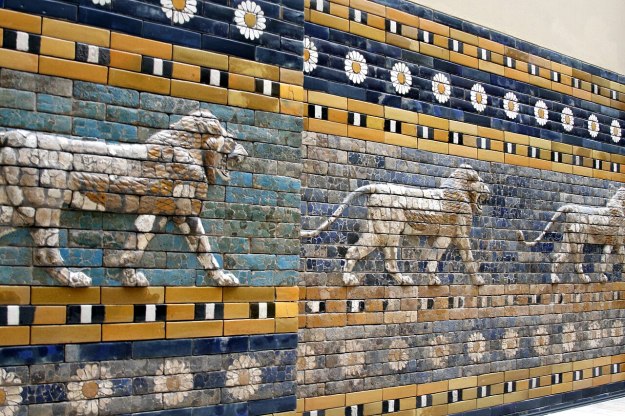
Striding lions from the Processional Street of Babylon. Exhibited at the Pergamon Museum in Berlin.
2 Kings 24: 1-7 The Reign of Jehoiakim
1In his days King Nebuchadnezzar of Babylon came up; Jehoiakim became his servant for three years, then turned and rebelled against him. 2He sent against him bands of the Chaldeans, bands of the Arameans, bands of the Moabites, and bands of the Ammonites; he sent them against Judah to destroy it, according to the word of the LORD that he spoke by his servants the prophets. 3Surely this came upon Judah at the command of the LORD, to remove them out of his sight, for the sins of Manasseh, for all that he had committed, 4and also for the innocent blood that he had shed, for he filled Jerusalem with innocent blood, and the LORD was not willing to pardon. 5Now the rest of the deeds of Jehoiakim and all that he did, are they not written in the Book of the Annals of the Kings of Judah? 6So Jehoiakim slept with his ancestors; then his son Jehoiachin succeeded him. 7The king of Egypt did not come again out of his land, for the king of Babylon had taken over all that belonged to the king of Egypt from the Wadi of Egypt to the River Euphrates.
Jehoiakim was installed by Pharaoh Neco to replace his younger brother Jehoahaz who Neco took into imprisonment at Riblah. Jehoiakim begins his reign as a vassal of Egypt but during his eleven years as king the situation dramatically shifts as Nebuchadnezzar of Babylon becomes the dominant power in the region forcing Egypt’s influence to recede back beyond the Wadi of Egypt. The forces of Babylon (Chaldeans,[1] Arameans, Moabites, and Ammonites) raid into Judah, and although the siege of Jerusalem will not occur until Jehoiakim’s sons brief reign, the forces that will bring about the end of the time of Judah are in motion.
Jehoiakim appears frequently in the book of Jeremiah in a negative light. The king is portrayed as living in luxury while the nation struggles, mistreating the poor and executing those who speak against his policies.[2] The king executes Uriah son of Shemiah who prophecies in a manner similar to Jeremiah and Jeremiah is protected by some of the officials, including Ahikam son of Shaphan (secretary during the time of Josiah)[3] Jeremiah sends a scroll with God’s words to Jehoiakim but in contrast to his father Josiah who tore his clothes in mourning Jehoiakim tore (same verb in Hebrew) the scroll after it was read and cast it into the fire.[4]
Jeremiah declares the Jehoiakim will die “the death of a donkey…dragged off and thrown out beyond the gates of Jerusalem.” (Jeremiah 22:19) 2 Kings states that Jehoiakim slept with his ancestors indicating a normal death and burial. Jehoiakim rebels against Babylon after being a vassal for three years, likely in response to a defeat in Egypt which Nebuchadnezzar returns to Babylon to give his forces time to recover and rebuild. This time the rebellion of Judah does not go unpunished, and this leads to the first siege of Jerusalem by Babylon. Jehoiakim is roughly thirty-six when he dies so it is possible that he is killed by elements within Jerusalem seeking a different leader to attempt to negotiate with the threat of Babylon.
2 Kings 24: 8-17 The Reign of Jehoiachin and the First Siege of Jerusalem
8Jehoiachin was eighteen years old when he began to reign; he reigned three months in Jerusalem. His mother’s name was Nehushta daughter of Elnathan of Jerusalem. 9He did what was evil in the sight of the LORD, just as his father had done. 10At that time the servants of King Nebuchadnezzar of Babylon came up to Jerusalem, and the city was besieged. 11King Nebuchadnezzar of Babylon came to the city while his servants were besieging it; 12King Jehoiachin of Judah gave himself up to the king of Babylon: himself, his mother, his servants, his officers, and his palace officials. The king of Babylon took him prisoner in the eighth year of his reign.
13He carried off all the treasures of the house of the LORD and the treasures of the king’s house; he cut in pieces all the vessels of gold in the temple of the LORD that King Solomon of Israel had made, all this as the LORD had foretold. 14He carried away all Jerusalem, all the officials, all the warriors, ten thousand captives, all the artisans and the smiths; no one remained except the poorest people of the land. 15He carried away Jehoiachin to Babylon; the king’s mother, the king’s wives, his officials, and the elite of the land, he took into captivity from Jerusalem to Babylon. 16The king of Babylon brought captive to Babylon all the men of valor, seven thousand, the artisans and the smiths, one thousand, all of them strong and fit for war. 17The king of Babylon made Mattaniah, Jehoiachin’s uncle, king in his place and changed his name to Zedekiah.
The short reign of Jehoiachin is significant because it marks a critical change for Judah. Jehoiachin inherits the troubles his father inflamed by rebelling against Babylon and reigns briefly over a besieged city. We know that the king and his royal household surrender on March 16 (the second of Adar) 597 BCE and the royal household, warriors, artisans and smiths are taken into exile while the remainder of the people remain under the charge of Zedekiah. This initial exile of the leaders, elites, and skilled members of the population are the setting of the narrative at the beginning of Daniel. We also know that the prophet Ezekiel was among those exiled.[5] The city of Jerusalem and the temple remain but ten thousand people and the riches of the temple and royal household are removed into Babylon.
This creates a new situation for Judah which now has two centers of life: one in exile in Babylon and one remaining in the land. Jeremiah will be the prophet remaining in the land while Ezekiel will emerge to be the prophet for those in exile. The prophet Jeremiah will receive a vision of two baskets of figs, one very good and one rotten, and in this vision the good figs will be Jehoiachin, and the people taken into exile who God views favorable and the rotten figs are Zedekiah and those remaining in Jerusalem.[6] Ezekiel also shares this perspective that the population in exile will be the population of Judah that endures.
2 Kings 24: 18-20 The Reign and Rebellion of Zedekiah
18Zedekiah was twenty-one years old when he began to reign; he reigned eleven years in Jerusalem. His mother’s name was Hamutal daughter of Jeremiah of Libnah. 19He did what was evil in the sight of the LORD, just as Jehoiakim had done. 20Indeed, Jerusalem and Judah so angered the LORD that he expelled them from his presence.
Zedekiah rebelled against the king of Babylon.
Zedekiah is left in charge of the remnant in Jerusalem. The final line of the chapter strikes the critical note for Zedekiah’s reign. He is portrayed in Jeremiah as a king who does seek the prophet’s words but is ultimately unable or unwilling to resist his advisors who lead him into conflict with Babylon. Jehoahaz, Jehoiakim, Jehoiachin, and Zedekiah all reign under the thumb of external powers, Egypt for Jehoahaz and Jehoiakim initially and then Babylon for Jehoiakim through Zedekiah. Yet for the narrator of 2 Kings all of this is a part of God’s action to judge the unfaithfulness of Judah which reaches its climax under Manasseh but extends back to Solomon and beyond. Judah and Jerusalem are expelled from the presence of God because of their disobedience in 2 Kings. Zedekiah’s rebellion sets Babylon in motion to be the instrument of that judgment.
[1] Although we think of Babylon as the empire, the Chaldeans were the dominant people of this empire. All ancient empires were coalitions of groups and so the presence of Arameans, Moabites, and Ammonites (neighbors of Judah) are not surprising.
[5] Ezekiel would receive his call as a prophet while in exile (Ezekiel 1). Kish the grandfather of Mordecai (uncle of Esther) was also among this group of exiles in Esther 2:5-6. Many scholars view the book of Daniel as a later book written well after the exile, but the setting of the initial chapters of the book are this initial exile of the elites to Babylon.
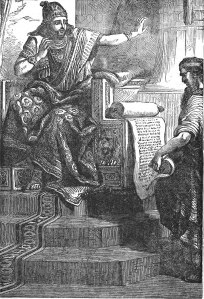
Josiah Hearing the Book of the Law (1873) Unknown author – The story of the Bible from Genesis to Revelation
2 Kings 22
1Josiah was eight years old when he began to reign; he reigned thirty-one years in Jerusalem. His mother’s name was Jedidah daughter of Adaiah of Bozkath. 2He did what was right in the sight of the LORD and walked in all the way of his father David; he did not turn aside to the right or to the left.
3In the eighteenth year of King Josiah, the king sent Shaphan son of Azaliah son of Meshullam, the secretary, to the house of the LORD, saying, 4“Go up to the high priest Hilkiah and have him add up the entire sum of the silver that has been brought into the house of the LORD that the keepers of the threshold have collected from the people; 5let it be given into the hand of the workers who have the oversight of the house of the LORD; let them give it to the workers who are at the house of the LORD repairing the house, 6that is, to the carpenters, to the builders, to the masons; and let them use it to buy timber and quarried stone to repair the house. 7But no accounting shall be asked from them for the silver that is delivered into their hand, for they deal honestly.” 8The high priest Hilkiah said to Shaphan the secretary, “I have found the book of the law in the house of the LORD.” When Hilkiah gave the book to Shaphan, he read it. 9Then Shaphan the secretary came to the king and reported to the king, “Your servants have melted down the silver that was found in the house and have delivered it into the hand of the workers who have oversight of the house of the LORD.” 10Shaphan the secretary informed the king, “The priest Hilkiah has given me a book.” Shaphan then read it aloud to the king. 11When the king heard the words of the book of the law, he tore his clothes. 12Then the king commanded the priest Hilkiah, Ahikam son of Shaphan, Achbor son of Micaiah, Shaphan the secretary, and the king’s servant Asaiah, saying, 13“Go, inquire of the LORD for me, for the people, and for all Judah, concerning the words of this book that has been found, for great is the wrath of the LORD that is kindled against us, because our ancestors did not obey the words of this book to do according to all that is written concerning us.” 14So the priest Hilkiah, Ahikam, Achbor, Shaphan, and Asaiah went to the prophet Huldah the wife of Shallum son of Tikvah son of Harhas, keeper of the wardrobe; she resided in Jerusalem in the Second Quarter, where they consulted her. 15She declared to them, “Thus says the LORD, the God of Israel: Tell the man who sent you to me: 16‘Thus says the LORD: I will indeed bring disaster on this place and on its inhabitants—all the words of the book that the king of Judah has read. 17Because they have abandoned me and have made offerings to other gods, so that they have provoked me to anger with all the work of their hands, therefore my wrath will be kindled against this place, and it will not be quenched.’ 18But as to the king of Judah who sent you to inquire of the LORD, thus shall you say to him: ‘Thus says the LORD, the God of Israel: Regarding the words that you have heard, 19because your heart was penitent and you humbled yourself before the LORD, when you heard how I spoke against this place and against its inhabitants, that they should become a desolation and a curse, and because you have torn your clothes and wept before me, I also have heard you, says the LORD. 20Therefore, I will gather you to your ancestors, and you shall be gathered to your grave in peace; your eyes shall not see all the disaster that I will bring on this place.’ ” They took the message back to the king.
The thirty-one years of King Josiah’s reign in Jerusalem are a final window of hope for Judah. Even though as readers of 2 Kings we know that shortly after Josiah’s death we will reach the end of the story of the kings of the line of David and enter into the time of exile in Babylon, for the author of 2 Kings this is a moment of hope for a rediscovery of faithfulness, restoration of the temple, recommittal to the covenant, and even a hope for the reunification of Israel and Judah. The parallel telling of the story of the reign of King Josiah in 2 Chronicles 34-35 has the reformation of Josiah beginning in his twelfth year, but for 2 Kings the critical event is the discovery of the law in the eighteenth year[1] which initiates a period of repentance for the king and a recommittal to the covenant.
The characterization of King Josiah as one who ‘did not turn aside to the right or the left’ echoes the language of Deuteronomy calling for covenant obedience.[2] His obedience to the covenant links him to Moses, and then the text continues to link him to his ancestor David. Then the text takes us to the repair of the temple in language which parallels the actions of King Jehoash in 2 Kings 12: 1-16. In inquiring of the LORD through the prophet he, like his great-grandfather Hezekiah who sought God’s word through the prophet Isaiah. By his actions Josiah is shown embodying the actions of the good kings and leaders that have come before him. Although the prophet Jeremiah is not mentioned in this narrative, we also know that Jeremiah’s ministry begins in the thirteenth year of Josiah’s reign.[3]
The king sends Shaphan, the scribe or secretary, to the high priest Hilkiah[4] to instigate the utilization of the funds brought into the temple for the temple’s repair. As mentioned above, the narrative is similar to the rebuilding under Jehoash, but at this moment there is a critical discovery that is shared by Hilkiah with Shaphan and eventually with the king, the rediscovered book of the law. Shaphan reads this book to the king who responds by rending his garments in an act of mourning and repentance. Walter Brueggemann draws an insightful contrast between this action by Josiah and an opposite reaction by his son Jehoiakim:
Josiah, the good king, hears the scroll and tears his garment in a dramatic act of repentance (22:11). In Jeremiah 36:23, Jehoiakim, Josiah’s son who is a bad king, hears the scroll of Jeremiah and “cuts” the scroll and not his garments; that is, he does not repent but seeks to dispose of the troublesome scroll. (Brueggemann, 2000, p. 545)
Yet Josiah as a king who upon hearing the words of the law humbles himself and seeks God’s guidance is the model of what a good king is supposed to be.
The book of the law mentioned in this portion of 2 Kings has traditionally been thought of as Deuteronomy in some form. Deuteronomy is the only book among the torah[5] that specifically expects worship being concentrated in the city that God places God’s name upon. Deuteronomy also has lengthy sections of ‘curses’ that result from covenant disobedience. (Cogan, 1988, p. 294) We will never know whether the ‘law’ is Deuteronomy, the torah as a whole, or some proto-Deuteronomic document[6] but what 2 Kings wants us to understand is that Josiah received these words as the covenantal expectations of God and responded to them with the appropriate repentance and rigor.
The high priest Hilkiah, the scribe Shaphan, as well as Ahikam and Achbor are sent to the prophetess Hulda to seek God’s will. Ahikam, the son of Shaphan may be the son of the secretary and another advisor to the king, although some scholars are confused by Ahikam’s position in the list ahead of his father if they are related.[7] Ahikam son of Shaphan will be instrumental in preserving the prophet Jeremiah’s life during the reign of Jehoiakim.[8] In contrast Achbor’s son Elnathan will be charged with capturing the prophet Uriah and returning him to King Josiah for execution.[9] Like Josiah and Jehoiakim fathers and sons can take very different paths.
Hulda is the only woman prophet mentioned in either Israel or Judah, and yet she is trusted by the king and his men to speak the words of the LORD. Her message is ominous and hopeful. It is ominous because the king has heard the threats for covenant disobedience in the law correctly and the actions, particularly of Manasseh, have kindled an unquenchable wrath in God against the people. It is also hopeful because the actions of the king have been seen and appreciated by God. The king’s heart was penitent (literally soft in Hebrew) and tore his clothes and wept. God has postponed the disaster and held back the wrath during the reign of Josiah.
The humility and repentance of the king open the possibility for the repentance of the people. God’s judgment has been postponed, and there remains a hope that continued obedience can avert the disaster on the horizon. Jeremiah will continue to testify to the people after Josiah’s death to try to prevent the destruction that comes with this judgment enacted through the Babylonians. Yet Jeremiah will also see that the reforms enacted by Josiah will not change the heart of the people. Just as the people, in the narrative of 2 Kings, were quick to embrace the corruption of Manasseh the reforms of Josiah will unfortunately not survive his death. Yet 2 Kings wants to continue to celebrate this final good king who like Moses, David, Jehoash, and Hezekiah attempted to follow God’s will and to turn neither to the left or right.
[1] King Josiah would be roughly twenty-six at the time of the discovery of the law in the text.
[3] Josiah would have been 21-22 at the call of Jeremiah, five years before the rediscovery of the book of the law. Jeremiah is portrayed as a young, ‘only a boy’ in the narrative of his call. Jeremiah 1:6.
[4] Hilkiah is also the name of the prophet Jeremiah, but Jeremiah’s father is a priest at Anathoth, and it is likely that he is the son of a different Hilkiah than the high priest in this story.
[5] Genesis, Exodus, Leviticus, Numbers, and Deuteronomy.
[6] Scholars of the source critical school popular in the middle 20th century were focused on trying to find the source material behind the text. They had some good insights but ultimately, they tended to divide up the text into sections rather than engage the text as it has been received.
[7] Age does normally grant a person higher respect and status in ancient cultures, but Ahikam may also be a contemporary and valued advisor to this king who began his reign as a young boy.


 Sign of the Rose