Deuteronomy 18: 1-8: The Levitical Priests
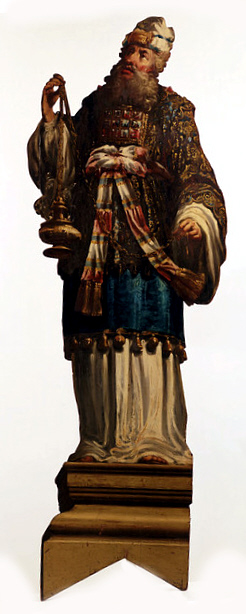
Painted board of Aaron, oil on wood panel, British, ca 1708
1 The levitical priests, the whole tribe of Levi, shall have no allotment or inheritance within Israel. They may eat the sacrifices that are the LORD’s portion 2 but they shall have no inheritance among the other members of the community; the LORD is their inheritance, as he promised them.
3 This shall be the priests’ due from the people, from those offering a sacrifice, whether an ox or a sheep: they shall give to the priest the shoulder, the two jowls, and the stomach. 4 The first fruits of your grain, your wine, and your oil, as well as the first of the fleece of your sheep, you shall give him. 5 For the LORD your God has chosen Levi out of all your tribes, to stand and minister in the name of the LORD, him and his sons for all time.
6 If a Levite leaves any of your towns, from wherever he has been residing in Israel, and comes to the place that the LORD will choose (and he may come whenever he wishes), 7 then he may minister in the name of the LORD his God, like all his fellow-Levites who stand to minister there before the LORD. 8 They shall have equal portions to eat, even though they have income from the sale of family possessions.
In addition to judges and the king outlined in Deuteronomy 16 and 17 respectively now a third ordering portion of society is added, already alluded to in Deuteronomy 17: 8-13 with their role being the final judicial appeal for cases too difficult for the regional judges. This third pillar of the society is the priesthood, a group set aside to minister before the LORD and who serve cultic, teaching and judicial roles for the people of Israel.
The Levites do not have an inheritance of agricultural land, they will have places to live but not the fields for growing crops or animals like the other tribes. On the one hand they are independent of the necessity to work in the fields and are able to dedicate their time to their work of ministering on behalf of the community. On the other hand, they are incredibly vulnerable and dependent on the other tribes providing for them and continuing to offer before the LORD their sacrifices and bringing in their first fruits. If Israel remains faithful to their calling to bring in from the fields their first fruits of grain, wine and oil as well as offering the firstlings of the flock and the other offerings that are outlined the Levites will be taken care of. If Israel becomes a more secular society then the economic security of the Levites is undercut because they do require the other tribes to provide the portion that they are living off of. They have no inheritance other than the LORD which gives them, perhaps, a closer sense of communion with their God but also depends upon receiving the blessing of the LORD through the labor and work of the other tribes.
Israel was intended to be a society structured around this covenantal relationship with their God, not a secular society. In this society structured around a particular understanding of justice the people will care for the tabernacle and later the temple and those who minister to it. The remembered reality is often far different: the priests would often fail in being faithful by abusing their position, the temple and tabernacle would fall into disrepair, the people and kings would be attracted by the ways of the other nations and the economy would become indistinguishable from the nations that surrounded them or the practices of Egypt where they were enslaved.
It is possible that the reference to Levites leaving the towns and coming to minister at the temple/tabernacle may reference the reforms of King Josiah in 2 Kings 23: 8-9, where he tries to centralize the worship of Judah in the temple and eliminates the high places. In the theology of Deuteronomy and the books that come after it, the high places are places where the worship of the LORD is not done correctly, perhaps blending in the elements of the surrounding nations. Perhaps this is also referencing the practices mentioned in 16: 20. The centralization of the cultic functions in Jerusalem does cause a concentration of a large number of levites, but the ongoing narrative also is aware of priests that are scattered throughout the nation. There would be tensions that would arise between the rural priests and the urban priests who became a part of the power structure in Jerusalem, but these verses imagine a situation where rural priests would be welcomed into Jerusalem as equals.
We live in a very different world than the one imagined in Deuteronomy. In Deuteronomy the Levites become one of the central parts of the society ordered around the worship of the LORD. In the United States where there is a strange hybrid relationship between the religious and the secular those in religious callings that are dependent upon the support of their congregations share the blessing and insecurity imagined for the Levites. There is the gift of being able to dedicate one’s time to the ministry that they fell called to be a part of. Yet, particularly in our increasingly spiritual but not religious age where many congregations are aging and shrinking and fewer people identify themselves religiously as a part of a congregation much less support one financially, many leaders of religious communities are finding their calling very tenuous. Unlike the Levites there is the opportunity in a diverse economy for dual callings where the religious role becomes one of two or more roles that sustain a person and their family, but in the ancient world where wealth was tied to land the Levites were placed in a vulnerable state if the other tribes did not support the religious system.
Deuteronomy 18: 9-14: Forbidden Magic
9 When you come into the land that the LORD your God is giving you, you must not learn to imitate the abhorrent practices of those nations. 10 No one shall be found among you who makes a son or daughter pass through fire, or who practices divination, or is a soothsayer, or an augur, or a sorcerer, 11 or one who casts spells, or who consults ghosts or spirits, or who seeks oracles from the dead. 12 For whoever does these things is abhorrent to the LORD; it is because of such abhorrent practices that the LORD your God is driving them out before you. 13 You must remain completely loyal to the LORD your God. 14 Although these nations that you are about to dispossess do give heed to soothsayers and diviners, as for you, the LORD your God does not permit you to do so.
We live in a world where magic is predominantly a part of fiction and the magicians we may see are illusionists that are able to trick our senses through various forms of deception. There are still people who look to horoscopes, palm readers, mediums and other spiritual forms of divining the future but for most people in our society theses are looked upon in terms of entertainment rather than items to place one’s trust in. In the world of Deuteronomy, the practices listed were apparently real and persuasive options available in the world they lived within. All of these forms of magic and divining the future were not to be things that the people of Israel were to heed.
Many of the prohibited practices relate to trying to predict the future or discern how a person is to act to bring about a desired future, whether through practices like augury or by inquiring of the dead. In many respects this vacancy is to be filled by the role of the prophet talked about in the coming verses, even though the biblical prophets are primarily concerned with the present and its impact on the immediate future. Perhaps one of the key differences comes from a different view of the universe. For many people in the ancient world the future was fixed and many ancient religions have some idea of fate. For the people of Israel the future rested in God’s freedom and their relationship with their God. Ultimately God would decide the course of their lives based upon their obedience to the covenant. Deuteronomy will echo repeatedly: if you follow the ways of the covenant you will be blessed and your lives will be long, if you do not follow the commandments and ordinances you will be cursed.
In verse 13, the command is that “you must remain completely loyal to the LORD your God.” Walter Brueggemann points out when speaking about the word translated completely loyal, “The Hebrew term tāmîm means “integrated, whole, undivided, as one unit.” This idea and term likely lies behind Jesus’ teaching in Matthew 5:48 which gets translated, “Be perfect, therefore, as your heavenly Father is perfect.” The translation in the gospel as perfect could mislead the reader to think this is about some type of moral perfection which is different from the direction of the Sermon on the Mount within which this verse is contained. Jesus and Deuteronomy are both calling for unreserved loyalty and living a whole integrated life within the followers ongoing relationship with their God. (Brueggemann, 2001 , p. 194)
Deuteronomy 18: 15-22 The Prophetic Voice

Jeremiah Lamenting the Destruction of Jerusalem by Rembrandt van Rijn 1630
15 The LORD your God will raise up for you a prophet like me from among your own people; you shall heed such a prophet. 16 This is what you requested of the LORD your God at Horeb on the day of the assembly when you said: “If I hear the voice of the LORD my God any more, or ever again see this great fire, I will die.” 17 Then the LORD replied to me: “They are right in what they have said. 18 I will raise up for them a prophet like you from among their own people; I will put my words in the mouth of the prophet, who shall speak to them everything that I command. 19 Anyone who does not heed the words that the prophet shall speak in my name, I myself will hold accountable. 20 But any prophet who speaks in the name of other gods, or who presumes to speak in my name a word that I have not commanded the prophet to speak– that prophet shall die.” 21 You may say to yourself, “How can we recognize a word that the LORD has not spoken?” 22 If a prophet speaks in the name of the LORD but the thing does not take place or prove true, it is a word that the LORD has not spoken. The prophet has spoken it presumptuously; do not be frightened by it.
The fourth and final pillar of the Israelite society is the voice of the prophet. The judges, priests and king will all be voices charged with defending the faithfulness of Israel and protecting the justice for all the people, especially the vulnerable. Yet, the judges, priests and king will all compose the ruling class of the people and come from privileged positions which may skew their perspective on justice at times. With Moses all of these roles are held within one person but in the coming future without Moses these gifts will need to be spread among the community, yet the prophetic voice, the one charged with speaking on behalf of God, is a unique gift of the Hebrew people. The prophets may or may not come from the priestly Levites, but they are charged with standing between God and the people as a mouthpiece. Often their words will be uncomfortable: they will challenge kings and sometimes be thought of as traitors. In Deuteronomy 13 it is the faithfulness of the prophet to the LORD that is the critical discernment as to whether the prophet is a true or false prophet, but sometimes a situation may arise, as in Jeremiah 28 where Hananiah and Jeremiah are proclaiming two very different prophecies and both apparently in the name of the LORD. Now the actual occurrence of the prophecy becomes a key part of discerning who the true and false prophet is. Being a true prophet of God is often a dangerous and lonely vocation because it often challenges the monarchy, priestly and judicial powers calling them back to justice and their vocation on behalf of the LORD. Only certain people seem to be able to hear the voice of the LORD, and this story places this back with the reception of the law at Mount Horeb/Sinai (see Exodus 20: 18-21). The word of God being enfleshed in messengers rather than appearing in its terrifying unveiled power is a concession to the people’s plea. Yet, in this enfleshment in the prophets there is also the potential for abuses even in this office. The story of Israel will be full of false prophets who tell people what they want or expect to hear or those who ensnare others. The prophets will also be those who at least in some cases, like Elijah and Elisha, are able to act as an extension of God’s power towards (or against) the people of Israel.
Within the person of Moses he bears together the roles of leader, priest, judge and prophet. From a Christian perspective these roles come together in a very different way with Jesus. Because of this it is not surprising that the gospel of Matthew spends a lot of time placing Jesus and Moses alongside each other and understands who Jesus is in light of Moses story and role. It is very early in the Christian church that you can find references to the three roles of Christ: as prophet, priest and king. And perhaps it is underappreciated how Jesus was seen by the people of his time as a prophet because his words and his actions would have called to mind some of the biblical prophets that had been a part of the story of Israel.