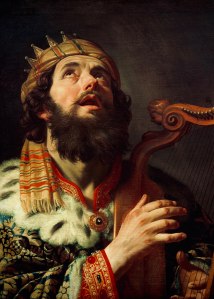
Psalm 132
A Song of Ascents.
1 O LORD, remember in David’s favor
all the hardships he endured;
2 how he swore to the LORD
and vowed to the Mighty One of Jacob,
3 “I will not enter my house
or get into my bed;
4 I will not give sleep to my eyes
or slumber to my eyelids,
5 until I find a place for the LORD,
a dwelling place for the Mighty One of Jacob.”
6 We heard of it in Ephrathah;
we found it in the fields of Jaar.
7 “Let us go to his dwelling place;
let us worship at his footstool.”
8 Rise up, O LORD, and go to your resting place,
you and the ark of your might.
9 Let your priests be clothed with righteousness,
and let your faithful shout for joy.
10 For your servant David’s sake
do not turn away the face of your anointed one.
11 The LORD swore to David a sure oath
from which he will not turn back:
“One of the sons of your body
I will set on your throne.
12 If your sons keep my covenant
and my decrees that I shall teach them,
their sons also, forevermore,
shall sit on your throne.”
13 For the LORD has chosen Zion;
he has desired it for his habitation:
14 “This is my resting place forever;
here I will reside, for I have desired it.
15 I will abundantly bless its provisions;
I will satisfy its poor with bread.
16 Its priests I will clothe with salvation,
and its faithful will shout for joy.
17 There I will cause a horn to sprout up for David;
I have prepared a lamp for my anointed one.
18 His enemies I will clothe with disgrace,
but on him, his crown will gleam.”
This thirteenth song of ascent is significantly longer than the other fourteen songs in this collection and is the only song to link both Zion and the Davidic line together. Both the LORD and David in this psalm are given a dwelling place as the events of 2 Samuel 6-7 are reimagined in poetic form. The first half of the psalm references the return of the ark of the covenant from Kiriath-jearim to the tent David established for it in Jerusalem and David’s desire to build a permanent home for God’s presence (2 Samuel 6:1-7:3). The second half of the psalm remembers response of the LORD to David through the prophet Nathan, promising to establish a house (lineage) for David (2 Samuel 7: 4-29). This song of ascents reminds the pilgrims of how Jerusalem became Zion, the dwelling of the LORD, and the house of David.
The psalm begins by asking the LORD to remember David and the hardships he endured. Although many of the events of the psalm reflect a particular moment early in David’s reign there is also the sense that the hardships may involve the hardships that have come upon the line of David. The language of ‘remember’ and ‘hardships’ echoes the end of Psalm 89, another royal psalm that contrasts the lofty promises of the beginning of the Davidic line with the later reality of the line seeming to be a dead stump.[1] The line in verse seventeen where God causes a horn to sprout for David may also indicate that the monarchy has ceased to exist and the rising of a horn, a symbol of power and vitality, is “the restoration of something that has been destroyed” as in Ezekiel 29:21 (NIB IV: 1212). Yet, whether the pilgrim is entering the city of David where the line of David still has its throne, or a city without a Davidic king, the speaker is reminded of the original David who brought the ark of the covenant, and by extension the symbolic presence of God, into Jerusalem.
In 2 Samuel when David becomes king over all of Israel one of his first actions is to conquer Jerusalem and make it the seat of his power. Shortly after this he moves to bring the ark of the covenant from Kiriath-jearim to Jerusalem. Ephrathah is the region around Bethlehem where David’s family comes from and Jaar is likely Kiriath-jearim where the ark has rested since its return by the Philistines. In 1 Samuel 4 the Ark of God is captured by the Philistines, but wherever the ark rests among the Philistines it brings them affliction. The Philistines eventually return the ark to Israel at Beth-shemesh and then shortly move it to Kiriath-jearim during the early years of Samuel serving as judge of Israel.[2] David has brought the ark of the covenant to a tent in his new capital city and desires to build a house for the Mighty One of Jacob.[3] David has created a temporary space where the LORD can dwell among the people and desires to create a permanent space, a task that will fall to his son Solomon.
A continual theme of the scriptures is God’s desire to dwell among God’s people and the tabernacle, the ark, and later the temple are all dwelling places for the presence of God to rest among the people. A place where the priests and the people can orient their sacrifice, worship, and praise. Zion as a city becomes the place where the faithful ones can come to seek God’s presence and the stability provided by the kings of David’s line who are charged with providing a place of security for both the people and the house of God.
In verse eleven the LORD becomes the actor and in response to David’s actions provides a line for David. The LORD is now the one who chose Zion and chooses to dwell in the midst of the people there providing both provision and protection. Yet for the promise of a son of David remaining on the throne in Jerusalem is contingent upon their obedience to the covenant and decrees. The hope of both Jerusalem and the line of David is the presence of God among them. As the pilgrims enter the city of God, they can remember the hopes of the past and the promise of God’s presence.
In 2 Chronicles 6: 41-42 as Solomon prays over the temple he closes with verses eight through ten of this psalm. Solomon and the kings who followed after him would often fail to keep the covenant and the decrees of God and even the temple would later be polluted by practices and images to other gods, but throughout the scriptures is the image of the God who desires to dwell among the people as well as the desire for peace and security provided by a faithful ruler. Pilgrims across the generations have come to places where God’s presence was promised to dwell in order to worship, praise, and offer their gifts to God and be recalled to the way of life God calls the faithful to practice.
[1] In the imagery of Isaiah 11:1.
[2] 1 Samuel 4-6.
[3] An early epithet for the God of Israel which appears initially Genesis 49:24 during Jacob’s blessing of Joseph. (Nancy deClaisse-Walford, 2014, p. 935)

