Tag Archives: Babylonian Exile

Ezekiel 1 Ezekiel’s Experience of the Divine Chariot in Exile

Ezekiel as depicted by Michelangelo on the Sistene Chapel ceiling

Ezekiel 1: 1-3 Meeting Ezekiel the Prophet

1 In the thirtieth year, in the fourth month, on the fifth day of the month, as I was among the exiles by the river Chebar, the heavens were opened, and I saw visions of God. 2 On the fifth day of the month (it was the fifth year of the exile of King Jehoiachin), 3 the word of the LORD came to the priest Ezekiel son of Buzi, in the land of the Chaldeans by the river Chebar; and the hand of the LORD was on him there.

The book of Ezekiel begins with fixing the beginning of Ezekiel’s ministry as a prophet on the thirtieth year, the fourth month, and the fifth day of the month in modern day Iraq between the Tigris and the Euphrates. Yet, even for all this specificity one initial question is what is the designation of the thirtieth year marking from? There are two primary conjectures that scholars have made: the first is that it is thirty years after the high priest Hilkiah rediscovered the book of the law in the temple and presented it to King Josiah initiating Josiah’s attempt to reform the practice of the people of Jerusalem and Judah. (2 Kings 22-23) More likely is the explanation which goes back to Origen (185-253 CE) that the thirty years designates the thirtieth year of life for the prophet. (Block, 1997, p. 83) Although there is no way to be certain about the marker the thirty years counts forward from, the thirtieth year of life for a person from a priestly family would indicate the time they would begin to serve in the temple:

from thirty years old up to fifty years old, all who qualify to do work relating to the tent of meeting. (Numbers 4:3, this is for the Kohathites but the same provisions relate to the Gershonites and the Merarites (divisions within the Levite families with different tasks in the tent of meeting) see verses 23 and 30)

Ezekiel’s twenty-two-year ministry would roughly cover the ages from thirty to fifty years old of service for a person in the temple if the thirty years is counting Ezekiel’s age. In exile, Ezekiel who has lost the ability to serve in the temple is now granted an equivalent or perhaps higher (if more challenging) calling to be a prophet to the LORD.

The secondary time marker, the fifth year of the exile of King Jehoiachin, fixes the date. King Jehoiachin is exiled in 597 BCE along with princes, military leaders, skilled craftsmen, royal officials, and the elite members of Jerusalem. This first exile leaves much of the population behind and creates two centers for the Jewish people: the exiles in Babylon and the remnant in Judah. When Ezekiel sits beside the river Chebar it calls to mind the psalmist mourning the exile: By the rivers of Babylon—there we sat down and there we wept when we remembered Zion. (Psalm 137:1) Though Psalm 137 may reflect the second exile where the temple and city are destroyed, Ezekiel surely mourns like the psalmist as they attempt to navigate their exile away from their home and the temple. The river of Chebar is in the vicinity of Nippur, a city destroyed by Nebuchadrezzar’s father Nabopolassar and resettled with deportees from across the empire. (Block, 1997, p. 84) Into this place of displaced and mourning people the son of the priest Buzi experience the hand of the LORD upon him as he encounters God’s presence in this foreign land.


Ezekiel 1: 4-28 The Chariot of God

4 As I looked, a stormy wind came out of the north: a great cloud with brightness around it and fire flashing forth continually, and in the middle of the fire, something like gleaming amber. 5 In the middle of it was something like four living creatures. This was their appearance: they were of human form. 6 Each had four faces, and each of them had four wings. 7 Their legs were straight, and the soles of their feet were like the sole of a calf’s foot; and they sparkled like burnished bronze. 8 Under their wings on their four sides they had human hands. And the four had their faces and their wings thus: 9 their wings touched one another; each of them moved straight ahead, without turning as they moved. 10 As for the appearance of their faces: the four had the face of a human being, the face of a lion on the right side, the face of an ox on the left side, and the face of an eagle; 11 such were their faces. Their wings were spread out above; each creature had two wings, each of which touched the wing of another, while two covered their bodies. 12 Each moved straight ahead; wherever the spirit would go, they went, without turning as they went. 13 In the middle of the living creatures there was something that looked like burning coals of fire, like torches moving to and fro among the living creatures; the fire was bright, and lightning issued from the fire. 14 The living creatures darted to and fro, like a flash of lightning.

15 As I looked at the living creatures, I saw a wheel on the earth beside the living creatures, one for each of the four of them. 16 As for the appearance of the wheels and their construction: their appearance was like the gleaming of beryl; and the four had the same form, their construction being something like a wheel within a wheel. 17 When they moved, they moved in any of the four directions without veering as they moved. 18 Their rims were tall and awesome, for the rims of all four were full of eyes all around. 19 When the living creatures moved, the wheels moved beside them; and when the living creatures rose from the earth, the wheels rose. 20 Wherever the spirit would go, they went, and the wheels rose along with them; for the spirit of the living creatures was in the wheels. 21 When they moved, the others moved; when they stopped, the others stopped; and when they rose from the earth, the wheels rose along with them; for the spirit of the living creatures was in the wheels.

22 Over the heads of the living creatures there was something like a dome, shining like crystal, spread out above their heads. 23 Under the dome their wings were stretched out straight, one toward another; and each of the creatures had two wings covering its body. 24 When they moved, I heard the sound of their wings like the sound of mighty waters, like the thunder of the Almighty, a sound of tumult like the sound of an army; when they stopped, they let down their wings. 25 And there came a voice from above the dome over their heads; when they stopped, they let down their wings.

26 And above the dome over their heads there was something like a throne, in appearance like sapphire; and seated above the likeness of a throne was something that seemed like a human form. 27 Upward from what appeared like the loins I saw something like gleaming amber, something that looked like fire enclosed all around; and downward from what looked like the loins I saw something that looked like fire, and there was a splendor all around. 28 Like the bow in a cloud on a rainy day, such was the appearance of the splendor all around. This was the appearance of the likeness of the glory of the LORD.

When I saw it, I fell on my face, and I heard the voice of someone speaking.

To most modern readers the descriptions of Ezekiel that begin the book are some of the strangest and least understood imagery in scripture. The Puritan scholar Willian Greenhill described Ezekiel as, “full of majesty, obscurity, and difficulty.” (Block, 1997, p. 89) This obscurity and difficulty has led to numerous psychological and even extraterrestrial explanations, but the imagery as much as it stretches the ability of Ezekiel to put into words, would also be more familiar within the imagery of the temple and the world around Jerusalem at this time. Throughout these reflections I have attempted to approach each of these books from the perspective of trust and faith and with the assumption that each work has something to teach me. In that light I am crediting Ezekiel with attempting to report as honestly as he can about this experience with things beyond his ability to describe. Ezekiel’s descriptions will gain additional precision in chapter ten when he has language for the living creatures as cherubim, but for now we will encounter these creatures, wheels, and throne through the writing describing through analogy what this overwhelming experience was like.

Ezekiel has a far more detailed report of his encounter with the divine than Isaiah, or Jeremiah and part of that may be due to his situation. Previous prophets had all operated in the land of Israel and many may have had access to the temple in Jerusalem, but Ezekiel is the first prophet operating from the exile. As Ellen Davis can insightfully state, “As the first prophet to receive a vision outside of the land, he had to produce a fuller record in order to be believed.” (Davis, 1989, p. 30) Ezekiel has an intense interest in priestly matters and in particular the temple, so perhaps it is not surprising that the imagery that Ezekiel sees is connected with the imagery of the temple and is also comparable to images from the surrounding region. This visitation comes from the north in a great cloud of lightning or fire with a center like gleaming amber or molten metal. The closest analogy to what Ezekiel sees is the approach of the hailstorm as the seventh sign (plague) in Egypt (Exodus 9:23-24). Yet the quick description of this ‘stormy wind’[1]is often forgotten by most readers as they become confused by the description of the four living creatures, the wheels, the throne, and the one upon the throne.

Before delving into the individual descriptions, it is important to realize what the overall image is pointing to: a great chariot with God sitting on a throne or seat upon that chariot. Many artistic renderings of Ezekiel’s vision miss the forest for the trees and become focused on the components of the vision without any way to coherently put the images together as below.

Augsburger Wunderzeichenbuch — folio 15? „Vision des Hesekiel“

Throughout these descriptions Ezekiel provides us enough information for our imaginations to be stimulated but, as is demonstrated by the diversity of artistic interpretations, not enough to fully grasp what his eyes see. Ezekiel seems to be at the edge of his ability to describe. In Tova Ganzel’s words:

As the prophet’s description of the vision progresses, he gradually seems to lose his grasp of tangible expression. It grows increasingly difficult for him to describe what he is experiencing. See, for example, the pervasive use of the prepositional kaf (like), and the growing number of instances in which he refers to a demut (semblance or likeness): (Ganzel, 2020, p. 22)

Much like the descriptions of the tabernacle in Exodus 25-27, 35-39 or the temple in 1 Kings 5-7 can only give us a general idea of those structures, the description of Ezekiel can give us an idea of this chariot and its occupant. Although Ezekiel may be at the edge of what his language can describe, knowing some cultural references can help us to better understand the image from the world he inhabits.
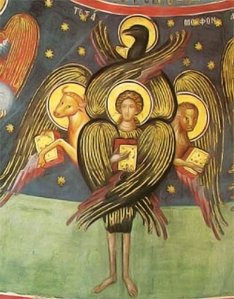
A tetramorph cherub, in Eastern Orthodox iconography 16th Century

Although the four faces of the four living creatures is a feature unique to Ezekiel’s description, much of the description of these creatures is similar to what scholars believe the cherubim on the ark of the covenant (Exodus 25: 10-22) and the temple (1 Kings 6:23-28). Most modern portrayals of the ark picture the cherubim as resembling humans with wings.

However, most representation of divine creatures in the surrounding world are sphinx like with both human and animal features.


Hittite sphinx. Basalt. 8th century BC. From Sam’al. Museum of the Ancient Orient, Istanbul.
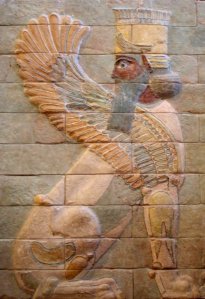
Winged sphinx from the palace of Darius the Great during Persian Empire at Susa (480 BC)
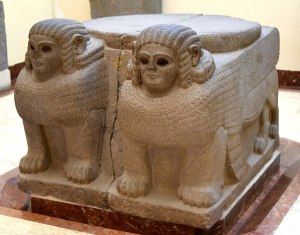
Column base in the shape of a double sphinx. From Sam’al. 8th century BC. Museum of the Ancient Orient, Istanbul.

These living creatures as described in Ezekiel have both humanoid and animal features. The creatures are able to move in any direction without turning (as the spirit/wind/breath moves them) and there are both animate and inanimate characteristics to these creatures which are a part of the divine throne. The creatures seem to be animated by the wind and the electricity/lighting/fire that is in the midst of these creatures.

The wheels also have had lively interpretation in the artistic imagination, but functionally this is a four wheeled chariot. The chariot seems to have a life that flows between the living creatures and the wheels as they are moved by the spirit/wind. The wheels gleam like beryl or glowing metal and the eyes may be eye shaped precious stones that are of a piece of the wheel. (Block, 1997, pp. 100-101) Although the pictures which are a part of this post are meant to help bring some visual structure to Ezekiel’s vision from an ancient context, the prophet’s descriptions are still challenging to envision and likely were overwhelming for the prophet to experience.

An ivory from Tel Megiddo showing a king sitting on a throne which is supplicated by a sphinx-esque winged hybrid.
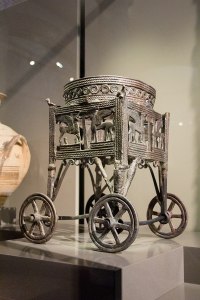
Wheeled stand for a cauldron, bronze, 12-11th century BCE. Probably from Kition, Larnaka district, Cyprus. Currently in the Neues Museum, in Berlin. IN : Misc. 8947.

Above this chariot is a dome to support the throne and the presence upon the throne. The scene describes an experience overwhelming to both the eyes and the ears. The crystal dome which supports the emerald or lapis lazuli throne on which seats something like a human form. Yet, the human form is enclosed with both a rainbow-like radiance and fire and brightness. Ezekiel is probably wise in limiting the description of the glory of the LORD, but the overwhelming scene prepares us for the end where the voice of the LORD speaks.

There are sound reasons for traditional limitation of the book of Ezekiel in Jewish circles to men over thirty as the strangeness of the book has inspired many strange and disparate interpretations. Ezekiel is strange to our ears, but it is easy to become lost in the initial descriptions and not pay attention to what the voice of the LORD has to say to Ezekiel. Four-faced, four-winged living creature and wheels within wheels with eyes are fascinating images but they are only to prepare us to hear the call of Ezekiel to his difficult ministry both to the exiles in Babylon and those remaining in Judah.

[1] Ruach se’ara in Hebrew. Ruach plays multiple roles in the Bible and in this passage: wind, breath and spirit are the most common meanings. Later in the chapter when it talks about the ‘wherever the spirit would go’ or ‘the spirit of the living creatures’ it is ruach behind each usage of spirit.
Psalm 89 Shattered Worlds and Broken Symbols

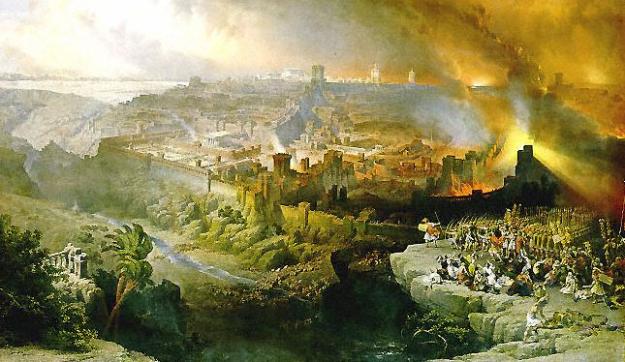
The Siege and Destruction of Jerusalem by Romans Under the Command of Titus, A.D. 70 by David Roberts 1850

Psalm 89

<A Maskil of Ethan the Ezrahite.>
1 I will sing of your steadfast love, O LORD, forever; with my mouth I will proclaim your faithfulness to all generations.
2 I declare that your steadfast love is established forever; your faithfulness is as firm as the heavens.
3 You said, “I have made a covenant with my chosen one, I have sworn to my servant David:
4 ‘I will establish your descendants forever, and build your throne for all generations.'” Selah
5 Let the heavens praise your wonders, O LORD, your faithfulness in the assembly of the holy ones.
6 For who in the skies can be compared to the LORD? Who among the heavenly beings is like the LORD,
7 a God feared in the council of the holy ones, great and awesome above all that are around him?
8 O LORD God of hosts, who is as mighty as you, O LORD? Your faithfulness surrounds you.
9 You rule the raging of the sea; when its waves rise, you still them.
10 You crushed Rahab like a carcass; you scattered your enemies with your mighty arm.
11 The heavens are yours, the earth also is yours; the world and all that is in it — you have founded them.
12 The north and the south — you created them; Tabor and Hermon joyously praise your name.
13 You have a mighty arm; strong is your hand, high your right hand.
14 Righteousness and justice are the foundation of your throne; steadfast love and faithfulness go before you.
15 Happy are the people who know the festal shout, who walk, O LORD, in the light of your countenance;
16 they exult in your name all day long, and extol your righteousness.
17 For you are the glory of their strength; by your favor our horn is exalted.
18 For our shield belongs to the LORD, our king to the Holy One of Israel.
19 Then you spoke in a vision to your faithful one, and said: “I have set the crown on one who is mighty, I have exalted one chosen from the people.
20 I have found my servant David; with my holy oil I have anointed him;
21 my hand shall always remain with him; my arm also shall strengthen him.
22 The enemy shall not outwit him, the wicked shall not humble him.
23 I will crush his foes before him and strike down those who hate him.
24 My faithfulness and steadfast love shall be with him; and in my name his horn shall be exalted.
25 I will set his hand on the sea and his right hand on the rivers.
26 He shall cry to me, ‘You are my Father, my God, and the Rock of my salvation!’
27 I will make him the firstborn, the highest of the kings of the earth.
28 Forever I will keep my steadfast love for him, and my covenant with him will stand firm.
29 I will establish his line forever, and his throne as long as the heavens endure.
30 If his children forsake my law and do not walk according to my ordinances,
31 if they violate my statutes and do not keep my commandments,
32 then I will punish their transgression with the rod and their iniquity with scourges;
33 but I will not remove from him my steadfast love, or be false to my faithfulness.
34 I will not violate my covenant, or alter the word that went forth from my lips.
35 Once and for all I have sworn by my holiness; I will not lie to David.
36 His line shall continue forever, and his throne endure before me like the sun.
37 It shall be established forever like the moon, an enduring witness in the skies.” Selah
38 But now you have spurned and rejected him; you are full of wrath against your anointed.
39 You have renounced the covenant with your servant; you have defiled his crown in the dust.
40 You have broken through all his walls; you have laid his strongholds in ruins.
41 All who pass by plunder him; he has become the scorn of his neighbors.
42 You have exalted the right hand of his foes; you have made all his enemies rejoice.
43 Moreover, you have turned back the edge of his sword, and you have not supported him in battle.
44 You have removed the scepter from his hand, and hurled his throne to the ground.
45 You have cut short the days of his youth; you have covered him with shame. Selah
46 How long, O LORD? Will you hide yourself forever? How long will your wrath burn like fire?
47 Remember how short my time is —  for what vanity you have created all mortals!
48 Who can live and never see death? Who can escape the power of Sheol? Selah
49 Lord, where is your steadfast love of old, which by your faithfulness you swore to David?
50 Remember, O Lord, how your servant is taunted; how I bear in my bosom the insults of the peoples,
51 with which your enemies taunt, O LORD, with which they taunted the footsteps of your anointed.
52 Blessed be the LORD forever. Amen and Amen.

The approach to Psalm 89 will be different than my approach to most of the other psalms because it evokes for me an important question that continues to be wrestled with in communities of faith. This psalm likely originates in the collapse of the Davidic line of kings in the aftermath of Babylon’s destruction of Jerusalem in 587 BCE and wrestles with the contrast between the psalmist’s understanding of God’s promises and their present experience. It is plausible that Psalm 89 may be a combination of one (or more) psalms which expressed the royal theology of the Davidic kings with the tough questions of verse thirty-eight onward. Like Psalm 88 it takes us into the darkness of the psalmist’s experience where no light appears on the horizon, but unlike the previous psalm this is the experience of the community of the faithful questioning how the God’s faithfulness proved unfaithful. The psalm is still processing the anger, grief, and the disillusionment over the loss of institutions they thought would continue perpetually.

The language of Psalm 89 weaves together the kingdom of God and the monarchy of David into a common tapestry. Psalm 89 is built upon the words through the prophet Nathan to David in 2 Samuel 7: 8-17, but the rough edges of this prophecy where the ‘seeds of arrogance’ (Nancy de Claisse-Walford, 2014, p. 681) seen in David are smoothed out. Like Psalm 2 the strength of the Davidic kings is directly linked to the strength of the LORD. Their victories are the LORD’s victories, their enemies are the LORD’s enemies, their unfaithfulness is punished but they are never separated from God’s steadfast love and faithfulness (unlike King Saul or the Kings of Northern Israel). The first seventy percent of the psalm weaves God’s reign which is founded on steadfast love and faithfulness into experience of life under David’s descendants. The royal theology is expressed through the temple, and the temple, Jerusalem, and the Davidic kings all become important symbols of God’s reign on earth. The covenant language of Psalm 89 leaves no space for God to change God’s mind despite the unfaithfulness of many of the kings in Jerusalem. Yet, when the seam holding God’s reign and the Davidic king’s reign unravels in verse thirty-eight, the psalmist now takes God to task for renouncing the covenant. The situation of humiliation that the people experience now moves the psalmist to the dangerous and perhaps blasphemous conclusion that God whose reign is built on steadfast love and faithfulness has now proven unfaithful. God who was once Father and Rock who exalted David’s horn and strengthened his arm now strengthens the arms of the foes of the people, has rejected God’s children, and has renounced the covenant.

Moving beyond the psalm for the moment, the close alliance of God’s kingdom with any individual or government always presents the danger of idolatry. King David occupies an almost mythical role in the story of Israel as the ‘once and future king’ who was a man after God’s own heart. The narrative of David in First and Second Samuel, and the experience of the Davidic kings in First and Second Kings is often disconnected from the interwoven theology which connects the stability of the kings in Jerusalem with a larger vision of God’s cosmic reign over the forces of creation and the nations of the world. When the destruction of Jerusalem by Babylon occurs and the Davidic line of kings seems to be a stump which is cutdown and never to rise again the Jewish people would have to reckon with their relationship with God in a new way and to discover their new identity as a people of God in exile without king, temple, or land. They would have to reimagine the role of David within their life of faith and to reexamine how the hopes of 2 Samuel 7 and Psalm 89: 1-36 ended in the desolation of 2 Kings 25 and Psalm 89: 37-51.

Although the United States there is the concept of the ‘separation of the church and the state’ there is also a semi-religious understanding of manifest destiny and exceptionalism which exists within the political language of the country. Recently there has been a strong movement among both individuals and churches towards a Christian nationalism which weaves these ideas of manifest destiny and exceptionalism into a religious retelling of the story of the United States which ignores many aspects of the country’s past and present. This Christian nationalism has coalesced around the Republican Party in the United States and is still wielded by former President Trump to link his presidency with the faith of many of his followers. The almost messianic fervor that some have placed upon him and the sharp polarization between adherents and opponents highlights the danger of this interweaving of God’s reign and any individual or political group.

As an heir of the Lutheran reformation, I am a part of what is sometimes referred to as the magisterial reformation. The magisterial reformation includes the Lutheran, Reformed, and Anglican reform movements that still believed that secular authority should be followed (in contrast to the radical reformers who rejected any secular authority). Yet, the Lutheran (as well as Reformed and Catholic churches) in Germany had to struggle with the demands for loyalty from the National Socialist party as they assumed power in the 1930s. Many prominent Lutheran scholars, like Paul Althaus,[1] welcomed the rise of the National Socialist and Althaus viewed the government of the state as an order of God’s creation which was given by God. If the government of the state was an order of creation it was not subject to critique by the church, but there were others in the church who would criticize the National Socialist. Dietrich Bonhoeffer is the most well known of these resisters to the demands of loyalty. For Bonhoeffer he viewed the government as a vessel God uses to preserve life and when the government fails in its responsibility the church has a responsibility to speak. Many in Germany in the 1930s were able to combine their practice of Christianity with the demands of the state. Looking back upon this time it is easy to wonder how many people of faith were able to participate in or tolerate actions which seem antithetical to the scriptures, yet it is amazing how malleable peoples’ interpretation of scripture can be to fit their political dispositions.

Within Psalm 89 the kingdom of God and the reign of the Davidic kings is woven together until the tapestry is ripped apart by the experience of the present. There were Christians during the Third Reich who viewed Adolf Hitler as God’s gift to Christianity[2] and I fear there are many Christians in the United States making a similar mistake today. Unfortunately for many in Germany and in the United States participation in these movements has drowned out critical voices that questioned this interweaving of God and nationalism. For Judaism the crisis of exile in Babylon led to a reexamination of their faith in light of their new situation. I fear that for many Christians the eventual collapse of Christian nationalism will lead to an abandonment of their faith.

For me the conclusion of this psalm in verse fifty-two is also a moment of hope. It closes the third book of the psalter and brings this open question into the continued act of praise. Even when there are no easy answers for shattered symbols, broken communities, and even a broken nation there is a community that sits in the discomfort and still brings these questions into the blessing of their God. It closes with a double ‘amen’ which acknowledges the still unanswered questions of the prayers while allowing them to be lifted up to the God who may be Father, may be opponent but still remains connected to the community of the faithful. Elie Wiesel in his memoirs All Rivers Run to the Sea captures the relationship of these faithful crying out to God when he says of his own experience of the Holocaust:

I have never renounced my faith in God. I have risen against His justice, protested His silence and sometimes His absence, but my anger rises up within faith, not outside of it. (Wiesel, 1994, p. 84)

[1] Paul Althaus was not an isolated example, but he was in the 1930s viewed as the leading scholar on Luther’s theology. When I was studying in seminary in the early 2000s his works The Theology of Martin Luther and The Ethics of Martin Luther were still used.

[2] Paul Althaus in 1933 stated, “Our Protestant churches have greeted the turning point of 1933 as a gift and miracle of God” (Ericksen, 2012, p. 37)

Psalm 79 Words of Pain and Hope in a National Crisis

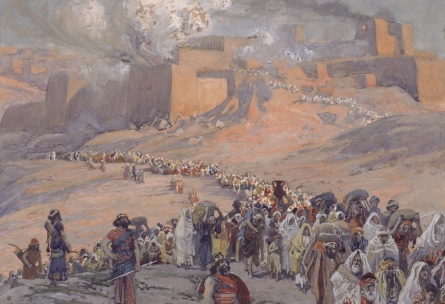
James Tissot, The Flight of the Prisoners

Psalm 79

<A Psalm of Asaph.>

1 O God, the nations have come into your inheritance; they have defiled your holy temple; they have laid Jerusalem in ruins.
2 They have given the bodies of your servants to the birds of the air for food, the flesh of your faithful to the wild animals of the earth.
3 They have poured out their blood like water all around Jerusalem, and there was no one to bury them.
4 We have become a taunt to our neighbors, mocked and derided by those around us.
5 How long, O LORD? Will you be angry forever? Will your jealous wrath burn like fire?
6 Pour out your anger on the nations that do not know you, and on the kingdoms that do not call on your name.
7 For they have devoured Jacob and laid waste his habitation.
8 Do not remember against us the iniquities of our ancestors; let your compassion come speedily to meet us, for we are brought very low.
9 Help us, O God of our salvation, for the glory of your name; deliver us, and forgive our sins, for your name’s sake.
10 Why should the nations say, “Where is their God?” Let the avenging of the outpoured blood of your servants be known among the nations before our eyes.
11 Let the groans of the prisoners come before you; according to your great power preserve those doomed to die.
12 Return sevenfold into the bosom of our neighbors the taunts with which they taunted you, O Lord!
13 Then we your people, the flock of your pasture, will give thanks to you forever; from generation to generation we will recount your praise.

Most of the Psalms of Asaph in this section are likely written in the aftermath of the devastation of Jerusalem and the destruction of the temple by the Babylonians in 587 BCE and emerge in a space of broken dreams and deep pain. The placement of this psalm immediately after Psalm 78, with its condemnation of Northern Israel and its belief that God’s love and protection focused on Judah and the sanctuary at Mount Zion, highlights the hopes that are now in pieces after the experience of the surviving the destruction caused after a long siege. The Davidic monarchy is shattered, the temple lies in ruins, the people are being forced into exile, and the land has languished under the violence of Babylon’s campaigns against Judah. The Babylonians have defiled the things the people of Judah believed would endure forever under God’s protection. In a space of national defeat and humiliation where God’s hand has not protected them the psalmist narrates the trauma of the survivors as they walk among unburied corpses in the shattered city calling on God for a response to the violence that has been done to them.

Prophets like Jeremiah had indicated that Babylon was God’s instrument of judgment, but the Asaph who narrates this psalm may have been one of those who would have considered Jeremiah’s words dangerous at best and traitorous at worst. Jeremiah and other prophets may have warned about the failure of the people to live according to God’s covenant with them and that their trust in the Davidic king and the temple were misplaced without this covenant faithfulness. One of the gifts of scripture is bringing together multiple voices and experiences around these critical times of crisis as the individuals and the people navigate who they are and how they are to live in the face of national disaster. This psalm comes from a place of shock, anger, and grief about the plight of the people and God’s apparent lack of action on their behalf.

The psalm tries to appeal to God’s honor and glory and the ways in which Babylon’s actions have defiled that. Instead of the peoples’ inheritance or the temple of Solomon the things that are broken are God’s. The corpse of God’s servant[1] is left unburied for the birds and wild animals to scavenge and with the imagery of the blood being poured out like water it is poetically like the Babylonians in their act of war have made a mockery of the sacrificial offerings of Judah. Now Israel itself has become the sacrifice laid upon the altar of the shattered stones of the city and no one is able to begin the process of undoing this desolation. Their situation is one of devastation and disgrace. Babylon made them an example of the cost of defiance of the might of their empire so that other nations might see and respond in fear.

Yet, the devastation has not turned the psalmist from their trust in God and it is to God they cry from their anguish. There is in the psalm an awareness that it is God’s anger that has allowed the devastation to occur and there is an awareness that God is justified in his anger over the sins of the past. Yet, in the psalmist’s view, the punishment far exceeds the crime and the license extended to the Babylonians has not brought dishonor not only to Israel but to God’s name. Moses used a similar argument after the golden calf to get God to turn away from God’s wrath towards the people, and here the psalmist appeals both to the nations’ perception of the God of Israel but also to the compassion of God that demonstrated when God responded to the cries of the oppressed in the past. They ask God to open God’s hearing to the cries of the prisoner[2] and to deliver the condemned[3] and to repay their enemies sevenfold[4] for the violence they have done and the dishonor they have done to God’s name.

The psalm ends in a place of hope where the broken people will praise God from generation to generation. Most of this psalm dwells in trauma and brokenness as the psalmist cries out in anger to God asking for vengeance but it does not end there. The hurt and pain eventually turn to praise, the deep wounds of the present heal, and the anger recedes as hope emerges out of the devastation. Times of national crisis change us. In my lifetime we thankfully have not experienced the depth of disaster that the Babylonian exile would have been, but September 11, 2001, the Covid Pandemic, the uncertainty of January 6, 2020, and many other events have caused me to cry out to God asking questions and wondering about my perception of God’s action or lack of action in these moments. Times of crisis force us to ask hard questions about our beliefs and to refine them. My instructor in Hebrew Bible two decades ago, Ann Fritschel, once said that the answer to almost any historical question in reference to the Hebrew scriptures was the Babylonian exile. That event caused both a great reconsideration of what the covenant faith in the LORD the God of Israel meant and a gathering and consolidation of the stories, poems, reflections, and words of the prophets to form the scriptures to ensure the tradition could be handed down. We stand as the inheritors of these voices that have come together to reflect upon the life of faith in both times of peace and times of conflict. These words spoken in trauma yet ending in hope may give words to our anger, grief, and mourning but they may also allow us to hope for a time when healing allows us to lift our voices in praise.

[1] This is singular in Hebrew. The Septuagint and most English translations make this plural, but it probably is used here like the servant in Isaiah which may refer collectively to Israel.

[2] Again, singular in Hebrew but also is probably used as a collective to refer to Judah.

[3] Literally the ‘sons of death’.

[4] Possibly an allusion to the words of God in protection of Cain in Genesis 4:13.

Psalm 75 God’s Answer to the Boastful and Arrogant

The Temple by Radojavor@deviantart.com

Psalm 75

<To the leader: Do Not Destroy. A Psalm of Asaph. A Song.>
1 We give thanks to you, O God; we give thanks; your name is near. People tell of your wondrous deeds.
2 At the set time that I appoint I will judge with equity.
3 When the earth totters, with all its inhabitants, it is I who keep its pillars steady. Selah
4 I say to the boastful, “Do not boast,” and to the wicked, “Do not lift up your horn;
5 do not lift up your horn on high, or speak with insolent neck.”
6 For not from the east or from the west and not from the wilderness comes lifting up;
7 but it is God who executes judgment, putting down one and lifting up another.
8 For in the hand of the LORD there is a cup with foaming wine, well mixed; he will pour a draught from it, and all the wicked of the earth shall drain it down to the dregs.
9 But I will rejoice forever; I will sing praises to the God of Jacob.
10 All the horns of the wicked I will cut off, but the horns of the righteous shall be exalted.

This short psalm which points to trusting God in the presence of those who are boastful and wicked may, like the previous psalm, originate in the context of the destruction of Judah by Babylon. The first three psalms of book three of the psalter are likely placed together intentionally at the beginning of the psalms of Asaph. Although the psalm itself does not have many references that would specifically point to the destruction of Jerusalem or the exile in Babylon it shares common language with the prophets of that time, particularly Habakkuk. Yet, the psalm itself can be a source of strength for anyone who is waiting for God to lift up the weak and bring down the arrogant, silence the boastful, and judge the wicked.

The psalm likely takes place in the context of a worshipping community praising God in preparation for petitioning God with their concern. The initial verse is a challenge to translate and understand because of the phrase ‘your name is near.’[1] Yet, if this is initially spoken within the context of a worshipping assembly in the temple (your name’s dwelling place in the previous psalm) it is a community giving God thanks in the midst of the temple. The words of the assembly are interrupted by God’s voice beginning in the second verse where God declares that at the appointed time God will judge with equity. The divine oracle may extend through verse five or verse six, but these words from the God who holds the pillars and foundations of the earth in the midst of the chaos tells the wicked and boastful not to sound their own horn. Perhaps this is the boastful Babylonians who are gloating in their military might and national power, but in the presence of the God of Israel their insolence is an annoyance. The solution to the crisis of that time will not come from the east (Egypt) or the west (Babylon) or the wilderness. The lifting up of the oppressed and lowly will be accomplished by the God of Israel. Verse eight uses a common image in scripture for God’s judgment, a cup,[2] and like the prophets the psalm expresses God’s judgment on the wicked and arrogant as a hope for the righteous who are suffering in the turmoil of the world. The divine voice returns for the final verse where the power (horns) of the wicked are cut off and the righteous are lifted up.

For the psalms, and the bible as a whole, the righteous live in dependence on God while the foolish, arrogant, and wicked boast in their own power and accomplishments. Even in the midst of the chaos of the world around them where the wicked seem to be powerful the faithful still assemble to give thanks to God and to anticipate God’s action to set the world aright.  The people of God have always been a “community waiting and hoping for justice.” (Brueggemann, 2014, p. 327) God’s justice may not be seen in the moment, but the community lives in hope and seeks out the places where they can hear God’s voice speaking to them. They wait for the time when the boastful are silenced and the wicked are brought down so that all of humanity and all creation can live in shalom (peace).

[1] The Hebrew versions of this (MT) reads “and near your name, they recount.” The Greek (LXX) and Syriac ancient translations read “and we call on your name.” (Nancy deClaisse-Walford, 2014, p. 602) I agree with the NRSV and NIV which follow the Hebrew as explained above.

[2] Isaiah 51: 17, Jeremiah 25: 15; 49: 12, Ezekiel 23: 32-34, Habakkuk 2: 15-16, Revelation14: 10; 16:19; 18:6

Psalm 74 A Psalm When the World Collapses

Memorial to the Main Synagogue in Munich which was destroyed during Kristallnacht, November 10, 1938. Psalm 74:18 is used in the center of the monument.

Psalm 74

<A Maskil of Asaph.>
1 O God, why do you cast us off forever? Why does your anger smoke against the sheep of your pasture?
2 Remember your congregation, which you acquired long ago, which you redeemed to be the tribe of your heritage. Remember Mount Zion, where you came to dwell.
3 Direct your steps to the perpetual ruins; the enemy has destroyed everything in the sanctuary.
4 Your foes have roared within your holy place; they set up their emblems there.
5 At the upper entrance they hacked the wooden trellis with axes.
6 And then, with hatchets and hammers, they smashed all its carved work.
7 They set your sanctuary on fire; they desecrated the dwelling place of your name, bringing it to the ground.
8 They said to themselves, “We will utterly subdue them”; they burned all the meeting places of God in the land.
9 We do not see our emblems; there is no longer any prophet, and there is no one among us who knows how long.
10 How long, O God, is the foe to scoff? Is the enemy to revile your name forever?
11 Why do you hold back your hand; why do you keep your hand in your bosom?
12 Yet God my King is from of old, working salvation in the earth.
13 You divided the sea by your might; you broke the heads of the dragons in the waters.
14 You crushed the heads of Leviathan; you gave him as food for the creatures of the wilderness.
15 You cut openings for springs and torrents; you dried up ever-flowing streams.
16 Yours is the day, yours also the night; you established the luminaries and the sun.
17 You have fixed all the bounds of the earth; you made summer and winter.
18 Remember this, O LORD, how the enemy scoffs, and an impious people reviles your name.
19 Do not deliver the soul of your dove to the wild animals; do not forget the life of your poor forever.
20 Have regard for your covenant, for the dark places of the land are full of the haunts of violence.
21 Do not let the downtrodden be put to shame; let the poor and needy praise your name.
22 Rise up, O God, plead your cause; remember how the impious scoff at you all day long.
23 Do not forget the clamor of your foes, the uproar of your adversaries that goes up continually.

This is one of several places in scripture where poets and prophets wrestle, together with the rest of the people of God, over the loss of the temple and the transport into exile. Some of these reflections engage with the deep hurt and anger at the loss of their home, like Psalm 137. Others, like Jeremiah or 2 Kings, point to the unfaithfulness of the people in their relationship with God as being responsible for the disaster. Psalm 74 also attempts to make sense of the destruction and violence that has been encountered and wonders how long it will be before God acts to restore the people and fulfill God’s portion of the covenant. In the aftermath of a defeat at the hands of an enemy which has destroyed both their military resistance and the symbols of their faith the psalmist calls upon God to act and restore the people and the house where God’s name dwells.

The defeat of Jerusalem by Babylon and the destruction of the temple causes a crisis of identity for the people of Judah. The temple, more than just a building but a symbol of their faith, the Davidic king, promised to reign perpetually, and the land have all been taken away and those who have attempted to remain faithful to the covenant now have to reshape their identity without these central aspects of their life. Unlike in the prophets or in the narration of Israel’s history, there is no confession of guilt here. Perhaps the psalm comes from a place still too fresh for that type of reflection, or the psalmist may view that they and those around them have remained faithful. They do not question the justice of God’s action against the people of Judah, but they turn back to the covenant and God’s action to claim them as a people and ask for God’s restoration and forgiveness. The cause of their disaster is God’s anger and casting off of the people and their restoration can only be found in God’s turning back toward them.

The appeal is to God’s sovereignty. Although there is no confession of guilt and no declared acts of repentance the psalmist believes their enemy has gone too far. God’s anger should be kindled against them because they have burned the holy place, smashed, and vandalized the building, have placed their emblems and symbols in the places where only the name of God should dwell and have burned any place where the people could gather. The enemy’s triumph has caused not only the people of God to be scoffed, but God’s name to be dishonored. With no holy place or holy people to bear a message from God the people can only shout ‘how long’ and hope in the silence for a word from God to answer their question.

I believe that the enemies in this psalm are the Babylonians who conquered Jerusalem in 598 BCE and the language in the second half of the psalms reflects a polemic against the religion of the Babylonians that we are familiar with through the Enuma Elish where Marduk kills the great multi-headed dragon Tiamat (Leviathan) and sea monsters (dragons). In contrast it is the LORD, the God of Israel, who triumphed over the chaotic forces of the sea in the creation and who subdued the great monsters that threatened creation. This God who created the day and night, sun and stars, springs, and streams, and fixed the boundaries of the earth can act on behalf of this conquered people. The God who formed a covenant with the people in the Exodus and overcame Egypt can now overcome Babylon. The God who hears the poor and the vulnerable can now hear their cry from their oppression and will deliver. But if none of these reasons are suspicious, the psalmist calls upon God to defend God’s name from the impious who scoff at God’s power. The enemy who conquered the people has arrayed themselves against God and the people wonder aloud how long they will wait before they see God’s response to the adversaries of this generation.

Psalm seventy-four ends without a resolution and those speaking it enter into the space of waiting for God’s answer. Even in the midst of crisis the faithful ones continue the conversation with God and call upon God to act. The Babylonian exile does not end the crises that will arise for the faithful people, and this psalm has been a resource in times where national or personal identity has been challenged among the faithful. The picture above is from a memorial for the main synagogue in Munich, which was destroyed during Kristallnacht on November 10, 1938 and the center of the memorial uses Psalm 74:18 as the Jewish people would once again ask God, “how long” while an impious people in their actions destroyed the holy places of the people and in words and actions reviled the name of God.

Matthew 2: 13-23 Hearing Hope in Tragedy

Jean-Marie Pirot (aka Arcabas) The angel of the Lord speaks to Joseph in a Dream

Matthew 2: 13-23

13 Now after they had left, an angel of the Lord appeared to Joseph in a dream and said, “Get up, take the child and his mother, and flee to Egypt, and remain there until I tell you; for Herod is about to search for the child, to destroy him.” 14 Then Joseph got up, took the child and his mother by night, and went to Egypt, 15 and remained there until the death of Herod. This was to fulfill what had been spoken by the Lord through the prophet, “Out of Egypt I have called my son.”

16 When Herod saw that he had been tricked by the wise men, he was infuriated, and he sent and killed all the children in and around Bethlehem who were two years old or under, according to the time that he had learned from the wise men. 17 Then was fulfilled what had been spoken through the prophet Jeremiah:

 18 “A voice was heard in Ramah, wailing and loud lamentation, Rachel weeping for her children; she refused to be consoled, because they are no more.”

19 When Herod died, an angel of the Lord suddenly appeared in a dream to Joseph in Egypt and said, 20 “Get up, take the child and his mother, and go to the land of Israel, for those who were seeking the child’s life are dead.” 21 Then Joseph got up, took the child and his mother, and went to the land of Israel. 22 But when he heard that Archelaus was ruling over Judea in place of his father Herod, he was afraid to go there. And after being warned in a dream, he went away to the district of Galilee. 23 There he made his home in a town called Nazareth, so that what had been spoken through the prophets might be fulfilled, “He will be called a Nazorean.”

This is a scripture shaped story. In ten short verses Matthew will reference two of the major events in the story of Israel and Judah: the Exodus narrative where God takes Israel out of its slavery in Egypt and the Babylonian exile, already highlighted by one of the major breaks in the genealogy in Matthew 1: 1-17. Matthew will adopt a practice used frequently throughout the bible using the language and imagery from one event and recasting it to bring additional light on the meaning of a current event. Matthew is not looking for prooftexts to prove a point but instead is using this recasting to shed additional light on a densely packaged story which is full of meaning.

Joseph, as in Matthew 1: 21-22, is once again approached in a dream by the angel of the Lord and twice in these ten verses the angel’s message in a dream will set Joseph, Mary and Jesus in motion on a path that will model the story of Israel in Genesis through Joshua. Joseph, like his namesake, will go down to Egypt but unlike the Joseph in the book of Genesis he is not going as one going into slavery but instead as a refugee fleeing the murderous policies of a paranoid king. Jesus has been linked to God, David, and here again he is linked to Israel and their story.

Scripture is again given a voice to interpret what is happening in this narrative when Hosea 11:1 is quoted: “When Israel was a child, I loved him, and out of Egypt I called my son.” Hosea 11 taps into the central defining event for the Jewish people, the Exodus, and uses that event to engage the struggle of the people of Israel in the time before they are conquered by Assyria (722 BCE). In Hosea, God refuses to give up on this people even though they have abandoned God’s ways. Within this chapter in Hosea God proclaims that he will call them back from Assyria and Egypt and they will return to their homes. More than simply the remnant of Judah, in this story somehow all of Israel now has an opportunity to return. Egypt is also one of the major sites for diaspora Judaism and as Jesus, embodying Israel, goes to Egypt we also tap into Hosea’s hope that, “They shall come trembling like birds from Egypt, and like doves from the land of Assyria; and I will return them to their homes, says the LORD.” (Hosea 11: 11)

In addition to tapping into the larger context of Hosea, the quotation of Hosea brings us into the larger narrative of the Exodus and this story will recast the Exodus narrative in some powerful ways. Within this echo of Exodus we see the king of Judea, Herod the Great, acting in the role of Pharaoh by ordering the death of infants who he fears will challenge his power. With Herod now being cast as Pharoah, Jesus now occupies the role of Moses who is saved from the murderous policies of a tyrant, and yet ironically this new Moses is saved by going to Egypt. The rhetorical effect of this is similar to the way the Civil Rights movement was able to use the way the United States adopted the Exodus narrative as their own in being the new Israel and instead prophetically cast the leaders who opposed the Civil Rights movement as embodying Egypt instead.

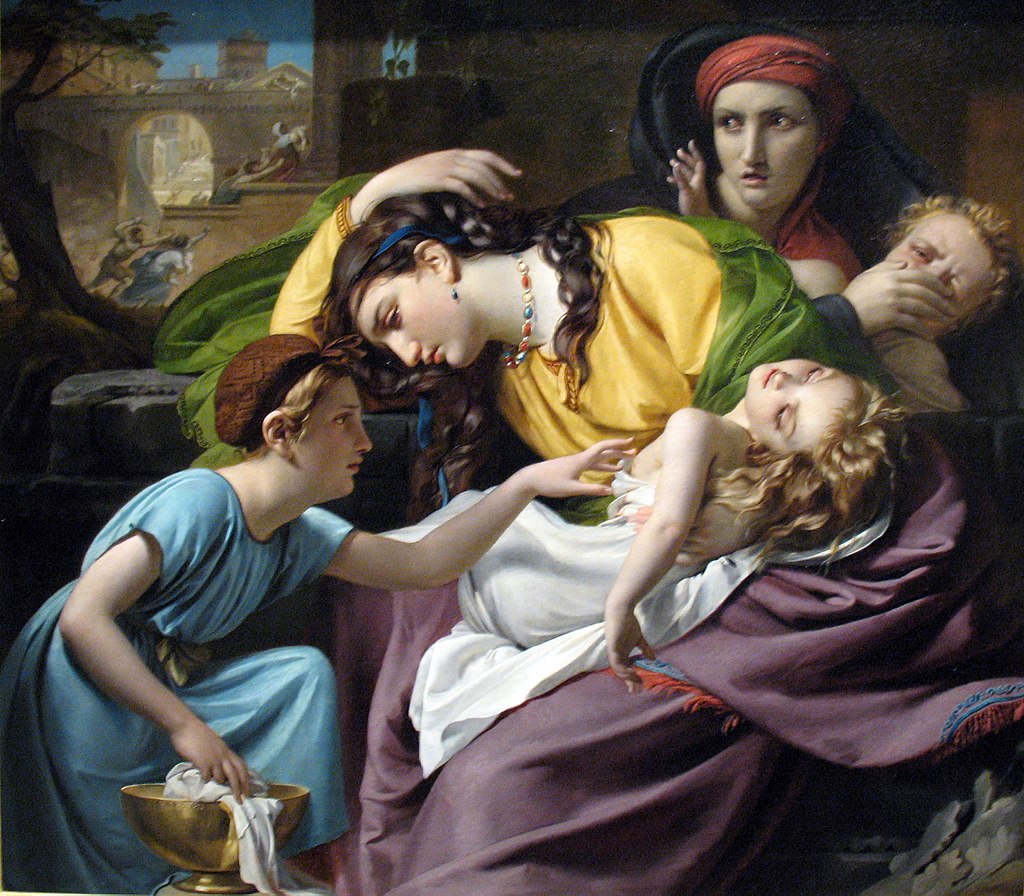
Francois-Joseph Naves, The Massacre of the Innocents (1824)

Knowing some of Herod the Great’s story may make the actions attributed to Herod in Matthew’s gospel understandable in his worldview and yet this story seems shocking to our modern ears. While the slaughter of the children of Bethlehem is not recorded in any sources external to Matthew, I do believe it is consistent with not only Herod but also the violent nature of the ancient world. Bethlehem was a small town and the number of children killed would have been smaller than an event like Columbine or Sandy Hook in our times, yet for the people of Bethlehem (and Columbine and Sandy Hook and others) these children would become one more example of the terror that violence can bring into families and communities without notice. As humans we attempt to make sense of these stories of violence and Matthew attempts to do this by linking this prophetically to the reign of terror in Egypt. Herod in this story is not a ‘King of the Jews’ but is instead a new Pharaoh whose policies bring death to those he is to shepherd.

I think we also need to remember that the world at the time of Jesus was a violent place and that there were no news reporters to carry the violence to the broader world. In recent times we saw ISIS beheading people as a terrorist act and are rightly horrified, but I think it is worth remembering that in Jesus’ time beheading was a noble way to die, especially in light of crucifixion and other practices. The ancient world was a violent world and the death of innocents rarely makes it into recorded history. Yet, within the gospels we do see a willingness to embrace the prophetic voice that was willing to challenge those in power and in many ways by his very being Jesus becomes a challenge to the Herods of the world.

Scripture speaks for a second time in this section by quoting Jeremiah 31: 15, and with this quotation the additional frame of the Babylonian exile is introduced into the narrative. Rachel crying for her children would be particularly poignant for Bethlehem because it is the site where Rachel is buried according to Genesis 35: 19-20:

So Rachel died, and she was buried on the way to Ephrath (that is, Bethlehem), and Jacob set up a pillar at her grave; it is the pillar of Rachel’s tomb which is there to this day.

Now this matriarch of the Jewish people which cried out at the at the loss of her children during the deportation to Babylon mourns with the mothers who have lost their children as a result of the actions of Herod. Now Herod who attempts to build his credentials as the King of Judea by building the temple is also framed as Nebuchadnezzar who is the destroyer of Jerusalem and the temple. Yet, within this particular choice in Jeremiah is the broader context of hope coming out of the destruction, Rachel’s weeping proceeds a prophesy of the end of the exile. As the next two verses of Jeremiah can state:

Thus says the LORD: Keep your voice from weeping, and your eyes from tears; for there is a reward for your work, says the LORD: they shall come back from the land of the enemy;  there is hope for your future, says the LORD: your children shall come back to their own country. Jeremiah 31: 16-17

The allusions and quotations of scripture in this chapter point to something larger that Matthew wants to communicate about who Jesus is and how he embodies Israel’s story. Matthew’s carefully constructed gospel wants us to understand through tapping into key portions of Israel’s story a bigger picture of who Jesus is and what he will mean for Israel and by extension for the rest of the world. As Richard B. Hays can describe Matthew as an interpreter of scripture:

Matthew is not merely looking for random Old Testament prooftexts that Jesus might somehow fulfill (as is sometimes suggested); rather, he is thinking about the specific shape of Israel’s story and linking Jesus’ life with key passages that promise God’s unbreakable redemptive love for his people. That is why Matthew’s comments on Herod’s slaughter of the children by selecting a citation from the same chapter in Jeremiah that also promises “a new covenant with the house of Israel and the house of Judah.” (Jer 31:31) (Hays, 2016, p. 116)

O. Wesley Allen highlighted that Matthew modifies his normal word pattern when introducing a direct quotation from scripture. Normally Matthew will say that something happens ‘so that’ (Greek hina) but instead Matthew simply says “then (Greek tote) was fulfilled what had been spoken through the prophet Jeremiah.” For those who are familiar with the recurring pattern in scriptures it shouldn’t be surprising that God’s action to set people free is met by violence by those invested in the current order. Yet, even though this violence may be a response to God’s initiative that does not make it God’s will. The slaughter of the innocents may be in Matthew’s view a fulfillment of scripture but unlike the other places where scripture is quoted it doesn’t link this to divine causality. (Allen, 2013, p. 32)

Herod the Great’s death makes the return of Jesus and his family to Israel possible. Herod’s death doesn’t remove his family from the scene and Herod Archelaus (simply called Archelaus here) is reigning in Judea. We aren’t given any clues why Herod Archelaus would be perceived as a threat and his brother Herod Antipas (ruling in Galilee) was not, perhaps it was merely a return to Bethlehem that would have caused questions by those in power. Joseph continues to be guided by the angel of the Lord appearing to him in dreams and this places the family in Nazareth for the beginning of the Jesus’ adult story. Perhaps to answer the perception we see in the gospel of John voiced by Nathanael, “Can anything good come out of Nazareth?” (John 1: 46) Matthew includes this what final attribution to the prophets that Jesus will be called a Nazorean. Matthew is referencing the tradition of Nazorites who were set aside for the Lord as holy (see Numbers 6, both Samson and Samuel were Nazorites).

Even though Matthew will reference multiple pieces of scripture and allude to two major stories of the Jewish people to frame this passage he is also communicating that in Jesus, God is doing a new thing. The original texts will have their meaning broadened and expanded upon. As Anna Case-Winters can state,

For Matthew, new meaning break forth from these texts as God is doing a new thing. Matthew reimagines these texts, if you will, to make a theological claim that God is at work in all these happenings and is bringing to fulfilment what was promised of old. (Case-Winters, 2015, p. 32)

Even though the Herods of the world may seem to be the ones who wield power in these texts, Matthew wants us to understand that God is at work in ways that may seem hidden, but which to a person familiar with the rhythms of scripture are familiar. God is speaking both through scripture, the angel of the Lord, through dreams and the stars in the heavens for those with eyes to see and ears to hear. The king of the Judeans may be acting as Pharaoh, but God has heard the cries of God’s people and even in this time to use Martin Luther’s words in a Mighty Fortress “this tyrant’s doomed to fail: God’s judgment must prevail! One little word shall triumph” (A Might Fortress is our God, verse 3 Fredrick H. Hedge translation)

Jeremiah 39: The City Falls

Jeremiah 39: 1-10 The Destruction of Jerusalem

James Tissot, The Flight of the Prisoners

James Tissot, The Flight of the Prisoners

In the ninth year of King Zedekiah of Judah, in the tenth month, King Nebuchadrezzar of Babylon and all his army came against Jerusalem and besieged it; 2 in the eleventh year of Zedekiah, in the fourth month, on the ninth day of the month, a breach was made in the city. 3 When Jerusalem was taken, all the officials of the king of Babylon came and sat in the middle gate: Nergal-sharezer, Samgar-nebo, Sarsechim the Rabsaris, Nergal-sharezer the Rabmag, with all the rest of the officials of the king of Babylon. 4 When King Zedekiah of Judah and all the soldiers saw them, they fled, going out of the city at night by way of the king’s garden through the gate between the two walls; and they went toward the Arabah. 5 But the army of the Chaldeans pursued them, and overtook Zedekiah in the plains of Jericho; and when they had taken him, they brought him up to King Nebuchadrezzar of Babylon, at Riblah, in the land of Hamath; and he passed sentence on him. 6 The king of Babylon slaughtered the sons of Zedekiah at Riblah before his eyes; also the king of Babylon slaughtered all the nobles of Judah. 7 He put out the eyes of Zedekiah, and bound him in fetters to take him to Babylon. 8 The Chaldeans burned the king’s house and the houses of the people, and broke down the walls of Jerusalem. 9 Then Nebuzaradan the captain of the guard exiled to Babylon the rest of the people who were left in the city, those who had deserted to him, and the people who remained. 10 Nebuzaradan the captain of the guard left in the land of Judah some of the poor people who owned nothing, and gave them vineyards and fields at the same time.

The city finally falls, the event which Jeremiah has foretold but also dreaded has finally occurred. Nebuchadrezzar’s army besieges the city of Jerusalem for a year and a half. The parallel telling of this event in 2 Kings 25 also relates, what we learned in the previous chapter of Jeremiah, that food had run out and that at the time the city wall is breached the people are beginning to starve. After a year and a half under siege this part of the narrative shows this final collapse happening with little resistance. The King Zedekiah and the remnants of the army and the officials flee by night, the officials of Babylon set up court in the gate of the city, and even in their fleeing we get the impression that Zedekiah and they are quickly overtaken as they attempt to flee across the Jordan river to Arabah. The punishment of the leaders is swift as the sons of the kin and the nobles of Judah, the leaders who had continued to push for resistance to Babylon, are killed when Nebuchdrezzar passes sentence in Hamath (Syria). Zedekiah is blinded and bound, most likely to be led back through the capitol of Babylon as a spoil of war to show how the might of Babylon has humiliated the Judeans who opposed them. In contrast to the first exile where the majority of the people are left in Judea, now this time Nebuzaradan, the captain of the guard, is charged with organizing a massive exile of those who survived the siege as well as those who fled and surrendered to Babylon. Only the poorest are left, these meek who inherit the earth, the pastures and the vineyards that were once owned by the powerful. Perhaps these are some of the slaves who were freed only to be brought immediately back into captivity (see Jeremiah 34), or those who suffered the loss of everything in the long costly war brought onto them by their leaders. Regardless, for the majority of the Judeans heading into exile it is a bitter pill to swallow. As Psalm 137 laments:

 By the rivers of Babylon—there we sat down and wept when we remembered Zion.
 On the willows there we hung up our harps
 For their our captors asked us for songs,
 And our tormentors asked for mirth, saying,
“Sing us one of the songs of Zion!”
How could we sing the LORD’s song in a foreign land?
If I forget you, O Jerusalem, let my right hand wither!
Let my tongue cling to the roof of my mouth, if I do not remember you,
If I do not set Jerusalem above my highest joy.
Remember, O LORD, against the Edomites the day of Jerusalem’s fall
How they said, “Tear it down! Tear it down! Down to the foundations!”
O daughter Babylon, you devastator!
Happy shall they be who pay you back what you have done to us!
Happy shall they be who take your little ones and dash them against the rock!
 (Psalm 137)

The promise of Jerusalem, the temple, the Davidic dynasty have all failed as the people are marched into a foreign land as exiles. They will have to begin to rediscover who they are as the people of God, and what it means to be the chosen people without the land, a temple or a king. But for this moment they are entering a season of lament and grief. We know from earlier in Jeremiah hope will rise again, but in the midst of the desolation of despair the people may only be able to sings songs of lament and utter prayers of vengeance.

Jeremiah 39: 11-18 Protecting Jeremiah and Ebed-melech

11 King Nebuchadrezzar of Babylon gave command concerning Jeremiah through Nebuzaradan, the captain of the guard, saying, 12 “Take him, look after him well and do him no harm, but deal with him as he may ask you.” 13 So Nebuzaradan the captain of the guard, Nebushazban the Rabsaris, Nergal-sharezer the Rabmag, and all the chief officers of the king of Babylon sent 14 and took Jeremiah from the court of the guard. They entrusted him to Gedaliah son of Ahikam son of Shaphan to be brought home. So he stayed with his own people.

15 The word of the LORD came to Jeremiah while he was confined in the court of the guard: 16 Go and say to Ebed-melech the Ethiopian: Thus says the LORD of hosts, the God of Israel: I am going to fulfill my words against this city for evil and not for good, and they shall be accomplished in your presence on that day. 17 But I will save you on that day, says the LORD, and you shall not be handed over to those whom you dread. 18 For I will surely save you, and you shall not fall by the sword; but you shall have your life as a prize of war, because you have trusted in me, says the LORD.

On the orders of King Nebuchadrezzar of Babylon, Jeremiah is sought out by the officials present in Jerusalem for protection. Jeremiah is freed from his confinement in the court of the guard and placed under the care of Gedaliah who is left in charge of the devastated city and land. Jeremiah is protected, and perhaps for many of his own people this only furthers their conviction that he is a traitor, yet he is sheltered and protected in the midst of the destruction and allowed to remain with the Judean people in the land. Although we only hear the promise of protection to Ebed-melech, the Ethiopian who pulled Jeremiah out of the cistern in Jeremiah 38, he also is promised his life and protection. In contrast to King Zedekiah who heard Jeremiah’s message several times and did not listen and is forced to watch his sons killed and led to Babylon in chains, now this servant of the king who is not a Judean and is a eunuch does hear and inherits his life, the same promise that Jeremiah made again to the king in Jeremiah 38.  This is not a story where Jeremiah or probably Ebed-melech live happily ever after, but in the midst of the death that surrounds them they live and they endure in the midst of the destruction of the nation and city around them.

Jeremiah 29: A Letter to the Exiles and the Recurring False Prophets

Letter to the Exiles

Psalm137-794316

Jeremiah 29
These are the words of the letter that the prophet Jeremiah sent from Jerusalem to the remaining elders among the exiles, and to the priests, the prophets, and all the people, whom Nebuchadnezzar had taken into exile from Jerusalem to Babylon. 2 This was after King Jeconiah, and the queen mother, the court officials, the leaders of Judah and Jerusalem, the artisans, and the smiths had departed from Jerusalem. 3 The letter was sent by the hand of Elasah son of Shaphan and Gemariah son of Hilkiah, whom King Zedekiah of Judah sent to Babylon to King Nebuchadnezzar of Babylon. It said: 4 Thus says the LORD of hosts, the God of Israel, to all the exiles whom I have sent into exile from Jerusalem to Babylon: 5 Build houses and live in them; plant gardens and eat what they produce. 6 Take wives and have sons and daughters; take wives for your sons, and give your daughters in marriage, that they may bear sons and daughters; multiply there, and do not decrease. 7 But seek the welfare of the city where I have sent you into exile, and pray to the LORD on its behalf, for in its welfare you will find your welfare.
8 For thus says the LORD of hosts, the God of Israel: Do not let the prophets and the diviners who are among you deceive you, and do not listen to the dreams that they dream, 9 for it is a lie that they are prophesying to you in my name; I did not send them, says the LORD.
10 For thus says the LORD: Only when Babylon’s seventy years are completed will I visit you, and I will fulfill to you my promise and bring you back to this place. 11 For surely I know the plans I have for you, says the LORD, plans for your welfare and not for harm, to give you a future with hope. 12 Then when you call upon me and come and pray to me, I will hear you. 13 When you search for me, you will find me; if you seek me with all your heart, 14 I will let you find me, says the LORD, and I will restore your fortunes and gather you from all the nations and all the places where I have driven you, says the LORD, and I will bring you back to the place from which I sent you into exile.
15 Because you have said, “The LORD has raised up prophets for us in Babylon,”– 16 Thus says the LORD concerning the king who sits on the throne of David, and concerning all the people who live in this city, your kinsfolk who did not go out with you into exile: 17 Thus says the LORD of hosts, I am going to let loose on them sword, famine, and pestilence, and I will make them like rotten figs that are so bad they cannot be eaten. 18 I will pursue them with the sword, with famine, and with pestilence, and will make them a horror to all the kingdoms of the earth, to be an object of cursing, and horror, and hissing, and a derision among all the nations where I have driven them, 19 because they did not heed my words, says the LORD, when I persistently sent to you my servants the prophets, but they would not listen, says the LORD. 20 But now, all you exiles whom I sent away from Jerusalem to Babylon, hear the word of the LORD:

The beginning of this chapter spends a long time situating when this letter is sent by royal courier to the people (predominantly the elites of Judean society) already in exile in Babylon after the first deportation in 597 BCE and the second invasion and massive deportation in 586 BCE. Here in the beginning of chapter 29 we can see some glimmers of hope for those already in Babylon. The Jewish people in Babylon now are charged with constructing their identity in the midst of exile, of getting on with their lives: planting gardens, building homes, getting married and having children for this will not be a short exile. They are to learn how to be the people of God as a minority culture in a very different culture. In their time they are to learn to embrace the exile as the place where God has placed them, that this is indeed from God and to oppose the exile is to oppose God. Also there is a hope in the long term for a restoration to their homeland, but the time is not near and certainly not now. For those already in exile Jeremiah writes a letter intending to bring comfort.
The Babylonian exile is a very productive time for the exiles, most scholars agree that this is when much of the Hebrew Bible reaches its final form. There are still books written after the exile, but being a conquered people in a foreign land caused the people to bring the traditions together to pass on their identity to their children and their children’s children. They became for the first time people of the book, rather than people of the land or oriented around the temple or the city of the Davidic dynasty. In particular these elites who are taken away in the first exile are the bearers of the hope for the future and, despite appearance to the contrary, are objects of God’s affection. Even in exile they are still the chosen people and they have a calling in the exile.
Even in exile they are to be a blessing to the nation they are exiled to. They have to learn how to be faithful to their identity as people of God, and that involves also seeking the well-being (shalom) of the city they are sent to. In contrast to the message they may be hearing from their own kin still in Jerusalem and Judah, they are bearers of God’s blessing. Those still in Judah and Jerusalem still have very dark days ahead, there is still more judgment before they can receive the consolation in the exile, but for those already in the exile they can begin the process of settling into their identity in the midst of the empire. Moving on with their lives in a new place, finding their new identity and holding fast to the covenant and promise that God intends for them.

More False Prophets

21 Thus says the LORD of hosts, the God of Israel, concerning Ahab son of Kolaiah and Zedekiah son of Maaseiah, who are prophesying a lie to you in my name: I am going to deliver them into the hand of King Nebuchadrezzar of Babylon, and he shall kill them before your eyes. 22 And on account of them this curse shall be used by all the exiles from Judah in Babylon: “The LORD make you like Zedekiah and Ahab, whom the king of Babylon roasted in the fire,” 23 because they have perpetrated outrage in Israel and have committed adultery with their neighbors’ wives, and have spoken in my name lying words that I did not command them; I am the one who knows and bears witness, says the LORD.
24 To Shemaiah of Nehelam you shall say: 25 Thus says the LORD of hosts, the God of Israel: In your own name you sent a letter to all the people who are in Jerusalem, and to the priest Zephaniah son of Maaseiah, and to all the priests, saying, 26 The LORD himself has made you priest instead of the priest Jehoiada, so that there may be officers in the house of the LORD to control any madman who plays the prophet, to put him in the stocks and the collar. 27 So now why have you not rebuked Jeremiah of Anathoth who plays the prophet for you? 28 For he has actually sent to us in Babylon, saying, “It will be a long time; build houses and live in them, and plant gardens and eat what they produce.”
29 The priest Zephaniah read this letter in the hearing of the prophet Jeremiah. 30 Then the word of the LORD came to Jeremiah: 31 Send to all the exiles, saying, Thus says the LORD concerning Shemaiah of Nehelam: Because Shemaiah has prophesied to you, though I did not send him, and has led you to trust in a lie, 32 therefore thus says the LORD: I am going to punish Shemaiah of Nehelam and his descendants; he shall not have anyone living among this people to see the good that I am going to do to my people, says the LORD, for he has spoken rebellion against the LORD.

Even in the midst of this time between the exile we continue to see false prophets who will continue to encourage a false version of hope. Ahab, Zedekiah, and Shemaiah are the latest examples mentioned. Ahab and Zedekiah are mentioned at the end of the letter that begins the chapter while Shemaiah is mentioned in a second letter included in the chapter. The accusations against Zedekiah and Ahab also include personal accusations of morality as well (committing adultery with their neighbors’ wives) and while we will never know about what actually happened to these false prophets spoken of only here their punishment is one of particular horror (being roasted on the fire). Shemaiah once again tries to get Jeremiah punished for speaking words that would have been considered treasonous by many of his contemporaries. Jeremiah we see again at least has some who listen to him or respect him. Zephaniah reads to Jeremiah the letter and Jeremiah is captured again by the word of the Lord and utters condemnation against Shemaiah. These false messengers continue to confuse the people and allow them to hear the words that are more palatable and trust in them even when they are not true. In our own context there are many times I could point to where pundits or politicians or even religious leaders have obscured or overstated ideas that fit their view of the way things were or told people what they wanted to hear. But for those who claim the role of prophets their words are to come from God even when the message God has is one nobody seems to want to hear.

Jeremiah 24-Exile, Figs and Reversals

Baskets-of-good-and-bad-figs,-Jeremiah-24,-tb092506048-bibleplaces

1 The LORD showed me two baskets of figs placed before the temple of the LORD. This was after King Nebuchadrezzar of Babylon had taken into exile from Jerusalem King Jeconiah son of Jehoiakim of Judah, together with the officials of Judah, the artisans, and the smiths, and had brought them to Babylon. 2 One basket had very good figs, like first-ripe figs, but the other basket had very bad figs, so bad that they could not be eaten. 3 And the LORD said to me, “What do you see, Jeremiah?” I said, “Figs, the good figs very good, and the bad figs very bad, so bad that they cannot be eaten.”
4 Then the word of the LORD came to me: 5 Thus says the LORD, the God of Israel: Like these good figs, so I will regard as good the exiles from Judah, whom I have sent away from this place to the land of the Chaldeans. 6 I will set my eyes upon them for good, and I will bring them back to this land. I will build them up, and not tear them down; I will plant them, and not pluck them up. 7 I will give them a heart to know that I am the LORD; and they shall be my people and I will be their God, for they shall return to me with their whole heart.
8 But thus says the LORD: Like the bad figs that are so bad they cannot be eaten, so will I treat King Zedekiah of Judah, his officials, the remnant of Jerusalem who remain in this land, and those who live in the land of Egypt. 9 I will make them a horror, an evil thing, to all the kingdoms of the earth– a disgrace, a byword, a taunt, and a curse in all the places where I shall drive them. 10 And I will send sword, famine, and pestilence upon them, until they are utterly destroyed from the land that I gave to them and their ancestors.

This vision takes place in the time between the initial exile of 598 BCE and the final massive deportation of 587 BCE. In 598 BCE, when the Babylonians come and deal with the people of Judea and the city of Jerusalem without the Judeans being able to effectively oppose them they take the elite of the land into exile leaving Zedekiah to reign in place of the removed Jeconiah. For the elite taken into exile it seems like the ending of everything they know, but they are the basket of good figs. This is the same exile spoken of, for example, in the beginning of the book of Daniel:

3 Then the king commanded his palace master Ashpenaz to bring some of the Israelites of the royal family and of the nobility, 4 young men without physical defect and handsome, versed in every branch of wisdom, endowed with knowledge and insight, and competent to serve in the king’s palace; they were to be taught the literature and language of the Chaldeans. (Dan 1:3-4)

With the officials, the artisans and the smiths taken into exile with King Jeconiah, what remains to surround the newly appointed Zedekiah are those who have risen to fill the void of power left by the removal of the elite. As Binyamin Lau describes it:

Whereas the exiled leaders had the capacity for leadership, their replacements come from the dregs of society, seizing the leadership vacuum as an opportunity to accumulate power. Violence and aggression prevail as paupers become princes overnight. Might makes right. King Zedekiah, young, weak, and bankrupt, cannot control the situation. (Lau, 2013, p. 131)

To those in exile there is now a word of hope. With their homes, wealth, position and status gone now God will act on their behalf to bring them back, to plant and to give them a new heart. Perhaps in the exile they will again find what it means to be the people of God. But for those still in Judah, the new officials of Zedekiah, the city of Jerusalem and the people of the land the nightmare is not over. Zedekiah will be led once again into conflict with Babylon and Babylon’s answer will be decisive. At this time where the people remaining in the land probably look upon those in exile as cursed and themselves as blessed, Jeremiah points to the opposite reality. Their horror still remains to come, they are not yet ready to receive a word of hope. Their course will still rely upon Egypt rather than the Lord. Just as the Assyrians became the instrument of judgment for the northern kingdom of Israel according to the prophets of that time, Babylon is the instrument of God’s judgment for Jeremiah. To oppose Babylon is to oppose God’s will at this time. The baskets of figs, good and bad point to a reality that defies the reality the people are experiencing at the time. The first harvest of the people out of the land become the first-ripe figs and in Jeremiah’s world of absolutes those left on the tree have spoiled and the time when they are swept away is quickly approaching.

Jeremiah 22: Justice, the King and Judgment

Justice and the Covenant

Gustav Dore, Jeremiah Preaching (1865)

Gustav Dore, Jeremiah Preaching (1865)

1 Thus says the LORD: Go down to the house of the king of Judah, and speak there this word, 2 and say: Hear the word of the LORD, O King of Judah sitting on the throne of David– you, and your servants, and your people who enter these gates. 3 Thus says the LORD: Act with justice and righteousness, and deliver from the hand of the oppressor anyone who has been robbed. And do no wrong or violence to the alien, the orphan, and the widow, or shed innocent blood in this place. 4 For if you will indeed obey this word, then through the gates of this house shall enter kings who sit on the throne of David, riding in chariots and on horses, they, and their servants, and their people. 5 But if you will not heed these words, I swear by myself, says the LORD, that this house shall become a desolation. 6 For thus says the LORD concerning the house of the king of Judah:
You are like Gilead to me, like the summit of Lebanon;
but I swear that I will make you a desert, an uninhabited city.
7 I will prepare destroyers against you, all with their weapons;
they shall cut down your choicest cedars and cast them into the fire.
8 And many nations will pass by this city, and all of them will say one to another, “Why has the LORD dealt in this way with that great city?” 9 And they will answer, “Because they abandoned the covenant of the LORD their God, and worshiped other gods and served them.”
10 Do not weep for him who is dead, nor bemoan him;
weep rather for him who goes away, for he shall return no more to see his native land.

Two conflicting views of reality are coming into conflict between the prophetic and the royal ideologies of the day. Jeremiah’s worldview comes out of the Mosaic and particular the Deuteronomic covenant where the covenant is conditional, if the people live into the vision that God has set before them they will be bless and if they do not they shall be cursed. For example the structure of Deuteronomy 28 illustrates this well:
If you will only obey the LORD your God, by diligently observing all his commandments that I am commanding you today, the LORD your God will set you high above all the nations of the earth; 2all the blessings shall come upon you and overtake you, if you obey your God:….
But if you will not obey the LORD your God by diligently observing all his commandments and decrees, which I am commanding you today, then all these curses shall come upon you and overtake you:
Deuteronomy 28: 1,2,15
And the prophetic voice interprets these obligations primarily not in terms of cultic actions but in terms of living in justice/righteousness (justice and righteousness are the same word families in both Hebrew and Greek). In contrast the royal ideology views God’s commitment as unconditional, so long as there is a Davidic king and a temple God will not forsake God’s people. The prophet Jeremiah tries again and again to call the people and the rulers back to the vision of justice and righteousness. They are charged again to not shed innocent blood, to care for the weakest of the society, the widows and orphans, and their success is conditional upon their living out of this justice. In contrast to the desire to accumulate more and more wealth among the elite as a way of securing their position, Jeremiah points to the practice of justice and righteousness as a condition for their security which ultimately comes from God. Numerous passages throughout the prophets echo this sentiment, perhaps one of the most well known being from Amos:
But let justice roll down like waters, and righteousness like an ever-flowing stream. Amos 5: 24

The King Of No Account

Vultures around a Dead Donkey

Vultures around a Dead Donkey

11 For thus says the LORD concerning Shallum son of King Josiah of Judah, who succeeded his father Josiah, and who went away from this place: He shall return here no more, 12 but in the place where they have carried him captive he shall die, and he shall never see this land again.
13 Woe to him who builds his house by unrighteousness, and his upper rooms by injustice;
who makes his neighbors work for nothing, and does not give them their wages;
14 who says, “I will build myself a spacious house with large upper rooms,”
and who cuts out windows for it, paneling it with cedar, and painting it with vermilion.
15 Are you a king because you compete in cedar?
Did not your father eat and drink and do justice and righteousness?
Then it was well with him.
16 He judged the cause of the poor and needy; then it was well.
Is not this to know me? says the LORD.
17 But your eyes and heart are only on your dishonest gain,
for shedding innocent blood, and for practicing oppression and violence.
18 Therefore thus says the LORD concerning King Jehoiakim son of Josiah of Judah: They shall not lament for him, saying, “Alas, my brother!” or “Alas, sister!” They shall not lament for him, saying, “Alas, lord!” or “Alas, his majesty!” 19 With the burial of a donkey he shall be buried– dragged off and thrown out beyond the gates of Jerusalem.
20 Go up to Lebanon, and cry out, and lift up your voice in Bashan;
cry out from Abarim, for all your lovers are crushed.
21 I spoke to you in your prosperity, but you said,
“I will not listen.” This has been your way from your youth,
for you have not obeyed my voice.
22 The wind shall shepherd all your shepherds,
and your lovers shall go into captivity;
then you will be ashamed and dismayed because of all your wickedness.
23 O inhabitant of Lebanon, nested among the cedars,
how you will groan when pangs come upon you, pain as of a woman in labor!
24 As I live, says the LORD, even if King Coniah son of Jehoiakim of Judah were the signet ring on my right hand, even from there I would tear you off 25 and give you into the hands of those who seek your life, into the hands of those of whom you are afraid, even into the hands of King Nebuchadrezzar of Babylon and into the hands of the Chaldeans. 26 I will hurl you and the mother who bore you into another country, where you were not born, and there you shall die. 27 But they shall not return to the land to which they long to return.
28 Is this man Coniah a despised broken pot, a vessel no one wants?
Why are he and his offspring hurled out and cast away in a land that they do not know?
29 O land, land, land, hear the word of the LORD!
30 Thus says the LORD: Record this man as childless,
a man who shall not succeed in his days;
for none of his offspring shall succeed in sitting on the throne of David,
and ruling again in Judah.

Much of the ire of the prophets is directed at the kings, and we need to remember that this is a time much different from our own. In an age where the vast majority of the population was illiterate and relied on the kings and the elites of the society to establish the systems of justice that the society operated within. As Brueggeman accurately states, “The conduct of the king is decisive for the weal or woe of the entire social system.” (Brueggemann, 1998, p. 194) and so here at the end of the Davidic monarchy, at the point where the elites are being taken into exile, including King Jehoiakim and his son Jeconiah (here referred to as Coniah) who is contrasted to his well respected father/grandfather Josiah. He is of no account, he will not have the honors he desires, instead of an honorable death Jeremiah declares he will have the death of a donkey—simply thrown beyond the gates. God is done with Jeconiah, ready to cast him off. In contrast to Josiah who rebuilt the temple, his son and grandson are accused with surrounding themselves with luxury far greater. This is not a new critique, it goes at least as far back as Solomon when the amount of resources placed into the temple is compared with the amount of time and resources that go into the construction of Solomon’s houses. Yet in contrast to Jeremiah’s words at the end of this chapter about his being recorded childless, when the people return to Jerusalem under the Persian empire it will be Zerubabbel, the grandson of Jeconiah will be leading the people home. The grandson of the one who if he was a signet ring on the LORD’s finger he would be cast off will experience the reversal of being the signet ring that is put back on after the exile is over.

On that day, says the LORD of hosts, I will take you, O Zerubbabel my servant, son of Shealtiel, says the LORD, and make you like a signet ring; for I have chosen you, says the LORD of hosts. Haggai 2: 24

And the harsh words of Jeremiah about the type of death Jehoiakim (or Jehoiachin) would receive seem also not to come to pass as the ending of 2 Kings points to:

27 In the thirty-seventh year of the exile of King Jehoiachin of Judah, in the twelfth month, on the twenty-seventh day of the month, King Evil-merodach of Babylon, in the year that he began to reign, released King Jehoiachin of Judah from prison; 28 he spoke kindly to him, and gave him a seat above the other seats of the kings who were with him in Babylon. 29 So Jehoiachin put aside his prison clothes. Every day of his life he dined regularly in the king’s presence. 30 For his allowance, a regular allowance was given him by the king, a portion every day, as long as he lived. 2 Kings 25: 27-30