Tag Archives: Babylonian Exile

Jeremiah 22: Justice, the King and Judgment

Justice and the Covenant

Gustav Dore, Jeremiah Preaching (1865)

Gustav Dore, Jeremiah Preaching (1865)

1 Thus says the LORD: Go down to the house of the king of Judah, and speak there this word, 2 and say: Hear the word of the LORD, O King of Judah sitting on the throne of David– you, and your servants, and your people who enter these gates. 3 Thus says the LORD: Act with justice and righteousness, and deliver from the hand of the oppressor anyone who has been robbed. And do no wrong or violence to the alien, the orphan, and the widow, or shed innocent blood in this place. 4 For if you will indeed obey this word, then through the gates of this house shall enter kings who sit on the throne of David, riding in chariots and on horses, they, and their servants, and their people. 5 But if you will not heed these words, I swear by myself, says the LORD, that this house shall become a desolation. 6 For thus says the LORD concerning the house of the king of Judah:
You are like Gilead to me, like the summit of Lebanon;
but I swear that I will make you a desert, an uninhabited city.
7 I will prepare destroyers against you, all with their weapons;
they shall cut down your choicest cedars and cast them into the fire.
8 And many nations will pass by this city, and all of them will say one to another, “Why has the LORD dealt in this way with that great city?” 9 And they will answer, “Because they abandoned the covenant of the LORD their God, and worshiped other gods and served them.”
10 Do not weep for him who is dead, nor bemoan him;
weep rather for him who goes away, for he shall return no more to see his native land.

Two conflicting views of reality are coming into conflict between the prophetic and the royal ideologies of the day. Jeremiah’s worldview comes out of the Mosaic and particular the Deuteronomic covenant where the covenant is conditional, if the people live into the vision that God has set before them they will be bless and if they do not they shall be cursed. For example the structure of Deuteronomy 28 illustrates this well:
If you will only obey the LORD your God, by diligently observing all his commandments that I am commanding you today, the LORD your God will set you high above all the nations of the earth; 2all the blessings shall come upon you and overtake you, if you obey your God:….
But if you will not obey the LORD your God by diligently observing all his commandments and decrees, which I am commanding you today, then all these curses shall come upon you and overtake you:
Deuteronomy 28: 1,2,15
And the prophetic voice interprets these obligations primarily not in terms of cultic actions but in terms of living in justice/righteousness (justice and righteousness are the same word families in both Hebrew and Greek). In contrast the royal ideology views God’s commitment as unconditional, so long as there is a Davidic king and a temple God will not forsake God’s people. The prophet Jeremiah tries again and again to call the people and the rulers back to the vision of justice and righteousness. They are charged again to not shed innocent blood, to care for the weakest of the society, the widows and orphans, and their success is conditional upon their living out of this justice. In contrast to the desire to accumulate more and more wealth among the elite as a way of securing their position, Jeremiah points to the practice of justice and righteousness as a condition for their security which ultimately comes from God. Numerous passages throughout the prophets echo this sentiment, perhaps one of the most well known being from Amos:
But let justice roll down like waters, and righteousness like an ever-flowing stream. Amos 5: 24

The King Of No Account

Vultures around a Dead Donkey

Vultures around a Dead Donkey

11 For thus says the LORD concerning Shallum son of King Josiah of Judah, who succeeded his father Josiah, and who went away from this place: He shall return here no more, 12 but in the place where they have carried him captive he shall die, and he shall never see this land again.
13 Woe to him who builds his house by unrighteousness, and his upper rooms by injustice;
who makes his neighbors work for nothing, and does not give them their wages;
14 who says, “I will build myself a spacious house with large upper rooms,”
and who cuts out windows for it, paneling it with cedar, and painting it with vermilion.
15 Are you a king because you compete in cedar?
Did not your father eat and drink and do justice and righteousness?
Then it was well with him.
16 He judged the cause of the poor and needy; then it was well.
Is not this to know me? says the LORD.
17 But your eyes and heart are only on your dishonest gain,
for shedding innocent blood, and for practicing oppression and violence.
18 Therefore thus says the LORD concerning King Jehoiakim son of Josiah of Judah: They shall not lament for him, saying, “Alas, my brother!” or “Alas, sister!” They shall not lament for him, saying, “Alas, lord!” or “Alas, his majesty!” 19 With the burial of a donkey he shall be buried– dragged off and thrown out beyond the gates of Jerusalem.
20 Go up to Lebanon, and cry out, and lift up your voice in Bashan;
cry out from Abarim, for all your lovers are crushed.
21 I spoke to you in your prosperity, but you said,
“I will not listen.” This has been your way from your youth,
for you have not obeyed my voice.
22 The wind shall shepherd all your shepherds,
and your lovers shall go into captivity;
then you will be ashamed and dismayed because of all your wickedness.
23 O inhabitant of Lebanon, nested among the cedars,
how you will groan when pangs come upon you, pain as of a woman in labor!
24 As I live, says the LORD, even if King Coniah son of Jehoiakim of Judah were the signet ring on my right hand, even from there I would tear you off 25 and give you into the hands of those who seek your life, into the hands of those of whom you are afraid, even into the hands of King Nebuchadrezzar of Babylon and into the hands of the Chaldeans. 26 I will hurl you and the mother who bore you into another country, where you were not born, and there you shall die. 27 But they shall not return to the land to which they long to return.
28 Is this man Coniah a despised broken pot, a vessel no one wants?
Why are he and his offspring hurled out and cast away in a land that they do not know?
29 O land, land, land, hear the word of the LORD!
30 Thus says the LORD: Record this man as childless,
a man who shall not succeed in his days;
for none of his offspring shall succeed in sitting on the throne of David,
and ruling again in Judah.

Much of the ire of the prophets is directed at the kings, and we need to remember that this is a time much different from our own. In an age where the vast majority of the population was illiterate and relied on the kings and the elites of the society to establish the systems of justice that the society operated within. As Brueggeman accurately states, “The conduct of the king is decisive for the weal or woe of the entire social system.” (Brueggemann, 1998, p. 194) and so here at the end of the Davidic monarchy, at the point where the elites are being taken into exile, including King Jehoiakim and his son Jeconiah (here referred to as Coniah) who is contrasted to his well respected father/grandfather Josiah. He is of no account, he will not have the honors he desires, instead of an honorable death Jeremiah declares he will have the death of a donkey—simply thrown beyond the gates. God is done with Jeconiah, ready to cast him off. In contrast to Josiah who rebuilt the temple, his son and grandson are accused with surrounding themselves with luxury far greater. This is not a new critique, it goes at least as far back as Solomon when the amount of resources placed into the temple is compared with the amount of time and resources that go into the construction of Solomon’s houses. Yet in contrast to Jeremiah’s words at the end of this chapter about his being recorded childless, when the people return to Jerusalem under the Persian empire it will be Zerubabbel, the grandson of Jeconiah will be leading the people home. The grandson of the one who if he was a signet ring on the LORD’s finger he would be cast off will experience the reversal of being the signet ring that is put back on after the exile is over.

On that day, says the LORD of hosts, I will take you, O Zerubbabel my servant, son of Shealtiel, says the LORD, and make you like a signet ring; for I have chosen you, says the LORD of hosts. Haggai 2: 24

And the harsh words of Jeremiah about the type of death Jehoiakim (or Jehoiachin) would receive seem also not to come to pass as the ending of 2 Kings points to:

27 In the thirty-seventh year of the exile of King Jehoiachin of Judah, in the twelfth month, on the twenty-seventh day of the month, King Evil-merodach of Babylon, in the year that he began to reign, released King Jehoiachin of Judah from prison; 28 he spoke kindly to him, and gave him a seat above the other seats of the kings who were with him in Babylon. 29 So Jehoiachin put aside his prison clothes. Every day of his life he dined regularly in the king’s presence. 30 For his allowance, a regular allowance was given him by the king, a portion every day, as long as he lived. 2 Kings 25: 27-30


Jeremiah 21: The Kingdom Laid Low

stump_by_abstractmatter-d5c3key

Jeremiah 21

This is the word that came to Jeremiah from the LORD, when King Zedekiah sent to him Pashhur son of Malchiah and the priest Zephaniah son of Maaseiah, saying, 2 “Please inquire of the LORD on our behalf, for King Nebuchadrezzar of Babylon is making war against us; perhaps the LORD will perform a wonderful deed for us, as he has often done, and will make him withdraw from us.”

 3 Then Jeremiah said to them: 4 Thus you shall say to Zedekiah: Thus says the LORD, the God of Israel: I am going to turn back the weapons of war that are in your hands and with which you are fighting against the king of Babylon and against the Chaldeans who are besieging you outside the walls; and I will bring them together into the center of this city. 5 I myself will fight against you with outstretched hand and mighty arm, in anger, in fury, and in great wrath. 6 And I will strike down the inhabitants of this city, both human beings and animals; they shall die of a great pestilence.

 7 Afterward, says the LORD, I will give King Zedekiah of Judah, and his servants, and the people in this city– those who survive the pestilence, sword, and famine– into the hands of King Nebuchadrezzar of Babylon, into the hands of their enemies, into the hands of those who seek their lives. He shall strike them down with the edge of the sword; he shall not pity them, or spare them, or have compassion.

 8 And to this people you shall say: Thus says the LORD: See, I am setting before you the way of life and the way of death. 9 Those who stay in this city shall die by the sword, by famine, and by pestilence; but those who go out and surrender to the Chaldeans who are besieging you shall live and shall have their lives as a prize of war. 10 For I have set my face against this city for evil and not for good, says the LORD: it shall be given into the hands of the king of Babylon, and he shall burn it with fire.

                11 To the house of the king of Judah say: Hear the word of the LORD, 12 O house of David! Thus says the LORD:

Execute justice in the morning,

and deliver from the hand of the oppressor

anyone who has been robbed,

or else my wrath will go forth like fire,

and burn, with no one to quench it,

because of your evil doings.

                13 See, I am against you, O inhabitant of the valley,

                O rock of the plain, says the LORD;

you who say, “Who can come down against us,

or who can enter our places of refuge?”

14 I will punish you according to the fruit of your doings, says the LORD;

I will kindle a fire in its forest, and it shall devour all that is around it.

A little context helps to make sense of this passage. So many times people had not wanted to hear Jeremiah’s words but now the king sends Passhur, a different Passhur from the previous chapter, and Zephaniah to seek the prophet’s words. King Zedekiah was appointed in the time between the two exiles as a puppet king of the Nebuchadrezzar, a child of Josiah was left to rule over a bankrupt kingdom with most of its leaders taken into exile into Babylon after the first time the Babylonians conquered the city, and as Rabbi Lau paints the picture

Whereas the exiled leaders had the capacity for leadership, their replacements come from the dregs of society, seizing the leadership vacuum as an opportunity to accumulate power. Violence and aggression prevails as paupers become princes overnight. (Lau, 2013, p. 131)

In the nine years between 597 and 586 BCE the majority of the people of the land remain in Judea, but there are many who long for Judea’s former status as an independent nation. In 594 BCE there is a regional summit of the nations in the region in which the leadership sets a pro-Egypt and anti-Babylonian policy. When Judea begins to delay making its payments of dues to the Babylonian empire they are slow to respond, trying to resolve things diplomatically, but by 588 BCE it is clear to the Babylonians that more drastic measures are called for and they launch a punitive campaign against Judah. Every hope seems dashed, the support they desired from Egypt has not been delivered, the Babylonians are rolling over the fortified cities to the north of Jerusalem and nothing seems to be stopping their advance, so Zedekiah sends to Jeremiah in a last gasp of hope.

This is the time immediately before the final exile in 586 BCE the king and his entourage see the writing on the wall and hope for a rewrite, but God is not giving them the answer they seek. There is no undoing the bad decisions of the past, the ways they have trusted in their own strength or their alliances with other nations and not in God and no eleventh hour return is going to stay the consequences of their actions at this point. Even beyond surrendering the people to the consequences of their own actions, God is against the people at this point. The only way out the prophet gives is surrender, to abandon the city and beg for the mercy of the Babylonians. There is a way to life, but it leads through the death of all that is known before. The last sprout of the Davidic line of kings is about to be chopped down, the city left as a waste and the people of the land will soon be landless. They are entering the time of broken dreams and hopes were all that is to be seen in the immediate future is desolation and despair. This is not the end of the story, but it is the hell that the people and the prophet will endure in their immediate future and their only hope is that, as in ages past, their God will look down and see their oppression in a foreign land and bring them out once again with a mighty hand.

purple rose 01 by picsofflowers.blogspot.com

Jeremiah 16: A Vision of Resurrection, But Only Through Death

Jeremiah Lamenting the Destruction of Jerusalem by Rembrandt van Rijn 1630

Jeremiah Lamenting the Destruction of Jerusalem by Rembrandt van Rijn 1630

The word of the LORD came to me: 2 You shall not take a wife, nor shall you have sons or daughters in this place. 3 For thus says the LORD concerning the sons and daughters who are born in this place, and concerning the mothers who bear them and the fathers who beget them in this land: 4 They shall die of deadly diseases. They shall not be lamented, nor shall they be buried; they shall become like dung on the surface of the ground. They shall perish by the sword and by famine, and their dead bodies shall become food for the birds of the air and for the wild animals of the earth.
5 For thus says the LORD: Do not enter the house of mourning, or go to lament, or bemoan them; for I have taken away my peace from this people, says the LORD, my steadfast love and mercy. 6 Both great and small shall die in this land; they shall not be buried, and no one shall lament for them; there shall be no gashing, no shaving of the head for them. 7 No one shall break bread for the mourner, to offer comfort for the dead; nor shall anyone give them the cup of consolation to drink for their fathers or their mothers. 8 You shall not go into the house of feasting to sit with them, to eat and drink. 9 For thus says the LORD of hosts, the God of Israel: I am going to banish from this place, in your days and before your eyes, the voice of mirth and the voice of gladness, the voice of the bridegroom and the voice of the bride.
10 And when you tell this people all these words, and they say to you, “Why has the LORD pronounced all this great evil against us? What is our iniquity? What is the sin that we have committed against the LORD our God?” 11 then you shall say to them: It is because your ancestors have forsaken me, says the LORD, and have gone after other gods and have served and worshiped them, and have forsaken me and have not kept my law; 12 and because you have behaved worse than your ancestors, for here you are, every one of you, following your stubborn evil will, refusing to listen to me. 13 Therefore I will hurl you out of this land into a land that neither you nor your ancestors have known, and there you shall serve other gods day and night, for I will show you no favor.
14 Therefore, the days are surely coming, says the LORD, when it shall no longer be said, “As the LORD lives who brought the people of Israel up out of the land of Egypt,” 15 but “As the LORD lives who brought the people of Israel up out of the land of the north and out of all the lands where he had driven them.” For I will bring them back to their own land that I gave to their ancestors.
16 I am now sending for many fishermen, says the LORD, and they shall catch them; and afterward I will send for many hunters, and they shall hunt them from every mountain and every hill, and out of the clefts of the rocks. 17 For my eyes are on all their ways; they are not hidden from my presence, nor is their iniquity concealed from my sight. 18 And I will doubly repay their iniquity and their sin, because they have polluted my land with the carcasses of their detestable idols, and have filled my inheritance with their abominations.
19 O LORD, my strength and my stronghold,
my refuge in the day of trouble,
to you shall the nations come from the ends of the earth and say:
Our ancestors have inherited nothing but lies, worthless things in which there is no profit.
20 Can mortals make for themselves gods? Such are no gods!
21 “Therefore I am surely going to teach them, this time I am going to teach them my power and my might, and they shall know that my name is the LORD.”
This is a really harsh passage, and there have been a number of these harsh passages in the book and in the life of Jeremiah. Here Jeremiah is commanded not to share in the joy of others in the community, not to have the joy of a wife or family, but to live in preparation for the coming destruction. He is a contrast to the people around him, and his life of sorrow is a message to the surrounding world in the midst of its feasting and celebration. It is a hard life as a prophet, a life that no one would choose on their own if they knew what it would entail. Jeremiah will suffer, and perhaps not having a family prevents the deeper suffering of seeing the ones you love wounded by the convictions you are called to live out of, yet this is a call to a very lonely life and profession. Yet, he is the bearer of a message of the death of not only an age, but of people: of families and friends, of a way of life, of the world as it is known. It is a death so profound that it overwhelms the past stories that made the people who they are and strips away all the things that held the community together.
It is a time of death, but in the middle of this chapter we also see the glimmer of a resurrection. For the new covenant between God and God’s people to come to light the current relationship has to die. For something truly new to be born something old is having to give way. The people who have trusted in Kings, in land, in the Temple and the temple cult are about to have all these things stripped away and as exiles in a foreign land only then will they refind who they are. The promised new identity will be so strong that no longer will they point to the Exodus as their defining story but rather the regathering of the people after the Babylonian Exile as God brings them home from all the places they have been.
Yet the passage closes again with the death and with the fishers and hunters who are seeking out the people. Much as the narratives at the end of the synoptic gospels (Matthew, Mark and Luke) sometimes called the Olivet Discourses point to a similar seeking:
Then two will be in the field; one will be taken and the one will be left. Two women will be grinding meal together; one will be taken and one will be left. (Matthew 24: 40f)
And I think Jesus is also pointing towards the coming destruction of the city and temple that will come in the Jewish War around 70 CE. Yet Jeremiah continues to wrestle with God and enters once more into the language of lament in 19-20 hoping and praying for a merciful turn, yet perhaps God sees that it is only through death that a resurrection will be possible, only through exile that the people can return to their new home, and only through the loss of the old relationship that a new relationship can be born, and only through the loss of these idols (or things that the people have placed their trust in) that they can once again see the living God. As Isaiah states:
A shoot shall come out of the stump of Jesse, and a branch shall grow out of its roots. (Isaiah 11:1)
Without making the too quick jump to Christ, that many Christians naturally make with this passage, let us also consider that for Jeremiah and Isaiah who would see the house of Jesse, the line of David kings cut off and reduced to a stump, that it would take the death of this line before the people could see new life. There is no avoiding the harshness and the pain of this passage, but without the hope of new life, resurrection or the shoot that comes out of the stump; without the hope of the return from the exile that will outshine the remembrance of the journey to the promised land from Egypt-without these things the journey into the loneliness and brokenness that Jeremiah and the people will encounter is senseless hell. It only is bearable in the hope that God will once again create life out of death.

purple rose 01 by picsofflowers.blogspot.com

Review of Jeremiah: The Fate of A Prophet by Binyamin Lau

Jeremiah the Fate fo a Prophet

JEREMIAH: THE FATE OF A PROPHET, by Binyamin Lau. Translated by Sara Daniel. Jerusalem: Maggid Books, 2013. Pp.230.  $24.95 (hardcover)

The book of Jeremiah is one of the most challenging to approach in all of scriptures due to its enigmatic arrangement, wide historical context and challenging material. Rabbi Dr. Binyamin Lau does an incredible service in taking the book of Jeremiah and rearranging the chapters into sections that parallel the prophet’s life and placing the prophet’s words in the surrounding historical context. Set within this broader context we see the struggle of the prophet as he moves from soaring hope for the reunification of Israel and Judah through the disillusionment with the nationalistic struggles of Judah and eventually into the despair of the Babylonian exile. Rather than producing a commentary which deals with each chapter of Jeremiah, Rabbi Lau produces a narrative using: the text of Jeremiah, the recorded memory of the events in 2 Kings and 2 Chronicles in conversation with other historical sources and other prophets active at various points in Jeremiahs long career as well as the Rabbinic tradition of interpretation. The end result is a coherent and tragic narrative of a disparaged and disgraced prophet who tried desperately to eliminate the social injustices and corruption of his people and to save the Temple from its impending doom.

The introduction of the work argues that the modern context the prophet might be understood as the public intellectual who must summon all of their intellectual powers and persuasive skills to convince their audience of the truth of their words. Lau argues that prophecy does not depend upon being accepted and among the prophets only Jonah was able to fulfill his mission by convincing the people of Nineveh to see the error of their ways (xiv-xv). Yet the prophet must love the people enough to pay the personal price for their visions, and even be willing to be declared an enemy of the people. Jeremiah’s prophetic ministry, as the narrative will tell, will come at a high personal cost.

The book is divided between the three primary kings that Jeremiah’s prophetic ministry took place under: Josiah, Jehoiakim, Zedekiah. Part I begins by setting the stage with the story leading up to the time of Josiah by dealing with his predecessors. Briefly touching on the conflict between Samaria and Judah, in the context of the Assyrian domination of the Trans-Euphrates region, we see a picture of a divided people where savage wars between the nations of Judah and Israel overshadow the blood ties that once united them. (3) During the miraculous salvation of Jerusalem, in the time of Isaiah the prophet and the reign of King Hezekiah, we see the entry of Babylonia into the Judean world with Merodoch-Baladan’s delegation to Hezekiah. When Hezekiah’s son, Manasseh, ascended to the throne in 697 BCE he attempted to put the nation of Judah back on its feet but could not resist the lure of Assyrian culture and began to forfeit the cultural and religious heritage of Judah. It is within this context, after a brief reign by Amon, that Josiah becomes king in 640 BCE and the story of Jeremiah’s prophetic career begins.

Jeremiah’s prophetic calling occurs in the thirteenth year of Josiah’s reign, or 626 BCE, which is a time of great change in the region. This is the time when King Josiah has begun to cleanse and purify Jerusalem from Assyrian culture and worship. The young king is also sending envoys to Samaria to attempt to reunite the kingdoms of Judah and Israel. This grand dream of King Josiah to bring the people of Judah and Israel back to being one kingdom and worshipping the Lord only can be understood within the horizon of the crumbling of the Assyrian empire which is waging a war of attrition on its northern border. (10) Jeremiah’s ministry begins prophesying the unification of Israel and Judah, appealing to their shared ancestor Jacob. Jeremiah is captured by this vision and is convinced that God’s promise to rebuild after the destruction will soon be realized. Yet, as Jeremiah begins to yearn for this change he recognizes a discrepancy between the king’s attempted reforms and the other local leadership who still continue to represent the sinful generation of Manessah, yet Jeremiah believes that God is about to get rid of these shepherds and gather the scattered flock from Samaria. Jeremiah’s most optimistic words go out to the cities of Samaria, but in Judah and particularly in his own homeland of Benjamin Jeremiah witnesses a people “engrossed in their own land and wealth, wrapped up in everyday life, and awash in paganism.” (33) Throughout the remainder of the reign of Josiah and his attempts to reform Judah, Jeremiah will become increasingly distraught over the superficiality of these reforms among the leaders, priests and the people. “Jeremiah sees behind this façade and recognizes the falsity and the hypocrisy, the thin veneer of piety serving as a fig leaf for corruption and warped social values.”(49) When King Josiah dies in 609 BCE, while going out to confront Pharaoh Necho, Jeremiah’s observation of the shallowness of the reforms of Josiah bear their unfortunate fruit as the new king sets the nation on a very different course.

Part II deals with the reign of Johoiakim (609-598 BCE) and his pro-Egyptian regime. This is a time where Egypt experiences a renewal of power and influence. Egypt lays a heavy tariff on Judah, which Johoiakim passes onto the people of the land. “Jehoiakim strikes a winning combination: economic reliance on Egypt, spiritual and national reliance on the Temple, and a general atmosphere of compliance with the leader. What can go wrong?”(78) Jeremiah’s prophecy rails against all three of these items stating that reliance on Egypt will lead the king and his followers to their demise, that the temple is like the tabernacle at Shiloh that was destroyed by God after it was corrupted by the high priest’s sons, and the king and his loyalists will fall into the hands of Babylonia. Jeremiah finds himself struggling against the leaders of his nation, the priests and other prophets and is viewed as a traitor to the very people he is attempting to save from their coming doom. Jeremiah finds himself caught between the message of impending doom he feels compelled to pronounce and the persecution this pronouncement brings. The nation’s ability to rely on Egypt falters in 605 when Nebuchadnezzar begins his conquest, and Judah becomes subservient for three years, but in 601 when Egypt enjoys a brief resurgence Judah again sides with Egypt and rebels against Babylon. Jeremiah is able to see Babylon as the instrument of the Lord’s judgment and yet he still holds a single thread of hope that the people will repent and the terrible coming destruction of the Babylonians will be averted. Yet, in 597 Nebuchadnezzar in a brief campaign recaptures the rebellious cities of Judah the reign of Jehoiakim and the three month reign of his successor Jeconiah come to an end and the time between the two exiles begins under the Zedekiah, who was Josiah’s youngest son, after he swore loyalty to Babylon.

Binyamin Lau continues to masterfully tell the story of Jeremiah and the people of Judah in the time leading up to the destruction of Jerusalem and the final deportation of the Judean people as a punishment for breaching of their treaty with Babylon. King Zedekiah finds himself surrounded by those who have seized power in the leadership vacuum left by the Babylonians taking most of the previous leaders into exile in 597 BCE. When Babylon returns to the north in 594, Judah finds itself with the other nations in the area becoming a part of an Egypt led alliance. To the consternation of many of the leaders in the land as well as many other prophets, in particular Hananiah, Jeremiah continues to proclaim that the nation is to serve the King of Babylon and live and he passionately pleads for the city to turn from its course and avoid the destruction that is coming. Yet again the prophet’s words will fall on deaf ears. Even though King Zedekiah has some sympathy for Jeremiah and his prophesy the king finds himself powerless in the face of those who are leading the nation on a path of confrontation once again with Babylon. Even after Jeremiah’s words come true with the destruction of Jerusalem and the temple in 586 BCE, the people still refuse to pay attention to the prophet who for decades has tried to save the city and temple from this fate.

Jeremiah’s story is one of bitter disappointment. Throughout the story and prophecy of Jeremiah, Rabbi Lau is able to illuminate parallels in modern day Jerusalem. “The streets of Jerusalem still throng with false prophets who earnestly claim, ‘the tradition of our forefathers is in our hands; the Third Temple shall not be destroyed!’ Once again they seek to lull us into a sense of false security, to make us forget the grave responsibility we shoulder: to be worthy of this national home, the Jewish state.”(225) It is also very easy to make connections between the political and religious movements in modern day Israel and similar political and religious rhetoric in the United States. This is an insightful journey into the world of the prophet and illuminating in approaching not only Jeremiah but the world of the Hebrew Scriptures.

purple rose 01 by picsofflowers.blogspot.com

The Place of Authority: A Brief History Part 3b: The Exile, Reconstructing Identity-Narrative, Practice and Hope

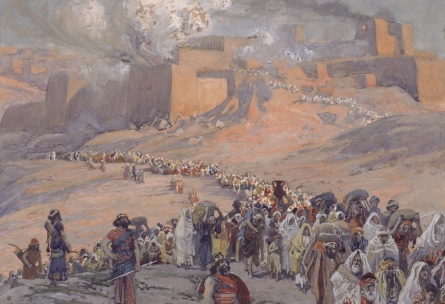
James Tissot, The Flight of the Prisoners

Thus says the Lord of hosts, the God of Israel, to all the exiles whom I have sent into exile from Jerusalem to Babylon: Build houses and live in them; plant gardens and eat what they produce. Take wives and have sons and daughters; take wives for your sons, and give your daughters in marriage that they bear sons and daughters; multiply there, and do not decrease.  But seek the welfares of the city where I have sent you into exile, and pray to the Lord on its behalf, for in its welfare you will find your welfare. Jeremiah 29. 4-7 NRSV

Even when the world as you know it ends, life still goes on, and we have to make sense of the conflict, the struggle and our place within it.  The communal memory becomes important, the stories parents have told their children, the history of families. In the midst of competing narratives what is the story that one can identify with? With the loss of the Davidic monarchy, the temple, the land of their ancestors the people did something amazing, they recast their identity.  They dug deep into their narrative, they began bringing together their stories, and in fact much of the Old Testament is brought together at this point. Stories of creation and exodus begin to be the patterns in which the present is made sensible and the community begins to come up with answers to the hardest question, “why did this happen?” They don’t come up with just one answer, they come up with many. They bring together their stories and the Torah (typically translated into English as law, but it is a term that is much more than what we understand as law in our context) begins to be center of their life.  Practice and story come together to bind together this community in exile.

This does not mean that everyone agrees, there is not a central authorizing authority for the narrative at this point, it is constructed mainly by the remnant of the elite (everyone else would have been illiterate at this point) from both the priestly and prophetic side. Some of the central ideas to emerge include:

Justice: a sense of living in harmony (shalom) with God’s desire for the way things are to be structured in society. This includes a strong sense of economic justice, compassion for the widows, orphan, immigrant, and the dispossessed. It is from this vision that many prophets operate out of, and this is a central image for the prophetic hope. The new Jerusalem, the new Israel is to be a place of justice where the nations around can look and say “Come, let us go up to the mountain of the Lord, to the house of Jacob; that he may teach us his ways and that we may walk in his paths” (Isaiah 3b, NRSV) and within God’s plan the nations will stream to Jerusalem.

Purity/Holiness: For us there is often a tension between Purity/Holiness and Justice, but it was not necessarily seen that way by the Jewish people.  Especially for priests there are practices that are to be done to prevent the contamination of unholiness from infecting them as a people and making them repulsive to the holiness of God. It also becomes a powerful way of distinguishing between themselves as a Hebrew people and the nations around them who are the Gentiles, the unclean ones.  This tends to be more of a priestly focus and there are conflicts between which will dominate going forward, but at the root both justice and holiness are practices which distinguish them from the hostile surrounding culture.

With these two distinctive directions emerges a new strand of a hope for a new beginning, a new temple, a New Jerusalem, a new anointed (and Davidic) king, a messiah.  Wrapped up within the memory of the stories of creation and the exodus of the people from Egypt hope springs forth of a return home and a new beginning:

Do not remember the former things, or consider the things of old. I am about to do a new thing: now it springs forth, do you not perceive it? I will make away in the wilderness and rivers in the desert. The wild animals will honor me, the jackals and the ostriches; for I give water in the wilderness, rivers in the desert, to give drink to my chosen people, the people who I formed for myself so that they might declare my praise. Isaiah 43.18-21

2nd Isaiah (Isaiah 40-55, which reflects the time of preparation for the return home, while Isaiah 1-39 deals with the time before the exile) in particular is full of this vibrant hope, along with other voices.  Empires rise and empires fall, and a generation later Babylon falls to Persia (modern day Iran) and Cyrus (who Isaiah interestingly calls Messiah/Christ-same word in Hebrew/Greek) makes possible the beginning of a return home.  Their stories and practices have maintained their identity and given them hope of a new beginning. With the return to Jerusalem, the land, and the possibility of reconstructing the temple comes yet another transition.  It is to that transition that we turn next.

purple rose 01 by picsofflowers.blogspot.com

The Place of Authority: A Brief History Part 3a: The Exile, the Crisis of Collapse

James Tissot, The Flight of the Prisoners

By the rivers of Babylon—there we sat down and there we wept when we remembered Zion. In the willows there we hung up our harps.For there our captors asked us for songs, and our tormentors asked for mirth, saying,

“Sing us one of the songs of Zion!”

How could we sing the Lord’s song in a foreign land? If I forget you, O Jerusalem, let my right hand wither! Let my tongue cling to the roof of my mouth, if I do not remember you,if I do not set Jerusalem above my highest joy. 

Remember, O Lord, against the Edomites the day of Jerusalem’s fall, how they said,

 “Tear it down! Tear it down! Down to its foundations!”

O daughter of Babylon, you devastator! Happy shall they be who pay you back what you have done to us! Happy shall they be who take your little ones and dash them against the rock!   Psalm 137 NRSV

In 721 BCE, after roughly 200 years of separation from the Southern Kingdom of Judah, the Northern Kingdom Israel falls to the Assyrian Empire (which has its origins in the Northwestern Part of modern day Iraq) and the Northern Kingdom is effectively absorbed into the Assyrian nation.  Somehow Judah holds on, even though it becomes completely surrounded by the Assyrian Empire.  Empires come and go, and power shifts to the Babylonian Empire (which has its origins in modern day Southern Iraq) without going into the bloody details: Jerusalem falls, the temple is destroyed, the Davidic monarchy effectively ends and the people of Judah are taken into exile or captivity in Babylon.  The loss of king and temple, as well as the land cause a crisis of authority which leads to one of the most constructive and important periods in Judaism.

The loss of home is catastrophic, it leads to a ton of questions about the future and there may not be any good answers at that point.  The closest cinematic example I could come up with was the loss of Anatevka in Fiddler on the Roof where families try to make the best of their coming exile, belittling what they are leaving behind-and yet families are broken apart, scattered across the world, many will never see each other again.

Something as catastrophic to not only the physical well-being but also to the communal consciousness can lead to several outcomes, many of which do emerge in this time. One response of the conquered is to assimilate with the conqueror, to align oneself with the victor, to adopt their values and practices and to set aside at least a portion of one’s previous identity to become a part of something different.  This is the perceived response of the Northern Kingdom by the Southern Kingdom-they stay on their land, intermarry with the Assyrians, and what emerges will be a hybrid people-no longer really Jewish, already separated from the Davidic monarchy and the temple hundreds of years before they become the other…the Samaritan (yes this is where those Samaritans that Jesus runs into in the New Testament come from).  But to be fair, a large number of the Judeans also assimilate into Babylon, only a small portion of the Judean people will return to their homeland at the end of the exile, most will remain dispersed throughout the nations.

In the lead up to the exile, the prophetic voice becomes very harsh in its critique of the monarchy, temple, the lack of economic justice within the nation, and the perceived idolatry of the shepherds of the nation.  This is the time where the first parts of Isaiah, much of Jeremiah and Ezekiel and many of the Minor Prophets become active in the memory of the people. The prophetic voice leads the way pointing to the ways in which kings and priests, throne and temple have not only failed as sources of authority but are at the very heart of the crisis viewed as a judgment from the LORD.  The prophets announce condemnation for the shepherds (the leaders, the authority in throne and temple) as one example among many:

The word of the Lord came to me: Mortal, prophesy against the shepherds of Israel: prophesy, and say to them—to the shepherds: Thus says the Lord God: Ah, you shepherds of Israel who have been feeding yourselves! Should not the shepherds feed the sheep? You eat the fat, you clothe yourselves with the wool, you slaughter the fatlings: but you do not feed the sheep. You have not strengthened the weak, you have not healed the sick, you have not brought back the strayed, you have not sought the lost, but with force and harshness you ruled them.  So they were scattered, because there was no shepherd: and scattered wandered over all the mountains and on every high hill; my sheep were scattered over the face of the earth, with no one to search or seek for them. Ezekiel 34.1-6 NRSV

 Instead of coming to believe that somehow their God is weaker than the gods of the Assyrians or the Babylonians, something amazing happens in the prophetic imagination (to use Walter Brueggemann’s keen words) and they begin to understand the transitions and the conflict around them as a part of God’s work—that behind Assyrian and Babylonian is the Lord of hosts (literally the Lord of armies-typically we think of this as heavenly armies, but I am beginning to think that in there is something more earthly to this term than often given credit). The coming destruction is a judgment particularly on the leaders, but also within all this death is the chance for something new: a fresh start, a redefinition, a chance to redefine and re-imagine what it means to be the chosen people.

The hand of the Lord came upon me, and he brought me out by the spirit of the Lord and set me down in the middle of the valley; it was full of bones.  He led me around them; there were very many lying in the valley, and they were very dry.  He said to me, “Mortal, can these bones live?” I answered, “O Lord God, you know.” Then he said to me, “Prophecy to these bones, and say to them: O dry bones, hear the word of the Lord. Thus says the Lord God to these bones: I will cause breath to enter you, and you shall live. I will lay sinews on you, and will cause flesh to come upon you, and cover you with skin, and put breath in you, and you shall live; and you shall know that I am the Lord. Ezekiel 37.1-6 NRSV

The prophetic voice will help the people re-imagine a new way forward, a way that is so critical to the way we understand things that we need to take some time with it.  Hope will not die, in fact it will be reborn in a new and powerful way and the people will understand themselves as a chosen people, but what that means takes a dramatic turn in the exile.  To that we shall turn next.

purple rose 01 by picsofflowers.blogspot.com