Tag Archives: Babylonian Empire

Ezekiel 31 Egypt as a Mighty Tree Cut Down

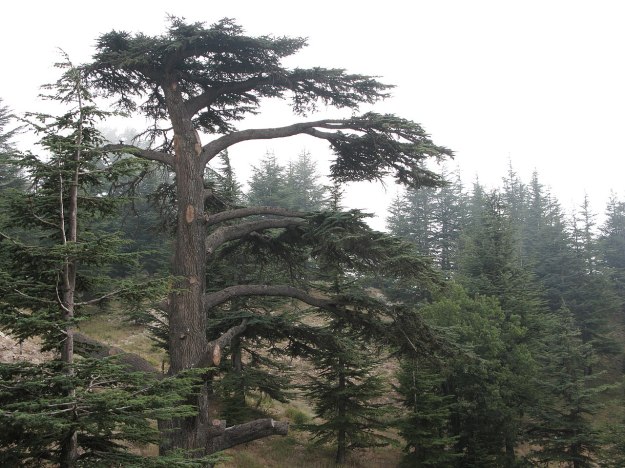
Cedar of Lebanon (Cedar of God), Lebanon By © Vyacheslav Argenberg / http://www.vascoplanet.com/, CC BY 4.0, https://commons.wikimedia.org/w/index.php?curid=92872076

Ezekiel 31

1In the eleventh year, in the third month, on the first day of the month, the word of the LORD came to me: 2Mortal, say to Pharaoh king of Egypt and to his hordes:
Whom are you like in your greatness?
3Consider Assyria, a cedar of Lebanon,
with fair branches and forest shade,
and of great height,
its top among the clouds.
4The waters nourished it,
the deep made it grow tall,
making its rivers flow
around the place it was planted,
sending forth its streams
to all the trees of the field.
5So it towered high
above all the trees of the field;
its boughs grew large
and its branches long,
from abundant water in its shoots.
6All the birds of the air
made their nests in its boughs;
under its branches all the animals of the field
gave birth to their young;
and in its shade
all great nations lived.
7It was beautiful in its greatness,
in the length of its branches;
for its roots went down
to abundant water.
8The cedars in the garden of God could not rival it,
nor the fir trees equal its boughs;
the plane trees were as nothing
compared with its branches;
no tree in the garden of God
was like it in beauty.
9I made it beautiful
with its mass of branches,
the envy of all the trees of Eden
that were in the garden of God.
10Therefore thus says the Lord GOD: Because it towered high and set its top among the clouds, and its heart was proud of its height, 11I gave it into the hand of the prince of the nations; he has dealt with it as its wickedness deserves. I have cast it out. 12Foreigners from the most terrible of the nations have cut it down and left it. On the mountains and in all the valleys its branches have fallen, and its boughs lie broken in all the watercourses of the land; and all the peoples of the earth went away from its shade and left it.
13On its fallen trunk settle
all the birds of the air,
and among its boughs lodge
all the wild animals.
14All this is in order that no trees by the waters may grow to lofty height or set their tops among the clouds, and that no trees that drink water may reach up to them in height.
For all of them are handed over to death,
to the world below;
along with all mortals,
with those who go down to the Pit.
15Thus says the Lord GOD: On the day it went down to Sheol I closed the deep over it and covered it; I restrained its rivers, and its mighty waters were checked. I clothed Lebanon in gloom for it, and all the trees of the field fainted because of it. 16I made the nations quake at the sound of its fall, when I cast it down to Sheol with those who go down to the Pit; and all the trees of Eden, the choice and best of Lebanon, all that were well watered, were consoled in the world below. 17They also went down to Sheol with it, to those killed by the sword, along with its allies, those who lived in its shade among the nations.
18Which among the trees of Eden was like you in glory and in greatness? Now you shall be brought down with the trees of Eden to the world below; you shall lie among the uncircumcised, with those who are killed by the sword. This is Pharaoh and all his horde, says the Lord GOD.

This fifth oracle against Egypt is like Ezekiel’s earlier oracle against the King of Tyre where the king is highlighted for their beauty and preeminent state among the garden of Eden.[1] Like that previous oracle the one who excels all others is brought low as they exceed their station as a creation of God. Although this oracle is directed against Pharoah and his hordes, it only mentions Pharoah or Egypt in the first and last verse, the rest of the oracle uses Assyria as an example for Egypt to heed. Assyria who was once the great empire in the north has collapsed and dragged all who allied themselves with her down to Sheol, and the same fate awaits proud Egypt in this oracle.

It is likely that Ezekiel is building upon Isaiah’s imagery in Isaiah 2:11-13 linking pride and great trees.

The haughty eyes of people shall be brought low, and the pride of everyone shall be humbled; and the LORD alone will be exalted in that day. For the LORD of hosts has a day against all that is proud and lofty, against all that is lifted up and high; against all the cedars of Lebanon, lofty and lifted up; and against all the oaks of Bashan;

Just as Daniel will probably utilize Ezekiel’s imagery in his own image in Daniel 4: 10-17 and Jesus alludes to this imagery in his parable of the mustard seed.[2] Yet, Ezekiel’s usage is the longest sustained use of this metaphor.

This oracle is dated almost two months after the previous one, June 21, 587 BCE. The city of Jerusalem is still besieged by Babylon, and it is possible that Babylon has already repulsed the Egyptian attempts to lift the siege. Egypt has been one of the significant powers in the ancient world throughout Israel’s history, and Egypt has continually exerted influence in the region around Israel. Now Egypt in this parable is told to look at a metaphor of Assyria. Assyrian was the great empire in the north prior to the emergence of the Babylonian empire. There are some translators who view Assyria’s presence here as a mistake, but thematically it makes sense to use a metaphor about Assyrian to demonstrate to Egypt that it too can fall from its great heights. Even though verses three through nine repeatedly refer to the beauty of this metaphorical tree and portray its majesty in an admirable light, like the earlier references to the King of Tyre, this is a case of prophetic satire. Although the kings of Assyria normally have the date palm as their image, the use of the cedar of Lebanon would be a well-known image of both size and strength, and a tree frequently used in royal and holy construction.

There are mythical elements in the background of this image, but they should not distract from the basic point that Pharoah and Egypt, according to the oracle, will share the same fate as Assyria. Although the waters nourished it and the deep made it grow tall, it will still fall when the prince of nations (King Nebuchadrezzar of Babylon) cuts it down. The waters and deep are the same Hebrew words used in Genesis 1:2 and this tree surpasses the trees of the garden of God (Eden) but ultimately, like the King of Tyre, its beauty, strength, and height cannot prevent its falling into the realm of the dead. The remnants of the tree fall on the mountains and valleys, just as the defeated ‘dragon’ in the next chapter will have its remains fall on the mountains, valleys, and waterways.[3] Now this great tree and all the lesser trees that inhabited the space under its branches find themselves in the Pit.

The very forces which once gave this great tree life now bury it in the depths. The rivers that flowed around it are now restrained and this once beautiful and living tree is now debris scattered upon the ground, or in other places brought down into the pit. The great tree and the empire it represents are now dead, and Egypt who is similarly a great tree is in danger from the same axe wielding prince of the nations. In the oracle Pharoah and all his armies cannot oppose God and God’s chosen instrument of vengeance King Nebuchadrezzar.

As mentioned before there are limited historical records from this period. We do know that Nebuchadrezzar does eventually turn his army to march on Egypt. Although the Babylonians have enjoyed multiple victories over Egypt, Egypt never becomes a part of the Babylonian empire. The great cedar tree which represents Egypt will stand at least for a time longer. Ezekiel interprets the actions of the king of Babylon and his forces as an extension of the will of the God of Israel. Even though Jerusalem is under siege, the LORD’s actions, in Ezekiel’s mind, are just. The LORD is not merely the God of Israel but is at work in the movement of empires to bring about the will of God.

[1] Ezekiel 28.

[2] Matthew 13: 31-32, Mark 4: 30-32, Luke 13: 18-19

[3] Ezekiel 32: 5-6.

Ezekiel 30: Oracles Against Egypt Continued

A stele dating to the 23rd regnal year of Amasis, on display at the Louvre

Ezekiel 30: 1-19 The Third Oracle Against Egypt: The Day of The LORD

1The word of the LORD came to me: 2Mortal, prophesy, and say, Thus says the Lord GOD:
Wail, “Alas for the day!”
3For a day is near,
the day of the LORD is near;
it will be a day of clouds,
a time of doom for the nations.
4A sword shall come upon Egypt,
and anguish shall be in Ethiopia,
when the slain fall in Egypt,
and its wealth is carried away,
and its foundations are torn down.
5Ethiopia, and Put, and Lud, and all Arabia, and Libya, and the people of the allied land shall fall with them by the sword.
6Thus says the LORD:
Those who support Egypt shall fall,
and its proud might shall come down;
from Migdol to Syene
they shall fall within it by the sword,
says the Lord GOD.
7They shall be desolated among other desolated countries,
and their cities shall lie among cities laid waste.
8Then they shall know that I am the LORD,
when I have set fire to Egypt,
and all who help it are broken.
9On that day, messengers shall go out from me in ships to terrify the unsuspecting Ethiopians; and anguish shall come upon them on the day of Egypt’s doom; for it is coming!
10Thus says the Lord GOD:
I will put an end to the hordes of Egypt,
by the hand of King Nebuchadrezzar of Babylon.
11He and his people with him, the most terrible of the nations,
shall be brought in to destroy the land;
and they shall draw their swords against Egypt,
and fill the land with the slain.
12I will dry up the channels,
and will sell the land into the hand of evildoers;
I will bring desolation upon the land and everything in it
by the hand of foreigners;
I the LORD have spoken.
13Thus says the Lord GOD:
I will destroy the idols
and put an end to the images in Memphis;
there shall no longer be a prince in the land of Egypt;
so I will put fear in the land of Egypt.
14I will make Pathros a desolation,
and will set fire to Zoan,
and will execute acts of judgment on Thebes.
15I will pour my wrath upon Pelusium,
the stronghold of Egypt,
and cut off the hordes of Thebes.
16I will set fire to Egypt;
Pelusium shall be in great agony;
Thebes shall be breached,
and Memphis face adversaries by day.
17The young men of On and of Pi-beseth shall fall by the sword;
and the cities themselves shall go into captivity.
18At Tehaphnehes the day shall be dark,
when I break there the dominion of Egypt,
and its proud might shall come to an end;
the city shall be covered by a cloud,
and its daughter-towns shall go into captivity.
19Thus I will execute acts of judgment on Egypt.
Then they shall know that I am the LORD.

This third oracle against Egypt is undated. It may come early (during the siege of Jerusalem) like the first oracle or late (after the failed siege of Tyre) like the second oracle. It is sandwiched between a late oracle and an early one and either situation can fit this declaration against the Egyptians. My best guess is that it follows the timeline of the immediately preceding oracle but ultimately it makes little difference to the interpretation of the prophet’s words of judgment.[1]

Ezekiel’s third oracle against Egypt taps into the thematic day of the LORD. As I mention in my longer discussion on the Evolution of the Day of the LORD, this has been used both as a phrase indicating both judgment for Judah and salvation. Here the terrifying direction of the day of the LORD is directed against Egypt, and by extension the nations. Much of the day of the LORD language is thematic and has resonances across the prophets regardless of the direction of the judgment it implies. Ezekiel echoes Zephaniah 1:15[2] storm imagery:

That day will be a day of wrath, a day of distress and anguish, a day of ruin and devastation, a day of darkness and gloom, a day of clouds and thick darkness.

Although the Hebrew Scriptures continually remind the reader that the LORD is the creator of the heavens and the earth, the LORD’s power is often depicted coming from the sky. But here the judgment from the sky is paired with the judgment by sword from approaching armies. The LORD is both the Lord of heaven and earth and the LORD of hosts[3]. The LORD is moving in judgment against Egypt and any who stand with them in this oracle.

One of the reasons that people have been fascinated with Egypt has been its wealth. The wealth of the nation unearthed from the tombs of the kings of Egypt draws both modern interest but also drew ancient interest as well. Egypt’s elite hoarded this wealth, and this was to be one of the distinctions between the ways of Egypt and the ways of the people of Israel. Now this wealth or horde, (Hebrew hamon) will be taken away by the sword. That which they stored in temples and tombs will now become the reward for the wielder of the sword which causes both death and destruction for this proud empire. This focus on the wealth of Egypt being carried away links this to the previous oracle when Egypt’s wealth is to be the payment to Nebuchadrezzar for the effort and resources he expended against Tyre.

Ethiopia, Libya (Put), Asia Minor (Lud), the Arabians (literally mixed hordes), and an unknown people (NRSV Libya)[4]  and “the sons of the land of the covenant” (NRSV people of allied lands) all find themselves in danger of this approaching sword and storm. The Egyptians, like most ancient armies, had fighters from many lands which formed their army. Some may have been mercenaries; others were allied or vassal kingdoms. A similar dynamic is at work in Ezekiel’s metaphor of Tyre where the men of Paras, Lud, and Put were in their army and men of Arvad, Helech, and Gamad were archers on their walls.[5] The interesting addition to this list is the ‘sons of the land of the covenant’ who were likely Judean soldiers serving Egypt. There are several ancient sources who list Judean mercenaries serving in Egyptian campaigns, and there are Judean settlements in Egypt at the time of Ezekiel’s ministry.[6] Now these Judeans both serving and residing in Egypt are warned of the coming sword (assuming Ezekiel’s missive traveled to these communities).

The terror of this coming sword penetrates the length of the Nile into Ethiopia. Egypt had endured conflict before, but the communities on the eastern and northern edge of Egypt absorbed the threat. Ethiopians at the southern end of the Nile could benefit from the economic advantages of the river while being relatively safe from an invader coming from the Middle East. But now even these places at the edge of the Egyptian empire were no longer safe in the oracle. The ‘hordes’ or ‘wealth’ of Egypt will end under King Nebuchadrezzar of Babylon. This force coming from the north is portrayed as the ‘most terrible of nations.’

The destruction of Egypt’s wealth and military are paralleled by the loss of both the cities and the ‘gods’ of Egypt. Just as the ‘signs and wonders’ that the LORD utilized to bring the people of Israel out of Egypt struck at both the reign of Pharoah and the Egyptian gods[7] now the ‘idols’[8] and ‘images’ are destroyed as well as the cities where the temples are located.

The actions of Nebuchadrezzar’ army are paired with the actions of the LORD against the land. Nebuchadrezzar may wield the sword, but the LORD is drying up the channels of the Nile. At Tehaphnehes the day becomes dark[9] as it is covered by a cloud, echoing the day of the LORD imagery at the beginning of the oracle. The LORD of the heavens and earth wields the natural powers of destruction while the LORD of hosts dispatches the Babylonians with the sword against the Egyptians.

Ezekiel 30: 20-26 The Fourth Oracle Against Egypt Disarming Pharoah

20In the eleventh year, in the first month, on the seventh day of the month, the word of the LORD came to me: 21Mortal, I have broken the arm of Pharaoh king of Egypt; it has not been bound up for healing or wrapped with a bandage, so that it may become strong to wield the sword. 22Therefore thus says the Lord GOD: I am against Pharaoh king of Egypt, and will break his arms, both the strong arm and the one that was broken; and I will make the sword fall from his hand. 23I will scatter the Egyptians among the nations, and disperse them throughout the lands. 24I will strengthen the arms of the king of Babylon, and put my sword in his hand; but I will break the arms of Pharaoh, and he will groan before him with the groans of one mortally wounded. 25I will strengthen the arms of the king of Babylon, but the arms of Pharaoh shall fall. And they shall know that I am the LORD, when I put my sword into the hand of the king of Babylon. He shall stretch it out against the land of Egypt, 26and I will scatter the Egyptians among the nations and disperse them throughout the countries. Then they shall know that I am the LORD.

For this fourth oracle we once again have a date, and the date helps provide a context for this message. April 29, 587 BCE would be almost four months after the initial oracle and roughly four months before the destruction of Jerusalem. Jeremiah 37: 5-10 indicates that Pharoah did come to Jerusalem’s aid causing a temporary removal of the siege while Nebuchadrezzar turned his forces to deal with the Egyptian incursion, and that likely set the background for Ezekiel’s first oracle against Egypt. We know that the Egyptian forces did not remain and either retreated or suffered a defeat before the Babylonians. The time period of this oracle makes sense in a time after Egypt has been forced to retreat without providing liberation to Jerusalem.

The broken arm of Pharaoh is likely his weakened state after his initial defeat by Babylon. Egypt has suffered defeats to Babylon in the region before, but now this metaphorical wound which weakens Pharoah will not be bound or bandaged and allowed to heal properly. Now a weakened Pharoah with one remaining arm is left to oppose a Babylon with two strong arms, but even before the battle the LORD breaks Pharoah’s other arm as the arm of the king of Babylon is made strong and the LORD’s swords placed in his hand for judgment. Pharoah, once mighty, has now been disarmed and Egypt is vulnerable to this warrior who comes to deliver the LORD’s judgment.

[1] Many historical critical interpreters viewed this portion of Ezekiel as a later introduction by a different author of the “Ezekiel school” due to the lack of date and the language. Although it is worth acknowledging the insight of these scholars, Ezekiel often does not include a date and Ezekiel’s language varies widely throughout the book.

[2] Joel 2: 2 also utilizes this imagery, but Joel is most likely at 4th Century BCE prophet and is echoing Ezekiel or Zephaniah.

[3] The host referred to here is a military host in this commonly used title.

[4] Put is modern day Libya. The Hebrew kub could be another North African nation, but we simply do not know.

[5] Ezekiel 27:10-11.

[6] Jeremiah 24:8, 44:1.

[7] See my comments on Exodus 711.

[8] Hebrew gillum, Ezekiel’s coarse image for foreign idols.

[9] Eclipsing the sun god ‘Ra.’

Egypt’s Role in the Geopolitics of Israel/Judah During the Time of the Assyrian and Babylonian Empires

The Roman Kiosk of Trajan (left) on Agilkia island in the Nile River, near Aswān, Egypt

Egypt’s Role in the Geopolitics of Israel/Judah During the Time of the Assyrian and Babylonian Empires

Egypt’s connection with the story of Israel goes back to its beginning and is complex. At times the Egyptians have been allies and trading partners and at other times they are antagonists. Egypt was one of the first regional powers to emerge in history, and they would remain independent until they are brought under the Persian Empire in the sixth century BCE (roughly forty years after the siege of Jerusalem and the Babylonian exile). Egypt had been a military and economic power for thousands of years at the emergence of the Assyrian and later Babylonian powers to the north and had exercised both political and commercial influence over the region throughout this time.

One of the ways Egypt continued to exercise influence was by encouraging the rulers throughout the region to resist both Assyrian and Babylonian rule. Egypt was often sought for support or protection once these ruling powers were provoked, aid that sometimes materialized and often did not. For example, 2 Kings records Samaria (Northern Israel) attempting to resist Assyria in 724 BCE:

King Shalmaneser of Assyria came up against him; Hoshea (king of Samaria) became his vassal. But the king of Assyria found treachery in Hoshea; for he had sent messengers to King So of Egypt, and offered no tribute to the king of Assyria as he had done year by year; therefore the king of Assyria confined him and imprisoned him. Then the king of Assyria invaded all the land and come to Samaria; for three years he besieged it. In the ninth year of Hoshea the king of Assyria captured Samaria; he carried the Israelites away into Assyria. 2 Kings 17: 3-6a

Here Egypt is either unable or unwilling to march into Samaria to defend them from the Assyrians. This results in the collapse of Northern Israel (Samaria). Later Assyria would march against the Philistine city of Ekron who also appeals to Egypt for aid. In 701 BCE Egypt does march to the aid of Ekron but its forces are defeated and captured. (NIB VI: 1402) Assyria then turns towards Judah and when Rabshakeh, the commander of the Assyrian forces comes before the walls of Jerusalem he taunts the people:

The Rabshakeh said to them, “Say to Hezekiah. Thus says the great king, the king of Assyria: on what do you base this confidence of yours? Do you think that mere words are strategy and power for war? On whom do you rely, that you have rebelled against me? See, you are relying now on Egypt, that broken reed of a staff, which will pierce the hand of anyone who leans on it. Such is Pharoah king of Egypt to all who rely on him. 1 Kings 18:19-21, Isaiah 36:4-6

Rabshakeh’s siege does not capture Jerusalem when he abruptly turns away to another fight, biblical tradition indicates it is an internal conflict among Assyrian forces, and the threat is resolved.

Eventually Assyria and Egypt would change from opponents into allies at the emergence of the Babylonian empire. This becomes important for Judah’s history for several interconnected reasons. Judah under Josiah was undergoing a time of renewal according to the bible and there was even a hope for Judah to now once again rule over the lands of both Judah and what had formerly been Samaria. A part of this optimism was the alliance with Babylon. In 609 BCE when Pharoah Necho marches his army north to aid Assyria, King Josiah marches the army of Judah out to resist him. Judah’s army is conquered, King Josiah is killed, and Judah comes under Egyptian power with Pharoah Necho appointing Eliakim to rule in Jerusalem as a vassal. In 605 BCE Egyptian forces were defeated by Babylon at the Battle of Carchemish and pursued back to the Egyptian border. Even after Babylon asserted control over Judah and the surrounding region, Egypt continued to attempt to provoke Judah and other regional vassal states to resist Babylon.

When Babylon does react to Jerusalem withholding tribute by besieging the city, Egypt does march to their aid which causes Babylonian forces to briefly lift the siege of Jerusalem to deal with the Egyptian incursion. (Jeremiah 37:5-10) Yet the Egyptian forces quickly return to Egypt and Babylon resumes its siege. Egypt has once again proven to be an unreliable support for Jerusalem in its problems. This history of provocative behavior and unreliability likely informs Ezekiel’s words against Egypt.

The Babylonian Empire

Most readers of the Bible do not have much exposure to the history of the region 2,600 years ago, but this time is critical for much of the Hebrew Scriptures (or Old Testament). One of my Hebrew Bibles professors used to joke that if you were taking an exam on the Hebrew Scriptures and did not know the answer that the Babylonian exile was a solid guess. This is the time period that the books of Jeremiah and Ezekiel address and it is where 2 Kings concludes the Deuteronomic History[1] and shortly before 2 Chronicles ends its narration.[2] This becomes a time of redefinition for the Jewish people where the stories and writings are collected together to form a unified tradition to hand on to their descendants away once the temple, Jerusalem, and the Davidic kings no longer reign.

When talking about the Babylonian Empire in relation to scripture, it is actually the Second Babylonian Empire or the Neo Babylonian Empire. The Babylonians were also known as Chaldeans in scripture and historical references, and you will occasionally see this time referred to as the Chaldean Empire. Babylon begins its rise after the coronation of King Nabopolassar in 626 BCE and the rise of Babylonian power coincides with the collapse of the Assyrian Empire in 612 BCE.[3] In 605 BCE King Nebuchadrezzar II (or Nebuchadnezzar II) succeeded his father Nabopolassar as king. Shortly before his father’s death Nebuchadrezzar II won a critical victory over Pharoah Neco II’s Egyptian Army at the battle of Carchemish ensuring Babylonian power over the Levant (the region bordering the Eastern Mediterranean Sea which includes Israel/Judah).

Neo-Babylonian_Empire_under_Nebuchadnezzar_II By IchthyovenatorSémhur (base map) – Own work, CC BY-SA 4.0, https://commons.wikimedia.org/w/index.php?curid=105732621

In 601 BCE Babylon marched into Egypt to counter rising Egyptian influence in the Levant and this campaign ultimately failed in 599 BCE but did end Egyptian power in the Levant. During this war King Jehoiakim (or Jehoiakim) in Judah allied his country with Egypt[4] and Nebuchadrezzar after leaving Egypt turned his forces towards Jerusalem. In 598/597 BCE Jerusalem surrenders to Babylon, King Jehoiakim is taken captive to Babylon along with many of the elites of the land. This is the exile that Ezekiel is experiencing as he prophesies, and this is also the setting at the beginning of the book of Daniel. King Zedekiah is left in charge of Jerusalem as a puppet king of the Babylonian empire.

Egypt continued to be a regional force and both Jeremiah and Ezekiel point to the influence of Egypt in the decision of King Zedekiah to refuse to pay tribute in 589 BCE. In 587 BCE Ammon, Edom, and Moab all come together to form a mutual alliance against Babylon, but in 586 Babylon responds. Jerusalem is destroyed, and the Kingdom of Judah ends in 586 BCE with the survivors being taken captive in Babylonia. After the defeat of Judah, Babylon would continue to be militarily active ensuring the submission of the region under Babylonian control and repelling Egyptian influence. The Babylonian Empire would maintain control over the region until they were conquered by Cyrus the Great and the Persian Empire in 539 BCE.

[1] The books starting in Joshua and running through 2 Kings in most Christian bibles (excluding Ruth) which called the Deuteronomic history by scholars because they theologically follow the book of Deuteronomy.

[2] 2 Chronicles has two final verses which point to the end of the Babylonian exile under the Persian King Cyrus.

[3] The Assyrian Empire is responsible for the capture of Samaria and the ending of the Kingdom of Northern Israel in 721 BCE.

[4] Jehoiakim had been appointed by Pharoah Neco II so Judah’s alliance with Egypt against Babylon is not surprising.

Ezekiel 21 God’s Sword Against Judah

Swords Hanging in my Office, the sword on the left is a U.S. Army Ceremonial (Dress) Saber, the one on the right is a replica 1860 cavalry saber.

Ezekiel 21: 1-7 The LORD’s Challenge of Israel

1 The word of the LORD came to me: 2 Mortal, set your face toward Jerusalem and preach against the sanctuaries; prophesy against the land of Israel 3 and say to the land of Israel, Thus says the LORD: I am coming against you, and will draw my sword out of its sheath, and will cut off from you both righteous and wicked. 4 Because I will cut off from you both righteous and wicked, therefore my sword shall go out of its sheath against all flesh from south to north; 5 and all flesh shall know that I the LORD have drawn my sword out of its sheath; it shall not be sheathed again. 6 Moan therefore, mortal; moan with breaking heart and bitter grief before their eyes. 7 And when they say to you, “Why do you moan?” you shall say, “Because of the news that has come. Every heart will melt and all hands will be feeble, every spirit will faint and all knees will turn to water. See, it comes and it will be fulfilled,” says the Lord GOD.

At the end of the previous chapter the prophet is told to set his face towards the south (Teman, Darom, and Negev)[1] but then is accused by the people of being a maker of allegories. The previous section and this one belong together. The references to south are made clear when the prophet is instructed to set his face toward Jerusalem, the sanctuaries, and the land of Israel. The previous three different word for south is now decoded as Jerusalem, the sanctuaries and the land of Israel. The forests of the Negev may allegorically refer to the House of the Forest of Lebanon, a part of the royal buildings built by Solomon. (1 Kings 7: 2-5) Yet, now that the allegories are stripped away it is clear that the focus is on the city of Jerusalem, the temple, and the land of Israel itself. The upcoming judgment of the LORD will focus on the city but encompass the entire region.

The figure of God as a divine warrior is a common one in scripture, but now the divine warrior which has protected Israel in the past challenges the people of Israel to a duel. The LORD is coming against them and will draw out the sword, and yet this is not a fight that Israel can win. The image of the LORD drawing his sword was probably expected by the people to be a positive image, an image that the LORD was ready to fight for the people. Ezekiel inverts this image to where God is no longer their protector but their adversary.

The threat to cut off both the righteous and the wicked again illustrates that the prophecies in Ezekiel are not always consistent but are meant to evoke a hearing. At several points Ezekiel has been careful to allow for a distinction between the righteous and the unrighteous before God’s judgment.[2] There is an echo of Abraham’s challenge to the LORD on the LORD’s journey to Sodom, “Will you indeed sweep away the righteous with the wicked?” (Genesis 18:23) Yet, as in Ezekiel 16: 44-58 it is clear that the LORD views the transgressions of Judah as greater than Sodom. This may just be a shocking rhetorical device to encompass the totality of the people and shake them out of their stupor. Yet, Ezekiel’s prophecy has been less about the expectance of repentance than describing the upcoming horror in a way that people can look back upon his words and see that Ezekiel was a true prophet among them. A sword once it is swung is likely to cause collateral damage and war once unleashed is impossible to restrain where only the wicked are punished. Yet, this sword now taken out to the scabbard will become the central image for the remainder of the chapter.

Ezekiel is called to moan publicly, and this becomes another sign-act to cause people to question what the prophet is doing. The prophet is informed about the coming disaster but has no power to avert the catastrophe. He can look ahead to the time when hearts melt, hands are feeble, and the loss of bowel control causes people to wet themselves.[3] The disaster will physically and psychologically overwhelm the people. The God who has delivered them in the only offers challenge. The sword is drawn, and now Ezekiel will continue to develop this image throughout the chapter.

Ezekiel 21: 8-17 The Song of the Sword

8 And the word of the LORD came to me: 9 Mortal, prophesy and say: Thus says the Lord; Say: A sword, a sword is sharpened, it is also polished;

10 it is sharpened for slaughter, honed to flash like lightning! How can we make merry? You have despised the rod, and all discipline.

 11 The sword is given to be polished, to be grasped in the hand; it is sharpened, the sword is polished, to be placed in the slayer’s hand.

 12 Cry and wail, O mortal, for it is against my people; it is against all Israel’s princes; they are thrown to the sword, together with my people. Ah! Strike the thigh!

 13 For consider: What! If you despise the rod, will it not happen? says the Lord GOD.

14 And you, mortal, prophesy; strike hand to hand. Let the sword fall twice, thrice; it is a sword for killing. A sword for great slaughter — it surrounds them;

 15 therefore hearts melt and many stumble. At all their gates I have set the point of the sword. Ah! It is made for flashing, it is polished for slaughter.

 16 Attack to the right! Engage to the left! — wherever your edge is directed.

 17 I too will strike hand to hand, I will satisfy my fury; I the LORD have spoken.

Although the overall intent of this section is clear, the individual phrases are difficult to translate. Daniel Block suggests that the problems reflect the “heightened emotions of the prophet, who appears mesmerized by the image of the flashing weapon.” (Block, 1997, p. 675) Block’s suggestion is plausible, but it is also plausible that Ezekiel is adapting an existing poem, song, or invocation over a weapon and adapting it to the current image. This deadly sword which is drawn from the divine scabbard becomes a deadly image of destruction for the people and a lament of the prophet.

The repetitive references to the sword being sharpened and polished give the section a lyrical quality and this has led some to speculate that it derives from a sword dance or invocation over a weapon to prepare it for battle. (NIB VI: 1298) Armies both ancient and modern have rituals to prepare mentally for the upcoming battle that involve chants, movement, dance, and the focus on the weapons used in conflict. Psalm 144 is a biblical example of a prayer or song of a warrior preparing for combat as seen in its opening lines:

Blessed be the LORD, my rock, who trains my hands for war, and my fingers for battle, my rock and my fortress, my stronghold and my deliverer, my shield in whom I take refuge, who subdues the peoples under me. Psalm 144: 1-3

Yet, the focus in this image is exclusively on the sword. The wielder of this weapon will be revealed in the coming section, but now the sword itself is sharpened for slaughter and honed to flash like lightning. The princes of Israel are the ones sword is directed against, and they and the people are unable to stand against it. The sword, even without a wielder strikes multiple times and appears at every gate. The gates of the city are where the people can flee for safety but throughout the bible the city gates are also where public business was transacted, and cases brought for judgment. The sword at the gates also precludes the possibility of escape from the surrounded city.

The sword is a metaphor for war, and as we will see in the following section it is the war of Babylon against Judah. The siege of Jerusalem, often prophesied in the first twenty chapters, cuts off the possibility of escape. To echo a line from the Battle Hymn of the Republic, God “has loosed the fateful lightning of his terrible swift sword,” but the sword is not loosed against the enemies of Judah but upon Judah herself.

Replica 1860 Cavalry Saber hanging on my office wall

I was a cavalry officer in the U.S. Army prior to going to seminary and becoming a pastor. On the wall of my office, I have two swords from my time in the military. One is a ceremonial saber which is light and would not endure in a fight, but the other is a replica 1860 cavalry saber known sometimes called a wrist breaker because of its weight. This saber comes from a different era and is different technology than swords in the ancient world (which are shorter and thicker). Swords are shaped for the type of combat they will be used in. A saber is used on horseback for swinging downward, a rapier is a thrusting weapon, etc. Swords are not the primary implement used in slaughter[4] because both their value in the culture (they are costly to make and own) and the fact that they dull quickly. Ancient swords had to be heavy to be effective in combat, and they didn’t have the focused weight of an axe.[5] Yet, swords were the weapon of kings and great warriors and metaphorically they are often used to talk of war and battle.

Ezekiel 21: 18-27 Nebuchadrezzar Wielder of the Sword

18 The word of the LORD came to me: 19 Mortal, mark out two roads for the sword of the king of Babylon to come; both of them shall issue from the same land. And make a signpost, make it for a fork in the road leading to a city; 20 mark out the road for the sword to come to Rabbah of the Ammonites or to Judah and to Jerusalem the fortified. 21 For the king of Babylon stands at the parting of the way, at the fork in the two roads, to use divination; he shakes the arrows, he consults the teraphim, he inspects the liver. 22 Into his right hand comes the lot for Jerusalem, to set battering rams, to call out for slaughter, for raising the battle cry, to set battering rams against the gates, to cast up ramps, to build siege towers. 23 But to them it will seem like a false divination; they have sworn solemn oaths; but he brings their guilt to remembrance, bringing about their capture.

24 Therefore thus says the Lord GOD: Because you have brought your guilt to remembrance, in that your transgressions are uncovered, so that in all your deeds your sins appear — because you have come to remembrance, you shall be taken in hand.

 25 As for you, vile, wicked prince of Israel, you whose day has come, the time of final punishment,

 26 thus says the Lord GOD: Remove the turban, take off the crown; things shall not remain as they are. Exalt that which is low, abase that which is high.

 27 A ruin, a ruin, a ruin — I will make it! (Such has never occurred.) Until he comes whose right it is; to him I will give it.

The wielder of this divine sword is now revealed as the king of Babylon, Nebuchadrezzar II. The imagery fits the geopolitics of the time leading up to the destruction of Jerusalem in 586 BCE.  King Zedekiah (referred to as prince throughout Ezekiel) along with Tyre, Ammon, Edom and Moab rebelled against the Babylonians in 587 BCE and Babylon responds by placing Jerusalem under siege. This image envisions the king of Babylon at a crossroads with his servants divining the path they are to take in the battle ahead, do they take the eastern road heading to Ammon and a western road going to Jerusalem. Three divinations are conducted, the first using belomancy or rhabdomancy which draws inscribed arrows like a lot, the second consulting the household gods (teraphim), and the third being hepatoscopy which involves examining the irregularities of the liver of a sacrificed animal. Hepatoscopy is well attested in the historical record, but less is known about the other two practices. (Block, 1997, pp. 686-687)  The three divinations all reveal the western road to Jerusalem, even though the king and his servants suspect it is a false divination since Zedekiah had previously sworn allegiance to the king of Babylon. Yet, this foreign leader using divination, practices forbidden among the Jewish people, is shown the will of the LORD through these practices and comes in force to Jerusalem.

Geographically the image fits Damascus as the crossroads, and once the armies of Babylon are in motion there is no choice for the Judeans except to retreat behind the walls of Jerusalem. Battles in the ancient world between equal armies could take place along the roads and away from cities, but in an unequal fight the only hope for the smaller force was to utilize the strategic advantages of a walled city and force the larger force into a costly and timely siege. That is what Nebuchadrezzar does with Jerusalem and the siege becomes a traumatic event for the people trapped in the city. King Zedekiah (here the vile prince of Israel) will be forced to remove the marks of his reign because things will not remain as they are.

The LORD is turning the world of the Judeans upside down. The word translated in the NRSV as ruin (‘awwa) is rendered by Daniel Block as topsy-turvy. (Block, 1997, p. 691) This triple repetition of topsy-turvy in combination with the low being made exalted and the high being abased is God’s action of inverting the order among Jerusalem. The God who had been the divine warrior protecting Israel has now become the adversary of the people. The sword of the LORD has been placed in the hands of the king of Babylon. The city, the Davidic line of kings, the temple, the land, and the alliances formed to resist the Babylonians will all fail. Ezekiel’s visions, which will prove to be accurate, undermine the foundations upon which people had built their lives. It is a topsy-turvy world that will remake the people. Yet, there is a future under one whose right it is to rule.

Ezekiel 21: 28-32 The Future Judgment of Ammon

 28 As for you, mortal, prophesy, and say, Thus says the Lord GOD concerning the Ammonites, and concerning their reproach; say: A sword, a sword! Drawn for slaughter, polished to consume, to flash like lightning.

 29 Offering false visions for you, divining lies for you, they place you over the necks of the vile, wicked ones — those whose day has come, the time of final punishment.

 30 Return it to its sheath! In the place where you were created, in the land of your origin, I will judge you.

 31 I will pour out my indignation upon you, with the fire of my wrath I will blow upon you. I will deliver you into brutish hands, those skillful to destroy.

 32 You shall be fuel for the fire, your blood shall enter the earth; you shall be remembered no more, for I the LORD have spoken.

Ezekiel has an entire section of the book devoted to the proclamations against the nations surrounding Judea which begins with the proclamation against Ammon in chapter twenty-five. Because of this section of oracles against the nations later in the book some have believed this continuation of the sword imagery against Ammon to be out of place, but a Tova Ganzel reminds us, “Jerusalem preceded Ammon, it did not replace it.” (Ganzel, 2020, p. 162) The initial divination by Babylon to take the western road to Jerusalem does not mean that they will not also punish the actions of the Ammonite leaders to align themselves with Jerusalem against the Babylonians. The LORD is not only the God of Israel but is also the God of all the nations and his actions through the Babylonians judge also the Ammonites here. The sword will only return to its scabbard when its actions are completed.

[1] These are the three Hebrew words in 20:46. In the NRSV they are rendered south, south, and Negev, in the NIV they are all translated as south.

[2] Ezekiel 9:4-6, 14:12-20, 18

[3] This is the meaning of all knees will turn to water. See note on Ezekiel 7:17.

[4] The Hebrew word tabah translated slaughter in verse 10 often means the slaughter of domestic animals but can also refer to a massacre.

[5] Which is why axes and later the guillotines were used for executions. Swords dull quickly when they are used to cut through flesh and bone.

Jeremiah 50-51 The Cry Against Babylon


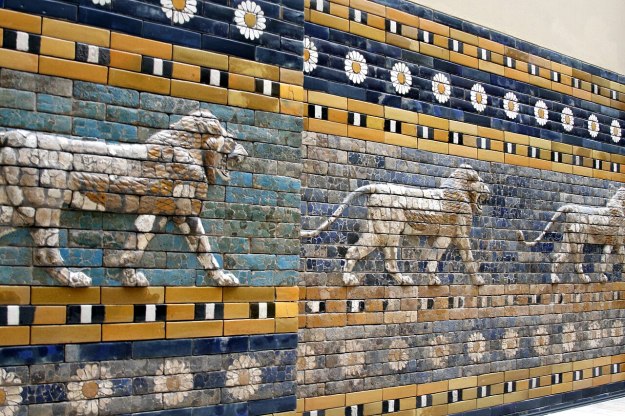
Detail from the Ishtar Gate (Reconstruction in Berlin's Pergamon Museum)

Detail from the Ishtar Gate (Reconstruction in Berlin’s Pergamon Museum)

I am going to break with my normal pattern with Jeremiah and put the text after the reflections. It didn’t make sense to me to cover these two chapters as separate because they are both a part of a long conglomeration of oracles against Babylon, set by the text in the fourth year of King Zedekiah (in the time between the first exile where leadership are taken into exile and the main exile where the largest group is taken into exile in Babylon). To place this oracle against Babylon coming from the mouth of Jeremiah combined with the sign act of throwing the scroll into the Euphrates by Seraiah seems to run against everything else Jeremiah is saying at this time. Many historical critical scholars would argue against this being composed by Jeremiah but the reality is that we have this massive book which we now receive as the book of Jeremiah and there is no way to go back to the ‘authentic words of Jeremiah’ or to tell exactly what Jeremiah the prophet wrote and some later compiler.

I take this long scream against the Babylonian empire about its coming destruction much the same way I take Psalm 137 which is a cry out of pain. The people of Judah after encountering the destruction of all that they know need some hope that God has not abandoned them to their fate, that Babylon is far from blameless and must also answer for its sins. The images and idols of Babylon are not more powerful than the LORD of hosts and will be put to shame and the armies which were viewed as an instrument in the LORD’s hands throughout the rest of the book now will have other armies from the north that come an terrorize them. The poetic language of disasters follows patterns seen throughout Jeremiah: beasts, arrows, clubs, violence. Warriors in misogynistic language become women, walls become leveled, honor becomes dishonor. Just as there was no balm for Judah and Jerusalem, now there is no balm for healing Babylon.

Babylon would fall to the Persian empire under Cyrus the Great, who the book of Isaiah lifts up as a messiah-which literally means anointed one as it is typically translated in English (see Isaiah 45:1).  It is in the continuing movement of armies and the realignment of power in the Middle East that the people in Babylon would be able to return to rebuild the city of Jerusalem, the temple and re-settle Jerusalem. Perhaps a part of this oracle which encourages people to leave Babylon also speaks to the reality of those born and raised in Babylon that have become accustomed to life in the Babylonian empire and an encouragement to return back to Judah.

Things are never as neat and tidy as they come out in oracles. Babylon would be conquered, but like Judah it never truly becomes a haunt of jackals, a place uninhabited that people avoid for all times. Babylon will be integrated into the next empire and the chain continues. Jerusalem and Judah are never the same again as well with the majority of the Jewish people being dispersed across the region from Egypt to Babylon to Asia Minor. In these chapters a powerless people hope for powerful actions by their God to deliver them again from their captivity. Much as in the founding story of the Exodus, now the hope is that God will see and hear God’s people’s plight in a foreign land and act to bring them back home again.

Jeremiah 50
The word that the LORD spoke concerning Babylon, concerning the land of the Chaldeans, by the prophet Jeremiah:
 2 Declare among the nations and proclaim, set up a banner and proclaim,
do not conceal it, say: Babylon is taken, Bel is put to shame, Merodach is dismayed.
Her images are put to shame, her idols are dismayed.
            3 For out of the north a nation has come up against her; it shall make her land a desolation, and no one shall live in it; both human beings and animals shall flee away.
 4 In those days and in that time, says the LORD, the people of Israel shall come, they and the people of Judah together; they shall come weeping as they seek the LORD their God. 5 They shall ask the way to Zion, with faces turned toward it, and they shall come and join themselves to the LORD by an everlasting covenant that will never be forgotten.
 6 My people have been lost sheep; their shepherds have led them astray, turning them away on the mountains; from mountain to hill they have gone, they have forgotten their fold.7 All who found them have devoured them, and their enemies have said, “We are not guilty, because they have sinned against the LORD, the true pasture, the LORD, the hope of their ancestors.”
8 Flee from Babylon, and go out of the land of the Chaldeans, and be like male goats leading the flock. 9 For I am going to stir up and bring against Babylon a company of great nations from the land of the north; and they shall array themselves against her; from there she shall be taken. Their arrows are like the arrows of a skilled warrior who does not return empty-handed. 10 Chaldea shall be plundered; all who plunder her shall be sated, says the LORD.
11 Though you rejoice, though you exult, O plunderers of my heritage,
though you frisk about like a heifer on the grass, and neigh like stallions,
12 your mother shall be utterly shamed, and she who bore you shall be disgraced.
Lo, she shall be the last of the nations, a wilderness, dry land, and a desert.
13 Because of the wrath of the LORD she shall not be inhabited,
but shall be an utter desolation; everyone who passes by Babylon
shall be appalled and hiss because of all her wounds.
14 Take up your positions around Babylon, all you that bend the bow; shoot at her,
spare no arrows, for she has sinned against the LORD.
 15 Raise a shout against her from all sides, “She has surrendered;
 her bulwarks have fallen, her walls are thrown down.”
For this is the vengeance of the LORD: take vengeance on her, do to her as she has done.
 16 Cut off from Babylon the sower, and the wielder of the sickle in time of harvest;
because of the destroying sword all of them shall return to their own people,
and all of them shall flee to their own land.
17 Israel is a hunted sheep driven away by lions. First the king of Assyria devoured it, and now at the end King Nebuchadrezzar of Babylon has gnawed its bones. 18 Therefore, thus says the LORD of hosts, the God of Israel: I am going to punish the king of Babylon and his land, as I punished the king of Assyria. 19 I will restore Israel to its pasture, and it shall feed on Carmel and in Bashan, and on the hills of Ephraim and in Gilead its hunger shall be satisfied. 20 In those days and at that time, says the LORD, the iniquity of Israel shall be sought, and there shall be none; and the sins of Judah, and none shall be found; for I will pardon the remnant that I have spared.
21 Go up to the land of Merathaim; go up against her,
and attack the inhabitants of Pekod and utterly destroy the last of them, says the LORD;
do all that I have commanded you.
 22 The noise of battle is in the land, and great destruction!
 23 How the hammer of the whole earth is cut down and broken!
How Babylon has become a horror among the nations!
 24 You set a snare for yourself and you were caught, O Babylon,
but you did not know it; you were discovered and seized,
because you challenged the LORD.
 25 The LORD has opened his armory, and brought out the weapons of his wrath,
for the Lord GOD of hosts has a task to do in the land of the Chaldeans.
 26 Come against her from every quarter; open her granaries;
pile her up like heaps of grain, and destroy her utterly; let nothing be left of her.
 27 Kill all her bulls, let them go down to the slaughter.
Alas for them, their day has come, the time of their punishment!
28 Listen! Fugitives and refugees from the land of Babylon are coming to declare in Zion the vengeance of the LORD our God, vengeance for his temple.
            29 Summon archers against Babylon, all who bend the bow. Encamp all around her; let no one escape. Repay her according to her deeds; just as she has done, do to her– for she has arrogantly defied the LORD, the Holy One of Israel. 30 Therefore her young men shall fall in her squares, and all her soldiers shall be destroyed on that day, says the LORD.
31 I am against you, O arrogant one, says the Lord GOD of hosts;
for your day has come, the time when I will punish you.
32 The arrogant one shall stumble and fall, with no one to raise him up,
and I will kindle a fire in his cities, and it will devour everything around him.
33 Thus says the LORD of hosts: The people of Israel are oppressed, and so too are the people of Judah; all their captors have held them fast and refuse to let them go. 34 Their Redeemer is strong; the LORD of hosts is his name. He will surely plead their cause, that he may give rest to the earth, but unrest to the inhabitants of Babylon.
35 A sword against the Chaldeans, says the LORD,
and against the inhabitants of Babylon, and against her officials and her sages!
36 A sword against the diviners, so that they may become fools!
A sword against her warriors, so that they may be destroyed!
37 A sword against her horses and against her chariots,
and against all the foreign troops in her midst, so that they may become women!
A sword against all her treasures, that they may be plundered!
38 A drought against her waters, that they may be dried up!
For it is a land of images, and they go mad over idols.
39 Therefore wild animals shall live with hyenas in Babylon, and ostriches shall inhabit her; she shall never again be peopled, or inhabited for all generations. 40 As when God overthrew Sodom and Gomorrah and their neighbors, says the LORD, so no one shall live there, nor shall anyone settle in her.
41 Look, a people is coming from the north;
a mighty nation and many kings are stirring from the farthest parts of the earth.
42 They wield bow and spear, they are cruel and have no mercy.
The sound of them is like the roaring sea;
they ride upon horses, set in array as a warrior for battle, against you, O daughter Babylon!
43 The king of Babylon heard news of them, and his hands fell helpless;
anguish seized him, pain like that of a woman in labor.
44 Like a lion coming up from the thickets of the Jordan against a perennial pasture, I will suddenly chase them away from her; and I will appoint over her whomever I choose. For who is like me? Who can summon me? Who is the shepherd who can stand before me? 45 Therefore hear the plan that the LORD has made against Babylon, and the purposes that he has formed against the land of the Chaldeans: Surely the little ones of the flock shall be dragged away; surely their fold shall be appalled at their fate. 46 At the sound of the capture of Babylon the earth shall tremble, and her cry shall be heard among the nations.
 
 Jeremiah 51
Thus says the LORD:
I am going to stir up a destructive wind against Babylon
and against the inhabitants of Leb-qamai;
2 and I will send winnowers to Babylon, and they shall winnow her.
They shall empty her land when they come against her from every side on the day of trouble.
3 Let not the archer bend his bow, and let him not array himself in his coat of mail.
Do not spare her young men; utterly destroy her entire army.
4 They shall fall down slain in the land of the Chaldeans, and wounded in her streets.
5 Israel and Judah have not been forsaken by their God, the LORD of hosts,
though their land is full of guilt before the Holy One of Israel.
6 Flee from the midst of Babylon, save your lives, each of you!
Do not perish because of her guilt, for this is the time of the LORD’s vengeance;
he is repaying her what is due.
7 Babylon was a golden cup in the LORD’s hand, making all the earth drunken;
the nations drank of her wine, and so the nations went mad.
8 Suddenly Babylon has fallen and is shattered; wail for her!
Bring balm for her wound; perhaps she may be healed.
9 We tried to heal Babylon, but she could not be healed.
Forsake her, and let each of us go to our own country;
for her judgment has reached up to heaven and has been lifted up even to the skies.
10 The LORD has brought forth our vindication;
come, let us declare in Zion the work of the LORD our God.
 11 Sharpen the arrows! Fill the quivers!
The LORD has stirred up the spirit of the kings of the Medes, because his purpose concerning Babylon is to destroy it, for that is the vengeance of the LORD, vengeance for his temple.
12 Raise a standard against the walls of Babylon;
make the watch strong; post sentinels; prepare the ambushes;
for the LORD has both planned and done what he spoke concerning the inhabitants of Babylon.
13 You who live by mighty waters, rich in treasures, your end has come,
the thread of your life is cut.
14 The LORD of hosts has sworn by himself:
Surely I will fill you with troops like a swarm of locusts,
and they shall raise a shout of victory over you.
15 It is he who made the earth by his power, who established the world by his wisdom,
and by his understanding stretched out the heavens.
16 When he utters his voice there is a tumult of waters in the heavens,
and he makes the mist rise from the ends of the earth.
He makes lightnings for the rain, and he brings out the wind from his storehouses.
17 Everyone is stupid and without knowledge;
goldsmiths are all put to shame by their idols;
for their images are false, and there is no breath in them.
18 They are worthless, a work of delusion; at the time of their punishment they shall perish.
19 Not like these is the LORD, the portion of Jacob, for he is the one who formed all things,
and Israel is the tribe of his inheritance; the LORD of hosts is his name.
20 You are my war club, my weapon of battle: with you I smash nations; with you I destroy kingdoms;
21 with you I smash the horse and its rider; with you I smash the chariot and the charioteer;
22 with you I smash man and woman; with you I smash the old man and the boy; with you I smash the young man and the girl;
23 with you I smash shepherds and their flocks; with you I smash farmers and their teams; with you I smash governors and deputies.
24 I will repay Babylon and all the inhabitants of Chaldea before your very eyes for all the wrong that they have done in Zion, says the LORD.
 25 I am against you, O destroying mountain, says the LORD, that destroys the whole earth;
I will stretch out my hand against you, and roll you down from the crags,
and make you a burned-out mountain.
26 No stone shall be taken from you for a corner and no stone for a foundation,
but you shall be a perpetual waste, says the LORD.
27 Raise a standard in the land, blow the trumpet among the nations;
prepare the nations for war against her, summon against her the kingdoms, Ararat, Minni, and Ashkenaz; appoint a marshal against her, bring up horses like bristling locusts.
28 Prepare the nations for war against her, the kings of the Medes,
with their governors and deputies, and every land under their dominion.
29 The land trembles and writhes, for the LORD’s purposes against Babylon stand,
to make the land of Babylon a desolation, without inhabitant.
30 The warriors of Babylon have given up fighting, they remain in their strongholds;
their strength has failed, they have become women;
her buildings are set on fire, her bars are broken.
31 One runner runs to meet another, and one messenger to meet another,
to tell the king of Babylon that his city is taken from end to end:
32 the fords have been seized, the marshes have been burned with fire, and the soldiers are in panic.
33 For thus says the LORD of hosts, the God of Israel:
Daughter Babylon is like a threshing floor at the time when it is trodden;
yet a little while and the time of her harvest will come.
34 “King Nebuchadrezzar of Babylon has devoured me, he has crushed me;
he has made me an empty vessel, he has swallowed me like a monster;
he has filled his belly with my delicacies, he has spewed me out.
35 May my torn flesh be avenged on Babylon,” the inhabitants of Zion shall say.
“May my blood be avenged on the inhabitants of Chaldea,” Jerusalem shall say.
36 Therefore thus says the LORD: I am going to defend your cause and take vengeance for you.
I will dry up her sea and make her fountain dry;
37 and Babylon shall become a heap of ruins, a den of jackals,
an object of horror and of hissing, without inhabitant.
38 Like lions they shall roar together; they shall growl like lions’ whelps.
39 When they are inflamed, I will set out their drink and make them drunk,
until they become merry and then sleep a perpetual sleep and never wake, says the LORD.
40 I will bring them down like lambs to the slaughter, like rams and goats.
41 How Sheshach is taken, the pride of the whole earth seized!
How Babylon has become an object of horror among the nations!
42 The sea has risen over Babylon; she has been covered by its tumultuous waves.
43 Her cities have become an object of horror, a land of drought and a desert,
a land in which no one lives, and through which no mortal passes.
44 I will punish Bel in Babylon, and make him disgorge what he has swallowed.
The nations shall no longer stream to him; the wall of Babylon has fallen.
45 Come out of her, my people! Save your lives, each of you, from the fierce anger of the LORD!
46 Do not be fainthearted or fearful at the rumors heard in the land– one year one rumor comes,
the next year another, rumors of violence in the land and of ruler against ruler.
47 Assuredly, the days are coming when I will punish the images of Babylon;
her whole land shall be put to shame, and all her slain shall fall in her midst.
48 Then the heavens and the earth, and all that is in them, shall shout for joy over Babylon;
for the destroyers shall come against them out of the north, says the LORD.
49 Babylon must fall for the slain of Israel, as the slain of all the earth have fallen because of Babylon.
50 You survivors of the sword, go, do not linger!
Remember the LORD in a distant land, and let Jerusalem come into your mind:
51 We are put to shame, for we have heard insults; dishonor has covered our face,
for aliens have come into the holy places of the LORD’s house.
52 Therefore the time is surely coming, says the LORD, when I will punish her idols,
and through all her land the wounded shall groan.
53 Though Babylon should mount up to heaven, and though she should fortify her strong height,
from me destroyers would come upon her, says the LORD.
54 Listen!– a cry from Babylon! A great crashing from the land of the Chaldeans!
55 For the LORD is laying Babylon waste, and stilling her loud clamor.
Their waves roar like mighty waters, the sound of their clamor resounds;
56 for a destroyer has come against her, against Babylon; her warriors are taken,
their bows are broken; for the LORD is a God of recompense, he will repay in full.
57 I will make her officials and her sages drunk, also her governors, her deputies, and her warriors;
they shall sleep a perpetual sleep and never wake, says the King, whose name is the LORD of hosts.
58 Thus says the LORD of hosts: The broad wall of Babylon shall be leveled to the ground,
and her high gates shall be burned with fire.
The peoples exhaust themselves for nothing, and the nations weary themselves only for fire.
59 The word that the prophet Jeremiah commanded Seraiah son of Neriah son of Mahseiah, when he went with King Zedekiah of Judah to Babylon, in the fourth year of his reign. Seraiah was the quartermaster. 60 Jeremiah wrote in a scroll all the disasters that would come on Babylon, all these words that are written concerning Babylon. 61 And Jeremiah said to Seraiah: “When you come to Babylon, see that you read all these words, 62 and say, ‘O LORD, you yourself threatened to destroy this place so that neither human beings nor animals shall live in it, and it shall be desolate forever.’ 63 When you finish reading this scroll, tie a stone to it, and throw it into the middle of the Euphrates, 64 and say, ‘Thus shall Babylon sink, to rise no more, because of the disasters that I am bringing on her.'”
Thus far are the words of Jeremiah.


Jeremiah 48: Against Moab

William Blake, Naomi Entreating Ruth and Orpah

William Blake, Naomi Entreating Ruth and Orpah

Concerning Moab.
Thus says the LORD of hosts, the God of Israel:
Alas for Nebo, it is laid waste!
Kiriathaim is put to shame, it is taken;
the fortress is put to shame and broken down;
 2 the renown of Moab is no more.
In Heshbon they planned evil against her:
“Come, let us cut her off from being a nation!”
You also, O Madmen, shall be brought to silence;
the sword shall pursue you.
 3 Hark! a cry from Horonaim,
“Desolation and great destruction!”
 4 “Moab is destroyed!” her little ones cry out.
 5 For at the ascent of Luhith they go up weeping bitterly;
for at the descent of Horonaim they have heard the distressing cry of anguish.
 6 Flee! Save yourselves! Be like a wild ass in the desert!
 7 Surely, because you trusted in your strongholds and your treasures, you also shall be taken;
Chemosh shall go out into exile, with his priests and his attendants.
 8 The destroyer shall come upon every town, and no town shall escape;
the valley shall perish, and the plain shall be destroyed, as the LORD has spoken.
 9 Set aside salt for Moab, for she will surely fall;
 her towns shall become a desolation, with no inhabitant in them.
 10 Accursed is the one who is slack in doing the work of the LORD;
and accursed is the one who keeps back the sword from bloodshed.
 11 Moab has been at ease from his youth, settled like wine on its dregs;
he has not been emptied from vessel to vessel, nor has he gone into exile;
therefore his flavor has remained and his aroma is unspoiled.
 12 Therefore, the time is surely coming, says the LORD, when I shall send to him decanters to decant him,
and empty his vessels, and break his jars in pieces. 13 Then Moab shall be ashamed of Chemosh,
as the house of Israel was ashamed of Bethel, their confidence.
 14 How can you say, “We are heroes and mighty warriors”?
 15 The destroyer of Moab and his towns has come up,
and the choicest of his young men have gone down to slaughter,
says the King, whose name is the LORD of hosts.
 16 The calamity of Moab is near at hand and his doom approaches swiftly.
 17 Mourn over him, all you his neighbors, and all who know his name;
say, “How the mighty scepter is broken, the glorious staff!”
 18 Come down from glory, and sit on the parched ground, enthroned daughter Dibon!
For the destroyer of Moab has come up against you; he has destroyed your strongholds.
 19 Stand by the road and watch, you inhabitant of Aroer!
Ask the man fleeing and the woman escaping; say, “What has happened?”
 20 Moab is put to shame, for it is broken down; wail and cry!
Tell it by the Arnon, that Moab is laid waste.
 21 Judgment has come upon the tableland, upon Holon, and Jahzah, and Mephaath, 22 and Dibon, and Nebo, and Beth-diblathaim, 23 and Kiriathaim, and Beth-gamul, and Beth-meon, 24 and Kerioth, and Bozrah, and all the towns of the land of Moab, far and near. 25 The horn of Moab is cut off, and his arm is broken, says the LORD.
 26 Make him drunk, because he magnified himself against the LORD; let Moab wallow in his vomit; he too shall become a laughingstock. 27 Israel was a laughingstock for you, though he was not caught among thieves; but whenever you spoke of him you shook your head!
 28 Leave the towns, and live on the rock, O inhabitants of Moab!
Be like the dove that nests on the sides of the mouth of a gorge.
 29 We have heard of the pride of Moab—
he is very proud– of his loftiness, his pride, and his arrogance, and the haughtiness of his heart.
 30 I myself know his insolence, says the LORD; his boasts are false, his deeds are false.
 31 Therefore I wail for Moab; I cry out for all Moab; for the people of Kir-heres I mourn.
 32 More than for Jazer I weep for you, O vine of Sibmah!
Your branches crossed over the sea, reached as far as Jazer;
 upon your summer fruits and your vintage the destroyer has fallen.
 33 Gladness and joy have been taken away from the fruitful land of Moab;
I have stopped the wine from the wine presses; no one treads them with shouts of joy;
the shouting is not the shout of joy.
 34 Heshbon and Elealeh cry out; as far as Jahaz they utter their voice, from Zoar to Horonaim and Eglath-shelishiyah. For even the waters of Nimrim have become desolate. 35 And I will bring to an end in Moab, says the LORD, those who offer sacrifice at a high place and make offerings to their gods. 36 Therefore my heart moans for Moab like a flute, and my heart moans like a flute for the people of Kir-heres; for the riches they gained have perished.
 37 For every head is shaved and every beard cut off; on all the hands there are gashes, and on the loins sackcloth. 38 On all the housetops of Moab and in the squares there is nothing but lamentation; for I have broken Moab like a vessel that no one wants, says the LORD. 39 How it is broken! How they wail! How Moab has turned his back in shame! So Moab has become a derision and a horror to all his neighbors.
 40 For thus says the LORD:
 Look, he shall swoop down like an eagle, and spread his wings against Moab;
 41 the towns shall be taken and the strongholds seized.
The hearts of the warriors of Moab, on that day, shall be like the heart of a woman in labor.
 42 Moab shall be destroyed as a people, because he magnified himself against the LORD.
 43 Terror, pit, and trap are before you, O inhabitants of Moab! says the LORD.
 44 Everyone who flees from the terror shall fall into the pit,
and everyone who climbs out of the pit shall be caught in the trap.
For I will bring these things upon Moab in the year of their punishment, says the LORD.
 45 In the shadow of Heshbon fugitives stop exhausted;
for a fire has gone out from Heshbon, a flame from the house of Sihon;
it has destroyed the forehead of Moab, the scalp of the people of tumult.
 46 Woe to you, O Moab! The people of Chemosh have perished,
 for your sons have been taken captive, and your daughters into captivity.
 47 Yet I will restore the fortunes of Moab in the latter days, says the LORD.
Thus far is the judgment on Moab.


Moab is Judah’s neighbor and has had its role to play in the region. Unlike the Philistines, the Moabites are mentioned as one of the players in the regional conference mentioned in Jeremiah 27. Perhaps Moab has been one of the forces manipulating the opinions in Israel toward the pro-Egyptian/anti-Babylonian policy that led to so much destruction, but we will never know how exactly the politics and promises played in the events around the exile. Moab receives more direct condemnation than any of the other nations in this long and winding and repetitive poem. Moab is not a regional powerhouse and so it too finds themselves caught up between the two major players (Egypt and Babylon). But as is always the case in Jeremiah it is not just the movement of armies, but it is the LORD of armies, the God of Israel that is behind all the movements in the region around Judah. Jeremiah sees the LORD as not just the LORD of Israel but the LORD of nations.

This judgment on Moab utilizes a repetitive usage of images around Viticulture. Moab is wine, Moab is a vine, Moab is the vessel to hold the wine, and Moab is drunk. The wine presses and the merriment around them have stopped and Moab who has been spared from the consequences of exile and destruction in the past now shares with everyone else in the region in the destruction both at the hands of Babylon, and ultimately in Jeremiah’s view, at the hands of the LORD.

Coming up to the end of Jeremiah, these last judgments on the kingdoms around Judah are both similar to the judgment that Judah receives and the probably does serve a need to vent around the frustration of their own nation’s powerlessness. How these were used and what purpose they serve is  hard to know, but they stand here at the end of the book and are probably a part of how the people of Jeremiah make sense of their world. The God of Jeremiah is wild and uncontainable, incredibly powerful and in contrast to the people of Judah’s weakness this God is passionate and strong. Even though it makes me a little uncomfortable, and the entire direction of this unrelenting judgment is difficult as I have made my way through Jeremiah, it is a part of the people’s experience of God and their world and we continue to wrestle today with how active God is in our world and identifying where things are chance or destiny, divine providence or divine judgment or a series of causes and effects in the natural world.

Jeremiah 34: A Broken Covenant

Zedekiah, last King of Judah before the destruction of the kingdom by Babylon, "Promptuarii Iconum Insigniorum" published by Guillaume Rouille (1518-1589)

Zedekiah, last King of Judah before the destruction of the kingdom by Babylon, “Promptuarii Iconum Insigniorum” published by Guillaume Rouille (1518-1589)

Jeremiah 34: 1-7: A Final Chance for Zedekiah?

The word that came to Jeremiah from the LORD, when King Nebuchadrezzar of Babylon and all his army and all the kingdoms of the earth and all the peoples under his dominion were fighting against Jerusalem and all its cities: 2 “Thus says the LORD, the God of Israel: Go and speak to King Zedekiah of Judah and say to him: Thus says the LORD: I am going to give this city into the hand of the king of Babylon, and he shall burn it with fire. 3 And you yourself shall not escape from his hand, but shall surely be captured and handed over to him; you shall see the king of Babylon eye to eye and speak with him face to face; and you shall go to Babylon. 4 Yet hear the word of the LORD, O King Zedekiah of Judah! Thus says the LORD concerning you: You shall not die by the sword; 5 you shall die in peace. And as spices were burned for your ancestors, the earlier kings who preceded you, so they shall burn spices for you and lament for you, saying, “Alas, lord!” For I have spoken the word, says the LORD.

6 Then the prophet Jeremiah spoke all these words to Zedekiah king of Judah, in Jerusalem, 7 when the army of the king of Babylon was fighting against Jerusalem and against all the cities of Judah that were left, Lachish and Azekah; for these were the only fortified cities of Judah that remained.


Like the previous chapters we are in the context of the invasion of Judah by Nebuchadrezzar of Babylon but unlike chapters 30-33 this is not a chapter of hope, this is focused on the immediate reality of the collapse of Judah, Jerusalem, and the Davidic dynasty. On the one hand this is a much kinder word than his predecessor Jehoiakim receives from Jeremiah, in many ways it is the exact opposite word (see Jeremiah 22: 18-19). As Rabbi Lau narrates this part of the story he sees Jeremiah looking at Zedekiah in a web far beyond his own control and that ultimately this crisis is not his fault. (Lau, 2013, p. 162) The defenses and all the alliances have failed as the fortified cities of Judah quickly fall. Zedekiah actually endures a much harsher punishment than what Jeremiah states here, and perhaps this is one final plea for Zedekiah and the forces of Jerusalem to surrender. The city will fall either way, there is no escape for Zedekiah but perhaps Jeremiah offers him one final chance for some mercy for the king and by extension the people in the face of the destruction.


Jeremiah 34: 8-22: A Broken Covenant

Roman collared slaves-Marble relief from Smyrna (Izmir, Turkey), 200 CE

Roman collared slaves-Marble relief from Smyrna (Izmir, Turkey), 200 CE

8 The word that came to Jeremiah from the LORD, after King Zedekiah had made a covenant with all the people in Jerusalem to make a proclamation of liberty to them, 9 that all should set free their Hebrew slaves, male and female, so that no one should hold another Judean in slavery. 10 And they obeyed, all the officials and all the people who had entered into the covenant that all would set free their slaves, male or female, so that they would not be enslaved again; they obeyed and set them free. 11 But afterward they turned around and took back the male and female slaves they had set free, and brought them again into subjection as slaves. 12 The word of the LORD came to Jeremiah from the LORD: 13 Thus says the LORD, the God of Israel: I myself made a covenant with your ancestors when I brought them out of the land of Egypt, out of the house of slavery, saying, 14 “Every seventh year each of you must set free any Hebrews who have been sold to you and have served you six years; you must set them free from your service.” But your ancestors did not listen to me or incline their ears to me. 15 You yourselves recently repented and did what was right in my sight by proclaiming liberty to one another, and you made a covenant before me in the house that is called by my name; 16 but then you turned around and profaned my name when each of you took back your male and female slaves, whom you had set free according to their desire, and you brought them again into subjection to be your slaves. 17 Therefore, thus says the LORD: You have not obeyed me by granting a release to your neighbors and friends; I am going to grant a release to you, says the LORD– a release to the sword, to pestilence, and to famine. I will make you a horror to all the kingdoms of the earth. 18 And those who transgressed my covenant and did not keep the terms of the covenant that they made before me, I will make like the calf when they cut it in two and passed between its parts: 19 the officials of Judah, the officials of Jerusalem, the eunuchs, the priests, and all the people of the land who passed between the parts of the calf 20 shall be handed over to their enemies and to those who seek their lives. Their corpses shall become food for the birds of the air and the wild animals of the earth. 21 And as for King Zedekiah of Judah and his officials, I will hand them over to their enemies and to those who seek their lives, to the army of the king of Babylon, which has withdrawn from you. 22 I am going to command, says the LORD, and will bring them back to this city; and they will fight against it, and take it, and burn it with fire. The towns of Judah I will make a desolation without inhabitant.


This event gives a window into some of the competing ideals that are at work in the time of Jeremiah. Slavery in this time was an economic arrangement where a person no longer able to pay their debts would become a slave to the debt holder. Leviticus 25: 10 (also Isaiah 61:1 and Ezekiel 46: 17 refer to this idea) places a limit on this time of servitude requires the release of lands and bonded servants and Deuteronomy 15 also talks about this regular practice of the remission of debts and the freeing of those under those debts and indentured slavery. In a time of military and political crisis the people fall back on to this practice under the leadership of Zedekiah. The cut a covenant with God, set those in slavery free. In the context of the invasion this is also the point where the approaching Babylonian armies have to turn aside to deal with an approaching Egyptian army. Quickly, once the threat of the approaching Babylonian army turns aside economic concerns begin to dominate again and the people recently freed are returned to their positions of servitude. Perhaps the people are beginning to mock Jeremiah’s words and believe that they have averted yet another crisis: the city and the temple and the Davidic king are all the guarantee they need rather than living out the covenant they have made with their God. The Lord is furious with this turnaround, this is one additional illustration of the unfaithfulness of the people to the covenant that they made with the Lord. The Lord’s words refer to the action of cutting a covenant, similar to the action narrated in Genesis 15 between God and Abraham, where the action of cutting apart an animal and passing through the center is used to mark the cutting of the covenant and also to symbolize the consequences of breaking that covenant. Now the people who have broken this covenant will become a corpse like the calf and be left for the wild animals. They were a people who could have been a blessing but they in their turning away have become a curse. The army of Babylon will not stay away, they will come and burn, kill and destroy.

A Deep Sleep Came Upon Abraham and a Horror Siezed Him, as in Genesis 15: 12 from 1728 Figures de la Bible illustrated by Gerard Hoet (1648-1733)

A Deep Sleep Came Upon Abraham and a Horror Siezed Him, as in Genesis 15: 12 from 1728 Figures de la Bible illustrated by Gerard Hoet (1648-1733)

Jeremiah 25- Drinking the Cup of Wrath

Jeremiah 25: 1-14- The Voice of Frustration

The Prophet Jeremiah by Michelangelo

The Prophet Jeremiah by Michelangelo

1 The word that came to Jeremiah concerning all the people of Judah, in the fourth year of King Jehoiakim son of Josiah of Judah (that was the first year of King Nebuchadrezzar of Babylon), 2 which the prophet Jeremiah spoke to all the people of Judah and all the inhabitants of Jerusalem: 3 For twenty-three years, from the thirteenth year of King Josiah son of Amon of Judah, to this day, the word of the LORD has come to me, and I have spoken persistently to you, but you have not listened. 4 And though the LORD persistently sent you all his servants the prophets, you have neither listened nor inclined your ears to hear 5 when they said, “Turn now, everyone of you, from your evil way and wicked doings, and you will remain upon the land that the LORD has given to you and your ancestors from of old and forever; 6 do not go after other gods to serve and worship them, and do not provoke me to anger with the work of your hands. Then I will do you no harm.” 7 Yet you did not listen to me, says the LORD, and so you have provoked me to anger with the work of your hands to your own harm.

                8 Therefore thus says the LORD of hosts: Because you have not obeyed my words, 9 I am going to send for all the tribes of the north, says the LORD, even for King Nebuchadrezzar of Babylon, my servant, and I will bring them against this land and its inhabitants, and against all these nations around; I will utterly destroy them, and make them an object of horror and of hissing, and an everlasting disgrace. 10 And I will banish from them the sound of mirth and the sound of gladness, the voice of the bridegroom and the voice of the bride, the sound of the millstones and the light of the lamp. 11 This whole land shall become a ruin and a waste, and these nations shall serve the king of Babylon seventy years. 12 Then after seventy years are completed, I will punish the king of Babylon and that nation, the land of the Chaldeans, for their iniquity, says the LORD, making the land an everlasting waste. 13 I will bring upon that land all the words that I have uttered against it, everything written in this book, which Jeremiah prophesied against all the nations. 14 For many nations and great kings shall make slaves of them also; and I will repay them according to their deeds and the work of their hands.


After going through Jeremiah for the past several months, for whatever reason writing this chapter I wanted to stop. Twenty five chapters of darkness with little hope is difficult to go through intentionally and I can only imagine the pain that Jeremiah went through in not only bearing the difficult message he is given to bear but also the constant rejection and persecution by his people. Yet, after letting sit for a couple days I was ready to return again to hearing Jeremiah’s words and trying to understand them. This is a chapter that is filled with frustration, broken dreams and lost hope. For twenty three years Jeremiah has spoken the message given to him and for twenty three years it has not been heard and so the time of change is coming. In the frustration there is the promise of an everlasting disgrace, of a falling never to rise again, of a complete loss of joy and gladness. It is a picture of the exile to come, and yet even in the language of everlasting in English comes from the Hebrew ‘olam which doesn’t refer to a timeless future but rather the forseeable future. Regardless the judgment is harsh and at the beginning of the time of exile the prospect of being alienated from one’s homeland and all one knows for seventy years must have seemed like an eternity.

                Jeremiah probably seemed like a traitor to his people and his faith in saying that Nebuchadrezzar was a servant of the Lord, and yet he gives theological significance to the rise of the Babylonian empire and its king. Jeremiah gives voice to what others will not, that God is at work in the movement of nations and that even this pagan empire can be a tool that the Lord is using, and that the chosen people can be the recipients of both the Lord’s blessing and curse. The land and people that were meant to be a light will become darkness, the land of milk and honey will become a waste and ruin, and hope of a new light will have to come at some other time. In this time of the prophet’s heartbreak it is not here.

Jeremiah 25: 15-38- The Cup of Wrath

cup-of-wrath

15 For thus the LORD, the God of Israel, said to me: Take from my hand this cup of the wine of wrath, and make all the nations to whom I send you drink it. 16 They shall drink and stagger and go out of their minds because of the sword that I am sending among them.

                17 So I took the cup from the LORD’s hand, and made all the nations to whom the LORD sent me drink it: 18 Jerusalem and the towns of Judah, its kings and officials, to make them a desolation and a waste, an object of hissing and of cursing, as they are today; 19 Pharaoh king of Egypt, his servants, his officials, and all his people; 20 all the mixed people; all the kings of the land of Uz; all the kings of the land of the Philistines– Ashkelon, Gaza, Ekron, and the remnant of Ashdod; 21 Edom, Moab, and the Ammonites; 22 all the kings of Tyre, all the kings of Sidon, and the kings of the coastland across the sea;23 Dedan, Tema, Buz, and all who have shaven temples; 24 all the kings of Arabia and all the kings of the mixed peoples that live in the desert; 25 all the kings of Zimri, all the kings of Elam, and all the kings of Media; 26 all the kings of the north, far and near, one after another, and all the kingdoms of the world that are on the face of the earth. And after them the king of Sheshach shall drink.

27 Then you shall say to them, Thus says the LORD of hosts, the God of Israel: Drink, get drunk and vomit, fall and rise no more, because of the sword that I am sending among you.

28 And if they refuse to accept the cup from your hand to drink, then you shall say to them: Thus says the LORD of hosts: You must drink! 29 See, I am beginning to bring disaster on the city that is called by my name, and how can you possibly avoid punishment? You shall not go unpunished, for I am summoning a sword against all the inhabitants of the earth, says the LORD of hosts.

30 You, therefore, shall prophesy against them all these words, and say to them:

The LORD will roar from on high, and from his holy habitation utter his voice;

he will roar mightily against his fold, and shout, like those who tread grapes,

against all the inhabitants of the earth.

                31 The clamor will resound to the ends of the earth,

for the LORD has an indictment against the nations;

he is entering into judgment with all flesh,

and the guilty he will put to the sword, says the LORD.

                32 Thus says the LORD of hosts:

See, disaster is spreading from nation to nation,

and a great tempest is stirring from the farthest parts of the earth!

                33 Those slain by the LORD on that day shall extend from one end of the earth to the other. They shall not be lamented, or gathered, or buried; they shall become dung on the surface of the ground.

                34 Wail, you shepherds, and cry out; roll in ashes, you lords of the flock,

for the days of your slaughter have come—

and your dispersions, and you shall fall like a choice vessel.

                35 Flight shall fail the shepherds, and there shall be no escape for the lords of the flock.

                36 Hark! the cry of the shepherds, and the wail of the lords of the flock!

For the LORD is despoiling their pasture,

                37 and the peaceful folds are devastated, because of the fierce anger of the LORD.

38 Like a lion he has left his covert; for their land has become a waste because of the cruel sword, and because of his fierce anger.

In this vision of the cup of wrath, where Jeremiah takes it to all the nations beginning in Jerusalem and eventually ending with Babylon which seems as unforgiving a passage as one will find in scripture. The language is so angry it almost spits when it is said and yet perhaps it is precisely this language of cursing that is needed to move beyond the woundedness. As the cup and its wrath and curse pass among all the nations of the region no one is exempted. The sovereignty of God is completely and utterly unquestionable to the prophet. What is the pot to say to its creator when it is used in a way that the pot might find objectionable? To be honest I find this a very distasteful passage, it reveals a dark side of God in Jeremiah’s view that I have difficulty coming to terms with at times. It is a picture of God who is so wrapped up in God’s anger that the wrath must be spread over every nation, that each people is now being held to the same curse as the chosen people. Perhaps it only the language of brokenheartedness, the rage that needs to be given vent. Perhaps it is Jeremiah and others trying to assign theological meaning to the crisis and destruction going on around them. Regardless of where it comes from I know that as a 21st Century American I stand in a very different place than Jeremiah and there are times where I cannot faithfully place myself in his shoes nor give voice to the pain and anger in his words about the brokenness of his people and of all the nations.

The Place of Authority: A Brief History Part 3a: The Exile, the Crisis of Collapse

James Tissot, The Flight of the Prisoners

By the rivers of Babylon—there we sat down and there we wept when we remembered Zion. In the willows there we hung up our harps.For there our captors asked us for songs, and our tormentors asked for mirth, saying,

“Sing us one of the songs of Zion!”

How could we sing the Lord’s song in a foreign land? If I forget you, O Jerusalem, let my right hand wither! Let my tongue cling to the roof of my mouth, if I do not remember you,if I do not set Jerusalem above my highest joy. 

Remember, O Lord, against the Edomites the day of Jerusalem’s fall, how they said,

 “Tear it down! Tear it down! Down to its foundations!”

O daughter of Babylon, you devastator! Happy shall they be who pay you back what you have done to us! Happy shall they be who take your little ones and dash them against the rock!   Psalm 137 NRSV

In 721 BCE, after roughly 200 years of separation from the Southern Kingdom of Judah, the Northern Kingdom Israel falls to the Assyrian Empire (which has its origins in the Northwestern Part of modern day Iraq) and the Northern Kingdom is effectively absorbed into the Assyrian nation.  Somehow Judah holds on, even though it becomes completely surrounded by the Assyrian Empire.  Empires come and go, and power shifts to the Babylonian Empire (which has its origins in modern day Southern Iraq) without going into the bloody details: Jerusalem falls, the temple is destroyed, the Davidic monarchy effectively ends and the people of Judah are taken into exile or captivity in Babylon.  The loss of king and temple, as well as the land cause a crisis of authority which leads to one of the most constructive and important periods in Judaism.

The loss of home is catastrophic, it leads to a ton of questions about the future and there may not be any good answers at that point.  The closest cinematic example I could come up with was the loss of Anatevka in Fiddler on the Roof where families try to make the best of their coming exile, belittling what they are leaving behind-and yet families are broken apart, scattered across the world, many will never see each other again.

Something as catastrophic to not only the physical well-being but also to the communal consciousness can lead to several outcomes, many of which do emerge in this time. One response of the conquered is to assimilate with the conqueror, to align oneself with the victor, to adopt their values and practices and to set aside at least a portion of one’s previous identity to become a part of something different.  This is the perceived response of the Northern Kingdom by the Southern Kingdom-they stay on their land, intermarry with the Assyrians, and what emerges will be a hybrid people-no longer really Jewish, already separated from the Davidic monarchy and the temple hundreds of years before they become the other…the Samaritan (yes this is where those Samaritans that Jesus runs into in the New Testament come from).  But to be fair, a large number of the Judeans also assimilate into Babylon, only a small portion of the Judean people will return to their homeland at the end of the exile, most will remain dispersed throughout the nations.

In the lead up to the exile, the prophetic voice becomes very harsh in its critique of the monarchy, temple, the lack of economic justice within the nation, and the perceived idolatry of the shepherds of the nation.  This is the time where the first parts of Isaiah, much of Jeremiah and Ezekiel and many of the Minor Prophets become active in the memory of the people. The prophetic voice leads the way pointing to the ways in which kings and priests, throne and temple have not only failed as sources of authority but are at the very heart of the crisis viewed as a judgment from the LORD.  The prophets announce condemnation for the shepherds (the leaders, the authority in throne and temple) as one example among many:

The word of the Lord came to me: Mortal, prophesy against the shepherds of Israel: prophesy, and say to them—to the shepherds: Thus says the Lord God: Ah, you shepherds of Israel who have been feeding yourselves! Should not the shepherds feed the sheep? You eat the fat, you clothe yourselves with the wool, you slaughter the fatlings: but you do not feed the sheep. You have not strengthened the weak, you have not healed the sick, you have not brought back the strayed, you have not sought the lost, but with force and harshness you ruled them.  So they were scattered, because there was no shepherd: and scattered wandered over all the mountains and on every high hill; my sheep were scattered over the face of the earth, with no one to search or seek for them. Ezekiel 34.1-6 NRSV

 Instead of coming to believe that somehow their God is weaker than the gods of the Assyrians or the Babylonians, something amazing happens in the prophetic imagination (to use Walter Brueggemann’s keen words) and they begin to understand the transitions and the conflict around them as a part of God’s work—that behind Assyrian and Babylonian is the Lord of hosts (literally the Lord of armies-typically we think of this as heavenly armies, but I am beginning to think that in there is something more earthly to this term than often given credit). The coming destruction is a judgment particularly on the leaders, but also within all this death is the chance for something new: a fresh start, a redefinition, a chance to redefine and re-imagine what it means to be the chosen people.

The hand of the Lord came upon me, and he brought me out by the spirit of the Lord and set me down in the middle of the valley; it was full of bones.  He led me around them; there were very many lying in the valley, and they were very dry.  He said to me, “Mortal, can these bones live?” I answered, “O Lord God, you know.” Then he said to me, “Prophecy to these bones, and say to them: O dry bones, hear the word of the Lord. Thus says the Lord God to these bones: I will cause breath to enter you, and you shall live. I will lay sinews on you, and will cause flesh to come upon you, and cover you with skin, and put breath in you, and you shall live; and you shall know that I am the Lord. Ezekiel 37.1-6 NRSV

The prophetic voice will help the people re-imagine a new way forward, a way that is so critical to the way we understand things that we need to take some time with it.  Hope will not die, in fact it will be reborn in a new and powerful way and the people will understand themselves as a chosen people, but what that means takes a dramatic turn in the exile.  To that we shall turn next.

purple rose 01 by picsofflowers.blogspot.com